
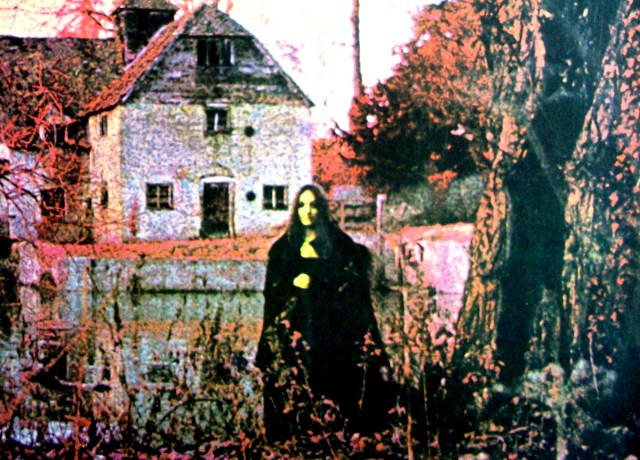
 If they’re the only band on the infinite linear mixtape to be featured twice, and back-to-back at that, it’s because of the singularity of their two lead singers, who so influenced their respective versions of Black Sabbath that each iteration of the band made a distinct impact on rock and metal. Sabbath guitarist Tony Iommi has stated that the difference lay in writing for Ozzy Osbourne, who sang the melody of the riff, versus writing for Ronnie James Dio, a far more technically accomplished singer, who sang around the song’s chords. But even with Dio’s vocal expertise stretching Sabbath’s range, the core of Black Sabbath’s legacy really does belong to Ozzy, whose shakily intoned shriek conveyed — at least across their first six records, and before it became Ozzy’s schtick — the terror of a man trapped inside a nightmare.
When Sabbath took to the studio in October 1969 to make their first record, they were like dozens of other post-Cream British blues rock bands struggling to find their own voice. But, they had some advantages that maybe weren’t immediately apparent. Iommi’s short and ultimately unsuccessful stint in Jethro Tull in 1968 was an education, as that band was finding its own, heavier feet following the departure of Mick Abrams (Martin Barre, the definitive Tull guitarist, would be hired shortly after Iommi filled in, with a thunderingly loud but finessed guitar style not unlike Iommi’s). And Ian Anderson provided an object lesson for Iommi when Iommi went back to his band Earth: success would largely depend on the labor you put in. Tull worked for its fortune. As Earth transformed itself into Black Sabbath, Iommi demanded the band become a workhorse, and the group began developing a set of songs around bassist Geezer Butler’s night frights, a fascination with horror movies (e.g., Black Sabbath), and two significant technical issues that became key to a conceptual breakthrough: the tips of Iommi’s fingers on his right (fretting) hand had been shorn off in an accident in 1965, and it was while developing his newly renamed band’s sound and songs that he down-tuned his guitar to make it easier to play with the plastic tips he adhered to the tops of his fingers; also, Butler’s facility on bass was limited in their early days, so he ditched melodic runs and just mimicked Iommi, also down-tuning his bass. The result was literally diabolic. From the opening notes of “Black Sabbath,” the sound sends shivers, and it is here that heavy metal was born, out of imaginative use of limitation — such is Art — and the doom-laden tritone, the diabolus in musica, that Sabbath employed as its calling card. Iommi, riffing on Butler’s attempt to mimic Gustav Holst’s “Mars: The Bringer of War” from The Planets suite, produced a metal manifesto so potent that it resonates almost 50 years on, remaining a rock touchstone of its era as significant as Velvet Underground & Nico, Astral Weeks, Forever Changes, or Funhouse, ever begging the question: What is this that stands before me?
Studio version here but also the Paris ’70 version, with Ozzy jumping like Iggy.
There is, in fact, none more black.
soundstreamsunday presents one song or live set by an artist each week, and in theory wants to be an infinite linear mix tape where the songs relate and progress as a whole. For the complete playlist, go here: soundstreamsunday archive and playlist, or check related articles by clicking on”soundstreamsunday” in the tags section.
 As a commercially successful American hard rock band fronted by two women in the 1970s, Heart was unique, and while it’s Patti Smith and the Runaways that have turned legendary (with merit, no doubt) for their stories, Heart’s impact on women in rock is, must be, outsized, and deserving of the same attention. While their 80s albums were marred by a soft rock sheen (but still, wildly successful), the early catalog resonates strongly: “Barracuda” with its gallop and biting reaction to a record company and music press that wanted, badly, to portray the Wilson sisters as objects of sexual intrigue; “Crazy on You”; “Magic Man”; “Straight On”; “Heartless”; “Dog and Butterfly”; “Dreamboat Annie.” For what they did and when they did it, Heart’s story is that of women in rock and roll itself, playing off and pushing against an industrial complex bent on making them something they weren’t.
 Progarchy