

 For the Clash there was no leaving politics off-record or offstage, and more than any of the mainstream punk or post-punk bands, except for maybe Gang of Four, they worked the seam in rock’s goldmine that pitted the disempowered and disenfranchised against authority, entitlement, and impunity. No mistake their hit cover of Bobby Fuller’s “I Fought the Law.” They gave punk a much-needed edge that went beyond simple nihilism, stoking it with purposeful aggression that, even as an act that in part it was, absolutely rocked. The Clash were also a band in the way the British loved their bands, from the Beatles to the Faces — laddish, swaggering, a drama of excess unfolding — a story of their empire in microcosm.
I’m a latecomer to the Clash’s London Calling (1979), but I’ve been listening to it on and off over the last 20 years or so, and in terms of British rock I think it’s the natural next step after the Stones’ Exile on Main Street — like that record it is a glorious, sprawling double album by a band so at the top of their game that they became a cultural filter. Rather than American blues, though, the Clash relied heavily on Jamaican music as a launchpad, investing the songs with an utterly contemporary feel that at once gave the finger to the British post-colonial Man while celebrating the multicultural consequences of empire. Ironies abound.
For years I honestly thought that the “Rudie” in “Rudie Can’t Fail” was just the name of the song’s central character. This is because I’m generally uneducated in Jamaican music, where the “rude boy” as anti-hero has been kicking around since the 60s. It just goes to show what a great song this is, with it’s big undertow of a riff and the back-and-forth singing of Joe Strummer and Mick Jones. It’s an ebullient shout-fest with horns, a big-hearted victory lap for punk.
soundstreamsunday presents one song or live set by an artist each week, and in theory wants to be an infinite linear mix tape where the songs relate and progress as a whole. For the complete playlist, go here: soundstreamsunday archive and playlist, or check related articles by clicking on”soundstreamsunday” in the tags section above.
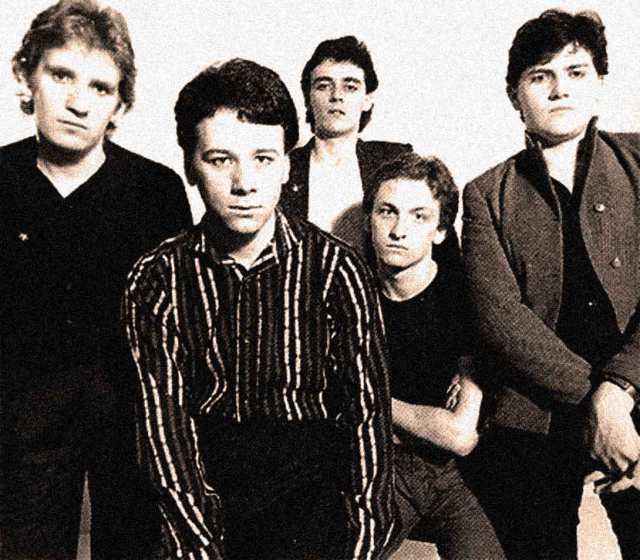 Few bands seem to cause such division as Simple Minds. There are fans of the early stuff, fans of the later stuff, fans of New Gold Dream…. I never had a horse in that race, since I never particularly cared to follow them. I liked what I heard on the radio of theirs well enough, it was certainly expertly crafted and, in retrospect, helped define its time. But recently I felt like mining a bit deeper and came upon their early records. I understand the early fans’ passions more now, since it’s made clear on Real to Real Cacophony and Empires and Dance that the band was chasing an ambition to recast pop music coming out of the 70s. That they caught up with it is apparently a deep disappointment for those who read sellout in the tracks of Once Upon a Time, but of course the one — a deeply enjoyable confection of well-honed hooks and musicianly smarts, no matter its commerciality — would not have been possible without the other, a proving ground that was hit and miss, but when it found its mark was incendiary.
 The principles of exclusion, constraint, and limitation are drivers of art as much as what ends up on the canvas, and more than anything explain how U2’s “The Three Sunrises” did not make the cut of their seminal 1984 album The Unforgettable Fire. That album, their fourth, changed the band’s trajectory by broadening their palette (thus ultimately guaranteeing their longevity). Subduing the band’s onward-Christian-soldier martial airs without dulling its passion, producers Brian Eno and Daniel Lanois — who the previous year had created, along with Roger Eno, one of the great ambient masterworks in Apollo — worked at applying creative filters to make a music that was moody, introspective, less deliberate but also more whole. The Unforgettable Fire feels more like an album with a sonic narrative than any of its predecessors. Still, no one, not even Eno, could contain U2’s spirit or strong self-identity, and the recording sessions yielded some work with one foot still grounded in the energetic brightness characterizing their previous catalog.
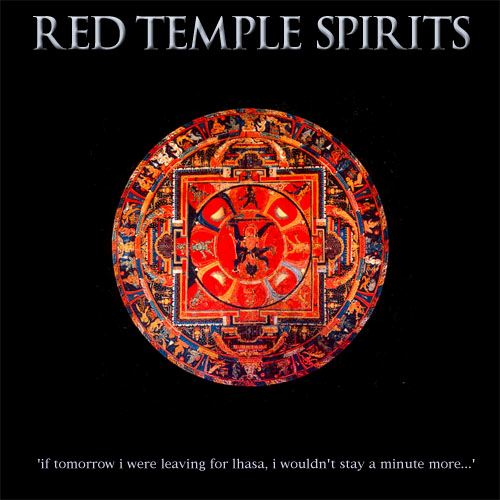 For years, LA’s Red Temple Spirits were a tease, a psych rock ghost that once got a short write-up in Rolling Stone, which gave an address to write to if you wanted the album, an address for an obscure label that never wrote back. It was the pre-internet treasure map to sacred recordings process that was our siren’s call. Guesswork, album reviews, dudes in record stores who’d gone to see Hendrix and never really come back. From the description I read, this band was for me. But for about five years, every record store I walked into got the question: “Red Temple Spirits?” and I would receive a shake of the head back. Along with Television Personalities, in the late 80s and early 90s they were my grail, a band whose records couldn’t seem to be found for love or money, as if they wanted it that way, ached to be left alone. Around 1993 I finally and gratefully scored a cassette of their 1989 album If tomorrow I were leaving for Lhasa I wouldn’t stay a minute more… (possibly from Austin’s Waterloo records, who had hooked me up with Television Personalities a couple years earlier too) and discovered the small window of hype Rolling Stone gave them was deserved. A rockier, psychier version of the
  The Cure’s Disintegration is a lush, beautiful masterpiece. When it was released in 1989, the band was cresting a wave of popularity, and rare was the college dorm room in America that didn’t have a copy of their singles comp, Staring at the Sea (1986), sitting next to the deck, while Kiss Me Kiss Me Kiss Me (1987) was radio ready. Robert Smith had become an unlikely hero, a post-punk goth who had paid his dues and, with a colossal songwriting talent, was reaping the rewards of someone who virtually created his own genre. Nobody else sounded like the Cure. Neither psychedelic nor prog nor punk, but fearless in their approach, comfortable in their painted skin. On Disintegration the band slows the tempos, backgrounding Smith’s economical lyrics with huge keyboard/guitar drift pieces that seem to exist in the gloaming. A perpetually wilting flower, the first-person character in Smith’s work has had a long shelf life, and would rot if it weren’t for Smith’s genius with song and his ability to effortlessly write pop hits at will. Entreat is from the tour supporting the album, recorded at Wembley in ’89, and consists of the all the songs on Disintegration in the same running order. It had a very limited release originally, but pieces of it emerged here and there on CD singles taken from Disintegration (I first heard parts of it on the Pictures of You EP), and was eventually, finally bundled with Disintegration on the 2010 re-release. Entreat was a bold move, a full performance of a newly-released record, and demonstrates just how confident Smith and his band were in the new songs.
 Progarchy