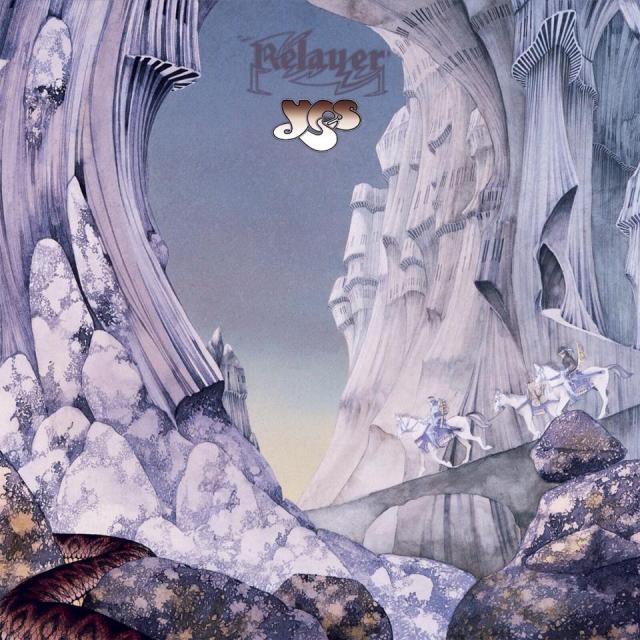
Shakira reviews the new Steven Wilson mix of Yes’ Relayer

shakira-cropped

Shakira signals her approval of the new Steven Wilson mix of Yes’ Relayer by wearing the appropriate T-shirt.

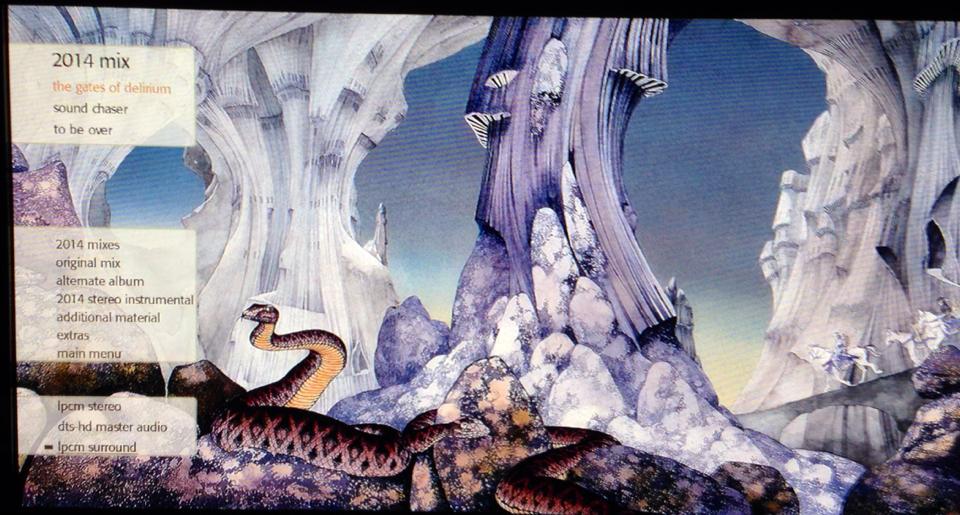
I’m still waiting for my copy to arrive. But here’s what’s in both the CD/DVD-A and CD/Blu-Ray versions:

CD (both versions):
NEW 2014 STEREO MIXES by Steven Wilson from the original multi-track tapes
1. The Gates Of Delirium
2. Sound Chaser
3. To Be Over
Bonus tracks (Mixed & produced by YES and Eddie Offord):
4. Soon (single edit)
5. Sound Chaser (single edit)

DVD and BLU-RAY:
NEW 2014 STEREO MIXES: LPCM Stereo 24/96
1. The Gates Of Delirium
2. Sound Chaser
3. To Be Over
NEW 2014 5.1 SURROUND MIXES: 24/96 MLP Lossless/dts 96/24
1. The Gates Of Delirium
2. Sound Chaser
3. To Be Over
ORIGINAL STEREO MIXES: Flat Transfer from original master LPCM Stereo 24/192
1. The Gates Of Delirium
2. Sound Chaser
3. To Be Over
THE “ALTERNATE” ALBUM: LPCM Stereo 24/96
1. The Gates Of Delirium (studio run through)
2. Sound Chaser (studio run through)
3. To Be Over (studio run through)

BLU-RAY ONLY CONTENT:
ADDITIONAL MATERIAL:
1. Soon (single edit)
2. Sound Chaser (single edit)
3. The Gates Of Delirium (Studio run through)
BLU-RAY EXCLUSIVE BONUS: LPCM Stereo 24/96
1. Sound Chaser (Live from Cobo Hall 1976)
2. Sound Chaser (demo version)
ARCHIVAL MASTER: LPCM Stereo 24/96
1. The Gates Of Delirium
2. Sound Chaser
3. To Be Over
2014 STEREO INSTRUMENTAL MIXES: LPCM Stereo 24/96
1. The Gates Of Delirium
2. Sound Chaser
3. To Be Over
NEEDLE-DROP 1: Original UK vinyl transfer: LPCM Stereo 24/96
1. The Gates Of Delirium
2. Sound Chaser
3. To Be Over
NEEDLE-DROP 2: US promo album vinyl transfer: LPCM Stereo 24/96
1. The Gates Of Delirium (Part I)
2. The Gates Of Delirium (Part II)
3. The Gates Of Delirium (Part III)
4. Sound Chaser (Part I)
5. Sound Chaser (Part II)
From the “Official Site”:
BLU-RAY: NTSC, all regions, LPCM playable in all Blu-ray players & Blu-ray drives
DVD: NTSC Region 0 hybrid DVD-A, compatible with all DVD players & DVD-rom drives
Both sets are presented in a mini vinyl replica gatefold card sleeve (with protective inner sleeves) with the original artwork expanded, restored and approved by Roger Dean. The booklet features new sleeve notes by Sid Smith along with rare photos and archive material.
relayer relayer-wilson

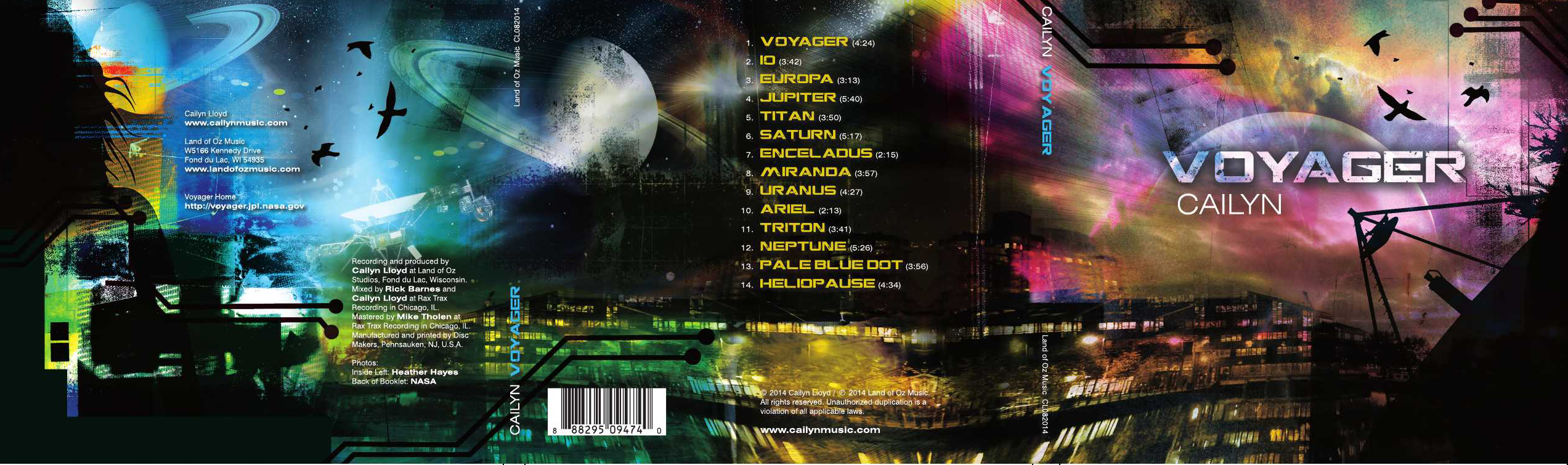
Cailyn’s Voyager concept album is mixed and mastered and has gone to production

Outside of Digipak

Progarchy friend Cailyn Lloyd’s Voyager has been a labor of love for many months now. Her cosmic tone-poem concept album is now all mixed to perfection, and the mastering was completed on November 7th in Chicago at Rax Trax Recording. It should have gone to production today, November 12th. You’ll be able to pre-order it soon. Right now, an advance preview is currently being listened to here in the Republic of Progarchy. Stay tuned!

Foo Fighters, Sonic Highways ♫♫♫♫♪

Foo Fighters, Sonic Highways

Progarchist Rating: 9/10 ♫♫♫♫♪

This album is pure rock and roll at its finest. You won’t find anything prog here other than the epic orchestrated finale to “I Am a River,” but then again the musicianship and songwriting is operating at such a high level that it is hard to deny it the moniker of “prog,” if by such you mean simply something like: “excellence in all its many forms.” Enjoy the adrenaline-fueled journey here, through eight glorious tracks, and pick your favorites. I am partial to the album opener, “Something From Nothing,” perhaps because the title is a nice echo of Rush, and also because there is even a little riff within it that makes me think of Rush’s “Stick It Out,” but in fact the track hits its stride when it gets its very own groove on. Listen to it and you’ll know what I mean. Other favorites are the resplendent “Congregation” and the heartening “God as My Witness” and the acrobatically nimble “In the Clear.” With rock like this, you can become a believer. Classic at birth, the lost art of the rock album is born again.

Ethos, “Supernova” (Official Music Video)

This song, “Supernova,” is from Ethos’ album Vessels (2012). I am sure you will agree with me about how amazing it is.

Check out the super-cool use of classical piano in their awesome prog metal. So sweet! What a great sound!

You can also get more of their music at ethosatl.bandcamp.com.

Who are these talented guys? Well, here is their bio (from ethosband.com):

Ethos is an American rock band from Rome, Georgia, formed in 2009. The band consists of Austen Earp (lead vocals, piano, guitar, synthesizer), Matthew Palopoli (lead guitar), Nick Riggs (bass, vocals), and Tribb Robison (drums, percussion). Known for their fusion of heavy rock riffs, classical piano, syncopated rhythms, and melodic vocals, the group exhibits a technically rich yet accessible rock sound with roots in Alternative rock, Progressive rock, and Post-metal. Ethos explores songwriting through the power of impression and are fascinated with music’s inherent ability to affect emotions, giving them an innovative edge that demands attention.

Their debut album, Vessels, was independently released in 2012, featuring high energy, emotive music by integrating the classical, progressive, and alternative genres. The record was written and recorded during the greater part of 2011-2012, produced by frontman Austen Earp, and mastered by Rodney Mills (Atlanta, GA).

Ethos’ most recent release, Evergreen, is an acoustic EP consisting of stripped-down versions of songs from their 2012 debut release, along with a brand new song, “Evergreen.” It features the use of the violin, cornet, and dobro, ultimately proving how diverse the band can be.

Neil Peart of RUSH: ½ Hour Interview with George Stroumboulopoulos

The Strombo Show welcomes Neil Peart, drummer and lyricist of RUSH, for a rare and intimate conversation from George’s home.

Damascus, “When We Last Met” — free streaming title track now available

damascus

Following the critical success of their 2013 release Heights, New Jersey-based instrumental band damascus is back with a new full-length album, When Last We Met. Like its predecessor, the record was recorded and mixed by Frank Marra at Treehouse Sound in Jersey City.

On When Last We Met, the group continues to explore and experiment in the space where post-rock, progressive metal, and droning ambient collide. The record offers some of the band’s most dynamic music to date: from soaring riffs and crushing grooves to delicate harmonies and acoustic passages, the band has never woven together more diverse textures and styles, though it remains totally accessible and immediately enjoyable.

The band is joined for the first time by Craig Vandenberge, whose double bass adds yet another dimension of thoughtful lyricism to the album. With its longform arrangements, oddly familiar time signatures, and overwhelming catharsis, When Last We Met is music to fascinate and delight.

The record was mastered by Erik Kvortek at Trax East Recording Studio. It will be released for free stream and download at damascus’ bandcamp website on November 25th, 2014. A limited vinyl pressing by SlyVinyl Records is planned for early 2015. Visit http://damascusnj.bandcamp.com to stream the title track now!

damascus is: Brendan Bianowicz, drums; George Eppinger, guitar; Gil Morejón, guitar and keyboards; Edwin Rivera, bass

Love and support

interstellar

Please send your love and support to Brad Birzer. He needs to devote Progarchy time to other projects, but we honor him for all the incredible passion he has poured into this most excellent site, and we pledge to keep the flame alive!

Philosophical Reflections on the Scorpions

Gregory Sadler, The Heavy Metal Philosopher, reflects on the career of the Scorpions and asks the Heraclitean question about whether the same band can exist twice. His conclusion? It makes a key metaphysical distinction about privation:

I’ll say this much though — perhaps we can speak of two overlapping musical periods after the Scorpions really got their sound together and coalesced in the mid-70s:  a serious and formative early metal period from Fly to the Rainbow (1974) to Taken By Force (1978), capped by their first live album (Tokyo Tapes) and the first Best of The Scorpions compilation — then a simply meteoric period from Lovedrive (1979) to Love at First Sting (1984), also capped by a live album (World Wide Livein 1985).  And then, for years, more and more touring.

Even though one can hear a difference between what let’s anachronistically call the 1970s Scorpions and the 1980s Scorpions — and one can hear analogous differences between earlier and later Judas Priest (compare, e.g. Sin After Sin with Defenders of the Faith), and despite a key lineup change on lead guitar from Uli Roth to Matthias Jabs,  there’s still a really vital and robust continuity, an ongoing incorporative development one can hear across this body of work.

Savage Amusement marked a shift of sound and ethos whose radicality wasn’t entirely apparent at the time — it needed additional albums to come along and confirm that something was really different.  Even though it came out — after a lot of anticipation on the part of their fans — in 1988, I’d say it’s already the 1990s Scorpions composing and producing it (key word there for that time — producing, not playing, not building, not hammering it out).

I remember listening to it at the time, and having to make a kind of emotional effort to find the new songs as exciting, as well-crafted — really simply put, as captivatingly interesting as those from the earlier albums.  It was competent, to be sure.  It rocked. . .  more or less.  Crazy World — and particularly the ballad “Winds of Change” — confirmed that something had indeed happened.  Something had gotten lost, was going missing — metaphysically, we’re not just talking about alteration, breakdown, movement from one thing to another, but rather that difficult to conceptualize reality of privation.

So, although we could certainly buy tickets and show up at the venue, and see at least some of the guys — Klaus Meine, Rudolph Schencker, Matthias Jabs — who carved out such new sonic spaces in the 1980s, compositions that retain their freshness and complexity decades later, in several important but difficult-to-clarify senses, it would no longer be the same band that created and played those songs who we’d get to witness covering them on stage.

We can, however, continue to enjoy those great albums from the 1970s and 1980s — there is a kind of complex continuity preserved partly in the past, but reenactable in the present, continuing even for generations yet to come in the future.

Long lost RUSH — I’ve Been Runnin’ (Laura Secord Secondary School 1974)

UPDATE: Watch the video HERE.

From Radio.com and their interview with Alex Lifeson:

The thing that Rush fans are probably going to be most excited about is the footage from the 1974 show at the Laura Secord Secondary School. What do you remember about that performance?  Oh my god, that was such a long time ago. I can vaguely remember it, I remember being on the stage in that auditorium in that school, and how all of the kids were sitting in their seats — no one was standing! —  and it was a little uncomfortable. But it’s a good example of the band we were at that time playing bars and high schools. What goes through your mind when you watch the footage of you and Geddy performing with John Rutsey?  Um, it’s funny. The things that I really noticed about it — this might be odd — is that we played so fast, all the time. I do recall playing everything quickly. We used to have a mono tape recorder that we used to record some shows. In fact, I might even have some of those old tapes lying around somewhere, from earlier in the ’70s. Great! Stuff for the next box set! [Laughs] Of course! But we were 19 years old, 20 years old: how quickly it all goes by. For decades, Geddy has been the guy to speak to the audience at your shows, but he doesn’t do it a lot. After watching some of the footage from that performance, I realized that addressing the crowd used to be John’s role, and he seemed to enjoy it. Yeah, very much so. He had a very witty sense of humor, and he had such balls. He would talk to the audience and say stuff; sometimes, I thought he’d get us killed. He was comfortable talking to people, and being that guy, whereas Geddy really wasn’t, and I’m not even sure he is that comfortable with it today. But John, he would tell stories, and tell jokes, he would pick someone from the audience and do running jokes with that person all night. He was really great at that. It was fun: those days were really fun with him. We were with him for six years. You know, John sang one or two songs… I think. He really didn’t have a singing voice, it was like a Bob Dylan-ish monotone. But there were a couple of songs that he sang, and he and I also did some backing vocals. His on-stage mic wasn’t just reserved for talking. Tell me about the song “I’ve Been Runnin’”; not only had I never heard it, I’d never heard of it. John wrote the lyrics back then. Geddy and I would generally write the music. Sometimes we would have band rehearsals and it would be all three of us, but it was always difficult to work out songs like that. It was easier for us to work on the music together and then teach it to John and go from there. We still do that with Neil [Peart], in fact. John did write the lyrics in those days for the most part. It was so weird when he didn’t want us to use his lyrics on the first album when we started to record it. It was a very strange time for us, just before he left the band. But to be honest with you, I’d totally forgotten about “I’ve Been Runnin’” until I saw it come up for this box set. That one was really lost to me. But it was a shuffle-y, Delta bluesy kind of song that we were inspired by via Led Zeppelin. A lot of people think of Rush as a hard rock/progressive rock hybrid. But at that point, Rush was a garage rock band. I don’t think that our quote-unquote “progressive” influences came in until Neil joined the band. Geddy and I were both leaning towards that kind of music, we loved what Yes was doing, and Jethro Tull, and of course we were big Pink Floyd fans. But John was a strong influence in the band and he was a real basic rocker. That was part of the reason for him leaving. There were other reasons: his health. But really when it came right down to it, he was a sort of Bad Company kind of rocker, and Ged and I want to move into something that was a bit meatier in terms of arrangements and performance. Do you remember anything about “The Loser”? That’s the other original song from that set that never made it to an album. I’d have to listen to it again! We did have a song… it was one of the first songs we wrote. It could be that song. If it is that song, we would have wrote it back in 1968. Again, it was very basic and very straight ahead rock. You guys never really did “box sets,” because you never really had any “unreleased material.” But is there the potential for a collection of early unreleased stuff from the John Rutsey era? There’s never any extra stuff, we only record what we need for the album. From that early period, there might be some tapes lying around, but I can’t imagine what sort of shape they’re in, 40 plus years later. Now I have them in storage, and I want to review them, but in the past there weren’t any kind of live performances. Actually, there was one from a high school, we recorded on both sides of the reel. Well, y’know, it was mono! And it was basically one mic in the middle of the stage. I remember listening to that over and over; it was probably recorded in 1971. But unfortunately, I don’t know what happened to that tape. We never thought about hanging on to that stuff back then. You think of something new and you say, “Forget about that old crap.”

Charge of the Dad Brigade

Neil McCormick surveys the reality:

“Fans are extremely loyal, and they love hearing new versions of old stuff. In fact, a lot of people would rather listen to that than a new album. Remarkable, really.”

But, let’s face it, an industry with a business model that depends on selling an ageing audience something that they already own is in big trouble. Thankfully, not every veteran is relying on their back catalogue. Neil Young and AC/DC have new albums on the schedules. And in the usual scheme of things Irish rock superstars U2 might have been expected to boost the Christmas sales with their new album, but instead they gave it away free on iTunes. Explaining their motives, Bono said “the charts are broken”. He has a point.

UK album sales have been in decline for most of the 21st century, down last year to a meagre 94 million from a 2004 peak of 163 million. CDs still account for nearly 80 per cent of those sales, although there are kids obsessively listening to music now who wouldn’t know what a CD was if you broke it over their heads.

Meanwhile, streaming services such as Spotify and YouTube are rapidly expanding, claiming worldwide listening numbers in the billions. These are forums where you can access music without actually owning it. To put it in perspective, U2’s 1987 album The Joshua Tree sold more than 25 million copies in the course of its lifetime. But U2’s Songs of Innocence has already been downloaded free more than 26 million times and actually listened to by more than 80 million iTunes users. By most criteria, you would have to call that a hit. But it only reached number six in the UK sales charts.

U2 have effectively opted to put their music where the majority of listeners might actually find it. The bigger point is that just because older fans still want to feel a physical object in their hands, it would be a mistake to think this means that oldies are taking over pop. The truth is, the kids are just having a different kind of conversation in an era of big pop singles, where individual tracks accessed online are all that really matters.

But you can’t put a download or a stream in a Christmas stocking.