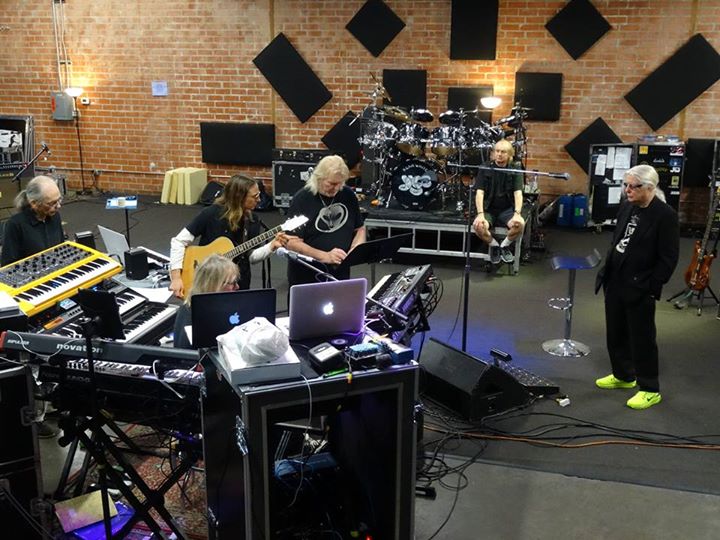
Sloan — “Forty-Eight Portraits” (17:49)

Whoa!

Sloan goes prog on their new album, Commonwealth, with “Forty-Eight Portraits” clocking in at 17:49 — to take up the entire fourth side of the double LP space!

Awesome.

The record company has the details:

The 15- song collection sees Sloan creating one of the most unique and ambitious recordings of their two-decade-plus career.

The Toronto-based rock quartet is perhaps the most truly democratic group in the annals of pop, with Jay Ferguson, Chris Murphy, Patrick Pentland, and Andrew Scott all contributing original compositions to each record, equal partners with equal say over every aspect of their work. Where in the past creative lines have been blurred to create the multi-faceted Sloan sound, Commonwealth sees the four bandmates disassociating ever so slightly to create an old-school double album sequenced with each member staking out a single side as their own artistic dominion.

Designated by the four playing card suits, the essentially solo sides allow for all four members’ work to at last be heard through the prism of individual identity. Ferguson’s opening “Diamond” side showcases his remarkable knack for symphonic pop, Pentland’s “Shamrock” offers a substantial helping of pedal-hoppin’ psych rock, and Murphy’s “Heart” is fit to burst with wit, jangle, and eclectic energy. As if the four-sided concept weren’t challenge enough, Commonwealth finishes with “Forty Eight Portraits,” an ingenious 18-minute pop suite that fills the entirely of Scott’s closing “Spade” side. Ultimately, what makes Commonwealth so special – and so distinctly Sloan – is how the fragmented approach in fact only serves to underscore the veteran band’s extraordinary strengths, showcasing the particular ingredients without ever losing sight of the sum of their parts.

Song cycles and concept-driven albums are nothing new to Sloan. Over the course of 10 albums and more than 30 singles – not to mention multiple EPs, hits and rarities collections, live albums and official bootlegs released, like all the band’s work, on their own independent label, Murderecords – the band has tackled countless creative conceits while ever forwarding a sonic palette that blends pure pop and radio rock into what is now a truly trademark sound, all big melodies and power hooks, cheeky charm and tearjerking introspection, rich harmonies and idiosyncratic personality.

Commonwealth follows 2011’s The Double Cross, which earned Sloan some of the most glowing notices of their acclaimed career. “(Sloan’s) impeccable power pop has often felt like the apotheosis of the genre,” wrote SPIN. “The hooks and harmonies rarely disappoint.” “An unapologetic celebration of Sloandom,” praised AV Club, “and a safe place for those who believe good dual-guitar breaks are the reason why we’re here on Earth.” Pitchfork summed it up best: “20 years in, they’ve made one of their best albums…That (Sloan) sound this creatively fresh this deep into their career is a real treat for people who’ve stuck with them through the years. If you’ve never given them a chance before, this is a great time to get to know them.”

Diamond Side (Jay):

1) We’ve Come This Far

2) You’ve Got A Lot On Your Mind

3) Three Sisters

4) Cleopatra

5) Neither Here Nor There

Heart Side (Chris):

6) Carried Away

7) So Far So Good

8) Get Out

9) Misty’s Beside Herself

10) You Don’t Need Excuses To Be Good

 Shamrock Side (Patrick):

11) 13 (Under A Bad Sign)

12) Take It Easy

13) What’s Inside

14) Keep Swinging (Downtown)

Spade Side (Andrew):

15) Forty-Eight Portraits
Jack White on “Entitlement” at Château de Fontainebleau

“Stop what you’re doing” …

… and watch Jack White performing “The Same Boy You’ve Always Known” and “Entitlement” at Château de Fontainebleau!

Or are you “sick of being told what to do”?

Hmmm, well, “Entitlement” beings at 4:33 …

Happy Birthday Alex

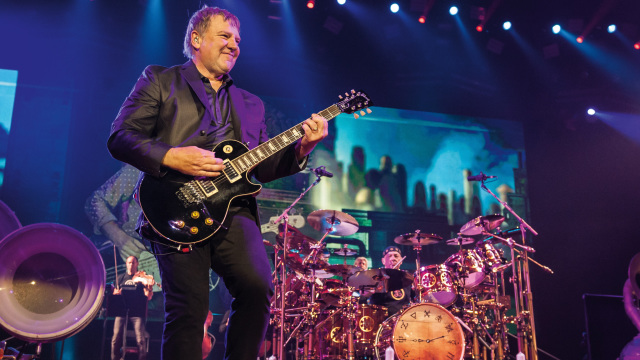
Officer of the Order of Canada. Guitarist. Trailer Park Boys kidnap victim. It’s the great Alex Lifeson’s birthday today, so here are nine Lifeson lessons whipped from the pages of Classic Rock.

“I make them up every night… it’s terrifying!” – Lifeson on his live monologues, Classic Rock issue 61

“It’s the most popular song in Mexico…ever!” – Lifeson on Closer To The Heart, Classic Rock issue 61
alex
“Much as I like what we do in Rush, on my solo album I wanted guitar…and then some more guitar!” – Classic Rock issue 71

“We had access to two studios, and nothing else to do at night.” – Lifeson on why the Snakes & Arrows album was recorded so quickly, Classic Rock issue 107

“We’ve had some difficult times with producers. Mainly because they didn’t happen to be a producer.” – Classic Rock issue 113

“We know how boring and ordinary we are.” – Classic Rock issue 148

“It’s kind of a success story. Kids from the suburbs have a dream, and they live their dream. Everybody can relate to that.” – Classic Rock issue 148

“Our whole relationship’s based on humour – laughing and goofing around, being idiots.” – Lifeson on Rush, Classic Rock issue 148

“I definitely hear a lot of Rush in a lot of bands coming through right now.” – Classic Rock issue 179

The Triumph of Kate Bush

katebush-concert

Tracey Thorn recounts her experience of the amazing Kate Bush concert in the pages of the New Statesman, namely, the experience of “the ecstatic triumph of a life’s work”:

Six straight songs and then, just as we are relaxing, the stage transforms, and the drama begins: a multi-sensory performance of “The Ninth Wave”, the suite of songs that forms side two of The Hounds of Love (1985). There’s Kate on screen in a life jacket, apparently slipping away from us, singing “And Dream of Sheep”, one of her most beautiful songs.

I should probably write this somewhere more formal – my will, perhaps – but in case I forget, let me say here that I would be happy for you to play this song at my funeral. I weep as she sings it, partly because I’m imagining my own funeral, but also because we are witnessing a struggle between life and death, where a drowning woman yearns to be saved, to return to her beloved family. “Let me live!” she cries a few songs later. Overwhelming and exhilarating as they are, all the special effects – Kate in a tank, a helicopter search beam strafing the audience – are in the service of the songs and the story.

Why is it so moving? Well, because when finally she is brought back it is not just the fictional heroine, but Kate herself who has survived the years, and those cold seas, and returned to us. The two strands, family love and audience love, intertwine as she shows us how both mean so much to her. “D’you know what?/I love you better now,” she sings, as the first half ends and we wipe our tears.

Part two is calmer, more reflective, consisting of one side of the recent album Aerial (2005). Reprieved from death, she now revels in the simple, sensuous pleasures of life. Birdsong on a summer afternoon. The setting of the sun and the rising of the moon. In more conventional hands this could be merely decorous and pastoral, even a little twee, but somehow she has found a way to transform contentment into euphoria. The mood is hypnotic, rhythmic and trancey, and the stage dazzles with images of light and flight; less genteel garden party, more full-on midsummer rave, it could be the ultimate blissed-out headliner of a blistering, sunny Glastonbury.

And her singing voice, which I so worried about? It is a thing of wonder, any youthful shrillness replaced by a richer, occasionally gravelly tone, and with a full-throated power unbelievable in someone who has so rarely sung live. All I can think is that she must have been practising, on her own in a barn somewhere, for the past 35 years. Practising, planning, waiting for all the stars to align – her own desire, the cast of collaborators, the right time and place – in order for this to happen. And it is an ecstatic triumph, a truly extraordinary achievement.

Goodbye Thomas, Hello Billy: Behind the Scenes Drama with Yes

yes-with-baker

Steve Howe has revealed in a radio interview that Yes wasn’t getting what it needed from Roy Thomas Baker on the production of Heaven and Earth, so they had to turn to Billy Sherwood, who left his stamp especially on the vocal mix:

“We got into it, and it was OK,” Howe tells WMGK‘s Ray Koob. “You know, every producer’s got a certain style. Roy’s method was pretty much about the sound. It wasn’t so much about the construction of the songs, like Trevor [Horn, producer of 2011’s Fly From Here], who worked very hard on that. So, Roy kind of let us do most of the music, and twiddled with a lot of knobs. But, I tell you, in the end we really did have to bring it back to Yes Central — because, in a way, I don’t think he was as familiar with our mixing style as say Billy Sherwood, who ended up doing that for us. Well, we did it with him; it was a collaboration. So, we had to kind of pull it back to Yes Central. It was all fair in love and war.”

When I saw Steve after the show in Vancouver, he remarked about his good memories of Vancouver because that was where The Ladder was recorded. Steve is really happy with the sound of The Ladder because of its unique “flavor.”

I think Jon Davison is fantastic and I have come to like Heaven and Earth very much, despite what initially struck me as weird about it — namely, the production! — and this news makes me wonder what the album could have been if Sherwood and not Baker had been involved for the entire process.

I hope they do another album with Davison soon, and with the right producer this time.

Chartbusting — Kate Bush

kate-bush-screen-siren

Kate Bush’s concert series this year has kicked off a remarkable return to the charts for her. She is now the first female artist ever to have 8 albums in the Top 40. And all of her albums are currently in the Top 50:

Her achievement is only bettered by Elvis Presley, who took 12 places after his death in 1977, and the Beatles, who scored 11 on their remaster releases in 2009.

Bush’s first chart record came when debut single Wuthering Heights made her the first female artist to reach No.1 with a self-written song. Now her 1986 record The Whole Story has made No.6 while Hounds Of Love, from the previous year, has reached No.9. Further titles are placed at 20, 24, 26, 37, 38 and 40, with three more at 43, 44, and 49. That means her entire back-catalogue is in the top 50.

Kate Bush album chart placings

No. 6: The Whole Story (1986)

No. 9: Hounds Of Love (1985)

No. 20: 50 Words For Snow (2011)

No 24: The Kick Inside (1978)

No. 26: The Sensual World (1989)

No 37: The Dreaming (1982)

No. 38: Never For Ever (1980)

No. 40: Lionheart (1978)

No. 43: Aerial (2005)

No. 44: Director’s Cut (2011)

No. 49: The Red Shoes (1993)

Death of the Album

If the future is streaming, what place is there in the future for the self-contained unit known as “the album”?

Jason Notte provides the sobering statistics:

Juniper Research finds that digital music industry will see worldwide revenue grow from $12.3 billion this year to $13.9 billion in 2019. Juniper’s research indicates that even that growth hinges on the streaming music sector bringing in more cash as sales of digital downloads, ringtones and ringback tones continue to plummet. …

That growth comes as any album that isn’t released on vinyl dies a horrible death. Nielsen Soundscan equates 2,000 streams to one album, but even with that in the equation, album sales are down 3.3% through June. Take streaming out of the mix and you’re looking at a 14.3% drop from the same time last year. The nearly 20% drop in compact disc sales over the last year is almost expected as CDs continue their post-’90s free fall, but the 11.6% drop in digital album sales and 13% drop in digital track sales is far more troubling.

Digital download sales fell for the first time last year and aren’t coming back. People aren’t loading up their smartphones with songs anymore and aren’t carrying iPods anymore.

That’s not great news for the music industry, which uses digital track sales as a crutch to limp toward respectable numbers. When you factor in “Track Equivalent Albums” — a stat that equates 10 of an artist’s tracks with one album — Katy Perry, Pharrell Williams, Lorde and Beyonce all had albums sell 1 million copies and go platinum this year. Take those individual tracks away and reduce album sales to strictly physical and digital albums in their entirety, and suddenly Beyonce, Lorde, Coldplay and Eric Church are the only artists to go gold and break 500,000 sales this year. The only album to go platinum by that measure? The soundtrack to Disney’s Frozen, with 2.7 million copies sold in the first six months of 2014.

According to Nielsen, album sales of any kind plummeted from 755 million copies in 1999 to just 290 million last year. Compact disc sales have fallen steadily from 730 million in 2000 to just 165 million last year. This year, the Frozen soundtrack was the only digital album to sell 1 million copies — or even more than 350,000.

Meanwhile, even as digital track sales fall, singles sales remain strong. Pharrell’s Happy sold 5.6 million copies in just six months. Katy Perry and Juicy J’s Dark Horse broke 4 million, but even artists a bit further down the chart are more representative of what anyone’s actually listening to. DJ Snake, Iggy Azalea, Bastille and Aloe Blacc are absent from the first-half album charts, but all sold more than 2 million copies of their singles Turn Down For WhatFancyPompeii and Man.

Move it over to on-demand streaming, and those 2 million to 5 million sales turn into 40 million to 65 million audio streams and 70 million to 120 million video streams. Psy’s Gangnam Style still managed 69 million video streams this year after making more than $1 million off of streaming royalties alone last year. Google CEO Larry Page watched Psy’s viral hit rake in $2 per 1,000 pageviews and called it “a glimpse of the future.” By that measure, the 122 million views Perry’sDark Horse received through June adds up to $244,000 alone. It isn’t seven figures, but it’s a whole lot of cash for one song doing six months of work.

He concludes:

As the music industry continues to gravitate away from an ownership model and toward its streaming future, it’ll take any gains it can get. A robust streaming ecosystem is great for everyone involved, but if cannibalization limits both artist and label options, the same losses plaguing physical album sales and digital album and track sales now could kneecap streaming in the not-so-distant future.

Note that, oddly enough, the Frozen album is available on vinyl, as some people still insist that it is the only way to buy music.

Fooling Yourself: Familiarity Breeds Lack of Contempt

Repetition helps you appreciate a song or an album …

… but be warned that critical thought is also required.

Otherwise you will end up fooling yourself …

…. due to the musical version of “Stockholm syndrome.”

Tom Barnes explains:

we now know that the emotional centers of the brain — including the reward centers — are more active when people hear songs they’ve been played before. In fact, those brain areas are more active even than when people hear unfamiliar songs that are far better fits with their musical taste.


The Kate Bush Story: Running Up That Hill

In case you missed it, here is The Kate Bush Story: Running Up That Hill:

This documentary explores Kate Bush’s career and music, from January 1978’s Wuthering Heights to her 2011 album 50 Words for Snow, through the testimony of some of her key collaborators and those she has inspired.

Contributors include the guitarist who discovered her (Pink Floyd’s David Gilmour), the choreographer who taught her to dance (Lindsay Kemp) and the musician who she said ‘opened her doors’ (Peter Gabriel), as well as her engineer and ex-partner (Del Palmer) and several other collaborators (Elton John, Stephen Fry and Nigel Kennedy).

Also exploring their abiding fascination with Kate are some of the musicians who have been influenced by her (John Lydon, St Vincent’s Annie Clark, Natasha Khan of Bat for Lashes, Tori Amos, Outkast’s Big Boi, Guy Garvey and Tricky) and some writers and comedians who admire her (Jo Brand, Steve Coogan and Neil Gaiman).