In Praise of Shoegaze

slowdive1
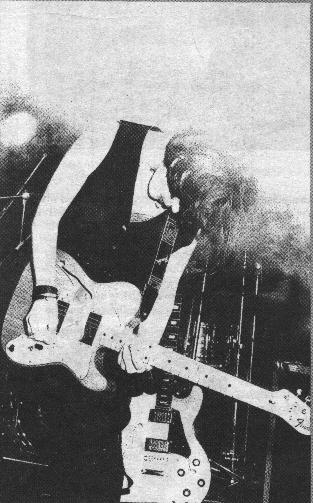
Rachel Goswell of Slowdive

And there in the square he lay alone 
without face without crown 
and the angel who looked upon 
never came down 

you never know what day could pick you baby 
out of the air, out of nowhere 

~ Sun Kil Moon, “Duk Koo Kim” (2003)

Was it excess, or a change in consumer preference?  Either or both, progressive rock music of the 1970’s ran afoul of the burgeoning punk rock scene.  Carefully constructed compositions ranging from eight to 25 minutes (or longer) gave way to three-minute outbursts of street angst resonating with a culture sick and tired of inflation and corruption and openly questioning the permanent things — things (classical, jazz, church music) that progressive rock had integrated (unwittingly, subconsciously) into its ethos.

Then, after a decade of new wave, new romanticism, and sundry forms of techno (music for the masses) there arose the Cocteau Twins and My Bloody Valentine.   Suddenly, pop song structure, melodic hooks, and outfront lead vocals were enveloped in a blizzard of distortion and dissonance.  Critics, ever wary of the latest “art” project, disparagingly labeled it “shoegazing,” noting the performers’ penchant for staring down (likely at their effects pedals) on stage.  Steve Sunderland (Melody Maker) went a step further, describing what he called “The Scene that Celebrates Itself” — in part, because the gazers attended each other’s gigs and drank together.  It was too much like rugby and less like football.  If the former is about gentlemen playing a hooligan’s game, then the press were quick to spot what they suspected were middle class values at play.  This could not end well.

At length did cross an Albatross / Thorough the fog it came…

But to back up a bit.  Whatever spirit inhabited the soundtrack of David Lynch’s Twin Peaks seems to have been carried aloft during that show’s run, falling out of the sky in the Thames Valley.  It descended upon a group of Reading teenagers who called themselves Slowdive.   Where to begin?  If one samples Slowdive’s output (three albums, six EP’s) there is no way to pin down the band’s idiom.   There are the ostensibly pop ballads (“Alison,” “Sleep”), Eno-induced trances (“Souvlaki Space Station,” “Changes”), pre-Kid A ambient exercises (“Option One,” “Sinewaves”), dark grunge (“So Tired”), ethereal raptures (“Catch the Breeze,” “Shine”), and others (“Albatross”) that defy categorization.

Like sorcerers they summoned other-worldly sounds from their guitars.  If there’s a common thread it is the drone — catching the breeze of an unorthodox riff, maybe two chords, and riding it in an ever-widening gyre.

Even a few of their loyal fans would say Slowdive spun out of control with 1995’s experimental Pygmalion.  By the time of its release British ears were drawn to Oasis and Blur, a Britpop North-South rivalry loaded to the hilt with working class ethos the press could celebrate.

“Revolution,” yes.  “Revolution 9,” no.  Within a year Slowdive had morphed into the country/folk Mojave 3.

I’ve Got a Gal… in Ypsilanti

While Slowdive was relinquishing the gazing muse, another obscure stateside band was taking it up.  Trey Many (pr. “may’-nee”), the drummer for Warn Defever’s His Name is Alive, was developing a side project at Eastern Michigan University.   Together with art student Amon Krist (daughter of folk singer Jan Krist) he formed Velour 100 and signed with Seattle’s alternative label, Tooth & Nail.
Velour+100
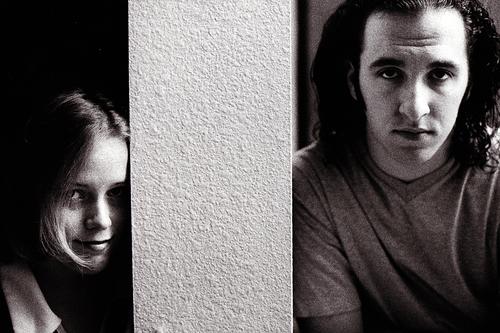
Amon Krist (left) and Trey Many

Velour 100’s first full-length recording was Fall Sounds (1996) with Many on all instruments and Krist on lead vocals (and occasional acoustic guitar).  Right away the listener finds the music here focused and thematically linked — a concept album based on the pair’s experiences of loss and renewal informed by their Christian faith.  The same dense, hypnotic atmospherics present with Slowdive are found here; but Many keeps the listening interesting with changes and unusual time signatures.  “Dub Space” is a sparkling eight and half minute tone poem that could have emerged from the waterfall at the end of “Close to the Edge.”  The strongest track on the album — and, in my view, among the best three and a half minutes of the ’90s — is “Flourish”:

http://grooveshark.com/s/Flourish/504rKT?src=5

Velour 100 never received a bad critical review.  As Krist departed to complete her studies and launch a teaching career, the duo’s first demo recording was re-recorded and released as Songs From the Rainwater EP to high praise.  Many produced one more LP, Of Color Bright (1997) that featured three female lead vocalists, including ex-Sixpence None the Richer guitarist Tess Wiley.  Wiley co-wrote “Dolphin Grey,” which showcases her distinctive alto against a splash of jangling guitars:

http://grooveshark.com/s/Dolphin+Grey/4FPo6B?src=5

Many recorded a final four-song EP, For An Open Sky (1999), with soon-to-breakout vocalist Rosie Thomas.  He now lends his formidable production skills to projects for other bands.

Ghosts of the Great Gaze

By the end of the ’90s “shoegazing” (or “dream pop”) was figured a dead letter.  Its artsy sensibilities (pretenses, to some) were destined to remain out of favor with an X Factor world.  But even into the 2000’s there remain artists who pay homage to the genre.   An excellent example is the expansive “Duk Koo Kim” by Mark Kozelek’s side project, Sun Kil Moon.  Aptly described by one listener as “magical sad tragic wonderful,” it is a meditation on mortality inspired by the Korean boxer who died from injuries suffered in a bout with Ray “Boom Boom” Mancini in 1982 (in fact, much of Sun Kil Moon’s Ghosts of the Great Highway is inspired by the stories of fighters).

In shoegazing fashion, the guitars ring and leave auras of reverb in their wake, Kozelek’s falsettos submerged in the melodies.  Unlike Slowdive’s binary pieces, “Duk Koo Kim” has three distinct sections, and (in prog rock proportion) sprawls over 14 minutes — each representing the number of rounds Kim lasted in the ring before succumbing.

Come to me once more my love 
show me love I’ve never known 
sing to me once more my love 
words from your younger years 
sing to me once more my love 
songs that I love to hear 
The Musical Biz

TheMusicalBox

Carlton Wilkinson reflects on the nature of music, arriving at a fundamental principle, which helps him think about the future of music:

Music is inherently live and therefore inherently local. The future of the music business is not in product sales, but in the service of that artist-listener relationship. Artists are thinking about tech. They’re embracing it and using it to reach their audiences directly.

He does this in “Pandora’s Box Is Open and the Music Biz Will Never Be the Same“, which develops a fascinating argument about how music is not a commodity:

It’s not a product that can be assembled in a production line or held in your hands. It’s something that comes naturally from every living person — some better than others — and can be enjoyed by every living person, for free as long as the musician is willing, with no other assistance needed.

The standard business model, perfected in the age of vinyl recordings, presented music as a tangible thing — a record — that a businessman could manufacture and sell like any other widget. But the music on those records is only a captured bit of the ephemeral, constantly changing musical experience.

A Bruce Springsteen song is never exactly the same two concerts in a row. A performance of Beethoven or Bach sounds different depending on who is playing, and were those composers themselves to play their most famous music for us, we would likely hear shocking differences from the versions we know — more radical than any modern interpreter would dare.

The experience of music is determined by its creators and by its listeners. By definition it is never completely recreated, but is created anew every time. It happens in the moment and will change in the next moment.

The traditional music business, built around the sale of fixed music recordings, handles manufacturing, packaging and distributing, middlemen selling something they didn’t make themselves, something never really theirs to begin with.

These days, though, tech is trashing that model, by fits and starts turning the business of music from a product-based market into something more like a social media service directly connecting artists and listeners.

Wilkinson earlier made his impassioned point that music is not a commodity in an insightful review of the music that Obama put on display for his second inaugural, “Obama’s Hit Parade“:

… I can overlook the lip-synching. What’s more disturbing, what I find harder to forgive, is the programming emphasis on pop music performers, including Beyonce and Kelly Clarkson, at the ceremony and elsewhere. …

The world of pop music has always revolved around money, the more the better. Money’s influence alters not just the way the music is presented, but the way it is created and the expectations of the creators and the audience. Success in this field is a dollar figure.

Classical and jazz don’t work that way. The musicians need to get paid, sure, and most aren’t above playing weddings or in some ways tailoring their music to suit their audience. Money pressures exist, but they don’t dominate the art form. Success here is rooted in technical accomplishment and in the musical experience itself.

When a classical artist verges on mass popularity, like Yo-Yo Ma, companies like Sony will maneuver themselves into a position to profit from it. But Ma didn’t get where he is by thinking about money — he got there by being a terrific cellist, and an inquisitive musician, constantly challenging himself, branching into new areas. His success was established long before big money entered the picture and continues largely because he is able to rely on his true artistic nature and ignore the role of money.

Pop musicians sometimes emulate that model, ignoring the financial rewards and following where talent and curiosity lead. Often they find themselves in a better place as a result, connecting more easily and honestly with audiences, developing a longer career trajectory.

They don’t let the money get in the way. …

Early in his first term, Obama made a commitment to present the U.S. cultural landscape in all its diversity. At that first inauguration, he shared the podium with Ma, Itzhak Perlman, Gabriela Montero and Anthony McGill playing a John Williams variation on the Shaker hymn “Simple Gifts.” He followed up on his promise by hosting workshops and concerts in various styles at the White House during the first year or two he was in office.

But at this year’s inaugural, that broader cultural perspective seems to have gone missing, narrowed to focus more fully on the most common commercial tendencies, music as a commodity.

Geddy Lee recently appeared on a TV sitcom in which the episode mocked Canadian culture as backwards, the fictional case in point being that its culture was transformed only much later by grunge. (In reality, of course, Rush’s prog metal had already allowed Canada to transform the musical world. Thus, Lee’s fake testimony on the sitcom imparts a delicious taste of irony to the self-deprecating joke being made at Canada’s expense.) Part of being able to get the joke was being able to comprehend the standard narrative that grunge changed the world of rock forever.

But Jason Notte, inspired by Wilkinson, debunks that standard narrative in “Nirvana’s ‘Nevermind’ and The Death of Guy Rock” by arguing that Nirvana in fact provided a negative example, by making clear only what rock cannot exclusively become—namely, grunge and grunge alone:

So where does Nirvana fit into all of this? Well, the familiar narrative says they did the world a big, huge favor by ridding it of hair bands and arena rock and making it safe for garage bands again. That’s not quite how it played out. The grunge and post-grunge era music world was filled with as much belabored growling, on-stage preening and aggro nonsense as ever, as evidenced by the lineup, fires and ensuing rioting and rapes that engulfed the ill-fated Woodstock ’99.

What Kurt Cobain and, later, Dave Grohl taught and most folks didn’t hear until Napster gave away much of the music and Woodstock ’99 made it very clear was that “rock” and, more importantly, pop music can’t be an exclusionary club filled with angry boys. …

Without making a concerted effort to do so, Cobain was being as inclusionary as he could within the confines of his genre. It’s something you hear echoes of in Jack White’s work and in his previous albums with the White Stripes and it’s something the Black Keys have reached for in their own blues-based fuzz rock and their collaborations with artists from various genres.

Inclusion is the common thread. …

That’s ultimately the key lesson from Nirvana and Smells Like Teen Spirit: It changed music and, more specifically, rock music by making “rock” sound nothing like Nirvana.

In other words, rock continues to progress. And it does so in its history by discovering innovative ways to facilitate inclusion and participation.

And that, arguably, is why progressive rock is the exemplary flower of the rock genre. Because, as is suggested by its lengthy songs and its display of musical virtuosity within the framework of group dynamics, it offers the greatest musical space for the flowering of inclusion and participation and a satisfying local experience.

Witness the relationship between the artists and the listeners of progressive rock. In our own time, Big Big Train is showing us how music, not as a commodity, but as a work of art that invites listeners to an immersive and unrepeatable experience, can bypass the music industry and allow rock to be what it is supposed to be according to its essence: namely, a musical experience of transcendence.

As Greg Spawton has observed:

In The Music’s All That Matters, Paul Stump makes some very interesting observations. Early on in the book, he correctly identifies that the main problem with progressive rock is its name (he calls it ‘the most self-consciously adjectival genre in all rock’). Another point that Paul Stump makes is about what unites the musicians of the genre. He says they have ‘a hankering after the transcendent’. I really like that phrase as it can take on a broader meaning than ‘progressive’. In Big Big Train, we combine our influences in a way, which is often original. But trying to do something different isn’t the be-all-and-end-all. What we are really trying to do is to make extraordinary music.

There’s only one way that prog rock can touch you.

And that is: in the present moment.

So why don’t you let it?

Now, now, now…

Porcupine Tree Comes Together – A Fresh Look at “Signify”

Signify Cover

Signify is an important album in the long and varied history of Steven Wilson and Porcupine Tree. The first PT album, On the Sunday of Life (1991), is a tongue-in-cheek solo Wilson tribute to British psychedelic rock in the vein of XTC’s Dukes of Stratosphear. Up the Downstair (1993) and Voyage 34  (1993) were also done primarily by Wilson alone, and are literal acid-rock albums.

The Sky Moves Sideways  (1994) introduces the first real band that operated under the moniker of Porcupine Tree: Wilson on guitars and keyboards, Richard Barbieri on synthesizers, Colin Edwin on bass, and Chris Maitland on percussion. Stylistically, the album is heavily indebted to classic Pink Floyd. While an enjoyable listen, it doesn’t break any new ground. It’s also easy to forget that the group Wilson had formed with Tim Bowness, No-Man, was actually more popular than PT during this period.

Which brings us to 1996, and Signify. Musically, it is a giant leap. Wilson, Barbieri, Edwin, and Maitland are working together as a seamless unit. There are lots of instrumental passages, and Barbieri’s electronic atmospheres are integral to the overall feel of the music. Beginning with the first track “Bornlivedie” and continuing throughout the album, Wilson juxtaposes samples of happy-sounding radio announcers, televangelists, and other snippets of spoken word with beautiful yet foreboding music.

It’s a device Wilson has become the master of: seduce the listener with gorgeous melodies, and insert dark lyrics. Personally, I think Steven Wilson is indulging a sly sense of humor. Continue reading “Porcupine Tree Comes Together – A Fresh Look at “Signify””

Open Your Eyes — and Ears — to Leslie Hunt

The unstoppably awesome Leslie Hunt is giving away downloads of her last two albums at her online store.

This is amazing music by a rare talent, so grab it while you can!

If you like prog phenom District 97, you’ll really enjoy comparing Leslie’s 2009 version of “Open Your Eyes” (track #13 on Your Hair is On Fire) with District 97‘s 2012 version.

If you’re like me, you can’t get enough of both!

Thanks, Leslie, for the gift of your superb music.

leslie-hunt-live

Cosmograf – The Man Left In Space (Album Sampler)

I pre-ordered my copy this week. You should too. It sounds terrific!

Hold On

90125

G.K Chesterton is the alleged source for Yes’ terrific 90125 song, “Hold On.”

Frank Weathers cites personal correspondence between Jon Anderson and a friend of his, in which Anderson attributes the song’s inspiration to this quotation:

In the struggle for existence, it is only on those who hang on for ten minutes after all is hopeless, that hope begins to dawn.

I searched the Internet and this quote is all over the place, attributed to Chesterton, as if writing thus in The Speaker on February 2, 1901.

Of course, that doesn’t mean Chesterton actually wrote it. There are lots of fake quotations propagated by the Internet.

And the way the “struggle for existence” phrase is placed in that sentence doesn’t sound like Chesterton to me.

I did a search through the Collected Works of Chesterton published by Ignatius Press but I have been unable to verify the quotation.

In addition, my scouring of Chesterton books via the tremendous power of Google Books yields no results.

Is there anyone out there who can cite me a published source, in order to verify this Chesterton quotation?

Until then, I will have to conclude that it is fake.

Still, this would be a marvelous case of felix culpa…

Marvelous that Anderson could read a simple fake quotation somewhere and then spin a glorious Yes song out of it.

Perhaps it would not be too much to say that Anderson had a connatural understanding of Chesterton on this one point, in somewhat the same way that Chesterton himself had an intuitive grasp of Thomas Aquinas by way of connaturality, as Marshall McLuhan has argued in his “Introduction” to Hugh Kenner’s Paradox in Chesterton:

[Chesterton] seems never to have reached any position by dialectic or doctrine, but to have enjoyed a kind of connaturality with every kind of reasonableness.

According to Weathers’ friend, Anderson apparently had this to say about his inspiration:

He told me that the song was about pressing forward into a new world—like moving from black and white into technicolor. We could either accept the end of the world, war, corruption, the extermination of mankind, or we could work toward a bright, peaceful world based on “common sense.”

He wrote—and this is why I’ve always remembered it—that “hang on” doesn’t sound as pleasing when sung as “hold on.”

Sounds connatural to me…

After all, Chesterton is the Apostle of Common Sense.

Urban Jungle

paper-house.bandcamp.com

British Columbia band Paper House has released a preview of their forthcoming second EP, Whistles and Missiles (Feb 1, 2013): namely, track #2, “Urban Jungle.”

It’s nice retro rock that you may find refreshing. Their prog rock-flavoured first EP is available over at Bandcamp.

But if you are interested in the theological reasoning behind the statement “all dogs go to heaven,” you’ll want to download Paper House’s hilarious country rock track, “Lucky (In Memoriam).”

And you can also download their track “Movie B.S. Theme,” which makes for a nice one-minute palate cleanser between the lengthier hyper-epic prog tracks on your playlists.

Thieves’ Kitchen’s new album releases Jan 29, now available for pre-order

On 29 January Thieves’ Kitchen release their new album, “One for Sorrow, Two for Joy.”

It’s now available for pre-order. More information at the link below.

On “One for Sorrow, Two for Joy”, the band are joined by Paul Mallyon (Drums – Sanguine Hum), Brad Waissman (Bass – Sanguine Hum), and Anna Holmgren (Flute – Anglagard) to provide a thrilling journey into a musical landscape rooted in a progressive heritage, but not limited by it. Fans of The Water Road will hear a continuity of their instantly recognisable sound, but from a band still moving forward, still exploring.

Recorded and mixed by Rob Aubrey at Aubitt studios (IQ, Big Big Train, Spock’s Beard), “One for Sorrow, Two for Joy” is a crystalline document of a band surfing the extremes of dynamics across a mosaic of shifting themes to provide an organic and engaging listening experience.

http://us6.campaign-archive2.com/?u=9765a966a943631101e12f74b&id=7b6c2dc271

The Medium Is the Massage (1967)

The Medium Is the Massage

Did you know that Marshall McLuhan recorded a prog album?

And this rare album is now available again as a handsome reissue CD. (I would recommend owning the CD because of the gatefold cover and nifty booklet, rather than simply downloading the MP3 files.)

The album consists of two tracks, each one taking up a whole side of a vinyl LP: track one is 19:21 in length, and track two is 23:15.

You may wish to classify it as Spoken Word Prog, since the focus is arguably on McLuhan’s words. But there is such an interesting blend of music, other voices, and sound effects, that — by design! — the LP seems to defy that categorization. Perhaps it is better simply to classify it as Proto-Prog, because of the date at which it was recorded.

DJ Spooky (who even did a 3:07 remix as an audio abstract of the album) writes in the liner notes for the reissue:

Mcluhan wrote his stunningly prescient monumental work, one of twelve books and hundreds of articles, Understanding Media: The Extensions of Man, in 1964. He followed up with The Medium is The Massage: An Inventory of Effects in 1967. The record you hear arrived after that, but it embodied the same ideas. The baseline subject that would preoccupy almost all of McLuhan’s career was the task of understanding the effects of technology as it contextualized popular culture, and how this in turn affected human beings and their relations with one another in communities. For him, everything was connected. Because he was one of the first to sound the idea that electronic media and pop culture were eerily interconnected, McLuhan gained the status of a cult hero and “high priest of pop-culture”.

Acoustic space, pattern recognition: boundless, infinite play of text and thought — that’s what you need to think about when you listen to this album. The record version of the “Medium is the Massage: An Inventory of Effects” project was meant to embody some of the issues that the graphic design and radical use of new fonts and images to enhance the text of the book and create a dynamic linkage between how the collision of fonts and graphics would work and how they could be represented in sound. The whole thing is presented as an audio collage focused around McLuhan’s own voice reading parts of the book. There are other “character” voices—’the old man’, ‘the Hippie chick’, ‘the Irishman’, ‘Mom’, ‘the little girl’, etc.—who utter McLuhanisms, snatches from Pop culture, and excerpts from Finnegans Wake and The Iliad. Weaving amongst these is a very 1960s selection of jazz, classical, and psychedelic pop musics. This is all topped off with incursions from the recording engineer, backwards tape effects, sped-up and slowed-down voices, ambient recordings, and a whole jungle of other Foley and sound FX. One could argue that the book was as much about the graphics as it was about creating a place where the images could embody the philosophy graphic design that Mcluhan advocated — the record was the audio version of the same process. As Mcluhan once said: “For tribal man space was the uncontrollable mystery. For technological man it is time that occupies the same role.”

The record version of the “Medium is the Massage” presents that as a DJ mix — it presents the entire book as a series of samples, just like a mix-tape.

Think of this record as a collection of some of Mcluhan’s spoken texts recorded, collaged, cut-up, spliced, diced, ripped, mixed, and burned. It’s a mix tape made in a different era — before the rise of digital media files, but it has the same kind of resonance of a mix of any current sound art project one could care to name.

English Electric — Part One (The Best of 2012)

BBT

It’s the best album of 2012. It towers above all the others. What an achievement!

Every other album or artist that I talk about this year is a mere footnote to this incredible music.

Thank you, Big Big Train. A very Merry Christmas to all!