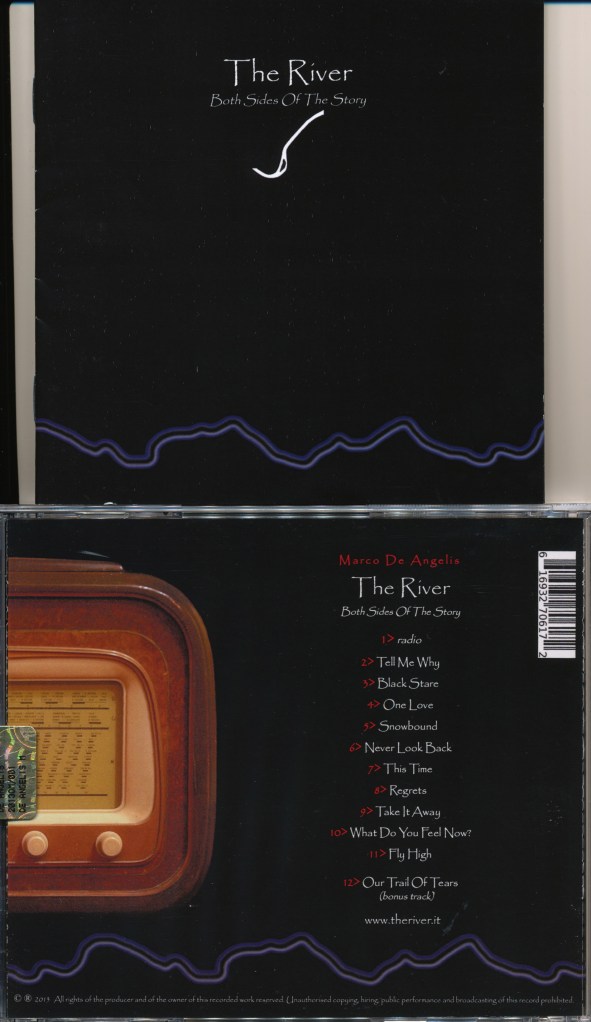
Two things arrived today, much to my happiness. First, via post from Roma, Marco De Angelis, The River: Both Sides of the Story. For more info on de Angelis, go here: http://www.marcodeangelis.com.
Marco De Angelis, The River (2013).
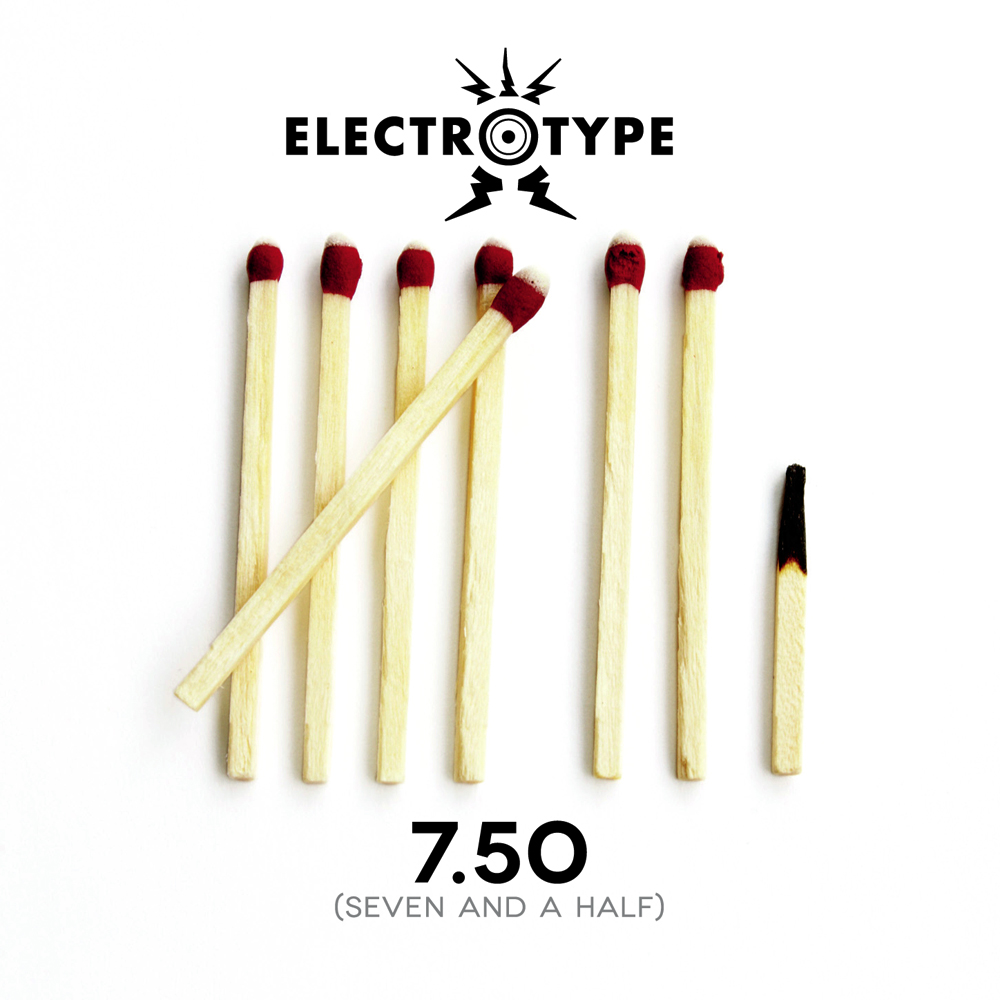
And, via the web, Electrotype, a one-person prog act. That one person is Beth Maplesden. She describes Electrotype as: “an independent art/prog rock uno based in the Philadelphia, PA area. The latest Electrotype EP, 7.50 (Seven and a Half), fuses art rock and alternative rock—New Prog and “old” prog with touches of garage, punk, metal, and grunge.”
Over at The Prog Report, “Nick D’Virgilio, drummer for Big Big Train, talks to The Prog Report about his time as Spock’s Beard frontman, his work with Genesis and Tears For Fears and his love for golf”, in what Greg Spawton calls a “prog-length interview (25 minutes)”:
This post deviates slightly from my series focusing on the old and the obscure. I decided to review this album per request of Brad, who suggested this band to me. I must say I was skeptical as I set forth on my quest to tackle this project, as I am not an avid fan of prog-metal. Nonetheless, there is beauty in all prog, so I gave it a try and I must say I was impressed, but I’ll expound on that later. Unified Past is the brainchild of singer/guitarist/keyboardist Steve Speelman and drummer Victor Tassone. This group has actually been around for about 20 years, but this was my first introduction. Their music can best be described as a blend of Rush and Dream Theater, although Genesis and Pink Floyd influences manifest themselves in some of their songs. Their album Spots, released in June 2013, features Speelman and Tassone as well as bassist Dave Mickelson, all in top form I may add. Here’s a brief description of each song:
Blank– excellent heavy drumming, similar to Mike Portnoy; solid guitar that sounds like Alex Lifeson and John Petrucci; the vocals are not that great, but the instrumentation more than compensates for Speelman’s subpar voice
Deep– similar to Blank in sound; solid bass performance by Mickelson
Hot (instrumental)- a fun song with a jazzier feel; would be perfect for a jazz metal swing dance class (if you were so inclined to begin one)
Seeing– opens with a riff that may remind some of Slash’s riff in Sweet Child o’ Mine; the heavy sound of the album continues
Tough– a longer song with a great instrumental passage; Speelman really shows off his guitar skills here
Age– features an intro heavy with a synthesizer, reminiscent of Pink Floyd’s Shine on You Crazy Diamond; picks up the pace eventually though
Sun (instrumental)- explosive opening with loud drums and louder guitar; fine guitar soloing by Speelman
Big (instrumental)- my favorite piece on the album (overall the instrumental pieces appeal to me more); solid bass line; Genesis and Steve Hackett influences are present: listen to Hackett’s Ace of Wands from his debut album Voyage of the Acolyte after you listen to this song and you’ll know what I mean
Wet (instrumental)- another Genesis influenced song similar to Big, but with a heavier sound; picture Hackett, Collins, Gabriel, Rutherford and Banks playing with raw intensity (and a dash of ferocity) and you’ll get the picture
G (instrumental)- shortest piece on the album; Mickelson showcases his talent on bass guitar much like Chris Squire did on The Fish
The Final– the band states on their website that this piece was inspired by Genesis and Pink Floyd, and it’s hard not to agree; a solid ending to a solid album; Speelman is great on both guitars and keyboards; a Rick Wakeman-like synth solo is featured near the end
Overall I was impressed by this album, considering I rarely give prog-metal much of a chance. For those of you out there who love Rush and Dream Theater, this album will be music to your ears (no need to laugh at that one). For those who love Genesis, Pink Floyd, and other symphonic prog bands, this album is certainly worth a listen. Steve Speelman is equally impressive on guitars and keyboards, Tassone can rival any metal drummer, and Mickelson laid down some thunderous but catchy bass lines. For all those out there who appreciate solid prog (even those like me who don’t care much for prog-metal), this is one album worth a shot. The songs are available for purchase on iTunes.
Last month, we posted Haken’s very entertaining “Cockroach King” video. Here’s the official video to another song from their excellent TheMountain album, the epic “Pareidolia”. Blending Indian and Greek elements (bouzoukis anyone?) with scorching guitars and tremendous vocals, Haken has come up with a prog/metal classic.
Pareidolia “is a psychological phenomenon involving a vague and random stimulus (often an image or sound) being perceived as significant” (according to Wikipedia). You can watch the curling smoke and cascading light in the video and experience your very own pareidolia.
Fans of Rush, Dream Theater, Ayreon, Riverside, and Devin Townsend will be all over this album.
The Flower Kings have been an essential part of my life for the last thirteen years. In 2000, one of my students (now, rather happily, a colleague) lent me his copy of Flower Power. I’d never heard of the band up to that point, though I’ve been a progger since the age of 4, way back in 1972.
Courtesy of Insideout Music.
I’d purchased my first Spock’s Beard album (their first as well) when it first came out in the fall of 1994, and I knew that Morse had been working with a Swede (all I knew about him) in a new a “supergroup,” Transatlantic. I remember thinking, “Wow, this phase of progressive rock truly is mighty if it can have a ‘supergroup.’”
It’s almost humorous now to think there was a time when I didn’t know the work of Roine Stolt. Through Stolt’s work, I found out about The Tangent. And, really, life without The Flower Kings or The Tangent? Too weird to even contemplate.
From the opening few notes of Flower Power, I was hooked. I loved the packaging, the music, the dreaminess. I immediately purchased the back catalogue of The Flower Kings, and I’ve since purchased every release upon its release date. And, I’ve done the same with all of Stolt’s projects. I was also lead, of course, to Tom Bodin’s solo work, Agents of Mercy, Kaipa, and Karmakanic.
Be ware, gentle reader, the rabbit hole into the world of Swedish Prog is a winding but glorious one.
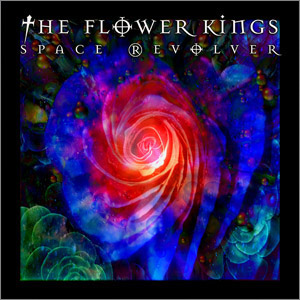
A desert-island disk, Space Revolver (released July 4, 2000).
While there’s no album by The Flower Kings I dislike (quite the opposite), Space Revolver has always been my favorite. It has a perfect flow to it, and it only grows increasingly interesting with each listen. It served as a real life saver for me when traveling fourteen days for my job. I’d never been away from my family that long, and it was painful. This was back before I owned an ipod (did they exist then?; I can’t remember), and I only took about ten cds with me. It was Space Revolver that gave me the most joy and comfort on that trip. But, this is getting too long winded, and I’ll save this story for another time and another post. Let me just state here, Space Revolver is a desert island disk for me. I think it might very well be one of the top ten albums of the rock era. If you don’t own it, you should. In fact, you should stop reading this right now and order it now. Yes, it’s that good.
Admittedly, I’ve listened to the band so much, I’m really not sure I could even pretend objectivity when reviewing them. Nor at this point in my life, do I really want to be objective. All of the Birzers love The Flower Kings.
Additionally, whatever creativity I might possess, I owe a lot to The Flower Kings. Space Revolver served as the sound track for my first book, Unfold the Future for my second, and Paradox Hotel for my third. The Sum of No Evil and Banks of Eden have played a major role in the one I’m currently writing.
As I’ve stated too many times before, I dislike labels, as they’re almost always used to bypass real engagement with a person, an idea, or a work of art. But, even if I appreciated labels, I really don’t know how I’d label this band. The Flower Kings have produced so much beauty, and in such diversity, that they’re almost fully resistant to categorization. Well, that is, to label properly. For me, every Flower Kings album is a mood or a state of being.
The Flower King: Humanity.
Back in the World of Adventure: Exploration.
Retropolis: Playfulness.
Star Dust We Are: Redemption.
Flower Power: Mythic.
Space Revolver: Appreciation.
The Rainmaker: Warning.
Unfold the Future: Righteousness.
Adam and Eve: Confidence.
Paradox Hotel: Tranquility.
The Sum of No Evil: Love.
Banks of Eden: Elegance.
Desolation Rose: ?
The most common description I’ve seen of the Flower Kings is “retro.” But, of course, this is meaningless. The band pays homage to those they love. Shouldn’t we all? I deeply admire my maternal grandfather, and I’ve tried to live my life in accord with the dignity he displayed. Does that make me “retro”? I speak the same language as my mother. Does that make me “retro”? The Flower Kings love Genesis and King Crimson. So do most proggers. At some point, labels become not only offensive, but absurd. But, enough of this rant. . . . If anything, pietist might be better than retro. Ok, now, really, the rant is over.
Desolation Rose
Through the good graces of Edge at Insideout Music, I was able to receive an advanced release of Desolation Rose.
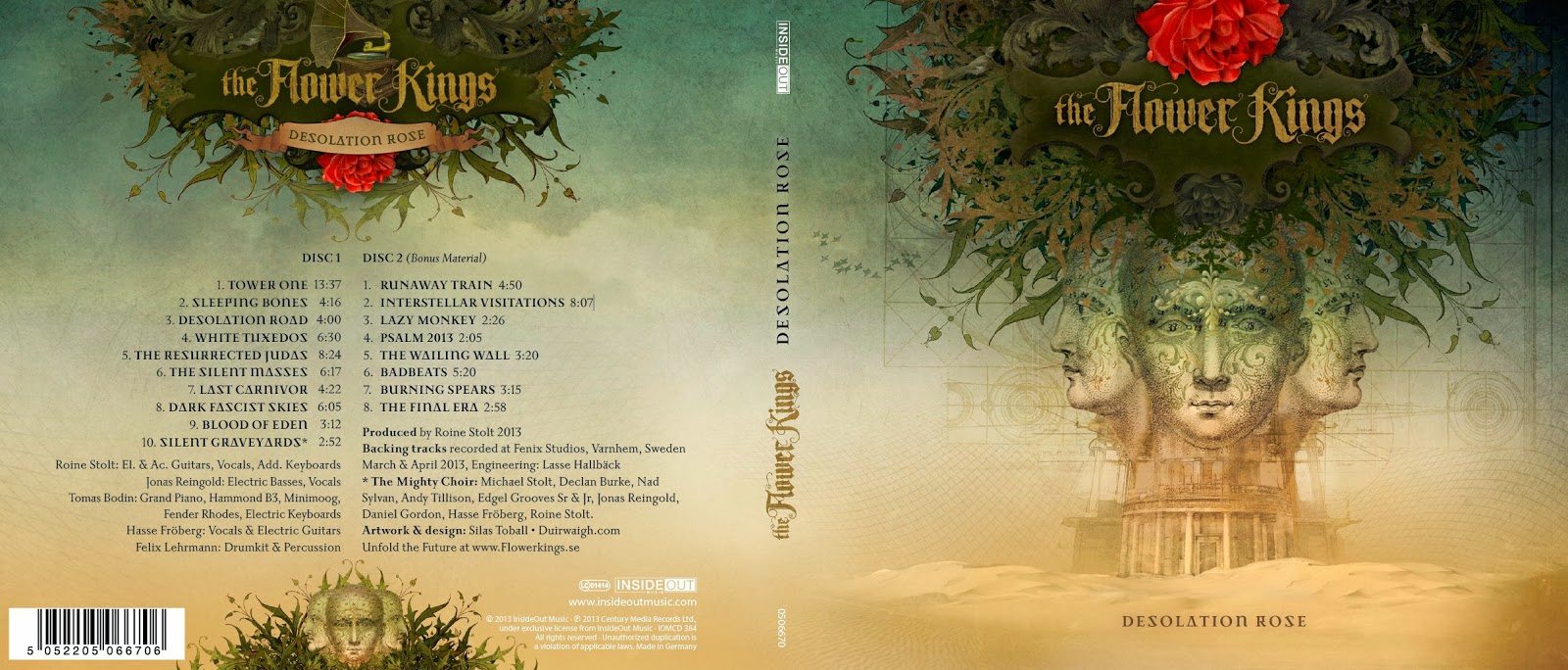
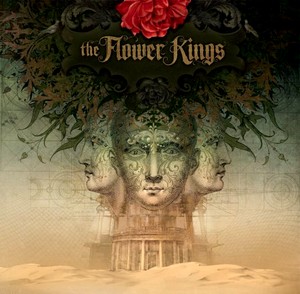
The first thing to notice about this release is the darkness of the art as well as of the subject matter. The cover art depicts three tattooed human heads resting atop a deserted (and in a desert) classical structure. Above the heads blooms a bright red rose, surrounded by nesting birds of paradise intertwined in intricate greenery. From a distance, the image could be an explosion, possibly atomic. There are visual references to the cover art of Space Revolver as well as Unfold the Future.
The title could mean many things. Desolation almost never has a positive connotation, unless one might be referring to the landscapes of the American West. But, Rose? Rose is almost always good, at least as a noun and a proper name. Who couldn’t love a Rose? It’s the middle name of two of my daughters. And, traditionally, the rose is almost always associated with the mother of Jesus. She’s not exactly been absent from the art of The Flower Kings. She appears weeping in the lyrics of Space Revolver, and the devil hides from her in his playground in Unfold the Future. It’s worth noting again, the cover art of Desolation Rose refers to the albums that already have a reference to Mary.
Unfortunately, as with Eric and Tad, I don’t have the lyrics in front of me, and I’ve had to interpret them simply through listening to them repeatedly. I’m fairly sure that I am probably hearing what I want to hear, and I hope any interpretation I make will be taken with this caveat.
Though ten separate tracks appear on the main disk, the music flows from one song to another without a moment of silence. The album as a whole, however, ebbs and flows, and every track bleeds into the one following it. This only adds to the intensity and urgency of the record. A number of images and lyrics recur as well: revolution; false kings and false idols; mechanized man; the abuse of power; our place in the order of existence (“we’re the third from the sun”); our life as a game or a false dream; the soil of Eden; silent graveyards (where is the voice of the ages?); and, above all, the need to be individuals, unchained by the restraints of corrupt authorities and mass thinking.
TFK, live. Photo courtesy of Roine Stolt.
All of the songs build to a climax in “Last Carnivore” and “Dark Fascist Skies.”
This has to rank as one of the darkest and most politically charged and angry (righteously so) of all Flower King’s tunes. It’s also absolutely brilliant. At the end of the song, the album rather quickly embraces a quiet denouement in the very short “Blood of Eden” and “Silent Graveyards.” In the end, the Flower Kings affirm that “we are stardust/we are sunkissed/we are brothers and still we’re strangers.”
Songs: Tower One; Sleeping Bones; Desolation Road; White Tuxedos; The Resurrected Jadas; Silent Masses; Last Carnivore; Dark Fascist Skies; Blood of Eden; and Silent Graveyards.
The album, itself, is flawless. Every instrument has a punctuated clarity to it. Upon my first listen, it was the bass I heard most. On the second, it was the guitar. On the third, it was the keyboards. On the fourth, it was the interplay of Stolt’s vocals with Frosberg’s vocals. On, probably, my fifth listen, I realized it was everything. Stolt has produced this album with an eye toward perfection. This album feels, at least at this point in my listening, less symphonic than other modern prog masterpieces, such as Big Big Train’s English Electric. In terms of urgency, it has a similarity to The Tangent’s latest studio album, Le Sacre Du Travail.
Stoic Kings. Photo courtesy of Roine Stolt.
The only thing I find painful in Desolation Rose is the sampling of Richard Nixon’s voice in “White Tuxedos.” Don’t get me wrong. The song works, and it works well. But, having been born in 1967 and having been raised in a very politically libertarian family, Nixon was always the bad guy. His voice, to this day, makes me wince. And, as many times as I’ve listened to this album over the past week, I still cringe every time his voice pops up. Equally creepy, the voice from “Bavarian Skies” returns, but so does one of the coolest guitar lines ever (think The Good/The Bad/The Ugly meets Chris Isaak). Even the song, “Silent Masses,” makes me pause a bit, as Nixon continuously attempted to appeal to those he called the “silent majority.”
I can’t end a review with THAT man’s name in my conclusion.
So, on a much happier note, this year, 2013, has been nothing short of an annus mirabilis. When the new year hits, every prog lover will be, materially, worse off after having survived 2013. Every prog lover will be, also and more importantly, enlivened spiritually and intellectually after having survived 2013.
In the top of this astounding year of Prog is Desolation Rose. Empty your pockets. Another must–absolute must–buy.
Unlike Eric Perry in his earlier, excellent review, I approached the new Flower Kings album from a position of relative ignorance. I greatly admire Roine Stolt’s work with Transatlantic, but I do not have any Flower Kings in my music library. However, after listening closely to Desolation Rose the past few days, that is about to change!
21st century media provide wonderful benefits (could something like Progarchy have even existed 15 years ago?), but any technology can also be perverted into something terribly harmful. Desolation Rose is a dark and brooding jeremiad on the dangers of corrupt media and government, perpetual war and violence, and religious fanaticism. Freedom is not a given, and Desolation Rose is a dire warning to those who would trade it for “security”, whether by indiscriminately believing what governments and mainstream media tell us, or by neglecting critical thinking when it comes to the claims of deceptive religious figures. Each song segues seamlessly into the next, reinforcing the overall impact of the lyrics. It may take a few listens for them to take hold, but once they do, they are very powerful.
A sampling of some of the most memorable lines (as best I can decipher them; I do not have a lyrics booklet):
“Lies bring comfort to the king and his nation/Like fools, we just stare at the sun.” (‘Tower ONE’)
“In the silent soil of Eden lie the bones of a predator/From the sun and the stars, a dreamless penitentiary.” (‘Sleeping Bones’)
“In silent graveyards we look for saviors/A promised land beyond our prayers” (‘Desolation Road’)
“So if you follow, go look beyond the lies/A brand new kingdom will brighten up the skies/Close to the sea, the river’s getting wider/Take off the blinders, and love will take you higher” (‘Resurrected Judas’)
“We are just the silent masses/The things you need are out of fashion/And so the clock keeps ticking out of time” (‘Silent Masses’)
“When a man is not a man, but hostage to machinery/Will they ever let you out from this dreamless penitentiary?” ‘(Last Carnivore’)
“So the state has become the offender/To the point where there’s no turning back/Now you dream of your new independence/While they tighten their grip round your neck” (‘Dark Fascist Skies’)
“We are stardust and we’re sun-kissed/We are brothers and still we’re strangers” (‘Blood of Eden’)
Just as words and phrases are repeated in the songs, musical themes recur throughout, making the album a remarkably cohesive work. The propulsive drumming of Felix Lehrmann is terrific; Tomas Bodin’s manic organ locks horns with Roine Stolt’s lead guitar and musical sparks result. Hasse Froberg’s vocals are outstanding – full of dark menace one moment, and aching lament the next. Jonas Reingold’s bass work is as melodic and inventive as Geddy Lee’s.
Highlights are ‘Resurrected Judas’, which has a nice “Trick of the Tail”-era Genesis vibe and a graceful, loping guitar solo; the straight-ahead rocker ‘Silent Masses’, with its jaunty piano riff and nimble bass line; and ‘Last Carnivore’, which is very dark and oppressive until a key change brings relief and light. ‘Last Carnivore’ is representative of the album as a whole – from the first track, the band creates an atmosphere of conflict, darkness, and oppression which isn’t relieved until the beautiful and stately ‘Blood of Eden’ makes its appearance near the end. Hearing it is like seeing clouds part and the sun shine through after a violent thunderstorm. However, lest we think everything’s going to be fine, the ‘Silent Graveyards’ show up one last time in a musical coda that ties together the various themes masterfully. Froberg’s voice rises as if he’s framing a question, and it is unsettling to realize that ‘Dark Fascist Skies’ are always lurking around the corner.
With Desolation Rose, the Flower Kings have produced an album of extraordinary power and depth. Lyrics and music combine to pack an emotional punch that cannot be ignored. Detta är en att älska.
I came across this interesting interview of Ian Anderson by Fox News. In it he talks about deciding to play the flute instead of the guitar, Thick as a Brick, Thick as a Brick 2, his current tour, and his next album. Enjoy.
It’s probably accepted by many people who have followed the career of The Flower Kings that the prime years for them were the albums that ranged from the official band debut, ‘Back in the world of Adventures’ (1995) through to the peak of the era ‘Space Revolver’ (2000).
The work that followed on from this time was by no means less prolific and has examples of some of their best moments however there was a sense that some of the spark and sheer wonderment of the earlier work was lacking. Indeed by 2007 the experience seemed exhausted for some, with the feeling that the music was going through the motions and as a result the band was put on a break for the next five years.
Last year the return of the regular line-up produced ‘The Banks of Eden’ (2012) which signaled a new charge driven in part by the lively and talented drummer Felix Lehrmann. The heavier, gutsy sound was a continuation of the harder edge that had shaped the group over the past decade, with all the elements that made up The Flower Kings still present.
Fast forward to now and the new release, ‘Desolation Rose’ and we see that the band have embarked on a new methodology which ironically provides the listener with 60 minutes of familiar music which firmly places it high up among the bands aforementioned peak period. Rather than arriving at the studio with the new material prepared, the approach was much more of an organic, cohesive effort of ideas and creativity. The results are exciting and varied and yet the sound is pure Flower Kings, pure Prog and kingly epic.
An initial first glance at the track listings and the die-hard fan might begin to wonder where the regular 25 minute song is this time around. But fear not, Desolation Rose is essentially a continual piece where the melodies and passages that open the first half are revisited in the closing sections. A powerful ascending refrain, very typically Flower Kings, crops up from time to time, effectively bringing it together and ensuring a neatly stitched continuity. The tracks bleed into each other like chapters in a novel adding to the overall joined up assembly. After several listens it begins to feel similar to ‘Garden of Dreams’ from ‘Flower Power’ (1999) in its journey-like experience. The connection to this album is likely emphasised in the input from Thomas Bodin who like ‘Flower Power’ has had a bigger contribution this time in the making of ‘Desolation Rose’.
Bodin’s contributions are spectacular, providing a dazzling symphonic base for the frequently soaring guitar from Stolt. The stand out moments from him are everywhere, but ‘Desolation Road’ (not rose) is perhaps one of the greatest of them, from the gentle piano opening to the glorious choral symphonies – “While the road to desolation….lingers on….” and finishing with a growling angry wild animal of an organ over a pounding Lehrmann beat .
“Pure Flower Kings, pure prog and Kingly epic.”
However the darker themes around the realities of war and suffering contrast the dream like qualities of Garden and are more evenly presented than their earlier opus too. That said, after many listens to the ambiguous lyrics and there is still uncertainty about the imagery and meanings. Yet this is a good thing, rather like sitting at an abstract painting in a gallery and seeing something new each time.
It is clear enough to see though that ‘Desolation Rose’ is TFK’s outcry and dismay at the world and its problems. Particularly conflict, and the senselessness of it. The latter is dealt with in ‘White Tuxedos’, a bleak picture of the inevitable conclusions of war, the title referring to the shroud of white over the dead. It’s a tale where there are no winners, neither from civilians or the soldiers who are sent to the four corners of the earth to fight under a flag of peace. The looping mantra of Nixon telling us of his desire for peace over and over again is a particularly chilling bookend to the track.
Following the intensity of White Tuxedos there is the almost certain contender for some of the finest Flower Kings magic anywhere. ‘Resurrected Judas’ ( him again) features some sublime guitar from Stolt over with a driving middle section instrumental, underpinned by some incredible bass and drums which is classic TFK, with shades of Genesis from a time when they made your skin tingle.
The darkest moments of this album are still matched with some regular TFK celebration at the beauty of the universe and the view from space at the earth. In ‘Blood of Eden’, our home is presented, still green and beautiful, -“We are Stardust and we are sun kissed”)- and we hear a pleading call to the heavens to a higher power to provide an answer to the problems we make.
Somewhat coldly though we are returned to the reality of the world in the closing gospel-like lament of ‘Silent Graveyards’-“in silent graveyards we look for saviours” – a reprise of the title track. The lonely desperation builds towards the finale where there is a hopeful prayer for a promised land and for an end to suffering, closing with a desperate agonising scream, from the impressive vocal abilities of Hasse Fröberg. There probably isn’t a Flower Kings album that closes as powerful as this, with the exception of the majestic end of ‘Stardust We Are’ (1997)
Without doubt the band have produced something spectacular again with this album, If there is such a thing as a flawless release this would be nudging to be a member of that club. Quite how they have pulled it off again is a mystery as it was written and produced in a time frame that is almost beyond belief. Much more than a stop gap between now and the next Transatlantic, this is an album that should be regular favourite for many fans and still talked about as one of the very best.
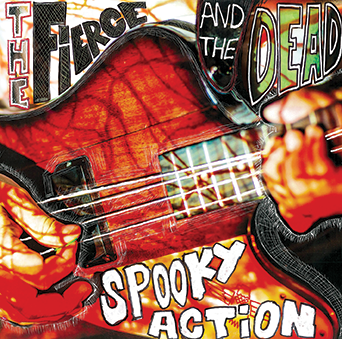
So, here is the eagerly-awaited new release from The Fierce and the Dead, their first on Bad Elephant Music, and it’s difficult to imagine a more appropriate title. Whatever else might be meant by the title, the music that you’ll find here is quite rightly described as “spooky action.”
Those who were paying attention probably caught the effusive note that I wrote for Progarchy back in May, just after I had really discovered TFATD. I was ushered into this sound-world from the antechamber of guitarist Matt Stevens’ solo recordings (apparently, just as Matt himself fell into TFATD). Do you remember that scene from the Wizard of Oz, when Dorothy opens the door from the spooky (artfully unsettling) black-and-white Kansas landscape onto the spooky (attractive, but even more unsettling?) color landscape of Oz? That first experience was, for me, that powerful, that attractive, and that blissfully unsettling.
Does Spooky Action live up to the expectation set by its predecessors? No. “Live up to” is (if I may resort to somewhat technical language here) totally lame. What we have in the music of TFATD, and what shines as brightly as we might have hoped on this new set, is the spooky action that is music-making. Not just writing songs and playing them. Not just outstanding playing (though it certainly is that too). The music that these guys make is a sort of alchemy, transforming sonic base metals into gold. Gold, that is, of the sort that gives in just the right way when you give it a trial bite.
Naturally, a number of earlier influences make themselves known in these tracks. As with earlier TFATD, I hear the sort of minimalist spirit that made its way so strikingly from Steve Reich into the early XTC. I hear the grungy (not grunge, but grungy) soil-like qualities of early 1970’s King Crimson. I hear collages of textured audio drawn from some of the same esoteric tomes consulted earlier by Sonic Youth. But what makes the musical action here so spooky is the alchemical feel, the je ne sais quoi that makes the sounds you are hearing music in the deepest and richest sense. Rhythmic complexity doesn’t come across here as contrived, as “lookie what we can do that isn’t 4/4,” but as a breathless invitation to join the band in an invigorating dip into a pool of ecstatic expression. The making of music should be a spooky action, and here it is so.
Do any of the tracks on Spooky Action have weaknesses? Limitations? Faults? I bet I could find some if I keep listening. But some music gives up its weaknesses early on, and having listened to Spooky Action twice now, it gives with an open, immediate generosity and profundity that outshines about everything new that I’ve heard lately, except perhaps the very different but equally enthralling sounds of Big Big Train. If the first listens are considered as a surface, at which I splash tentatively, gently lowering my face into the liquid warmth, then I see no immediate evidence that it has a bottom. There’s no measure for its depth available to the naked ear.
Having some familiarity with prior work by TFATD and by Matt Stevens, I suspect that one of the main ingredients in its depth is an overt avoidance of excess gravity. (Hmm. Can an avoidance be overt? I think it is here.) This is music that reaches the depth and richness it reaches precisely because it does not take itself too seriously. These guys are having fun, and that’s one of the keys to their achievement of a nearly perfect level of seriousness. The shortness of the tracks (especially by prog standards) enhances the intensity of the fun but fierce and deadly seriousness.
At a time when a fair amount of good music is being released at a fairly steady rate, The Fierce and the Dead have already made recordings that stand out, and by my initial listenings, Spooky Action is no disappointment. Matt Stevens, Kevin Feazey, Steve Cleaton and Stuart Marshall are an amazing unit.
Listen to it! And in case you haven’t seen it yet, here again is their delightful video for “Ark”:





 Progarchy