
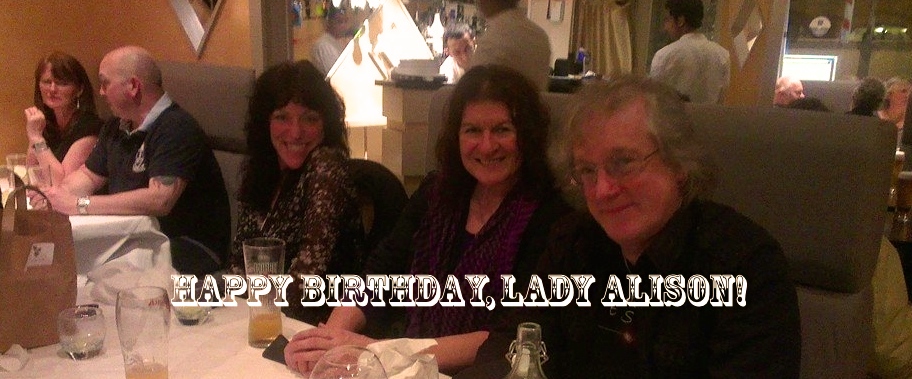
One of our great progarchists has reached the very old age of 20! Congratulations, Connor. We love what you write. Glad to have you with us.

One of our great progarchists has reached the very old age of 20! Congratulations, Connor. We love what you write. Glad to have you with us.
Pedants and purists will forever grumble about Yes line-ups that feature neither Jon Anderson nor Rick Wakeman, but the fact remains that a performance of The Yes Album, Close To The Edge and Going For The One in their entirety was simply too good an opportunity to miss. After all, how many more chances will any of us get to hear Awaken in all its shiver-inducing, goosebump-raising magnificence? Hence we needed no persuading to make the relatively short train journey south from Leeds to Sheffield for this very special show, the fifth UK date of the band’s extensive three-album tour.
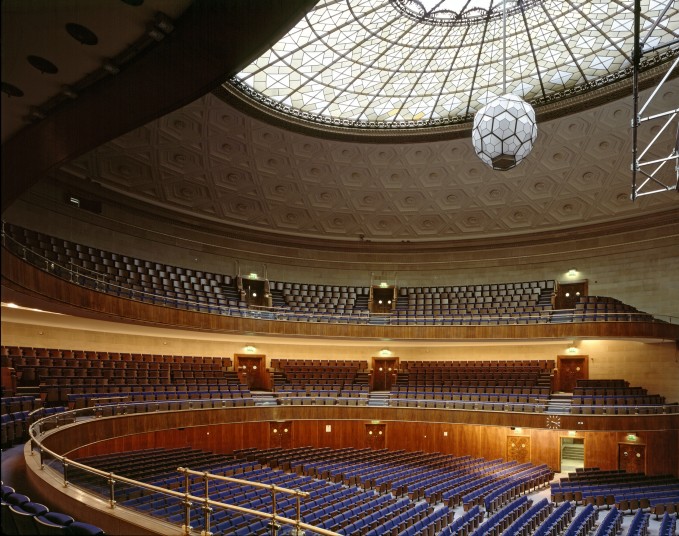
As we took our seats after collecting our VIP passes and goody bags, I couldn’t help thinking that the art deco interior of this Grade II-listed building was a fitting venue for music with such a distinguished pedigree, but there was little time for further rumination as the house lights dimmed and the languid opening notes of the familiar Firebird Suite intro tape sounded out across the Oval Hall. A screen above the drum riser displayed a fast-moving montage of photos, magazine covers, promotional posters and gig tickets from tours past, before the band took to the stage, readied themselves and then launched into Close To The Edge.
You read that right: they began with Close To The Edge – arguably the most intricate and complex piece in the entire set. Unsurprisingly, therefore, the first few minutes weren’t as tight or assured as they could have been. What with this and the disturbance of latecomers wanting us to move so they could find their allotted seats – a literal case of “I get up, I get down” – the start of the show didn’t quite have the impact I was hoping for. But it didn’t take long for that feeling to pass. Soon enough, the band were fully warmed up and, as ‘Total Mass Retain’ segued into Chris & Steve’s “In her white lace…” vocal duet, the music was casting its spell over the audience and the anticipated goosebumps were all present and correct.

And You And I was just as magical and moving as you’d expect, and Siberian Khatru just as powerful, if played a bit more sedately than the band would have countenanced in their younger days. All three pieces from this most definitive of albums earned rapturous applause and standing ovations from the crowd, but it all seemed to have passed too quickly – the hallmark of those classic gigs where you are so captivated that you lose any sense of time.
All too soon, it seemed, Steve Howe was introducing the second album of the evening, Going For The One. This was the undoubted highlight of the show for me, not because it is my favourite Yes album – it isn’t – but because Wonderous Stories was the only track from it that I had previously witnessed in concert. To say I was giddy with anticipation at experiencing the rest of the album performed live is a massive understatement. In fact, this segment of the show put me in such a state of transcendent joy that I’m struggling here to provide any cogent analysis. Had a camera been pointed at me for the next forty glorious minutes it would undoubtedly have captured a facial expression alternating between ‘big dumb grin’ and the quivering lower lip of someone valiantly attempting (but failing) to ‘keep their shit together’.
After the earnestness of CTTE, Going For The One’s title track gave the band their first opportunity to cut loose and really rock out, an opportunity which they seized hungrily. Parallels, too, packed a powerful punch. But it was in recreating the album’s more delicate moments that this segment ascended to even greater heights. Turn Of The Century, undeniably beautiful in its recorded form, was an absolute revelation live, thanks to a peerless vocal performance from Jon Davison. It was the biggest emotional hammer blow of the evening so far, if the lump in my throat and the moistness of my eyes were anything to go by – exceeded only by an utterly mesmerising rendition of epic pagan hymn Awaken that put tears on the cheeks of many of those present (myself included). It was a fitting climax to the first half of the show and gave us the interval to pull ourselves together!
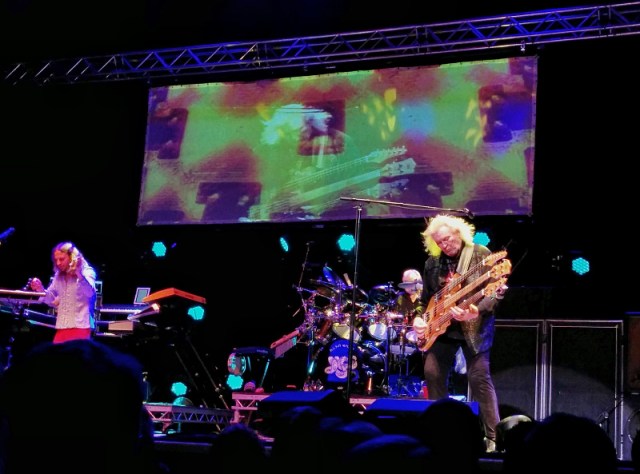
Twenty minutes later, the house lights dimmed a second time for the evening’s final act: The Yes Album. With the intensity of CTTE and GFTO behind them, the band seemed more relaxed, moving effortlessly through the album’s six classic tracks. Yours Is No Disgrace and Starship Trooper were every bit the crowd-pleasers you’d expect them to be, whereas the reception given to the long-unplayed A Venture was more polite than rapturous. Curiously, the stand-out piece for me was Clap, played flawlessly by Howe and earning a huge cheer from the audience. Seriously, I don’t recall a single missed note or buzzing string. The man’s powers seem remarkably undiminished by time, praise be.
That left only the customary encore of Roundabout, as energetic and rousing as ever, bringing most of the audience to their feet and prompting some of those in front of the stage to move around in a manner perilously close to ‘dancing’ – hardly the most natural state for prog fans, it must be said! The band lingered on stage for a while, revelling in the crowd’s lengthy ovation, and then it was time for us all to head home, drained by the experience but with a buzz that would last for days and precious memories that will live considerably longer than that.
I suppose I should finish by considering new vocalist Jon Davison. On this evidence, he is a fine fit for the role. Predecessor Benoit David’s voice is closer in timbre to Jon Anderson’s, but Davison’s has superior purity and power – and he also seems more of a natural showman than Benoit. It will be fascinating to hear how he sounds on forthcoming album Heaven And Earth.
There are always confessions to be made at the outset. Seldom are any of them actually made, and never are all of them made, but they are always “there.” The one that I will make right away here is that I never developed any strong liking for Echo and the Bunnymen. It’s not that I actively or particularly dislike them; it’s just that hearing their songs now and then during the 1980’s never really sparked my interest. My consciousness of “popular” (as opposed to “classical”) music in general was very spotty during the 1980’s for various reasons, or you could say “selective” if you’re open to having it sound a bit less negative or indifferent.
 The confession is relevant because Poltergeist consists of original Bunnymen Will Sergeant (guitar) and Les Pattinson (bass), along with Nick Kilroe on drums. Their 2013 release, Your Mind is a Box (Let Us Fill It With Wonder) is the second “instrumental prog” disc passed on to me by Brad “I-WAS-paying-attention-in-the-80’s” Birzer. The confession is called for because I came to the disc with that perception: “Oh, this is, like, Echo and the Bunnymen without Ian McCulloch.” … Aaaand get ready for ass-kick number two.
I found a helpful quote online from Sergeant. (It appears several places, but I first found it in a blurb on amazon.com.)
We do not want to fence the project in… with vocal barbed-wire so to this end we are an instrumental band and are very happy about that.
Now, we could argue about whether or not this is too harsh. The kind of containment suggested by the metaphor of barbed-wire could have all sorts of nasty connotations. But let’s not get bogged down by considering them all. There are times when you want fences that divide clearly, that enforce division and containment, right? And there are times when, however right it may be other times, barbed-wire is the last thing you want. To give up whatever it is you are seeing (at the moment) as barbed-wire is hardly to give up division and containment in general.
Following this lead, I’m asking myself: What’s freed up when these guys decide to do without vocals, seen at least from here, now, as barbed-wire? The answer is the kick: On the one hand, a multitude of constraints remain in place; if you expect radical departure, something “free” in the sense of “free jazz,” that’s definitely not what happens. On the other hand (and nonetheless, we might say), everything is freed up! So much of the texture here remains nicely tethered to an “80’s” “poppish” feel. To say that may seem like a put-down, but I think it turns out NOT to be. It’s a revelation for me to hear this instrumental exploration of that feel, placing more emphasis than I’m used to on how broadly prog sensibilities have always been there in a lot of the supposedly “post-punk” or “new wave,” often electronics-laden music to which I paid less attention (but never no attention at all, I now see more clearly). Everything is freed up here in the sense that I can hear the pleasing resonance of those sensibilities better without the “vocal barbed-wire.”
I’m very aware, as I write this, how it may come across as “damning with faint praise.” I doubt that I can wholly avoid that impression, but I hope you will see that it is not meant as such. While it is true that Your Mind is a Box is less category-resistant than the other two instrumental albums I’m considering, it definitely hits my ear as indifference-resistant. Because the members of Poltergeist allow themselves to stretch out in quite specific ways, experimenting without being “experimental” in an in-your-face fashion, I hear this disc as a warm invitation to reconsider that era during which I was spending a lot more time with Mahler, Reich, Penderecki, Glass, Schnittke, Boulez and Zappa. Your Mind is a Box helps me to hear the elements of early prog, funneled through 7o’s Bowie, Fripp, and Eno, moderately seasoned by the legacy of Kraftwerk and Tangerine Dream, that kept me watching MTV a fair amount in the 80’s (back when they were a network that played music videos). I would suggest that a major ingredient of the wonder with which Poltergeist wishes to fill our minds is the abiding presence of broadly prog influences in popular music since the 1970’s.
That Poltergeist comes across as this sort of invitation suggests two more things to me: The first thing is that referring to “vocal barbed-wire” in this context involves no particular negative reflection at all on McCulloch or any other prominent vocalists of that (or any other) era. The semantic constraints introduced by vocals are often what allows music to be profoundly accessible to so many people. But music is never only the words that are sung or the voice(s) of the singer(s); it’s much more than that even in a capella music! What one can hear (in the sense of perceiving) more clearly by listening to a delightful romp like Your Mind is a Box is how there is a danger that vocals can be barbed-wire. So the second thing is that this is another way in which the moniker “instrumental” fits this music. It can serve that aesthetically valuable end.
French philosopher Maurice Merleau-Ponty suggested that we do not so much see a painting as we see according to it. Poltergeist give us the wonderful (in line with the intention expressed in their title) gift of music according to which we can hear other music.
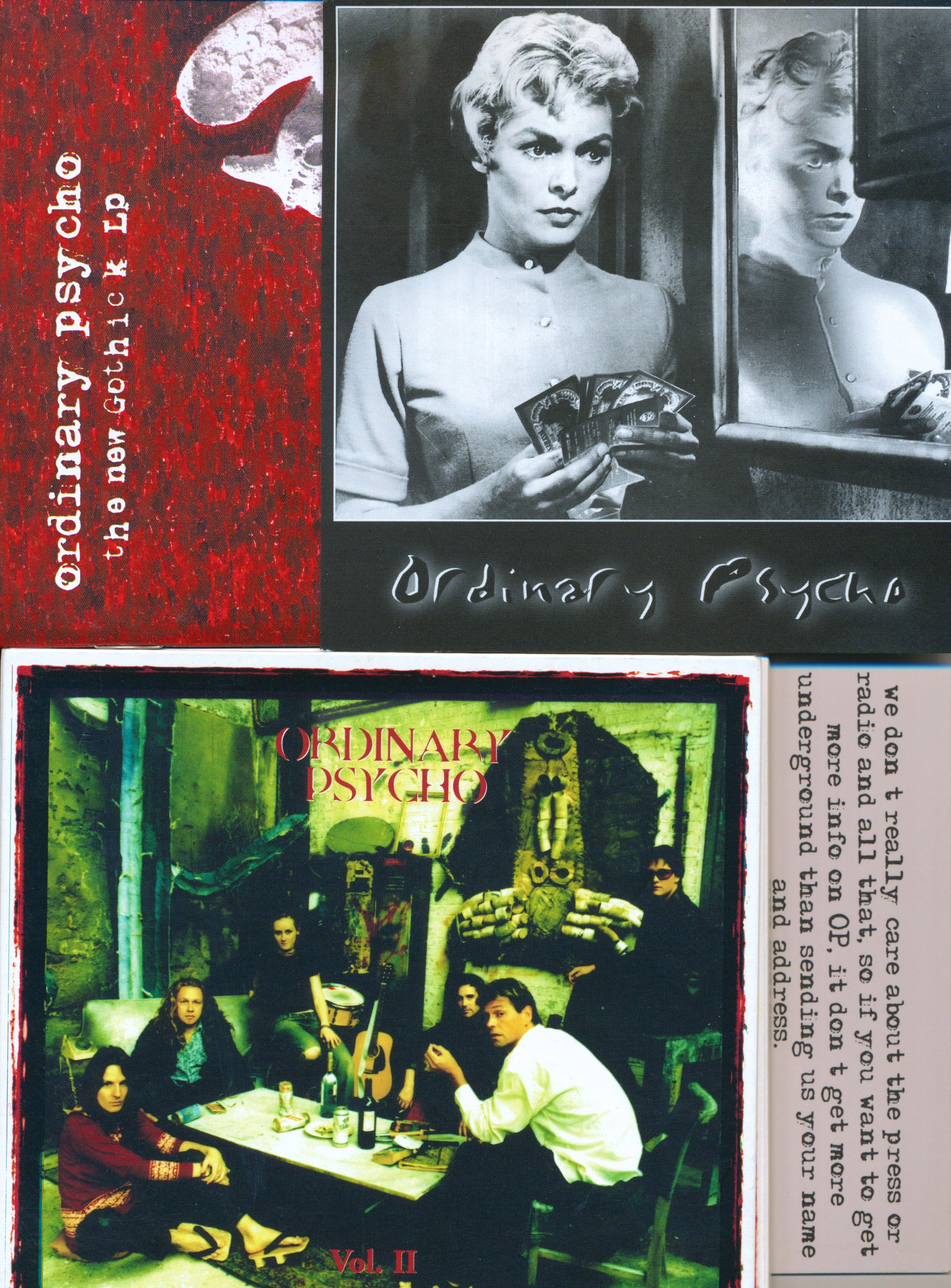
The English band Ordinary Psycho enjoyed a short but brilliant burst of life from about 1997 to 2004.
Their first EP, “Introducing Ordinary Psycho, Special Limited Discovery CD (With Marion Crane,” offered the world only twenty minutes of music. So well crafted, though, the music continues to speak to me after innumerable listens over the past sixteen years. Enjoying its pleasures as I type this piece, the music seems as alive to me today as it did in 1998. In 2000, they released their first LP, The New Gothick LP (sometimes just The New Gothic–without the k). A year later, they released their second and final LP, Vol. II.
https://progarchy.com/2013/09/24/ordinary-psycho-calling-david-gulvin/
As I’ve mentioned in a previous post—back in September 2013—I first encountered the music through a Talk Talk discussion group sponsored by a Danish website. David Gulvin, one of the two founders of Ordinary Psycho, popped into the discussion offering the band’s introductory cd. I requested one, and, lo and behold, it showed up in the States only a week or so later. I immediately fell in love with it, and I still consider it one of my most prized cds (out of a rather unseemly large collection!).
The brain child of brothers Tony and David Gulvin, Ordinary Psycho incorporates normal rock instruments—guitar, bass, and drums—but the band also employs lots of real strings (viola and cello, predominately), piano, double bass, and various forms of percussion. In the background to many of their songs, one can hear church choirs, children’s choirs, soundbites, samples of everyday life, and movie dialogue. All of the music warrants careful listening and high-quality headphones.
In the band’s only EP, “Introducing Ordinary Psycho,” the 20-plus minutes of music tell a story revolving around Alfred Hitchcock’s masterpiece, Psycho (based originally on Robert Bloch’s novel of the same name). In what could best be described as a theatrical play or actually interesting performance art, Ordinary Psycho manages to ask the most important existential questions for any person—who am I, why am I here, what do I do—in a soundscape that flows as naturally as human creativity allows in this rather crazy world. The production on this little EP is immaculate and the flow of the music and the lyrics simply perfect. Again, though I’ve heard the story of Marion Crane told many, many times, it never fails to grab me. This is how powerful the Gulvin brothers can be in their art.
The lyrics of all three releases titillate the intellect as well as the soul. No mere lyrics of “baby, baby”, the Gulvin brothers offer some of the most serious social and cultural criticisms I’ve ever encountered since Roger Waters and before Andy Tillison. “Generation X gave away to Generation Bland” screams one of the first lines of the first song of the first album. The brothers employ lots of Catholic imagery (Gnostic, too), critiques of anything bureaucratic (corporate, governmental, or educational), and an existential embrace of some vision of life ranging from the carnival-esque and to what would be considered mildly anarchist and libertarian.
Though one can hear many of these same themes throughout the three Ordinary Psycho releases (always creatively presented and often with raw anger), no style of music predominates. Any attempt at labeling this music would fail miserably. There are straight rock, prog, punk, folk, theatrical/music, and acid elements throughout. Never does any album, song, or passage move predictably, though, and one style easily and readily blends into another. Each album makes sense, however, and each clearly and abundantly overflows with intense imagery and equally intense creativity.
Sadly, there’s very little to find about the band or its history. It’s official website, www.ordinary-psycho.co.uk is defunct. Utterly kaput. Across the web are questions from fans asking such things, repeatedly, as “Does anyone know what happened to Ordinary Psycho?” or “Does anyone know where to find” this or that Ordinary Psycho release? But, there’s no solid information out there. When I googled the band, I came up with the piece I wrote about them last September. I could quote myself, but I know as little about the band’s actual history today as I did then. So, quoting myself would only be vain.
From what I can tell (and I have received a very nice email from Tony Gulvin, but with no details about the band or why it called it quits), the band began in the mid 1990s, released the EP and the two LPs, and ended itself around 2004.
Youtube has a couple of songs available as well as a few videos of some live performances. Classic Rock (the magazine) had one article about the band in July 2000, though it, in and of itself, is a bizarre article [as a quick note—I was able to access this about a year ago, but I’m unable to access it as I’m writing this piece]. It’s clear that the writer for Classic Rock had no idea how to classify the band.
It’s also very difficult to locate any of the Ordinary Psycho releases any where, even in specialty shops on the web. But, you should try. Really, you should. You should track these releases down as quickly as you can. Make it a treasure hunt (sorry, I have small children–such enthusiastic imperatives just come into existence from time to time!)! Listening to this band is an absolute feast for the ears, the mind, and the soul. I’m sorry they only produced what they produced. But, holy schnikees, it’s so much better to produce one great thing (or three great things) than a load of trash. Really.
That Ordinary Psycho was and remains a cult band only adds to its mystery. I feel today about the Gulvin Brothers the way many in the 1970s and 1980s felt about J.D. Salinger. His absence only added to his attraction.
Still, if the Gulvin brothers re-emerged, they’d find no greater fan than yours truly.
If nothing else, Tony and David, please release all of your music through Soundcloud or Bandcamp so that the world can enjoy your sheer brilliance. In this surreal existence of sorrows, the Good Lord knows we can always use a little extra truth, beauty, and goodness.
*****
Ordinary Psycho’s Discography
EP
“Introducing Ordinary Psycho, Special Limited Edition Discovery CD (With Marion Crane)”
LPs
The New Gothic LP (2000)
Vol. II (2001)
So, I was talking to Brad Birzer a little while back, and he said he wanted me to listen to some recent “instrumental prog,” and to write about it for Progarchy. Well, sure! Why not?
Of course, I knew what Brad meant, but I was still rather struck that particular day by the usage of that word, ‘instrumental.’ I teach social theory and philosophy, and in that context, I’m used to the word ‘instrumental’ meaning “serving as a means toward some end or goal.” I’m also used to that meaning carrying a rather negative connotation at times, as in “merely instrumental,” meaning valuable only so far as it it a means to an end. I guess it was that sort of connotation that especially hit me when Brad used it, even though he certainly did not mean it that way. (I’m pretty sure his main agenda was to get me to listen to stuff that’s not from the 1960’s or 70’s.)
Thinking about that, the musical memories associated with the word ‘instrumental’ washed over me for the next few minutes, and I knew (even before I listened to the three CD’s Brad was sending my way) that a strange convergence of these two semantic streams was setting a particular context for my listening. I knew that I could not avoid explicit awareness of “instrumental” as descriptor for what I was hearing. So let me tell you about how that listening went in each case, and why you should listen to these discs too. Oh, sure, you may just think of what I’m doing as reviewing the three discs, if you’re more comfortable with that. But I do want you to know that I’m always hoping for something that spills out over the mundane edges of a “review.”
 I considered telling you about all three in a single post. Then I wondered if that would be most friendly to the artists. But then, when I actually listened, I realized more was at stake. Because I was prepared by that funny adjective, ‘instrumental,’ what I really heard was everything that refused to be contained by it. For the sake of simplicity, let’s say that the boundaries of instrumentality, however vaguely they may have been set, were blown down/past/apart in three different ways. Hence, three parts.
I begin here in part 1 with Rafart’s The Handbook of the Acid Rider (2013). Francisco Rafart is a Chilean composer and Chapman Stick performer. I’ve heard music employing several incarnations of the Chapman Stick, and never quite known what I really thought of it. All along, I’ve had the sense that the greatest strength of the Stick is also its greatest weakness. (Duh. As if this were not generally true of strengths and weaknesses.) That strength/weakness, from what I can tell, is the precarious perch that it seems to occupy between “guitar-like” and “keyboard-like.”
I didn’t realize until I heard Rafart’s Handbook how ambivalent I must have been toward the Stick up to now. I’ve generally liked what Tony Levin has done with it, and been favorably impressed by others at times. But I guess I’ve not been excited about the instrument per se, and have not ever really purposely or systematically sought out exemplary recordings or videos.
Rafert brings my ambivalence into a harsh light, precisely by shoving it firmly but pleasantly aside! It’s not only that Francisco Rafart’s playing is outstanding. (Oh yes, it definitely is!) It’s even more the deeply satisfying musical integration of his trio (with Fernando Daza on guitars and Pablo Martinez on drums). I expected to be distracted by the effort to pick up on what comes from the Stick versus what comes from the guitar. But what I heard on Handbook is an ensemble in the best sense.
This was where my associations with the word ‘instrumental’ got their first ass-kick. I expected instruments, and I was thoroughly won over by an ensemble playing as a single joyous sound-source. The depth and supple texture of the compositions would not allow me to dwell upon distinct instruments. And this is also because I expected “songs,” or musical pieces (suggesting detachment), and I was thoroughly won over by compositions, in the fullest sense of that word. I found myself attending less to the question of when I was hearing Stick and when I was hearing guitar, and more to the experience of a unified musical event. Looking at videos after my first listen, I get a clear sense that Rafart is achieving a new level of success in making the Stick an integral part of a band.

You know those memories that I mentioned before, that washed over me and caught me off-guard? One of them is the memory of how I generally reacted as a young listener upon seeing a song referred to as an “instrumental.” When the album cover included the lyrics to other songs, but when there were no lyrics, you’d still find the name of the song printed there, followed by that lonely word (seeming lonely in this case, anyway): INSTRUMENTAL. I expected an instrumental to provide a framework within which each of the members of a band may”solo” (read: show off). Increasing exposure to a variety of jazz de-centered such expectations over time. But even jazz can often allow itself to fit into that “showing off within a supporting framework” mold. The supporting framework, in that case, would be… Yeah, you guessed it. Merely instrumental.
It is these memories and expectations that were blown away, for me, by the intricate beauty of Rafart’s music.
The Handbook of the Acid Rider bears some of the contours of several molds, but its tracks are clearly compositions. This is music that has benefited every bit as much from the explorations of Steve Reich and other contemporary composers as from progressive rock or jazz. (Also look for Francisco Rafart on YouTube for some of his “chamber music.”) But if there are molds here, they are springboards rather than constraints or blinders. When he first talked to me, Brad suggested a comparison with some of Pat Metheny’s work, and that does fit pretty well as a first approximation. One can also hear the complex rhythmic sensibilities that trace back to early prog, and — if I’m not mistaken — a healthy dose of Zappa-esque compositional deftness. But listen for how Rafart overflows these banks. Yes, I will confirm our fearless leader’s characterization of this as great “instrumental prog,” but most emphatically not as a mere means to an end, or as a mere concatenation of singular instrumental voices.
You can see videos of Rafart in action, but I recommend listening and palpating the aural textures first, adding the visuals after at least one hearing without them.
Links:
Official website: http://www.ordinary-psycho.co.uk. Totally and completely and absolutely defunct.
*****
A few songs, however, exist–however legally?–at Youtube. Prog, rock, prog rock, folk, prog folk, acid prog, carnival prog, anarchist prog, Thoreauvian prog?
What say you?
You know we’re havin’ good days
And we hope they’re gonna last,
Our future still looks brighter than our past.
We feel no need to worry,
No reason to be sad.
Our memories remind us
Maybe road life’s not so bad.
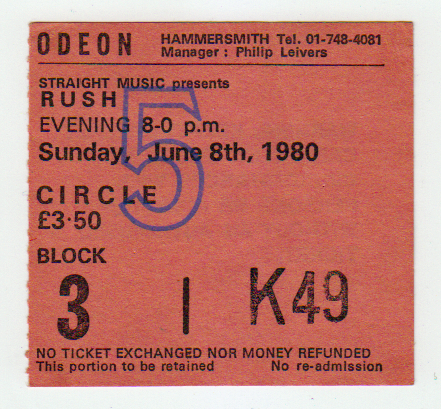
Thank you, Alex, Geddy & Neil.
It’s been an immense pleasure and privilege to have you in my life for the last 35 of your 40 glorious years as rock’s greatest trio. On behalf of all Rush fans, let me wish you well and say that we are looking forward to more road life memories in 2015!
 I am on Holiday. Having endured the drizzling rain and wind for the past month in the North of England, I am sitting in the sunshine of Lanzarote nursing a small beer and listening to some new albums. Usually when on holiday, I load up the I Pod with 1500 tracks, press shuffle and let it do its thing. A sort of radio station full of prog ( but with no DJ’s ) and not knowing what’s coming on next.
But this time it’s different. I am listening to full albums in their entirety. And not just once. Many times over. Serious listening. All in the Progarchy cause. In the sun. It’s a tough job but someone has to do it.
The first album up is IQ The Road of Bones. I listened to it on the Plane coming over. Noise cancelling headphones of course. Further listening’s over the last couple of days in aforementioned sunny pool area. Do your surroundings when you first hear an album have a direct influence on how you feel about it? Every time I hear Dark Side Of The Moon I can picture my small bedroom, where the posters were on the wall and the small portable record player I had to play my albums on. Now, every time I hear the new IQ album, I will think of this holiday. Why???
Because it is stunning.
Russell Clarke has already posted a fantastic review of this album and has gone into all the tracks in detail. I just want to add my little two penneth to certain tracks and my feel about the whole album.
I liked Frequency. Didn’t blow me away but I liked it. This album blew me away from the start and just kept on blowing. Russell is right. Don’t mess around with the single album. Get the double. One of the best “bonus discs” ever. It could stand alone as an IQ album. My guess is that these songs didn’t fit in with the Road of Bones concept and so found themselves on a separate disc. The fist two tracks are prog at its very best. Knuclehead starts like its going to be a track on a Peter Gabriel album then gets heavier and heavier.
1312 overture is very clever. It starts with the end of the 1812 overture by Tchaikovsky, then goes into a tight prog rhythm. Do you like to count beats to songs. I can spend many a happy minute counting along to Apocalypse in 9/8. This one had me confused for a while until I looked at the title. 1312 overture. Why 1312. Start counting. One bar of 13 beats followed by another of 12 beats. Very clever.
The Road of Bones album has to be a contender for 2014 top 5. Peters vocals are controlled and sound more mature. He is sweet when he needs to be and downright ugly when the song calls for it. On this album IQ get very angry indeed. Throughout, the synths lay down a template for the bass and guitars to layer on top. There never seems to be a dominant instrument but there are some fine moments of soloing. Everyone will have a different favourite track but I think mine is the title track.
IQ have a fantastic album on their hands. Lets hope it gets the sales it deserves.
Now where did I put that sun cream?
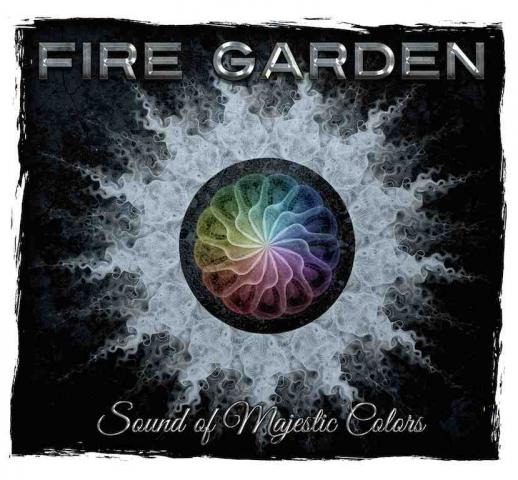 Great news from the Chicago proggers, Fire Garden.
We are pleased to announce the details of our first full length studio album ‘Sound of Majestic Colors’ . The album will be released on May 20.
The album will be available on CD with a 24 page booklet containing song artworks and lyrics as well as on all digital stores such as iTunes, Amazon and Google. Pre-orders will be starting soon on Fire Garden website so stay tuned.
‘Sound of Majestic Colors’ is produced by Zee, Mixed by Jared Kvitka (Kevin Shirley, Dream Theater, Iron Maiden, Joe Bonamassa), Mastered by Andy VanDette (Dream Theater, Rush, Porcupine Tree, Steven Wilson).
I wanted to make a versatile progressive record that could bring all our influences together. The record contains something for everyone from epic prog moments to soulful ballads to skull crushing riffs – Zee
The track listing for ‘Sound of Majestic Colors’ is as follows:
The Joker
Alone
Time Machine
Endless Memories
Redemption
Behind the Face
Forsaken
Echoes in Silence
Far from Grace
The Last Step
– See more at: http://firegardenmusic.com/news/fire-garden-sound-of-majestic-colors#sthash.NyuXjp5a.dpuf
 Progarchy