Big Big Train has made the pre-order of Ingenious Devices available at Bandcamp.
Head on over there to support them, ideally on the next Bandcamp Friday (May 5), so they can obtain maximum cash flow.
The band explains the upcoming touring situation in their Bandcamp pre-order note:
PLEASE NOTE: Ingenious Devices will be released on 30th June 2023 (NOT on 9th June). We have setup this pre-order earlier than usual to generate some income to help us with touring costs later this year. We will be on tour in August and September but many of our touring costs will fall in the next four months and we will not receive income from the tour until the autumn.
Ingenious Devices consists of new versions of East Coast Racer, Brooklands and Voyager, which prominently feature an elite 17-piece string section recorded at Abbey Road Studios in London.
With the exception of the late David Longdon’s lead vocals, which have been compiled from the original album sessions, East Coast Racer is a completely new studio version recorded by the line-up of the band as it was in 2019. Brooklands features newly recorded drums, bass and bass pedals, while Voyager includes additional guitar and violin. All three songs have been re-mixed for this release and all the audio is presented at 24/96.
Ingenious Devices also includes a previously unreleased orchestral piece called The Book of Ingenious Devices, which links East Coast Racer and Brooklands.
BBT’s Gregory Spawton explains: “I was always happy with the original recorded version of East Coast Racer, but re-arranging the song to feature a full string section gave ECR a further lift. The new recording also features Dave Gregory’s guitar solo on the closing section, a solo which has only previously featured on live performances of the song. I am pleased we now have the definitive studio version on Ingenious Devices. The timing of this release also deliberately ties in with the 85th anniversary of the Mallard’s speed record which inspired the lyric.
“By contrast, I was never entirely satisfied with Brooklands and felt it got a bit overlooked on the Folklore album. The Abbey Road strings have significantly enhanced the song and I’m delighted with the outcome. The additional track, The Book Of Ingenious Devices was composed to act as a segue between East Coast Racer and Brooklands and I like the way the tracks now flow into each other. The changes to Voyager are more subtle but still elevate the song beyond the version on our Grand Tour album.”
Ingenious Devices also features a live performance of Atlantic Cable, recorded at Friars, Aylesbury in September 2022.
New BBT vocalist Alberto Bravin comments: “Atlantic Cable was recorded at our second show of the tour last year. It’s not an easy song to play at all and we were both amazed and relieved that we pulled it off so well. I experienced a real baptism of fire playing that show in front of over 1,000 passionate BBT fans, but their response to the song and the rest of our live set that night was truly motivating.”
Nick D’Virgilio says: “Ingenious Devices is a great way of uniting four of Big Big Train’s epic songs about technology. The album also celebrates the wonderful vocals of our late, great friend David Longdon on East Coast Racer, Brooklands and Voyager and looks forward to the future with Alberto putting in such a great performance on Atlantic Cable.”
The title alone may have made you unsure if this is the kind of music for you or weary of any music put out by these apparent galvanic fruits. However, I’m here to tell you that The Electric Prunes have some incredibly notable psychedelic rock opera songs that will quite literally bring you closer to the Heavens. The Electric Prunes are better known for their consistent and classic ’60s rock ‘n’ roll sound; “I Had Too Much To Dream Last Night” is a great example of this through the band’s garage punk vibe. “Onie” is another certified ’60s classic from the group, and a personal favorite of mine because of its iconic, delicate, and melancholic sound.
However, through the name of The Electric Prunes, composer David Axelrod created some of the most unique, spiritual, and coolest psychedelic rock. The songs I’ll be covering are from an EP and album that were sort of unnecessary, but intentional additions to the discography of The Electric Prunes. Personally, I think they are fascinating creations by Axelrod and worthy of praise by fans of psych. The following songs consist of delectable and extraordinary blends of R&B, rock, psychedelica, Gregorian music, soul, and jazz. So, get ready for a spiritual awakening of sorts.
Mass in F Minor was the EP that started this short, but very interesting phase for the band. It consists of six tracks which are entirely sung in Latin, and is almost thirty minutes of a psychedelic mass. What you’ll notice throughout the songs is the authenticity of Gregorian chant and its use of what is known as “stepwise motion”. Stepwise motion is when each note in a melody moves up or down a single note. It creates this singular and uniform sound, making this EP a respectable piece to this medieval craft. In addition, drummer Michael Weakly stabilizes a jazzy feel by holding all of the other musicians’ instrumental parts together. Interestingly enough, this release was sort of the start of the decline of The Electric Prunes due to their inability to keep up with their producer David Hassinger’s demands for the EP. The band played on every track, however, session musicians were brought in and, in a sense, took over the project. As unfortunate as this was for the band members, some great music was created. David Axelrod is really the genius behind this concept and why it works so well; he wrote and arranged everything. Axelrod’s style shines brightly throughout, creating such a solid set of confident and holistic tracks. Stripping it down to the basics: the blend of the vocals, electric guitar, drums, bass, and organ form this cadence that really itches the part of my brain that adores the aesthetics of the past.
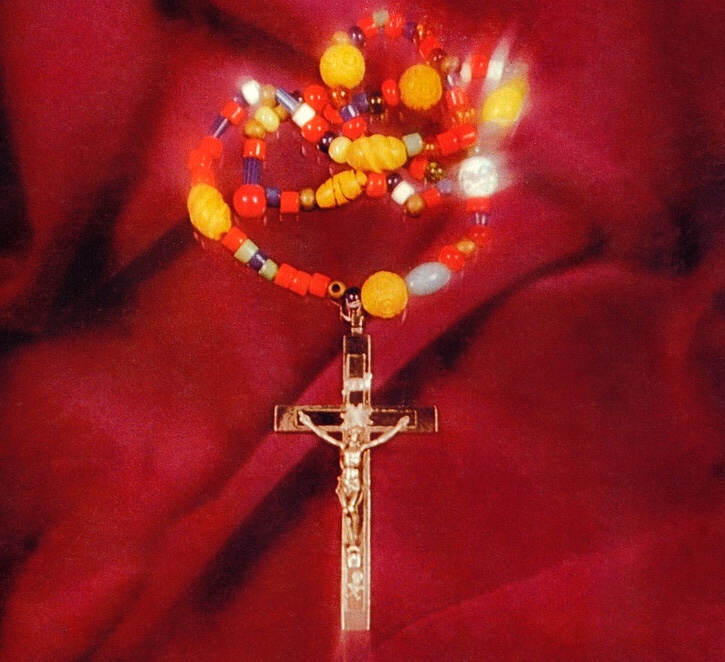
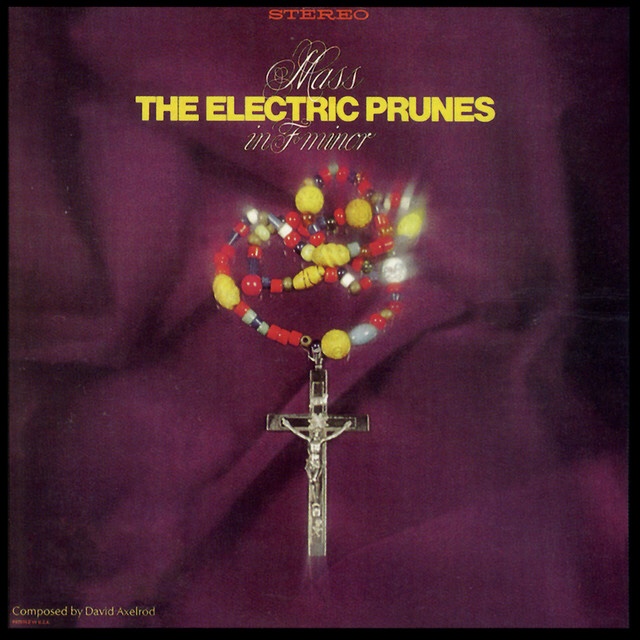
Cover art for Mass in F minor EP
The opening track: “Kyrie Eleison”, better known from cult classic film Easy Rider, is sung boldly and outspokenly by lead singer James Lowe. I think Lowe did a great job on all the tracks—he really added so much mystique and graveness. There’s a point in the song when Lowe’s vocals are isolated. You really get immersed in it all because he truly sounds like a man of religious order, strongly citing a sacred chant for a congregation to hear. This song, along with the others, have a signature ’60s rock sound mixed with music that goes back hundreds of years. Without his superb vocals, I would not be transported to a daydream of ancient ceremony and royal garbs. The simple guitar riff and drum combo as soon as the song starts is cool and collected. The guitar reverb is essential in creating that dreamy, psychedelic effect. Every time I hear it, I can’t help but sway. Another cool thing in the song is this brief guitar rendition of the song “My Favorite Things.” Guitarist Ken Williams plays this demented version of it for just a few seconds towards the end of the song.
The song “Credo” is my favorite example of the use of stepwise motion. The song starts off pretty regular and then it jumps to this faster pace cadence with Lowe’s vocals leading a fleet of instruments. It is only a small portion of the song, but it is so catchy. Lowe is surfing off that singular melody with a massive wave of instruments behind him. The rest of the song is pure instrumental rock ‘n’ roll with subtle trickles of allure.
My personal favorite song is the last one off the EP titled “Agnus Dei”. This song starts and ends with so much confidence. I can see David Axelrod’s vision so clearly with how he arranged and directed this piece. This song does not quiver or feel unsure of itself, but instead almost stands on its own as this beautifully written piece. The fusion of stringed instruments and electric guitar blend with grand conviction. In the beginning, Lowe sings the title of the song and after a momentary pause the stringed instruments emerge gracefully. Then, the rock ‘n’ roll begins: Weakly starts things off with a simple groove, and then, the iconic, echoing reverb of the electric guitar takes over. The unification of the orchestra and rock is one of my favorite parts of the song. I can’t help but get lost in the music. Midway through is this instrumental tunnel the musicians take you into. It’s Williams’ guitar and the strings surfing through this cosmic echo chamber that I never want to leave. Ultimately, this song is solid throughout and unwavering.
Listen to “Agnus Dei”—my favorite song from this EP
Not too long after Mass in F minor, their next album, Release of an Oath was released. It is the same concept as its predecessor with its religious undertones intertwined with rock and jazz fusions. This album is centered more around R&B type tunes and is sung entirely in English. At this point, the original Electric Prunes had disbanded. The musicians playing on this album are an entirely new set of people. It was kind of sad to learn that this was not the original band nor was it done in the true spirit of The Electric Prunes, however, some truly unique music was born in the process; there is no doubt about that. Just like the previous release, Axelrod created a solid set of songs that matched one another very nicely. The instrumentals are an easy listen for all fans of psych, so it’s a no brainer to check this album out. My favorite parts of this album are the drums and keyboard.
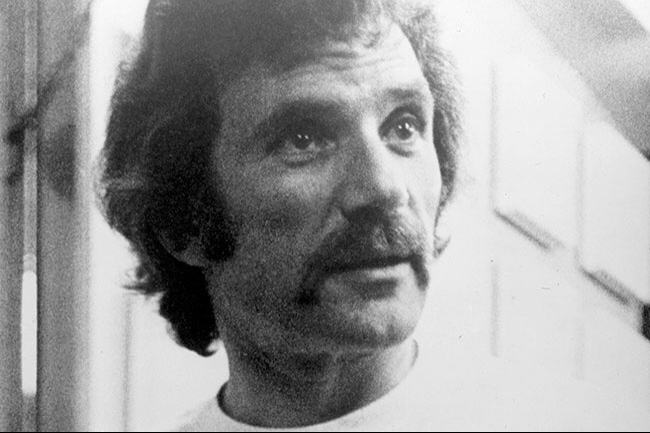
David Axelrod, the man behind Mass in F minor and Release of an Oath
“Holy Are You” is the most recognized song from the album, and rightfully so, because this song is absolutely timeless. The beginning, middle, and end take you on this beautifully mastered journey. Within the first minute of the song we go from a simple keyboard and vocal combo to a groovy R&B beat. The percussion in this track is incredible. It is no wonder this song has been sampled many times by Rap and Hip-Hop artists. (Sidenote, “Respect Mine” by Fat Joe is a perfect example of a great song that sampled “Holy Are You”). Drummers, Earl Palmer, Gary Coleman, and Richard Whetstone elevate the song entirely and are the reason the song is such a contemporary tour de force, in my opinion. With every groove and fill carrying the song to mastery, I can’t help but dance and sing along every time I hear it. A part I really love from the song is when you can hear the percussion, flute, bass, and keyboard create this enchanting jam. The keyboard adds this delightful twinkling sound to the mix that just whisks the listener away into an instrumental dream. And, of course, the insanely awesome guitar solo is another notable feat. Every note and every instrument in this song feels absolutely necessary and purposeful. I can not stress this enough: the unity of the orchestra, R&B, and electric guitar are perfect. This song is simply fantastic and is truly an example of Axelrod’s best.
Listen to this legendary R&B song “Holy Are You” by The Electric Prunes
The other song I want to briefly cover from this album is “Closing Hymn”. As you can tell from the title of the song, it is the final one on the album. I really enjoy the repetition in this track and the tune overall. Again, you have this killer drum beat that holds everything together and makes you want to dance along. Despite being such a simple note change from up to down and vice versa, keyboard Don Randi performs a wistful lulling effect through this. The dreamlike sound of the notes brushes you softly like the touch of flower petals and the subtle reverberation in the ending of the notes are a hollow, ethereal echo. It is such a pretty song and a great close to the album.
I learned a lot while writing this review, but I’m most excited about hearing more of David Axelrod’s works. I listened to a few of his solo works and I have to say I think I found another style of music that deeply resonates with me. He does such a great job blending genres together like I’ve never heard before. Even though this psychedelic gospel wasn’t what the original Electric Prunes had in mind, some truly special melodies were made in the process. David Axelrod did good in the name of The Electric Prunes. Thank you to all the musicians involved in these pieces and thank you for reading.
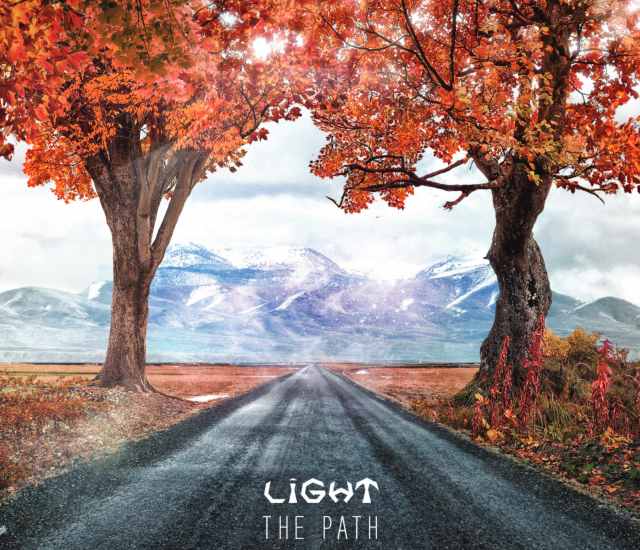
Light, The Path, January 8, 2023 Tracks: Seekness (14:15), Cornua (1:31), The Sweet Release Of Death (5:04), Blue Sun (8:38), Tibia (1:19), Betray (3:13), Newts (6:44), Electris (1:40), The Sublimation Of An Oak (4:13), Tympana (1:23), Dive (13:57), Chalemia (1:47), Mesmerize (3:12), Burning Birds (7:12), Lux Æterna (3:24)
Light is the brainchild of Toulouse, France, based artist Camille De Carvalho, who wrote The Path together with Auriann Rossard, Loup Vaillant, and Paul-Henry Touzac. Carvalho plays an astounding number of instruments on the record, from keyboards to clarinet to duduk and everything in between. She’s joined by a talented cast of other musicians providing additional orchestral work as well as guitar, bass, drums, and vocals. The record is a unique blend of prog, jazz, and classical, leaning most heavily on the symphonic with a distinctly modern flair.
“Blue Sun” perhaps best exemplifies what Light does best. The symphonic overtones dominate, but the overall sound gradually builds adding in the rock elements as it crescendos in a King Crimson-esque wall of controlled chaos. The vocals come in after the midway point, adding further depth to the sound. As the record moves along, the vocals increase, typically in a more classical form than the lead vocals to which rock listeners might be accustomed.
The album’s mix is very lush, with the varied instruments all sounding clear in the mix. There’s a lot of depth to the overall sound as well, making it a very immersive experience.
The Path is an album that will stretch the typical prog fan’s ears, but there is much to enjoy in this album.
Progarchy got the chance to interview Light mastermind Camille about her recent release and what it took to make this project a reality.
You released an album in January 2023 entitled “The Path” How do you feel about the release?
I’m very excited ! I’ve been working on this for 14 years, almost half of my life !
I’ve spent so much time and money in it, it’s really strange to see it done. I thought (and many of my friends too) that I’d never finish it, that I’d always find something to change, to add, to tweak… Having now the CD in my hands feels unreal.
How much of a challenge was it to work on the album?
It was the most challenging thing I’ve ever done. Basically, I wanted to write for orchestra, but I had no orchestra and the ones I contacted were not interested.
I had to learn to play around 100 instruments, spend all my evenings playing, writing, practicing or reading books about how to write for all of these instruments.
And then when I met the first persons interested by the project, I had to manage the recordings, the rehearsals, the writing of the lyrics, the communication…
It was really a lot, but I stayed determined.
Speaking of challenges, did you set any in the early phase of what has become the final result?
Yes, at the very beginning, the challenge was to record an album featuring only keyboards (then I heared White Noise 2, hated it, and decided it was a bad idea)
Also, every piece I wrote was challenging : there’s always a point where I tell myself «and what if, instead, I did this ?» and it’s always some horrible over complicated polyrythm, or scale… the piano part of Dive, for example, is really a nightmare to play. I wrote it in 2010, and managed to play it in 2020, after years of working on my fingers independance and stamina
Tell us about the different instrumental aspects that you explore on these new songs.
I tried to mix a lot of genres, mainly prog rock but also jazz, classical and a little bit of metal. But the main way I see my music is that I want to write impossible things.
Apart from the interludes and maybe one or two simple tracks, all are impossible to play live as is : it can be because of the polyrythms (particularly the infamour 107:100:93 in Blue Sun, or the 48:47 in The Sublimation of an Oak), the time signatures (I used some things like 61/32 and 47/16), or the instruments’ balance : as every instrument is recorded separately, I can make the ocarina sound louder than the trombone for example, and it’d be impossible in real life. I wanted to push the complexity as far as I could, but keep “listenable” by anyone. I don’t want my music to be seen as really harcore to listen to, even though I love some pretty hardcore bands. I want people to groove, in a way, when they listen to it. To think it’s strange, but in a good way.
I love math, and used a lot of formulas or concepts to create a starting point for the tracks. I don’t let math do all the work, because I didn’t like the results obtained by the people who tried it; I only use it as a basis and it’s often a challenge to adapt to what it has created, because it doesn’t follow musical logic. I drew explanation for the things I used and put it in the booklet, you can try to decypher it and find how it has helped me.
Also, all the interludes are inspired from plain chant, a singing technique used by monks in medieval times. I love it ! And it’s so rarely used
What is your opinion about the current progressive rock scene?
I must confess I don’t listen to enough new bands, there are so much things to discover in the past I tend to forget the present ! But still, Auriann, the drummer of the band, is constantly searching for new music and dragging me to shows so I know some, like Ni, PoiL, Piniol, Pryapisme, Sungazer, Haken, Myrath… I think prog rock never died and will never die, and now with modern techniques and instruments, we can push the music further than ever. You have to search for them, but there are really good bands currently.
Let us know about your influences—the artists that in a way shaped and continue to shape the your music.
Haha it’s hard to answer without being boring so I’ll limit myself, but I have to categorize :
In classical music, I’m really fan of the beginning of the 20th Century : Ravel is my first love, Holst the reason why I’m not single anymore, and Lili Boulanger my current obsession.
For rock, my 2 main and most obvious inspirations are Magma and Frank Zappa, and I’m a huge fan of Gentle Giant, King Crimson and all the 70’s era.
For jazz, I’d say that Coltrane, John Zorn, Andy Emler and Louis Amrstong shaped my tastes, even if their influence isn’t as prevalent as Zappa’s or Holst’s in this album
What are your top 5 records of all time?
Hard question, I think it is for everyone. I think the best way to answer it is with rare unknown albums, as they’re better to help understanding the tastes of someone. So yes, I could say Relayer by Yes, or Kid A by Radiohead and sure, they’re great, but it’s also obvious that I love them.
Here is my pick :
1 – “Everywhere At The End of Time”, by The Caretaker : my biggest musical shock, an album about dementia ; you can’t stay the same after you’ve listened to this madness
2 – “Trout Mask Replica”, by Captain Beefheart : well known, but I had to. A lesson in what is freedom, and music. Try again if you hate it : you’ll get it (eventually)
3 – “8”, by Supersilent : it’s an improvisation band, without any planning or concertation. First time I listened to this, I was at work : the walls and roof disappeared and I suddenly was in a cold storm, completely lost. My tasks did not progress after that
4 – “Rire, c’est pas sérieux”, by Raoul Petite : I love Zappa but as english is not my main language, I don’t always understand the lyrics. Well if you love Zappa but speak french primarily, there’s Raoul Petite for you
5 – “Circus”, by Circus : this album taught me something very important : to shut up. Sometimes, there are unexpected silences in their music, and it creates a very peculiar atmosphere that can be mimicked by nothing else. I can’t say I used it in my album, at all, but I will probably in the future
Besides the release of “The Path” are there any other plans for the future?
I’ve already started to write the concept of the next album, which will be greatly inspired by the life of Lili Boulanger (and her music).
Also, a music video will be released with the album, and I have a few covers I still have to finish recording, as they were rewards of the Kickstarter campaign. I’m currently working on Shine On You Crazy Diamond, it’s nearly finished ; it’ll contain no guitar, no bass and no drums… you will see!
(A quick note: for new releases, order links are embedded in album titles; online playlists/previews/etc. follow reviews when available. For catalog albums, playlists are linked with titles.)
Once again, I get to second a positive review from Bryan — this time of Fauna, the new release from prog-metallers Haken. Wildly creative, I found this to be the British sextet’s most appealing effort since 2016’s Affinity, stirring in flavors of fusion, postmodern pop, funk, reggae, electronica and even opera alongside one heavy yet tuneful chorus after another. Whether on the short, sharp shocks of “Taurus” and “Lovebite” or the extended journeys of “Sempiternal Beings” and “Elephants Never Forget”, Ross Jennings’ vocals soar, Charlie Griffiths and Richard Henshall’s guitars crunch, Peter Jones’ keys fill what few sonic crevices remain, and rhythm section Conner Green and Raymond Hearne thunder. Play it loud — but look out for multiple, exciting curveballs on every track!
Last month also saw the release of two live albums from veteran bands who’ve made it through the pandemic back to the stage:
Van der Graaf Generator’s The Bath Forum Concert(a CD/DVD/BluRay set) documents the venerable trio’s 2022 return to action; tackling an ambitious setlist that spans their entire career, guitarist/pianist/singer Peter Hammill is as declamatory and vehement as ever, organist Hugh Banton covers the aural spectrum between cathedral and crypt, and drummer Guy Evans locks into or disrupts the grinding soundscapes as the spirit moves him. The beautifully filmed video shows VDGG working hard and watching each other, opting for the flow as they feel it rather than relying on clinical precision; warts and all, this is refreshingly in the moment, a strong show that captures the band’s existential angst and humanistic idealism in full.
Two years after their 2020 Far Eastern tour collapsed around them, King Crimson satellite band Stick Men returned to Japan and blew away any cobwebs that might have accumulated at Osaka’s BB Live venue. The resulting album Umedashowcases avant guitarist Markus Reuter, multi-bassist Tony Levin and percussionist Pat Mastelotto at their aggressive, angular best; whether on long-standing improvisational frameworks “Cusp”, “Schattenhaft” and “Swimming in Tea”, newer compositions “Ringtone”, “Tentacles” and “Danger in the Workplace” or Crimson classics “Red”, “Larks’ Tongues in Aspic Pt. II” or “The Sheltering Sky”, these guys are frighteningly good, whether working up a hair-raising din or backing off for spacey, unexpectedly lush interludes. A great introduction for newbies and a must for fans.
Plus, in February and March the recorded music industry resumed cranking out deluxe box set reissues and compilations — apparently the market of Boomers (like me) with more money than sense isn’t tapped out yet:
I am ashamed to say it has been a full year since I last posted in this series! But I have returned, this time with Hartmut Zinn, a German musician whose debut effort, Heile’s Land, will transport listeners back fifty years to Mike Oldfield’s legendary debut Tubular Bells. Like Oldfield, Zinn released his first album at a very young age (20), played every instrument himself (over a dozen, sans tubular bells), and opted for an entirely instrumental concept album. Although the highlight of the work is the two-part title track (which opens with beautifully layered keys, similar to the aforementioned T. B.), the shorter pieces showcase Zinn’s talents on various acoustic guitars, which he plays with skill and gusto.
This is no cheap imitation of Mike Oldfield, but rather an album that deserves greater attention, especially from aficionados of instrumental symphonic prog.
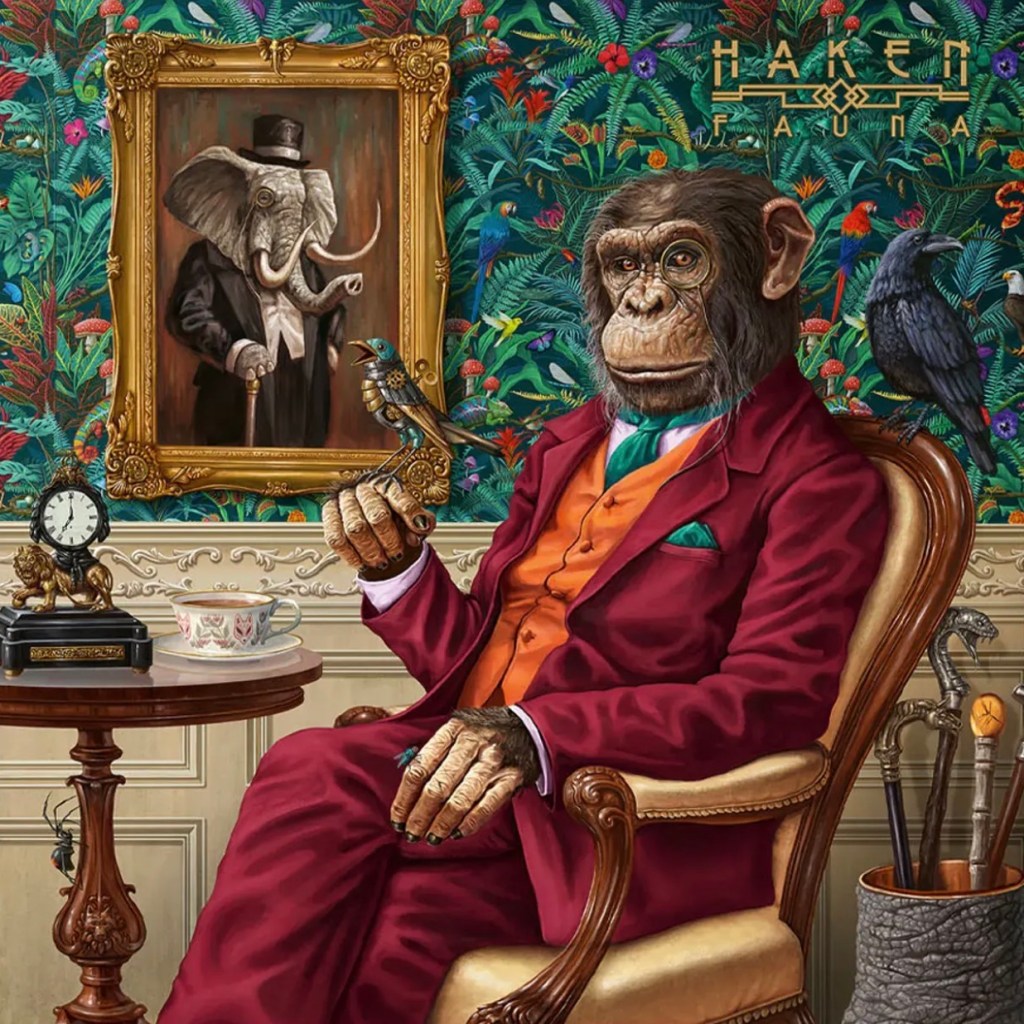
Haken, Fauna, Inside Out Music, 2023 Tracks: Taurus (4:49), Nightingale (7:25), The Alphabet of Me (5:34), Sempiternal Beings (8:24), Beneath the White Rainbow (6:45), Island in the Clouds (5:46), Lovebite (3:50), Elephants Never Forget (11:07), Eyes of Ebony (8:32)
Haken have never been a band to shy away from experimentation, yet no matter what musical pond they dip their toes into, their albums always sounds distinct. There’s no mistaking their music for someone else’s. Maybe it’s the syncopation and the speedy jazz-influenced guitar riffing. Or Ross Jennings’ signature voice. Or the band’s ability to make quiet music remarkably complex while still being able to lay down intensely heavy riffs that hold their own amongst the heaviest prog metal powerhouses of the day. And they can go back and forth between the two seamlessly.
Fauna is in many ways a typical Haken album, then, in the sense that is features the band’s playfulness and willingness to experiment. “The Alphabet of Me” has both rapped lines (before you get mad, even Dream Theater has tried that) and trumpet. “Sempiternal Beings” (sempiternal is a fancy word for eternal) has a masterful balance between the dark and light sides of Haken’s music. “Island in the Clouds” even has cowbell.
The ocean between us is where we find inner peace.
“Sempiternal Beings”
“Beneath the White Rainbow” is magnificently chaotic. The bizarre filter on the vocals make it seem a bit cloudy, and the heaviness of the music give it a djent edge. “Lovebite” has a pop edge with a catchy melody in the chorus, but the chorus remains heavy enough to make it palatable to my prog snob ears. Keyboardist Peter Jones’ (original Haken keyboardist who rejoined the band; not the Tiger Moth Tales PJ) swirling key acrobatics adds a layer of interest here as well, as does the brief guitar solo in the final third. The drum blast beats to open the song are anything but pop.
“Elephants Never Forget” is the prog star of the record and the best song here, in my opinion. This is the kind of song that made me fall in love with Haken a decade ago. It has the playfulness of “The Cockroach King” with the epic grandeur of “Crystallised.” The vocal harmonies return, although they probably could have been used to even greater effect. But they are there. The song’s length gives it space to breathe and move, which is generally what holds my interest in music. And it doesn’t get more prog than singing about the “leviathan of Doggerland.”
I think the album would have been better served by ending on this track rather than “Eyes of Ebony.” It has a sort of swell to it that feels complete. “Eyes of Ebony” is still a great track, especially once it gets rolling, but I don’t think it’s the best choice for an album closer. It kind of just tapers off, leaving the record on a bit of an uncertain note. “Elephants Never Forget” has a satisfying ending.
Truth be told, I’d be perfectly happy if Haken made an entire album of songs like “Elephants Never Forget,” rather than the rabbit trails they often go down into other musical genres. A lot of the electronic, rap, etc. does very little for me, but I appreciate how they are able to fold those elements into their sound without compromising their style of music. I generally prefer the softer elements in Riverside’s and TesseracT’s music over Haken’s softer side, but that may be because both of those bands have a spacier Floydy edge that Haken doesn’t really have. It all comes down to preference. All in all this is another solid record from one of the foremost names in the prog metal scene today. It’s one of the best records released thus far this year, second only to Riverside’s ID.Entity.
Transatlantic’s The Final Flight: Live at L’Olympia is a worthy souvenir of the latest — and last? — tour by our favorite “more never is enough” classic-prog supergroup. Over three hours, Neal Morse, Roine Stolt, Pete Trewavas, Mike Portnoy and sidekick Ted Leonard play every possible note of their ultra-epic The Absolute Universe, plus generous chunks of the band’s first three albums (sorry, Kaleidoscope fans). You might notice some rough edges in Morse’s singing despite a few preemptive downward key shifts, but Transatlantic still delivers the goods without fail — the jaw-dropping ensemble work, knockout solos, choral counterpoint, head-spinning transitions and heart-stopping climaxes just keep coming. And if this is their swan song, thanks for 20+ years of over-the-top thrills and spills are well past due!
Rick Wakeman’s latest album, A Gallery of the Imagination, is less a conceptual effort (like The Six Wives of Henry VIII or even the recent The Red Planet) than an impressionist suite based on a overall musical approach (as on his Piano Portraits releases). As such, Wakeman’s strong suit — spacious melodies decorated with arpeggios aplenty, then rocked up via finger-busting solo work — is here in abundance, with appropriately sturdy backing by The English Rock Ensemble. But be prepared — the line between prog and middle-of-the-road pop is remarkably thin at times, especially when sentimental lyrics like “A Day Spent on the Pier” are declaimed with stagey brio by vocalist Hayley Sanderson. If you can deal with that, there’s plenty to enjoy here.
Simon Collins and Kelly Nordstrom (best known in the prog world for the Sound of Contact album Dimensionaut with Dave Kerzner and Matt Dorsey) veer in a heavier direction with their new project, eMolecule’s The Architect. The initial blasts of electronica-laced prog-metal, amped up with gusto by Nordstrom, slot in beautifully with the dystopian sci-fi narrative, but it takes a while for Collins’ trademark vocal inflections to peek through the robotic audio processing. Ultimately, the light and shade of “Beyond Belief” and “Awaken” (a ballad in the Phil-to-Simon family tradition) and a building sense of Floydian atmospherics provide the contrast needed for eMolecule’s well-executed sound and fury to fully connect.
I stumbled across the British post-rockers Plank via 2014’s excellent Hivemind. After tackling animals and insects as their previous subjects, the trio widen their horizons here, returning after 9 years for their new concept opus The Future of the Sea. This is a stunning set of limpid, gorgeous instrumentals, weaving elements of psychedelia, prog and math-rock into textures of massive breadth and heft (whether the big guns are being held in reserve or out on parade at any given moment). The closing 6-part suite “Breaking Waves” is a full-on, monolithic delight that mounts to a shattering, satisfying climax. Give this one a try!
The ongoing passing of rock legends tends to direct me toward their most recent releases, especially if I’d dismissed them on initial notice. Thus, when David Crosby died in January, I bit the bullet and picked up his Lighthouse Band’s CD/DVD Live at the Capitol Theatre. Ignoring this beauty, released late last year, was a mistake; it’s a thoroughly enjoyable, even moving document of Crosby’s late career renaissance, here shown in collaboration with Snarky Puppy bassist Michael League and singer/songwriters Becca Stevens and Michelle Willis. Yes, the man’s voice is a shadow of its former self here — but so is his legendary ego; this lovely set may be more of a team effort than Crosby, Stills and Nash (& Young) ever was. The jazz-inflected songwriting, the hushed vocal blend, the lovely sense of understatement and space all make this delicate music blossom and take root in the heart. This tour came to West Michigan on Thanksgiving weekend of 2018; hearing this set, I’m sorry I missed the show! Yes, it’s that good.
I wish I could say the same about 18, the collaboration with Johnny Depp that turned out to be guitar legend Jeff Beck’s swan song; even putting aside Depp’s recent notoriety, there’s a mismatch of tone that makes the album a puzzling listen. Though Beck’s rich melodicism is as compelling as ever, his soaring aesthetic keeps bouncing off the consistently lugubrious song selection and morose vocals from Depp. Usually I’d be all over an album that ricochets from Motown and the Everly Brothers to Killing Joke and The Velvet Underground, but the eclectic selection simply refuses to cohere. Some glorious moments (instrumental takes on the Beach Boys’ “Don’t Talk” and “Caroline, No”, the John Lennon cover “Isolation” that closes the album on a solid footing), but Beck’s light and Depp’s dark cancel each other out far too often for the music to take wing.
In the meantime, the past month has seen multiple first-rate releases in the jazz (and jazz-related) world:
From out of left field, Lake Street Dive singer Rachael Price teams with guitarist/songwriter Vilray Blair Bolles for I Love A Love Song! This second duo effort pairs Price’s well-honed jazz and pop sensibilities with whimsical Vilray originals in the Great American Songbook tradition. Well-upholstered arrangements from a finely tuned large combo and a boxy yet lush recorded sound set up the retro feel; but ultimately it’s Price’s subtle, in-the-pocket sense of swing that sells the music, often breezy and melancholy at the same time.
Piano legend Brad Mehldau has never hesitated to incorporate rock songs into the jazz canon; with Your Mother Should Know, he makes a program of Beatles tunes (plus David Bowie’s “Life on Mars” — it originally featured Rick Wakeman on piano!) sound not just obvious, but inevitable in the idiom. Above all, this is fun, albeit often of a serious stripe; from the headlong boogie woogie of “I Saw Her Standing There” through the thickened harmonies of “I Am the Walrus” and hovering balladry of “Here There and Everywhere” to the stretched-out gospel of “Baby’s in Black” and the ecstatic extended solo of “Golden Slumbers”, Mehldau’s instincts for where to take these songs by Lennon, McCartney and Harrison are unerring, his invention refreshing and often astonishing, his technique impeccable. Absolutely worth a listen, whether you’re a Fabs fan or not.
Are improvisational Australian trio The Necks “jazz”? Hard to say; but while their music resists categorization (or even description), their latest release Travelis as attractive a summation of what they do as anything. Four pieces of music, each one made from scratch at the start of a day in the studio, building from a minimal idea that gains momentum, complexity and impact through repetition and variation of ideas, dynamics and sounds. “Signal” rambles, “Forming” smolders, “Imprinting” shimmers and “Bloodstream” flares up for a riveting double-album journey. Is it world-inflected rock? Ambient jazz? Something else? I frankly don’t care; I just know that after an online listen, I had to buy it. (And kudos to Vertigo Music of Grand Rapids for having it in stock!)
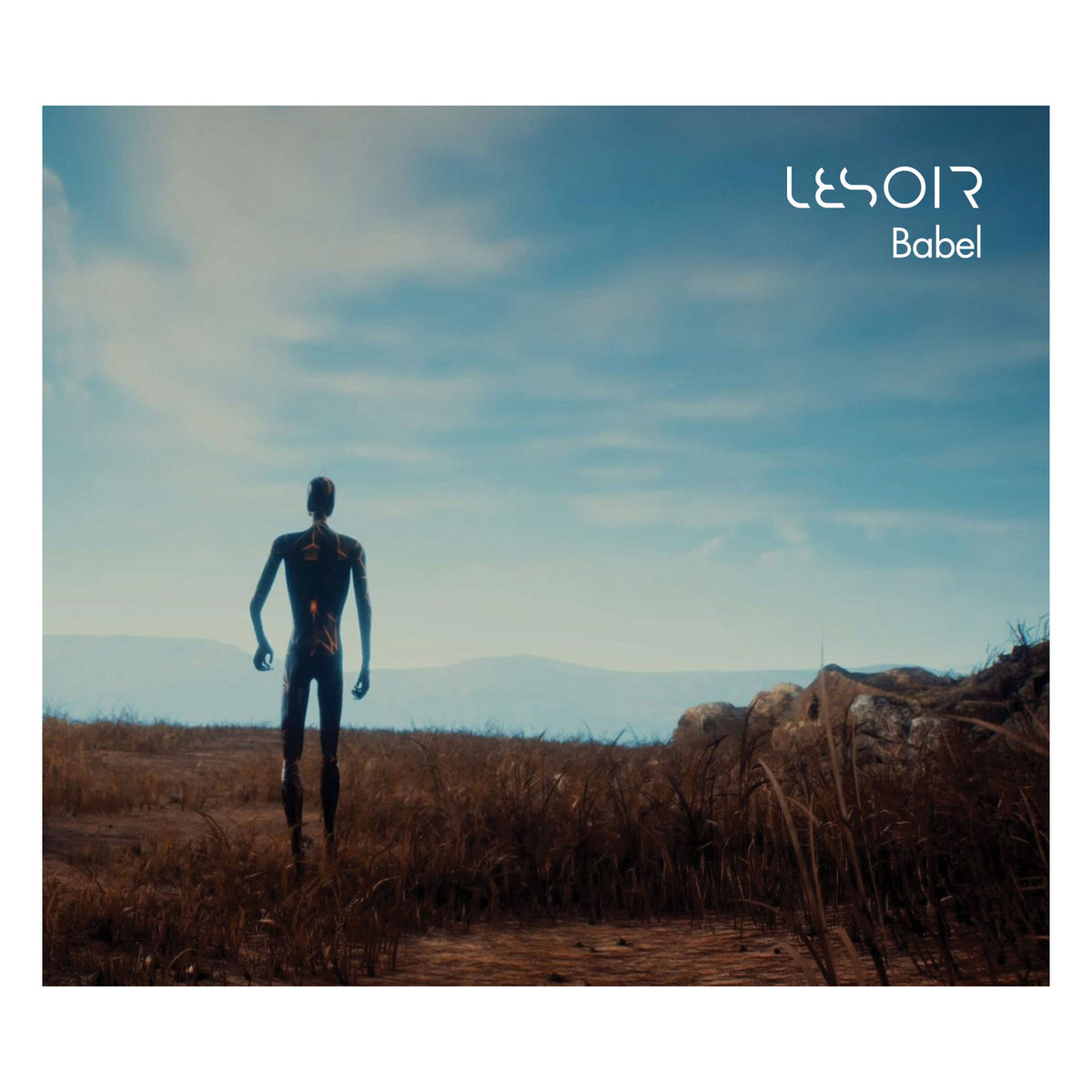
If you like Porcupine Tree, or Pink Floyd, or The Pineapple Thief, or Riverside, or Anathema, or The Gathering, then you’re sure to dig the 20:20 stunning epic “Babel” from Lesoir.
We are big fans of Lenoir’s album from 2020, Mosaic. What a thrill to then hear them take things to the next level, with this beautiful long-form song that clocks in a quad-digit run time.
They’ve done a limited edition pressing of the CD version of this song. If you pay attention to the sensitive and empathetic lyrics, it should come as no surprise that Lesoir has announced that they are donating all proceeds from their Babel CD to the earthquake victims in Turkey and Syria:
ALL PROCEEDS FROM THE SALES OF THIS ALBUM WILL BE DONATED TO THE EARTHQUAKE VICTIMS IN TURKEY AND SYRIA.
When the flood disaster in Limburg (NL) took place in 2021, the band Lesoir decided to donate all proceeds from their one-off Babel live performance to the victims of the disaster. Now with the terrible earthquake in Turkey and Syria, Lesoir wants to do the same.
The band cannot bear to watch how the people in this area have to deal with the terrible suffering. Lesoir therefore wants to donate all income (excluding shipping and transaction costs) from the Babel EP (CD) to Giro555.
Will you help Lesoir collect a nice amount and then donate it?
Of course, the song is 1 whole, but especially for the CD, we have marked the different parts separately, so you can ffwd to your favourite part right away.
Art rock band Lesoir made a virtue of necessity in the quiet but turbulent lockdown period and in 2020 started working on something that would then become an ‘interim project’ for the band. Recorded at various locations in South Limburg, the resulting 20-minute and 20-second epic grew into a full-fledged addition to the band’s already existing repertoire.
Under the name Babel, Lesoir’s creation was released on vinyl, handmade and limited to only 250 pcs in January 2022. Each piece is numbered and on request signed by the band.
By popular demand the band have released Babel as a limited edition CD in January 2023. All proceeds of the album sales since the devastating earthquake will go the victims in Turley and Syria.