Google Play and British rock legends Queen have teamed up to create The Bohemian Rhapsody Experience, a virtual reality experiment powered by groundbreaking immersive audio and interactive technologies that aim to push the boundaries of creative expression and evolve the way we experience entertainment. Soundtracked by a remixed 3D spatialized version of the quartet’s iconic hit “Bohemian Rhapsody” that reacts sonically to the user’s movements, the app gives users the opportunity to travel through an interactive visual narrative developed by VR pioneers Enosis VR along with a team of worldng-class animators and designers.
Through the new medium of VR, contemporary animation techniques, and aesthetics that drawinspiration from the iconography and symbolism of Queen’s music and artwork, The Bohemian Rhapsody Experience offers a journey through frontman Freddie Mercury’s subconscious mind and recreates the sensation of being onstage with the band, with visual and audio elements that respond…
Corvus Stone, Corvus Stone Unscrewed (Melodic Revolution Records, 2015)
Tracks: Brand New Day (3:52), Early Morning Calls (3:52), Joukahainen Without Chips (2:53), Horizon (Remixed) (1:52), Landfill (3:44), After Solstice (Remix) (4:05), Jussi Pussi (Remix) (2:45), Scary Movie Too (special release) (7:38), Petrified in the Cinema Basement (3:10), Lost and Found Revisited (3:29), Cinema Finale (6:02), Pack Up Your Truffles (2:07), Moustaches in Massachusetts (4:18)
Another great album cover by Sonia Mota
Here we are, yet again, with another belated review of a great Corvus Stone album. It seems I’m off by about a year. But no matter, the music is wonderful! From the pounding of the opening bassline to the uniquely Colin Tench guitars, Unscrewed has it all and more. Nobody was really expecting a new Corvus Stone album last year, but that didn’t stop the band from making a good one.
Much like in the first two albums, Unscrewed is hard to nail down to any one genre. It has clear jazz influences, but the guitars definitely have a Floydian touch to them, much like in Tench’s work with Andy John Bradford’s Oceans 5. The keyboards offer a nice proggy vibe from all eras of progressive rock, courtesy of Pasi Koivu. The jazziest part of the music definitely comes from Robert Wolff’s amazing drums. Steady, yet understated, bass throughout, courtesy of Petri Lidström, keeps everything together.
Like earlier Corvus Stone albums, Unscrewed is primarily instrumental, even more so than the first two albums. However, when they do use vocals, they do a great job of breaking up the album. The vocals are often used as an added instrument, rather than the lyrics being the focal point of the song. Take the chanting of the line, “Early morning call” on the second song, “Early Morning Calls.” The singing melts into the music rather than standing apart from it.
As you can see from the tracklist, several of the songs are remixes from earlier songs. This is a nice way a revisiting earlier material while displaying the songs in a new light. “Scary Movie Too” provides a sequel to a song off of the first album, as well as a darker turn to the music. “Pack Up Your Truffles,” a new song, is driven by an almost bluesy guitar line, further demonstrating the wide variety of styles present in Corvus Stone’s music. My one complaint with this song is its length – I could have listened to it for a lot longer than 2 minutes and 7 seconds.
As usual, Sonia Mota did a beautiful job with the artwork. The raven is a recurring theme in the band’s artwork, and I love how the movie posters in front of the theater are all Corvus Stone artwork. There’s a lot going on, and it matches the music perfectly.
Corvus Stone Unscrewed is another great album from the obscure band. Their music is a lot of fun to listen to, and it is generally pretty lighthearted. The band has a lot of fun writing goofy names and lyrics, and their love of music shines through.
An album that was originally released back in 1994, and recorded in the year 1975. The music is made for the movie Le Berceau De Cristal, which was released in 1976. All music is recorded in Studio ROMA, except the title track Le Berceau De Cristal, which was recorded during a live concert at Palais du Festival in Cannes. The CD has a booklet where the complete story of the making of the album is written.
The album was made by two members of Ash Ra Tempel; Manuel Göttsching (who composed most of the music) and Lutz Ulbrich. Ash Ra Tempel can be categorized as pure German Krautrock. The music is instrumental, it’s vivacious but most of the time very lingering. It has its roots in psychedelic and experimental moments. Both Manuel and Lutz play several (acoustic and electric) guitars with effects, and Manuel also plays on a Farfisa Organ and EKO drum/rhythm computer.
This is not an album that you can listen to track by track, you have to see it as a whole. It’s exactly one hour long, which makes it quite a long, but interesting trip. First track Le Berceau De Cristal is also the longest one, and lasts almost fifteen minutes. A slow song that moderately builds up. Some moments sound haunting and spooky halfway through, while the outro is more placid. L’Hiver Doux is the second longest track, and is mostly one big but interesting solo moment of the organ. Later on more sounds start to occur, making it more spacey. Silence Sauvage is filled with a catchy rhythm and space like soundscapes that lingers through the track. Le Souire Volé is quite up tempo because of the firm and steady rhythm loop and organ. Deux Enfants Sous La Lune is just like the previous track quite up tempo and also has a steady rhythm loop, but with a guitar sound that prevails above it. Le Songe D’or is more serene compared to the previous songs and reminds me a bit of the first track. Le Diable Dans La Maison is the shortest track, and also the most inimitable. There are a lot of spacey sounds and things happening. Last song …Et Les Fantômes Rêvent Aussi carries a nice atmosphere. It’s a more calmer track and there isn’t too much happening. It gives you a certain mellow feeling.
This is something you would listen to on the background, and still it sucks you into the swirling psychedelic world. I haven’t seen the movie where this music is made for, but I think that the music has been very important for this movie. If you don’t like krautrock and psychedelic music with tedious moments, then this is something you probably avoid, but I do recommend to listen to this album at least once. It also feels very “time bound”, but I’m a big fan of a lot of (experimental and psychedelic) music that was made back in the seventies.
I wish I had a review ready, but I just received the book today! So, sadly, no review yet. Just a notice. This, however, is the conclusion to Anderson’s brilliant, Saga of Shadows trilogy.
For those of you who don’t know, Anderson is not only one of Neil Peart’s closest friends, but he’s also the co-author of Clockwork Angels and Clockwork Lives with Peart. Much to celebrate in the prog world.
What else to write about Kevin? I mentioned he’s brilliant, but did I mention he also writes lyrics for Roswell Six, is a great guy, has an equally great wife, and has been nominated for the Hugo?
“Power of Prog was originally formed in 2009 as a Prog Social Network by Melodic Revolution Records. Moving forward in 2016, Power of Prog is now “A Website For The Prog Minded,” featuring Music News, Reviews, Interviews, and more.
We realize that times are changing as Social Media continues to evolve, however our goals have never wavered. Power of Prog’s main goal has always been to promote all forms of Prog and its Sub-genres.
We hope you enjoy the new site, and thank you for supporting the Power Of Prog music community.”
– Nick Katona
Yes, I know… Another review of an old Porcupine Tree album, but I just couldn’t resist! Released back in the year 1999, the album that came out three years later after my favourite album Signify.
As someone who loves fantasy, sci-fi, and horror fiction, I was pretty thrilled to discover a new (new to me, that is) author this week, Joe Hill.
I started his novel, THE FIREMAN, on Friday, and I was rather excited to find that one of the characters had been the bassist in a prog-metal band, Unbreakable.
Granted, it’s one reference thus far, but outside of the work of Kevin J. Anderson and Ernest Cline, I can think of almost no author who embraces prog at any level.
So, a huge thank you to Mr. Hill. And, by the way, he’s an excellent story teller.
Maurice Ravel’s Boléro has a long, complex relationship with rock and roll, sometimes quoted explicitly (Jeff Beck’s “Beck’s Bolero”) other times through suggestion (Rush’s “Jacob’s Ladder”). In its thematic and rhythmic repetition and building orchestration there is a tension and release, an erotic energy inseparable from rock’s spark. This has often been perceived as a weakness of the work, even signaling cultural dissolution, to its detractors.* Ravel himself had misgivings about the piece, and almost immediately following its first performance equivocated on what exactly he had created.
I am particularly desirous that there should be no misunderstanding about this work. It constitutes an experiment in a very special and limited direction, and should not be suspected of aiming at achieving anything different from, or anything more than, it actually does achieve… The themes are altogether impersonal – folk-tunes of the usual Spanish-Arabian kind, and (whatever may have been said to the contrary) the orchestral writing is simple and straightforward throughout, without the slightest attempt at virtuosity… It is perhaps because of these peculiarities that no single composer likes the Boléro – and from their point of view they are quite right. I have carried out exactly what I intended, and it is for the listeners to take it or leave it. — Maurice Ravel, London Daily Telegraph, July 1931.
This is a primordial punk/art statement, the “take it or leave it” a rejection of the academy, rock and roll’s essence, defying established thought but not without some churning within. It takes some mastery of a form to be able to do this, and so the statement is no easy out for the composer. His qualifications are not rationalizations or apologies, but a struggle with what he’s wrought. Boléro is a masterpiece, and like many orchestral works it is a shapeshifter. It tends towards 10 minutes in length or 19 — although Ravel preferred it to be in the 15- to 16-minute range. It is an arabesque, a sketch of Spain, a jazz age jewel, a childhood memory, a factory rhythm, an experiment, a riff monster, an impulse, an excercise, a piece of wizardly power. It is very occasionally, as it was originally, the score to a ballet. It is in its essence enigmatic. Even the better recorded version, and there are many out there, is a topic of fierce debate among aficionados. Many prefer Charles Munch’s RCA Living Stereo version from the 1950s, but at 13 minutes it quick-times the proceedings, undoubtedly for the consideration of the LP and perhaps influenced by the Toscanini performance that popularized the work in America, at a tempo that set the composer and conductor at odds. If it’s true, the story is great:
Ravel: That’s not my tempo.
Toscanini: When I play it at your tempo, it is not effective.
Ravel: Then do not play it.
Many longer versions are out there, however, and it’s probably hard to find one, fast or slow, that isn’t at least a little great, as it is apparently quite difficult not to knock this one out of the park if the conductor can keep the pace steady. For the sake of authenticity here is presented the 1930 version conducted by Ravel himself, or perhaps by Albert Wolff with Ravel present (this too is a topic of some debate) and approving. The provenance is sketchy, lost in the murk and mire of Ravel’s looming madness, the carelessness of record companies, and the vagaries of YouTube; however, this performance is most likely from 1930 with the Orchestre De L’Association Des Concerts Lamoureux.
* Allan Bloom famously called it the only classical piece of music young people liked, as puzzling “proof” — for who knows what that survey must have looked like — that everything was going to hell in the 1980s.
** Above painting of dancer/actress Ida Rubinstein, who commissioned Ravel to write the piece, by Valentin Serov (Wikipedia).


 Google Play and British rock legends Queen have teamed up to create The Bohemian Rhapsody Experience, a virtual reality experiment powered by groundbreaking immersive audio and interactive technologies that aim to push the boundaries of creative expression and evolve the way we experience entertainment. Soundtracked by a remixed 3D spatialized version of the quartet’s iconic hit “Bohemian Rhapsody” that reacts sonically to the user’s movements, the app gives users the opportunity to travel through an interactive visual narrative developed by VR pioneers Enosis VR along with a team of worldng-class animators and designers.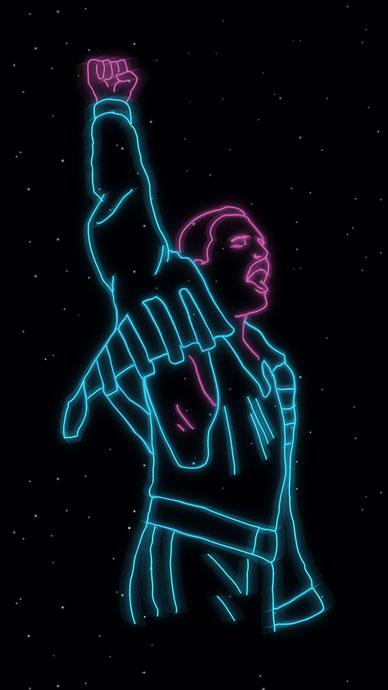




 Maurice Ravel’s Boléro has a long, complex relationship with rock and roll, sometimes quoted explicitly (Jeff Beck’s “Beck’s Bolero”) other times through suggestion (
