
You’re not ready to step into the Court of the Crimson King, but let’s go back to the egg for some Sunday evening inspiration:
And remember, no air-drumming this time “Bruford can change the timing up so fast it could snap your wrists.”

You’re not ready to step into the Court of the Crimson King, but let’s go back to the egg for some Sunday evening inspiration:
And remember, no air-drumming this time “Bruford can change the timing up so fast it could snap your wrists.”
So far, 2015 has been absolutely huge in terms of the sheer amount of great music that has been released. In fact, the first six months have been ridiculously strong. As such, it is very difficult to bring you my half-way round-up in the normal way – there’s just too much to fit in. And also, I have reviewed a fair number of the albums as well, so I didn’t want to repeat myself too much.
Therefore, I thought I’d celebrate by creating a more punchy couple of posts that offer a whistle-stop overview of my favourite music released between January and June 2015. In no particular order, here goes:
Audioplastik – ‘In The Head Of A Maniac’
Bad Elephant Music
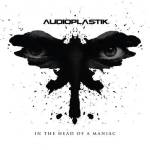 From the minds of members of Frost*, Threshold and Darkwater, this was never going to be anything other than brilliant and so it has proved. ‘In The Head Of…
View original post 643 more words
Welcome to part 2 of my round-up of the very best music that was released during the first six months of 2015.
If you missed it, you can find Part 1 right here:
Half-Way Through 2015 – The Best So Far – Part 1
As I mentioned before, this year has seen some extraordinarily strong albums hit the shelves and so it has been extremely difficult to truncate my list of artists that deserve a place in this round-up. To be honest, if the year stopped here, I’d still have difficulty picking a full-year Top 20 because of the quality on offer. But that’s a headache to be faced at a later date. In the meantime, here’s the next batch of albums that have made a big impression on me so far in 2015:
Lonely Robot ‘Please Come Home’
InsideOut Music
 It is a fairly accurate statement to say that…
View original post 758 more words
Lael has travelled and met up with the Travel Fan Team for several shows. This year she headed off to the Wild Horse Pass Resort and Casino with SnapHappy Pam, another long time travel fan, for the Arizona stop on the tour. Here’s here experience…
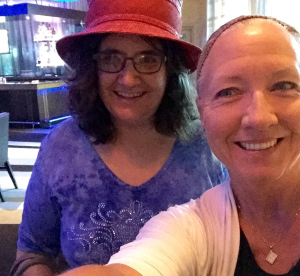 Lael and Pam… long time travel fans… 🙂
I connected up with SnapHappy Pam, who takes great pictures and videos of bands, for the TFF show in Chandler, Arizona. She was gracious enough to pick me up at Sky Harbor International Airport. I was highly concerned about the heat that day, as it was expected to get up to 115 degrees Fahrenheit!!
Pam and I also had our work cut out for us, as we needed to find a birthday card for Curt Smith, and gifts for both Curt and Roland Orzabal. We found some nice gifts at the Arizona Mills Shopping Center, but we…
View original post 1,442 more words

For such a uniquely talented vocalist and musician, Tim Bowness doesn’t need to fill the frame. As his band Henry Fool hinted on 2013’s excellent and slyly-titled Men Singing (https://progarchy.com/2013/08/12/men-singing-by-henry-fool/), what a voice is and what it has to say is as elastic as what we’re willing to hear. His long partnership with Steven Wilson in no-man likewise produces soundscapes that find a wholeness in laying back and cherry-picking essentials. Getting to the heart of what matters and why is a recurring theme in Bowness’s work, and It is fitting that Bowness’s new album begins with a song titled “Electric Teenage Dream,” the video for which sets images of jurassic 1950s technology against words echoing our slippery grasp on the electronic toys that so demand our attention.
Stupid Things That Mean The World is rich with rejoinders to a world running over with unfiltered shadowplay. Teasing out the meaningful from the stupid things (sometimes finding they might be one and the same), trying to jump start a false life on found truths, to, as one song says, “press reset,” is a central struggle, and Bowness’s emotive, low-key delivery makes the struggle immediate, engaging, and deeply moving.
With a voice embedded in British folk and art rock but defining a space entirely his own, Bowness sings towards a quiet grandeur. And yet while that stately-paced slow burn colors much of the record with the torch-driven songcraft common to his work (thinking particularly of no-man’s Returning Jesus), the album ignites under the heat Bowness brings to “Stupid Things That Mean The World,” “The Great Electric Teenage Dream,” and “Press Reset,” their detailed observations accompanied by taut arrangements moving from the apocalyptic to the pop. The moods he summons join together seamlessly, so this is indeed an album rather than a collection of songs, a conjuring of Johnny Hartman entwined with Nick Drake and Radiohead and autumn leaves falling. Jarrod Gosling’s artwork nails the vibe, with its feel of a classic EG Records album cover mirroring the hidden edges and complexities of the music within, and the credits are a who’s who of cross-generational art rock, including Bruce Soord, Peter Hammill, Phil Manzanera, Pat Mastelotto, Colin Edwin, Anna Phoebe, David Rhodes, Rhys Marsh, and members of the no-man live band (Stephen Bennett, Michael Bearpark and Sanguine Hum’s Andrew Booker), with Andrew Keeling providing string arrangements. It makes for a complete and satisfying experience, and again shows the kind of standard we’ve come to expect from the music Bowness creates.
Progarchy sat down with Tim via email to talk about the new album, his music and career, and what’s next for him.
The production on Stupid Things That Mean The World is immediate, it feels live, and you are upfront in the mix. What sort of decisions did you make to have this record sound the way it does?
I’d have offered opinions about mix/instrument levels, treatments and so on. Pretty much as I usually do on any project, except on my solo works no-one argues with me and I get rejected less! 🙂
I have ideas about sounds and approaches to music and inevitably I pursue those (for better or worse). I quite like live and direct approaches to drum, strings and vocal production in particular, and I also like allowing quieter elements to dominate busy arrangements.
Tell us about the title of the record, and what brought you to the themes you explore, particularly in “Electric Teenage Dream,” “Press Reset,” and the title track?
The title song is about a relationship, but not necessarily a romantic one. It could be about a collapsed close friendship, or life in a band or a business with a sort of kindred spirit.
The title concerns the small and seemingly trivial things that make us who we are or help us through our lives. It could be an old toy, art/music, shared intimate language, a belief system, an annual holiday, the image or idea of someone you loved in your youth etc etc. I was also thinking of something like the significance of the seemingly insignificant Rosebud in Citizen Kane.
Press Reset and At The End Of The Holiday are my two favourite lyrics on the album and have more of a short story quality about them. The first is a depiction of someone desperate to escape the pressures of their life, while the second is about a temporary escape from domestic difficulties. Press Reset’s theme is something that has interested me for a long time – people consciously disappearing from their own lives and families – and something that in retrospect I realised had happened in my own family.
The lyric to The Great Electric Teenage Dream is part of a larger project called Third Monster On The Left, which is about what it’s like for musicians of a certain age to make music at this point in the 21st Century. A few tracks from it appeared on Abandoned Dancehall Dreams and I’m hoping to present it as a complete project at some point in the future.
Know That You Were Loved was the last song written for the album and it’s possibly the most emotional song on the album. To an extent, it deals with death bed reminiscences and has roots in the work I used to do with the elderly at old people’s homes in the 1980s.
Cheery!
3) What’s your favorite song on the new record?
For very different reasons, Know That You Were Loved, Press Reset and The Great Electric Teenage Dream are my favourite songs on the album. Partly because they either achieved or exceeded my ideas of what the songs could be and partly because they were developing all the time due to some really nice contributions from the guest musicians.
4) You’ve said that this record and Abandoned Dancehall Dreams constitute a new chapter for you. Why do you think that is?
Due to my input in terms of writing and production, ADD and Stupid Things feel more like ‘solo’ works than anything else I’ve done.
In both cases, there was a lot less co-writing than on most projects I’m involved with. Also, with both these albums everything had to begin and end with strong input from me. I assembled the collaborators, booked the studios, provided the material, suggested the sonic approach and so on.
While I might contribute a fair amount to no-man, Henry Fool or Bowness/Chilvers, my input is still being filtered through somebody else’s wishes, opinions and organisational ability, so they’re very much collaborations.
5) What’s your approach to arranging on your solo records as opposed to other projects like no-man?
I think my approach to arranging varies from project to project and song to song as arrangements have to work for the benefits of the song or the musicians involved in the recording.
A good example of differences between projects would be the piece Press Reset. If I’d have presented the song to no-man (for example), Steven would have most likely complicated the final section’s chords and not allowed through the more simplistic pummelling coda rhythm. Conversely, Steven may have simplified compositional aspects of Know That You Were Loved while suggesting a more dense arrangement. Basically, if I’d have presented Press Reset to no-man, Peter Chilvers, Henry Fool or Memories Of Machines, the finished result would have been different and in some cases radically different due to the involvement of other people.
6) You have a distinct, instantly recognizable style, and a signature delivery. What/who shaped your development as a singer?
Ultimately, as with the music, what comes out is instinctive and natural. It may sound corny, but my singing’s my emotional response to whatever music I’m singing over really.
When I started out, my singing inspirations would have been the likes of Kevin Godley, Peter Hammill, Peter Gabriel and David Bowie. Later on, I really liked Paddy McAloon, John Martyn, Nick Drake, David Crosby, Mark Eitzel and others, plus female singers such as Joni Mitchell, Billie Holiday, Nina Simone and Kate Bush.
I hope I’ve developed my own voice over time. It’s something I don’t think about much when I’m actually singing, so I’m not sure how much influence from others comes through.
7) How would you describe your writing process?
Anything that works basically.
Songs can come from me writing on acoustic guitar or playing on my synth or programming within GarageBand or Logic. I can either start with a strong sense of something I want to create, or an idea can naturally emerge out of the process of just playing.
Songs like Know That You Were Loved, I Fought Against The South and Everything You’re Not/Everything But You developed out of me playing on the guitar. The likes of Press Reset and Smiler At 52 came out of programming and then making the pieces more organic and loose with instrumental additions. The Warm-Up Man Forever came out of a combination of looping, playing keyboards and programming.
When I co-write, it can be in real time (generally me with a pianist or a live band) or retrospectively working from existing backing tracks.
8) Can you talk a little bit about Jarrod Gosling’s artwork for Stupid Things and Abandoned Dancehall Dreams?
I think Jarrod’s got a really distinctive style and I used him in order to distinguish the look of my work from the look of no-man’s, and also to reinforce the sense that the solo albums represented a new chapter for me.
Artwork is important to me. I started buying music in an era when the imagery of album covers was a significant part of the music experience and I’ve never lost that fascination with attention to detail or the evocative link between sounds and image.
Jarrod’s a lovely guy and very easy to work with. He listens to other people’s ideas without compromising his own singular style.
9) As someone who is not only an artist but also involved in the business of music, what’s your take on the way music is distributed today?
A big and complex issue!
The internet has been a blessing and a curse to musicians. It’s allowed Burning Shed to thrive internationally in a way that would have been difficult before, so the immediacy of access has mostly been a positive thing for the company. I’ve always felt that Burning Shed has pushed forward traditional ideas – elaborate packaging, physical product, conceptually intentional albums – via an innovative, contemporary medium.
On a personal level, I feel extremely lucky that I can still release music I believe in and that there’s still an interest in what I do. Also, the internet has allowed Burning Shed to thrive internationally in a way that would have been difficult before.
10) What are you reading? What’s a current favorite record, and why?
I tend to read several books at the same time, so at the moment I’m reading Chuck Palahniuk’s Haunted, Clive James’s Sentenced To Life, Kent Haruf’s Our Souls At Night and Pete Townshend’s Who I Am. I recently finished Station Eleven by Emily St. John Mandel which I enjoyed, but the best book I’ve read in recent years is E L Doctorow’s Homer & Langley. It’s a brilliantly written chronicle of obsession and retreat from the world.
Musically, I go through phases of listening to back catalogues by artists (currently David Crosby, Stephen Stills, Bill Nelson/Be Bop Deluxe and The Who) and new things. Of late, I’ve liked albums by Sanguine Hum, Keaton Henson and Troyka (a really interesting contemporary UK band who are carrying on the Progressive tradition of 1970s Rock influenced Jazz).
What’s next for you?
Immediately, a new Bowness/Chilvers album. We’ve completed 90% of a follow-up to California, Norfolk and it really feels like a progression from that album. Lyrically it’s more dense and musically it really shows how Peter’s work has evolved since he’s been working with Brian Eno and Karl Hyde. I’m looking forward to hear how it develops.
Tim Bowness, Stupid Things That Mean The World (Burning Shed/Inside Out Music, available July 17, 2015: https://www.burningshed.com/store/timbowness/product/71/6640/).
This, fresh off this morning’s pony. . . .
*****
Hi
Here’s a quick round-up of news ahead of the BBT London shows next month:
* Wassail (the song) has been nominated in the Anthem category of the 2015 Progressive Music Awards. Listeners can vote for their favourites here: http://awards.prog.teamrock.com/
* Wassail (the EP) has been flying high in Amazon’s folk(!) charts for over a month. The CD version of the EP is available at Burning Shed: http://www.burningshed.com/store/progressive/collection/506/ and the download and streaming versions are available from the usual sources.
* Wassail t-shirts are available from The Merch Desk: http://themerchdesk.com/shop/index.php?route=product/product&path=87_115&product_id=504
* An interview with David and Greg appears in the July issue of Prog magazine which is on sale now.
* David performed Spectral Mornings with Magenta at two gigs in June.
* For those coming to the BBT gigs at Kings Place, London, next month, please be aware of the gig timings:
Fri 14th & Sat 15th Aug:
Band on stage: 7.30pm
Finish: 10.25pm
Sun 16th Aug:
Band on stage: 2.00pm
Finish: 5.00pm
* The “Stone & Steel” DVD, featuring “live in the the studio” performances recorded last year at Real World Studios, is due for release in time for Christmas this year.
* After the gigs in August, we will be returning to the studio to finish work on the next album which will be called “Folklore” and is due for release early in 2016.
Best wishes
Andy, Danny, Dave, David, Greg, Nick, Rachel and Rikard
Corvus Stone, Corvus Stone II (Melodic Revolution Records)
Tracks: 1. The Simple Life (2:00), 2. Early Morning Call (3:52), 3. Boots For Hire (8:59), 4. Sneaky Entrance in to Lisa (0:30), 5. Purple Stone (3:22), 6. A Stoned Crow Meets the Rusty Wolff Rat (7:38), 7. Lisa Has a Cigar (0:47), 8. Mr. Cha Cha (4:50), 9. Dark Tower (1:49), 10. Scandinavians in Mexico (5:06), 11. Mystery Man (6:37), 12. Camelus Bactrianus (Tuolla Tuonnempana) (8:42), 13. Uncle Schunkle (4:38), 14. Eternal Universe (3:53), 15. Moaning Lisa (14:08), 16. Campfire (Tulen Luona) (2:17)
On the dawn of the release of Corvus Stone’s upcoming third album, I bring you an overdue review of their last album, “Corvus Stone II.” The band has 4 permanent members, but they are beautifully complemented by a variety of guest artists. The four permanent members:
Colin Tench – guitars
Pasi Koivu – keyboards
Petri Lemmy Lindström – bass
Robert Wolff – drums
Rather than list all of the amazing guests on this album, check out this handy page on Corvus Stone’s website. They add a lot of fantastic talent to the album, and most have collaborated with Colin Tench and other members of Corvus Stone in the past, most notably in Andy John Bradford’s Oceans 5. Oceans 5 was actually how I first heard of Colin Tench and Corvus Stone, and I must say, the people involved with the creation of all of this music have been incredibly friendly, as well as extremely talented. (Check out my review of Oceans 5’s “Return to Mingulay.“) For me, it always makes a difference when I know that the musicians aren’t… well, jerks. It probably shouldn’t make a difference, but I appreciate it when artists are approachable and appreciate their fans. Corvus Stone and their related musicians understand that well.

In an email to Colin from last fall, I told him that I loved Corvus Stone’s combination of prog, jazz, rock, and “whateverthehellallofthismixedtogetheris.” I firmly stand by that description. While mainly instrumental, the 80 minute “Corvus Stone II” covers all that and more. The music is incredibly layered, with exquisite guitar work (very similar to Colin’s guitars with Oceans 5), multi-layered keyboards, driving bass, and guiding drums. The added guest vocalists act as another instrument, with their particular vocals fitting in nicely with the theme of their respective songs. Initially, I didn’t like the gruff vocals on “Boots for Hire,” but after repeated listens, I think it fits quite well with the theme of the song, and the heavy bass matches perfectly with the voice.
Overall, the music has a very bright, uplifting tone, with Colin’s amazing guitars featured front and center. The guitars are clear, undistorted, and arranged beautifully. Fans of guitar driven rock will certainly find Corvus Stone of interest. (I’m not just saying that because I know Colin will be reading this. I honestly think his guitar work is outstanding!) Pasi Koivu’s layered synths compliment the guitars nicely. Sonically, the album flows very well, through all 80 minutes of it. One of my favorite songs from the album is the short “Purple Stone,” which would be perfect to play while cruising down the highway in a convertible (too bad I can’t test that theory, since it has rained here in Chicago basically every day for the past 2 weeks). The song even begins with a car starting and zooming off down the road. The singer reminds me of Damon Fox from Bigelf.
Throughout the album, Corvus Stone demonstrate their collective sense of humor, which can be seen in the cover artwork and is shining through in what I suspect is the sexual innuendo in the names of some of the songs. Interestingly, the lyrics never really seem to go in that direction. Despite what the album cover might imply, the music is safe for the kiddies. The band also gets a bit weird with the song “Camelus Bactrianus (Tuolla Tuonnempana),” which I think is being sung in Hawaiian, but I really have no idea. I’m going to go out on a limb and guess that this song is about Bactrian camels, but again, I have no clue. It is weird, but it is fun. In fact, that would be a good description for the band: weird, but fun.
Although there are several songs with vocals, it is important to remember that Corvus Stone are primarily an instrumental band. Indeed, their strengths lie in their musicianship. At times it sounds like jazz, other times like classic progressive rock, and others a blend of Lord knows what. However, it is always interesting and never boring. I can’t really compare it to anything else, because I’ve never heard anything quite like Corvus Stone. They are an independent bunch, and it is clear that they play music that makes them happy. That happiness is evident in the music.
An interesting facet of Corvus Stone is the integration of Sonia Mota’s artwork. From her work with Oceans 5 to the art I have seen her create with Corvus Stone, she has a talent of developing beautiful pieces that add depth and humor to the music. Without her work, the band would be completely different. The band utilizes her art to the fullest extent, with it also decorating their website.
Corvus Stone’s music cannot really be pigeonholed to any one genre, and I think that is exactly what the band wants. Their musical influences are likely too numerous to number, and yet the listener can still find elements of some of their favorite music throughout “Corvus Stone II.” Plus, at 80 minutes long, Corvus Stone really give the listener a lot for their money. With the release of another album this year, within the next few days/weeks, the band surprised their fans with an unexpected treasure trove of more Corvus Stone sonic adventures.
And so another giant of the genre passes.
I’ve found it difficult to put into words how I truly feel about this. When someone you’ve regarded as a musical hero for 35 years of your life is suddenly gone, there is bound to be shock and numbness, but I’ve been trying to reach beyond that and think about what Chris meant to me and how he fits into the pantheon of rock’s greatest musicians.
The thing that always struck me on the sadly relatively few occasions that I saw Yes live was just how imposing a presence Chris Squire was. Partly, this was physical; he was a big guy, after all, and he prowled the stage like he owned it, in a manner befitting his stature. Of course, the other part of it was entirely down to how he handled a bass guitar.
Playing Fragile’s The Fish (Schindleria Praematurus) for the very first time was, for me, an ear-opening, revelatory experience, as I’m sure it was for many other fans of the band. That multi-layered sound was simply astonishing. And he made that Rickenbacker growl and scream, made it do things that few other rock bassists had dared to try. Back then, when I began my exploration of progressive music as a wide-eyed lad of thirteen, I had a complacent attitude to the instrument, content to think of it as something in the background, lending structure and texture to the overall sound but not being of particular importance melodically. Chris Squire was one of two people who changed that view irrevocably. The other, you’ll be unsurprised to learn, was Geddy Lee. But of the two, I think it was Chris who affected my view the most profoundly.
In a band with a complex and convoluted history of line-up changes, Chris was the singular fixed point: the axis about which The Roundabout turned. The Yes family will miss him sorely, and Yes, whatever form it might take in future, will be a very different beast without him.
 Pic: Patric Ullaeus
Seeing as the very excellent Evergrey were making the effort to travel to the UK in support of the magnificent new album, ‘Hymns For The Broken’, I felt it would be rude not to make an appearance to support my favourite band and hopefully say ‘hi’ to my Swedish buddies.
I arrive in Camden and, within a few minutes, I’m spotted by vocalist/guitarist Tom Englund and greeted with hugs from the big man as well as keyboardist Rikard Zander and bassist Johan Niemann. ‘What are you doing here?’ Tom smirks, ‘come with us, we’re going to soundcheck’. Almost immediately, my decision to make the 150 mile round trip is thoroughly vindicated.
A little later, once the band are happy with their sound in the underground den of iniquity that’s The Underworld, I’m running through the pouring rain towards the tour bus upon which I sit with Johan…
View original post 2,422 more words


 Progarchy