
Subtitle: “Or, How Plato Made Me Realize We Need to Love 2013. And, If We Don’t, Why We’re Idiots.”
A week or so ago, I had the opportunity to list my top 9 of 11 albums of the past 11 months. Several other progarchists have as well, and I’ve thoroughly enjoyed looking at their lists as well as reading the reasons why the lists are what they are. I really, really like the other progarchists. And, of course, I’d be a fool not to. Amazing writers and thinkers and critics, all.
I’ve been a bit surprised, frankly, that there hasn’t been more overlap in the lists. I don’t mean this in the sense that I expect conformity. Far from it. We took the name progarchists—complete with the angry and brazen red anarchy sign in the middle—for a reason. We’re a free community—free speech, free minds, free citizenship, and free souls. We have no NSA, CIA, or IRS. Nor would we ever want any of these. And, we’ve really no formal rules. We just want to write as well as we can about what we love as much as we love. Any contributor to progarchy is free to post as often or as infrequently as so desired, and the same is true with the length of each post.
I, as well as many others, regard 2013 as the best year of prog in a very, very long time, perhaps the best year ever. I know that some (well, one in particular—a novelist, an Englishman, and a software developer/code guy; but why name names!) might think this is hyperbole. But, having listened to prog and music associated with prog for almost four decades of my four and one-half decades of life, I think I might be entitled to a little meta-ness. And, maybe to a bit of hyperbole. But, no, I actually believe it. This has been the best year in the history of prog. This doesn’t mean that 2012 wasn’t astounding or that 1972 was less astounding than it actually was. Being a historian and somewhat taken with the idea of tradition, continuity, and change, I can’t but help recognize that the greatness of 2013 could never have existed without the greatness of, say, 1972, 1973, 1988, or 1994.
In my previous posts regarding 2013, I thanked a number of folks, praised a number of folks, and listed some amazing, astounding, music—all of which, I’m sure I will continue to listen to for year to come, the good Lord willing. And, I’m sure in five years, a release such as Desolation Rose might take on new meaning. Perhaps it will be the end of an era for Swedish prog or, even, the beginning of an era for the Flower Kings. Time will tell.
So, what a blessing it has been to listen to such fine music. My nine of 11 included, in no order, Cosmograf, The Flower Kings, Ayreon, Leah, Kingbathmat, The Fierce and the Dead, Fractal Mirror, Days Between Stations, and Nosound.

And, there’s still so much to think about for 2013. What about Sam Healy (SAND), Mike Kershaw, Haken, Francisco Rafert, Ollocs,and Sky Architects? Brilliant overload, and I very much look forward to the immersion that awaits.
No one will be shocked by my final 2 of the 11 that have yet to be mentioned. If you’ve looked at all at progarchy, you know that I can’t say negative things about either of these bands . . . or of Rush or of Talk Talk. Granted, I’m smitten. But, I hope you’ll agree that I’m smitten for some very specific and justified reasons. That is, please don’t dismiss the following, just because I’ve praised them beyond what any reasonable Stoic with any real self respect would expect. No restraint with these two, however. Admittedly.
So, let me make my huge, huge claim. The following two releases are not just great for 2013, they are all-time great, great for prog, great for rock, great for music. In his under appreciated book, NOT AS GOOD AS THE BOOK, Andy Tillison offers a very interesting take on the current movement (3rd wave) of progressive rock.
The current, or third wave of new progressive rock bands is as interesting for demographic and social reasons as much as for its music . . . . Suddenly a wave of people in their late thirties began to form progressive rock bands, which in itself is interesting because new bands are formed by younger people. . . .
I’m not sure how much I agree with Andy regarding this. I’m also not sure I disagree. I just know that I’ve always judged eras or periods by what releases seem to have best represented those eras. Highly subjective, highly personal, and highly confessional, I admit. But, I can’t escape it. For me, there have been roughly four periods: the period around Close to the Edge and Selling England by the Pound; the period around The Colour of Spring, Spirit of Eden, and Laughing Stock; a little bit longer—or more stretched out—period around Brave, The Light, Space Revolver; and Lex Rex.
Of course, I’ve only listed three. We’re passing through the fourth as I type this. Indeed, the fourth is coming from my speakers as I type this. Over the last year and a half some extraordinary (I’m trying to use this word in its purest sense) things have happened, all in England and around, apparently, some kind of conflicted twins.
When asked about why he participated in latest release from The Tangent, Big Big Train’s singer, David Longdon, replied:
Amusingly, [Tillison] has said that The Tangent is Big Big Train’s evil twin.
In this annus mirabilis, does this mean we have to choose the good and the evil? Plato (sorry; I’m not trying to be pretentious, but I did just finish my 15th year of teaching western civilization to first-year college students. And, I like Plato.) helped define the virtue of prudence: the ability to discern good from evil.
Well, thank the Celestial King of the Platonic Realm of the Eternal Good, True, and Beautiful, we get both, and we don’t have to feel guilty or go to Confession.

Aside from being the Cain and Abel of prog, The Tangent and Big Big Train offer the overall music world three vital things and always in abundance of quality.
First, each group is smart, intelligent, and insightful. Neither group panders. The music is fresh, the lyrics insightful—every aspect is full of mystery and awe. The listener comes away dazzled, intrigued, curious, and satisfied, all at the same time.
Second, each group strives for excellence in every aspect of the release—from the writing, to the performing, to the engineering, to the mastering, to the packaging. And, equally important, to interaction with fans. Who doesn’t expect an encouraging word and some interesting insight on art, history, and politics—always with integrity—from either band?
 As maybe point 2.5 or, at least, the culmination of the first two points, each band has the confidence to embrace the label of prog and to embrace the inheritance it entails without being encumbered by it.
In Big Big Train’s English Electric Full Power, there are hints of Genesis and, equally, hints of The Colour of Spring and Spirit of Eden. But, of course, in the end, it’s always Greg, Andy, David, Dave, Danny, Nick, and Rob.
In The Tangent’s Le Sacre du Travail, there are obvious references as well as hints to Moving Pictures, The Sound of Music, and The Final Cut. But, of course, in the end, it’s always mostly Andy.
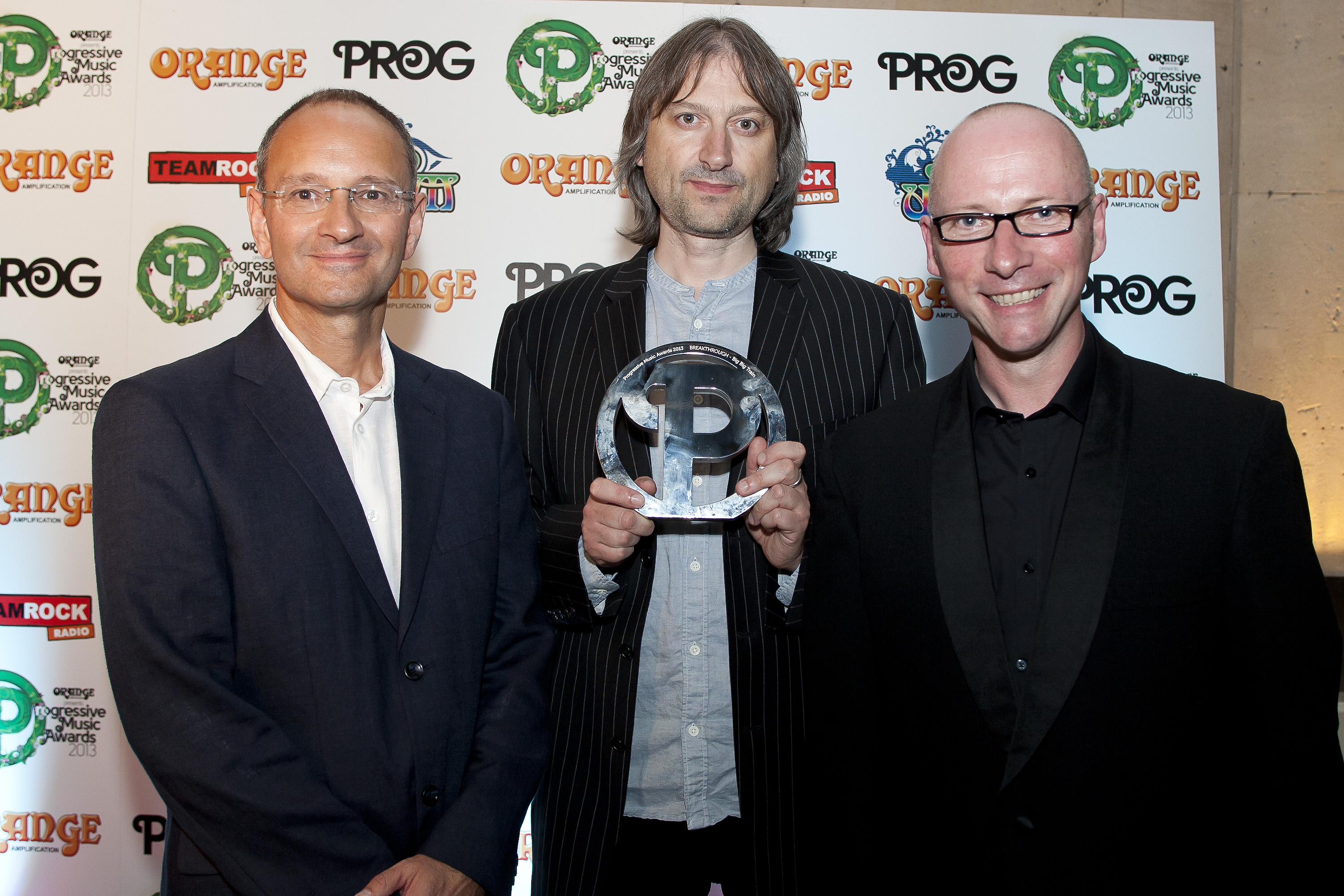
Regardless, each gives us what David Elliott masterfully calls “Bloody Prog™” and does so without hesitation. Indeed, each offers it without embarrassment or diversion, but with solidity of soul and mind.
Finally, but intimately related to the first two, each band releases things not with the expectation of conformity or uniformity or propaganda, but with full-blown art. Each band loves the art for the sake of the art, while never failing to recognize that art must have a context and an audience. Not to pander to, of course, but to meet, to leaven.
Life is simply too short not to praise where praise is due. Life is too short to ignore the beauty in front of us. And, no matter how dreary this world of insanities, of blood thirsty ideologies, of vague nihilisms, and of corporate cronyism, let us—with Plato—love what we ought to love.
The Tangent and Big Big Train have given us art not just for the immediate consumption of it, or for the year, 2013,—but for a generation and, if so worthy, for several generations, perhaps uncounted because uncountable.
[Ed. note–if there are any typos in this post, I apologize. I’ve been grading finals, and I’ve been holding my two-year old daughter on my lap. She’s a bit more into Barney than Tillison or Spawton at this point.]


 Progarchy