

Gong was one of prog’s dark horses — too droney for the shredders, too silly for the serious, too jazz for the rockers and too rock for the jazzers. A moving target, their sound sprung mostly from self-styled pothead pixie Daevid Allen, a founding member of Soft Machine who, abandoned by that band in France due to a bum visa (it was 1967, how bad could it’ve been?), created a web of musical partnerships and produced a set of jazz-driven psych records, culminating in the trance-soaked Radio Gnome Trilogy (1973’s Flying Teapot, 1974’s Angel’s Egg, and 1975’s You). Evaporating into its disparate parts shortly thereafter, Gong and its many members to this day hover like clouds, appearing and disappearing with their seasons.
But that trilogy of albums remains a grail of sorts, a kind of rebuke to prog either as bacchanal for sci-fi bikers on the one hand or as outpost for conservatory-trained longhairs on the other. They indeed smell like early Soft Machine, but way more fragrant. The knotty songs sing like bop, but usually, around mid-point, lift off into breathy, woman-moaning space jams that have a lot in common with contemporaries like Cosmic Couriers/Jokers, Amon Duul II, and like-minded European bands that came late to the acid party but then stayed long past last call.
If Gong made any money at all it had to have gone right back into the drugs, but for at least one of their members Gong was less a destination than an early stop on the journey. Steve Hillage, a Canterbury regular, jumped ship from Khan and landed on planet Gong long enough to stamp the Trilogy with his signature fluidity and tone, driving the songs into a direction that would later, with the rise of trance electronica, appear prescient. With his partner, Miquette Giraudy, who along with Gilli Smyth provided Gong with its siren cooing — for how else to describe it? — Hillage split from Gong soon after Allen did, and made a bunch of records in the late 70s, not altogether unlike the Gong records he contributed to, that ended up having a big impact on British beat mechanics like The Orb. With such recognition, he and Giraudy put together System 7 in the early 90s, producing both beat-heavy and ambient records featuring Hillage’s guitar textures and Giraudy’s burbling synths. While it wouldn’t be fair to say these records — Gong, Hillage solo, System 7 — don’t have any wasted notes, they all have way more to recommend them than not. “Master Builder” (from You) remains a favorite, a far-reaching and future-seeing ommm drone that morphs into a breathtaking jazz jam with Hillage, on fire, heaving the whole mess past the summit. The influence of Miles Davis’s electric bands is palpable. Hillage never lost sight of that kind of funk, and saw the relationships between the deeply groovy and the deeply abstract.
Two recent albums, featuring Hillage then and now, go a long way towards making this point. Live in England 1979 finds Hillage at University of Kent, playing a well-chosen selection of some of his better known songs. Taped for broadcast, the sound is good, and the playing is energetic, the killer rhythm section giving Hillage plenty of room to showcase his always tasteful, melodic soloing. At its best, such as on “Salmon Song” and the clutch of other driving, George Clinton-filtered-through-Frank Zappa funky tracks, Hillage has no peer except perhaps Adrian Belew in the King Crimson of that same era. The guitar is angular, the singing gonzo, the funk is there. (Hearing this, I think it would have been fascinating had Brian Eno or Robert Fripp gotten ahold of Hillage in one of their productions at the time.) Contrary to how you might imagine an ex-Gong sounding in the wake of punk, the music is surprisingly fresh, with “1988 Activator” even admitting Johnny Rotten happened. The only dinosaur-betraying moment is a cover of Donovan’s “Hurdy Gurdy” Man, which had been a minor hit for Hillage several years earlier and which he was probably obliged to play. It’s a drag on the set, and when in the midst of the solo he breaks into the main riff of “Master Builder” it makes Hillage sound like he’s out of ideas, which he clearly wasn’t. The CD adds a couple of studio tracks, what sound like demos from his 1977 album “L,” so as a whole the album’s pieced together and not without flaws, but a fun listen and, in its live moments, has some booty-shaking space power.
You can watch the entire show here — it’s really worth a look:
More coherent in its conception and execution, Phoenix Rising finds Hillage and Giraudy, as Sysem 7, paired with Japanese post-rock/electronica/space outfit Rovo, and is a nice example of electronic/analog jazz fusion. The opening track, “Hinotori,” lays it all out. Two drummers, two guitarists, violinist, bass, keyboards, lots of processing.
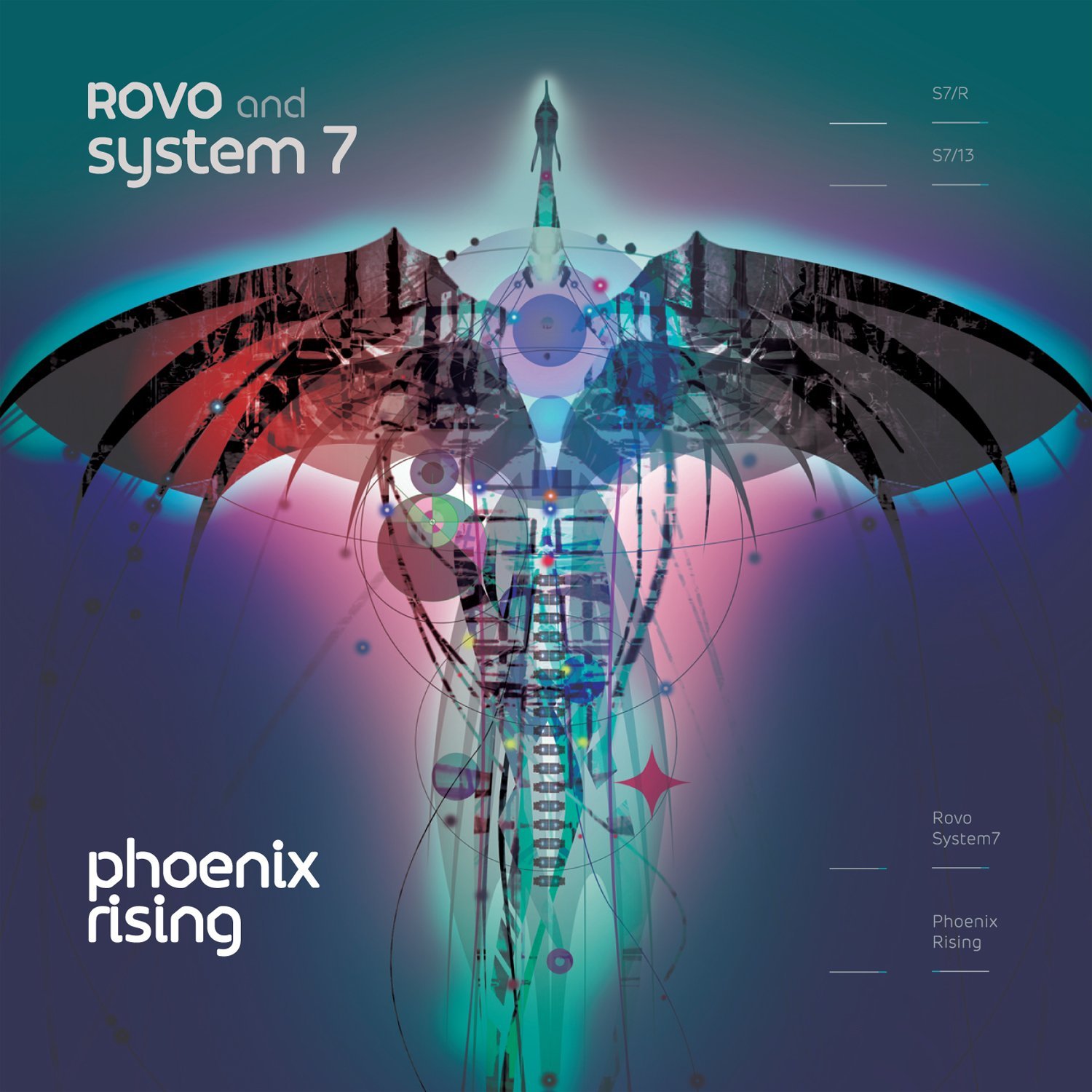
If this suggests a Mahavishnu Orchestra obsession, you’d be right on. John McLaughlin’s fabled band and its Inner Mounting Flame is directly quoted, as Hillage and Rovo cover “Meeting of the Spirits.” Now, the problem with covering McLaughlin is similar to the problem of covering the Beatles — how to do it and make something else out of it that’s your own while also reminding all of us why the song’s so great in the first place? While I’m not certain this is achieved, and have been on the fence about whether the track belongs on Phoenix Rising given the strong writing in the other compositions here, it does fit the spirit of the record, which mostly makes me think of what a Santana album would sound like if Carlos decided to make a smooth electronica record but keep half his band in analog mode. Are barriers being broken? No. Am I going to put this in my McLaughlin mix? Sure. Does it work? Absolutely, and it’s an enjoyable listen all the way through.
What impresses me about Steve Hillage is his journeyman’s approach to his music. He’s a gifted musician with that most cherished of attributes, an identifiable sound, but I have a feeling he’s never been terribly happy resting on his laurels or going for a money grab. He participates in the occasional Gong one-offs, but I think is more at home in the kind of environment Rovo provides on Phoenix Rising. Not the star, not the solo soloist, but an integral part of a larger group. In “Unzipping the Zype,” on Live in England 1979, Hillage sings “I ain’t no guitar hero, I just want to be a guitar zero.” I doubt that wish will ever come true for him, but his drive to find a level stage has been a benefit to those of us listening.
 Progarchy