

Okay, I remembered another one of my “generic” 8-tracks from the early 70’s (see my prior post). In Search of the Lost Chord by the Moody Blues (1968). (Yes, I’ve owned at least two legitimate copies since.) My experience with it was in many ways comparable to that with King Crimson’s Islands (discovered at nearly the same time, if not the same day).
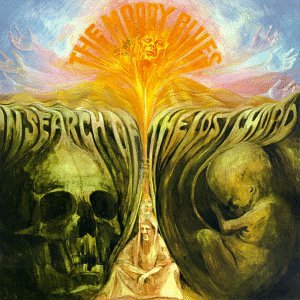
My entrée into a high orbit around the notion of “prog” had not been through radio airplay, and I was only beginning to discover the wonders of WMMS in Cleveland (in its Golden Age). As with King Crimson, I was not yet familiar with the Moody Blues’ first two albums, so Chord was my point of entrance, and has remained a sort of fulcrum in my perception of the band. I heard the music first without the impact of cover art. And to be quite honest, the art didn’t do that much for me when I eventually saw it.
I love the whole album, partly because of its place in my early listening life. But this “mini-review” is really about one song, the one that has most profoundly stuck with me from then to now: “The Best Way to Travel” (credited to Mike Pinder).
In the early 7o’s, I was rather blissfully naive regarding drugs, so I didn’t hear that I could “fly high as a kite” as others might have heard it. Oh, I knew vaguely who Timothy Leary was, but my general intake of the album’s search-and-discovery motif was uncluttered with chemical enhancement experience. Others were often more aware than I was of my apparent destiny as an academic and an intellectual (in 7th grade, several other kids at school called me “Professor”). Nonetheless, what I heard was that thinking… THINKING… is the best way to travel.
Texture in music is almost always uppermost to my ears, as if it were a surface to caress or to palpate. This is one of those songs with a texture that carries its lyric with an ease or a naturalness that approaches perfection. (Other examples of this: “Jerusalem” by ELP, “Earn Enough for Us” by XTC, and several Genesis songs, including “The Colony of Slippermen” and “Squonk.”) The texture conveys precisely the sort of “travel” to which the lyric alludes. Bold, dense, percussive acoustic guitars that propel whatever is the vessel (seesaw?) on which we ride. Yet they hesitate dramatically to allow us to regain a fix on the ethereal “beep,” reminiscent of radar, which may or may not be some sort of guide. We may need to follow a bit in order to find out.
Four decades later, I still believe every strum and every word. Thinking is the best way to travel.
 Progarchy