

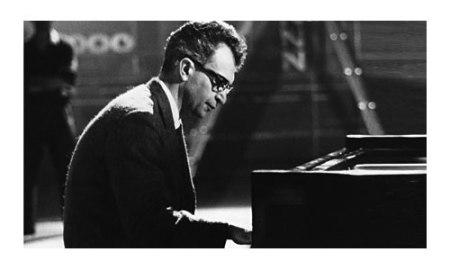
 The following was originally written in May 2011 for the Insight Scoop blog. I’ve decided to share it here as a very modest homage to Dave Brubeck, who died this morning, one day shy of being 92 years young. It sounds like Brad has more about Brubeck on the way. Anyhow, here goes!
I just read a fun post, “The Catholic Roots of Jazz?”, by Joe Trabbic on the “End of the Modern World” blog, and wanted to blather about it for a bit. Joe writes:
Jelly Roll Morton was a key figure in the early development of jazz. Some people even regard him as the first real jazz musician, the man who brought together various musical forms into the new thing that we now know as jazz. Jelly Roll’s real name was Ferdinand Joseph LaMothe and he was raised Catholic, but the dissolute life that he began leading as a teenager, when he secretly took a job as a piano player in a New Orleans brothel, quickly made his Catholicism unrecognizable. But who knows the hearts of men save their Maker?
He goes on to mention early jazz giants Dominic “Nick” LaRocca and Louis Armstrong, and then remarks upon Dave Brubeck, one of the finest (and longest-performing) jazz pianists, saying, “Well, if jazz didn’t have anything Catholic about it, why did one of the greats of later jazz, Dave Brubeck, decide to enter the Church of Rome?”
He admits he is having fun with it, but the two questions are interesting: “Does jazz have Catholic roots?” and “Is jazz Catholic?” The first one, it seems to me, is bound up to a large degree with the history of jazz, which is a complicated matter. But it is pretty evident that jazz, to put it rather simplistically, has roots in both the European cIassical tradition and very American forms of music—ragtime, blues, early country, spirituals, gospel, dance music, etc.—harkening back not only to New Orleans, but Chicago, New York, Texas, and a variety of other places, especially throughout the southeastern United States. Elijah Wald’s How The Beatles Destroyed Rock ‘n’ Roll: An Alternative History of American Popular Music (Oxford University Press, 2009), offers a fascinating and slightly iconoclastic version of that history, especially in the first seven chapters. Jazz was, in the beginning, very much dance music, and was usually associated with a less than upstanding life-style. And that image was hardly helped in the 1940s and ’50s when many jazz musicians came under the spell of heroin and other drugs.
One of my heroes, G. K. Chesterton, had nothing good to say about the jazz of the 1920s and 1930s. I beg to differ with him, but I’m sure it was an unusual and even jarring thing for the Englishman to hear. It was a music filled with great energy, imbued with a beguiling combination of rawness (sometimes sexual in nature) and sophistication (often classical in origin), being both very rhythmic and melodic, with an ever-increasing harmonic complexity. I own dozens of books on jazz (and close to 11,000 songs classified as “jazz” on my iTunes), and they all agree that defining “jazz” is a very difficult matter. Barry Ulanov was one of the first great jazz critics (he was also a Catholic scholar—more on that in a moment), the author of A History of Jazz in America (Viking Press, 1954) and A Handbook of Jazz (Viking, 1960). He wrote, in the latter book, “The harder one listens to jazz, the more one hears European rather than African influences—the folk songs of England, Scotland, and Ireland, of France and Germany and even the Balkans, rather than the music of the jungle and the coast settlements from which the slave ships came.”However, many jazz musicians of the past few decades—especially since the lae 1960s—have purposefully sought to incorporate more non-European rhythms—African, Cuban, etc.—into their music (jazz really is, in many ways, the original “worldbeat music”). The fact is, jazz has long been notably “catholic” in the sense of being recognizably “jazz” while presenting itself in a wide range of forms and schools, with distinctive sounds coming from New Orleans, Chicago, Kansas City, and the West Coast. Those unfamiliar with jazz could be forgiven if they, upon hearing pieces by Armstrong, Charlie Parker, early/mid/or late Miles Davis, and Weather Report, muttered, “I have no idea what those have in common.” But the common thread of jazz, I think, is the unique improvisational conversation that takes place between musicians within a certain foundational structure. This is true whether the jazz in question is defined as traditional, bop, cool, post-bop, free, fusion, or otherwise (for those interested in a detailed and learned excursion, see The Jazz Book: From Ragtime to the 21st Century [Lawrence Hill Books, 2009], by Joachim-Ernst Berendt and Günther Huesmann [seventh edition]). Having said that, as far as I know, the two best-known practicing/serious Catholics who were/are world-class jazz musicians are Brubeck and pianist/composer Mary Lou Williams, herself a convert. Duke Ellington wrote three “Sacred Concerts”—1965, ’68, ’73—but they were apparently for an Episcopalian setting. But it appears that the legendary trumpeter and bandleader Dizzy Gillespie may have been Catholic. This piece about Williams (check out the picture of her with Pope Paul VI!) provides the following background:
However, by the mid-1950s, jazz was losing its audience to rock ‘n roll, forcing many jazz artists to work in Europe. While Williams was working in France, she suffered a spiritual crisis/awakening and returned to New York. She gave up performing and devoted her time and energy to helping drug-addicted musicians get clean.
She also devoted herself to prayer and fasting. The Baptist church she was attending wasn’t open during the week, but the Catholic church was. Williams spent long hours praying in front of the tabernacle, and eventually converted to Catholicism in 1957. Lorraine Gillespie, wife of trumpeter Dizzy Gillespie, was her godmother.
Her spiritual director advised her to give up the dangerous work of drug rehabilitation and return to music. He suggested that she offer up her playing as prayer for others.
Dizzy Gillespie introduced Williams to Bishop Wright, who headed the Diocese of Pittsburgh from 1959 to 1969. The two became friends in the early 1960s — she would return to Pittsburgh to visit her family.
Williams wrote music for a “jazz mass” in 1970; I’ve not heard the entire work, but the clips suggest a very time-bound piece with a heavy gospel and blues flavor. Brubeck composed a piece, “To Hope! A Celebration Mass” in 1996 that seems to have a much more classical/European sound to it. Regardless, I’ve long said that I never want to hear jazz at Mass, now matter how well it is played or composed, for while jazz is very beautiful, powerful, and even spiritual (in the best sense of that word), it’s very nature—improvisational, largely profane (in the correct sense of that word)—is not well-suited, in my judgment, to liturgical settings.
But I would also insist that outside of liturgical settings, good jazz is good music, which means it is an artistic expression in keeping with Catholicism, which prizes and recognizes all that is good, true, and beautiful. Personal tastes differ, it goes without saying, and I can only take a little bit of Ornette Coleman or Cecil Taylor before I turn to the Blue Note albums of the 1950s and ’60s, or the trio albums of Keith Jarrett, or the recent works of Joshua Redman, Brad Mehldau, Roy Hargrove, and so forth. Great jazz, to my mind and ear, is a marvelous combination of structure and improvisation, where intelligent musical conversation takes place upon a chosen, mutual theme, revealing both the individual thoughts/voices of those participating, as well as the deeper meaning and heart of the piece they are playing. It is a music that recognizes and honors and draws upon tradition while speaking about and within that tradition in the here and now. In my mind, jazz bears a certain analogy to the human condition: we are creatures endowed with great freedom, but freedom is to be exercised in pursuing the good, recognizing and respecting the limits and boundaries of our nature and of creation as established by God the Creator.
Ulanov (b. 1918), who played classical violin (until a car accident made it impossible) and whose father was a well-known concertmaster, converted to Catholicism in 1951 while he was becoming known as one of the finest jazz critics and editors of the time. He had a Ph.D. from Columbia, organized jazz concerts, edited or wrote about jazz for Downbeat, Metronome, Esquire, Vogue, and other magazines. His obituary in the New York Times states, “Mr. Ulanov placed popular culture within the context of American art rather than isolating it as mere entertainment, and wrote some of America’s first serious books on jazz. He taught at Princeton University and Barnard College for almost four decades, covering subjects as varied as literature, art, religion and psychology.” He wrote books on Duke Ellington, Bing Crosby, Thèrése of Liseux, Alphonsus of Liguori, and Augustine; his 1960 book, Sources & Resources: The Literary Traditions of Christian Humanism, is a remarkable and beautifully written work that has chapters on patristics, Augustinian thought, Boethius, Gregory the Great, St. Bernard, Dante, John of the Cross, Pascal, Newman, and many others. My guess is that Ulanov, who died in 2000, would say that jazz can be Catholic, and I would agree, while always recognizing that the sacred and profane have their proper places and purposes, and that great music, art, and literature will always, in some way, express truth and reveal beauty.
UPDATE: Here is “An Idiosyncratic List of Instrumental Jazz Albums (By Real Jazz Musicians) For People Who Swear or Think They Do Not and Cannot Like Jazz”, originally posted on this blog in June 2010 (with a list of recommended classical pieces as well). Highly subjective? Yes. Helpful? I hope so:
• Miles Davis: Kind of Blue. A timeless masterpiece, worthy of the many accolades. You can’t go wrong with Miles up until the late 1960s, when things get, um, electrified.
• Keith Jarrett: The Köln Concert. Improvised solo piano of the highest order. Also see Jarrett’s later solo album of standards, The Melody At Night, With You, recorded as he was recovering from a lengthy illness.
• Herbie Hancock: Maiden Voyage. A concept album and a tone poem of sorts, focused on oceanic themes. Hancock’s Gershwin’s World and The New Standard demonstrate how gifted he is at interpreting other composer’s music.
• John Coltrane: Ballads. An ideal introduction to Coltrane, whose incredible music can often be dense and intimidating (Ascension, anyone?). The collection, Coltrane for Lovers, is an equally good place to start.
• Jan Garbarek: Twelve Moons. This is recommended for those who like melancholy music with a strong sense of Nordic bleakness. By the way, Garbarek and Jarrett have recorded several albums together, including Belonging, which is an up-tempo, joyous set.
• Sonny Rollins: Saxophone Colossus. There is a lot to choose from with the prolific Rollins, but this classic album has “St. Thomas,” a bouncing calypso piece that simply cannot be resisted. A more recent album with the same upbeat sound is Global Warming.
• Brad Mehldau: The Art of the Trio, Vol. 1. It’s impossible to do wrong by Mehldau (I’ve seen him perform live twice, and he is a stunning pianist). For those looking for an eclectic, cross-over sound, check out Largo; for those who like cinematic, epic pieces, find the recently released Highway Rider.
• Joshua Redman: Joshua Redman. Redman’s later work has become more dense and intricate, so begin with his debut album, which is big, fun, and more straight forward.
• Bill Evans: Sunday At The Village Vanguard. It’s hard to imagine anyone disliking this beautiful set of music from one of the greatest jazz trios. Also see The Best of Bill Evans.
• Wynton Marsalis: Standard Time, Volume 5: The Midnight Blues. Marsalis has a vast body of work, but I think nearly everyone will enjoy this mellow, gorgeous album. And Joe Cool’s Blues, a tribute to “Peanut’s” music recorded with his father, Ellis, is a very fun disc.
• Branford and Ellis Marsalis. Loved Ones. An emotional, reflective album of duets by saxophone-playing son and pianist-playing father. Melodic and memorable.
• James Carter: Gardenias For Lady Day. This tribute album to Billie Holiday is one of my more “out there” picks, from a venturesome and versatile young saxophonist. Something for everyone.
• Kurt Rosenwinkel. Heartsong. Another gamble, but I come back to this album, by an exceptional young guitarist, on a regular basis. For a more traditional, mellow sound, see Rosenwinkel’s recent release, Standards Trio: Reflections.
• Weather Report. Heavy Weather. I’m not much for fusion, but Weather Report is the exception, as their signature tune, “Birdland,” demonstrates. The Best of Weather Report also works.
 Progarchy
Thanks so much for this, Carl. Brubeck would’ve been 92 today. God thought he should only have 91 years, though. His death hit me much harder than I ever would’ve expected. Looking through some accounts of his life yesterday, I was struck by how many offered the dismissive “he was a safe jazz musician for white people.” Either I’m an idiot or delusional (or both), but I don’t and never did care if Brubeck was white or black or anything else. The man could play, and he understood time and beauty better than most artists in the 20th century. Safe? Sure, in hindsight. I really doubt his label assumed “Time Out” (1959) was safe in the least. My guess is that they thought they had a failure on their hands. Brubeck’s music is many things, but “safe” was never one of them.
LikeLike