A Look At The Lyrics: Ocean Cloud

One of prog’s many attractions is its willingness to tackle unusual or obscure subject matter, and to do so via a lengthy piece of music if the subject is difficult or complex enough to demand it. Not that there’s anything wrong with 3-minute ballads, you understand. But an album consisting solely of short songs about love, lust and relationships can end up sounding a little… well… repetitive.

Marillion’s Ocean Cloud, an 18-minute piece from their acclaimed 2004 album Marbles, is an excellent example of the ‘long song on an unusual subject’ format. The subject in question is a man who is rowing single-handed across the Atlantic Ocean.

A song about rowing? Really?

It’s a testament to Steve Hogarth’s skill as a lyricist that he is able to tease something interesting from such an apparently unpromising starting point. In fact, there are many questions that can be explored here. What is the attraction of such a lonely and dangerous activity? What is the rower trying to prove, and to whom? What is he running away from?

The mournful first line, sung over the sound of waves and seagulls’ cries, immediately sets the tone:

He’s seen too much of life and there’s no going back.

Already, we are being asked to think of this as an escape, an act with a certain finality to it. Hogarth allows this line to stand alone; the first verse doesn’t begin properly until after a few bars of Steve Rothery’s haunting guitar, and it opens with

The loneliness calls him, and the edge which must be sharpened.

Hogarth wants us to recognise the seductive nature of being alone with one’s thoughts; moreover, he highlights the idea that danger can be attractive – the old cliché that you will never feel more alive than when you are putting yourself in harm’s way, ‘sharpening that edge’.

The second verse is, I think, my favourite:

The smell of the earth is his favourite smell
But he’s somehow compelled to the stinging salt hell,
To the place where he hurts and he’s scared,
And there’s no one to tell, and no one who doesn’t listen.

Despite the comforting familiarity of land, the call of the wild ocean is impossible to resist. He will face pain, fear and loneliness – but is being in the middle of that vast expanse of water any more lonely than being with someone “who doesn’t listen”?

Later, the mood changes and the tone becomes defiant:

Only me and the sea
We will do as we please

The defiance soon fades as the song enters its quieter middle section, the calm before the storm. Then the ‘black wall of water’ hits and a flashback reveals what the rower is trying to prove by his mad heroism:

He remembers the day he was marched to the front
By the physical knuckle-head teacher of Games.
“Look lads,” he declared, “this boy’s a cream puff,”
“No guts and no muscles, no spine and no stuffing!”
The whole schoolroom sniggered
And silently thanked God it wasn’t them…

Hogarth spins a positive outcome from this horrible memory, letting us know that the rower is the ultimate victor: that he has proven himself more successful – more of a man, even – than those who once belittled him so cruelly:

But time is revenge, all the bullies grow weak
And must live with faithless women who despise them.

The reminiscence becomes more wistful as the rower reflects on past loves before rejecting these thoughts, declaring

Don’t want to remember when I was alive

And what better way to banish painful memories than to immerse yourself in the physical demands of the challenge?

Watch me, watch me
Paint this picture,
Stretching, cursing, hurting,
Watch me taking it

Before a final chorus ends the song, the last verse captures the seductiveness of ‘perfect solitude’, achievable only by destroying that last means of contact with civilisation:

Between two planets
In the black daylight of space.
Between two heavenly bodies,
The invisible man.
Ripping out the radio; I want to be alone…

You can view a live performance of Ocean Cloud from 2009 here:

Mini-review: Porcupine Tree’s “Octane Twisted”


Porcupine Tree’s new live album, “Octane Twisted” arrived in the mail today. It comes in several configurations – the one I ordered is a 2-cd and single dvd set of their April 30, 2010 concert in Chicago.

The first disc is a complete presentation of their 2010 album, “The Incident”. It’s an excellent performance, with the highlights being the Animals-era Floydian song “Time Flies”, and the album closer, “I Drive the Hearse”.

Because they perform the entire album without breaks, the audience is pretty much taken out of the picture. While watching the dvd of the show, it’s clear there is incredible chemistry between the band members, but I didn’t get much sense of rapport with the crowd. Gavin Harrison once more demonstrates he is one of the greats of prog percussion. He deserves to be mentioned in the same breath with Neil Peart and Nick D’Virgilio. Richard Barbieri is a master at creating evocative atmospherics, and Colin Edwin makes playing complicated bass runs look effortless. Once again, John Wesley joins the core PT members to play guitar and vocals.

Steven Wilson is the main attraction, and he doesn’t disappoint – playing both electric and acoustic guitar, and some piano. He pulls off some excellent solos in “The Incident”, “Time Flies”, and “Octane Twisted”. And, of course, he’s barefoot throughout the concert!

Disc 2 contains the rest of the Chicago concert, as well as three songs from an October 14 London show. The other Chicago songs are “Hatesong” (probably my least favorite PT song), “Russia On Ice/The Pills I’m Taking” (“Russia On Ice” drags, but “The Pills I’m Taking” picks up the pace nicely), “Stars Die” (from the early days!), and “Bonnie the Cat” from The Incident (odd choice for a concert closer). The London songs are “Even Less” (a perennial favorite, but this performance is a little lackluster), “Dislocated Day”, and “Arriving Somewhere But Not Here” (a really good rendition of a beautiful song).

Overall, this a fine performance, and you get a lot of music for your money. “The Incident” is not one of my favorite Porcupine Tree albums, though, so unless you like it a lot, you could probably give this one a pass. I was very disappointed that the dvd is just the basics: no special features, and it only offers 2.1 audio, not a 5.1 mix. Also, the editing was much too jumpy for my tastes; the camera rarely stayed on one angle for more than 3 seconds, and I would have preferred to have longer shots of the entire band playing.

If you are trying to decide which dvd of Porcupine Tree to buy, I highly recommend “Anesthetize”. It’s an incredibly energetic performance of an excellent album, “Fear of a Blank Planet”. “Arriving Somewhere” is also very, very good, and features music primarily from “Deadwing” and “In Absentia”.

Norwegian Visions of Purgation: The Eddas of Gazpacho

[Progarchists, I published a version of this about six months ago, but I’ve revised it significantly since then.  I’m also very much desirous of celebrating the re-release and bettering of a must-own (YES, a MUST-OWN ALBUM) album, “Night.”  I honestly didn’t think this album could get any better.  And, just to be clear, I rank it somewhere in my top ten albums of all time.]

Little things that make up her life

Watching them pick winners with her standing by

She read a tired pamphlet by a fire-starting freak

Campbell’s ice cubes, the drinks are unique!

But everything is cool as long as you dare

To bend a few taboos, to sacrifice pawns

Pockets filling up with gold

From the shades of his soul

Lost in the panic that she typewrote

Of lightbulbs that burn out in rain

And he saw his wife to be in someone

But she couldn’t see and she never cared

How small is your life

Is it too small to notice?

–Gazpacho, “Valerie’s Friend” (2007)

Nearly six years ago, I finally listened to a band I’d avoided for over half of a decade. Having been a part of various prog newsgroups (the “National Midnight Star” was the greatest of these in the 1990s), news feeds, and websites for the entirety of my adult life, I’d come across the name of Gazpacho numerous times, and the mention was always in a positive context.

For reasons which now elude me, I kept putting off purchasing one of their cds. I even consider their original patrons, Marillion, one of my favorite bands, and I have for nearly two decades now.

Still, even the praise and promotion of Gazpacho by Marillion didn’t convince me.  From my poor memory, I was a bit turned off by the name, and I’d assumed they were merely a Marillion cover band and tribute band.  “Gazpacho” is the name of one of Marillion’s songs from their album, “Afraid of Sunlight” (1995).

Then, almost half a decade ago, a friend I trust explicitly told me I had (yes, HAD) to listen to the latest album, “Night,” a single 53-minute song broken into five parts.  It’s as much a suite as it is a song.

Well, I’m certainly a huge fan of concept albums and albums without any breaks in the music. To me, if something is worth saying, it generally takes much longer than the traditional 3-minute pop song allows. As I posted here recently, the only real flaw in The Cure’s 1989 “Disintegration” is the few seconds of silence between songs.

But, 53 minutes?

Was this too good to be true?  Seemingly so. This would be akin to complaining to Costco that their 56lbs. (yes, I exaggerate. I think it’s 5 lbs., 6 ounces–but it’s huge and glorious!) of M&Ms for $8 isn’t enough.

Asking for more would just be sheer decadence and would probably require a quick jog down to the confessional at church.

With the prompting of my friend and my eagerness to hear a 53-minute song, I purchased “Night.”  To say this changed my life would be too much. To say it reshaped my taste in music and set my listening standards to a new level would not be an exaggeration in the least.  I was just on the verge of discovering Big Big Train at the moment I first listened to “Night,” and I think Gazpacho raised my understanding of what’s possible in music to a very high height.

“Night” is, to my thinking, a proper successor to Talk Talk’s “Spirit of Eden.”  Musically, there are certainly similarities, and I’d be rather shocked to learn that the shadow of Mark Hollis, Tim-Friese-Greene, and Phill Brown did not over over the work of Gazpacho.  Indeed, Talk Talk seems much more of a direct influence than does Marillion despite the name of the band.

“Night” has been in constant listening rotation now for as long as I’ve owned it, and I’ve never once gotten tired of it or felt I’d actually reached and understood it in all of its depth and breadth. As I’m listening to it now, writing this review, it’s almost as fresh to me as it was on the first listen or whatever number of listens yesterday’s was.

[I’m revising this article (November 21, 2012), which I first wrote about six months ago.  As I’m revising, I’m listening to it yet again–it’s just stunning.  So stunning, in fact, that heart is actually skipping a few beats.  No, unlike with the 56 lbs. bag of M&Ms mentioned above, I’m not exaggerating.]

“Night,” for me, ranks up with the greatest post-classical albums of all time. Indeed, it’s in a league with “Close to the Edge,” “Selling England by the Pound,” “Grace Under Pressure,” “Hounds of Love,” “Ocean Rain,” “Skylarking,” “Spirit of Eden,” “Disintegration,” “Brave,” and “The Underfall Yard.”

From the first listen of “Night,” I was hooked. The piano, the violin, the voice, the bass, the drums, the guitar–everything just fits, and it does so beautifully. It also does so as an organic whole, one note and one idea leading mysteriously, yet perfectly, to the next.

I knew fully well upon the first few moments of listening to “Night” that I would have to become a Gazpacho completist. My prediction has come true, and I rather proudly own their seven studio cds and two live ones.

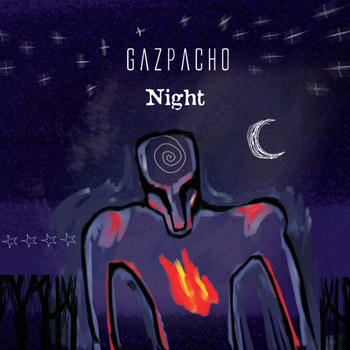
Rare for me, I even purchased the new re-release of “Night” from Kscope, despite already owning the original.  The new version comes with new artwork and typically beautiful Kscope packaging, but it also has new drums, a few new parts, and three of the five parts of “Night” recorded life.

And, did I mention the lyrics? These guys know how to write, and they know how to integrate the lyrics with the music and the music with the lyrics into something profoundly and seamlessly whole and good.

Despite its brilliant intensity, the album seems to come to a fitting denouement at around forty minutes into it, when Jan-Henrik Ohme sings one of the best and most haunting lines in all of rock music: “St. John got gunned down with a cold 38.” My mind reels every time I hear this. Am I in Norway, on the island of Patmos, or in some twilight realm of progressive/art rock bliss?

And, so, I’ve concluded, listening to a Gazpacho album is akin to every poetic description of purgatory I’ve ever encountered. It’s not the perfection of heaven, but it’s also not the twilight and long defeat of this earth, or, in any way, the pains of hell.

A Gazpacho album is purgatory in the best sense: a journey toward perfection, offering brief glimpses of the most beautiful things possible, reaching for that which the Platonic Celestial King reached: the Good, the True, and the Beautiful.

For those of you have had the blessing of reading Dante’s Divine Comedy, you know exactly what I mean.  No scene in literature touches me as much as Dante realizing he has escaped the Inferno and found himself staring at the stars of Purgatory.  Listening to this album is akin to this.

The touch of its hand is memory

A kiss to lead the blind

In water I hear slamming of doors

St.Christopher beneath the rocks

An empty dream of summer fields of daisies

Perfect endings

–Gazpacho, “River” (2010)

Gazpacho-esque Eddas

Despite the name, Gazpacho hails from the glorious northern Kingdom of Norway, home of many, many good and meaningful things, including one of the finest writers to ever grace this earth, Sigrid Undset, and one of the kings who actually gives monarchy a fine name, the courageous Haakon VII.

Oh, and let’s not forget, some of the best stories (the Sagas and myths) ever written come from this land as well.

Sadly, I’ve only visited once, and that was way back in 1988. Still, the memories of the intense and stark beauty of the Norwegian landscape inspire me to this day, and I happily keep a map of Scandinavia (dated 1815) framed above my desk as a reminder of what wonders can exist in creation.  Could I travel anywhere in the world at the moment, my first choice would be Norway and Sweden.

Interestingly, though we always associate the word with the Scandinavian mythic tradition, “Edda” is one of the most debated words in the history of Europe. No one is exactly sure of its etymology, but it’s generally agreed that it means “a soulful utterance” and is applied almost exclusively to northern myth. Whatever its history, it’s a stunning word, and the peoples of northern Europe (as the great English author and scholar, J.R.R. Tolkien, knew well) should be proud of it as an immense part of their cultural traditions.

Indeed, northern mythology is every bit as interesting, as complicated, and as developed as classical Mediterranean mythology. There are, understandably, similarities between the two polytheistic systems, but there’s a nobility and a will found in northern myth that is missing in the much more rationalistic and abstract realm of classical myth.

Whether the members of Gazpacho have intentionally embraced this northern Eddic tradition or not, it certainly seems to be in their very blood.

Formed in 1996 by Jon-Arne Vilbo, Thomas Anderson, and Jan-Henrick Ohme, Gazpacho has now released seven studio albums (recently adopted by Kscope Records) and two live releases. The seven studio: Bravo (2003); When Earth Lets Go (2004); Firebird (2005); Night (2007); Tick Tock (2009); Miss Antropos (2010); and March of Ghosts (2012). Each release is a delight, and while I find myself drawn back to “Night” more than the others, this is no small praise, and I find myself liking everything these men have produced.

Broken glass

The plan has failed

The silence knows

A man of faith

Everything that he knows, what a layman will do for diamonds

Fell on his knees gave in to sad overload

And all of the survivors shamed in the trench

Scrape up what’s left of his soul

Of his soul, of his soul

–Gazpacho, “Tick Tock” (2009)

Daughter of Night or of Zeus: Either way, mischief.

While the albums prior to “Night” are certainly artful and progressive, they are not part of a greater concept.

After “Night”, though, Gazpacho has produced three concept albums, each as progressive as progressive can possibly get. “Tick Tock” (2009) follows the story of a downed French pilot, trying to make it safety back to civilization in 1935. A number of separate stories comprise Gazpacho’s latest album, this year’s “March of Ghosts.” In a sense, at least thematically, this album best represents the very purgatorial idea of Gazpacho, literally following the souls of a variety of those who have passed from this existence.

Rather humorously (yes, I laughed for probably ten minutes solid), the lead singer describes his own theological beliefs on his Facebook page as “Frisbeetarianism”–the belief first proposed by comedian George Carlin that at death, the soul “goes upon a roof and gets stuck.”   Admittedly, I’m a Roman Catholic.  A pretty bad one, frankly.  But, I love the idea of Frisbeetarianism.

With “March of Ghosts,” however, the restlessness of souls pervades the album. I live across the street from a very large nineteenth-century graveyard, and, in ways I could never describe, “March of Ghosts” fits perfectly with the sense one gets walking around the cemetery at any time of the day or night. There are haunted and restless feelings present, but there’s also a calm that really can be found no where else but in a cemetery and, maybe, on a Gazpacho album.

As much as I love the driving qualities of “Tick Tock” and the pervasive certain uncertainties of “March of Ghosts,” I find their 2010 album, “Missa Atropos” the most interesting and most daring of their post-“Night’ concept albums.

The story of Gazpacho’s “Missa Atropos” is exactly what the title states: a Mass written for one of the three Fates. Little recorded remains of her. A quick glance at Hesiod’s Theogony reveals only a conflicting story. In the same work, Hesiod claims that she is one of the seven children of Zeus and Themis, the god’s second wife (Lines 901-906), as well as the offspring (alone; no father) of the horrific Night (Lines 217-219). In each version, however, Hesiod recorded that the Fates determined what good and what evil should be given to every man.

The protagonist of Gazpacho’s story, however, struggles to accomplish the writing and completion of a Mass. To write it, he disappears into the solitude of a light house. The conflicting ironies in Gazpacho’s story are simply brilliant. A “Mass” is meant to be a communal celebration, and a lighthouse is meant to aid those who cannot see clearly. Here, a man turns away from the world in a project to connect this world to the next, thus bridging the horizon with the heavens. By residing in a light house, he also guides the desperate to a safe haven, a port, thus bridging chaos and order. But, he also writes a Mass to appease the Fate–who, by definition, should be unappeasable–and thus bridges determinism with free will.

Struck down in the middle of

a little life

Star spangled by the wayside

As the trains roll by

Mercy, what can you do?

Try to be a saint?

Leaving cannot heal you

First try it with a kiss.

–Gazpacho, “Black Lily” (2012)

Summa Gazpacho-ia

If you’ve had the opportunity to listen to the beauty that is Gazpacho’s music, none of the above matters much–you already know exactly what I’m trying to write, and probably in a better fashion that I can communicate.

If you’ve not had the opportunity to listen to Gazpacho’s music, well, I’m incredibly jealous. I’d give a lot to be able to listen to them again for the first time–it would be an experience akin to reading Eliot’s “Four Quartets” or Tolkien’s Lord of the Rings for the first time, again.

Those first times are intensely precious.

Yet, as with Eliot and Tolkien, each new listen of Gazpacho reveals even more depth and more width and more breadth. As with Eliot and Tolkien, I’m sure I’ve not comprehended it all yet, not matter how many times I’ve heard or read.

I’ve yet to hear a note or a lyric by Gazpacho that is out of place. While everything they do is unpredictable, it’s never chaos; it’s always justice and harmony–but arrived at through the most artful of ways.

So, yes, Gazpacho’s music is brilliant, stunning, shattering, and healing. It is, truly, in the most Dante-esque sense, purgatorial, a purging of our imperfections through fire, and a reaching, searching journey toward all that is perfect.

After Summa

Please take my advice.  This is a MUST OWN (yes, I’m shouting at you!) album.  In the U.S., Amazon.com has it for $4.95!  What in the world?  Well, take advantage of it.  I can’t be held responsible for what happens after.  If you have any love of music–and how would you have made it through nearly 2,500 words if you didn’t???–you will end up purchasing all of Gazpacho’s releases.  Along with Big Big Train Matt Stevens, and The Reasoning, these are the absolute leaders of the new movement and embracing of progressive rock.

The official Gazpacho website is here.

Scam involving The Enid. Beware.

Dear Bradley,

SOMETHING SHABBY THIS WAY COMES?

ewcd03 390x390INNER SANCTUM IN ANOTHER REPACKAGING SCAM?

If past releases by these Tin Pan Alley scumbags purporting to be something special are anything to go by, this latest scam is very likely to be just another naff attempt to rip you off.

I can tell you now that Inner Sanctum does not possess the original masters for any of these tracks. Therefore recordings can only have been compiled from ripped retail products which in the past have included washed out cassettes and second hand vinyl served up as “digitally remastered”. We posses all the original masters here at Enid HQ.

Whatever may be the content of the claimed exclusive 2,000 word commentary on The Enid’s chequered history”, it has not been authorised by the band and could consist of almost anything.

So – If you do decide to buy this item from Inner Sanctum and it turns out not entirely to your satisfaction, send it back and demand a refund.


Yours as ever,

Robert John Godfrey


Ever ancient and ever new

Take a look at Unboxing: The Beatles Vinyl Boxed Set from Mark Judge on Vimeo.

Nothing like the tactile pleasure of opening a new vinyl LP!

Mark Judge writes over at Acculturated:

One of the reasons that I love rock and roll is that, when it’s at its best, it exemplifies St. Augustine’s observation about God being ever ancient and ever new. When you hear a great pop song for the first time there is a sensation of both familiarity and innovation; you feel like you’ve discovered something wonderful and timeless that has always existed that at the same time is fresh and mysterious. Contemporary pop music is good at the evoking the first feeling, but not the second.

He pins down the mysterious side of the Beatles this way:

Today’s bands usually begin weird and adventurous and grow bland and mainstream over time (a great exception is Radiohead). The Beatles did the exact opposite.

Prog seems to especially strive after the mysterious and adventurous. But prog’s Achilles’ heel is when, at its worst, it lacks the truly rocking sensation of freshness.

Which is why prog always needs to rediscover that fountain of eternal youth, to be found, perhaps, at the rock show

Islands of Sound, Sea of Silence

Islands Trifid Nebula

King Crimson, Islands (1971)

When I think of silence as a part of sound, I often think of this specific album.  Its “silence” was in fact the hiss of a pirated tape.

For a while in the early 1970’s, I remember being able to buy 8-track copies of “popular” albums at the grocery store.  They resembled the early “generic” food products, with the plain white label and black printing.  (I remember how compelling those white cans looked, with only the word “BEER” on the side.)  This was before changes in copyright law of the mid-70’s, and the tapes were simply recorded from the albums and sold, presumably always without permission or payment.

I probably only ever had a small handful of these, and now I only remember one of them.  I had picked up Islands by King Crimson, not yet knowing anything about them at that point, but finding myself intrigued by both the band name and the album title.

Now, this was still very early in my awakening to prog.  Imagine this naive young American teen from rural Ohio, listening to “Ladies of the Road.”  Then listening to it again.  Then again.  As many critics have suspected, it probably didn’t help with my intensely awkward, ignorantly misogynistic adolescent confrontations with my sexuality.  But oh man, that saxophone entrance!

I think it was at least a week before I really listened to the whole album with the same level of attention that I gave to LOTR.  (If I use that abbreviation, it will probably drive Brad Birzer crazy, which will be totally worth it.)  The second song on the album that began to reverberate deeply was “Song of the Gulls.”  What’s up with this?  All strings?  Like a “classical” piece?

Remember how those 8-tracks worked?  If I remember right, at that point I could just listen to the third section of the tape over and over.

By the time the entire album had me entwined in its tendrils, I had repented and bought a legitimate copy.  Removed the shrink wrap, so there was no band name or title, and it was another one of THOSE covers: Peter Sinfield’s original “Islands” painting.  My third (second legitimate) copy eventually had the Trifid Nebula cover.

Once I had immersed myself in the remainder of the album’s tracks, I began to feel the importance of pauses, of “silence” (I would learn a bit later from John Cage the relativity of “silence”).  It was this album, as much as any early “prog” album, that got me to notice the role of silence in music, of “negative space” in aural texture.

It was also a bit later when I went back to the earlier King Crimson, once I had made the connection that this was where Greg Lake had come from.  The transitional character of Islands gave its music greater depth for me.  It prepared the way for the coming adventures with Wetton, Bruford, and Cross, which are actually my favorite Crimson albums overall.  But Islands remains my point of entrance, and so inescapably a sort of benchmark for my sojourn with Robert Fripp.

Listen again to Islands, and notice the surrounding sea.

The Tangent: Le Sacre Du Travail

A brief update on Brad’s post from yesterday, regarding Andy Tillison’s new project for The Tangent.

The new website is up and running at http://www.thetangent.org/ as of today and is taking ‘pre-pre-orders’ for the new album, entitled Le Sacre Du Travail. According to Tillison, the new work is The Tangent’s “deepest foray yet into the world of classical/orchestral music” and draws inspiration from Stravinsky’s The Rite Of Spring. Intriguing, to say the least – and when you consider that Andy is hoping to involve the likes of Theo Travis, Jakko Jakszyk and Big Big Train’s Dave Longdon, the prospect becomes positively mouthwatering!

The notion of pre-pre-orders is an interesting one and mirrors what Magenta did with their last release, Chameleon. Essentially, you pay more for the album up-front and, in return, get access to digital versions of the tracks as they develop. Andy is right to point out that this isn’t for everyone, but if you are a music nerd then what better way to get inside the head of a musician you admire?

Andy has posted an 8-minute clip of his initial demos for the new work:

I’ve pre-pre-ordered and have already received a link to a longer 22-minute demo. When I’ve had the chance to have a proper listen, I’ll post some thoughts here.

The The: The Real Article

Remember the days when there were a few artists whose albums you would buy, no questions asked, before you heard a single note? They were so consistently good that you rushed to the record store on the Tuesday the new album was released, and finding it in the bin made your heart skip a beat. The The was that kind of artist for me.

The The was/is one person: Englishman Matt Johnson. I first became aware of him in 1982 when the 12-inch single (that’s vinyl, for you youngsters) of “Uncertain Smile” showed up at WRVU where I was a college-radio DJ. The artwork was attention-grabbing, and I put it on the turntable. The most amazingly catchy tune poured out of the monitors, and I was soon bopping round and round the tiny studio. For months afterward, whenever I made a mixtape (that’s a cassette, for you youngsters) for a friend, “Uncertain Smile” was always included.

“Uncertain Smile” was a track off of Johnson’s debut US album, Soul Mining, which is a mother lode of earworms. Every single song burrows its way into your brain with an irresistible hook that won’t let go. However, beneath the surface of these new wave/pop masterpieces, turbulence was brewing.

Johnson’s next album, 1986’s “Infected”, while maintaining the high hook-to-song ratio, was also chock-full of bile and bitterness. The title track’s chorus included the line, “So infect me with your love”. Love is a disease? Hmm…. “Heartland” comes across now as surprisingly prescient, as Johnson bemoans his country’s loss of independence: “The ammunition’s been passed/And the Lord’s been praised/But the wars on the televisions/Will never be explained/All the bankers getting’ sweaty/Beneath their white collars/As the pound in our pocket/Turns into a dollar/THIS IS THE 51ST STATE OF THE USA.”

For 1989’s Mind Bomb, Johnson put together a real band, including Johnny Marr on guitar, whose Smiths had recently imploded. Once again, the lyrics convey Johnson’s fury at religious conflicts: “But if you think that Jesus Christ is coming/Honey you’ve got another thing coming/If he ever finds out who’s hijacked his name/He’ll cut out his heart and turn in his grave/Islam is rising/The Christians mobilizing/The world is on its hands and knees/It’s forgotten the message and worships the creeds.” (Armageddon Days Are Here Again) However, alongside those rants are beautiful ballads like “Gravitate To Me”, where he croons, “I am the lighthouse/I am the sea/I am the air that you breathe/Gravitate to me.” And, as always, it all goes down easy, thanks to the gorgeous melodies wrapped around the words.

1993’s Dusk is the last of The The’s “classic” albums. It starts off with the sound of a needle dropping onto a vinyl record, and the listener is suddenly in the middle of a monologue by Johnson that sounds like it was recorded live in a comedy club. Except what he’s saying isn’t particularly funny – he sounds like he’s on the verge of being totally unhinged – and just when things begin to get really uncomfortable, he strums an acoustic guitar and sings, “Well, I’ve been crushing the symptoms/But I can’t locate the cause/Could God really be so cruel?/To give us feelings/That could never be fulfilled/Baby…” and we are off on a rollercoaster ride as Johnson explores his frustrations with love, lust, God, personal isolation, and the evil that every human is capable of .


Instead of railing against countries’ foreign policies and various religious doctrines, Johnson gets intensely personal in Dusk: “Everybody knows what’s going wrong with the world/But I don’t even know what’s going on in myself.” (Slow Emotion Replay) In the song “Lung Shadows”, a beautiful, jazz-tinged theme plays while he softly begs repeatedly, “Come closer to me”. In “Bluer Than Midnight”, he echoes Paul as he laments, “One sin leads to another/Oh, the harder I try/I can never, never, never find peace in this life.”

The album closes with “Lonely Planet”, which features a cathartic, uplifting melody, and the chorus, “If you can’t change the world, change yourself.” It’s a powerful song that reflects the wisdom gained from looking at a fallen world with unblinking eyes, and realizing, “The world’s too big and life’s too short/to be alone .. to be alone.” In the end, simply loving someone is the greatest thing we can hope to accomplish.

One last note: in 2002, Epic/Legacy rereleased Soul Mining, Infected, Mind Bomb, and Dusk in remastered versions that are excellent. If you get all four, the slipcases form two portraits of Matt Johnson when placed side-by side (which I think is pretty cool):

And here is “Uncertain Smile” performed live:

Latest from Matt Stevens/Tangent

Photo © TheChaosEngineers. For information: info@thechaosengineers.com

Great news this weekend.  First, from Matt Stevens:

Hello Brad

Hope you’re good. It’s been crazy here, a weird kind of post gigging come down. The Jazz Cafe gig was great fun, they treat you well there, blimey. Dressing rooms and beer!

I made a Spotify playlist with a “best of” my solo stuff. Is there any chance you can share it on your Facebook, Twitter, Groups or on any Forums you are a member of? This stuff makes a MASSIVE difference to obscure/DIY artists like me. The URL is:

http://open.spotify.com/user/1117036918/playlist/0uecTVxzs6d4dIBdWiOYDc

I know Spotify is controversial but for me at the moment the important thing is to grow the audience for the music. Your help is really appreciated, thanks loads.

Also if anyone is voting in the Prog magazine reader awards at:

http://www.progrockmag.com/news/vote-in-our-2012-readers-poll/

And fancies voting for for Fierce and The Dead or me it would be really appreciated 🙂 Exposure in these sort of polls really helps 🙂 Hopefully all the gigging this year has raised the profile a bit…

I’ve no more gigs booked now so the next months will probably be a bit quiet while we write and record  the new Fierce and The Dead record and plan my new solo record. Busy busy. The new Fierce And The Dead demos sound really good. They may be some sort of Pledge Music type pre-order. I’ll let you know.

Also we’re planning to tour outside the UK so please let us know where you’d like to see us. Thanks 🙂

Speak soon,

Matt Stevens

News from the invisible world

http://www.mattstevensguitar.com

http://www.spencerparkmusic.com

mattstevensguitar@btinternet.com

 ***

And, I had the great privilege of listening to about 75 minutes of Geoff Banks’s Prog Dog Radio Show this afternoon.  He announced some exciting news from The Tangent.  Pre-sales for their next album will be open beginning tomorrow afternoon.

On Friday, The Tangent released this on their Facebook page:

OK Folks the wait is over here is the very first chance to hear BRAND NEW work (in progress) from THE TANGENT. email workday@thetangent.org to get updates and find out how you can be part of a pre-pre order campaign to support this project. http://www.youtube.com/watch?v=wkOgivtLy_U

So much good coming out of the progressive rock community right now, it’s more than a bit overwhelming.  Of course, it’s the kind of overwhelming any lover of the genre craves.


Tarzan: Son of Man, Son of Prog

I was raised listening to the 3 M’s: Motown, Musicals and Mozart. My knowledge of singers, let alone songwriters, was limited to The Temptations, Dionne Warwick, and Rogers and Hammerstein. My mother likes the story of driving me and a neighboring girl to pre-school one day, and the little girl told us that she loved Michael Jackson. “Oh, me too!” I said. “And what is your favorite Michael Jackson song?” asked my mother. “Thriller,” said the girl. “Oh What A Beautiful Morning!” replied I.

Fast forward to 1999: my oldest friend’s birthday was approaching in late June. We decided to see Tarzan, the Disney film released that summer. Perhaps you’ve never seen it; it’s a good movie, though I have serious doubts that Edgar Rice Burroughs would have ever penned a gorilla character that sounds like Rosie O’Donnell. This was also my first encounter with anything prog music related.

At age 11, “progressive rock” was not in my vocabulary or musical repertoire. Genesis was the first book of the Bible. And yet, Phil Collins filled my ears. He wrote the entire soundtrack of Tarzan, you see. He sang his own songs, instead of the animated characters filling in the key notes. It was mesmerizing, playful, and flowed like chocolate over strawberries: it was utterly delicious to listen to, and I sat in that dark theater and occasionally closed my eyes, if only to make the song’s notes linger.

A few years down the road, in high school, my musical tastes included The Band, The Who, Led Zeppelin, Coldplay, Bob Dylan, Queen, Pink Floyd, Johnny Cash and plenty of pop music. I passively listened to Phil Collins  because my Studio Art I, II and III teacher played him during class. I had yet to connect the reasons of why I love certain types of music, but that would surface in college.

In rural Michigan, thanks to Pandora Radio and its music shuffle, I  formally met progressive rock (in the form of RUSH) over my abundance of reading requirements. After a few songs, I became smitten. I would spend hours plugged into the music, getting to know these new friends. Prog rock’s lyrics have substance; prog rock’s instrumental prowess are unmatched; prog rock kept my attention through paper writing, research and editing the independent paper I co-ran on campus.

But back to Phil Collins and Tarzan. Tarzan, the story of the man raised by gorillas who eventually comes into contact with other humans like himself and such, human nature. Collins’ song “You’ll Be In My Heart” won an Oscar, and deservedly so, but that song is far from my favorite.

In third place, “Two Worlds”:

The song parallels two families (human and gorilla) growing in their environments who both face tragedy.

Collins: “Raise your head up/ Lift high the load/ Take strength from those that need you/ Build high the walls/ Build strong the beams/ A new life is waiting/ But danger’s no stranger here.”

In second place, “Strangers Like Me”:

(And for good measure, here is the radio version video that has Phil Collins in it.)

This is the song that explores the relationship between Tarzan and Jane, his love interest and fellow human. Less subtly, however, the film shows how the three explorers give Tarzan his first education by showing him slides of city life and the solar system, watching the stars through a telescope, teaching him to read and how to ride a bicycle. But it is Tarzan who has something bigger to teach them about being human: family ties, loyalty, protecting one’s community.

Collins: “I wanna know, can you show me/ I wanna know about these strangers like me/ Tell me more, please show me/ Something’s familiar about these strangers like me // Come with me now to see my world/ Where there’s beauty beyond your dreams/ Can you feel the things I feel/ Right now, with you/ Take my hand/ There’s a world I need to know.”

Finally, in first place, “Son of Man”:

This is one shows Tarzan’s childhood, and the challenges he encounters which shapes his person and his character. His father figure rejects him, his gorilla mother and cousin teach, help and love him, he’s forced to learn his limitations while pushing his abilities, all the while surviving in the jungle. This song reminds me of Rudyard Kipling’s poem “If…”:

If you can talk with crowds and keep your virtue,
Or walk with Kings – nor lose the common touch,
if neither foes nor loving friends can hurt you,
If all men count with you, but none too much;
If you can fill the unforgiving minute
With sixty seconds’ worth of distance run,
Yours is the Earth and everything that’s in it,
And – which is more – you’ll be a Man, my son!

Collins: “Oh, the power to be strong/ And the wisdom to be wise/ All these things will/ Come to you in time/ On this journey that you’re making/ There’ll be answers that you’ll seek/ And it’s you who’ll climb the mountain/ It’s you who’ll reach the peak.”

There is much to be said for the Tarzan soundtrack. Because of it, Phil Collins was inducted as a Disney Insider’s Legends in 2002. This may seem like a silly award, but I find it touching. In an interview with People magazine in 1999, Collins said, “We’ve broken some molds. The fact that I’m singing and the characters don’t burst into song makes it (the film) very different.”

The molds he broke were more than him singing: he introduced progressive rock into the mainstream culture via a children’s animated film, and won an Oscar as a result. He also translated the Tarzan album into German, Italian, French, and two dialects of Spanish (Latin American and Castilian), according to the Disney website – “an unprecedented feat by a musical artist for a motion picture.”

May there be many more recordings! Keep spreading the prog love, Phil.