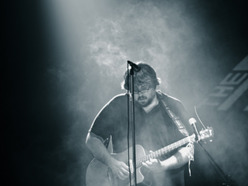
The Fierce and the Dead forthcoming UK Tour

Prog guitarist extraordinaire Matt Stevens has sent out a nice thank you, request, and notice regarding the very quickly forthcoming U.K. tour.  Of course, all North American Progarchists are jealous, but we’re also very happy for our British brethren.  Matt, play your heart out, as you always do.

Hi Brad [Yes! A personal email from Matt!]

I just wanted to say a massive thank you to everyone who shared the link and photo for the Fierce And The Dead/Knifeworld/Trojan Horse tour last week. Hundreds of you shared it!! Amazing 🙂 We really need this tour to work for us, financially it’s really difficult and we really hope to break even so we can continue to gig and make records. Word of mouth is so important and what you’ve done will make a big difference.

There is now an animated VIDEO promo featuring snooker legend and prog DJ Steve Davis again:

http://www.youtube.com/watch?v=NnaBtWeR1wg&feature=youtu.be

If you could share the video that would be amazing 🙂 If you can post it on your blogs, facebook, forums and twitter it will really help.  Everything counts at the moment, this is really make or break time for the band.

Thanks to everyone who came to the gigs this weekend – lots of you out and that’s really appreciated, lets hope that the same people come to the Fierce And The Dead tour 🙂

Here is the info for the tour:

STABBING A DEAD HORSE

Knifeworld, The Fierce And The Dead and Trojan Horse are to undertake a three way, week long tour of the UK in late October/Early November. We’re proud to say that the tour is sponsored by Prog Magazine, Rock-A-Rolla and Z-Vex Guitar FX.

Expect gnarled Northern experimentalism from Manchester four piece Trojan Horse. Acoustic loop wizard Matt Stevens ‘gone electric’ delivers angular and epic swathes of post- riffery with The Fierce And The Dead while eight-piece Knifeworld, fronted by Cardiacs and Guapo guitarist Kavus Torabi and including members of Chrome Hoof, deliver dense, soaring, kaleidoscopic prog.

Here’s the full letter:  http://www.reverbnation.com/c/fr5/artist_158359?eid=A158359_14950393_46610553&fsc=7414a21cb7f

Spirit of Talk Talk: A Well-Deserved and Respectful Tribute

The sound experience which I prefer to all others, is the experience of silence.

John Cage

A shared pleasure among some of the writers of this blog is an appreciation for the 1980’s British group Talk Talk. They began as a slick synthpop band, but quickly outgrew that genre. By the time they released Colour of Spring, their third album, their music had become something unique and very special.

Spirit of Eden came next in 1988, and the music press was utterly befuddled when confronted with a real work of art that had an almost sacred feel to it. In my 1992 edition of Rolling Stone Album Guide, J. D. Considine rated Spirit of Eden one star, saying, “Good bands usually improve over time, while bad bands generally just fall apart. But Talk Talk took a different approach with its musical growth; instead of getting better or worse, this band simply grew more pretentious with each passing year…..by Spirit of Eden, Mark Hollis’ Pete Townshend-on-Dramamine vocals have been pushed aside by the band’s pointless noodling.”

What Considine and other critics didn’t get was Mark Hollis’ and producer Tim Friese-Greene’s desire to pare the music down to its absolute essentials. This included the use of silence as a compositional element. Spirit of Eden works, because everything extraneous is ruthlessly stripped away, and we are left with the beauty of the bare structure of the melodies. Just as the most effective way to get an audience’s attention is to speak softly, Talk Talk used space and “pushed aside” vocals to draw the listener into their music. And a funny thing happened. As the years passed, the reputation of Talk Talk grew in stature, and Spirit of Eden is now seen to be the visionary and influential work of art it was back in 1988. Case in point: it’s hard to imagine Radiohead’s Kid A ever being released without Talk Talk’s groundbreaking work.

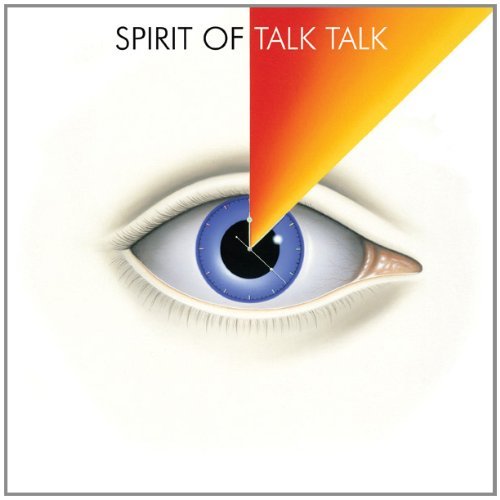
Which brings me to the topic of this post: a Talk Talk tribute album that has recently been released by Fierce Panda Records. Spirit of Talk Talk is a 2-disc collection of Talk Talk songs interpreted by 30 different artists. Alan Wilder, of Depeche Mode and Recoil fame, is the executive music producer and supervisor. James Marsh, the artist whose distinctive visual style was as much a part of the Talk Talk experience as their music, has done the cover art (Marsh loves visual puns: look for the clock in the cover shown above).

Tribute albums can be dicey affairs, often being attempts by deservedly obscure artists to get some attention. Spirit of Talk Talk is an album of respectful and sensitive interpretations of the original songs, while providing new insights into them. Imagine how even the poppiest early songs from The Party’s Over would sound if they were done in the style of Laughing Stock, and you get an idea of what this collection sounds like. The song selection favors tracks from Spirit of Eden and Laughing Stock, with some songs getting two different interpretations.

The first track, “Wealth”, performed by Lone Wolf, sets the tone for the album with a beautiful rendition that is almost liturgical in its plea to

Create upon my flesh
Create approach upon my breath
Bring me salvation if I fear
Take my freedom
A sacred love
Create upon my breath
Create reflection on my flesh
The wealth of love
Bear me a witness to the years
Take my freedom
Let my freedom up
Take my freedom for giving me a sacred love

Other highlights include a smoldering Duncan Sheik/Rachael Yamagata duet on “Life’s What You Make It”, King Creosote’s folk-polka performance of “Give It Up”, an intimate acoustic jazz performance of “April 5th” by the Matthias Vogt Trio, and the final song, “I Believe In You” by Arcade Fire’s Richard Reed Parry, whose hushed, multi-tracked vocals conjure up echoes of Thomas Tallis.

One of the most pleasant surprises for me has been hearing the Laughing Stock songs in a new light. I had not fully appreciated their beautiful melodies and lyrics until these interpretations showed me new facets of them. It’s been like seeing an old friend after several years’ absence, and discovering even more reasons for the friendship.

Even though it has been more than twenty years since Talk Talk has recorded, it is nice to see them finally get the praise and respect they deserve. Since it seems unlikely we’ll ever hear Mark Hollis sing again, we’ll have to make do with Spirit of Talk Talk. Fortunately, Fierce Panda has offered us an excellent and worthy substitute.

Lone Wolf Performing Wealth:

Universal Yodel – Penguin Cafe Orchestra

I’m reposting here an article on Penguin Cafe Orchestra I wrote for Perfect Sound Forever several years ago.  More work needs to be done on this band (and on EG Records, mentioned in other posts), but for now my intention in repurposing my article is to place it in the context of Progarchy, where connections might be made outside of the borders of Perfect Sound Forever.  First, an exercise in beauty:

http://www.youtube.com/watch?v=P6df-1tvYsg&feature=related

Jimmie Rodgers hopped the rails, and the world changed. The “Singing Brakeman” saw all that his green Earth had to offer – the rolling southern hills and delta country of the United States – and along the way picked up some blues to add to his bag of “hillbilly” songs. One of those might have come from bona fide ‘billy Riley Puckett, a blind guitar player who would come to fame with Gid Tanner’s Skillet Lickers, and who in 1924 recorded “Rock All Our Babies to Sleep,” a waltz-time favorite that spawned eleven more versions before Rodgers himself laid it down in 1932. Where Puckett might disappear into the scratchy crackle of just another hillbilly 78, however, he puts a hair-raising yodel at the end of each chorus. It is a compelling moment that may have spoken volumes to Rodgers, who mastered many “blue yodels” up ‘til his death in 1933, their popularity earning him the mantle of country music’s first true star.

Yodeling suited the new Babel of radio, and it is little wonder that Rodgers had as much influence on blues as he did on country music. To listen back to his songs today, it’s as if the turnarounds between verses, where the many-hued “yodel-ay-heees” speak to us in tongues, are a kind of reverent return to an original common language afforded by the luxury of recorded sound; it is a quality that errant British guitarist Simon Jeffes, nearly a half-century later, might have termed “imaginary folklore.” And, in Jeffes’ hands, the yodel would be transformed into an imaginary cultural cornerstone.

Disillusioned with both the academy and the avant-garde, Jeffes made a career of crossing borders. A first step occurred while traveling in Japan in 1972, when he heard a tape of African music that sparked an ecstatic experience revealing to him, “why it is we play music, that gut level sound of humans being human.” That same year, Jeffes had a feverish vision, again in a foreign clime, this time the south of France. He dreamt of a place, “where everybody was taken up with self-interested activity, which kept them looped in on themselves. It wasn’t like they were prisoners, they were all active, but only within themselves.” In response to the visceral African music he had heard on the one hand, and to this flattened dream-world on the other, Jeffes created a separate vision he termed the Penguin Café, where the “unconscious can just be,” and that would guide the musical output, over the next 25 years, of his Penguin Café Orchestra.

The Orchestra evolved slowly; its albums took time, starting with Music from the Penguin Café (1976), which tends to divide fans and critics. The product of an early association with its executive producer Brian Eno, it ably bears the stamp of the EG Records catalogue, and is at home beside Eno, King Crimson, and the galaxy of unclassifiable modern British musicians who landed at the label. Its electric instrumentation gives the album an unsettling quality that is almost conscientiously avant-garde. It shares, with its successors, absurd titles (a personal favorite, “Hugebaby”), a love of simplicity, and a fine timelessness.

The self-titled second album did not arrive until 1981, and is considered by many their definitive work. Like great records should, Penguin Café Orchestra captures its composer and musicians at a critical moment of prowess, an acoustic sensibility replacing the stiffer electric stance, its fantastically melodic themes performed concisely, and with intense discipline.Broadcasting from Home (1984) and Signs of Life (1987) continued that trend, and by the 90s their work was so associated with “themes” that Jeffes began undertaking soundtracks and scores (he had already gained some notoriety for arranging “My Way” for Sid Vicious and Malcolm McLaren). These included a ballet based on Orchestra music, Still Life at the Penguin Café Orchestra, and the soundtrack to the film Oskar and Leni. The scores included PCO standards arranged for larger orchestras, a development that would bear fruit on their last studio album, Union Café, featuring new pieces comparatively fleshed out, both in length and in orchestral depth. Their two live albums, 1987’s When in Rome (recorded, in actuality, at the Royal Festival Hall in London) and 1995’s Concert Program offer a nice comparison of this shift as well, the former capturing the simplicity of their earlier work, the latter making use of extended instrumentation.

Despite the consistency, progression and weight of their work, however, dial up Penguin Café Orchestra in your favorite record guide, and you will find a) Nothing at all (even Mark Prendergast’s sprawling and comprehensive Ambient Century presents naught but a great hole in the index where Penguin Café Orchestra should be); b) Befuddled hipster confusion, usually concluding with the unfortunate designation “New Age,” or, less typically, c) Jeffes’ own description of their music, as “imaginary folklore.”

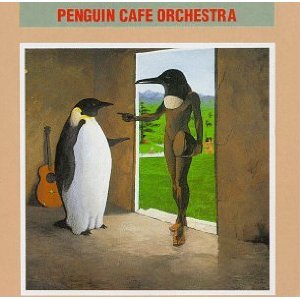
For the sake of “imaginary context,” we can embellish a bit, adding that the Orchestra created music in a chamber setting that might, for temporary convenience only, be considered “hillbilly ambient” or “minimalist hot jazz,” echoing the displacement of its author’s life. For Simon Jeffes, like Jimmie Rodgers before him, hitting the road was a way of being. The roots of both men were in “this culture of slightly dispossessed people who live in the modern West but haven’t got one rooted home.” For all such dispossession the Orchestra itself remained remarkably cohesive over the years: Helen Liebmann’s cello informed nearly every composition with equal parts grace and rhythmic chug, Neil Rennie’s ukelele kept things skipping lightly, Gavyn Wright contributed on violin, and Geoffrey Richardson’s and Simon Jeffes’ filled in, or left out, anything that did or didn’t belong. The album art, by Emily Young, was another constant, importantly defining the band visually as at once fun, mysterious, and potentially rather dark.

Yodels are like that, too – silly, deeply communicative, shaded. Riley Puckett knew it, Jimmie Rodgers capitalized on it, and Simon Jeffes found an anchor in it. Starting with their second record, Penguin Café Orchestra, the group’s albums are littered with yodels. Some, like “Yodel 1,” “Yodel 2,” “Prelude and Yodel,” “Yodel 3,” make their intentions plain (although, as in most of the Orchestra’s output, vocals are absent, if not missed), suggesting a train on approach, making the bend, stepping down, energy released and restored. This from a clipped guitar, a plaintive piano, a lone cello, looping their themes like an acoustic Kraftwerk, so you can hear the creak of the wood, the incremental variations, and the chance that’s involved with every note. The Orchestra never gave short shrift to chance.

Although Jeffes’ British-ness reverberates through the group’s tendency to a pastoral loveliness, reminiscent of the orchestrations of Nick Drake’s best work, his vision in song is continental in scope, looking in turns to the avant-garde, “world” musics, and in particular to the repetitive power of the country blues. The simple “Telephone and Rubber Band” is at once cerebral and gut wrenching, moving from an exercise in making music out of a telephone signal to a woozy-bloozy, cello-driven resolution. Philip Glass getting his fingers dirty? A hillbilly Erik Satie, or drawling Raymond Scott? Waves of understanding now wash over us: it is all this and more, so as to avoid description rather than disturb the “unconsciousness,” and not dare look into the face of God, it is better to leave it as is. Like contemporaries such as Cluster or Popol Vuh, Penguin Café Orchestra risks remaining mute in history, having made a music that speaks many languages.

If folklore somehow comes from a common cultural expression, Penguin Café Orchestra might be ahead of the game in creating it, despite the “imaginary” quality of their folksong and perhaps because of their very anonymity in the literature. Their works appear often in commercials, themes for film, TV, and radio, and on others’ albums. That you are hearing the Orchestra’s “Perpetuum Mobile,” “The Ecstasy of Dancing Fleas,” or “Music for a Found Harmonium,” is perhaps less important than the unshakeable feeling you have heard this music before.

Annotated discography, excluding compilations:

Music from the Penguin Café [1976; Editions EG] | Adorned with an almost camp melody, the opening track on Music from the Penguin Café, “Penguin Café Single,” seems at odds with the rest of the album, and could almost come from their final record. A subtle electric glow (gloom?) shades the rest of the record, a series of vignettes including the brilliant “In a Sydney Motel,” one of the Orchestra’s very few vocal tracks; it straddles a Velvet Underground/Faust/Slapp Happy continuum, and wouldn’t sound out-of-place on any number of recordings being released today. The perennial from this album, however, is “Giles Farnaby’s Dream,” a “collaboration” between centuries-dead composer Farnaby and Jeffes, who creates an epic baroque hoedown akin to the Beatles’ “Piggies.”

Penguin Café Orchestra [1981; Editions EG] | The comparatively long “Numbers 1-4,” at seven minutes, is Penguin Café Orchestra‘s thematic centerpiece, so richly gorgeous as to distract the listener from the album’s overall musical severity, a tight discipline that is the record’s fountainhead. Yodels, airs, and breakdowns, and even a dervish version of “Walk Don’t Run” fill a space that’s at once contemplative and enormously positive. It is a delicate balance that was achieved over a three-year period of composition and recording.

Broadcasting from Home [1984; Editions EG] | A companion piece to Penguin Café OrchestraBroadcasting from Home shares many of that album’s characteristics. Opening the album, “Music for a Found Harmonium” rises from a drone like steam from the harmonium that was, in fact, found by Jeffes just lying on a Kyoto street, having been tossed out by its owner. It breaks into a Celtic dance, swinging so hard there was no way the Irish couldn’t take notice, as they did, in fact, when the group Patrick Street covered the song to great success on 3 Irish Times 3. The balance of Broadcasting from Home continues the feel, swaying through “Prelude and Yodel” to “Music by Numbers” and “Isle of View (Music for Helicopter Pilots),” with a graceful tilt signaling the complete comfort Jeffes and group felt with the material. There is even a brief return to the first album with “More Milk,” interpreting that record’s “Milk” within an almost African setting.

Signs of Life [1987; Editions EG] | A quieter, maturing record that hints at unease, Signs of Life follows the themes of the previous two albums with a more contemplative tone, its standouts including “Southern Jukebox Music,” the oft-heard “Perpetuum Mobile,” and the long, drifting, refreshingly uncharacteristic “Wildlife.” The opener, “Bean Fields,” and “Dirt” harken back to Penguin Café Orchestra‘s classic “Ecstasy of Dancing Fleas.”

When in Rome [Live, 1988; Editions EG] | This live album served, for some years, as the best introduction to the Orchestra; they remained fairly faithful to their originals, but stretched a bit.

Still Life at the Penguin Café Orchestra (the score to David Bintley’s ballet of the same name) [1990; Decca] | A successful reworking of Orchestra songs for a ballet based on the group’s music, Still Life at the Penguin Café Orchestra gave Jeffes the opportunity to arrange his music for a new setting, a development that would be felt on subsequent recordings.

Union Café [1993; Zopf] | Exhibiting in places a greater reliance on orchestration, perhaps the result of Jeffe’s score and soundtrack work, Union Café builds themes in similar fashion to the Orchestra’s best songs, with an added formality and elegiac beauty that moves much of the work here towards the realm of classical chamber music. The tracks are longer, perhaps reflecting composition for CD rather than vinyl, and at times one gets the sense the concise discipline exercised on early albums is, if not absent, less of a guiding principle. This may be a good thing, depending on one’s point of view. Songs like “Nothing Really Blue,” “CAGE DEAD” (occasioned by John Cage’s death, it uses the progression of the title as its theme, with a rhythm suggesting a Native American chant), and the frenetic, nervy “Yodel 3” show a band gleefully reworking themes, building anew, and most definitely moving forward. The solo piano of “Silver Star of Bologna” and “Kora Kora” are eye-opening glimpses into the gracefulness Jeffes achieved as a composer.

Concert Program [Live, 1995; Zopf] | A nice two-disc set that treats much of the material from Union Café, and older work, to an orchestral concert setting, with admirable success. This Orchestra is of a different sort than the one that played on When in Rome – richer and fuller – and therefore a worthwhile companion to the first piece, even where dealing with the same songs (which suggests these works might continue to benefit from future interpretation).


Originally posted on Perfect Sound Forever: http://www.furious.com/perfect/penguincafeorchestra.html

A Forgotten Masterpiece–UK from 1978

Happily, my good friend, Thad Wert, just agreed to become a Progarchist.  

He just published a wonderful examination of U.K. on his own excellent website.  

Here’s an appetizer:

In England in 1978, when Sex Pistols, The Clash, and Buzzcocks were riding high, you could not go more against the grain of musical tastes than to record a prog-rock album featuring veterans of Yes, King Crimson, Roxy Music, and a fusion jazz guitarist. Yet that is what John Wetton (bass & vocals), Bill Bruford (percussion), Eddie Jobson (keyboards & violin), and Alan Holdsworth (guitar) did. Released on the EG label, the eponymous lp was pretty much ignored in the U.S. Bruford was a former member of Yes, and he had played with Wetton in King Crimson during their “Lark’s Tongues In Aspic” through “Red” period. Eddie Jobson had played keyboards and violin in Roxy Music, and Alan Holdsworth had been a member of the jazz drummer Tony William’s fusion group Lifetime as well as Soft Machine.

To read the full thing, go here–http://fractad.wordpress.com/2012/10/13/1978s-u-k-an-overlooked-prog-masterpiece/

Prog Master Greg Spawon on Prog

ImageThe question at TIC: What does “prog” mean to you?  The English gentleman (and intellect), Greg Spawton of Big Big Train, answered:

To me, ‘progressive’ is a term which describes a genre of music. That genre emerged from the rock and pop music of the 60’s and became fully defined in the early 70’s. But what I think may be the sub-text behind your question is whether bands writing and performing music in the progressive genre need, by definition, to be striving for some sort of statement of originality in everything they do. I think not, but I am aware that many others take a more absolutist view of things and this has caused an endless debate. In The Music’s All That Matters, Paul Stump makes some very interesting observations. Early on in the book, he correctly identifies that the main problem with progressive rock is its name (he calls it ‘the most self-consciously adjectival genre in all rock’.) Another point that Paul Stump makes is about what unites the musicians of the genre. He says they have ‘a hankering after the transcendent’. I really like that phrase as it can take on a broader meaning than ‘progressive’. In Big Big Train, we combine our influences in a way, which is often original. But trying to do something different isn’t the be-all-and-end-all. What we are really trying to do is to make extraordinary music.

To read the whole interview (well, well worth it), go here:

http://www.imaginativeconservative.org/2012/06/english-autumnal-bliss-progressive-rock.html

Rush thinks about retirement.

Completely understandable.  They’re legends, they’re at the absolute top of their career.  It seems like a just and sane move.  http://www.classicrockmagazine.com/news/rush-face-up-to-retirement/

Stabbing a Dead Horse Tour

ImageOne of our favorite proggers, Matt Stevens, posted this video today of his new tour, Stabbing a Dead Horse.  Great job putting the video together–it has a rather English flair to its humor.  Sadly, no North American branch of the tour–but, let’s hope soon.  Best to you Matt!

http://www.youtube.com/watch?feature=player_embedded&v=NnaBtWeR1wg#!

Interview with Mike Portnoy

wpid-portnoyoctober122012-2012-10-13-16-51.jpegPortnoy seems happier than he’s been in years. After watching him drum some of the greatest drumming I’ve ever heard or seen last night in Chicago (“Chicago or St. Paul or wherever we are. . .”), I was very excited to see this interview with him today.
http://rollingstoneindia.com/backstage-with-mike-portnoy/

Q.  And finally, how did you manage to get a progressive band like Dream Theater up and running in the late Eighties and early Nineties, at the height of prog-phobia?

A.  When we recorded Images and Words in 1991, it was at the height of the grunge explosion. It was Nirvana-ville at the time. You would think that us getting signed to a label and having success with that album was completely impossible, but somehow it clicked. The only thing I can think of is maybe it was a reaction to the fact that nobody else was doing it. We were so drastically out of fashion, but  there was an audience that was looking for something like that. For the first 10-15 years of Dream Theater’s career, prog was a dirty word. We always embraced it, we never had a problem with it, but all the critics would blast us for it and it wasn’t until the turn of the millennium that it started to turn around, and it was our perseverance that helped that happen.

Mike, I’ve been listening to you since “Pull Me Under.” Now that I’ve seen you live, I only think the absolute best of your ability and your personality.

Neal Morse, Chicago, October 12, 2012.

Last night, fellow Progarchist Mark Widhalm, our lovely and patient wives, and I had the wonderful privilege of enjoying six hours of live progressive rock.  We saw District 97, Three Friends (Gentle Giant), and Neal Morse.

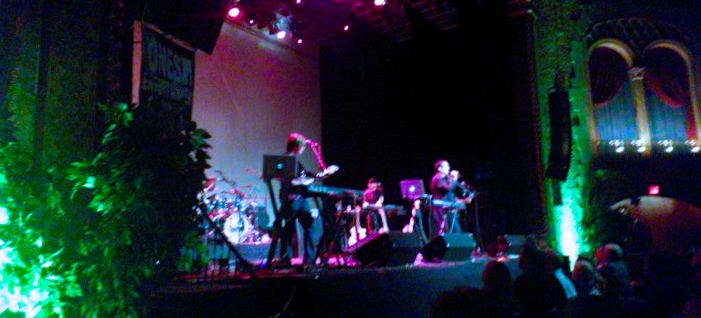
Here are two photos from the event.  The first is of Three Friends.  The second is of Neal Morse.

Image

Image

Sorry about the poor quality of the photos; I took these with my Nokia phone.  I also got to see Chicago celebrities (well, at least they’re celebrity in the Birzer house), Mike and Sarah D’Virgilio.  I glimpsed Neal Morse’s manager and Facebook friend, Chris Thompson, from a distance, but he was a man understandably on a mission, and I didn’t want to interfere with his direction of the show.  “Hey Chris, it’s me, Brad, your Facebook friend!”  Yes, I can be obnoxious, but this might have gone a little too far, even for me.

A few quick impressions–Gary Green was one of the single finest guitarists I’d ever seen as was his bassist, Lee Pomeroy (of It Bites).  The music of Gentle Giant was rather mind-boggling and profound.  It was, I think, rock at its highest art.  Steve Hayward has been encouraging me to immerse myself.  Add Steve’s suggestion with actual performance, and I’m sold.  Now, another band to explore in its entirety

But, we went originally to see Neal Morse and Mike Portnoy.  The other music was just an excellent fringe benefit.

Neal Morse is a wonderfully talented madman.  I pretty much hung on his every word and action on stage.  His energy, his talent, and is ability to direct and lead his band is probably beyond compare.  While I’m sure I’m not the first person to place supernatural ability on a great show man, but Morse’s showmanship did seem to be animated by something well beyond (and above) this world.  I know this probably sounds absurd, but there was glow about him that I’ve only seen (once at most) on truly holy persons.

And, while I’ve always considered Mike Portnoy one of the world’s best drummers (along with Nick D’Virgilio and Neil Peart), I’ve always also thought his studio records seem more mechanical than soulful.  Watching him in action convinced me, rather strongly, that he’s a man as full of soul as he is of ability.  In judging his abilities, I realized I should never allow his precision and perfectionism to detract from his power and radiance of soul.  Having him and Neal Morse on the same stage was overwhelming, to say (write) the least.  These are two powerful personalities who served as critical poles of incarnate myth.  Because of my seating, I had a perfect view of Morse but a poor one of Portnoy.  Had I been able to choose between one or the other to focus on during the concert, I would’ve been rather torn.

The two men, despite clearly being perfectionists and powerful personalities, are obviously the best and most trusted of friends.  At one point, two obvious Mike Portnoy fans yelled something at the end of a very powerful moment in Morse’s Testimony.  Morse was a bit taken aback (as was the entire audience), and I would guess that the audience as a whole lost a story of some kind because of the interruption.  Portnoy stood up from his drumkit and yelled directly at the two: “There will be no heckling at a Neal Morse concert.”  He did it with great humor and strength.  Needless to write, no one yelled like that again.

Everyone in Morse’s band, not surprisingly, was an expert and multi-talented musician.  Randy George didn’t move around much, but he played his bass with confidence and skill.  All of the musicians, though, were equally good, and the most impressive part of the whole night were the vocal multipart harmonies which Morse directed with passion.

This was probably the best concert I’ve ever seen (Three Friends as well as Neal Morse).  Yes, I’m still basking in it.