

Shortly after the release of his album, Courting the Widow, I had the good 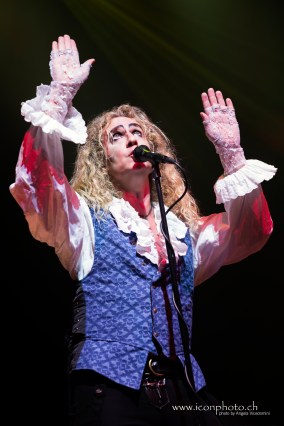 fortune of interviewing Nad Sylvan. Sylvan has become well known in the prog community as of late based on his singing with Steve Hackett’s touring band. Now he’s come out with his own solo album that is a fine piece of progressive rock, with a great character carrying a great storyline throughout. And not only that, but it has an outstanding epic smack in the middle of the album, and you know how us proggers love our epics. Nad and I also talked about his career jump, his album and the persona behind it, and a number of other topics. Hopefully you’ll enjoy this read as much as I enjoyed my conversation. And hopefully you’ll give his album a listen – you won’t be sorry.
Nad Sylvan: More liberating than scary. Of course, it’s a bit scary, but I didn’t expect this to happen with Steve Hackett. I thought I was doomed to being one of those guys you might hear about sometime. I was fine with that. The job, I couldn’t endure heavy traffic, and I was working night shifts and evenings, I was on my own and it was boring. It was a good income for what it was, as I was able to buy and maintain a house. They granted me leave for two years (four tours). But when this tour with Steve came up again, they questioned me with “what do you really want to do, because we want give you anymore leave?” And I said “that’s it, I’m leaving.” And to make that jump is very liberating. A bit scary, because I’m on my own now, I have to make sure I do everything right, by the book, so I don’t get in trouble with the tax company. So I’m very busy these days, but I don’t regret it at all.
Progarchy: You have a fairly extensive history in music. How did you come to prog?
Nad Sylvan: Before I even started to do prog, the songs I was writing when I was young – this is when I was very young, 13, 14, 15 – I was influenced by guys like Gilbert O’Sullivan, Elton John. I was a guy who would write ballads by the piano and sing them, very young. Then after I quit school when I was 16, I was working at a record shop. This guy who was working there pulled out ‘The Lamb [Lies Down on Broadway]’ and said “this is what you should be listening to, this is great music.” And I was instantly floored, this has to be the most exciting music I’d ever heard. This was in 1975. In 1976, I just happened to meet some guys of my age that just happened to need a keyboard player, because I played the keyboards. So I just started to play with them, and their emphasis was Genesis, Yes, all that kind of stuff. So when I was 17, we kicked off playing progressive rock, and after a year I had an organ, a minimoog, a mellotron, and all that kind of stuff. So that’s where I started and I did prog for a couple of years until the late 70’s and then the band split up. Then I was in transition mode and listened to Gino Vanelli, Al Jarreau, and all that kind of stuff. It sounded fresh to me so I wandered in that direction. Then I did some 80’s pop. Prog, I just accidentally drifted back into it when I saw The Musical Box. By that time I had done my 3rd solo album, and it was really good, soulful rock album, but it didn’t do anything so I thought “what the [heck .., :)] it didn’t do anything, so I might as well do prog because that’s what’s in my heart. So I did, and you know what happened.
Progarchy: Can you explain the storyline that runs through many of the songs on “Courting the Widow”?
Nad Sylvan: As you know, progressive rock, as typical progressive rock album is multi-dimensional in a way. It always leaves the listener free to interpret the songs the way they want, the lyrical content and everything. For me I have this stage persona called The Vampirate. Someone used to tell me “you look like a vampire” and “you look like a pirate.” I know, a vampirate! I just laughed at it and thought “what a great gimmick.” So I developed that. Of course, a pirate, the vampirate must have his own ship, which the vampirate certainly has. In the first song you hear the moored boat, the people walk on board, and you hear the vampirate’s wings, he’s sort of coming from nowhere before the synth kicks in, you hear him soaring through the sky and land on the yardarm and stuff like that. When you get the physical album, you see that a couple of songs have a log attachment, log I, log II, log III. So that’s when you hear the ocean roaring in the background.
It’s also where my musical journey from where I kicked off. In 2008, I did an album called Unifaun with a guy called Bonamici. That’s sort of a Genesis pastiche if you like. Our own music, but it sounds like the missing 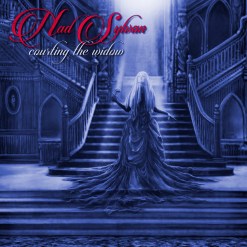 Genesis album, just for fun. Nothing serious, but it was taken seriously and we got a record deal with that. And that was a springboard for where I am today, both Roie and Steve love it. The music on this album is a journey from where I left off from Unifaun, and gradually moving into present day, with Where The Martyr Carved His Name and Long Slow Crash Landing, they were written this year. That’s why it doesn’t stay exactly the same way. It’s like a journey, it goes from place to place. Also, of course, if you listen to the lyrics, it’s all about death or dying, the afterlife, or the before life. It has a lot of questions. That also, I was thinking The Widow herself become a symbol of death and she symbolizes the whole album, she is the star of the whole album. I’m just the interpreter. That sort of the way I’m thinking of this album in conceptual terms.
Progarchy: Can you explain more about The Vampirate, who he is?
Nad Sylvan: The vampirate was born in about the 16th century, late 16th century, but his active life was in the 17th century. If you look what I’m wearing on stage, you’re probably thinking I’m from that era. That even started with Unifaun. It’s just something I feel confident with doing, I think it’s unique and nobody else is doing it and I enjoy elaborating on it. During the course of working with these past years with Steve [Hackett], I grew into this character. And I thought when I went to do a solo album, why not just get him out of his coffin and let him do his thing. So that’s what it is, that’s my persona.
Progarchy: Is he going to make an appearance in future projects?
Nad Sylvan: Well, I’ve always been fond of a trilogy. I think I should do The Vampirate for at least three albums. Then I might do something completely different. As long as it works. Or, I may just stay faithful to this character, I don’t know, it’s too early to tell. Let’s just see where this album is going at first. I’d like to tour for this album, but I don’t know how that’s going to be executed.
I must say I’m absolutely stunned at all the critics, so many good reviews, I didn’t expect that to happen. One or two bad apples, but in general the album has been very, very well received, and I didn’t expect that. I’m extremely grateful for that.
Progarchy: And about your epic, To Turn The Other Side?
Nad Sylvan: I just went for it, I know I’m into prog now, Steve will want to play on it, everyone will want to play on it. And I thought ‘why not just do this extended peice?’ that prog-heads actually yearn for. It’s almost as if they crave something like that on a prog album. I’m not sure it’s the best prog piece ever, but I’m content with it. You’ll probably know in a couple of years how good it is, if you want to go back to it. I’m sure Genesis was clueless in 1972 when they did Supper’s Read. I think they were even doubtful that they were going to keep their record contract. They didn’t have any history with that song, but now they do. I’d like to see what happens one or two years from now.
Progarchy: How do you think working with Steve Hackett affected you? Did it affect the direction of the music on this album?
Nad Sylvan: Not really. I’m being very honest now, I’ve been a songwriter for four decades, and I started working on three of these songs from 2009 and 2011. So I was starting work on these song before I met Steve for the first tour. In 2012 I started working on the epic piece. But I could here where he could play. There is a song on the album I actually wrote for Steve to play, it’s third song on the album, Echoes of Ekwabet. There’s a guitar solo on the album I wrote for him, and I’m the one who’s playing it, but it was intended for Steve. And when he heard it, it said “You know, I don’t think you should change this, just let it be like it is.” With his blessing I thought, ok, ok. I’m not a very skilled guitarist, but I do well in the studio.
Progarchy: Well, if Steve Hackett likes it, that’s a good feather to have in your cap!
Nad Sylvan: I think so. In the end it’s about good music, if you like the songs or not, not who plays them.
Progarchy: Could you elaborate on the back story of Echoes of Ekwabet?
Nad Sylvan: We did a show in St. Charles, just outside of Chicago, about two years ago. If you walk along the Fox River, there’s a big statue of an Indian Chief. The statue itself is called Ekwabet, which means in Potawatomi “watching over.” That statue commemorates the removal of  the Indians back in the 19th century. I remember reading lots of things about it and I was intrigued by it. I liked the sound of Ekwabet, I think it sounds like a male Elizabeth. And it’s rhythmic and melodic and I thought “Echoes of Ekwabet” because the lyric echoes what happens. I had already started writing the music, a year before, I wasn’t finished with the song and went back and finished it, bits and stuff. So I had a story, and I thought it really matched the vibe with this song. I arranged some of the instruments to sort of image the lyrical content, to reflect it, mirror it. To me, personally, it’s one of the outstanding tracks on the album, I just love that track.
Progarchy: Other influences, what other influences have affected you?
Nad Sylvan: Well, I’m 56 years old now, so I’ve listened to a lot of music in my life. Basically my interests are what they are. For instance, the epic piece, everything I’ve listened to is in there, everything from Yes, Genesis, to Motown, 80’s pop, everything is in there, but combined in a way that I think works. I’ve listened to so much stuff. There’s very little hard rock, I’m a huge fan of hard rock, not metal, but stuff like Deep Purple from the 70’s. But I just wanted to make a solid prog album, and I hope that happens.
Progarchy: The Motown sounds are an interesting twist even by prog standards. What brought that into the album?
Nad Sylvan: It’s not like Motwon per se, it’s not like I’m trying to do another, what’s his name, Marvin Gaye. It’s the attitude and the voice, it’s soulful, it’s bluesy at some points. Some of the bits from To Turn The Other Side, I think it’s the Dreaming of Afar section, many of the vocals kicking in. To me, that’s not something Genesis would do, that’s more towards Motown. I think it’s good to bring in a bit of soul music into prog, because that’s what it needs, there’s more sex, and lust, and romance (laughing). Not always about eclipse and stars and such. It can be anything, but as long as it’s emotional.
Progarchy: Anything else you’d like to tell us about your album?
Nad Sylvan: I can say like anything else I do, it’s a very honest album, and I don’t put on anything, I don’t try to sound like someone else. If I do occasionally, it’s still very honest, it’s just what I hear in my head. I’ve heard numerous times that I sound like Collins or Gabriel when I sing Genesis stuff, and I come back with “I sing the songs the way I’ve heard them.” I hear the original voices in my head and I emulate that and that’s what comes out. I’m just being honest with what I do, I don’t think you should change. Of course I will always put my stamp on it, but I sing them the way I’ve heard them, and so far people seem to appreciated that.
Progarchy: Well, you are given the voice that you’re given …
Nad Sylvan: Exactly, I couldn’t go on singing Yes music, it wouldn’t sound right. I don’t have that voice. But I’m a chameleon, I can change, but right now I’m into prog rock, so I go with that.
Progarchy: Thank you very much for your time. It’s been a very enjoyable conversation.
Nad Sylvan: You’re welcome, thank you very much.
————————————————————–
BTW, Nad, the same offer I made to Mariusz Duda of Riverside stands for you as well – play a gig here in Austin, and I’ll buy dinner 😉
 Progarchy