

Atlanta-based progressive rock band ETHOS is back with their latest release, An Eye for an Eye, a full-length album that dropped on June 25th, 2024. With a rich blend of progressive rock elements and thought-provoking themes, ETHOS continues to push the boundaries of their sound, marking a significant evolution since their last work. In this exclusive interview, the band delves into the inspirations behind the album, the challenges they faced during its creation, and the unique songwriting processes that shaped this dynamic release. From tackling global power structures to exploring personal resilience, An Eye for an Eye offers a complex narrative that is as bold as it is introspective. ETHOS also shares their experiences working remotely, collaborating on guitar parts, and mastering the album alongside the renowned Jens Bogren. This interview gives fans a deeper look into the creative minds behind the music and what they can expect from ETHOS moving forward.
Congratulations on the release of “An Eye for an Eye”! Can you tell us about the inspiration behind the album’s title?
Austen: Thank you! I have a painting by fantasy artist Fian Arroyo that shares the same title. At some point during the post-production process for this album, I walked past the piece and it just clicked. A lot of the lyrical content is fueled by distrust of power structures or a tongue in cheek commentary on those systems and their inevitable reckoning. However, the implication of the phrase “An eye for an eye” assumes there is remedy for every wrong doing, and I don’t believe that to be true. Rather, I believe that through creativity we can heal ourselves and each other by transforming our experiences – even the worst – into something beautiful. There is a lot to be angry about in today’s world, but it’s important to ask yourself “what will you do with it?”
How did the process of writing and recording “An Eye for an Eye” compare to your previous works?
Kuyper: We relied more heavily on remote work this time around, for a variety of reasons. A lot of the initial ideas for this album came from remote sessions Austen and I had via JamLink, where we could join a session and play in real time. We started recording those sessions which led to me tracking my parts separately and sending them to Austen. Then the rest of the guys would get together in the studio and we would solidify song structures and rewrite parts until we were all happy with them. For a while we didn’t know how writing would work out of state but we adapted to that challenge and it definitely contributed to how we approached songwriting. Times when we were all in the same room were rare and precious so we handled a lot of the meticulous stuff over calls and remote sessions so we could enjoy every moment we had in person as a full band.
Austen, as both the vocalist and the keyboardist, how do you balance these roles during live performances and recordings?
Austen: It’s a much easier balancing act than vocals, keys, AND guitar… It used to be that Matt and I wrote a lot of dueling guitar parts together, I would sling the guitar over my back, hit a piano break, and back to guitar! “An Eye for An Eye” marks a shift in that and I focused more on vocals and keys. If it’s a piano driven song I tend to work out vocals earlier on, but we have plenty of material that was written instrumentally before most of the vocal ideas came into play. When the ideas are written that way it takes forethought and practice to make sure it’s feasible live. I still do some writing on the guitar but with 5 of us now, a lot of possibility has opened up and even more ideas can be shifted from instrument to instrument.
Kuyper and Matt, how do you collaborate on guitar parts to ensure a cohesive yet dynamic sound?
Matt: This EP was the first time Ethos has released music as a 5-piece. Before Kuyper came aboard, I was used to occupying most of the guitar space. Kuyper is an absolute beast of a guitar player and an incredible composer and what he brings to the table is so unique, but we each have our own way of approaching the guitar and songwriting. This allows us to give each song exactly what it needs. We are both writers and lead guitarists but I find that we mostly complement each other because of our differing styles.
Kuyper: Collaboration has been interesting because of the distance since I am in Nashville, TN and Matt is in Rome, GA. We really haven’t gotten to sit in the same room and write before. Because of that, we have had to cultivate a ton of trust. Matt is a brilliant guitar player and composer so it makes it easy to respond to an idea he has written. Overall I think our collaboration is defined by an unwavering trust in the other’s abilities and musical sensibilities.
Nick, can you talk about your approach to bass on this album and how you ensure it complements both the rhythm and the melody?
Nick: For me, the approach was a bit different than our previous releases. This was the first time we wrote music as a five piece, so with two distinct guitar parts going on for many of the songs, I was very careful in how I weaved in and out of those parts. I approach bass composition differently now than I did on our previous releases anyway. I have begun to find more interest in the “less is more” approach and how much is actually going on in rests and the spaces between notes. In other words, I don’t have to show my full hand or dig so deep in my bag of tricks for every song. I think it is OK to say that I am pretty proud of my parts on this album. I feel like they compliment the guitar parts instead of trying to push through or fight for space against the guitar parts. I always want to be conscious of what’s best for the song. It may not be the most flashy or technical part, but if it holds the song together and lays a good, solid foundation for the other parts, that is what I want to always strive to do.
Tribb, what were some of the challenges and triumphs you experienced while recording the drum tracks for this album?
Tribb: For this release, we took a different approach from our previous releases and I tracked drums remotely using an e-kit to help create a more crisp, punchy, “modern metal” production. In the past it’s been purely me on an acoustic kit, which of course has that warmth, dynamic, and imperfection that makes a natural drum performance so magical and have that human aspect that’s hard to replicate in an electronic setting. The danger in this day and age with all this technology at our exposure is phoning it in and over-editing drums so it essentially becomes a cold, perfect drum machine, instead of an actual drum performance. I think people can tell when it’s not real. It was important to me to still perform the parts and get them how I wanted them to be and how I actually played them and I’m more than happy with the end result.
Austen, you mixed the album at Darkroot Studios. How did being involved in this part of the production process influence the final sound of the album?
Austen: It’s a tricky thing to work on post production for your own project but I leaned on the guys for feedback in order to check my own bias. It allows me to run with ideas in the part writing such as doubling certain layers or being creative in how intentionally certain parts come through in the final mix. One of the benefits is that I am able to let the recording process inform some of the decisions we make in the arrangement of the songs – having a good pre-production process and creating demos allows you to hear how everything is interacting in a way that is more objective. Removing yourself from the performance often informs a decision to adjust parts, move them to a different instrument, or drop it completely for the benefit of the entire song.
The album was mastered by Jens Bogren at Fascination Street Studios. What was it like working with Jens, and how did his mastering impact the final product?
Tribb: Jens (Bogren) is one of the masters in the production world, mixing and mastering for bands we love like Haken, Katatonia and Opeth, so we were beyond ecstatic to work with him again. It was all through remote communication and file sharing and he was a pleasure to work with as usual. His mastering really rounded out the overall sound to make the songs sound fuller and bring out certain frequencies to really give it that extra push and a nice overall sheen.
Can you walk us through your typical songwriting process? How do you start, and how does a song evolve within the band?
Matt: Writing with Ethos is highly collaborative. It requires input from every band member. Typically one or two of us are instigators with some kind of riff or idea and then we continue to shape and mold it–usually over a long period of time. We’ll start a recording session or hash it out in a room until it sits well with everyone. Sometimes it’s seamless and other times it’s grueling and we completely disagree or dismantle a piece. However the process goes, we work until we are happy with it, which usually entails us getting the “feels” from the composition.
“An Eye for an Eye” has a very progressive sound. Which bands or artists have influenced your music the most?
Tribb: This could obviously be a very long list and we’ve all got varying influences across a lot of genres. Early on there was a heavy Muse, Circa Survive and 30 Seconds to Mars influence, then more modern prog bands like Karnivool, Porcupine Tree, and Haken, and more recently some “heavier” prog metal bands BTBAM, Opeth and Periphery. Mix in some more alternative bands like Third Eye Blind, Keane, The Reign of Kindo and a lot of influence from the “classic” prog bands like Rush, Queen, Yes and Styx have always been there as well.
What themes and messages are you trying to convey through the lyrics on this album?
Austen: Some key themes that come to mind are balances of power, calling out corruption and greed, introspection and our derivation of purpose, the cyclical nature of existence and what role we have to play in all of it. There is both a sense of hope and despair at times and I think it tends to reflect a lot on the fundamental truth that our experience is shaped by both. What truly defines a person is not their beliefs, but their adversities.
We tend to view chaos as fundamentally “evil” but the truth is that order breeds its own brand of evil and all things must live in balance if we are to call it “good.” I think ultimately Carl Jung said it best, “No tree can grow to reach heaven unless its roots reach down to hell.”
An Eye for An Eye by EthosHow do you think your music fits within the broader landscape of the progressive rock genre?
Tribb: Stylistically, we’ve definitely got a lot of progressive elements but one could argue we’re more in the alternative rock realm, and of course with some metal thrown in there. We venture into “classic” prog territory with certain pieces that are heavier on classical piano, theatrics, and more complexity in instrumentation with odd time signatures, like some of “The Archetype Suite”, but for the most part we’re looking more to experiment with layers and how pieces fit together and unique melodic approaches and creative rhythmic structures, rather than flexing any ability (or lack thereof) to shred in 13/8 or anything like that, though we all love those kinds of bands.
Can you share any interesting stories or experiences from the recording sessions for “An Eye for an Eye”?
Austen: There were a lot of unexpected road blocks along the way. We started recording this EP in early 2020 before having to step back during the shutdown and resuming in 2021. I wound up very sick after having COVID in August that year and continued to decline until I nearly died in the hospital with late onset Type 1 Diabetes February 2022. Recording was further delayed because of this but I came back feeling stronger than ever vocally and with a renewed sense of urgency in finishing what we started.
Kuyper: We didn’t plan for this EP to have any Archetype songs on it. It kind of dawned on all of us independently. I remember typing out a long Discord message to the group like “Hear me out…” pitching the idea to make the last 3 songs part of “The Archetype Suite”… Little did I know that Austen had the same epiphany the night before and had already spoken to at least one of the other dudes about it. It was a fun revelation and we knew it had to be that way since we were already on the same page without even talking about it.
What has been the response from your fans to the new album so far? Any feedback that particularly stood out to you?
Kuyper: A lot of people have spoken about how this release is more mature and polished. We have always taken care to put out a polished product but a few things have helped with that this time around. Growing as friends and being intentional with our time together in the studio has been a big part of it. Because of that we have been much more liberal with giving parts the ax and refining things. When you trust the other dudes with your life, making music is an incredible thing. Another significant callout on this polished sound absolutely comes from Austen’s continued dedication to production excellence. His business Darkroot Studios has allowed him to become an absolute monster and I would be remiss if I didn’t talk about what he has added to the album. His attention to detail is all through this album.
How do you prepare for live performances, and what can fans expect from an Ethos concert?
Tribb: We try to make our live performance high energy and dynamic. It’s nice to see people moving around and really getting into the music, but typically it’s equally rewarding for us to see people standing there really paying attention or with their eyes closed soaking it all in as well. We hope to eventually get to a point where more visuals and greater production can be a reality, since our music seems to translate better in theaters or closed environments to experience the atmosphere we’re going for. We’ve not played live in several years and actually never played with all five of us on stage, so that will take a lot of rehearsing and getting back in “live shape” and finding out what works or what we might need to change.
With the album released, what are your plans for the rest of the year? Are there any tours or live performances scheduled?
Nick: We’ve not scheduled any shows so far, but definitely hope to get back on stage at some point. Likely early next year, once schedules can line up and we can properly rehearse and prepare to bring the best live show we’re able to.
In the meantime, we’ve already gotten a head start on writing new material and have three or four fairly well developed ideas we’re all excited about. So hopefully we can get some new songs out there sooner than later.
How do you see the band’s sound evolving in the future? Are there any new directions or experiments you’re excited to explore?
Matt: To be honest, I don’t exactly know how it will evolve but I think that’s what is most exciting. I truly don’t believe we are a band that sets out to make progressive rock music, it’s just the product of all our collective minds, influences, and skill sets. With that being said, it’s astonishing the kinds of ideas we run with and we never know how it will end up. It’s like a painter with a blank canvas that doesn’t know what they’re about to paint but they start putting colors together and suddenly it’s a beautiful portrait or landscape. We have already started writing a new body of work since the release of “An Eye for an Eye” and it’s got us all jazzed… I can’t quite put my finger on the sound yet, which is exciting.
What do you think sets Ethos apart from other bands in the progressive rock scene?
Tribb: We’ve evolved a bit over the last several years and have some slightly different elements now that maybe weren’t as present before, but the classical piano has always been an integral part of our sound. Many prog bands have keyboards of course, but the way that Austen utilizes it with more of a classical sensibility, or even the songs that have more synth, hopefully provide a unique sound when mixed with our melodic alternative prog rock/metal approach.
Can you talk about the artwork for “An Eye for an Eye”? Who designed it, and how does it reflect the album’s music and themes?
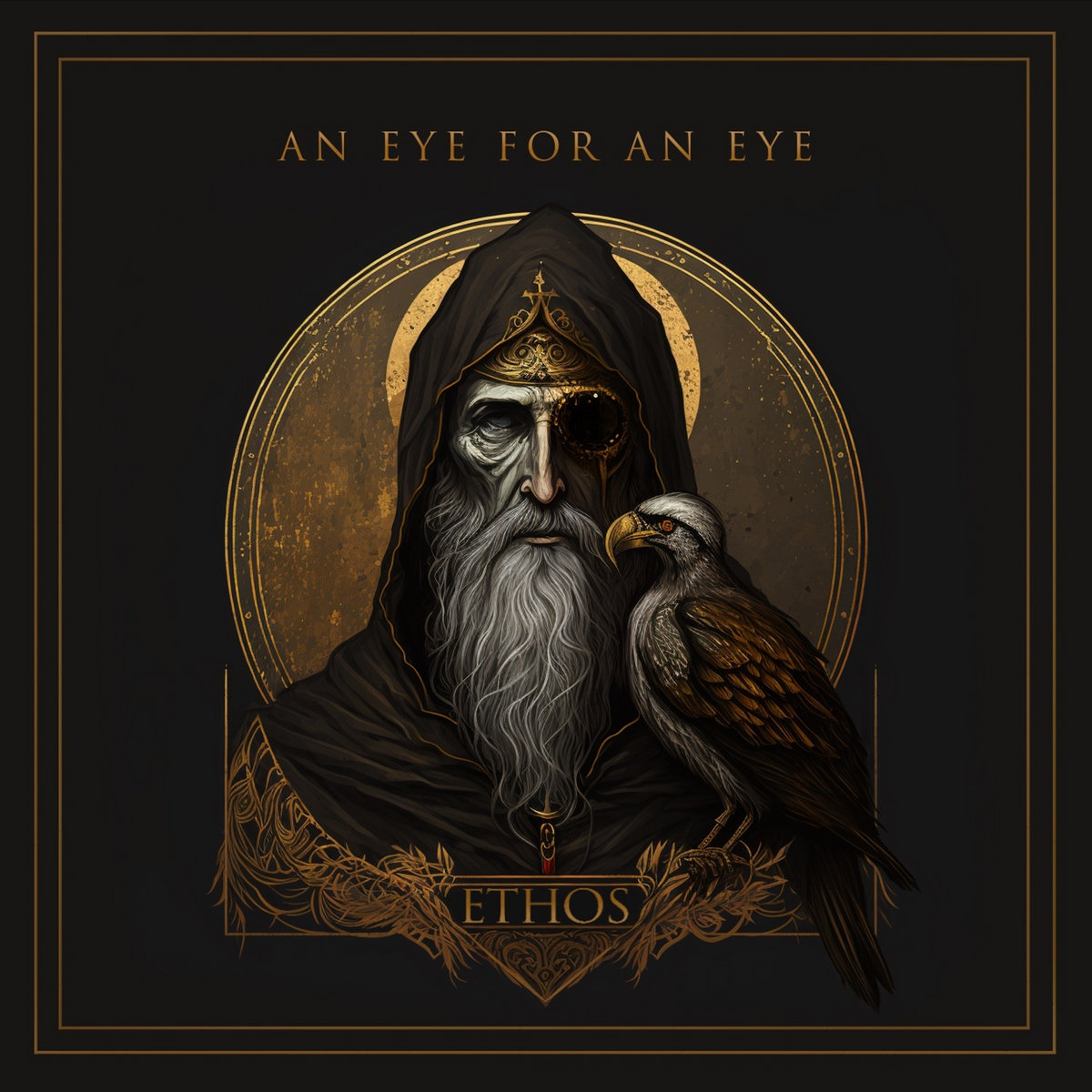
Austen: I designed the album art and have done so for all of our releases so far. I was inspired by gold leaf orthodox icons for the style. There is a sinister tone to a lot of the material on this record and a leaning into our metal influence – I wanted that to be represented visually for this record. There are lyrical themes of corruption and commentary on power structures throughout with a tone of “holding the feet to the fire” so to speak. I would say that “Holy Water” probably informed a lot of the imagery when I was working on the artwork for this record, not to mention, I am a huge fan of the Dark Souls game series.
How do you stay creatively inspired and avoid burnout, especially in a genre as demanding as progressive rock?
Tribb: I think we all have enough unique ideas between the five of us to keep things interesting and exciting, in terms of writing creatively. Like any band, there are certain stages in the process where we might get stuck or there might be some frustration, but usually leaving it and revisiting later solves that. Most of us try to stay abreast of newer bands and hear fresh ideas and innovations and that helps to motivate us in a sense to try different things. We try to play to our strengths and stay true to our sound as well, instead of trying to be the “best”, “fastest” etc. since that’s an easy way to make it about an unhealthy competitive mindset and it can be really easy to get down on ourselves when there are so many insane bands out there, in terms of speed and technicality. It’s more about songwriting, melody and fitting pieces together in a way that’s unique for us I think.
For someone who is new to Ethos, which track from “An Eye for an Eye” would you recommend they listen to first and why?
Tribb: That’s tough since every song has different elements of our overall sound, but maybe a good starting point is “Holy Water”. It’s a bit more on the heavier, post-hardcore side than some of our other stuff and has less prog or classical elements, but it’s got good energy, Muse-tinged verses, a catchy chorus, and a heavy bridge with some organ thrown in. It’s already becoming a fan favorite from the feedback we’ve received.
Finally, what message would you like to send to your fans and listeners as they experience “An Eye for an Eye”?
Matt: First of all, thanks for listening! I hope the music takes them to a far away place. We love to write stuff that you don’t hear very often and may even surprise you. It’s not about the progressive rock skill flex, it’s about the relationship between the listener and the music. It’s that feeling of hearing a song for the first time and then having to play it back 10 more times because it strikes you exactly where you are but takes you to a different plane. I want someone to be carried away by it.
ETHOS are:
Austen Earp – Vocals & Keyboards
Kuyper Cummings – Guitars
Matt Palopoli – Guitars
Nick Riggs – Bass
Tribb Robison – Drums
An Eye for an Eye is out and is available from Bandcamp. Stay in touch with ETHOS via http://www.ethosband.com/.
 Progarchy
Pingback: Album Review: ETHOS – An Eye for an Eye – Prog Sphere PR