
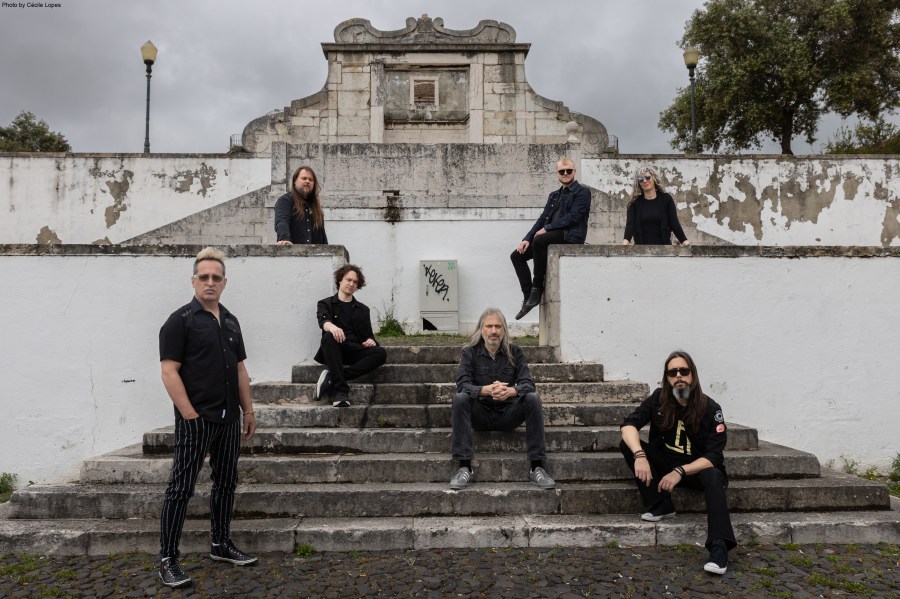
Two years on from our first chat, Alberto Bravin of Big Big Train joins us again to bring us the inside scoop on the superb new BBT album Woodcut, released February 6th on Sony’s InsideOut label. (Woodcut is available for preorder on CD, CD/BluRay combo and vinyl from The Band Wagon USA and Burning Shed. Andy Stuart’s companion book Woodcut: The Making and the Meaning from Greg Spawton’s Kingmaker Publishing is also available.)
For Woodcut, Alberto was in on the genesis of the album concept and composed a substantial chunk of the material; in the studio, he sang lead vocals, played guitar and keys, and produced the whole thing – so he has plenty to share about its creation! A lightly edited transcript of our conversation follows the video.
So, first of all, congratulations on Woodcut. I’ve been able to listen to it and I’m really impressed and moved by it. It’s a powerful album.
Oh, thank you. Thank you very much.
You’re welcome. So, what was the original spark for its concept?
So, it was really random. Because we never talk about doing a concept seriously. Like, sitting down and saying, “Okay, we’re doing a concept album now.” We’ve never done it. So, me and Greg, we were on tour. We were in Oslo at the [Edvard] Munch Museum.
Okay.
And it was just me and Greg. I mean, we wake up early. We like to have a walk in the early morning. So, we went there and it’s an incredible place. Really, really nice. And everybody knows Munch for “The Scream.” That it’s his most famous painting. But I didn’t know, he actually made a lot of woodcuts.
So, we were there and there was a part of the museum about these woodcuts. And I know what a woodcut is. But I didn’t know that in English you call it woodcut. I knew the Italian word, but not the English word. So, as soon as I’ve seen the name woodcut, I just looked at Greg. And Greg looked at me and we said, “Oh, this is the title of a concept album!”[Laughs]
So, that moment was the actual spark of the concept. And we had no music, no story, no lyrics, nothing; it was just the title. And we started to work from there. [Laughs]
So, once you had that brain spark, how did the rest of the band react? And how did you go about fleshing out what would come from just that word association?
So, as I said, we were on tour. We were like on the bus together. And I think that night or maybe the day after, we just thought about it, me and Greg. And we said, “I think this is a good pitch to tell them what it could be about.” At the beginning, the idea was to write a story about Munch. That was the first idea. “Oh, he has an interesting story; it could be interesting.”
But then we wanted to have a little bit more freedom on the story. So, we kind of invented our own artist there. But we had this idea of a struggling artist. And it could have been something a little bit more magical. And the idea was to have kind of a dark album. But with the Big Big Train stamp on it.
So, we just told the other guys! Like a stream of words and stuff. And everybody was, “oh, this is great! Let’s do it!” And from there, everybody was aware of this. And everybody wrote some ideas or some songs or some melodies and stuff, and put it on a Dropbox folder. And then we started from there. We started from the music, actually. The lyrics came later.
Okay. And I know that happens a lot in the rock and roll field. You get the music and then you get the lyrics to go with it.
Yeah.
It’s also interesting to me, because certainly in Big Big Train’s history, there’s been this sense of craftsmanship. Of creativity. You see that in the lyrics. You see that in the sort of artisan, bespoke way the band has been run for such a long time. But it’s interesting that you decided to go in a slightly darker direction with it. That’s not necessarily what people have come to expect. Which I suppose is one reason to do it!
No, absolutely. I mean, if it’s easy, [laughs] I don’t like it. I want to do, every time, something different. And the approach was really different from The Likes of Us, the previous album, where we had some songs that were already there. And we kind of went for the Big Big Train way. Everything sounded, apart from the singer of course, like Big Big Train.
I think this time – this is just the photo of the band now. So there was nothing like a thought or something that we sat down and said, “Oh, we have to do this.” It was just so easy! We just wrote those songs and I put them together. And it just sounds like us now.
Well, yes. A couple of things pop in my head. First of all, I’ve seen you guys live twice with you in the lead. And both times I’ve noticed, wow, these guys really like each other and really like playing with each other. That vibe is constantly coming off the stage.
Oh, yeah.
And the other thing that I noticed when I was listening to Woodcut, I mean, it doesn’t have one extended track. The whole thing has that sense of organic growth, of heading for a destination.
Yeah.
And my question was going to be, did that fall into place? Was it a lot of hard work to get there? Or was it kind of both of the above?
It was a crazy amount of work. I mean, we had this folder with a lot of songs, songs and melodies, ideas and stuff.
From day one, I had the idea of, “If we’re doing a concept album. It’s going to be a proper concept album, like one hour of music. No stop. You cannot skip it. [Laughs] You have to listen to it.” So, yeah, the idea was that. Like a flow, like everything had to be linked and everything like this one song when it’s going to go into the other.
And so I put all the ideas and all the songs and all the melodies in a Logic project, like the DAW [digital audio workstation] that I use to do production and mixing and stuff. I had everything just laid down. And so from there, I tried to put them together like a Tetris thing. And I was like a crazy, crazy guy. I just cut it and pasted it and changed the keys and pitch. It was like a crazy, crazy moment. But I had the idea of this stream of music.
And whenever I was listening, I was hearing a strong theme or a line – of course, I didn’t invent something. It is the progressive thing – you have a theme, you repeat it. So I tried to do that as much as possible, find the way to put everything [in]. All the themes are repeating during the album. And one time it’s the trumpet; one time it’s the vocals; one time it’s guitar and everything put together.
So I remember I was working. I mean, I worked, more of one month just to have the initial idea of something. Because I wanted to present to the guys that – what I had in mind. Maybe it was a mistake! OK, I throw away one month of my life! But I wanted to. And so everybody was saying, “what is Alberto doing? Where’s the music?” They were waiting for me to just send a file to listen to!
And then I did actually. And everybody was really happy! Of course, we changed stuff; we changed it in the pre-production. But then when we went to the studio to record the album, we changed it again! We changed the set list; one song was completely written in the studio. We’re playing with these guys, it’s like this. We can do it! So it’s good.
Yeah. Before we go on into the recording process, just a little bit, you mentioned you were kind of following the classic concept album/rock opera model. It starts here; it goes to there. And I know Greg has mentioned in the publicity [Genesis’] The Lamb [Lies Down on Broadway] and [Yes’ Tales from]Topographic Oceans as the two [of the most] famous or infamous prog albums out there. Can you think of any models from prog history that maybe influenced you or even any that you tried to avoid?
[Laughs] I think so. I mean, I’m a huge fan of Transatlantic! And [The] Whirlwind is one of my favorite albums of all time. So that was that was one of – the ideas where, “oh, OK, they’re repeating this.” I mean, I love Neal [Morse]. He became like, well, not a friend; I know him, I sang with him and I was just a fan and I’m still a fan. But now knowing him, it was magical. I’m a huge, huge fan. So I love that.
But actually, I also listened to The Incident by Porcupine Tree. That’s a little bit more metal thing. But for the ideas, sometimes you can take the ideas.
And actually, I always go back to The Beatles and the Abbey Road medley. Sometimes always something where I have to refresh my ears. So I listen to that. “Oh, they did this in ‘69. I can do something in 2026! So let me try to do something.”
Exactly. All those really resonate with me: Transatlantic was kind of my gateway drug back into prog after some time away. And Abbey Road I’ve loved since I was a kid.
Yeah! And of course, Genesis, of course Yes. There are a lot of incredible concept albums. But yeah, those were “just go in there, just in the background, just to have a listen and to get inspired.”
Well, you learn from the masters, it’s true.
Absolutely, yes, of course.
So I wanted to play kind of a lightning round game with you. And this can be maybe talking about your time in the studio, especially, but also about the rest of the development process. I wanted to ask you your perspective on what each of your bandmates kind of brought to Woodcut that’s special.
[More after the jump . . .]
And I’m going to start with Greg first, Greg Spawton.
Well, I mean, he’s the guy! So me and him, we had the idea, the initial idea together. And he always brings some masterpieces [to] the table, the songwriting and the lyrics.
And sometimes it’s – you don’t realize how good he is on the bass because – I mean, we have one of the greatest drummers of all time with us. But drums and bass are pretty solid. And Greg, he’s an incredible bass player. So, he’s the guy! [Laughs]
Next, Nick D’Virgilio, because obviously, like you say, the two of them lock in so well. But also he contributes compositional ideas. He’s got the one lead vocal.
So, we know the drums. He is one of the greatest, but he’s such a good singer. So I can throw vocal lines to him and he is incredible! And also, in an artistic point of view, we were in the studio and how he changed the grooves and the drums from the demo to make it actually alive. Because nowadays – we recorded to a click track, of course. We are not that crazy to not record to a click track! [Laughs] That could be really dangerous when you’re producing, doing some editing and producing the stuff. But he’s so great to play on the click track, just going up and down with the groove and make it alive, so it’s not a machine. It’s amazing!
Yeah. He flows within the click so well.
Oh, my God!
So Rikard, Rikard Sjoblom.
I mean, Rikard is a genius. He’s one of the most talented music guys that I’ve ever seen. And the crazy thing is that you need to give him freedom in the studio. Because he will never record twice the same thing. So OK, you need to record all the time. You just record: “Oh, this is perfect!” And most of the solos that you hear in the album, they are just one take.
So it’s crazy! It’s not like, “cut and paste and do this.” We actually did that for one solo. And we said, “This sounds weird! I mean, it’s not like you.” So he [said], “Just let me try it one more time.” And he just nailed it. Again, great singer, great keyboard player.
So, yeah, solo after solo on that album, I’m just going, “Where did that come from?” Clare, Clare Lindley, I think, really comes to the forefront this time around.
Absolutely. She did an amazing job here. First of all, she brought “The Sharpest Blade” as a song to the table. And immediately we said, “Oh, this is something special.” At the beginning, it was kind of a dark folk kind of song, just guitar and vocals. And she was recording – I think the guitar there, it’s actually from her demo. [Laughs]The acoustic. We kept those guitars because they were great. She was noodling with a violin underneath and she was singing stuff. And we said, “Oh, this is great!” And then we worked together on the song. Of course, we added the [Black] Sabbath ending thing.
Yeah.
But I think the most special thing here – she wrote most of the lyrics. And at the beginning, we were thinking, “I think we need Clare to help us with the story with because she has some sensibility and she’s an awesome girl.” And so we said, “Can you do it?” “Yeah, yeah, yeah, please. I would love to.”
And I was a little worried at the beginning, because the lyrics in Big Big Train are always really important. And having the Big Big Train lyric style was important. And Greg is one of the lyricists here. So I didn’t want to lose that if somebody else was doing the lyrics. But Clare just nailed it.
And she – you cannot tell who wrote what during the album. So this was the goal, actually. And NDV wrote, of course, one of the lyrics. But she was amazing.
Yeah. The folk tradition she comes from. It makes sense that it slides in. And she just nailed the tone. It doesn’t feel like anything else.
Yeah.
Oskar, Oskar Holldorff.
So Oscar, I mean, he is crazy! I mean, he was so well prepared in the studio. He arrived and just played everything.
And actually, he is more of a keyboard and piano player. But he just – we had the opportunity at Sweetwater, in the studio, to have a real Hammond organ. And when you are in front of the Hammond organ, cranked with the Leslie going, I mean, you have kind of a trip, because it’s so powerful! And he really enjoyed it. And he was rocking and doing all the stuff that you think it’s maybe Rikard’s thing. But actually, it’s Oskar.
So he’s super talented. He can sing so well. And yeah. And it’s a pity that he didn’t contribute with songs this time. But he was doing the Dim Gray album. And other stuff. So it was not – just crossing paths during the writing process.
Yeah. I know he’s got a lead vocal on one track. And you’re right. I grew up on the Hammond and that’s a ferocious beast. But it’s fun to ride!
Yeah. Yeah. I wanted to play it! They didn’t let me. [Both laugh]
And then last, the newest member, Paul Mitchell.
Paul Mitchell is such a super cool guy. And he was not in during the recording with us in the US. Because all the trumpet stuff, I did the demos and we actually didn’t need him there. So we recorded the trumpet after that at Rob Aubrey’s studio.
And again, he just arrived super prepared and he played all the parts. But also, like every time, just adding some stuff or asking, “Can I try this or can I try that?” So he was really into the process and into this stuff. Actually, when we asked him to officially join the band, he was super, super happy. And we are happy because he can sing; he can play the trumpet; he can play the keyboards. We need a lot of hands onstage! [Laughs] Everybody is playing every little bit of everything. It’s really useful.
Yes. I saw you guys at the Token Lounge and one of the things I loved – wasn’t that a fun place?
Mm hmm. Yeah, that’s an amazing place. I love – well, it’s not a dirty club, but a little bit. It’s a dirty rock club! I love it. It’s a little grungy.
It’s Detroit grungy. That’s Detroit.
Yeah, grungy, grungy.
I grew up there. My best friend actually lives half a mile from that venue.
OK, cool.
So I’ve got to tell you, he was the guy who introduced me to Rush way back when and I said, “You’ve got to hear these guys!” And of course, I copped a room overnight with him. But I took him to that and he said, “That is the best show I have seen in ages!”
Oh, my God!
So you made a convert that night.
Yeah. Cool. Hope to come back!
Yeah. So, I know you’re going on the road; you’re going to have the third Cruise to the Edge. What’s it like to be on that boat, to be playing for that really hardcore audience?
So this will be my fifth Cruise to the Edge because I played there with PFM twice and [this] will be my third with Big Big Train.
And when I when I was there with PFM, that’s a well-known name in the prog community. But of course, I was just the keyboard player and a little bit of vocals, a little bit of guitar. I was the guy in the band.
So I was there more as a fan, not actually an artist. And I’ve seen, I don’t know, Mike Portnoy: “Can I have a photo with you?” and blah, blah, blah. So that was my experience there. It was crazy, crazy, emotional to play there with those giants!
But actually at the first Cruise with Big Big Train, I said, “What’s happening now? I mean, I am the singer of a band now. It’s a different thing. And I think people will know me at least for the news that I am the new singer.” or something like that. And it was different because people were – a couple of my heroes knew who I was! And that was breathtaking. I was like, “What are you talking about? [Laughs] What the hell? You know who I am?” So it was crazy.
And the first one, I mean, was like the first time Big Big Train played in the States or at the Cruise. So it was it was special. I mean, it was super special. And the second one, again, it was more like knowing everybody. I mean, the Cruise to the Edge, it’s like you are on the same boat. Everybody’s on the same boat. And you’re just talking to everybody. And you met new people from the fans. But you met new people from the artists’ side.
So it’s a crazy, crazy place. Super fun. It’s a great chance to see all your heroes, actually. [Laughs] For me, that’s crazy.
So you kind of started as a fan and then you became a peer.
Well, I mean, yeah.
And then you have fans.
[Laughs] I mean, yeah, but it’s still crazy to think about it in that you are there. And I feel to be like a fan still. I mean, I am a fan. I’m a fan of music and I’m a fan of prog and everything. So it’s a weird feeling being there and people asking you to [Laughs] – it’s crazy. But yeah, it’s great.
Yeah. Cool. And then I know you’ve had some dates announced for this fall for the UK. And I know that any other touring is up in the air and you probably can’t talk about it until it happens. But what do you think that that UK tour is going to be like? Can you give any hints?
Hmm. I mean, we are playing UK and Europe in the fall. We’re closing the tour at the Shepherd’s Bush Empire in London. This is going to be pretty crazy that that it’s one of one of the famous places in London! So it’s nice to play there. We played Cadogan Hall for a couple of times, and I think it was right to change the venue and go to something a little bit bigger. And we hope to do it well.
In Europe we’ll play Germany, we’ll play Italy. We have two gigs in Italy. And I can’t wait. And I mean, now we’re going to play the Cruise [after] not seeing each other for a year. It was like a year that we were not together somewhere. So I can’t wait to do this. And then in the fall to do the proper tour.
And I hope maybe next year we can do the States again. I hope we can make it.
Well, certainly we hope that, too. And as always, those of us, we folks at Progarchy, we’ve been eagerly anticipating this album. And I think it lives up to any expectations we may have had for it. Is there anything else you’d like to say to our readers?
So the effort put in this album was gigantic. So I hope everybody will love this album as much as we do, because we really believe in it. I hope everybody will love this new music.
Well, that love really does come through. And congratulations on it! I just ordered my CD and the companion book the other day.
Oh, cool!
I’m looking forward to having those in my hands.
Well, mine arrived today!
Ooh!
Yeah! I’ve seen a couple of reviews with people with the CD, and I didn’t have it! [Laughs] So they arrived today. And it’s this weird feeling to have the CD in your hand, and it exists! It’s real! [Laughs]
Yup! Now there’s no backing out, right?
No, I cannot mix it again! [Both laugh]
Well, again, we wish you all the best with this album and this tour.
Thank you.
Congratulations on a really fine achievement.
Thank you, my friend.
And it’s been really great talking to you. So thanks so much for your time!
Thank you; thank you!
— Rick Krueger
 Progarchy