By day, I'm a father of seven and husband of one. By night, I'm an author, a biographer, and a prog rocker. Interests: Rush, progressive rock, cultural criticisms, the Rocky Mountains, individual liberty, history, hiking, and science fiction.
It is rare that I undertake an interview with a band about which I know very little. Normally, I have been fortunate enough to hear the album in advance of the interview or, if it’s an established band, I can do my homework and be prepared. In the case of Earthside, they are a new name in heavy metal circles. As such, they have yet to release their debut album and to date, I have only heard two tracks from the impending release. I say ‘impending’, although as far as I’m aware, no release date has even been divulged.
Shrouded in secrecy they may be but there seems to be a buzz growing on the Internet about the band, a quartet hailing from New Haven, Connecticut, comprised of guitarist Jamie Van Dyck, keyboardist Frank Sacramone, bassist Ryan Griffin and drummer Ben Shanbrom. Hardly…
As I have written ad infinitum within other posts on this very blog, I vividly remember the first time that I was introduced to melodic death metal. It was In Flames’ ‘The Jester Race’, one of the early pioneers of the Swedish ‘Gothenburg sound’ movement, and immediately I fell in love. Here was a style of music that blew my mind thanks to the simple yet ingenious blend of death metal brutality with choruses and melodic refrains that were lifted straight of the traditional, New Wave Of British Heavy Metal rulebook. I never looked back and I used this genre as an important stepping stone into the more extreme and heavy recesses of metal’s underground. That said, I have remained a fan of the genre and, whilst it’s fair to say that it has been tested…
In my post two days ago offering a twenty-year retrospective of RAOUL AND THE KINGS OF SPAIN by Tears for Fears, I made some bald claims:
Orzabal has never embraced the term “progressive,” identifying it with Pink Floyd, but he is certainly the most experimental pop musician alive—rivaled only by Brian Wilson, Paul McCartney, Robert Smith, Andy Partridge, and Peter Gabriel. From my perspective, Orzabal is the greatest living pop musician, but I think this would be open to debate. And, of course, the debate would demand a proper definition of pop.
A good friend of mine (a fellow music lover and a fellow Kansan), Derek, properly challenged this assertion of mine while also admitting how much he loves Orzabal.
I did my best to defend my claim. Here’s the conversation:
Derek: “From my perspective, Orzabal is the greatest living pop musician…” Wow! I’m still trying to wrap my head around that statement. Not disagreeing necessarily, but wow. I love Orzabal’s work but also equally love Neil Finn’s work, especially with Crowded House (and double especially on the album “Temple of Low Men”). Oleta Adams with Orzabal on “Me and My Big Ideas” is just sublime. I had forgotten how much she brought to the TFF sound. Hiring her was a stroke of genius on the part of Orzabal and Smith.
Me: Derek–it’s debatable, for sure. But, I think about Orzabal’s willingness to experiment–and his slow but excellent body of work over 30+ years. I’m excluding straight rock and prog musicians in the comment. I must admit, I don’t know Neil Finn’s work beyond a few wonderful songs he wrote in the 80s. But, for example, Michael Stipe is good, but his music sounds dated to me in a way that Orzabal’s doesn’t.
Derek: All compelling points, Bradley. The point about Orzabal’s “slow but excellent body of work over 30+ years” is well taken. If you can, give Crowded House’s “Temple of Low Men” a spin. It is downright criminal that that album wasn’t a smash. The song “When You Come” should have been just as big of a hit as “Don’t Dream It’s Over” or “Something So Strong.” Finn is hands down one of my favorite pop music lyricists, bar none. An example from the aforementioned “When You Come.”
When you come across the sea
Me like a beacon guiding you to safety
The sooner the better now
And when you come the hills
Will breathe like a baby
Pulled up heaving from the bottom of the ocean
The sooner the better now
When you come to cover me with your kisses
Fresh like a daisy chained up in a lion’s den
The sooner the better now
I’ll know you by the thunderclap
Pouring like a rain of blood to my emotions
And that is why
I stumble to my knees
And I haven’t even mentioned the other amazing songs from Temple of Low Men like “I Feel Possessed,” “Into Temptation,” “Sister Madly,” and “Better Be Home Soon.”
Me: The first master was Brian Wilson, in my opinion, but his career, for obvious reasons, faded quickly.
Derek: Agreed 100%.
Me: Andy Partridge is brilliant, but he’s so dark and cynical. It’s hard to take some of his music, especially when he’s not tempered by Dave Gregory. Then, Paul McCartney, but, again, a career that was stunning but relatively short–though some of his best work was with early Wings.
Let me try to defend my claim that Orzabal is the greatest with a bit more gusto and in a larger space. A few caveats, however. Yes, I’m an American. Yes, I’m prone to hyperbole. Yes, I’m an American prone to hyperbole! The kind of hyperbole that makes non-Americans uneasy. Neil Peart is the greatest drummer who ever lived. George Washington is the greatest American ever. SPIRIT OF EDEN is the greatest prog album ever written. KIND OF BLUE is the greatest jazz ever made. The Aeneid is the greatest story ever written. Etc. Etc. Etc. I plead guilty to hyperbole.
I also plead guilty to wielding strong loyalties.
Reunion! Beauty and success, too.
So let me try to explain what I mean about Roland Orzabal.
First, he is experimental, and he’s more than willing to take chances, wherever those chances lead him. He’s willing to embrace high pop (Sgt. Peppers), art rock, soul, gospel, rock, power pop, prog, minimalism, electronica, and dance. His very output and his very life seems to transcend labels in the best way possible, just writing what needs to be written, when and where it needs to be written. And, this is just within his individual songs.
His albums, each taken as a whole, are equally diverse:
THE HURTING: Minimalist New Wave
SONGS FROM THE BIG CHAIR: Progressive Pop (Art Rock)
SEEDS OF LOVE: Jazz, theatric soul and pop
ELEMENTAL: Atmospheric and moody pop
RAOUL: Autobiographical earnest pop
TOMCATS: Electronica
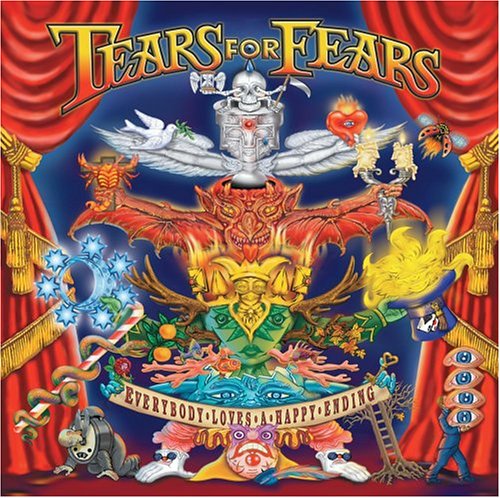
EVERYBODY LOVES A HAPPY ENDING: High Art Rock/pop; progressive pop
Orzabal’s B-sides: every thing and every genre imaginable.
Second, think about his competition, as I mentioned in the above discussion with my friend, Derek. Brian Wilson was brilliant, but, for sad and obvious reasons, he has not been able to sustain his career. Sir Paul McCartney had an amazing run with the Beatles and with early Wings, but, he too, wasn’t able to sustain it. His pop became more and more bland as the mid 70s became the late 70s. Robert Smith is a master as well, but, frankly, he’s so much better when he’s writing gothic rock than when he writes pop. DISINTEGRATION is The Cure’s best album because it’s not pop in any way. There’s no “Friday, I’m in Love,” to bring the album down. Peter Gabriel is Orzabal’s greatest rival, but even his music has a sameness (relatively speaking), at least over time, that Orzabal has avoided. At this point, Gabriel is simply offering (brilliant, of course) reworked versions of his music from the 70s and 80s. And, as great as Andy Partridge is (my gosh, think about the gorgeousness of a song such as Bungalow), he’s so unremittingly dark and bitter. He desperately needed a Dave Gregory to temper him. Other candidates are out there. Sarah McLachlan? She made three great albums, then descended into blandness. Sixpence None the Richer? Again, wonderful, but lost it after three albums. Michael Stipe? So great at one point, but his music seems dated now.
Third, Orzabal’s lyrics. Whether telling a story, railing against a politician, writing about depression, or simply stringing works together for the love of the words themselves, Orzabals lyrics are always very clever, and so very able to mixed note and/with meaning so perfectly. I don’t always agree with his politics or religious views (I’m probably as libertarian and conservative as he is liberal; and I’m also a practicing (if poor) Roman Catholic, while I understand he is not only a lapsed Catholic but an atheist), but I always take him and his ideas seriously. And, whether he’s writing about love, loss, redemption, physics, or anything else that matters, he’s very, very good! His lyrics mix intelligence with whimsy, but they’re also just so beautifully constructed.
Fourth, his voice. Granted, you always know when Orzabal is singing. But, he can vary it in so many ways, and he can make the strangest, weirdest voices, when the music demands it. For the longest time (well, for thirty years), I thought this was all just studio trickery. I was wrong. After seeing him live, I realize just how capable of goodness and weirdness(!) he is.
Fifth, he’s utterly sincere—whether its in his music, his lyrics, his views, his moods, or his first novel. Whatever it is, it has meaning to him. One of my greatest pet peeves is when an artist tries to mock his own success or mock those who adore him and his art. It’s one thing to be humorous and self-deprecating (both of which are wonderful and necessary in this rather insane world). It’s a completely different thing to mock one’s fans. There’s nothing cynical about Orzabal’s art. What you see is what you get, though, of course, always layered and nuanced.
One major admission. I could not have written this piece a week ago. As I mentioned in my concert review of TFF the other day, I had assumed for thirty years that TFF was at their best in the studio. I’d dismissed their live performances as uninspired. Granted, I did so out of complete ignorance, having never seen them play life until six days ago.
Seeing them perform in Denver last Sunday night made me realize just how wrong I was. A year or so ago, I wrote about SONGS FROM THE BIG CHAIR as the best pop album ever written. Now that I’ve seen TFF live, I can state with conviction and evidence that Orzabal is our greatly living pop artist.
And, I’ll make this prediction. The forthcoming TFF album will be an unexpected and satisfying work of art that will take the pop and rock world by storm. Orzabal and Smith aren’t living on or in the past. They are at the absolute height of their game right now. And, of course, they’ve earned every single accolade they will receive.
Review retrospective: Tears for Fears, RAOUL AND THE KINGS OF SPAIN (Sony, 1995; Cherry Red, 2009).
Twenty years ago, Roland Orzabal (born Raoul Jaime Orzabal de la Quintana to an English mother and a Basque/Spanish/French father) released the fifth Tears for Fears studio album, RAOUL AND THE KINGS OF SPAIN.
Overall, we should remember, 1995 was a pretty amazing year for music—really the year that saw the full birthing of third-wave prog.
Raoul’s mythic mother.
Not all was prog, of course, but there was so much that was simply interesting. Natalie Merchant, TIGERLILY; Radiohead, THE BENDS; Spock’s Beard, THE LIGHT; The Flower Kings, BACK IN THE WORLD OF ADVENTURES; Marillion, AFRAID OF SUNLIGHT; and Porcupine Tree, THE SKY MOVES SIDEWAYS.
As the time that RAOUL came out, I liked it quite a bit, but I didn’t love it. The first five songs just floored me, but then I thought the album as a whole fizzled in the second half. Or course, when I write “fizzled,” I mean this in the most relative sense. Even Orzabal’s weakest track is far better than most musicians will ever achieve in and with their best.
So, I’m judging one TFF song only with another by TFF.
There’s a bit of interesting history behind the release of the album. This would be the second of only two albums that appear under the name Tears for Fears without Curt Smith. Whereas the first, 1993’s stunning ELEMENTAL dealt with the breakup of the twosome, RAOUL tells a mythical story about himself.
More on this in a bit.
So, not only was this the last album without Smith, it was also the first album on the new label, Sony. Previously, Tears for Fears had shared label space with Rush: on Mercury Records. Mercury had gone so far as to release promo copies of RAOUL, complete with different artwork and a different track listing. I’ve never actually seen a copy of the Mercury promo, but I’d love to get my hands on one at some point. Instead of the tracks “Hum Drum and Humble” and “I Choose You,” the original listing had “Queen of Compromise.”
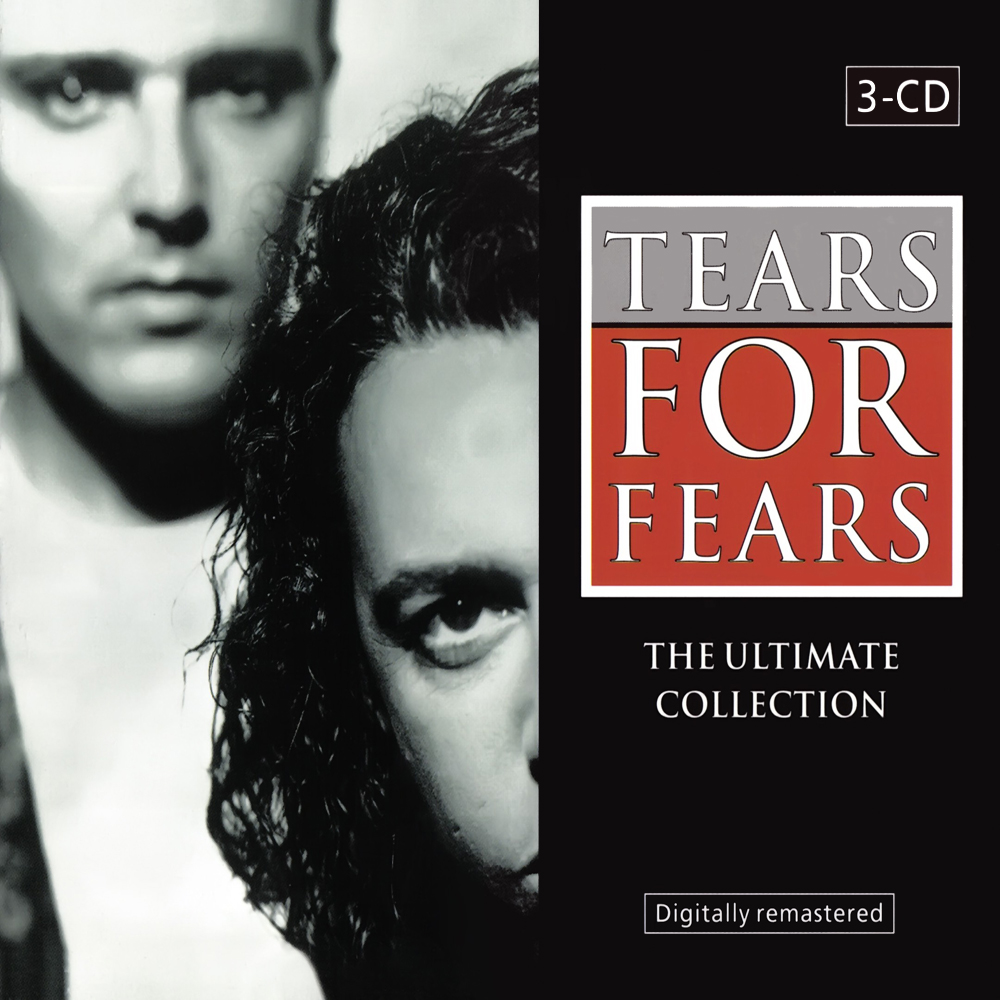
Since its official release in 1995, there have been three different versions of the album: the Sony 12-track original; a deluxe cigar box edition; and the 2009 Cherry Red edition—the original release remastered, five b-sides, and acoustic versions of the tracks “Raoul and the Kings of Spain” and “Break it Down.”
Not surprisingly, given Orzabal, the b-sides are every bit as good as the full-blown tracks, and the acoustic version of “Break it Down” is quite moving with its additional line: “No more walls of Berlin.” My favorite of the b-sides is “War of Attrition,” a martial exploration of relationships that simply slide out of existence.
Though written and produced in a post-LP/vinyl world, RAOUL has, for all intents and purposes, two sides. Tracks 1 through 5 make up the first side, and the seven remaining tracks, bookended by versions of “Los Reyes Catolicos,” make up the second side. This isn’t surprising either, given that SONGS FROM THE BIG CHAIR and ELEMENTAL have the same structure. Orzabal has never embraced the term “progressive,” identifying it with Pink Floyd, but he is certainly the most experimental pop musician alive—rivaled only by Paul McCartney, Robert Smith, Andy Partridge, and Peter Gabriel. From my perspective, Orzabal is the greatest living pop musician, but I think this would be open to debate. And, of course, the debate would demand a proper definition of pop.
Side one of Raoul is jaw dropping. The first time I played the second track, “Falling Down,” for fellow progarchist, Kevin McCormick, back in late 1995, he replied, “Wow. It’s just so earnest.” I’ve never read or heard a better description of the song. It is, utterly and essentially, earnest. There exist both revelation and humility in the song, perfectly intertwined.
Some of us are free
Some are bound
Some will swim
Some will drown
Some of us are saints
Some are clowns
Just like me they’re falling down
All five songs of side one—again, as I’ve defined the sides—flow so readily from one to the other. No break in sound. Essentially, these are five parts of a single track. While my favorite track is “Falling Down,” “God’s Mistake” is also a standout.
And, frankly, so is the finale of side one, “Sketches of Pain,” an obvious and intelligent allusion to Miles Davis’s “Sketches of Spain.” As with “Falling Down,” this track is confessional without mere navel-gazing.
Side two, gives the listener snippets of what can really only be described as a mythic autobiography. And, yet, despite the autobiographical nature of the entire album, side two seems to look at the life of the protagonist from a broader perspective than side one. If side one is confessional, side two is almost historical and analytical.
What if, as family history has suggested, Roland had been Raoul, descendent of the Catholic kings of Spain? Naturally, this side begins with a version of “Los Reyes Catolicos”:
When time is like a needle
And night is the longest day
A home is a cathedral
A place where a king can pray
Ghosts all gone
Ghosts all gone
The following track, “Sorry,” explodes into a bitterness that emerges every once in a while in TFF songs. Accusations and questions fly. “Do you love or do you hate? Why do you hesitate?”
“Humdrum and Humble” begins with an experimental loop before transforming into a clever pop song.
“I Choose You,” a piano ballad of emotional depth follows.
Immediately after comes an up-tempo song filled song effects as well as some appropriate absurdities, “Don’t Drink the Water.” This is pure pop sweetness.
The penultimate track, “Me and My Big Ideas,” sees the return of soul diva, Oleta Adams. Much as they had on “Sowing the Seeds of Love,” she and Roland offer a meaningful—if not downright profound—duet, balancing the strengths of each other well.
The album ends with a softly building version of “Los Reyes Catolicos.”
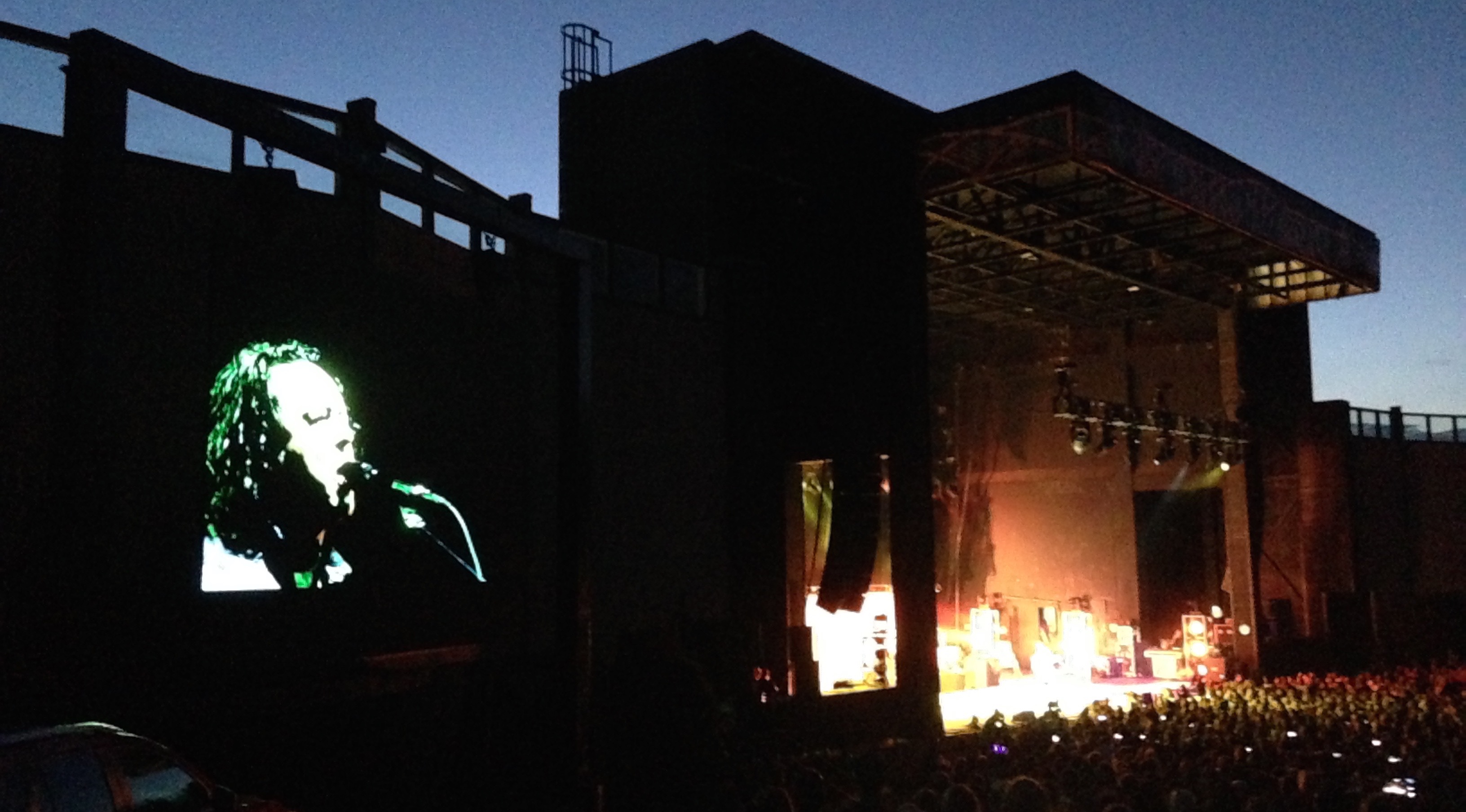
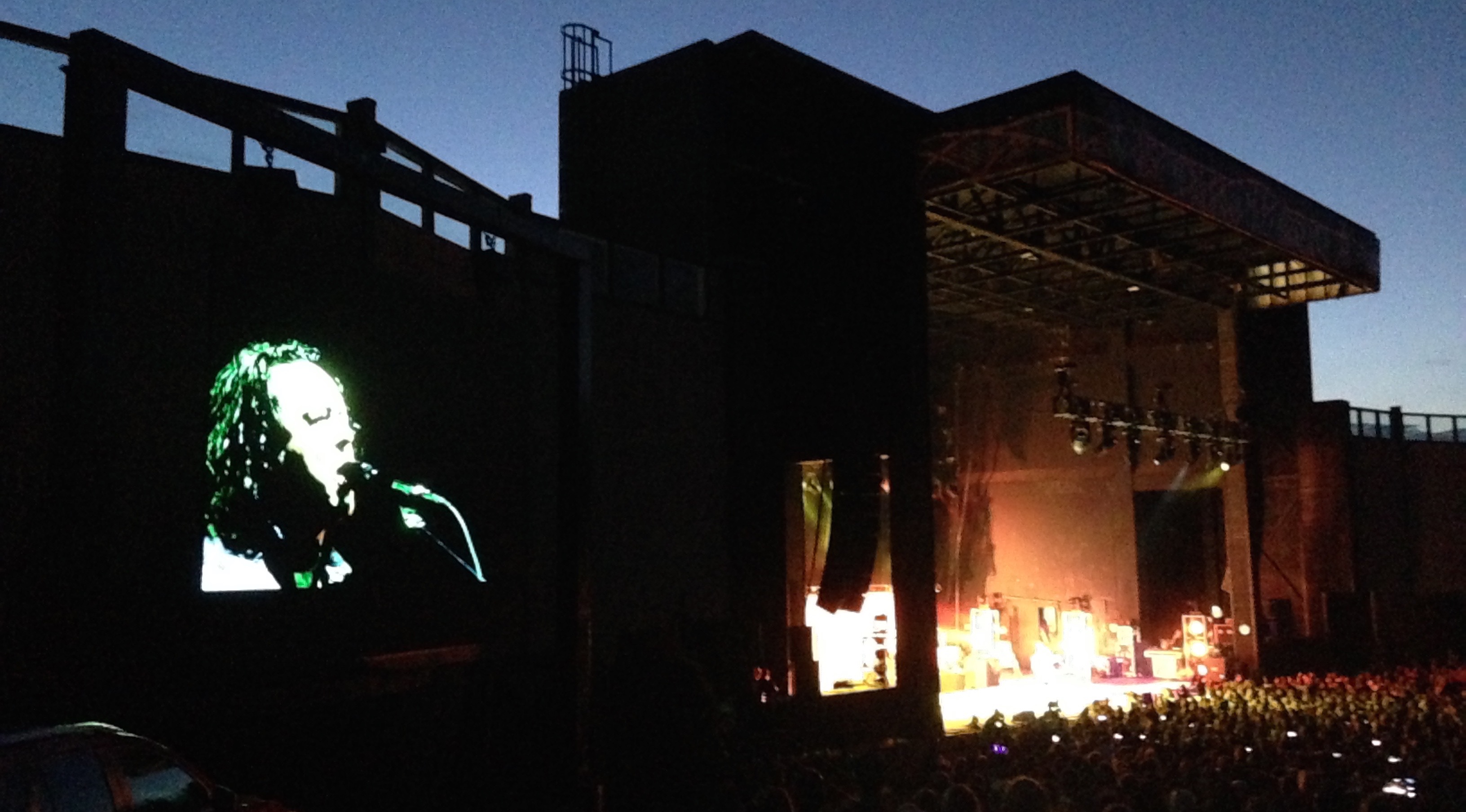
My blurry picture of TFF in Denver, June 2015.
Like all of the music of Tears for Fears, this album holds up very well, even after twenty years. Indeed, the flaws I thought I perceived when this album first came out simply don’t hold up. I don’t think the flaws have disappeared as much as I simply didn’t understand or appreciate what Orzabal was doing in 1995.
In hindsight, I appreciate the art and the choices he made to make this art. Not that he needs my appreciation, but Orzabal certainly has it.
Last night, my wife and I—just about to celebrate our 17th wedding anniversary—treated ourselves to a concert by Tears for Fears.
For those of you who read progarchy.com regularly, you know that not only do we as a website love the work of TFF, but I, Brad, have been rather obsessed with Roland Orzabal and Curt Smith since 1985.
Yes, 30 years—just four more years than I’ve been in love with Rush. And, of course, what a comparison. Can you imagine Peart and Orzabal writing lyrics together? Tom Sawyer meets Admiral Halsey!
A blurry iPhone picture from last night’s concert in Denver: Tears for Fears.
I came to TFF in the same way almost every American my age did, from hearing “Everybody wants to rule the world” on MTV. What a glorious song. Here was New Wave, but New Wave-pop-prog. Here were intelligent lyrics. Here, to my mind, was music done properly. Having grown up on Yes and Genesis and Kansas, I wanted my New Wave to be just a bit edgier than, say, that of the B-52s. I wanted my New Wave artists to take themselves as seriously as Yes had done on “Close to the Edge.”
Well, as I’ve written elsewhere at progarchy, Songs from the Big Chair has remained in my top 10 albums of all time—ever since I first purchased it in 1985. Of course, I worked backwards after discovering TTF, finding The Hurting to be a brilliantly angsty and claustrophobic look at the world. I think I’m just about six years younger than Curt and Roland, and I could easily imagine them as schoolmates.
Since 1985, I have purchased every single thing TFF has released—every TFF studio album, every live album, every cover, every b-side (TFF’s b-sides are every bit as good as the Cure’s; the b-sides for each matter, a great deal), every remaster, every deluxe edition, and every solo album. No matter the cost, I’ve happily paid the price. When I switched to CDs in the 1990s, the first two I bought were The Hurting and U2’s October. I also have Orzabal’s novel. Yeah, I’m definitely a bit obsessed.
Have I revealed enough of my TFF street cred to move on?
***
So, despite loving TFF as one of my three favorite bands for thirty years (Rush, Talk Talk, and TFF), I owe the two Englishmen a rather large apology. For thirty years, I’ve dismissed their live performances as much as I have lauded their studio work. Not that I really knew much about them live. I’d never seen them actually in the flesh. Everything I knew of them live had been recorded, and it always felt a bit “uninspired” to me, with their vocals especially sounding weak.
Well, let me be blunt. I couldn’t have been more wrong.
Last night, TFF played their hearts out. I mean: Played. Their. Hearts. Out. Holy Moses. Not only were they amazing live, they were even better live than on their studio albums. I thought it must be just my excitement at the moment as I listened to them last night. My very American enthusiasm—the kind that makes the Brits think me “over the top”—can sometimes get the best of me. But, no. Right after the concert, I listened to the brand new remastered (Steven Wilson) version of Songs from the Big Chair just to check myself and my impressions. I wasn’t wrong. They did sound better live than on Songs from the Big Chair. But, for thirty years, I’ve been wrong! So, my apologies.
From the first explosion of sound to Roland and Curt waving their final goodbyes to the audience, they performed flawlessly, with deep emotion, and with a complete (equaled only by Rush fans at a Rush concert) connection to the audience.
And, Roland and Curt loved every moment of the concert. No English reserve here. Just pure love of the art.
The show began with what I assume was a taped recording of a number of voices singing “Everybody Wants to Rule the World.” In hindsight, I’m questioning whether this was taped or not, as the voices might very well have been Roland’s, Curt’s, and the guest female vocalist’s (I apologize—but I didn’t catch her name). However it was done, it was done well. From complete darkness and the disembodied voices floating around the venue, an explosion of light and sound revealed the full band, and they immediately played the opening song of “Everybody. . . .”
From that very first explosion and revelation, TFF held the entire crowd (about 18,000—there were no empty chairs or spots in the entire venue) in rapt attention. I mean, that audience belonged to TFF: lock, stock, and barrel.
Though the band never took a break—expect for a minute or so before the encore—it would be fair to divide the show into two sets, broken by a cover version of Radiohead’s “Creep.”
The first set ran for 10 songs without a single pause in the music—with the exception of some very sincere and humorous banter from Roland, Curt, and the audience—Everybody; Secret World; Sowing the Seeds of Love; Pale Shelter; Break it Down Again; Everybody Loves a Happy Ending; Change; Mad World; Memories Fade; and Closest Thing to Heaven.
Set Two, coming after Creep, consisted of: Advice for the Young at Heart; Badman’s Song; Head over Heals; Woman in Chains; and Shout.
So, TFF played at least one song from every studio album except Raoul. The first set emphasized The Hurting and Everybody Loves a Happy Ending, while the second set featured The Seeds of Love.
As a three-decade long TFF fan(antic), let me make a few observations—all of which were revelations to me last night, whether minor or major ones.
First, as noted above, Roland and Curt were in top form. Not only did they sound simply perfect (Roland’s voice only gets better with age), but they were obviously happy and confident. Indeed, I think they were fairly overwhelmed by the loving response of the audience. At one point, Roland talked about a recent conversation with Curt. Roland, remembering their performance at Red Rock’s in 1985, asked Curt when the “best days” were? Curt responded: “now.”
Second, Roland is hilarious. He loves adding weird voices on a number of his songs. This, I knew. I just assumed it was all studio fun. What I’d never realized before—not yet having seen them live—is that Roland is very clearly channeling Peter Gabriel from his Genesis days. No, Roland wasn’t wearing strange outfits, but he was definitely playing different characters throughout the songs, especially in the first set. During “Break It Down” (featuring a very enthusiastic Curt, even though this song came from one of the two albums Roland wrote without him), Roland pretended to be Paul McCartney’s Admiral Halsey. It was hilarious and quite true to the art.
Third, set one could’ve been none more prog. It was just so artfully woven together. Every song flowed into every other so beautifully. Really, so TERRIBLY beautifully. I was riveted. Whether the songs were in the XTC vein of “Everybody Loves a Happy Ending” or the Steve Reichian vein of “Pale Shelter,” everything flowed together so perfectly. Obviously, Roland and Curt had created, essentially, a whole new album with their choice of individual tracks. What a tapestry of sound and texture.
Sadly, I never caught the names of the supporting band members, but they performed perfectly as well. In particular, I was struck by how the band as a whole rearranged songs from The Hurting, changing out the brass for fascinating drum or guitar fills. Again, it could get NONE MORE PROG! The transition between “Memories Fade” and “Mad World” was especially powerful, with the guitarist capturing the attention of the audience with a really weird but compelling solo. It could’ve been a 1972 Yes concert.
Fourth, the real friendship—whatever their past—between Roland and Curt was palpable. Simply put, these two men belong together. In a full-bodied Aristotelian/Thomist kind of way, nature meant these two to walk the earth together at the same time. One of the most moving (of many moving) moments came when Curt sang “Change.” As he sang the lyric, “What has happened to the friend I once knew,” Roland just looked at him with a knowing and satisfied smile. All spontaneous, all beautiful.
Fifth. This wasn’t a nostalgia tour. This was real. A real concert with real artists who have made art so well that it breathes freely and readily even after three decades.
What more to say? 13 hours after Roland and Curt waved goodbye to us, I’m still in a satisfied state of mind and soul. That my wife and I got to share that evening—an evening of art, friendship, meaning, and creativity with one of my three favorite bands over 2/3 of my life—means everything. I’m just basking in the afterglow.
If you have the chance, do not under any circumstances miss this tour. I’m already planning on seeing Tears for Fears again in Detroit in September. When I asked my wife if she’d want to go to see them again, she responded, “Of course.”
Most proggers regard side two of Hounds of Love as Kate Bush’s greatest work. I love it as well, and I have since I first heard it thirty years ago this coming autumn. Who wouldn’t be moved by the invocation of Tennyson’s Ninth Wave, by Kate as an ice witch, and by the observation of it all from orbit? The entire album, but especially side two, is a thing of beauty.
A vision of the Natural Law itself: Kate Bush, ca. 2005
Equally gorgeous to me, though, is Bush’s 2005 album, Aerial, and, in particular, side two, “An Endless Sky of Honey.”
No one, no one is here
No one, no one is here
We stand in the Atlantic
We become panoramic
The stars are caught in our hair
The stars are on our fingers
A veil of diamond dust
Just reach up and touch it
The sky’s above our heads
The sea’s around our legs
In milky, silky water
We swim further and further
–Kate Bush, “Nocturn”
Indeed, let me blunt, it’s not only my favorite Bush song, it’s probably one of my top ten songs of all time. All 42 minutes of it—an examination of the beauties and creativities in one twenty-four hour period.
Birdsong.
The song is without a flaw, to be sure, and it’s the interplay of Bush’s ethereal vocals, the adventuresome grand piano, and the tasteful upright bass that makes this song such a gem even with nothing more than a superficial listen. The drumming, too, does much for the music. It’s not varied, it’s consistent in a Lee Harris fashion. In it’s consistency, it allows every other instrument to swirl in a varied menagerie.
But, even more than this, it’s Bush’s use of birdsong that makes this song nothing less than precious in the history of music. If music at its highest reflects the turning of the spheres, as Plato believed, then Bush has mimicked nature with perfection. It’s as though Bush embraced the Natural Law in all of its mysterious rhythms and held the entire delicate thing in a shaft of sunlight, that moment when the twilight sun peers into stained glass revealing not just the spectrum and the mote of light, but the unpredictable oceanic dance of freed dust particles.
Not atypical for prog epics, Bush broke the song in multiple parts: Prelude; Prologue; An Architect’s Dream; The Painter’s Link; Sunset; Aerial Tal; Somewhere in Between; Nocturn; and Aerial. Again, not atypically, there exist no moments of silence between the parts, each part lushly flowing into what follows.
Whose shadow, long and low
Is slipping out of wet clothes?
And changes into the most beautiful iridescent blue
Who knows who wrote that song of Summer
That blackbirds sing at dusk
This is a song of color
Where sands sing in crimson, red and rust
Then climb into bed and turn to dust
Every sleepy light must say goodbye
To the day before it dies
In a sea of honey, a sky of honey
Keep us close to your heart
So if the skies turn dark
We may live on in comets and stars
Who knows who wrote that song of Summer
That blackbirds sing at dusk
This is a song of color
Where sands sing in crimson, red and rust
Then climb into bed and turn to dust
–Kate Bush, “Sunset”
If side two of Hounds of Love, “The Ninth Wave,” reached deeply into Celtic myth, disk two of Aerial, an “Endless Sky of Honey,” reifies the thoughts of Aristotle, Cicero, Thomas Aquinas, and Thomas More, calling upon the rigorous reflection of creation itself.
Nature makes nothing in vain, but only grace perfects nature.
Last night, as I was getting ever closer to sleep, I decided to check out the website for Rocket 88 Books.
I’ve been reading and throughly enjoying their book on the history of Dream Theater, LIFTING SHADOWS.
Lo and behold, what did I find on the website? That Rocket 88 will soon be releasing a paperback version of the 2012 coffee-table book, THE SPIRIT OF TALK TALK.
For those of you who know me, you know how much I adore Talk Talk. But, even with my normal lack of frugality and my love of the band, I just couldn’t bring myself to pay the price that was being asked for that hardback–no matter how beautiful–three years ago.
And yet, here it is.
So, of course, I ordered it. Immediately. Here’s the response I awoke to from the press:
Hello Bradley,
Congratulations, you were the first person to pre-order the new paperback edition of the Spirit of Talk Talk book! And before we have even told anyone it is avalable, impressive work
The email that was sent to you to confirm the order bounced back though, that address you gave us was bradletbirzer@xxxxxxx.com
We have taken a high level executive decision and reckon it should have been bradleybirzer@xxxxxx.com and have updated it.
We can also confirm we have your order, reference number: xxxx.
We will keep you updated along the way on progress we can tell you that books are planned to be in the UK in October but will take a little longer to get to our warehouse in the US, so you should expect to have your book in November.
It sounds like you’re very, very good at executive decisions.
Yes, bradleybirzer@xxxxxx.com is correct. I can only blame large, clumsy fingers on my typo. I don’t want to badmouth my fingers too much, though, as they’ve served me well in handshakes, eating, opening doors, etc.
I just happened to be on the Rocket 88 website and saw the new books. Great press, by the way. I’m just finishing up the LIFTING SHADOWS about Dream Theater.
Again, thanks for taking the time to clarify. No worries on October or November. Either way, I’ll be happy.
Yours, Brad
And, finally, their response to my response to their response:
Ha! Yep keep those fingers handy.
Thanks for your kind words and great to hear you’re also enjoying Lifting Shadows. We have a couple more titles coming in that area too which may interest you as we are presently working feverishly to finish books from Devin Townsend and from Opeth.
Ok, so I know that I wasted some poor person’s time. But, you know what? They now have my total loyalty. If every one in the world brought this kind of excellence and humor to what ever it is they do, we’d have a pretty great world.
Muse finally released their seventh studio album Drones this week after months of releasing individual singles – six to be exact.
Fully, it’s 12 (let’s just call it 10) songs are not as inventive as 2012’s The 2nd Law but is certainly awash with Matthew Bellamy’s soaring vocals and guitar chords, Chris Wolstenholme’s thumping bass and is just about everything you’ve come to expect from Muse. It’s arena rock in some areas, keyboard heavy in others, a touch of pop in one and a couple of surprises in some.
Muse is not shying away from their political commentary either as Drones gives plenty of discourse starting with the album cover clearly illustrating mind control. It’s a concept album they pull off well because what else could it be once you hear what’s inside?
Drones starts off with “Dead Inside” which is such a Muse song complete with Dominic…
UK Country Rock Band Quill Featuring Bev Bevan of ELO, The Move and Black Sabbath to Release New Album “Brush With The Moon”
Birmingham, UK – QUILL is a well-established, 7-piece country/folk/rock band based in Birmingham, England, from the same stable as ELO, Black Sabbath, The Moody Blues, Led Zeppelin, Christine McVie (Fleetwood Mac) and more, have been wowing audiences for many years. In the past, all of these musicians played in and around Birmingham and kept in touch with each other.
Says lead singer Joy Strachan–Brain, “ ‘Brush With The Moon’ is Quill’s first album to be released Worldwide and we are excited!!Until 2012, Quill was one of the busiest gigging bands in the UK, just getting out there and making music. Our self-penned album ‘Privileged’ sums up how we felt, doing a job we loved, visiting interesting countries , meeting amazing people and making music.”
The band’s new album “Brush With The Moon” is a collection of songs written by the late BEN BRAIN. Ben was bass player and husband to Quill’s lead singer Joy Strachan–Brain. He left a legacy of wonderful songs and inspired by Jeff Lynne’s use of John Lennon’s demos on “Free as a bird”, Quill was moved to use Ben’s vocals and original demos to create this new album. “Brush with the Moon” is a tribute to Ben and has truly been a labor of love.
Featuring respected musicians: Bev Bevan (ELO, Black Sabbath), Brian Tatler (Diamond Head), Tony Kelsey (who has played guitar with Robert Plant, Stevie Winwood, Jim Capaldi) and Matt Davies (well respected bass player and vocalist) along with band members Joy Strachan-Brain, Dave Bailey, Kate McWilliam and Tim Tandler
Bev Bevan commented, “Over the years I have always been an admirer of Quill. I was particularly a fan of Joy, the lead singer, who I considered to be the best female singer around the Midlands area. When I was asked to put a band together for a national tour called ‘Stand up and Rock and found that the show needed a female lead vocalist, I immediately asked Joy to be part of it and she agreed. Since then ‘Stand up and Rock’ has become one of the most successful shows around with sell out tours around Great Britain. About a year ago I joined Quill as percussionist (being a drummer, I have always also liked playing percussion instruments too and have done so in the studio with The Move, ELO, Black Sabbath and Jose Feliciano). It’s great to be doing it live on stage now, and playing drums on some songs too. The line up has changed since I joined and the band now has a more folk and country rockier edge to it. The band is also now concentrating on just theatre shows and festivals and I’m very proud to be part of it and delighted to be on this current , newly released album ‘Brush With The Moon’. Joy and I are writing songs together and we are looking forward to recording tracks for another album to be released later this year.”
Ben Brain was not only a fantastic wordsmith and performer, but a well respected artist. All of the album artwork consists of Ben’s sketches, which accompany his handwritten lyrics. All of Ben’s drawings seemed appropriate for the “Brush With The Moon” digipak artwork. The front cover is a water colour painting Ben had produced depicting the songs on the album. Additional artwork contribution to the album was from Ben’s daughter, Jenna Swann.
QUILL is enjoying performing to sell-out shows throughout the UK, taking the audience on an exciting and emotional journey that features songs from an album that the audience can relate to.
Quill tour dates
Acoustic Festival of GB – June 21, 2015, Uttoxeter Racecourse Wood Lane ST14


 Credit: Ian Christmann Photography ( http://catalystphotography.com/ )



 Progarchy