Kansas’ “Carry On My Wayward Son”, from the 1976 album Leftoverture, was the band’s breakthrough hit, reaching #11 on Billboard and ushering in the Golden Age of Classic Kansas (c. 1976-1980). As Kerry Livgren noted in the excellent documentary “Miracles Out of Nowhere” (see my Progarchy review), the song came to him rather suddenly and it is loaded with hooks, bursting forth like ears of corn in a Kansas cornfield (as, yes, that’s a rather corny but apt metaphor). If, by chance, you’ve never heard the song (yeah, right), here it is performed live circa 1976:
(Is Steve Walsh a madman, or what!?) The original 7″ single of the song was an edited 3:26 version; the entire song is two minutes longer. Thus, the single has more of a classic/hard rock feel, while the album version–especially in the context of the entire, brilliant Leftoverture–is much more proggy. Regardless, what is surprising, nearly four decades later, is how this hard rock/prog song continues to make appearances in somewhat unexpected places. Such as beer commercials (full disclosure: I drink only micro brews):
Apparently the song has been played several times in the drama “Supernatural” (which I’ve never watched), including in some rather striking forms:
Not surprisingly, the song has been covered a number of times. But the Wikipedia (boo! hiss) entry on such covers missed one of the more interesting renditions, performed by the all female Christian rock band Rachel Rachel back in 1991, on the debut album “Way To My Heart”. In the video for the song, Kerry Livgren joins the band to play guitar; however, much of the guitar on the studio album was actually played by producer/guitarist/vocalist Dan Huff–who fronted the group Giant (“Last of the Runaways” is a scorching album), has played guitar on Madonna albums, and produced Megadeth, Keith Urban, Faith Hill, and a bazillion other artists:
Finally, what is perhaps most refreshing about the success of “Carry On…” (as well as “Dust in the Wind”) is the lyrical content. The song isn’t about sex, drugs, and rock ‘n’ roll, but peace, searching, and ultimate rest: “Nothing equals the splendor/Now your life’s no longer empty/Surely heaven waits for you.”
In one of my first posts here at Progarchy.com–“A Pilgrim’s Prog-ress”–I wrote about the key role that Kansas (the band, not the state) played in opening the doors to prog for me:
Around 1985 or so, I bought a copy of “The Best of Kansas”. That opened the door to prog. There was something about the mixture of Livgren’s lead guitar, Steinhardt’s violin, and Steve Walsh’s amazing voice, along with lyrics soaked in spiritual longing and Americana, that grabbed me by the scrawny neck. Over the next three or four years, I ended up collecting everything by Kansas, Kerry Livgren (solo and with AD), and Steve Morse (solo, Dixie Dregs, etc.). My favorite Kansas albums are “Song for America” and “In the Spirit of Things”, although they weren’t the chart-toppers that “Point of Know Return” and “Leftoverture” were.
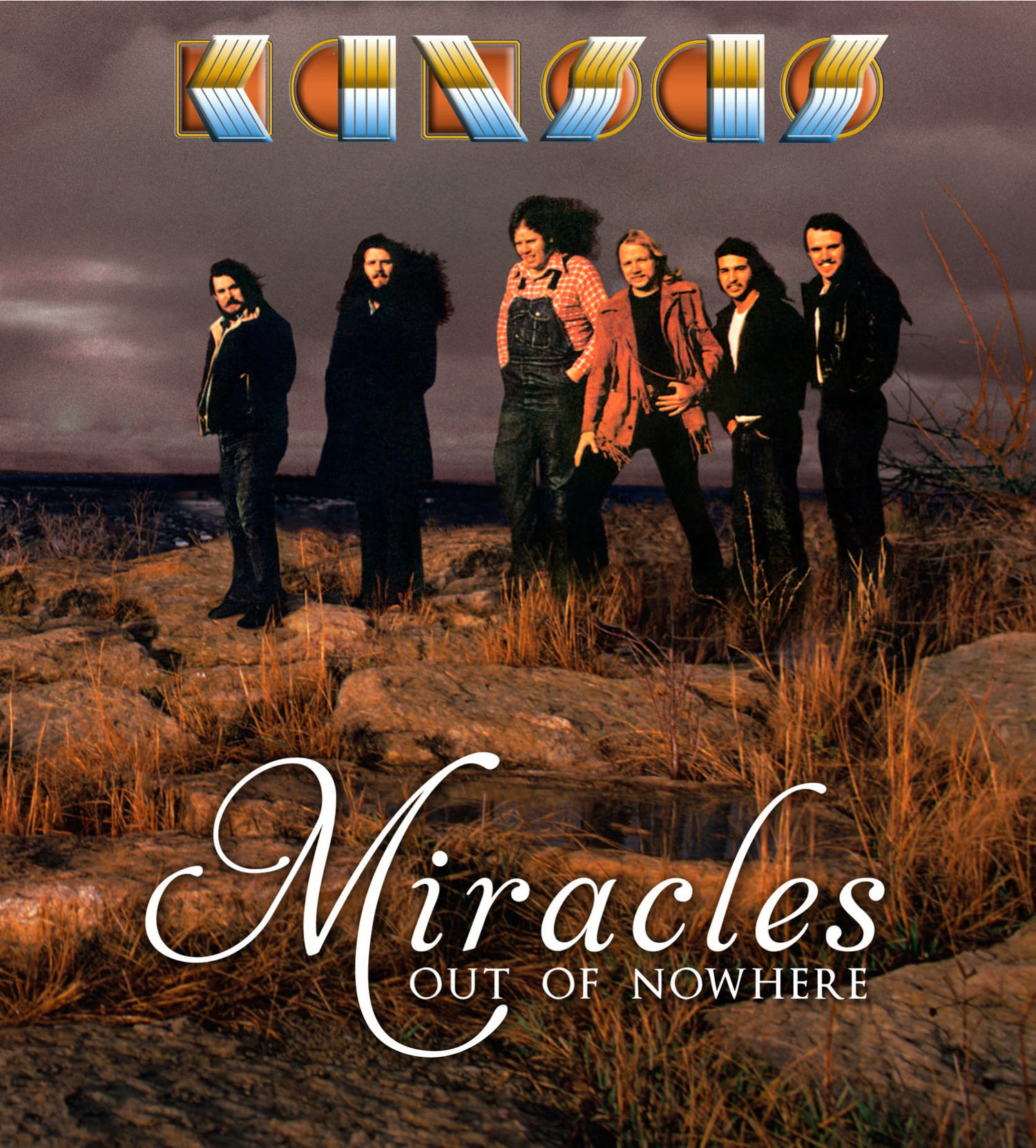
Early on in the documentary, “Miracles Out of Nowhere”, which was released in March, drummer Phil Ehart emphasizes that it was Livgren’s song writing, Steinhardt’s violin, and Walsh’s vocals that made Kansas such a distinctive-sounding band in the 1970s. He is surely correct about that, but he also, in saying so, humbly passes over another key to the band’s steady rise and eventually rather surreal success (or miraculous, a consistent theme in the documentary): he own unassuming, balanced personality and rooted, yet deeply musical, drumming. As Garth Brooks, one of several rather surprising guests, marvels in recalling his first Kansas show: “It was the first time I’d seen a drummer play actual notes!”
Miracles and music: those are the two constant themes throughout the documentary, which begins with childhood memories and concludes with 1977’s “Point of Know Return”, Kansas’ fifth album and the apex of the band’s commercial success (it hit #4 in the U.S. and featured the band’s biggest hit and best-known song, “Dust in the Wind”). That album is, arguably, a fitting conclusion to the documentary as the band would soon learn there really are points of no return; or, in the words a certain young lady, “Toto, I’ve a feeling we’re not in Kansas anymore”. It wasn’t long, in fact, before Walsh departed, then Livgren, and then the band entered into the post-classic-Kansas era (I provide some details here). Continue reading “Miracles (and Music) Out of Kansas”→
I began writing this post several months ago, in January, carried along on the brief rush of excitement that comes with a new year. “2015! How about noting a bunch of anniversaries of great albums?” And, in fact, one of the great strengths of Progarchy.com is the sense of music history and the awareness of anniversaries: “Forty year ago….thirty years ago….twenty-five years ago…twenty years ago…”, as opposed to the dominant model out there, which is “Forty minutes ago…thirty seconds ago…twenty tweets ago…” But then life overwhelmed me and the burst of focused energy dissipated for a while. Now it’s back. Best strike while the vinyl is hot—or something along those lines.
The idea here is very simple: I listen to hundreds of new albums every year, along with hundreds of older albums that I come back to for various reasons; but how much of that music has real staying power? And what, in the end, makes a person return repeatedly to This Album rather than That Album? Sure, of course it is because of impeccable taste and a rare instinct for timeless music. (Duh.) But there is a wonderful mystery to it all, for so much of what resonates in a particular album comes from accidental things: the time, the place, the event, the moment. Certain songs bring back great memories; certain songs make you want to jump off a cliff (yes, I’m looking at you, Olivia Newton-John’s “Physical”).
But it isn’t simply a matter of nostalgia, which can only go so far; it is, I hope, more often a matter of discovery, of hearing something new—or, in some cases, hearing something old and suddenly hearing it. Really hearing it.
My criteria is this: what albums from 60, 50, 40, 30, 25, 20, and 10 years ago do I still listen to now on a regular basis? And never tire of hearing? And why? With that, here goes!
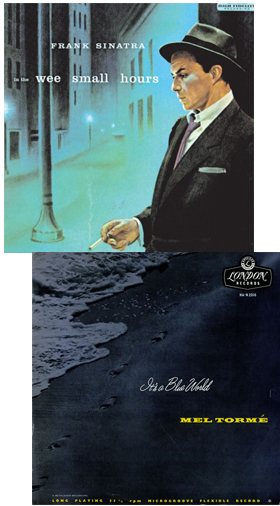
1955: In the Wee Small Hours by Frank Sinatraand It’s a Blue World by Mel Tormé. I was not raised on Sinatra’s music; quite the contrary—I was raised on decent hymns and mediocre to rotten “Christian” music; I hardly paid attention to Top 40 pop and rock until I was in junior high. And I didn’t really listen to Sinatra or Tormé until a dozen years ago. Prior to that, I simply didn’t “get it”. Then I did. Why? I’m not sure. But since then, I’ve collected some 1300 Sinatra songs. The Chairman of the Board produced many classic albums, but this one is my personal favorite: dark, lush, aching, beautiful, gut-wrenching, perfect. I sometimes fall to sleep listening to it, especially when it’s 2:00 in the morning and I’m wide awake. Sinatra had the rare gift of making you, the listener, believe The Voice was singing only to and for you. It’s impossible to describe; it simply has to be heard and experienced. And don’t forget: Sinatra is the God Father of Prog. Really. Sinatra, by the way, was born a hundred years ago this year.
Tormé did not have the edge or darkness of Sinatra, nor did he ever plumb the depths of emotional despair as did the legend ten years his senior. But Tormé had range, talent, and genius to burn, not just as one of the greatest vocalists of the 20th century, but also as an accomplished songsmith (he penned 250 songs or so), fabulous arranger, top-notch drummer (and decent pianist), novelist, biographer, author, actor, screen writer, consummate showman, and collector (guns, cars, movies, etc.). It’s a Blue World is a lush, impeccable set of songs, likely influenced by Sinatra’s Wee Small Hours. While Sinatra packs an emotional punch, Tormé thrills with pure beauty and dazzling musicality, all delivered with an effortless ease that reminds me of watching Roger Federer play tennis at Wimbledon. Bing Crosby, asked late in life to name his favorite musicians, named only one vocalist–Tormé–saying, “Any singer that goes to hear this guy sing has got to go and cut his throat.” For a taste, check out Tormé singing Duke Ellington’s “I’ve Got It Bad, And That Ain’t Good”. Continue reading “60 Years, Twelve Albums, One Man’s Favorites”→
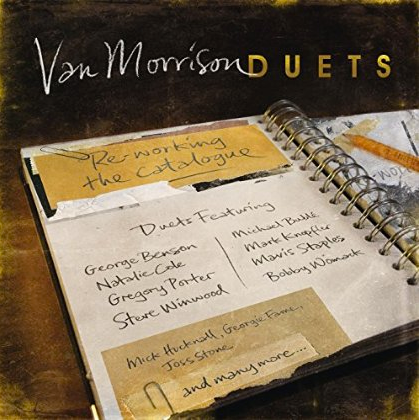
The number “50” is off—an 18-year-old Van the Man actually joined Them in April 1964 (thus, 51 years on)—but it’s fitting, as playing with time is something Morrison mastered early and continues to do very well, as singer, songwriter, and player. In 1966, Morrison and Them performed a series of shows at the Whisky a Go Go; the opening band was The Doors, and the two Morrisons—Jim and Van—performed together. On his new release (his 35th studio album), Duets: Re-working the Catalogue, the Belfast Cowboy performs with several singers who were born after the Sixties: Joss Stone, Michael Bublé, Clare Teal, Gregory Porter, Morrison’s daughter, Shana. Many of the other guests have been there and done that, including Bobby Womack (who died last summer), Mavis Staples, George Benson, Steve Winwood, PJ Proby, Taj Mahal, Mick Hucknall, Natalie Cole, Georgie Fame, and Chris Farlowe.
Those sixteen duet partners encompass blues, jazz, blue-eyed soul, rock, R&B, gospel, and pop, all of which are genres that Morrison mastered long ago, in addition to Celtic, country, and skiffle. No, there’s not a lick of prog on this or any other Morrison album, but there is, I suggest, a certain spiritual connection with certain forms of progressive rock, especially in the mystical journeying of Astral Weeks, the joyful, ecstatic visions of Moondance, and the epic, spiritual wanderlust of Avalon Sunset and Hymns to the Silence. Part of the genius of Van Morrison is that he largely ignores prevailing musical trends, yet is able to connect to a wide range of listeners because of a certain timeless quality to his songs, which are consistently melodic and memorable. My first real initiation into Morrison’s music was in the summer of 1991, when a friend played Avalon Sunset for me; I was instantly hooked, and quickly began acquiring all of Morrison’s music. In my 2002 essay, “The Incarnational Art of Van Morrison,” I reflect on the various spiritual and mystical themes in Morrison’s music. Continue reading “50 years after Them, Van Morrison cuts one of Those “Duets” Albums”→
Chris Cornell cemented his reputation long ago as one of the greatest rock vocalists ever, first with Soundgarden in the 1980s and ’90s (and currently), and then with Audioslave in the early 2000s. But Cornell, who is now 50 years old, has a rather intriguing history of crossing genres, beginning with “Temple of the Dog” (1991), which was certainly rock, yet with hints of gospel and folk. His surprising 1997 version of “Ave Maria” (on “A Very Special Christmas 3”) indicated an interest in music far outside the usual grunge/metal arena. And with his 1998 song “Sunshower” (on the “Great Expectations” soundtrack), which became a hit without ever being released as a single, and “Euphoria Morning” (1999), his first solo album, Cornell further demonstrated his ability to sing (and write) within numerous genres. His 2009 album, “Scream,” caused plenty of screams—from fans who welcomed the electro-R&B-Timbaland-produced songs and from those who hated it and saw it as a sign of the apocalypse.
In recent years, Cornell has written and performed a hit song for a blockbuster movie (“You Know My Name”, the theme song for the 2006 James Bond film, Casino Royale), sang lead on the funky, Euro-fusion tune “Lies” with Gabin, and crooned a mellow, old-school duet (“All I Have To Do Is Dream”) with Rita Wilson on Mrs. Tom Hanks’s 2012 solo album, “AM/FM.” And in his various solo acoustic tours [see my October 2013 review of one such show], Cornell has always played some left field tunes, such as Michael Jackson’s “Billy Jean,” which he first played unplugged many years ago as a slow-burning blues song (and inspiring a similar take from “American Idol” winner David Cook in 2008).
There are more examples, but that’s enough of an intro to Cornell’s latest collaboration, which was released last week: the single, “Heavy Is the Head,” with the Zac Brown Band, which appears on ZBB’s forthcoming album, “Jekyll + Hyde”. I’ve enjoyed the ZBB’s past albums, which are a mixture of Souther-country-rock, traditional country, and some Jimmy Buffet-type tunes, and I expected I would enjoy the tune. In fact, I think it is a great cut; it is far heavier than expected and is a near perfect marriage of Southern/country rock and grunge, hence my use of the word “Southerngarden”. The song is built on a distorted, grungy bass line, which leads into some distorted guitar and Cornell’s somewhat menacing vocals; it builds over some fine riffs and, at the 3-minute mark, a nifty Soundgarden-ish breakdown and some trademark wailing. Here is a recent performance for SNL, marred only by a bad mix (the vocals are pushed too the back):
It is, as AllAboutJazz.com notes from the top, a “bold concept”: A big band and a jazz/fusion guitarist reinterpreting (“covering” isn’t it at all, not by a long shot) Pink Floyd’s “Dark Side of the Moon”—that modest little 1973 album that sold a bazillion copies and cemented Waters, Gilmour, and Co. as rock legends. The chances of such an audacious project going sideways, upside down, or simply “splat” are fairly high. Most Floyd purists, I suspect, would dismiss it immediately, and most jazz purists would be right behind them. (I hope I’m wrong, but I think that’s a fair guess.) That would be unfortunate, because “Celebrating the Dark Side of the Moon” is a stunning album, a splendid example of what can happen when exceptional jazz musicians take on exceptional rock/prog material with an equal measure of respect and experimental energy.
The album is the brain child of ACT-director Siggi Loch (ACT is a German label focused on contemporary jazz), and Stefan Gerdes and Axel Dürr, producers for the NDR Big Band; they enlisted legendary composer and arranger Michael Gibbs and the wildly eclectic, always surprising guitarist Nguyên Lê. The sleeve notes read, in part:
Nguyên Lê enlightens the Floyd’s repertoire – pure happiness – and enchants it with the collusion of the NDR Bigband and its brilliant soloists, deploying new sound-textures created by the uplifting orchestrations of Michael Gibbs. The arrangements here – Gibbs wrote three, Nguyên Lê wrote the others – provide choice settings for inspired improvisations and also reveal other compositions which appear as natural extensions of the original opus. The guitarist’s playing sparkles with those fiery, oriental accents we’ve learned to love, sustained by guests he can trust: Jürgen Attig, Gary Husband, or Youn Sun Nah, whose chalice is brimming with magnetic grace. “Celebrating The Dark Side Of The Moon” is no simple tribute to a record which made history. It fervently expresses the re-creation – exempt from all imitation – of a score which you can hear in filigree. This is a palimpsest. The writing can still be (re)read, with warm hues forged by respect for the original matrix and the multiple expressions of its identity. Like a principle of Life.
The playing throughout, no surprise, is top of the line; but what really jumps out is the muscular, bold, and detailed quality of the arrangements, as well as the propulsive fluidity of the solos and ensemble playing. Yes, you know you are hearing Pink Floyd songs, but you hear them in a new and invigorating way. Lê is especially dynamic; he plays the vocal parts in several songs, and his tone is as rich and expressive as any vocal, bringing out melodic qualities deep in the original material. Listen, for example, to “Money,” with the solo starting at the 1:00 mark:
The other stunner is South Korean singer Youn Sun Nah, whose solo work has always demonstrated a willingness to push—and sometimes simply flatten, by virtue of her power and precision—musical boundaries, moving from sweetness and light to primal, raging darkness at a moments notice (check out her rather harrowing version of “Enter Sandman”). Here she is singing “Breathe”:
The Telegraph gave the album a begrudging decent review, stating, “The remarkable thing is that eventually, the album persuaded me to forget the original. It does this very cleverly, by confirming and subverting our expectations at the same time.” Meanwhile, AllAboutJazz.com concludes its far more positive review by saying, “Nguyên Lê’s CTDSOTM is an ambitious, uplifting and frequently exhilarating project whose textural layers and conceptual riches are gradually revealed upon repeated listening. It should appeal to Floyd freaks, progressive big-band addicts and the musically curious alike.” I hope so!
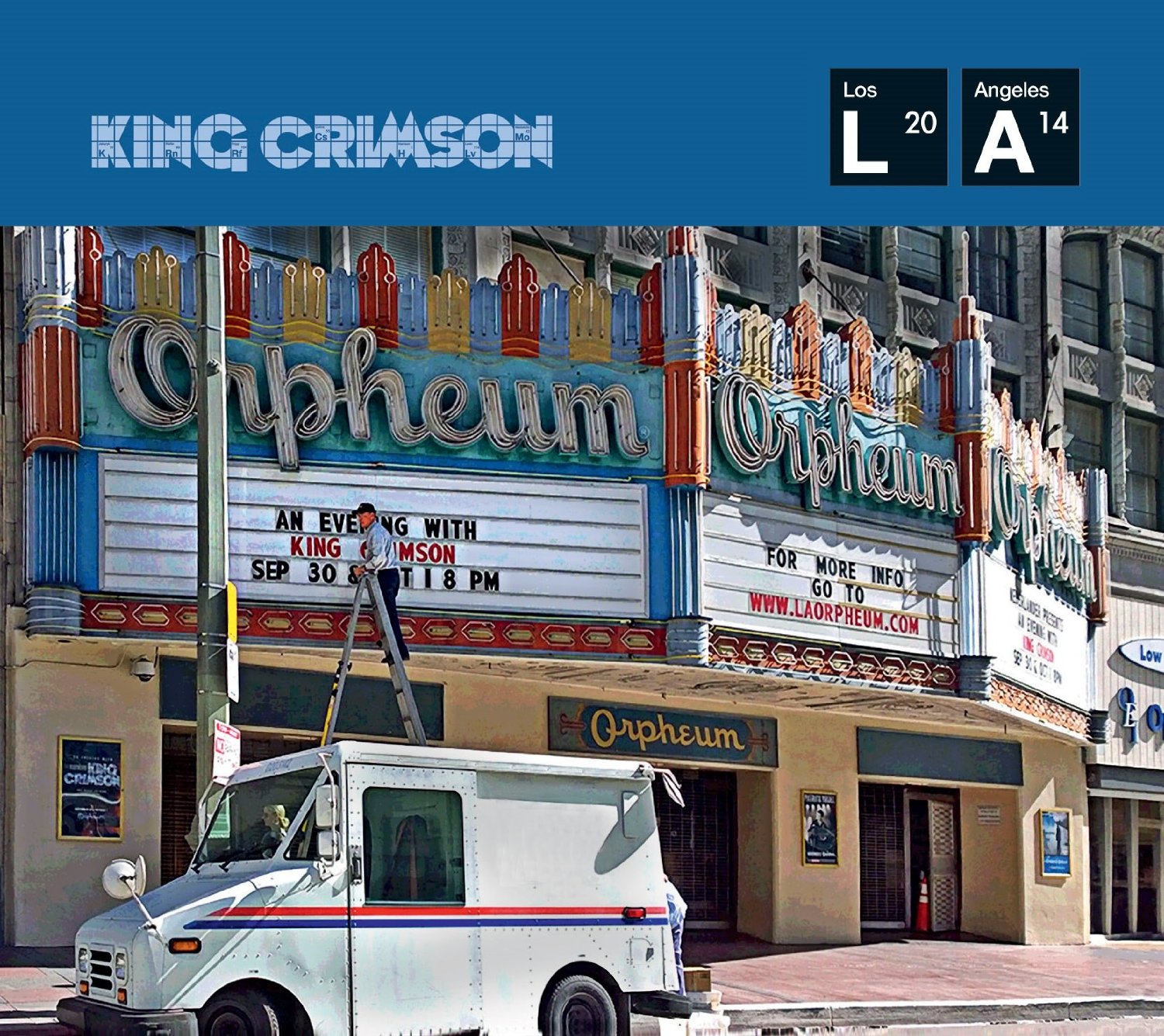
It’s not surprising that AllAboutJazz.com, one of the best jazz sites out there, will occasionally review albums that aren’t fully or even remotely jazz. But it may be a bit surprising how often the site features reviews of prog albums. But jazz and prog have a lot in common, not least the interplay of tradition and innovation, composition and improvisation, individuality and group interplay. Oh, and the curious fact that no one is really able to provide a succinct, satisfactory definition of either “jazz” or “prog”. And, of course, many prog groups and artists have feet in both worlds; names such Bill Bruford, Tony Levin, Jean-Luc Ponty, and King Crimson come to mind (there are many others). Speaking of King Crimson, the band’s newest release, “Live At The Orpheum,” rates a 5 star review from AllAboutJazz.com’s John Kelman, whose encyclopedic knowledge of the band is evident in his detailed review:
Based on the group’s two-night run at San Francisco’s legendary The Warfield, the groundswell of support was not just well-deserved; this was, it turns out, one of the best Crimson lineups ever…perhaps, even, the best, with the possible exception of the ’72-’74 lineup recently documented in the third of three consecutive box sets to be released in as many years, Starless (Panegyric, 2014). This was a Crimson that may have been taking a good look back at its long legacy but this was no retro band; King Crimson 2014 was truly, well, as 21st century as they come.
There’s even an argument to be made that despite the mid-’70s Crim’s reputation as fearless and often ear-splitting improvisers, King Crimson 2014 is an even better unit because, with the addition of Collins’ reed and woodwinds and three drummers who also bring electronics and, in the case of Rieflin, keyboards to the mix, this is a group that can play virtually anything from the group’s 45-year repertoire, and do it in ways that previous, smaller incarnations could not—all with perfect intuition and dynamics. Jakszyk is a singer and guitarist who, while as riveting and talented as Belew, is a more integrated band member than his immediate predecessor, whose presence somehow seemed to dominate every incarnation he was in over the course of nearly three decades. Not that Belew’s dominance was necessarily a bad thing, but it was, in some ways, self-limiting. And with Levin back, the group has a groove-heavy bassist capable of everything from Chapman stick and fretted and fretless basses to upright bass. Like Levin, it would seem that King Crimson 2014 has the chops to do just about anything.
A truth made all the more clear on Live at the Orpheum, the new line-up’s first official release, recorded during its two-night Los Angeles run prior to moving north to San Francisco. It’s a great reminder to those who saw the tour just how special this incarnation was, while allowing those unable to catch the shows to get some idea of what all the hubbub was about.
There will inevitably be those who will criticize co-producers Jakszyk and Fripp’s decision notto include an entire performance but, instead, make it a vinyl-length recording—the double-disc CD version also includes the stereo mix in 24/96 Hi-Res on a DVD-A—that only includes about a third of the group’s live set. But there are two approaches to compiling a live release. One, the relatively easy route, is to present a full show (or a composite taken from multiple nights) that may represent the overall best performances while still containing all the inevitable minor imperfections that are part and parcel of any live performance—barely noticed, if at all, at the time but, with a permanent document, there to be heard time and again. The other, a more time and work-intensive approach, involves listening to each show’s multitrack tapes in minute detail to identify the absolute best performances and then make any necessary minor (but not necessarily quick or easy) adjustments to remove those imperfections, creating a document capable of standing up to detailed scrutiny and of more lasting quality. A show, after all, is a fleeting thing, while a recording is intrinsicallypermanent.
Clearly Crimson opted for quality over quantity, but that meant, with just three months between the tour’s end and the release of Live at the Orpheum, the work required to sift through hundreds of hours of high resolution multi-tracks may simply have been too great to manage anything more than its 41 minutes.
Based on the end result, however, Live at the Orpheum more precisely documents how King Crimson 2014 sounded; rather than a “warts and all” live recording put together on the quick, it suits—and, perhaps most importantly, respects—the detail, complexity and unbridled energy of the group’s shows.
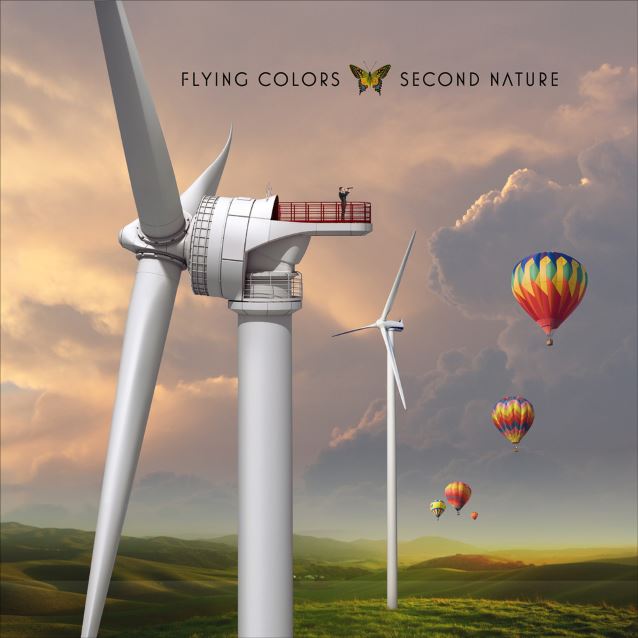
At risk of annoying those who waded through my New Year’s Day post on my favorite prog/rock albums of 2014, I’m (re)posting my #1 pick from that list, as I think it stands alone just fine as a review. And because I think so highly of this album. Oh, and because I don’t post nearly enough on this fine blog, so maybe this can count toward my post total! By the way, a recent issue of PROG magazine (Issue 51 2014) raved about this album—but didn’t get into the lyrical content as I do below.
“Second Nature” by Flying Colors. Every once in a while—perhaps once every few years—I hear an album that I listen to again and again…and again: Jeff Buckley’s “Grace”, “OK Computer” by Radiohead, and Soundgarden’s “Superunknown” come to mind. I’ve now listened to this album 75 times or so (according to my iTunes), and I’ve not tired of it at all. Not even close. If anything, I like it more than ever, and I’m confident I’ll be listening to it for years to come. There are numerous reasons for my obsession with “Second Nature,” but I’ll note just a couple of big ones. It begins with the album title, “Second Nature,” which certainly references that this is the group’s second studio album and the fact that making music, for these five masters, is second nature.
But it finally points to the intertwining, overarching theme of the album, which is that of spiritual awakening, ascent, and transformation, the movement from putting off the “old nature” and putting on the “new nature,” spoken of by Paul the Apostle in his letter to the Ephesians (4:22-24). The arch can be seen in the opening and closing lyrics. “Open Up Your Eyes” is a song of self-examination and spiritual assessment:
Dream, empty and grey
A story waiting for a place to begin
Hands, laying all the best laid plans
But where do we leave our mark
In this life?
There is reference to original sin, echoing Eliot’s “Four Quartets”: “Torn, wearing the disease you mourn/Like a deep freeze it burns.” And then the promise and the hope is proffered: “Open up your eyes and come awake/You will be created now”—itself a reference, I’m quite certain, to the Apostle Paul’s various exhortations to rouse oneself from spiritual slumber and to be made a “new creation.” The language of redemption and salvation are shot through the entire album; in many ways, this is the most open and covert Christian album I’ve ever heard (up there with early King’s X), and the approach is perfectly balanced and executed.
“Mask Machine” laments the layers of deception inherent in the dominant, de-sacralized culture, “With love for sale and gold for dirt/I’ll worship every fleeting aching.” The song “Bombs Away” furthers the lament and confesses the sad state of the first and fallen nature: “Run by my instincts/I’m high on the freeway/And I’m scared I’ll come down.” But there is a recognition of the vocation to transcendence: “I’d love to be found” and, “I need to find a way beyond.”
The next four songs, “The Fury of My Love”, “A Place In Your World”, “Lost Without You”, and “One Love Forever” are love songs—but for whom? Or Whom? There is a certainly ambiguity in the first two, as if nodding to the face that earthly love is itself a reflection of heavenly love: “Singing I surrender/I surrender/Tearing all the walls away/I’m giving you a place.” but by “One Love Forever” the ambiguity is gone, replace by clarity and knowledge of the God-sized hole in the human heart: “One love forever/For one consuming hole inside/One love forever/… One love for all time/Is calling/Our eyes contain eternity.”
The final two songs, “Peaceful Harbor” and “Cosmic Symphony”, mark the apex of the redemptive ascent: arrival and contemplation. And the music, amazingly, more than matches the rather mystical topic at hand. “Peaceful Harbor” is a soaring, ecstatic hymn: “I’ll look beyond/With this bedlam behind me/And I embrace the sky/My soul will cry/May your wind ever find me.” The final song is both prog heaven and, well, a hopeful glimpse of heaven: “I’m searchin’ for the air but I’m stuck here on the ground … And when I get to walk the streets/Without this burden on my feet/I know I’ve been called home…”
The monumental final, three-part track, “Cosmic Symphony,” is deeply emotional but resolute in nature. Once again, Eliot comes to mind (“Preludes” and “The Hollow Men” in particular), with references to scarecrows and cigarettes, with descriptions both abstract and apocalyptic: “Shrinking violet wounded by her mother/Old men sleep while porcelain screams take over/And the wolf disguises her undying lover.” There is a recognition, it seems, that redemption comes through acknowledging our limits in this temporal realm: “I’m searching for the air but I’m stuck here on the ground now…” But the conclusion, again, is one of hope in the world beyond: “And when I get to walk these streets/Without a burden on these feet/I’ll know I’ve been called home…”
Secondly, as indicated, the music perfectly carries and conveys the rich lyrical content. We all know that these guys can play anything; what is especially striking to me is how they play as a band, for the sake of the music. There are no solos for the sake of solos; everything is at the service of the songs. Steve Morse, who I’ve been listening to for 30 years now, continues to amaze with his ability to play with such precision and economy, yet with such soulfulness. See, for example, his solos in “Peaceful Harbor” and “Cosmic Symphony”. Morse is always distinctly Steve Morse, and yet he has an uncanny—humble, really—ability to serve the music at hand (I also think of his masterful work on Kansas’ criminally underrated “In the Spirit of Things”). Neal Morse and Carey McPherson have apparently mind-melded as vocalists; at times it is hard to say who is singing, nor does it matter. The amount of energy and love they have poured into this album is obvious. Dave LaRue is the epitome of virtuoso bass playing that is rooted and melodic; his brief solo near the beginning of “Cosmic Symphony” is a piece of sheer beauty—again, at the service of the song. And Mike Portnoy’s playing is so very tasteful, with all sorts of meticulous detail.
In short, this is, for me, a magical album. Thank you, Flying Colors!
In the process of putting together an end-of-the-year book list for CWR, I came upon my 2004 post on my favorite books and music of 2004. The music list is quite interesting, with just one overtly prog album (Pain of Salvation’s “Be,” which is, in hindsight, one of my least favorite POS releases), and a fair amount of jazz (no surprise) and country (some surprise). I’m glad to say I still listen to much of the music on that list.
This year, I’ve decided to break my music picks from 2014 into three categories: prog/rock, jazz, and the kitchen sink (country, electronica, weirdness). I want to emphasize “favorite” here because there were so many releases I simply didn’t get to, despite uploading over 6500 songs in the past 12 months. Ah well!
And I’m going to try to keep it short and simple, with the exception of my thoughts on my #1 pick in prog, which is also my Favorite Album of the Year. What is it? Read on!
Favorite Prog and Rock Albums of 2014:
12. “Live at Rome Olympic Stadium” by Muse and “Tales from the Netherlands” by Mystery. Muse is about as proggy as a mega-selling, world-famous band can be, known for putting on live performances that are equally energetic and well played. This July 2013 performance is no exception, with the trio ripping through nineteen of their eclectic songs, ranging from from electro-tinged funk (“Panic Station”) to Queen-ish pomp (“Knights of Cydonia”) to Floyd-ish slyness (“Animals”). The DVD is very impressive, not only because it was filmed with HD/4K cameras but also because the band is at the top of their game.
Mystery is fronted by Benoit David, who was lead singer for Yes for a short time a few years ago, before illness led to his firing. David never seemed comfortable with Yes, but his work with Mystery is of the highest caliber. The Montreal-based group is lead by multi-instrumentalist Michel St-Père (guitars, keyboards, bass, production) and has an epic, soaring sound built on fabulous melodies and exquisitely structured songs. The production, for a live album, is excellent, and David (who has since left the group) is in top form; this is not easy music to navigate vocally, yet he nails it at every twist and turn.
11. “Magnolia” by Pineapple Thief. Bruce Soord has more talent in his toes than most alt-bands have in their entirety, whether it be as a writer, producer, player, or singer. I’ve enjoyed everything from Pineapple Thief, but this collection of incisive, beautifully burnished tunes is Soord’s best work yet, the sort of intelligent, catchy, and detailed modern rock that deserves to be all over the airwaves. Classic Rock magazine sums it nicely: “Small but perfectly formed pockets of 21st century prog.”
10. “The Ocean At the End” by Tea Party. I was thrilled that this Canadian trio (now based in Australia) got together again after several years apart; I still listen to their early albums (“Splendor Solis”, “Edges of Twilight”) which feature an overt Led Zep vibe with a brooding, even epic, melancholy, rooted in Jeff Martin’s powerful voice and bluesy guitar playing. The latter quality is more in evidence here, and the rocking cuts (“Brazil” and “The Cass Corridor”) are the least enjoyable for me. The highlights are the dark cover of “The Maker,” the aching “Black Roses”, and the tour de force “The Ocean at the End”. Distinctive, powerful, emotive rock.
9. “Beyond the Visable Light” by Ovrfwrd. This album made a late charge on my playlist, as each listen revealed deeper layers of detail, melody, and interplay. The four-man group from Minneapolis is instrumental only, with an emphasis on group dynamics and song structures that are complex but very accessible. There is a lot of territory covered in the 5-song, 48-minute-long album, with grungy, propulsive passages melting into subtle, jazz-ish sections, and then giving way to Deep Purple-ish organ, and so forth. Great use of piano throughout, which brings a distinctive detail to the entire, enjoyable affair. Continue reading “From Carl’s Critical Kitchen: A Baker’s Dozen of Tasty Prog/Rock from 2014”→
As an Asia album: 6/10
As a John Wetton album: 8/10
Earlier this year I posted about the (then) upcoming, new Asia album, “Gravitas,” and wrote the following about the first single, “Valkyrie”:
The positives: Wetton sounds great; his vocals are impressively strong and clear at the age of 64. The song itself is quite decent, with the distinctive Asia “sound”: soaring keyboards, big chorus, and lyrics tinged with semi-mythical elements. The negatives: the video is rather (very!) low budget, the song sounds quite a bit like most Asia songs of the past couple of decades, and young Coulson seems underused. What strikes me odd, as I’ve read about this new album, is that while the band members talk about Coulson bringing a harder, even more metal-ish, sound with him, it doesn’t show up in the first single or in the clips of the other eight tunes. And, of course, none of them really sound prog-gy at all. Come to think of it, when did Asia last really incorporate anything obviously proggy in its albums?
Having now listened to the entire album a dozen times or more, I confess to being a bit conflicted. The positives are pretty much as described above. Wetton, who is 65, sounds exceptional; his vocals are strong, clear, and with plenty of nuance and bite, as evidenced on the title track. If anything, my appreciation for Wetton as a vocalist expanded in listening to this new release, especially for the various colorings and emotional nuances he brings to the table. The production, handled by Wetton and keyboardist guru Geoff Downes, is mostly excellent (see below for the negative), featuring lush soundscapes and impeccably crafted waves of vocal harmonies, a classic Asia staple.
In short, the top end—lead vocals, vocal harmonies, and keyboards—sound great.
Unfortunately, the rhythm section and guitar ranges from occasionally agreeable to rather boring. There are times, frankly, when I wondered, “Carl Palmer still plays drums, right? Where, oh where, is the bass?!” Yes, there are a few moments that rise above average (“Nyctophobia”, for example), but overall the drums are so far back in the mix and so generic sounding, it may as well have been Session Drummer Bob Smith behind the kit. The same could be said for much of the bass guitar, with a couple of exceptions, such as a nifty solo-ish section in “Russian Dolls”. Simply put, the bass and drums are often quite pedestrian, especially for players of this caliber; they might as well have been mailed in via Pony Express and then told, “Sit down way back there and play quietly!”
As for the harder guitar sound, I’ve heard heard more rockin’, “in your face” guitar on Michael Jackson albums. Sam Coulson might be the next Joe Satriani, but he rarely gets a chance to show what he brings to the table, and his solos are short, safe, and sadly generic. There is more guitar in, say, “Sole Survivor” or “The Heat Goes On,” than on the entire “Gravitas” album.
Having listened to “Gravitas” several times, I went back and listened to “Asia” and “Alpha”, which established, for me, the benchmark for subsequent Asia albums. Two things stand out: first, the early Asia songs were far more interesting, especially musically, with a remarkable amount of “proggy” elements for such commercially successful albums (of course, the early ’80s were far kinder in that regard, as also evidenced by Yes’s “90125”); secondly, the early Asia sounded like a band that wrote songs as a band and wanted to be a band. The input and influence of Steve Howe and Palmer are readily evident, even if Wetton and Downes were the primary songwriters. And so the songs were far more diverse, ranging from “Heat of the Moment”, with its upfront guitar lick, to the dramatic push-and-pull of “True Colors”, to the deeply longing, semi-epic “Open Your Eyes” (a personal favorite). To sum it up, the songs on “Gravitas” lack variety, suffering from sameness and, in places, some overly long and repetitious choruses and outros.
“Gravitas” is, as an Asia album, rather mediocre; it has some good moments, but is lacking. Those good moments are due mostly to Wetton’s singing and Downe’s keyboards. Lyrically, there is a singer/songwriter quality here that also suggest this is more of a Wetton vehicle than a real band effort. There’s nothing wrong with that, I suppose, but I miss the interplay and band-oriented sound of earlier Asia.



 Progarchy