A sprawling, highly subjective review of Soundgarden’s “King Animal”

“I’ve been away for too long …” — “Been Away Too Long”, opening song from King Animal
“Don’t know where I’m going/I just keep on rowing” — “Rowing”, closing song from King Animal

I suppose that first lyric could, alas, be applied to my postings on this fine blog. The past few weeks have been incredibly busy, with each day passed the cause for more muttering on my part about all of the brilliant, world-changing posts I should be foisting upon Progarchy readers. But since brilliant, world-changing posts are difficult to write, I’ll settle for writing a long and highly subjective review of the new Soundgarden album, King Animal, to be followed later this week with my “Favorite Music of 2012”, which I’ve now narrowed down to less than a hundred releases.

But before the review, a note of thanks. First, to the amazing Brad Birzer, the Sleepless and Tireless One, whose leadership and energy have really made Progarchy.com into the fabulous, progressive site that it is (and, yes, that’s the only time I’ll write “fabulous, progressive site” in my life). Thank you, Brad. You took the flimsy whim of my fleeting brain drizzle and turned into a lively, robust, and darned fun site. Hat’s off! And, secondly, to everyone who has contributed, thank you. I’ve tried to read every single post, and I’ve never been disappointed. The variety of perspectives, insights, tastes, eccentricities, and musical journeys has been fabulous to behold. Kudos!

One problem I have writing a review of King Animal is that I am tempted to turn it into something far more: a rambling, semi-coherent tribute to one of my favorite bands ever, late discovered (c. 2005) but perpetually played since; a sprawling rant about the word “grunge” and why Nirvana is (ahem) an incredibly overrated band and Pearl Jam leaves me completely cold (although I acknowledge that group’s abilities); a circling soliloquy about how Soundgarden—despite not being “prog”—has managed to do something that great prog bands do: create music that is soundgarden_kinganimalrestless, impossible to pin down either musically or lyrically, and incorporate a bazillion different influences and styles while producing a sound that is so distinctive that any rock fan worth their salt will shout, “Soundgarden!” after hearing just a handful of notes of any given song.
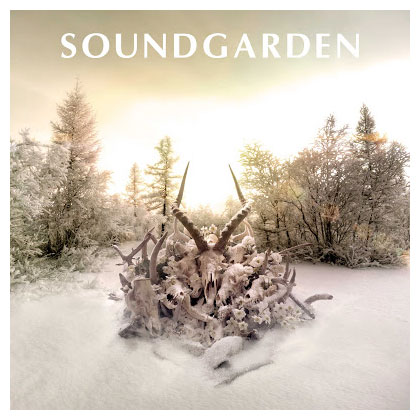
I’ve now listened to King Animal over three dozen times, and here, in short, is my take: it is not a perfect album, but it is a great album (a 9 out of 10, if I used such a system). And when you consider the thirteen-year long break (sixteen years between new albums), the fact that most reuniting bands play it safe and easy, and that the band members have always had quite different musical perspectives and approaches, it is a really great album. And, in fact, it has received solid to glowing reviews, as it should. I won’t bother pointing to this or that review, although there have been some good ones. However, if you want a great track-by-track description, here the place to start. And if you want to listen to the album online, here you go. Or, if you just have time for a single, defining moment from the album, be sure to here the song, “Bones of Birds”, which is perhaps the most stunning track among several stunning tracks.

Chris Cornell, the legendary voice and primary lyricist for the band, said recently, “The album is a story. It has a lot of twists and turns.” That jumped off the page (well, screen) at me because as I’ve listened to the album and reflected a bit on the lyrics, I keep coming back to (ready for it, Brad?) my favorite T. S. Eliot poem, “Ash Wednesday”. That poem is about spiritual struggle and ascent, the tension between the past and all of its failures and demons, and the future, which is filled with hope (ultimately eternal and God given) as well as fraught with peril. It refers to twists and turns, to the mystical ladder of ascent:

 At the first turning of the second stair
I turned and saw below
The same shape twisted on the banister
Under the vapour in the fetid air
Struggling with the devil of the stairs who wears
The deceitful face of hope and of despair.

At the second turning of the second stair
I left them twisting, turning below;
There were no more faces and the stair was dark,
Damp, jagged, like an old man’s mouth drivelling, beyond repair,
Or the toothed gullet of an aged shark.

One of the reasons Soundgarden has fascinated me over the past few years is because so many of their songs explore and reflect the spiritual struggle and existential crisis so evident in the modern/post-modern world. And rather than being trite, didactic, preachy, posturing, or narcissistic, those songs have tended to be both very honest and very fragmentary, as if Cornell (primarily) is looking into a shattered glass and trying to put it back together, like a mosaic both broken and coveted. Think, for example, of their huge (and unexpected) hit, “Black Hole Sun”, from the masterwork, Superunknown (1994):

In my eyes,/Indisposed,
In disguise/As no one knows.
Hides the face,/Lies the snake,
And the sun  …
In my shoes,/A walking sleep,
And my youth/I pray to keep.
Heaven send Hell away,/No one
Sings like you anymore.

Like who, exactly? The brilliance of such lyrics is, again, the shard-like ambiguity and artful lack of full resolution. But there is no denying the longing, and how that longing is rooted in a quite Catholic perspective, even if it resists any and all systematic explication. Cornell was raised in a Catholic home, and while he had, by all accounts, a fairly miserable childhood (alcoholic father, etc.), he has repeatedly used Catholic motifs and more generally theistic language in his songs. Some of more overt references can be found on the first Audioslave album, as in the song, “Show Me How To Live”: Continue reading “A sprawling, highly subjective review of Soundgarden’s “King Animal””
Rush to be inducted into the Rock and Roll Hall of Fame

From RollingStone.com:

The Rock and Roll Hall of Fame has officially announced next year’s inductees: RushPublic Enemy, Heart, Randy Newman, Donna Summer and Albert King will all join the class of 2013, with Summer, who passed away this May, and King, who died in 1992, earning the honor posthumously. Lou Adler and Quincy Jones will both receive the Ahmet Ertegun Award for non-performers.

“It’s a terrific honor and we’ll show up smiling,” Rush’s singer and bassist, Geddy Lee, tells Rolling Stone. “It made my mom happy, so that’s worth it.” Lee is especially happy for Rush’s army of hardcore fans. “It was a cause they championed,” he says. “I’m very relieved for them and we share this honor with them, for sure.”

More from the Q&A with Geddy Lee:

I’m sure some small percentage of your fan base will say, “They should protest the whole thing by staying home.”
I never got too hot and bothered about the subject, and I don’t think that’s a very gracious way to respond to an honor. 

Axl Rose stayed home last year, and the Sex Pistols refused to come, too.
We’re nice Canadian boys. We wouldn’t do that. 

It’s a pretty eclectic lineup this year. Are you fans of the other inductees?
I certainly have worked with Heart and I know them well. I’m very happy for them. I have great respect for Albert King and for Randy Newman. I don’t know the music of Public Enemy very well, but I know they have a very strong fan base. They’ve certainly played a role in the development of that style of music for sure, so it’s a nice group.

To be frank, I am disappointed that Deep Purple is not included in that group. Certainly Heart and Rush would not sound the way we sound without Deep Purple. 

I’m sure they’ll get in soon.
Yeah, I hope so. 

I keep saying this to everyone, but I can’t picture the jam at the end of the ceremony.
Yeah, that’s for sure. What do you jam to? “YYZ?” I don’t know. [Laughs] That’d be pretty fun. 

Read more!

The catholicity of jazz (with an idiosyncratic list of jazz albums for people who don’t like jazz)

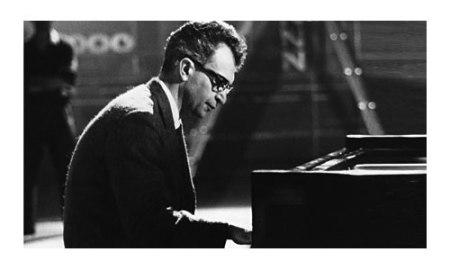
davebrubeck_progarchyThe following was originally written in May 2011 for the Insight Scoop blog. I’ve decided to share it here as a very modest homage to Dave Brubeck, who died this morning, one day shy of being 92 years young. It sounds like Brad has more about Brubeck on the way. Anyhow, here goes!

I just read a fun post, “The Catholic Roots of Jazz?”, by Joe Trabbic on the “End of the Modern World” blog, and wanted to blather about it for a bit. Joe writes:

Jelly Roll Morton was a key figure in the early development of jazz. Some people even regard him as the first real jazz musician, the man who brought together various musical forms into the new thing that we now know as jazz. Jelly Roll’s real name was Ferdinand Joseph LaMothe and he was raised Catholic, but the dissolute life that he began leading as a teenager, when he secretly took a job as a piano player in a New Orleans brothel, quickly made his Catholicism unrecognizable. But who knows the hearts of men save their Maker?

He goes on to mention early jazz giants Dominic “Nick” LaRocca and Louis Armstrong, and then remarks upon Dave Brubeck, one of the finest (and longest-performing) jazz pianists, saying, “Well, if jazz didn’t have anything Catholic about it, why did one of the greats of later jazz, Dave Brubeck, decide to enter the Church of Rome?”

He admits he is having fun with it, but the two questions are interesting: “Does jazz have Catholic roots?” and “Is jazz Catholic?” The first one, it seems to me, is bound up to a large degree with the history of jazz, which is a complicated matter. But it is pretty evident that jazz, to put it rather simplistically, has roots in both the European cIassical tradition and very American forms of music—ragtime, blues, early country, spirituals, gospel, dance music, etc.—harkening back not only to New Orleans, but Chicago, New York, Texas, and a variety of other places, especially throughout the southeastern United States. Elijah Wald’s How The Beatles Destroyed Rock ‘n’ Roll: An Alternative History of American Popular Music (Oxford University Press, 2009), offers a fascinating and slightly iconoclastic version of that history, especially in the first seven chapters. Jazz was, in the beginning, very much dance music, and was usually associated with a less than upstanding life-style. And that image was hardly helped in the 1940s and ’50s when many jazz musicians came under the spell of heroin and other drugs.

One of my heroes, G. K. Chesterton, had nothing good to say about the jazz of the 1920s and 1930s. I beg to differ with him, but I’m sure it was an unusual and even jarring thing for the Englishman to hear. It was a music filled with great energy, imbued with a beguiling combination of rawness (sometimes sexual in nature) and sophistication (often classical in origin), being both very rhythmic and melodic, with an ever-increasing harmonic complexity. I own dozens of books on jazz (and close to 11,000 songs classified as “jazz” on my iTunes), and they all agree that defining “jazz” is a very difficult matter. Barry Ulanov was one of the first great jazz critics (he was also a Catholic scholar—more on that in a moment), the author of A History of Jazz in America (Viking Press, 1954) and A Handbook of Jazz (Viking, 1960). He wrote, in the latter book, “The harder one listens to jazz, the more one hears European rather than African influences—the folk songs of England, Scotland, and Ireland, of France and Germany and even the Balkans, rather than the music of the jungle and the coast settlements from which the slave ships came.” Continue reading “The catholicity of jazz (with an idiosyncratic list of jazz albums for people who don’t like jazz)”

Trevor Rabin: “As long as it’s good and well-played, all music is worth listening to.”

Once again, the AllAboutJazz.com site has another great piece about a prog musician: “Trevor Rabin: All Colors Considered”, by Ian Patterson. The focus is on Rabin’s outstanding new solo album, Jacaranda  (one of my favorites of 2012), which is Rabin’s first solo excursion since his exceptional 1989 album, Don’t Look Away, which I played incessantly back in the day and revisit on occasion. Patterson begins by putting Rabin’s impressive career in perspective:

Whether taking a stance against apartheid in the early ’70s in his native South Africa or turning down the opportunity to play in super group Asia for artistic reasons, Rabin has always done things his own way and stuck to his principles at every step. Rabin is perhaps best known around the world for the mega-hit “Owner of a Lonely Heart” and his 12-year stint with progressive rock giant Yes, but there are a surprising number of strings to the musician’s bow.

While it would have been easy to carry on touring and recording with the legendary British group, Rabin felt that after a dozen years a new challenge was needed, and he said no to Yes. So it was in the mid-1990s that Rabin embarked upon another career as a composer of film soundtracks. In a little over 15 years, Rabin has recorded 40 film soundtracks of varying genres, winning numerous awards in the process.

Just when it seemed as though Rabin’s music would only be heard in cinema houses around the world, he’s back with another surprise in the form of his sixth solo album, Jacaranda (Varese Fontana, 2012). It’s his first solo album of original material since Can’t Look Away (Elektra, 1989), and it’s an inspired collection of guitar- based instrumental compositions.

Continue reading “Trevor Rabin: “As long as it’s good and well-played, all music is worth listening to.””

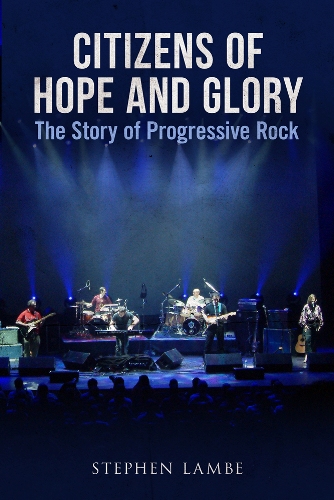
Detailed review: “Citizens of Hope and Glory: The Story of Progressive Rock”

Citizens of Hope and Glory: The Story of Progressive Rock (Amberley Publishing, 2012) by Stephen Lambe

Ten years ago, my wife and I had the pleasure of spending a day in Belize as part of a week-long Caribbean cruise. Our tour guide, oddly enough, was from Germany; he and his family had moved to Belize some twenty years prior. I’ve never been a tour guide, but I assume it must be challenging in many ways: dealing with difficult and clueless tourists, recounting the same information again and again, trying to find the right combination of being informative and entertaining, and being the leader of the tour while not making the tour about yourself, but about the country, the culture, and the sites. This tour guide was exceptional: he was informative and detailed without being obsessive about every nook and cranny; he had a passion for his adopted homeland but also a knowing sense of objectivity; he mixed together trivia and humor and history with ease; he helped us experience Belize with the knowledge that we were in capable hands. It made for a delightful day.

Stephen Lambe, author of the recently published book, Citizens of Hope and Glory: The Story of Progressive Rock, reminds me of that tour guide. Now fifty years old, Lambe is something of a late-comer to prog, although he states so with a certain British dryness. He begins with with a wink and wry sigh: “To my constant irritation, I missed it. I was born in 1962, so by the time I had had my Prog epiphany in 1978 it was all over.” Only two sentences in and you have a nice phrase to insert into your next musical conversation: “Prog epiphany”. Lambe recounts how hearing the 1971 Yes album, Fragile, “blew my mind”; that was in 1978, as punk was rudely clawing and pawing its way onto the musical throne, albeit briefly.

And so the tour begins, with Lambe making it quite clear from the start what he hopes to accomplish—and what he will not try to do, for this or that good reason. It’s a small thing, but also significant. Having written a couple of books myself (and trying to finish a couple more at the moment), I think certain books—especially non-fiction works intended to educate and inform on a particular topic—should state from the start what they will and will not do. Lambe’s book is the third book I’ve bought that is dedicated solely to prog music. And, without naming the other two, I’ll simply note that this is the first of the three to be straight up about what the reader will find between the covers. (The other two are collections of essays, and are more academic in tone; they are mixed bags at best.)

What parameters does Lambe set? First, he focuses mostly on “symphonic” prog groups, with some mention of progressive metal, electronic music, and certain pop/rock groups, such as Talk Talk, XTC, Kate Bush, Tears for Fears, Elbow, and Radiohead, that have embraced many elements of prog without themselves being or becoming prog. Secondly, Lambe uses almost no quotes from either musicians or other publications. “I have chosen”, he states, “to make this book a personal history … in the hope that my experience and opinions will strike a chord with other fans of the genre. This book contains fact and opinion. … In the end this is a history of Progressive Rock filtered through my own tastes and experiences and I hope it is all the better for that.”

Some readers might be put off by such a statement, and I can appreciate their concerns. Lambe the tourist guide has spent over thirty years living in the land of Prog, and he has definite opinions about the sights and sounds therein. Personally, I like the approach. It reminds me of the similar tack taken by the exceptional American music critic, Will Friedwald (just a year old than Lambe, by the way), whose books on Sinatra and other popular and jazz singers from the early and mid-twentieth century are opinionated, informative, occasional quirky, often humorous, and never dull. Granted, Lambe is not the writer Friedwald is—but few people are. But Lambe, like Friedwald, is both knowledgeable and reasonable; he has his preferences, but he never pontificates, lambasts, or chides. On the contrary, he is agreeably positive; his occasional criticisms are almost always along the lines of noting that Album B is simply not quite as good as Album A by the same artist—and here are some reasons why.

Third, Lambe points out that since he is English, he tends to focus on artists from the UK, especially when he writes about the 1970s. Fair enough, especially since England in the 1970s was the center of the prog universe. The book is a chronological history; it does not try to be cute and jump around needlessly. Over the course of the book’s ten chapters, Lambe highlights about sixty essential prog albums, what he calls “pivotal albums”. These are not necessarily the “best” prog albums, he takes pains to note, but are a good, solid start to any prog library. Groups that receive substantial attention from the ’70s include Yes, Genesis, King Crimson, Gentle Giant, and Emerson, Lake and Palmer. Later groups include Marillion, The Enid, Twelfth Night, Rush, Magnum, Dream Theater, and Porcupine Tree, among many others. Due attention is given to American and European bands, including groups from Poland, Italy, and Germany.

Lambe is at his best when he makes connections, highlights influences, shares his personal experiences, and places bands and albums within both immediate and larger contexts. Here is a good example of his approach, about halfway into the book, in the chapter, “The 1980s: A Short-Lived Revival”:

Much more of a surprise than the last gasp of Yes was the seemingly sudden emergence of King Crimson. Towards the end of the 1970s, Robert Fripp had been increasingly active. This included an excellent solo album, Exposure, and work with Daryll Hall, Peter Gabriel and his own band, The League of Gentlemen. Working largely in the USA, he had managed to re-invent himself as a pioneer of the New Wave rather than a Progressive Rock dinosaur. In 1980, he set about forming a new band.

This time, Fripp had a different style of music in mind, something informed by the post-punk pop of Talking Heads (from which band he stole innovative guitarist and vocalist Adrian Belew), the intricate minimalism of Steve Reich and the rhythmic complexity of the old King Crimson. With a rhythm section comprising Tony Levin (on bass and the strange Chapman Stick) and Bill Bruford (drums), the band began rehearsing in Britain before taking a short set on tour in small British venues. I caught this tour at Keele University and was very impressed, although despite playing Crimson classics ‘Red’ and ‘Larks Tongues in Aspic’, they had less an hour’s worth of material. They were called Disciples at that point, although it was no surprise when they changed their name to King Crimson.

The resultant album, with its striking, minimalist cover, is a masterwork. It mixes Talking Heads-style vocals and song structures with a Prog style that few people had heard before. Belew sounds like he is having a whale of a time, his vocals clearly heavily influenced by David Byrne of his former band, but his melodic sense superbly utilized. His inventive guitar playing dips in and out of Fripp’s more intricate patterns. Bruford and Levin sound like they were born to play this music, with Levin’s intricate and inventive Chapman Stick work particularly impressive. But Fripp was the boss, and his remarkable guitar patterns are what make Discipline so memorable.

Of the ten chapters, six are devoted to history, groups, and albums; the other four are about the important relationship between technology and prog, the various aspects of live performances, prog art and design, and the content of prog lyrics. I would have preferred, if push came to shove, for the latter four to have been grouped together as the second part of the book rather than be dispersed among the historical chapters, where they break up the narrative flow. As it was, I skimmed some of those four chapters; however, I’ve no doubt they will prove informative to readers interested in those specific topics, especially musicians, producers, and others actually involved in creating music. The Epilogue, “Darlings of the Press at Last?”, notes that “Progressive Rock is a specialist genre once again, with an aging audience. However, the success of Porcupine Tree, Dream Theater and Elbow should give us all hope. Wherever there are people are willing to put in a little work to get more than a catchy tune and a trite lyric out of music, then Progressive Rock, in some form, has some hope for survival.” I suspect that most of the contributors and readers of Progarchy.com agree completely.

Lambe’s book is, I think, a near perfect introduction to progressive rock for nearly anyone interested in the topic. Passionate, obsessive prog fans who have spent years reading and collecting and communicating may find it a bit “101” at times. But even they will likely appreciate how Lambe has put together a cohesive narrative that makes many connections and fills in many holes without losing sight of the forest for the trees. This is a tour worthy taking, with a very adept and enjoyable tour guide. Highly recommended.

Yes, A Floydian Rush to Jazz!

I’ve been buried with real work and real reality, but I do have grand designs for review posts of the new Soundgarden CD, “King Animal”, which released today, and Stephen Lambe’s book, Citizens of Hope and Glory: The Story of Progressive Rock, which I’ve almost completed reading (very short review: 4.5 stars out of 5, recommended). In the meantime, in my unrelenting quest to show the many wonderful connections between prog and jazz, here are three covers of prog classics, performed by the trio, Bad Plus (band site).

For those who aren’t familiar with Bad Plus, the trio—Reid Anderson, Ethan Iverson and David King—has made its name by being, in two word, distinctive and controversial. Part of their distinct (and controversial, to some) approach has been to cover tunes that aren’t a part of the usual jazz canon. For example, have you heard many true jazz covers of ABBA’s “Knowing Me, Knowing You”, Heart’s “Barracuda” (with singer, Wendy Lewis), or Black Sabbath’s “Iron Man”? No, I didn’t think so. And those covers, in my opinion, are excellent; they not only get your attention but they reveal aspects and possibilities in the original songs that weren’t obvious before. And it is done with a winning mixture of intensity, fabulous interplay, respect for the material, sly humor, and some “out there” moments. The Guardian puts it well when it describes the trio in this way: “If the Coen Brothers put together a jazz trio, perhaps it would be like this, the comic and the dramatic rolled together.”

And how about the fact the trio titled its 2007 album, “Prog”? Fabulous! Here, then, are Bad Plus covers of Rush’s “Tom Sawyer”, Pink Floyd’s “Comfortably Numb”, and Yes’s “Long Distance Runaround”:

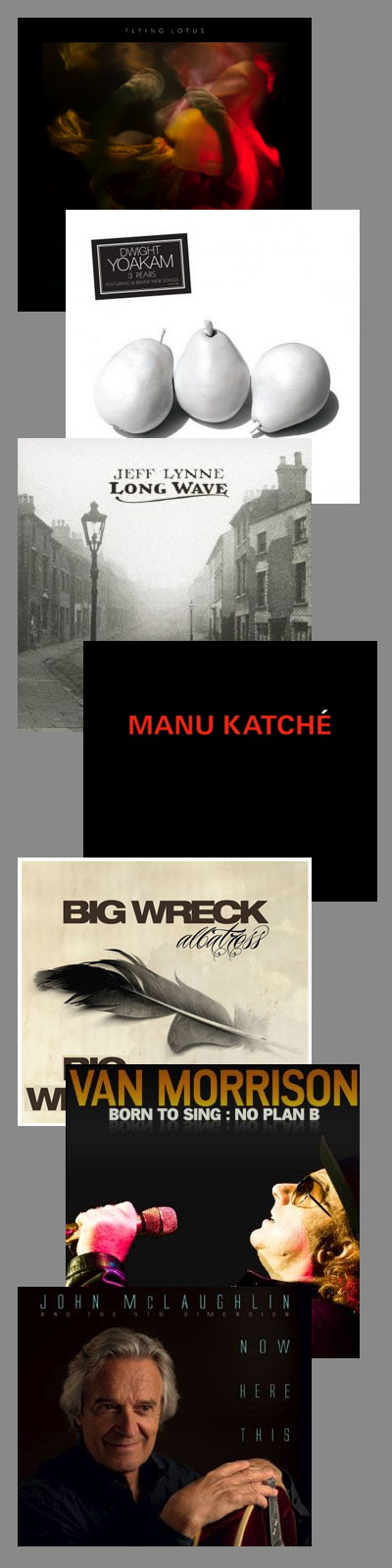
Succinct Reviews of Seven Sterling (Non-Prog) CDs

I live with several people and many things: my wife, our three children, a dog, two cats, five chickens, numerous fish, a dated wardrobe, and countless delusions. Among those delusions is an unwarranted—irrational!—belief that I will write long, detailed reviews of every album I deem worthy of such. Reality smirks at such excessive dreams, but I continue to harbor them. Still, I sometimes relent to reality, with gritted teeth and a fleeting snarl. So, what follows are short reviews of seven recently released albums (mostly downloads, actually) that share two qualities: they are not prog, and they are excellent. I should note that although the main focus of Progarchy.com  (which I conceived and Brad birthed—ooh, that sounds a bit, uh, strange) is obviously prog, it is open to all forms of good music. Genre is of far lesser importance than quality. That said, let’s push “Play”.

• “Until The Quiet Comes” by Flying Lotus. This is my sort of electronica: richly detailed, sumptuous, quirky, edged with darkness, possessing a jazzy flair, and endlessly inventive. The jazzy element has a genealogy, as Steven Ellison (who is Flying Lotus) is the great-nephew of Alice Coltrane, wife of the late, legendary ‘Trane. Includes a track, “Electric Candyman”, with a certain Thom Yorke. A near perfect late night album, this rewards repeated listens.

• “3 Pears” by Dwight Yoakam. His music has always been lean and his lyrics dry, but the new twist is subtle: a warmth in both content and sound. An example of the first is “Waterfall”, which is playful, with a wry and wistful sense of joy. The second comes through in Yoakam’s superb vocals, set in arrangements that are fat-free and feature just the right amount of twang and reverb, with tasty touches of organ and piano. The man is a superior songwriter and this set is further proof that country music can be twangy and contemporary without being shallow and trendy.

• “Long Wave” by Jeff Lynne. A part of me was prepared to dislike this because it is a covers album and is quite short (barely 28 minutes). Yes, this is a rather nostalgic homage to songs Lynne grew up on (standouts include “She” and “Beyond the Sea”), but the wizard of ELO brings such an obvious love to the project, I was won over. It doesn’t hurt that it is impeccably sung, played and produced, with lush Lynne-harmonies and ELO-like arrangements that are all about the songs. Besides, if there is one thing Lynne’s music has always had, it was a sense of nostalgic melancholy and romantic regret. Short, bittersweet, and stellar.

• “Manu Katché” by Manu Katché. Who hasn’t this phenomenal drummer played with? Notable names include Peter Gabriel, Sting, Jeff Beck, Tears for Fears, Tori Amos, and about a billion others. This is Katché’s fourth disc for ECM, and each has been fabulous; this newest release is notable for its propulsive approach. As one reviewer noted (I’ve lost the link), this is perhaps the funkiest ECM album ever, the sort of playful, soulful jazz album that gives an assured nod to modern sounds (read: synths and loops), but is rooted in acoustic bliss, with plenty of warm horns and shimmering organ. Recommended for anyone who loves great jazz and anyone who needs an entry point for modern jazz that is equally brainy and passionate.

• “Albatross” by Big Wreck. I was oblivious to this fine group (a “neo-prog hard-rock outfit” according to AllMusic.com) until I stumbled upon this new release on emusic.com. Singer Ian Thornley brings Chris Cornell to mind with his powerful, expressive vocals, but is hardly a clone, nor does he try to be. Three successive songs—”Wolves”, “Albatross”, and “Glass Room”—are worth the price of admission. “Wolves” (see YouTube video), especially, is a dynamite track, a perfect four-minute modern rock song, with top-notch playing and subtle melody. One of my favorite releases of 2012.

• “Born to Sing: No Plan B” by Van Morrison. No need for a Plan B for the Belfast Cowboy because he is the supreme Celtic synthesist, so soaked in jazz, blues, roots, and early rock, he can sing about grass growing and it is magical (and, in that regard, reminds me of G.K. Chesterton). This jazz-oriented album, on the Blue Note label, is arguably his best in a decade; he sounds refreshed, focused, and even happy. The horn arrangements are special and the songs are leisurely without ever wandering, mellow without ever dragging. The real revelation here are Morrison’s horn-like vocals, which are strong, elastic, and restless. Great album by one of my favorite musicians.

• “Now Here This” by John McLaughlin and The 4th Dimension. Some fans of McLaughlin’s legendary projects from the 1960s and ’70s aren’t too taken with his recent albums, which often feature guitar-synth and other modern devices. But while this album is occasionally frenetic and has a very modern (and crisp) sound, the adjective that keeps coming to mind is “soulful.” This comes through more obviously when things slow down, as on the lovely “Wonderfall”. The guitar solos are technically brilliant of course, but also have passionate, hungry logic that cannot be denied. This is music for the mind and the soul, which is about the highest praise I can give it. Fantastic effort from the legendary axe man.

My favorite prog track of the week: “Chuta Chani”

Every few days or so I go to the ProgArchives.com site and check out new material and reviews. The most recent visit was rewarded with the discovery of the Italian neo-prog band, Profusion, who recently released their second album, “RewoToweR”. The band’s site offers this description:

There are many languages ​​that lead the climb: rock, metal, fusion, pop, acoustic-tango. Each floor is a different dimension from the previous, but never isolated. Just as you can look at the title letters in both directions, the tower is also an ascent and descent together, until it gets to be a maze. The “RewoToweR” building is not like a “Babel of different languages” but the attempt to speak, through experimentation, a new and modern language.

Yes, that’s a bit cutesy and a tad hyperbolic, but the music is quite good, even outstanding, with assured playing, tasteful arrangements, and hook-heavy songwriting that is at turns playful, ambitious, mythical, and, on occasion, a little corny (see “Treasure Island”, a song about pirating).

The song “Chuta Chani” is a perfect example of what the band has to offer. Melodic violin solo intro? Check. Crunchy, tasty riff? Yep. Great bass line? Of course. Guitar with a hint of Middle Eastern spice? Indeed. Clean, strong semi-exotic vocals? In spades. Catchy bridge and chorus? Oh yeah. Breakneck keyboard solo with classical motifs? And how! Short chorale section to conclude? Why not? The singer, Luca Latini (described on the ProgArchives.com page as a “pop-soul singer”) has personality to spare. Normally, I’m not too taken with English lyrics sung with a strong accent, but Latini makes it work (at least for me) because he has fabulous tone and range, and he does inject so much enthusiasm and energy into the proceedings. And, despite the accent, he reminds me quite often of the criminally underrated Ted Leonard of Enchant (and other projects), which is high praise. Here is the band’s video for “Chuta Chani”:

“[P]erhaps the first genuine Progressive Rock track”

Yesterday I downloaded Stephen Lambe’s book, Citizens of Hope and Glory: The Story of Progressive Rock (2011), and am now about three chapters into it. Lamb is, according to his book’s site, a “co-promoter of the Summers End Progressive Rock festival since 2006” who is “also heavily involved with contemporary progressive rock band Magenta.” I’ve enjoyed the book so far; Lambe’s approach is a good mixture of the personal and the journalistic; the book strikes me as a fine introduction to prog music history for folks who are new to the topic but also an engaging guide for those who know prog fairly well (I’m somewhere in-between!). I appreciate that Lambe, in his introduction, explains what his book will and will not attempt to do (for example, his focus is on symphonic prog, with less material on other forms of prog). He is clearly both a huge fan of prog as well as a thoughtful musical critic. Anyhow, I will likely post a more formal review once I’ve finished the book.

In a section titled, “Yes—The Most Inventive Covers Band in the World”, Lambe provides some background to the legendary band’s formation: “Jon Anderson and Chris Squire met for the first time at La Chasse, a drinking club not far from the famous Marquee club, which was much frequented by musicians. … Their vision was that this was to be a rock band with an emphasis less on hit singles than on ambitious, sophisticate arrangements, great harmonies and high-quality players.” And then, in discussing the first Yes album—”Yes”, fittingly—Lambe writes of how the “band began playing radical rearrangements of other people’s songs, gradually combined with their own material … This include covers of ‘I See You’ by the Byrds and the Lennon/McCartney song ‘Every Little Thing’. Musically, it includes plenty of hints at the band to follow. … Closing track ‘Survival’ is marvellous, perhaps the first genuine Progressive Rock track.”

Which meant I had to download the album, which I’m embarrassed to say, I’d never heard before (shame!). It’s great stuff, more raw than the later Yes material, but with a really obvious jazz vibe, thanks for Bruford’s fabulous drumming. That said, what do you think? Is “Survival” perhaps the first genuine prog rock track?

Who said it? “I was a nerdy shut-in who listened to prog-rock…”

Surprise, surprise, the lead of singer of Soundgarden (and Audioslave), in this April 2012 interview in Details magazine:

DETAILS: What were you like growing up?
Chris Cornell: Wild. And reclusive. Sometime between 12 and 14 I smoked PCP and had a real bad reaction. By the time I was high-school age, I didn’t want to do drugs anymore, so I went a couple years without having any friends. I got in touch with the creative process between the age of 14 and 16, mainly because I was alone so much.

DETAILS: And yet you became a frontman. Did playing music change you?
Chris Cornell: I was a nerdy shut-in who listened to prog-rock—and then I got on stage. Most frontmen are not born hams like David Lee Roth. We’re more like Joey Ramone: awkward geeks who somehow find our place in the world on the stage. Nobody ever said a positive thing to me, ever, in my life, until they heard me play music.

DETAILS: I bet it helped you meet girls, too.
Chris Cornell: Oh yeah. Initially I was a drummer, and I remember standing somewhere in public with a pair of drumsticks, and these cute girls came up and started talking to me. We hadn’t even played yet! It was actually uncomfortable. I thought, “Is that all I have to do? Just hold drumsticks?” It immediately made me not like the girls.

Ha! Gotta love the sense of slightly twisted humor. Cornell also has this to say about the state of rock music:
DETAILS: There’s been a lot of talk recently, most of it negative, about the current state of rock music. What’s your take? Is rock dead?
Chris Cornell: It’s definitely lost its place at the center of the musical universe. Rock never meant the same thing to everyone, but when I was growing up in the late seventies, everyone could identify the five, ten bands that formed the center. Even if you preferred the fringe—the Clash over, say, Van Halen—you still knew what the center was. Now kids turn on the radio and hear Eminem or Kanye, so that’s what they gravitate toward. They’re making music on iPhones. Everything’s fractured. The reason there’s no modern-day Shakespeare is because he didn’t have anything to do except sit in a room with a candle and think.
So, what Cornell song is most proggy? That’s nearly impossible to say, as the “prog” elements (strange chords, odd time signatures, epic and semi-mythical lyrics) used by Cornell and Co. are seamlessly mixed into a delicious musical stew that also draws on early metal, Krautrock, punk, pop (the Beatles, to be exact), blues, gospel, and even Middle Eastern music. But here is my choice: “Limo Wreck” from Soundgarden; it is one of my 5 favorite Soundgarden songs, but was never a single or a hit:
>