Mini-review: Porcupine Tree’s “Octane Twisted”


Porcupine Tree’s new live album, “Octane Twisted” arrived in the mail today. It comes in several configurations – the one I ordered is a 2-cd and single dvd set of their April 30, 2010 concert in Chicago.

The first disc is a complete presentation of their 2010 album, “The Incident”. It’s an excellent performance, with the highlights being the Animals-era Floydian song “Time Flies”, and the album closer, “I Drive the Hearse”.

Because they perform the entire album without breaks, the audience is pretty much taken out of the picture. While watching the dvd of the show, it’s clear there is incredible chemistry between the band members, but I didn’t get much sense of rapport with the crowd. Gavin Harrison once more demonstrates he is one of the greats of prog percussion. He deserves to be mentioned in the same breath with Neil Peart and Nick D’Virgilio. Richard Barbieri is a master at creating evocative atmospherics, and Colin Edwin makes playing complicated bass runs look effortless. Once again, John Wesley joins the core PT members to play guitar and vocals.

Steven Wilson is the main attraction, and he doesn’t disappoint – playing both electric and acoustic guitar, and some piano. He pulls off some excellent solos in “The Incident”, “Time Flies”, and “Octane Twisted”. And, of course, he’s barefoot throughout the concert!

Disc 2 contains the rest of the Chicago concert, as well as three songs from an October 14 London show. The other Chicago songs are “Hatesong” (probably my least favorite PT song), “Russia On Ice/The Pills I’m Taking” (“Russia On Ice” drags, but “The Pills I’m Taking” picks up the pace nicely), “Stars Die” (from the early days!), and “Bonnie the Cat” from The Incident (odd choice for a concert closer). The London songs are “Even Less” (a perennial favorite, but this performance is a little lackluster), “Dislocated Day”, and “Arriving Somewhere But Not Here” (a really good rendition of a beautiful song).

Overall, this a fine performance, and you get a lot of music for your money. “The Incident” is not one of my favorite Porcupine Tree albums, though, so unless you like it a lot, you could probably give this one a pass. I was very disappointed that the dvd is just the basics: no special features, and it only offers 2.1 audio, not a 5.1 mix. Also, the editing was much too jumpy for my tastes; the camera rarely stayed on one angle for more than 3 seconds, and I would have preferred to have longer shots of the entire band playing.

If you are trying to decide which dvd of Porcupine Tree to buy, I highly recommend “Anesthetize”. It’s an incredibly energetic performance of an excellent album, “Fear of a Blank Planet”. “Arriving Somewhere” is also very, very good, and features music primarily from “Deadwing” and “In Absentia”.

The The: The Real Article

Remember the days when there were a few artists whose albums you would buy, no questions asked, before you heard a single note? They were so consistently good that you rushed to the record store on the Tuesday the new album was released, and finding it in the bin made your heart skip a beat. The The was that kind of artist for me.

The The was/is one person: Englishman Matt Johnson. I first became aware of him in 1982 when the 12-inch single (that’s vinyl, for you youngsters) of “Uncertain Smile” showed up at WRVU where I was a college-radio DJ. The artwork was attention-grabbing, and I put it on the turntable. The most amazingly catchy tune poured out of the monitors, and I was soon bopping round and round the tiny studio. For months afterward, whenever I made a mixtape (that’s a cassette, for you youngsters) for a friend, “Uncertain Smile” was always included.

“Uncertain Smile” was a track off of Johnson’s debut US album, Soul Mining, which is a mother lode of earworms. Every single song burrows its way into your brain with an irresistible hook that won’t let go. However, beneath the surface of these new wave/pop masterpieces, turbulence was brewing.

Johnson’s next album, 1986’s “Infected”, while maintaining the high hook-to-song ratio, was also chock-full of bile and bitterness. The title track’s chorus included the line, “So infect me with your love”. Love is a disease? Hmm…. “Heartland” comes across now as surprisingly prescient, as Johnson bemoans his country’s loss of independence: “The ammunition’s been passed/And the Lord’s been praised/But the wars on the televisions/Will never be explained/All the bankers getting’ sweaty/Beneath their white collars/As the pound in our pocket/Turns into a dollar/THIS IS THE 51ST STATE OF THE USA.”

For 1989’s Mind Bomb, Johnson put together a real band, including Johnny Marr on guitar, whose Smiths had recently imploded. Once again, the lyrics convey Johnson’s fury at religious conflicts: “But if you think that Jesus Christ is coming/Honey you’ve got another thing coming/If he ever finds out who’s hijacked his name/He’ll cut out his heart and turn in his grave/Islam is rising/The Christians mobilizing/The world is on its hands and knees/It’s forgotten the message and worships the creeds.” (Armageddon Days Are Here Again) However, alongside those rants are beautiful ballads like “Gravitate To Me”, where he croons, “I am the lighthouse/I am the sea/I am the air that you breathe/Gravitate to me.” And, as always, it all goes down easy, thanks to the gorgeous melodies wrapped around the words.

1993’s Dusk is the last of The The’s “classic” albums. It starts off with the sound of a needle dropping onto a vinyl record, and the listener is suddenly in the middle of a monologue by Johnson that sounds like it was recorded live in a comedy club. Except what he’s saying isn’t particularly funny – he sounds like he’s on the verge of being totally unhinged – and just when things begin to get really uncomfortable, he strums an acoustic guitar and sings, “Well, I’ve been crushing the symptoms/But I can’t locate the cause/Could God really be so cruel?/To give us feelings/That could never be fulfilled/Baby…” and we are off on a rollercoaster ride as Johnson explores his frustrations with love, lust, God, personal isolation, and the evil that every human is capable of .

Instead of railing against countries’ foreign policies and various religious doctrines, Johnson gets intensely personal in Dusk: “Everybody knows what’s going wrong with the world/But I don’t even know what’s going on in myself.” (Slow Emotion Replay) In the song “Lung Shadows”, a beautiful, jazz-tinged theme plays while he softly begs repeatedly, “Come closer to me”. In “Bluer Than Midnight”, he echoes Paul as he laments, “One sin leads to another/Oh, the harder I try/I can never, never, never find peace in this life.”

The album closes with “Lonely Planet”, which features a cathartic, uplifting melody, and the chorus, “If you can’t change the world, change yourself.” It’s a powerful song that reflects the wisdom gained from looking at a fallen world with unblinking eyes, and realizing, “The world’s too big and life’s too short/to be alone .. to be alone.” In the end, simply loving someone is the greatest thing we can hope to accomplish.

One last note: in 2002, Epic/Legacy rereleased Soul Mining, Infected, Mind Bomb, and Dusk in remastered versions that are excellent. If you get all four, the slipcases form two portraits of Matt Johnson when placed side-by side (which I think is pretty cool):

And here is “Uncertain Smile” performed live:

A Potpourri of Pineapple Treats

Kscope Music has been reissuing The Pineapple Thief’s albums beginning with their third, Variations on a Dream. With the recent release of their sixth, What We Have Sown, a wonderful back catalog is now available to those of us who missed them the first time around.

I happen to love Bruce Soord’s music, but there might be a “sameness” to it that can be frustrating to some prog fans. Soord’s compositional technique is very minimalist (in the same sense Philip Glass, Steve Reich, and Arvo Part are minimalist). For example, the song “Vapour Trails”, from Variations on a Dream, is nine minutes long, and the entire lyrics consist of

we’re flying too low/we’re flying too low/and trying to go far/but finding it hard/we’ve got your vapour trails to follow/you home/we’ve got your vapour trails to follow/we’re flying too fast/we’re flying too fast/and finding it won’t last/but something will pass…/we’ve got your vapour trails to follow/you home

As the words are repeated over and over, they become part of the overall sound of the song, and small variations in the melody have a much greater impact. It takes patience to listen to a typical Pineapple Thief song, but it is definitely rewarding. Every song creates a sense of time being suspended, as endless permutations of the basic melody are worked out. Perhaps Soord is the Bach of prog, and his songs are fugues!

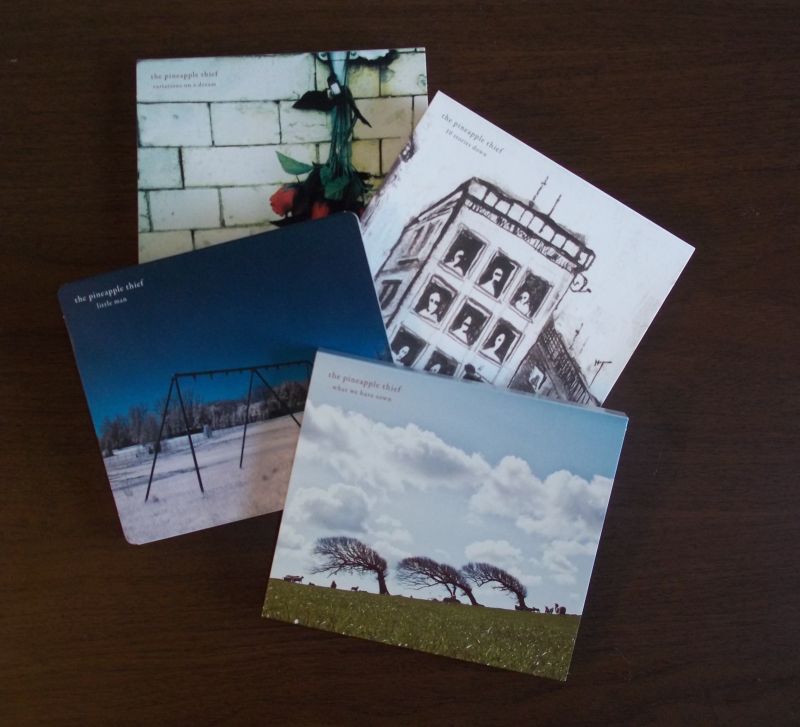
If you’ve never heard anything by The Pineapple Thief, a good place to start is the two-disc compilation, 3000 Days. Variations on a Dream (probably my favorite, with the amazing mini-suite “Part Zero”)  is Pineapple Thief at their most Radiohead-like. 10 Stories Down is more acoustic and lighter in feel.  Little Man is a heartbreakingly beautiful account of Soord’s loss of a child at birth.

What We Have Sown was initially released as a quickly-recorded farewell work for the Cyclops label just before The Pineapple Thief began its relationship with Kscope. Recorded in 8 days, it is a wonderful collection that features one of Soord’s finest songs, the 27-minute “What Have We Sown?” as well as the sinuous, Middle Eastern-flavored “Well, I Think That’s What You Said”. Kscope has tacked on two bonus tracks, making it an even better package than the original.

As a matter of fact, Kscope has done an excellent job with all four reissues. They come in attractive slipcases, and all have updated artwork. Variations on a Dream and 10 Stories Down each include a bonus disc of music that was originally given away in limited editions.

The Pineapple Thief represent a more contemplative side of prog, and based upon their latest release, All The Wars, they are still exploring new and exciting musical territory.

James Marsh Talk Talks

Over at Album Cover Hall of Fame is an excellent interview with James Marsh, the artist responsible for all of Talk Talk’s album covers. He provides some fascinating background on how each cover was chosen for Spirit of EdenLaughing Stock, and After the Flood.

Here’s a sample:

“When asked to consider producing a cover for SOE, I recall being consciously aware of permeating undertones from the natural world that were somehow imbued on the album, as far as I had heard on the sample tracks, so it seemed quite apt for me to suggest something containing naturalistic imagery. I produced some visuals to discuss at the next meeting, along-side showing Keith a selection of transparencies of my personal, unpublished work, a painting titled “Fruit Tree” being one of them. It was a simple case of him saying “Oh, I like that image, I’d like to show it to the band”, or words to that effect, which he promptly did and shortly afterwards a unanimous decision was taken to use it.”

The Roots of Prog: Miles Davis’ In a Silent Way

My introduction to jazz was through Weather Report in the late ‘70s, and I couldn’t have made a more fortunate choice. Led by Josef Zawinul on keyboards and Wayne Shorter on saxophone, my love for that group’s music opened the door for me to the mother lode of jazz: Miles Davis.

Miles’ 1969 album, In a Silent Way, is a cornerstone of progressive music. Consider this – it contains just three songs: “Shhh/Peaceful” (18:16), “In a Silent Way” (4:11), and “It’s About That Time” (11:27). These songs don’t follow any typical structure; they are mostly jams, albeit within a strictly controlled atmosphere. Hearing the album gives the listener a sense of time being suspended, while gifted musicians at the top of their game improvise with each other. Also, as with many prog classics, the studio was an integral part of the finished result.

In 1969, Miles’ group was in transition. Pianist Herbie Hancock was itching to go solo, drummer Tony Williams was starting up his fusion band Lifetime, and bassist Ron Carter was tired of touring. Miles recruited British bassist Dave Holland for the sessions, guitarist John McLaughlin, and electric pianist Chick Corea. At the last minute, he invited keyboardist Josef Zawinul to join them. So the sessions began with a unique lineup never before seen in jazz: three keyboards (Hancock, Corea, and Zawinul), bass (Holland), electric guitar (McLaughlin), soprano sax (Shorter), drums (Williams), and trumpet (Davis). Teo Macero, Miles’ long-time producer, was again at the controls.

Apparently there was very little actual composition written out beforehand. However, that doesn’t mean the songs are aimless noodling. Tony Williams is a master of restraint, playing a steady pulse on his cymbals almost the entire album. Here is how Ian Carr, in his biography of Miles Davis, describes the music:

There is great delicacy and finesse in the solos, great subtlety in the keyboards (everybody is listening to everyone else), and the music is pervaded by Miles Davis’ unique atmosphere of buoyant though melancholy reflection. Perhaps paradoxically, the total impression is powerful and seductive because the steady time with its occasional pauses (as if the music were actually breathing) creates the non-western climate of timelessness – and in a sense, it is music which should be inhabited rather than merely listened to.

Some of Miles’ greatest solos are in these sessions, as well as Wayne Shorter’s. By this time, they had played together so long they seemed to be one mind with their improvised interplay. When the sessions were over, they had about two hours of material. Teo Macero had learned to just let the tapes roll as soon as Miles began, and not stop until everyone quit.

Macero used editing to cut and paste together the final album, and he deserves most of the credit for making it such a satisfying listen. In “Shhh/Peaceful”, he includes a trumpet solo at 1:35 that states the theme, then he lets everyone trade solos for the next twelve minutes. At 13:31, he brings back the same solo to close out the piece.

“In A Silent Way”, which opens side two, begins with John McLaughlin alone on guitar. Miles famously suggested to McLaughlin that he “Play it like you don’t know how to play guitar”, and the result is a beautiful and simple tune that is charming yet challenging to listen to. It then segues immediately into “It’s About That Time”. Again, Tony Williams sets up a steady pulse over which the others can vamp and solo. Holland plays a repeated riff on bass that slowly builds tension while McLaughlin, Shorter, Corea, and Davis take turns soloing. The keyboards and guitar join Holland playing the bass riff until finally, at 9:00, Tony cuts loose and flails away on the drums while Miles solos. Then the exact same take of “In A Silent Way” that began the side brings the listener back to earth. No one had used tape editing in such a radical fashion before, but Macero makes it work.

It would be hard to overstate the influence In A Silent Way has had on music. Pink Floyd, Frank Zappa, King Crimson, Brian Eno, Joni Mitchell – all display hints of this music. Talk Talk’s Spirit Of Eden is heavily indebted to it, as well as a lot of Steven Wilson’s latest work (Grace For Drowning and Storm Corrosion). Practically anything that has “space” in it can trace its roots to this album.

Once again, Miles proved himself to be a visionary artist, building the bridge between traditional jazz and the newborn genre that would soon be known as progressive rock.

Listen to a stream of Side Two:

Thick As A Brick: A Confession

Here’s a quick recounting of my introduction to prog. In 1972 I was 11 years old, and my parents had asked the teenaged son of good friends what would be a nice album to buy me for Christmas. Apparently, he convinced them that the only possible choice was Jethro Tull’s “Thick As A Brick”. So they dutifully wrapped it up and put  it under the tree.

I was already well on my way to my obsession with music, having saved every spare cent I could get to buy Creedence Clearwater Revival’s “Green River”, and Simon and Garfunkel’s “Greatest Hits”. However, “Thick As A Brick” was a different proposition altogether. How weird could you get, making an entire album that contained one song? And who exactly was this Jethro Tull guy? I admit it was quite awhile before I realized that “Thick As A Brick” was not done by a solo artist.

The newspaper cover – I spent hours poring over every article in the St. Cleve Chronicle, until I felt I personally knew the inhabitants of that English borough. In the front page photo, Gerald Bostock’s friend, Julia, intrigued me. Why was she holding her skirt like that? And imagine the embarrassment and confusion I felt when I finished Fluffy Duck’s connect-the-dots puzzle! I quickly realized that I probably shouldn’t leave the album near the family stereo where Mom and Dad could pick it up and peruse the cover’s contents.

But the music – wow. I’d never heard anything like it. I could listen to it dozens of times and find new things to appreciate with each hearing. To this day, I can replay the entire “song” in my head from start to finish. After I became comfortable with mp3 digital technology, one of the first things I did was use Audacity to edit the two LP sides into one seamless song. Now I can listen to it the way Ian Anderson must have intended it to be heard.

Thanks Mom and Dad, for your willingness to introduce me to new music, and your long-suffering patience as I played my progressive rock albums during many family dinners!


Label Spotlight: Kscope Music

One of my favorite labels in the current prog scene is Kscope Music. Its first release was The Pineapple Thief’s Tightly Unwound in 2008, and it has rapidly become a force to be reckoned with. Steven Wilson has released all of his solo work on Kscope, as well as Porcupine Tree’s The Incident, and several PT reissues.

Everything Kscope does is top-notch, both musically and visually. They favor quality over quantity, and as a result, prog fans eagerly anticipate their releases. Their site is one of the most informative on the web, incorporating minisites for new and upcoming releases, music videos, artist’s tour dates, Soundcloud samples, Twitter feeds, desktop and mobile wallpapers, and a monthly podcast.

They have put together an impressive stable of artists, promoting what they call “post-progressive” music. Here’s a quick rundown of my favorites (in alphabetical order):

Anathema began as a very dark and heavy metal band, but now they are full of light and beauty. Their songs grapple with issues of life, mortality, and spirituality. Here’s a sample from their latest album, Weather Systems:

Engineers are what would happen if Pink Floyd and Crosby, Stills, & Nash decided to team up with My Bloody Valentine. Lush vocal harmonies on a bed of multilayered guitars. Gorgeous stuff, in my opinion. Here’s a link to an audio stream of their album In Praise Of More.

Gazpacho are from Norway, and, like Anathema, they aren’t afraid to tackle serious topics in their music. Here’s the video to “What Did I Do”, a song about P.G. Wodehouse’s being accused of treason after he made some naïve German radio broadcasts during WWII:

Lunatic Soul is essentially a solo project of Mariusz Duda, bassist for the excellent Polish prog-metal band Riverside. Their two albums tell the story of a soul in limbo who is given a choice of returning as a reincarnated person with no memory of his past life and loves, or keeping his memories and remaining a shade (at least that’s what I think it’s about!). There is a third Lunatic Soul album consisting of instrumental tracks based on the first two albums’ songs. Duda’s music is mostly acoustic, very melodic, and has a world music feel. Here’s a sampler:

North Atlantic Oscillation is a duo from Scotland. Their latest album, Fog Electric, is one of my top 5 albums of 2012. Imagine Beach Boys mashed up with shoegazers. Here’s a montage from the album:

As I mentioned earlier, both Porcupine Tree and Steven Wilson’s solo music are now on Kscope. I love his work, and if you’re reading this blog, I probably can’t add anything to what you already about him!

Finally, we have The Pineapple Thief. Bruce Soord has been making wonderful music for more than ten years. As I wrote in a review of their album Variations on A Dream, “Depending on your listening temperament, his songs can either be maddeningly long and repetitious or seductively beautiful. I fall into the latter camp, and it might be because I enjoy the music of Philip Glass, Arvo Part, and Steve Reich – minimalist composers who write tonal pieces that rely upon a lot of repetition.”

Here’s “Last Man Standing” from their recently released album All The Wars:

Kscope is a label that is creating its own distinctive style, like ECM and Blue Note did with jazz, and 4AD did with, well, whatever you want to call 4AD’s music in the ’80s. By taking full advantage of social media, Kscope is spreading the word about post-progressive music worldwide.

Spirit of Talk Talk: A Well-Deserved and Respectful Tribute

The sound experience which I prefer to all others, is the experience of silence.

John Cage

A shared pleasure among some of the writers of this blog is an appreciation for the 1980’s British group Talk Talk. They began as a slick synthpop band, but quickly outgrew that genre. By the time they released Colour of Spring, their third album, their music had become something unique and very special.

Spirit of Eden came next in 1988, and the music press was utterly befuddled when confronted with a real work of art that had an almost sacred feel to it. In my 1992 edition of Rolling Stone Album Guide, J. D. Considine rated Spirit of Eden one star, saying, “Good bands usually improve over time, while bad bands generally just fall apart. But Talk Talk took a different approach with its musical growth; instead of getting better or worse, this band simply grew more pretentious with each passing year…..by Spirit of Eden, Mark Hollis’ Pete Townshend-on-Dramamine vocals have been pushed aside by the band’s pointless noodling.”

What Considine and other critics didn’t get was Mark Hollis’ and producer Tim Friese-Greene’s desire to pare the music down to its absolute essentials. This included the use of silence as a compositional element. Spirit of Eden works, because everything extraneous is ruthlessly stripped away, and we are left with the beauty of the bare structure of the melodies. Just as the most effective way to get an audience’s attention is to speak softly, Talk Talk used space and “pushed aside” vocals to draw the listener into their music. And a funny thing happened. As the years passed, the reputation of Talk Talk grew in stature, and Spirit of Eden is now seen to be the visionary and influential work of art it was back in 1988. Case in point: it’s hard to imagine Radiohead’s Kid A ever being released without Talk Talk’s groundbreaking work.

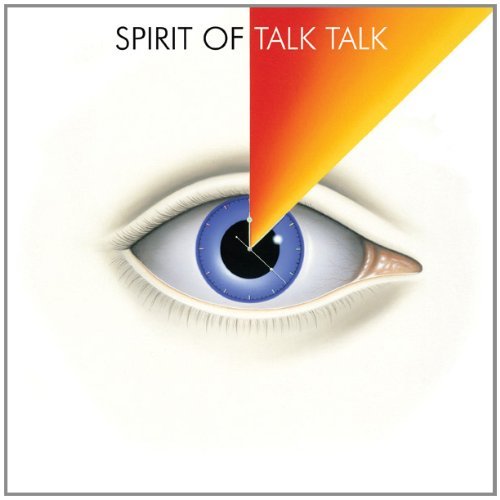
Which brings me to the topic of this post: a Talk Talk tribute album that has recently been released by Fierce Panda Records. Spirit of Talk Talk is a 2-disc collection of Talk Talk songs interpreted by 30 different artists. Alan Wilder, of Depeche Mode and Recoil fame, is the executive music producer and supervisor. James Marsh, the artist whose distinctive visual style was as much a part of the Talk Talk experience as their music, has done the cover art (Marsh loves visual puns: look for the clock in the cover shown above).

Tribute albums can be dicey affairs, often being attempts by deservedly obscure artists to get some attention. Spirit of Talk Talk is an album of respectful and sensitive interpretations of the original songs, while providing new insights into them. Imagine how even the poppiest early songs from The Party’s Over would sound if they were done in the style of Laughing Stock, and you get an idea of what this collection sounds like. The song selection favors tracks from Spirit of Eden and Laughing Stock, with some songs getting two different interpretations.

The first track, “Wealth”, performed by Lone Wolf, sets the tone for the album with a beautiful rendition that is almost liturgical in its plea to

Create upon my flesh
Create approach upon my breath
Bring me salvation if I fear
Take my freedom
A sacred love
Create upon my breath
Create reflection on my flesh
The wealth of love
Bear me a witness to the years
Take my freedom
Let my freedom up
Take my freedom for giving me a sacred love

Other highlights include a smoldering Duncan Sheik/Rachael Yamagata duet on “Life’s What You Make It”, King Creosote’s folk-polka performance of “Give It Up”, an intimate acoustic jazz performance of “April 5th” by the Matthias Vogt Trio, and the final song, “I Believe In You” by Arcade Fire’s Richard Reed Parry, whose hushed, multi-tracked vocals conjure up echoes of Thomas Tallis.

One of the most pleasant surprises for me has been hearing the Laughing Stock songs in a new light. I had not fully appreciated their beautiful melodies and lyrics until these interpretations showed me new facets of them. It’s been like seeing an old friend after several years’ absence, and discovering even more reasons for the friendship.

Even though it has been more than twenty years since Talk Talk has recorded, it is nice to see them finally get the praise and respect they deserve. Since it seems unlikely we’ll ever hear Mark Hollis sing again, we’ll have to make do with Spirit of Talk Talk. Fortunately, Fierce Panda has offered us an excellent and worthy substitute.

Lone Wolf Performing Wealth: