Study claims extreme music purges depression, in that case, Immolation should be among the most effective antidepressants. Emerging from the most fertile era in death metal, these New Yorkers effortlessly stood their own against Tampa and Stockholm scene’s invasion. A dose of bludgeoning drums, some excessively intricate guitar patterns, followed by sheer death metal growls – simply bulldozes depression and anything else in its path.
Immolation’s brand of dissonance is multifaceted; no other band rips your senses into such divergent paths. In other words, response to this imposing symphony can be – a still veneration, an accepting nod, or just violent moshing – depends solely on the listener’s filter. More crucially, this near deathly experience can be at times overwhelming – crossing those boundaries from being a mere antidepressant, and moving straight into the territory of ecstasy – illegal.
Years ago I had visited this rundown record store, and tucked away into one corner was this used CD – a grotesque cross-over artwork with Morbid Tales stamped on it. Of course, picking that up for the long drive back home was the next obvious step. Definitely not my first encounter with Celtic Frost, but this time they stunningly hit all the right notes. Not every day will someone inadvertently stumble into a Morbid Tales, quite an understated introduction for a viciously influential record.
How that eerie album intro explodes ‘Into the crypt of rays’—making an instant and deep impact. With the dusky coastal highway as an idyllic backdrop – a moment forever engraved in mind.
The whole experience was almost like discovering a trap door, straight into the nether vaults of metal. Suddenly, numerous aspects of late 80s and early 90s black/death wave starts to make sense. Those coarse structural patterns, surreal and nightmarishly poetic lyrics – they afflicted and spawned hordes of imitators. Some elevated those very elements to stratospheric levels. Quite like Venom — Hellhammer and Celtic Frost are vital, to grasping an era which otherwise might sound like sheer white noise.
Nile rumbles — “The scourge of Amalek is upon you” – hardly a hyperbole. These South Carolinians construct some of the most sinister patterns known to man. 180 beats per minute, brutal growls and Middle Eastern influences — all weaved into a vicious arrangement. Channeling Florida death contemporaries, Nile crafts a truly ravishing Egyptian dissonance at an intensity unparalled. Here, these assault patterns are unique, recognizable and quite atmospheric, a rarity within this lineage.
Egyptian chants and not so poetic gruesome mythology – “Horus hammereth them. Nepthys hacketh them to bits. The eye of Ra eateth into their faces. Their carcasses will be consumed in the desert”. Guttural growls, sharp temporal variations, and ruthless bass lines – all peacefully coexisting with electrifying melodies. With these rich signatures, Karl Sanders effortlessly heaves the listener into an intricate, enchanting and extreme terrain.
Superficial differences aside, ‘Brave New World’ is quintessential Iron Maiden. Those references to English literature, sober yet deceptively dark overtones, and compositions bordering on progressive metal. Not to mention the galloping bass lines, rich melodic riffs and vocals absolutely operatic – all essential Iron Maiden signatures.
For a song named after the early 70s British horror flick, The Wicker Man might seem deceptively upbeat. But, Brave New World is straight disturbing —“Dying swans twisted wings, beauty not needed here.” — seems to mirror Aldous Huxley’s own dystopian vision. Accessible, and threateningly catchy choruses – “Nowhere to run, nowhere to hide, you’ve got to kill to stay alive” – illustrates just one of those reasons why Iron Maiden is still that dominant heavy metal life form on this planet.
How a whimsical – “Is this a new reality. Something makes me feel that I have lost my mind” – effortlessly regresses into more horrific hues – “Lost in a dream of mirrors, lost in a paradox. Lost and time is spinning, lost a nightmare I retrace” – is baffling.
Azazel — The fallen angel, sets the tone for a mercilessly melodic Out Of The Silent Planet. Lyrics are not exactly C. S. Lewis’s fiction, but it’s a blend of catchy riffs and vivid imagery. “Withered hands, withered bodies begging for salvation. Deserted by the hand of Gods of their own creation.” — anticipating an eventual apocalypse — “Nations cry underneath decaying skies above. You are guilty, the punishment is death for all who live.” Finally, leaving the listener reeling with a devastating chorus – “Out of the silent planet, dreams of desolation. Out of the silent planet, Come the demons of creation”.
A markedly refined take is reserved for the end. Actually, any civilized mind would have already pondered —“When a person turns to wrong, is it a want to be, belong? –– “But what makes a man decide, take the wrong or righteous road” — indeed “There’s a grey place between black and white.” More decisively — “But everyone does have the right to choose the path that he takes”.
The artistic sensibilities that shaped Iron Maiden are all being subtly explored here – “We all like to put the blame on society these days. But what kind of good or bad a new generation brings. Sometimes take just more than that to survive be good at heart. There is evil in some of us no matter what will never change.” Essentially, where others adopt contentious naive stands, Iron Maiden simply enlightens, illustrating that not so thin line separating the rare eminent from the mediocres.
Emperor ceased to exist, but Ihsahn continued to pursue that trajectory. While musically more ambitious, his work is still firmly grounded in that very bedrock of symphonic black metal. Arktis, like his other records, explore diverse genres/themes and prods a range of emotions.
Staying clear of progressive metal clichés, Ihsahn crafts splendidly heavy and sublime melodies. Even the fiercely romantic “My heart is of the north” involves thick riffs, and a jarring keyboard reminiscent of 70s Emerson Lake and Palmer. Making that brief mellow moment — “And should my spirit soften like snow in early spring, or waver in the sultry haze, that soothing summers brings“ — quite exceptional.
Fascinating how whispering vocals – “Static, Dogmatic, Death cult, Fanatic” – can be this threatening with electronica. Transition into some grinding industrial metal — “I’d rather live a life in sin. And take the devil’s fall” — cannot be more elegant. With a measure of painfully moving vocals – “What kind of promises could justify the sacrifice you make? “ – Ihsahn paints a vivid landscape. But eventually ends with his signature, absolutely devoid of all sentiments, grating vocals.
Exhibiting those exquisite symphonic prog aesthetics, like 70s Genesis or Gentle Giant, Arktis is poignant, layered, and at times emotionally distressing – “Longing for the hopeless. Losing all to own the end”.
Melancholic solos when accompanied by keyboards — layered over measured strumming and painful clean vocals – “You chose a life at war. Now choose a worthy enemy. You know, it doesn’t always have to be yourself” – blazes a grim road. Musically and lyrically, Ihsahn teleports the listener straight into vaults of emotional desolation.
In spite of prominent extreme metal elements, long time Rush listeners should be immediately taken with that very familiar background keyboards in ‘Until I Too Dissolve’. But we are still skimming the surface, influences are multitude and diverse. Ihsahn traverses a progressive metal territory decked with stunning jazz to bleak black metal. Intense and sublime, Arktis, in Ihsahn’s own lyrical terms is a masterful “conjurer of sorrow”.
The initial guitar harmony is quite enticing, and well tailored to mislead that unsuspecting casual listener. As you can hear, the musical terrain flips in a couple of minutes. Lyrics, quite aptly scream — “Innocent soul dismembered…Enter the dark regions. And suffer a thousand deaths”. It’s good old Swedish brand of hardcore/punk aggression, but reconciled with guitar melody.
Dismember is an apt introduction to the early 90s Stockholm scene. Borrowing elements from their American and English contemporaries, these Swedes distilled their own characteristic flow and melody. Here, we can clearly discern that multinational lineage of Venom, Celtic Frost, Possessed, and Napalm Death.
For the uninitiated, the elegantly down-tuned melodic leads make Dismember relatively more palatable. The sheer sonic density of Entombed or Grave could be a tad intimidating. In some ways, Dismember also exhibits tendencies mostly associated with Gothenburg death, especially that of ‘At The Gates’. A closer examination reveals even more musical parallels, especially with the legendary English death metallers — ‘Bolt Thrower’.
But not just from the neighboring avenues, fascinating how back in the 80s, influences from places as far as Tampa, Florida or the Bay Area traveled back to Stockholm. Informal networks and underground tape trading channels simply emerged. Even without the World Wide Web, Altars of Madness wrecked a sonic carnage within the European scene. Simply stated, it was artistic entrepreneurship which drove the most extreme sounds on the planet. To channel a wise Scottish philosopher – death metal evolution is yet another illustration “of human action, but not the execution of any human design”.
Mikael Åkerfeldt did this one album with Katatonia – ‘Brave Murder Day’, and his influence here is quite conspicuous. Within their whole catalog, this record is unique for its absolutely depressive death/doom imprint. Meandering riffs with dry shallow growls, layered atop melancholic leads — consequence is this splendidly agonizing atmosphere. Åkerfeldt’s discernible growls – “I know your smile is deadly at this point. Wherever you are, I am not” – crafts an equally uncommon emotional depth.
With occasional thick down-tuned riffs, the record also exhibits those murky funereal doom like contours. Åkerfeldt’s vocals – “I saw it end long before it ended, Life itself turned pale and ended” – hammers in that very Scandinavian grimness. The song does run into markedly heavy drums, eventually fading off towards that very pale ending. Dragged out growls with guitar strumming does illustrate how vocals can be akin to an instrument in extreme metal.
“Endtime” finally brings this death/doom torment towards a sober, but still forceful, ending – “Pierced by the darkness. They called it death. And surrounded me with sleep”. Undoubtedly, that unusually inhuman vocal shriek is more commonly found in the genres shaped by Norwegians. The record fades away, but Åkerfeldt’s dank vocal gnarls might just leave a lasting impression.
The Karelian Isthmus’ does further that recklessly snowballing early 90s black/death wave, but mostly into relatively less threatening waters. Compared to Norwegian and Swedish contemporaries, these Finns dial down the dissonance and integrate quite a few contrasting elements.
Florida death was undoubtedly a catalyst – surging across the great Atlantic it caused permanent mutations within the European scene. Within the early Amorphis albums, especially ‘Privilege of Evil’ and ‘The Karelian Isthmus’, we can clearly hear this wave brushing up against a firm melancholic chill – that Black Sabbath like doom metal overtones.
This confrontation of an all razing morbid dissonance with a doom like texture was unique – ideal for integrating even more vibrant influences.
Amorphis goes on to deck this framework with folksy tremolo picking, thick downtuned grinds, progressive riffs and brutal blast beats. Deep growls of Celtic influenced lyrics – “Distant gate, gothic grave, through ages our clan still remain” – does add to that vital grimness. It’s Carcass and Grave like abrasiveness, but mellowed with Finnish cultural influences. Essentially, all the elements which eventually lead Amorphis to their epic Tales From the Thousand Lakes, and beyond, are exhibited here – but in subtle and intense measures.
Our tribalism always finds an outlet through politics, sports etc – but they manifest in other spheres too. Art is no exception; metal definitely is not. T-shirts, tattoos and band patches – all signal tribal association. Instinctively adopting a genre identity and defending those musical sensibilities is a commonplace. Labels, artists and the other marketing aspects are also an accentuating factor here.
Years ago I used to frequent this bar, they mostly played 70s to 90s metal. So you could find a wide variety of old-school metal-heads being regulars there. Before these metallers split into factions, sub-factions and more nuanced quibbling sub-categories – there were two broad species – those who listen to power-metal and those who despised it. Needless to say, each considered the other as poseurs. The polarizing quality of power metal cannot be more evident. I guess melodramatic compositions and fantasy themes are not everyone’s cup of tea!
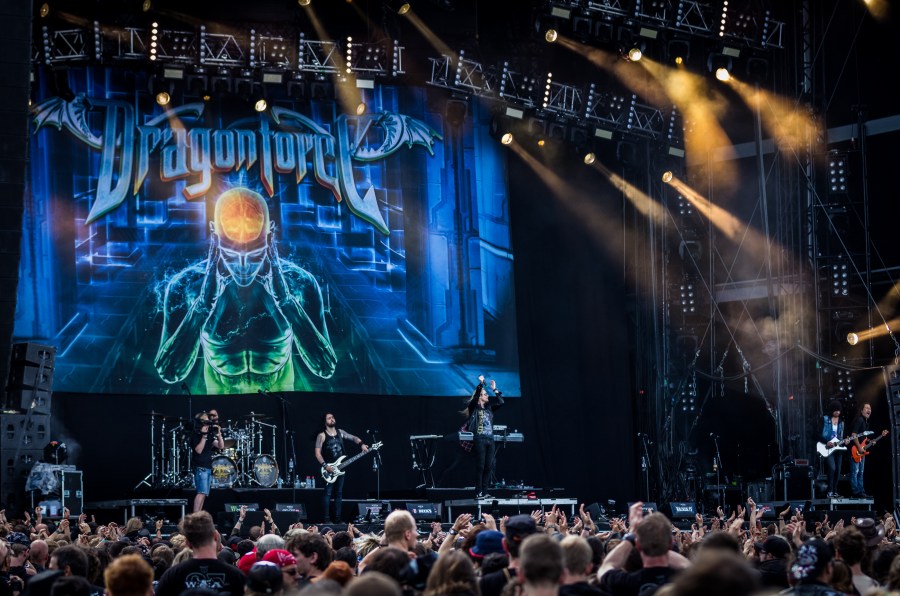
It’s difficult to identify sounds which might appease both these battling tribes, but DragonForce is a definite contender. This late 90s British band is a form of anachronism – classic power metal blueprint, but also extremely technical. In short, its power metal with intricate progressions and sonic intensity of 80s thrash.
Sheer speed of the guitar solos makes passages resemble Super Mario music. Herman Li and Sam Totman’s dual guitar harmony is melodic and maddeningly precise. Aggressive bass lines, blazing leads and blast beats are all quintessential extreme metal elements. While those fantasy themed lyrics, high pitched clean vocals and catchy choruses tailored for large arenas – all indicate Ronnie James Dio/Rob Halford lineage of power metal. DragonForce may not be genre-bending revolutionaries, but they might just manage to placate two seemingly irreconcilable tribes.
Groovy rumble of eight-string guitar, robotic barking, and this blunt calculated tempo variation – all Meshuggah signatures. Built on a musical skeleton forged from groove and death metal, obZen is akin to a cybernetic monster — mechanistic and precise. By constantly adopting math metal, jazz and progressive attributes, the band has always been pushing music into unimaginable territories. obZen is no exception.
Album is an excellent crossover from 90s to modern Meshuggah, basically more groove metal than djent. Needless to say, Jens Kidman’s vocals blend in as if it’s another discordant machine in this mechanistic orchestra. Odd rhythmic structures, Tomas Haake’s jazz like drumming, and down-tuned proggy leads – all simply inspire still reverence, not moshing.
Both for the artist and the listener, maximum creative bliss is at the margins. Meshuggah has been constantly placing themselves at those very structural margins of numerous demanding genres. Habitually creating novel classifications for what’s considered exceptional. obZen is yet another extraordinary dissonant chapter.




 Progarchy


.jpg)


