Concert Review: Carl Palmer and ELP’s Legacy

Carl Palmer’s ELP Legacy, live at the Park Theatre, Holland, Michigan, September 30, 2017.

by Rick Krueger

What does it feel like to be the last man standing?  Other than a few heartfelt but brief words between pieces, Carl Palmer didn’t say much about his late bandmates Keith Emerson and Greg Lake last night.  Instead, he let the music do the talking, digging deeper into the unique way he’s presented the work of ELP for the last 15 years, revealing just how audacious this repertoire really is.

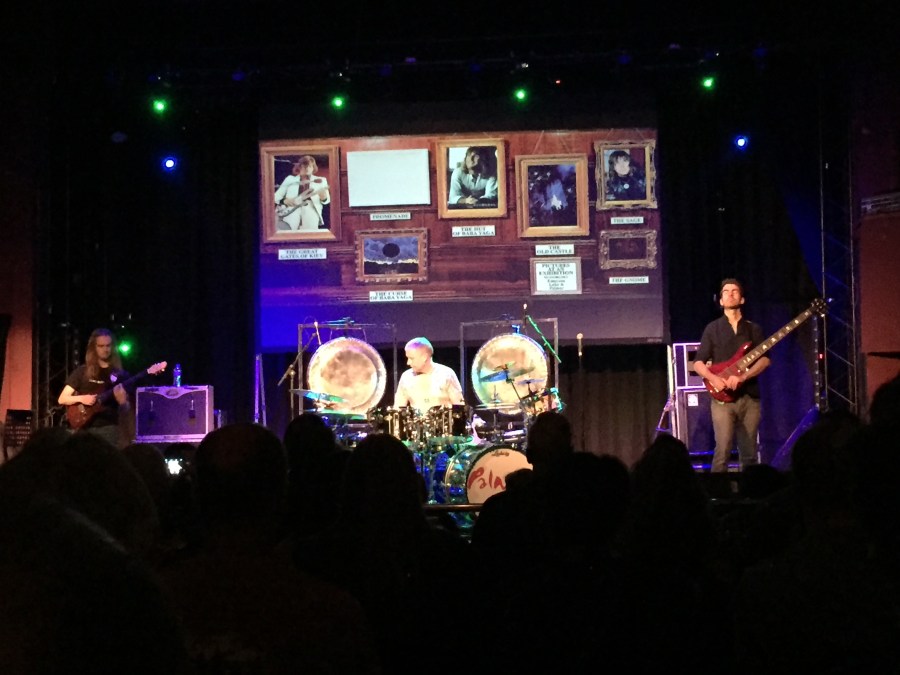
Palmer, guitarist Paul Bielatowicz and bass/Stick player Simon Fitzpatrick crammed the stage of this tiny 130-year-old theater, knocking back the 200-strong audience with their opening take on Aaron Copland’s “Hoedown.”   All the strong points of ELP’s barnstorming arrangement were note-perfect — the wailing synth glides, the driven organ flourishes, the burbling low-end work, the tongue-in-cheek folk-tune quotes — stylishly reshaped into fretboard fireworks, delightedly sailing over Palmer’s busy, irresistible drive.  Given that neoclassical shredmeisters like Yngwie Malmsteen acknowledged their debt to Emerson & Palmer’s virtuosity back in the 1980s, the approach makes an odd kind of sense — defiantly different than expectations, but coming from an intriguing angle that made for some cool surprises.

The biggest surprise was how adaptable so much of the ELP catalog turned out to be.  Focusing on music from the debut album, Trilogy and Brain Salad Surgery, along with tributes to Emerson’s work in the Nice and Lake’s contribution to King Crimson, the first set ran a broad gamut of moods.  It certainly helped to have players of Bielatowicz & Fitzpatrick’s caliber — for example, as the guitarist took the lyrical piano licks of “Trilogy’s” opening, the bassist “sang” Lake’s vocal lines on his high strings with precision and passion.  “Jerusalem” flipped their roles, Bielatowicz grabbing the vocal and organ parts, Fitzpatrick simultaneously laying down bass lines and synthesizer flourishes on his Stick.  Each of them also got a chance to shine by themselves: Fitzpatrick duetted with Palmer on a stirring “Take A Pebble;” Bielatowicz closed the first half with a meditative solo version of Debussy’s “Clair de lune.”  Palmer matched the mood throughout, always attentive and focused whether banging out intense grooves or making his cymbals sing.

For the second half Palmer & company wheeled out the big guns: the full-length ELP arrangement of Mussorgsky’s Pictures at an Exhibition, with the trio obviously fired up by the stop and start rhythms of “Promenade” and “The Gnome,” the muted menace of “The Sage” (illustrated by video screen photos of Rasputin?), the rollercoaster moods of “The Old Castle/Blues Variation” (complete with Bill Evans/Jim Hall quotes) & “The Hut/Curse of Baba Yaga,” and the grandeur of “The Great Gate of Kiev.”  “Fanfare for the Common Man” followed, climaxed by Palmer’s exploding into his long-awaited epic-length solo.

IMG_3888

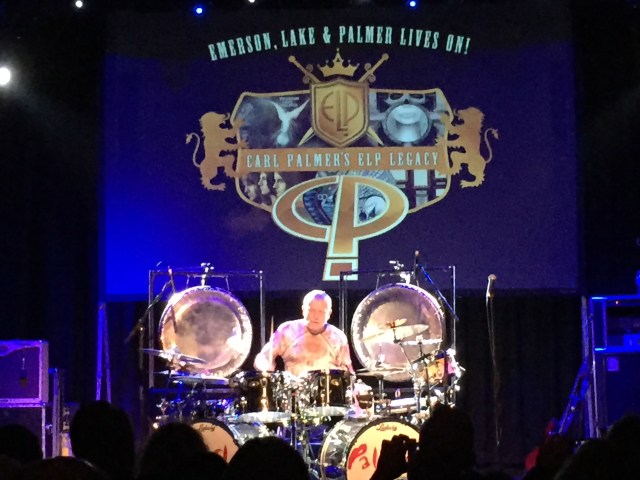
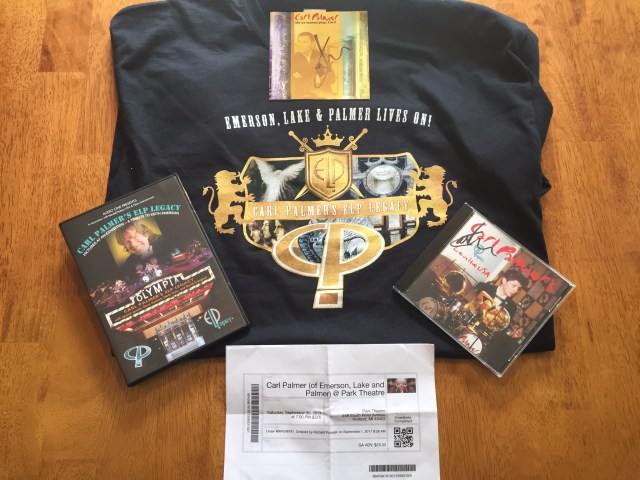
At 67, the man is still overwhelming on his instrument, a monster technician and an unstoppable force of nature, moving from brain-melting polyrhythms to playful showmanship on his ride cymbal to giving his twin gongs the whacking of their lives.  With Neil Peart and Bill Bruford in retirement, I’d argue there is no more amazing and impressive rock drummer onstage today (though Gavin Harrison is right up there).   With a speedy, whimsically crazed encore of “Nutrocker,” Palmer and his sidekicks took their bows, promptly retiring to the merch table for greetings, autographs and fist bumps (pre-concert announcement: “Please do not shake Carl’s hand or give him a high five”).  All in all, great value for money, an unmissable chance to see a legend from 50 feet away, and an evening of serious fun.

IMG_3896

Setlist:

Hoedown
Peter Gunn
Karn Evil 9, First Impression, Part Two
The Barbarian
Trilogy
America
Knife-Edge
21st Century Schizoid Man
Jerusalem
Take a Pebble (Fitzpatrick/Palmer duet)
Lucky Man
Clair de lune (Bielatowicz solo)

Carmina Burana/Rondo
Pictures at an Exhibition
Fanfare for the Common Man with drum solo

Nutrocker


Marillion Live in the USA February 2018

by Rick Krueger

Hot on the heels of next year’s Cruise to the Edge on February 3-8, Marillion will mount the second United States leg of their ongoing FEAR tour.  This time around, they’ll play towns and cities in the South, Northeast and Midwest they haven’t visited for a while.  Dates are as follows:


Friday 9 February               The Plaza Live Orlando, FL
Saturday 10 February         Variety Playhouse Atlanta, GA
Monday 12 February          Carolina Theatre Durham, NC
Tuesday 13 February          Palace Theatre Greensburg, PA
Thursday 15 February        Town Ballroom Buffalo, NY

Friday 16 February             Royal Oak Music Theatre, Royal Oak, MI

Sunday 18 February           20 Monroe Live Grand Rapids, MI
Monday 19 February         The Arcada Theatre St Charles, IL
Wednesday 21 February   Granada Theater Dallas, TX


I can vouch for the Royal Oak Music Theatre in metro Detroit (where I’ve seen Todd Rundgren and Steve Hackett) and the Arcada Theatre in west Chicagoland (where I’ve seen Neal Morse with District 97 opening) as fine, welcoming places for this kind of show.  But I’m especially jazzed that the boys are coming to the sleek new venue 20 Monroe Live in Grand Rapids, my home town.  Steve Hackett brought his terrific Genesis Revisited with Hackett Classics tour there this past February; it turned out to be a great spot for a prog show.  And this booking answers the fervent wishes and prayers of more Marillionaires than you might think!

Owing to a long-standing communal love of prog and the dedicated advocacy of local radio legend Aris Hampers, there’s been an eager Marillion fanbase here ever since they opened for Utopia at the Lowell Showboat, touring Script for A Jester’s Tear.  By the late 1980s, the band was regularly filling DeVos Hall, Grand Rapids’ mid-size auditorium.  When I moved here in 1990, I was pleasantly shocked to hear “Kayleigh,” “Lavender” and even “Incommunicado” regularly on drive-time rock radio!  And the enthusiasm continued after Steve Hogarth replaced Fish; his The Invisible Man: Diaries 1991-1997 recounts a memorable GR weekend of packed in-store appearances, dinner and entertainment with Hampers, and a sold-out club show (yep, I was there) while touring Holidays in Eden.

As Marillion’s profile faded in the US, their visits here petered out as well; the last time the boys played Grand Rapids was on the crowd-funded tour for This Strange Engine.  From the buzz on the band’s North American Fan page on Facebook, already building since this morning’s announcement, GR fans will be more than ready to give the band (along with fans from all over the country, the continent and the world) a warm, grateful welcome.  If Marillion isn’t playing near you on this tour, feel free to come visit us next February!  (Yes, it’ll probably be cold — but between the indoor skywalks that run for nearly a mile and the unbelievable density of craft breweries, brewpubs & craft distilleries downtown, there will be ways for everyone to stay warm.)

Tickets for the tour go on sale to the general public on Friday, October 6.  Venue presales may start before then; the Facebook page will be the best place to get info, presale codes, etc.


Bob Dylan, The Bootleg Series: Trouble No More, Volume 13 / 1979-1981

by Rick Krueger

I’m not a hardcore Bob Dylan fan, but I admire quite a bit of his work: the early folk music, leading into the groundbreaking electric stuff (basically what’s in The Original Mono Recordings box set); Blood on the Tracks and Desire; the recent run of “old guy plays the blues” albums that started with Time Out of Mind.  I’m also grateful that Dylan’s music has midwifed some of the most resonant work by highbrow rock writers like Greil Marcus, Clinton Heylin and Michael Gray, along with poet Christopher Ricks’ masterful Dylan’s Visions of Sin.

To top all that off, Dylan’s Bootleg Series is, in my mind, one of the best-curated rarities/reissue series from a major artist.  Every volume has been at least an interesting listen for me, and I consider the last two releases, The Basement Tapes Complete and The Cutting Edge 1965-1966 (as well as Volume 4, The ‘Royal Albert Hall’ Concert) downright essential.

I also remember, as a college freshman, reading Jann Wenner’s review of Dylan’s Slow Train Coming in Rolling Stone.  Wenner knotted himself into a human pretzel trying to reconcile the free-spirited, hippie picture of Dylan he had built up for himself with a new album of — shudder — “born-again Christian” music.  It was unintentionally hilarious.

I’d argue that Slow Train Coming was really more of an “lost Old Testament prophet” kind of record — and thus in line with Dylan’s long-term aesthetic.  It wasn’t a masterpiece, but it was quite good — and there were occasional fine songs on the other “Christian” albums, especially “Every Grain of Sand” from Shot of Love.

Thus, Trouble No More: The Bootleg Series, Volume 13 /1979-1981 is definitely on my want list.  8 CDs plus 1 DVD of live and unreleased studio material, to be issued (like King Crimson’s Sailor’s Tales) on my birthday, November 3.  I really need to find some long-lost rich relatives!

More info here.

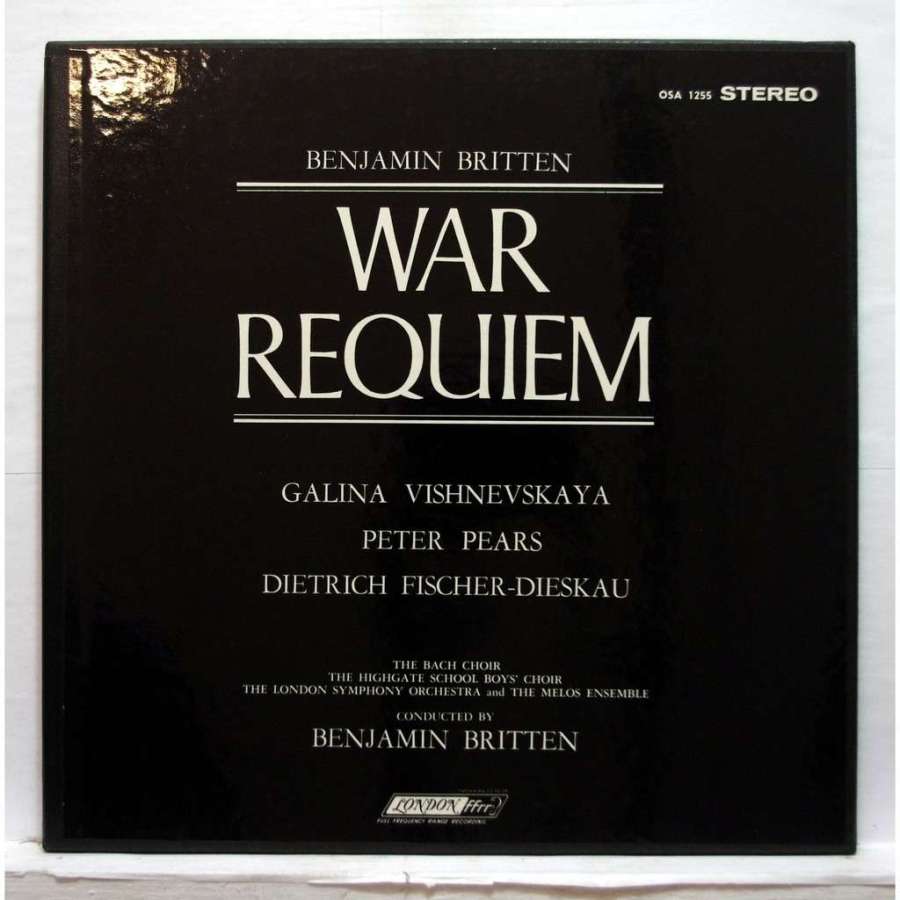
The Albums that Changed My Life: #5, War Requiem by Benjamin Britten

by Rick Krueger

“My subject is War, and the pity of War.  The Poetry is in the pity … All a poet can do today is warn.” — Wilfred Owen (1893-1918)

I took an orchestration class in early 1982.  The final project sounded simple: listen to Benjamin Britten’s War Requiem and write a report.  While I knew of Britten, and had heard his music — The Young Person’s Guide to the Orchestra was still standard music appreciation class material  — this piece was new to me.  I figured I’d borrow the record (conducted by the composer) from the college library, hear it once, and have what I needed to bang out an analysis.  Then I dropped the needle:

This piece demanded full attention — ears, head, heart and guts.  90 minutes later, I sat in my dorm room, drained and amazed.  35 years (and one long lost paper) later, I’m still completely engaged every time I hear the War Requiem, and singing it with the Grand Rapids Symphony Chorus in 2008 was a highlight of my life in performance.  It’s always commanded my wholehearted admiration, and it set me off on a deeper exploration of classical music (and 20th century music in particular) that’s endured to this day.  Why?

Continue reading “The Albums that Changed My Life: #5, War Requiem by Benjamin Britten” →

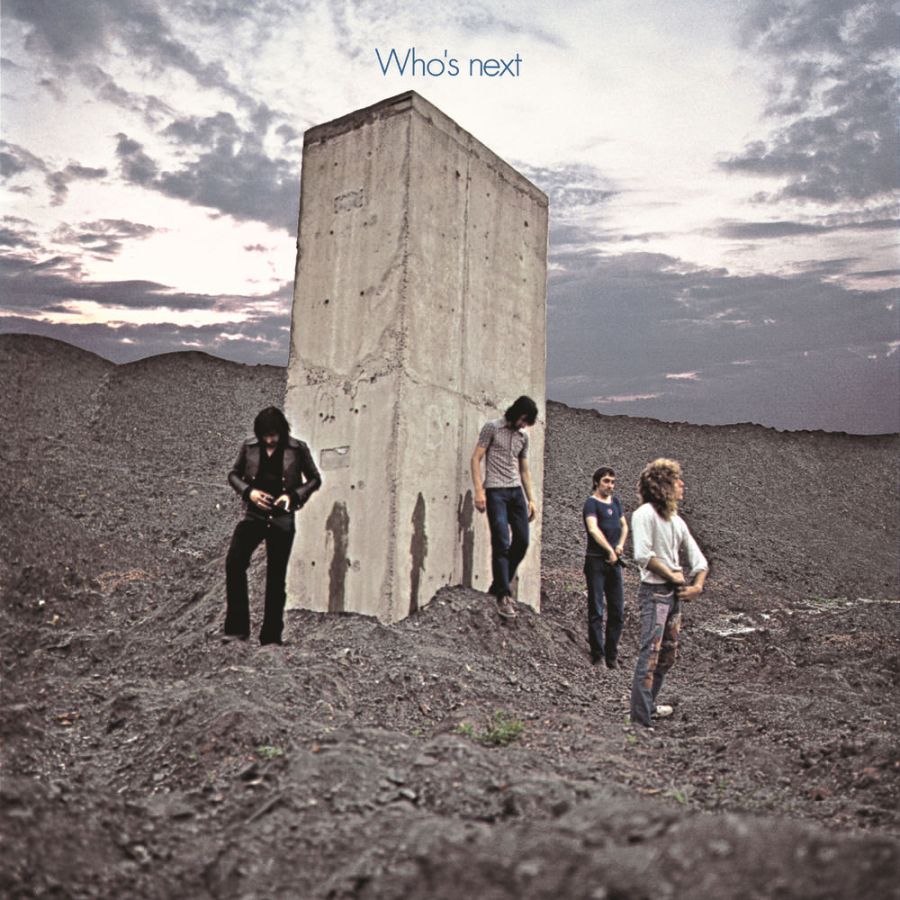
The Albums that Changed My Life: #4, Who’s Next by The Who

by Rick Krueger

“Rock ‘n’ Roll might not solve your problems, but it does let you dance all over them.” — Pete Townshend of The Who on Good Morning America, 1978.

From the 1960s through the early 1980s and beyond, Michigan loved The Who.  The only place their first single “I Can’t Explain” was a hit in the USA was Detroit.   Flint’s Holiday Inn became infamous as the hotel where, according to legend, Keith Moon drove a Lincoln Continental into its swimming pool on his 21st birthday.  Their 1975 show at the Pontiac Silverdome briefly held the record for largest indoor concert.

So it wasn’t as if I hadn’t heard songs from Who’s Next before I went to college in 1979; at that point, “Baba O’Riley,” “Behind Blue Eyes” and “Won’t Get Fooled Again” were inescapable on FM radio.  But it was at the end of my first term away from home that the 1971 album became something more to me.

Continue reading “The Albums that Changed My Life: #4, Who’s Next by The Who” →

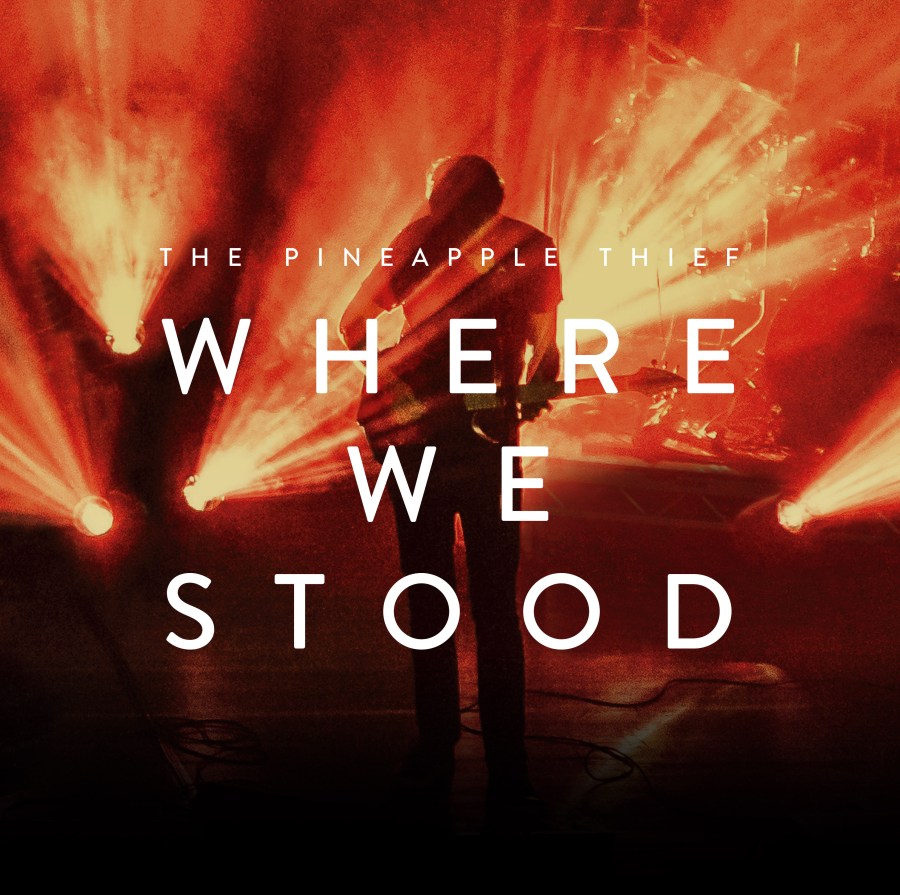
Rick’s Quick Takes: The Pineapple Thief, Where We Stood (In Concert)

by Rick Krueger

Today is — well, sort of —  the official release day for The Pineapple Thief’s Where We Stood concert video.  Turns out that, while vinyl and downloadable/streaming audio versions are now available, the Blu Ray, DVD and CD versions have been delayed until early October.  Kudos go to the fine folks at Burning Shed for sending along mp3s of the full concert to folks who pre-ordered in those formats!

After just one listen, I’m mightily impressed.  Back in my eMusic subscriber days, I ran across the Thief via the albums Tightly Unwound and Someone Here Is Missing, enjoying them thoroughly.  A decade ago, high quality new prog was still scarce enough that I absolutely delighted in hearing Bruce Soord and company plowing similar furrows to Steven Wilson in Porcupine Tree.  Unfortunately, the follow-ups All the Wars and Magnolia were, as our head Progarchist put it last year, good but bland.  Thankfully, 2016’s Your Wilderness was a major step back up, as Gavin Harrison’s stylish, tasty drumming slotted in with Soord’s sleek new tunes and moody guitar lines to hypnotic effect.

So Where We Stood is the right move at the right time, capturing the re-energized Pineapple Thief onstage in London, with an enthusiastic crowd egging them on.   Harrison is astonishing and impeccable as always, driving the band with relentless grooves and jaw-dropping fills, locking tight with Jon Sykes’ powerful bass lines.  While Steve Kitch’s keyboards conjure impressive atmosphere, Darran Charles and Soord seamlessly slide from badass surf music riffs to full-on metal chording, inspiring Soord to new heights of vocal power and expression.  This Thief rocks hard, with guts and class, in the service of first-rate songs from throughout their checkered career.

I’m optimistic that the visuals of Where We Stood will match the excellence of the music; in my opinion, the chance to see Gavin Harrison weaving his percussive magic in close-up is gonna be worth the wait all by itself.  Plus the Blu-Ray also includes Your Wilderness, 8 Years Later and bonus acoustic tracks in 24/96 stereo and surround.  If you haven’t ordered this baby yet, what are you waiting for?


King Crimson, Sailors’ Tales (1970-1972) and Earthbound (Expanded)

by Rick Krueger

Autumn is coming; can a Big Box Set o’ King Crimson be far behind?  In recent years, we’ve seen multiple-disc, multiple-format bundles based on Larks’ Tongues in Aspic, Red, Starless and Bible Black, and THRAK, along with a package focused on the 1980s albums (Discipline, Beat, Three of a Perfect Pair).  Each set has yielded an surfeit of riches: the 40th anniversary stereo and surround mixes of the studio albums; album rehearsals, outtakes and alternate mixes; and (for my money, the best part) more live performances, on both audio and video, than you can shake a stick at.

Robert Fripp has called the period covered by Sailors’ Tales (1970-1972) King Crimson’s “interregnum.”  After Ian McDonald, Michael Giles and Greg Lake left the original band, Fripp and lyricist Peter Sinfield struggled to assemble a Crimson that would stay together long enough to record and tour.  In the Wake of Poseidon (1970) mixed players and ideas from the 1969 band with new material and musicians, including stunning saxophone work from Mel Collins.  Lizard  (1971) spun in a more avant-garde direction; the cream of British free jazz players sat in, but vocalist Gordon Haskell quit before the album was even released.  (Is this why Yes’ Jon Anderson sings lead on one track?)  For Islands (1972), a solid line-up finally coalesced: Fripp, Collins, vocalist Boz Burrell (taught to play bass parrot-fashion for touring) and drummer Ian Wallace.  This Crimson proved ferocious live, but as they downplayed the new album’s pastel romanticism in favor of straight-up blues/jazz improv, friction mounted again.  Sinfield was forced out; the remaining quartet fell apart, then did a contractual-obligation US tour (documented on the bargain live album Earthbound), then tried to reform, then broke up for good.

No wonder Fripp basically disowned this era of Crimson for years; it took his 1990s reconciliation with Collins and Wallace, the release of multiple 1971-72 concerts through the King Crimson Collectors’ Club, and Steven Wilson’s revelatory remix of Lizard to ultimately change his mind.  With the current Crimson regularly performing music from all three albums (and Fripp and Collins both tearing up these selections onstage), the time is ripe for the rest of the world to find out why.

Thus, Sailors’ Tales.  As spelled out in the DGM press release:

  • 3 CDs feature Steven Wilson and Robert Fripp stereo mixes of In The Wake Of Poseidon, Lizard and Islands plus additional tracks.
  • 6 CDs feature the Islands line-up’s early concerts from Germany (new to CD) and the UK (1971).
  • 9 CDs feature live recordings (several new to CD and/or previously unreleased in any format) from the 1972 US tour, including a new stereo mix of Summit Studios and an expanded Earthbound.
  • 3 CDs feature auditions for the Islands band and two further, as yet, unidentified concerts from 1972 (all previously unreleased).
  • 3 Blu-Ray discs contain the main studio albums in 5.1 Surround Sound, recent stereo editions mixed by Steven Wilson and Robert Fripp, 30th anniversary masters of the original stereo albums mixes (all in 24/96 hi-res), plus extensive additional material with each disc also featuring a complete alternate album and a further selection of additional, related studio/live material in hi-res.
    • The Lizard Blu-Ray also contains the audition material from CDs 19/20.
    • The Islands Blu-Ray also contains the following concerts in stereo: Zoom Club (4 shows), Marquee Club, Plymouth, Glasgow, Detroit all from 1971.
  • A 4th, Earthbound Tour Blu-Ray disc features an expanded version of the original album, Summit Studios gig in Stereo and Quadraphonic (newly mixed), the “Schizoid Men” sequence from the Ladies of the Road album, 2 newly discovered concerts in hi-res stereo and every existing soundboard concert recording from the 1972 US tour: Wilmington, NYC (2 shows), Chicago (2 tracks only), Detroit, Jacksonville, Orlando, Pittsburgh, Milwaukee, Peoria, Indianapolis & Denver (2 shows).
  • 2 DVDs feature the expanded Earthbound, Summit Studios, “Schizoid Men,” New York 1972 and the recently discovered live concerts.
  • Presented in a 12” box with booklet, memorabilia, a further downloadable concert, and sleeve-notes by Sid Smith, Jakko Jakszyk and David Singleton.

Too much?  The budget option is a new CD/DVD edition of Earthbound, expanded from 5 to 12 tracks as on Sailors’ Tales, with the DVD also containing Summit Studios and “Schizoid Men.”

Both Sailors’ Tales and Earthbound are available for preorder from DGM and Burning Shed.  Release date is Friday, November 3 — my birthday.  Hmm … anybody feeling especially generous?

earthbound

Hamilton Live On Stage: “Sufficient to Strike Astonishment into Angels”

By Rick Krueger

Hamilton at the Private Bank Theatre, Chicago, August 30, 2017.

On August 31, 1772 (245 years ago today — wild, huh?) a hurricane ravaged the West Indies island of St. Croix.  Seven days later, a orphaned young man living there set the precedent for every newshound who’s camped out in Texas this past week.  He wrote a letter describing his experiences at the heart of the maelstrom, along with the whipsaw play of his emotions in its wake.  “It seemed as if a total dissolution of nature was taking place,” he wrote, “… sufficient to strike astonishment into angels.”

The businessmen of St. Croix were so impressed that they tracked down the letter’s anonymous author, took up a collection, and sent him off-island to be educated.  And Alexander Hamilton emigrated to New York City,  just as the nascent American Revolution began to gather speed.

Continue reading “Hamilton Live On Stage: “Sufficient to Strike Astonishment into Angels”” →

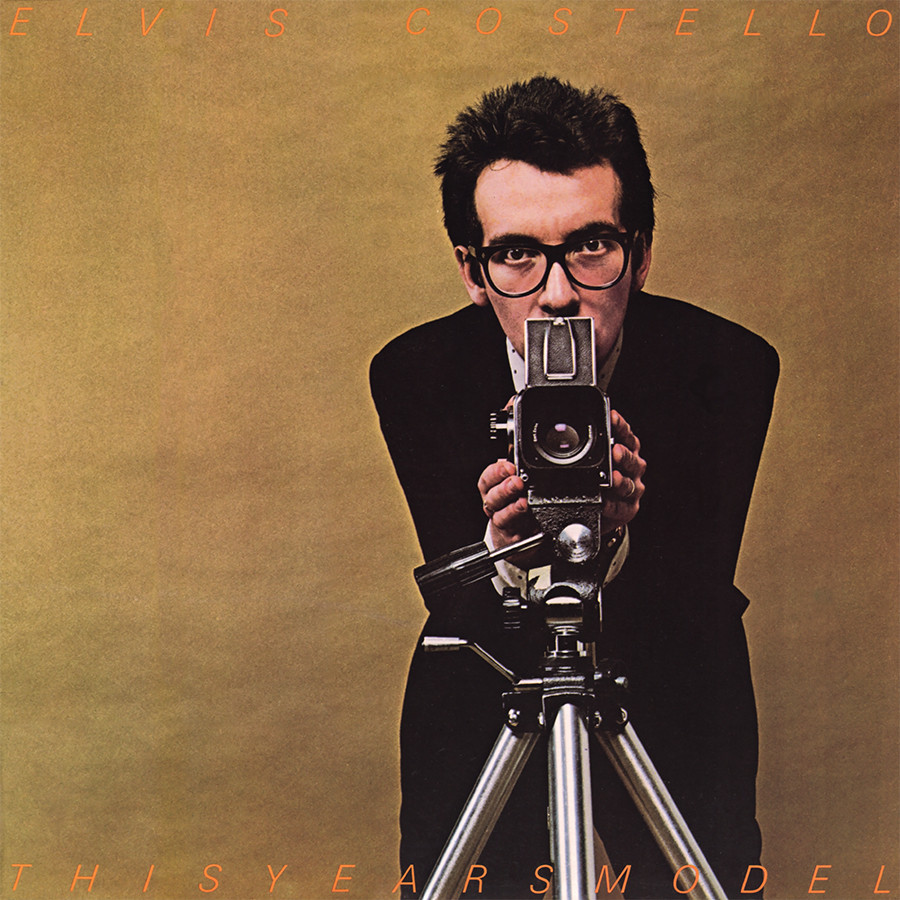
The Albums That Changed My Life: #3, This Year’s Model by Elvis Costello

by Rick Krueger

“The songs are lyrics, not speeches, and they’re tunes, not paintings. Writing about music is like dancing about architecture—it’s a really stupid thing to want to do.” — Elvis Costello, 1983, apparently quoting Martin Mull.

Ouch.

On the other hand, would I have ever even heard of Elvis Costello if it hadn’t been for the rock press?  Let alone listened to This Year’s Model?

Continue reading “The Albums That Changed My Life: #3, This Year’s Model by Elvis Costello” →

The Albums That Changed My Life: #2, Rubber Soul by The Beatles

by Rick Krueger

I’ve already written here about how, in late November 1977, this album grabbed me and has never let go.  Rubber Soul is (to paraphrase my previous comments) a sharp, cogent take on the folk rock fad of the time, mixing in flavors of soul, Indian ragas and Baroque elegance, with words matching the music’s new maturity.  It’s the sound of the Beatles downshifting and heading for new destinations, ready to move beyond shaking their moptops to a big beat and basking in the resulting screams.

There are no duds on either the British or the American versions of this album.  The UK Rubber Soul kicks off with “Drive My Car” — an exuberant Stax pastiche, a knowing mutual flirtation sketched in three-part harmony, topped with that goofy “beep-beep-yeah” tag on the chorus.  The US version, in contrast, starts with “I’ve Just Seen A Face” (from the British Help!) — Paul McCartney breathlessly singin’ and strummin’ a tale of new infatuation, a stream of consciousness laced with unexpected internal rhymes. Neither was at all typical of the Fabs; both sound wonderfully fresh, setting the tone for a different kind of Beatles record.

How many changes can you ring on the classic love song?  Rubber Soul shows how far the genre could stretch: surrealism with sitar (John peppering “Norwegian Wood” with non sequiturs a la Bob Dylan); break-ups with a backbeat (Paul’s “You Won’t See Me,” eventually covered with even more swagger by Anne Murray); suffering with added social comment (John’s “Girl,” featuring a chorus that’s just the title word and a deep, frustrated breath).  Ringo Starr does a country heartbreak turn on “What Goes On”; George Harrison glumly protects his personal space on the Byrds homage “If I Needed Someone.”  And this isn’t even including Paul’s earnest “Michelle,” which, if you were an easy listening artist and had already done “Yesterday,” quickly became the next Beatles tune to cover.

But what’s made Rubber Soul my ultimate touchstone for all things Fab is John’s “In My Life.”  It’s hard to top the reflectiveness and wisdom of these lyrics (in fact, I would argue that Lennon’s most famous songs are far less mature).  Every year they resonate more for me:

There are places I remember
All my life though some have changed
Some forever not for better
Some have gone and some remain
All these places have their moments
With lovers and friends I still can recall
Some are dead and some are living
In my life I’ve loved them all

But of all these friends and lovers
There is no one compares with you
And these memories lose their meaning
When I think of love as something new
Though I know I’ll never lose affection
For people and things that went before
I know I’ll often stop and think about them
In my life I love you more

Set to a lovely mid-tempo lope, with George Martin’s getting his Bach on for a gracious piano interlude, “In My Life” is evidence enough that, after Rubber Soul, both the Beatles and rock music would never be the same.   Listen to the album here:

Other Favorites by the Beatles: Well, the whole catalog, really.  But other favorites among the favorites are (as I’ve mentioned before), A Hard Day’s Night, Revolver, Abbey Road, and whatever Beatles album I’ve listened to last.

Related Favorites:

The Byrds: Essential Byrds (compilation); There Is A Season (box set); Sweetheart of the Rodeo.  Inspired by A Hard Day’s Night, the Byrds added Dylan, folk and country to the mix and made magic.  “Turn Turn Turn” is another song I never tire of hearing.

Cheap Trick: Heaven Tonight; At Budokan.  The Fab Four (pure pop version) of the late 1970s.  With added harder rock and wacky stage moves.

The Chipmunks: The Chipmunks Sing the Beatles. The first album my parents ever bought me.  Apparently I was tired of The Sound of Music.

Marshall Crenshaw: Marshall Crenshaw; Field Day,  The pride of Berkley, Michigan, replete with Beatlemania stage credentials.

The Smithereens: Blown to Smithereens (compilation); Meet the Smithereens (cover version of the complete U.S. album Meet the Beatles).  The Fab Four (pure pop version) of the late 1980s.