Gig Review: Anathema & Opeth, 15 November 2012

This was an event that I almost missed, because I was in a pretty sorry state on 15 November. I had been feeling fuzzy-headed and a bit shivery throughout the day; as gig time approached, I even thought about heading straight home from work to my bed.

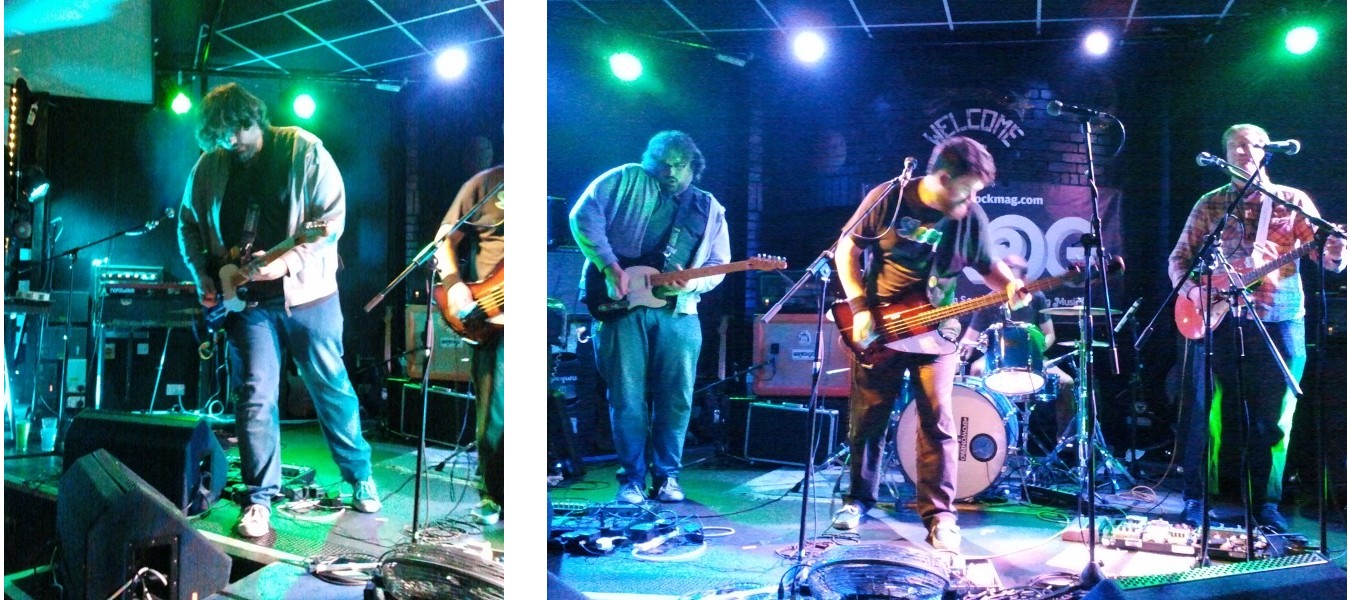
Thankfully, I didn’t bail – but I was definitely questioning whether that was a sensible decision as I stood near the front of the crowd at Leeds Metropolitan University Student Union. And then Anathema took to the stage. Right from the start, the atmosphere was electric, with Danny Cavanagh geeing up the crowd even before they launched into their first song – I think it was Deep, from the Judgement album, although I’m not sure my fever-addled brain can be completely trusted on that. I clearly recall the next three songs, though: Thin Air, from 2010’s excellent Steven Wilson-produced We’re Here Because We’re Here, followed by Untouchable Parts 1 & 2, the opening tracks of latest album Weather Systems.

A remarkable thing happened as the band began to play these three songs. Those earlier feelings of illness and discomfort dwindled into insignificance beside the strong emotions stirred up by the music: a sense of absolute joy, of being exactly where I ought to be, witnessing this. And there was a tear or two, as well – an inevitable response to the achingly beautiful and poignant Untouchable Part 2. Isn’t the transformational power of music a wonderful thing?

That euphoria persisted for the remainder of their 45-minute set, which seemed to come to an end far too soon. There was another track from We’re Here Because We’re Here, the powerful A Simple Mistake (Steven Wilson’s favourite, apparently); a failed attempt at playing Closer – thanks to an equipment failure, which the band took in their stride; a couple of other old tunes whose titles escape me. And then it was over, leaving me wishing fervently that they had another hour to play.

Now the fuzzy head was back with a vengeance. As the temperature rose and the crowd pressed in anticipation of Opeth’s set, I wondered how long I could last before passing out and began considering my options for an early exit. But again the discomfort subsided as I became increasingly absorbed by the music.

Let me admit at this point that I’m not an Opeth devotee. I have three of their albums, so I was able to recognise songs such as The Devil’s Orchard and Famine from latest album Heritage, or Burden from Watershed – but that left at least 50% of their set unfamiliar. Yet this didn’t seem to matter, in the end. I found myself enjoying simply being there, soaking up the atmosphere, admiring the power, precision and intensity of their performance. I had a great view, and the civilised volume levels meant that it was possible to hear how well they played, something that can’t be said for many of the gigs I’ve attended in the past.

In summary: an excellent evening, despite its inauspicious beginning.

Gig Review: Stabbing a Dead Horse, 30 October 2012

Last Tuesday evening, I took a short walk from my place of work to the Brudenell Social Club in Leeds, that night’s venue for the Stabbing a Dead Horse tour. This unnerving title derives from the names of the tour’s participants: Trojan Horse, The Fierce & The Dead and Knifeworld. All three bands are leading lights of a vibrant ‘modern progressive’ movement here in the UK.

Trojan Horse opened proceedings with a cover of Neil Young’s Ohio before attacking their own material – four songs in total – with gusto. From the short and sweet staccato prog-punk of Fire from their latest EP through to the brooding 8-minute epic Mr Engels Says from their eponymous debut album, this was powerful, uncompromising stuff, played with an infectious manic energy by the Salford-based four-piece. I was particularly taken by the jerking and pirouetting of Lawrence Duke, who wielded his bass guitar as if it were an untamed beast, and by the mad dash of brother Eden through the audience during Mr Engels Says, as he attempted single-handedly to get us all singing the “Yo ho ho and a bottle of rum” lyric.

Then it was time for The Fierce & The Dead, who treated us to a masterclass in instrumental music drawn from their recent EP On VHS and from debut album If It Carries On Like This We Are Moving To Morecambe, with a new piece called Arc (Ark?) as a bonus. There is something very special about the aural landscapes created by this band. On the face of it, their sound is very sparse and modern, and yet somehow the solid groove created by Stu Marshall’s drums and Kev Feazey’s powerful bass combines with the hypnotic interplay of Steve Cleaton’s and Matt Stevens’ guitars to conjure beguilingly rich, intricate and expansive music. There was complete commitment on display here, and real showmanship, too – albeit of a less demonstrative kind than that of Trojan Horse. It was clear from TFATD’s interactions with the audience that they were having a blast, despite the low turn-out.

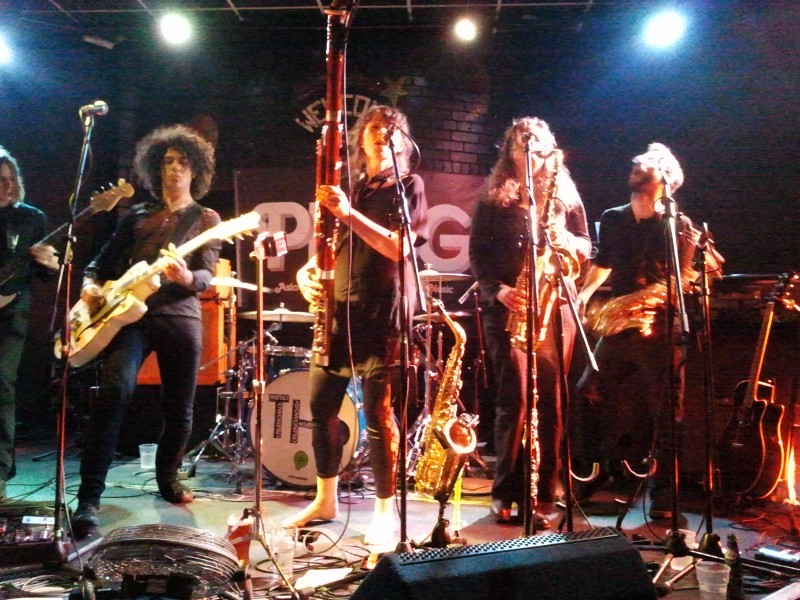
Headliners Knifeworld, performing as an eight-piece ensemble, brought the evening to a suitably exciting conclusion with a set drawing heavily on the terrific 2009 album Buried Alone: Tales Of Crushing Defeat and recent EP Clairvoyant Fortnight. It also featured an excellent new song, whose name I unfortunately didn’t catch.

Saxophones are relatively commonplace, but I’d hazard a guess that you don’t often see a rock band performing on stage with a bassoon. It’s a powerful symbol of just how unique Knifeworld are in their approach. I find it difficult to articulate just why I find them so interesting, but the fact that they are so gloriously unpredictable must have something to do with it. You never quite know where they are going with a song; heavy riffing can give way to a blast of Mellotron, then delicate vocal harmonies, then glockenspiel and sax, before guitar takes the reins again. A typical piece will feature unusual chord progressions and time signature changes galore. Any band trying to stuff that many ideas into a four- or five-minute tune is treading a fine line, but Knifeworld usually manage to stay the right side of it, leaving you exhilarated rather than exhausted.

The final verdict? A truly excellent night’s entertainment, and outstanding value for money at only £7 for the ticket. The only disappointment was that so few had shown up. I can only hope that the poor attendance doesn’t dissuade any of these bands from coming back to Leeds at some point in the future.

A Prog Awakening (Part 1)

I suppose it is inevitable that kids encounter music first through the filter of parents’ or siblings’ tastes. That was certainly true in my case. In the early 70s, the meagre set of records owned by my mum and stepdad was my only window onto the world of music. I remember several LPs by Elton John and Rod Stewart, the odd one or two by The Beatles and The Stones, also The Carpenters, John Denver, Mama Cass…

At some point, I began to assert my musical independence and sought out new sounds. At that time in the UK, the main channels for hearing new ‘popular music’ were Radio 1 and the TV show Top Of The Pops. Like most kids, I listened to ‘The Charts’ and had little awareness of anything else. Glam rock and disco had no appeal, but then punk and ‘New Wave’ came on the scene. Like many young people of that era, I found the energy and non-conformist attitude of these new genres incredibly exciting. For the first time in my life, I starting buying my own music: 7″ singles by The Clash, Buzzcocks, The Stranglers, Siouxsie & The Banshees…

Yet the signs were there that I would soon move on to other things. In amongst all that punk were singles by rock acts such as The Who, Queen and Nazareth. Further clues were to be found in my fascination with three albums from my stepdad’s otherwise middle-of-the-road collection. The first of these was a cassette of Pink Floyd’s seminal Dark Side Of The Moon. I forget when I first heard this, but it was before I started buying singles: probably 1975, certainly no later than 1976. I used to sit in the corner of the living room with headphones on, bewitched by the stereo sound effects as much as the epic qualities of the music. I hadn’t realised just how well-crafted music could be until that point.

The second of these intriguing albums was a Focus ‘greatest hits’ compilation – one of Polydor’s ‘Rock Flashback’ series. The cover was awful – fluorescent yellow with the band name spray-painted in green above a skewed, oddly-tinted band photo – but the music more than made up for that. There was so much to enjoy here: Jan Akkerman’s incredibly fluid and inventive guitar playing, Thijs van Leer’s unhinged, operatic performance on Hocus Pocus… In its own way, this was every bit as exciting as the punk that would very soon inspire me to start buying records. Focus remain a favourite of mine to this day, and Sylvia would almost certainly feature as one of my ‘Desert Island Discs’.

And the third of these influential albums? None other than Tangerine Dream’s Atem, completely unlike anything else in my stepdad’s collection. I suspect he saw it going cheap somewhere and bought it on the strength of the artwork. I doubt that he liked what he heard! He played the track Wahn for me, probably in the expectation that I would be shocked by its weirdness. I certainly found it challenging, but it was also strangely compelling. It was a tentative start to what would eventually become an infatuation with TD’s 1970s and 1980s material.

The transition period for me can be roughly dated as late 1978 to early 1979. Before that period, I was a chart-listening, single-buying slave to musical fashion who occasionally managed to reach beyond such superficiality and touch something deeper and more meaningful in music; after that period, I considered myself a serious music fan – album-focused, interested in seeking out new music for its own sake rather than its popularity, ready for the transcendent experiences of witnessing my favourite bands performing live.

That daunting leap from punk to prog was made via the convenient stepping stone of hard rock, principally in the form of Led Zeppelin and Deep Purple. The first rock album I owned was, in fact, Zeppelin’s The Song Remains The Same – a present from Christmas 1978, I think. I no longer recall the precise chronology of my musical discoveries, but I still remember all of the vinyl LPs that were added to my burgeoning collection over that period from Christmas ’78 to my fourteenth birthday in July ’79: the first post-Hackett Genesis album, And Then There Were Three; Pink Floyd’s Wish You Were Here; Paris by Supertramp; Mike Oldfield’s Exposed; and 2112 by Rush. The latter, in particular, had a profound effect on me. I think Side 1 of 2112 was probably my first encounter with a true prog epic. Rush have been one of my favourite bands ever since.

Coming up in Part 2: My own musical ‘Cambrian explosion’ of 1979-1981, and my first gigs…

Gig Review: Adventures In The City Tour

A write-up of last week’s York gig from Touchstone and The Reasoning‘s Adventures In The City tour is on my journal page at last.fm. Here’s a short link to it: http://bit.ly/adventcity

On The Futility of Genres

OK, confession time. After seeing this admission, you might decide to stop reading, thinking that I’m a little odd (and in that you’d probably be right). It’s my hope that some of you will be kindred spirits. Here goes:

After purchasing digital music from iTunes or Amazon, the very first thing I do, even before my first listen, is to right-click on the downloaded files and delete the genres that have been assigned to them. I do the same thing when ripping a CD; my first move, after CD details have been acquired from Gracenote or some other media identification service, is to delete the genre information.

There, I’ve admitted it. Is that weird? Do you do something similar?

In my case, this behaviour stems from early frustrations with digital music purchases. I would buy some Tangerine Dream and would be baffled by its classification as ‘Dance Music’, or I would download some classic Mike Oldfield and be astounded to see it labelled ‘New Age’. Besides such obvious travesties, I’ve downloaded many tracks where there is genuine ambiguity: a track labelled ‘Pop’ that I would tend to think of as ‘Rock’, or vice versa.

Just what is the difference between ‘Pop’ and ‘Rock’, anyway? I’ve never been clear on that; indeed, I no longer think it is possible to be completely clear on that.

The Amazon/iTunes model of music classification would have us believe that genres are an orderly array of rigid boxes, into which any given piece of music can be neatly placed. As prog fans we know better than anyone how flawed this model is. The boxes, such as they are, are not rigid. Their boundaries are fuzzy, very fuzzy – and these ill-defined boundary zones are precisely where the most interesting and rewarding music is to be found!

It is a familiar problem for any prog fan. Prog, with its tendency towards experimentalism and the effort it makes to draw upon many influences, invariably seems to lie at the intersection of some weird multi-dimensional Venn diagram of genres. And that point of intersection is difficult to pin down, as if a musical version of the Heisenberg uncertainty principle were at work, affecting our observations. The easy way out is just to define prog as its own genre and abandon any attempt to relate it to anything else – but that’s a question I shall explore in another blog post!

In my more facetious moments, I often think that there are only three meaningful genres of music: stuff you like, stuff you don’t like and stuff you haven’t heard yet. Or perhaps Tim Hall (@Kalyr) had it right when he suggested on Twitter and his blog that genres should be regarded as recipe ingredients rather than pigeonholes.

I’m not sure what the answer is, but for now I’m going to keep on deleting.