
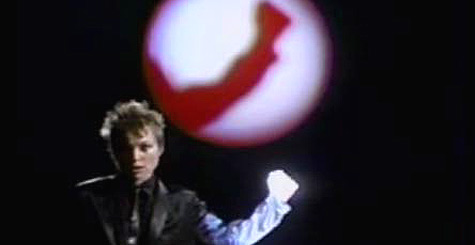
 Progressive rock’s avant garde wing has always acted as a kind of disciplined version of its more mainstream cousin, dependent on self-imposed constraints, those kinds of “oblique strategies” that Brian Eno and his expanding circle of collaborators employed to spur, and rein in, their impulses. The cross-pollination of these two (sometimes warring) factions — at least as that dichotomy might have been posed by critics — was most evident in the 1970s, and was particularly expressed in the Venn diagram that was Roxy Music and King Crimson, the kind of built-in tension that ultimately made Eno and Fripp’s projects guilty of indulgence — often too smart for their own good — but also wildly interesting. Within this world landed Laurie Anderson, a New York-based performance artist whose albums in the 80s employed many of the aforementioned Eno/Crimson cast of characters (in addition to the No Wave artists Eno became associated with), and whose songs, due to their melodic charm, could work their way into the popular consciousness to such a degree that rare was the record collection by decade’s end that — if it included a Talking Heads or Belew-era Crimson album — didn’t include at least one of her works. Her influence is inestimable. “Gravity’s Angel” is from the album Mister Heartbreak, and captures her sound and approach: a partiality to electronic instruments, experimentation abetted by first-class Crimon-ish musos (Adrian Belew, Bill Laswell, Peter Gabriel), and an emphasis on finding a relief of humanity against a plane that could be coldly distant, i.e., exploring the human condition in the late 20th century. My understanding via Wikipedia is that she asked Thomas Pynchon if she could musical-ize Gravity’s Rainbow, and he replied, well, yes, if she could do so with only a banjo. That didn’t happen, but this did:
 Progarchy