By Eric Perry
Manning’s latest album, ‘The Root, the leaf and the bone’ was released on the Festival Music label in October this year. On the lead up to the time of its release I was fortunate enough to hook up with Guy and put a series of questions to him about the ideas behind the album and the process of getting it ready for release.
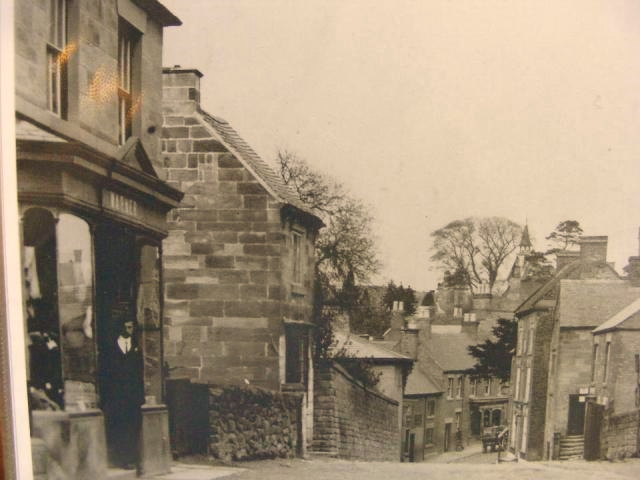
Eric Perry: In the new album, “The Root, the Leaf & the Bone”, you refer to a village that you chose as your original concept design to highlight the charm that is lost when progress builds up on top of things and I wonder if your view of progress is ultimately cynical because of the way you use the ‘sleazy banker’ in the song.
Guy Manning: I suppose I am a little cynical yes, but all I am really saying is to just take care, consider before you change anything. But really I know that there are certain things that are we don’t want to go back to. No one wants to suffer from typhoid if they can help it and no one wants to send mail by pony express instead of email and so there are things that are definitely good about progress and there are some things that are also bad about progress but I am not standing on a soap box! I’m not throwing my clog into the machinery and I’m not a Luddite. What I am saying is that there is always something traded in when we move forward and sometimes we are glad to get rid of that. I am taking the opportunity to be nostalgic and share a romantic view of things. There is sometimes, something rather comforting about things from the past, especially the further in time we get away from it.
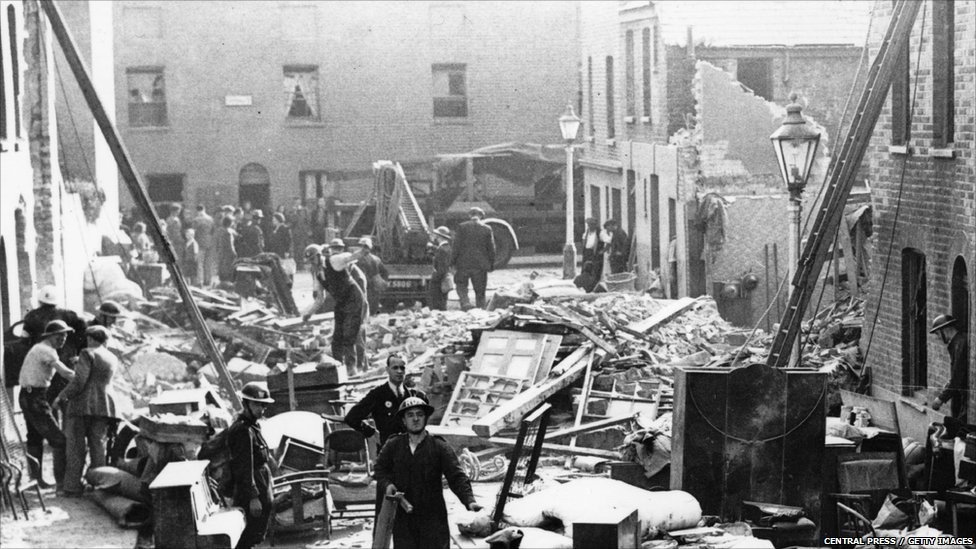
Funnily enough, I was talking to some people the other day and they were saying how good the war years were: “We never had it so good in the war years, what a sense of camaraderie, we never felt so close.” I thought are you potty? You were being bombed and shot at! There is something about the fact that the further you leave something behind, the more you develop a romantic view of it and I don’t know why that it is…it’s a weird, somewhat blinkered vision of the past.
As we go through life and we change as we get older, like in the song “Palace in Delights”, our viewpoints change. You know when we go through any change, whether it’s in ourselves or towns or races of people or technology or whatever it is, there is always something traded in. That’s okay for some things, but not for everything.

The Blitz, times were hard and actually not that great either….
I don’t know about you but sometimes when I see a vintage car, I look at it and I think about how much I would love to own it, but you know what? Would I really want to take it on? The maintenance and so on? Probably not!
EP: With ‘The Forge’, there is a theme that seems to be about progress but is it showing things from that Luddite perspective? Were you saying that the art of crafting in the heat of the furnace was better than the time when the machines took over and automation came along?
GM: Not Luddite because I know why we need certain things and I am not saying “Stop the machinery running!” There are 2 ways of looking at the Forge. There is the romantic view of the man struggling on his own in a battle of wills, just a man with his tools, crafting something unique out of raw metal. Or it’s about this factory where you don’t want anything unique, you want everything to be exactly the same and it’s about the juxtaposition of those two ideas. I’m not saying we should turn off the machine and go back to the old way of beating it out. I know that we need cheap pots and pans if money is tight.
EP: The whole of ‘Root’ seems to be similar to your others albums in that it concentrates more on the elements of storytelling than the soap box you mentioned earlier…
GM: Well I do write songs about us all but not as a great social commentator, however, I do write about the human condition. From the aspirations of a man working alongside Newton or someone sailing on a boat between Charlestown and Bristol…
I do think there’s a lot of hyperbole around these conceptual albums though. Sometimes the work has been cited as a Masterpiece, which is absolute rubbish! When I released “Charlestown”, a lot of reviews said it was a Masterpiece. It’s not a Masterpiece! I had to laugh. It’s just a series of good tunes…a Brandenburg Concerto, now that’s a masterpiece, Beethoven’s Pastoral symphony, that’s a masterpiece.
EP: Close to the Edge?
GM: Maybe yes, it’s close (no pun intended?) But to me, it cannot be compared with something like the Pastoral symphony. “Close to the edge” is rooted at its creation time and so I am not sure it’s as timeless. Sure, it’s got longevity but I’d be surprised if they are holding it up in 500 years alongside the former.
EP: Maybe they won’t with Beethoven either.
GM: Possibly, of course!. But Beethoven never released an “Open your Eyes’’ or did he?


Arguably two masterpieces…or just one?
EP: My question of the Soap box was related to the track ‘Old School’ on the new album which harks back to the old school days and the systems within them. It sounds like it’s a message about change, which has been for the better, when the old ways, corporal punishment and so on was still a part of school life. “Make a stand against draconian violence”. Yet some people argue from the other side on this.
GM: Yes, well I think there is that element in there, but you know, I lived through some of that era and I didn’t like it to be perfectly honest, but some kids DO get away with murder today…God!! I sound like my granddad!
In the old days, if we’d talked in class we’d have had our knuckles rapped with a ruler or we’d have the board duster hit us on the head or we’d get the cane or the slipper.
(“Didn’t do me any harm.” He whispers as an aside!)
But, at the time, yes, it bloody well did! But, who’s to know if it wasn’t a character defining moment and that as a result, I did not buck my ideas up. I don’t know, I’m certainly not preaching, all I’m saying is there is a certain not so romantic view of the old school life that I lived through. The song gave me a chance to air some of my resentments as a kid…
EP: Yet it’s not a very romantic view like hopscotch and short trousers. You refer to the somewhat nasty, authoritarian side of the old school ways.
GM: It gave me a chance to vent my spleen. Basically the kid in my story is saying “I’ve had enough!”
In his mind he rises up and says ‘Bollocks to all this’ and he takes over the school. But it’s all in his head. In the end we don’t see him marching off triumphantly. In the end, he’s standing in the corner, facing the wall with a sore bum, because that was the reality.
Some of it was quite horrible then, and I think things in education have changed for the better now. I don’t think there is anything good about beating a child into submission to get them to understand something. Especially when the child has maybe got some learning difficulties and some frustrated arsehole is whacking the hell out of them because he hasn’t got the insight to realise that the kid needs actual help and isn’t stupid.
The soap boxiest piece on the album isn’t that track however, it’s ‘Decon(struction) Blues’ that’s where I’m on my soapbox shouting “Don’t tear it down!”
Let’s consider what you’re doing. You tear things down and then bitterly regret when they’ve gone. So let’s take some time before we deconstruct and consider what should stay and what should go and what should be listed.
Going back to my point about me venting my spleen though, my school experience was not great and I hated some lessons. So, this song gives the kid at school a chance to see what it would be like to throw off the manacles and the shackles and take over the place – kick some ass, before he gets a beating from the headmaster.
EP: There is a strong theme on the album of nostalgia throughout…
GM: There is, I do like looking back quite a lot….
EP: I can see the theme of nostalgia at its most obvious in the track ‘Palace of Delights’
GM: That’s right.
EP: From a commercial angle?
GM: It isn’t really meant to be in those terms.
The “Palace of Delight” is overtly a shop in an old town which houses every element of your childhood on those shelves, like it’s been waiting for you your whole life and when you get to the age of 40 you go to this shop and suddenly you are transported to a time when you were 9.
Everything you got for Christmas when you were a child is waiting for you in that shop. It’s one of those strange shops where everything is juxtaposed together, Fishing nets, Diana and Charles wedding mugs, old Dinky model cars, stamp collections (which are way out of date), scouring pads, Ajax cleaner and clown balloons. You name it, it’s all in there and it’s all mixed up and higgledy-piggledy and, as soon as you close the shop door behind you, you’re transported to the time of your youth.
The Palace of Delights is the mind’s eye of what it’s like to be a child, to have your formative years presented back to you.
EP: The joy is revisiting that, is it?
GM: Yes, and everyone’s Palace of delight POV would be different. My Palace of delight would be the things I mentioned in the song, like the Man from U.N.C.L.E. bubble gum cards which I used to collect. When I went to school in 1969, I used to trade them round the school yard.
“I’ll give you two Mr Waverley’s for an Ilya Kurayakin” (Look that up if you don’t know what that is referring to…)
You used to have to collect the set of them but you’d always end up with five of the same card!
So in the shop I would see these ‘Man from U.N.C.L.E .’ cards, as well as Waddington’s game Railroader and ancient Beano annuals and suddenly I’m back at Christmas 1966…
It’s a pictorial representation of nostalgia and memories.
I believe that nearly every village has a shop like this in it somewhere. You find one and you are transported out of time – it’s a TARDIS shop!
It creates the emotional response between you, the object and the joy of remembering pure nostalgia.
EP: After you have done this album, Number 14, do you find it possible to keep discovering inspiration?
GM: I think I’ll write a reggae rock opera next.
EP: Did this album occur easily or was it a painful process?
GM: I find writing songs easy-ish, I find writing songs ABOUT something to be hard. Because you need an idea, a kernel of something. Once I get it, I’m off and running. “Charlestown” was a perfect example of that. I had snippets of melodies but I didn’t know what the hell I was going to write about. I went on holiday thinking this is all shit and I’ve got no ideas at all. I’m all washed up and quite depressed.
We went to Cornwall and happened to pop into this place, Charlestown. I went to the harbour and there is this great big four-master (Ship) you know…
I went on board. It’s one of those ships that has been used on ‘the Onedin Line’ and every other BBC sea related period drama going.
It was then that I started wondering where this thing had gone when it was a ‘real’ voyager. It was a grey day and it started me thinking…everyone gets this romantic vision of the sea and the ship cutting through the waves with people shouting “Avast Ye.”, but, in reality it must have been bloody horrible, setting off from Cornwall on a miserable grey, grisly day, carrying clay of all things. They were lucky to get to the other end alive in a lot of cases.
So that’s it, the light goes on and I get the idea. I went to the Charlestown maritime museum to find out more about the ships, the cargo and common voyage problems. I went to look up facts about it and there is was, that was Charlestown…It was all from that one thought. And once I get the idea about what I’m going to write about… VOOM! That’s it, I’m off. I find I can write.
I wrote the main structures of “Margaret’s Children” in about two weeks. I had a family tree on the wall and would look at who was on there. Once I know what I am going to write about its so much easier, I don’t think that writing the songs is a problem for me, I can probably write songs until the cows come home, but writing songs about something that’s worth listening to and has got something to say, that’s much harder.
Where I get the ideas from, I don’t know, I don’t question it, it beats the hell out of me. I don’t have a clue where some of it comes from, it’s peculiar some of it
The idea for ‘Root’, was all about this village and that there were things buried below the surface. Things that have changed, you know?
EP: The village is your creation, not one that you have visited, like say Haworth?
GM: No, it is imaginary, but I did do research. I did lots of reading. I have a folder here on my computer called ‘Dying Village’ and in it there’s lots of stories of old Yorkshire towns that have been lost, you know? Through some mining disaster or some other sort of disaster. I’ve been looking into how some of the places have changed completely. The pit has closed maybe and everyone has had to leave, and then the town got levelled, turned into a quarry for a while, and levelled again and then the site got redeveloped into an off-the-motorway retail park. You know, a Retail Centre or something like that.
The original idea was about this old village, with ‘Root’ it’s never really concerned with the new, it’s not really concerned with what is going on now, mainly with what was.
The title track looks at what is going on under the ground.
‘Decon(struction) blues’ warns you about tearing communities down.
‘Autumn song’ looks at the natural changing of the seasons.
‘Palace of Delights’ is about going back in time (for a moment).
‘Old School’ is also about looking back at an earlier time.
‘Mists of Morning’, again, even though it’s a ghost story, it’s about looking backwards. It’s going back to the beginning of the village, where they saw these trades people off – violently, and it came back to haunt them, literally.
‘Huntsman and the Poacher’ is also about an older way of life and ‘Amongst the sleepers’ is about remembering the personal Past.
A lot of it isn’t about modern times but it’s concerned with where we stand today.

The village, torn down and lost forever…
EP: You’re looking in that direction…
GM: Yes, over my shoulder basically.
EP: I’d like to ask you about the production. One thing that is notable about Root’s production is that it’s rich in Strings and Wind instruments, in particular the latter. There seems to be a bigger range of Saxes, Trumpet and Bassoon on the album. Was that a conscious decision when you were beginning the writing process or did that evolve? The texture of sounds appears to fit the album.
GM: It does, well in actual fact the textures fit the songs, and the songs fit the album. That’s the way it works. I don’t write to order as a rule, although there have been exceptions to that. I just write songs and if I happen to write one that’s got a funky soulful vibe, I can somehow hear the horns in the background already.
I do listen to Stax Motown and that sort of stuff. If I hear a rich horn section and I play a pop song-(and that’s what a lot of these songs are), I would then add to one of my demos a sort of synthetic brass sound and then I pass it along to Marek Arnold who does the saxophones…What I would get back from him are multiple tracks of Saxophone, but arranged slightly differently. So instead of my three fingers on the keyboard they are all done with different Saxes with different intonations, and he’s arranged them together as a brass arrangement. And…I got a lot of that back from him this time.
The way the sax songs fell, a lot of them had that brassy punch to it. I didn’t set out saying. “You know what I haven’t used brass than much, I’m going to use brass on this album.” It’s just that I wrote the songs and they happened to require brass IMO and when Marek got hold of them, he went wild really, he sent back far more than I could use.
I liked the arrangements this time and I didn’t do what I normally do which is pare it down. Instead I left a lot of the solid arrangements in because they were really good and because a lot of them have got a pop rock feel this time. There are some folky acoustic songs but a lot them are not folk songs per se, they’re more pop songs really, if you break them down.
I do love those brass arrangements
The thing about the Bassoon was that it was just fortuitous. I’d seen ‘Knifeworld’ at Summers End and I thought they were absolutely brilliant and I went over to chat with Chloe (Herrington) and Kavus (Torabi) to tell them how much I really enjoyed it. I’d seen her on stage with this bloody great Bassoon and she said ‘Can I have a bit more Bassoon in the monitor…’ (Laughs) You don’t hear that a gig very often do you?
….and it was just about the most wonderful noise and I thought…You know what… I bet that would sound really good on something like ‘Autumn Song’. It’s got that ‘Camberwick Green’ / ‘Ivor the Engine’ kind of feel to it, slightly rustic you know. It’s a folky-out-in-the-wilds folky feel.
EP: It just seems like a natural fit that the song which poetically describes the change of the season, combines with the wind instruments perfectly. It wouldn’t work in many other songs.
GM: You write each song as an individual piece you know…like an artist paints individual pictures. You don’t paint an exhibition, you paint pictures and then you put them in an exhibition and it’s the same with songs. I write them and quite by luck they all go together into the same collection.
I’m not constantly having to throw them out because they don’t fit with the other ones. I don’t care if they don’t fit, normally.
Just look at ‘Margaret’s Children’, perfect example. You’ve got something as big and symphonic as ‘Perfect Childhood’ then you’ve got ‘A Night at the Savoy’ with a slinky acoustic piano.
EP: That was one album where you seemed to go with what seemed right with each song…
GM: That’s right and ‘Root’ was no different. There was no great overarching plan with ‘Root’. It’s just the way the songs turn out and hopefully they run in the right order to keep you on board. The running order is crucial for an album like that. A lot of the time you’re not guided by chronology like in ‘Anser’s Tree’ or ‘Margaret’s Children’ where the first song had to be ‘Years of Wonder’ because it’s set in the 1600’s and the last one had to set in the future – so it runs from the past to the future…this one could be ordered anyway.
I knew that ‘The Root…’ (The title track) was going to open it and …Sleepers’ was going to finish it. It was where to put to put the ones in the middle that we had some debate about. Hopefully the songs come together and create a unified flowing album and you hear it and think that it couldn’t be any other way.
EP: I hear the pop elements on this album too and wanted to ask you about the song ‘Decon(struction) Blues’. It seems that this is a good example of one of your pop songs because it’s very clever in the way you also seem to blend in a wide range of styles successfully, like the middle rock-out section of guitar, with the chorus which is pop with a bit of soul and the wind segment which feels like something of a classic 60s TV theme tune. How did you make all that fit together?
GM: I don’t know. I didn’t set out to make it clever, it’s just the way it came together.
EP: Are the elements parts of the files that you keep gathering called ‘Newbies’?
GM: No, it didn’t happen that way. You have to realise that with ‘Decon(struction) Blues’ I could pretty much play the a full demo of it before anyone got their hands on it, and it didn’t change apart from some chopping of bits out, you know, being concise about things. The original flow and shape and arrangement was always going to be like that. The players (in the band) out there can bring it to life because they can understand their instruments far better than I can. But there’s nothing clever about it, I just wrote it as a complete song. I didn’t agonise over it. I didn’t aim to put a ‘stax’ bit in it. I just kind of go ‘Blurgh‘ and there it is. I work on the basic verse, chorus, verse and chorus and then decorate it with the instruments.
I try to use everyone’s performances. There’s far more material produced than ever gets used on the album though. Marek played loads of solos which just aren’t on there. Steve played some flute parts that aren’t there either, I just snip things when I think there’s enough of it. There might be 20 minutes worth of solos and I only want 3!
I assemble them like a relay race, one follows the next. Like stitching a collage together of all the people’s parts. If there is any art involved it’s in how I bring all these parts together so that it hopefully sounds natural.
As a solo artist you have to be objective and bring out the parts that you think people will want to listen to, not just the bits you have worked on. Otherwise it will just sound like Guy Manning’s greatest 5 minutes all over the place, you know. So even though it might be my favourite bit of piano I don’t stick it at the top of the mix, that’s not what it’s about. The Song is King!
The whole thing has to match the song, the song has to match the lyrics, the song and the lyrics have to match the artwork and everything comes together to provide the listener with the materials they need to build up that world in their minds. And if it’s unnatural, it will wake you up from that journey and the spell has been broken. So the art is to try to meld things in and also hope it lasts as long as it should last without becoming boring.
I’ve been bloody lucky really that it has turned out alright. Sometimes I don’t know how it’s going to end but I know it’s going to turn out alright, when you start you have to believe it’s going to turn out alright.
You know, one night I’m going to go to bed and the little cobblers elves are going to come into my studio overnight and sort out all the crap I recorded the night before. And in the morning I will go,
“You know what? It’s much better than I remember it last night. The little elves have been and sorted it all out for me.”
No…nothing clever. I don’t think of myself as clever.
EP: Do you find it easier to write the 3-4 minute pop song that the 12 minute sweeping epic?
GM: No not really because the 12 minute sweeping epic is just a series of 3-4 minute pop songs with just some linking passages in between. ‘Charlestown’ is 35 minutes but its 35 minutes of small songs which talk to each other.
‘Suppers ready’…Is that ONE song a cohesive piece? It is now! But it wasn’t that way when they wrote it. They stitched it together and yet you wonder how else could it have been? That’s just the way it was always meant to be. ‘Willow Farm’, that was just a small, little bit of nothing until it was in the middle of ‘Suppers Ready’ and suddenly it became very important you know.
Whatever it is, it just needs to have a good melody or a good tune. I firmly believe that having things without a melody is just silly. You don’t have to be discordant to be adventurous. Melody for me is extremely important. I want people to be able to hum the tune. I want a Dave Gilmour type solo you know, as in one that you can sing afterwards. I want you to be able to sing the guitar line. I don’t need speed. No matter how wonderful and dextrous it is, I want melody in there, I want it to build.
I like to sing my guitar solos – ‘Southern Waves’ you know, I can sing that guitar solo, it was one of ‘those’. We could all include shredding for shredding sake. I can shred with the best of them, you know! ‘Oh look at me, aren’t I so gifted? Look how fast my fingers blur as they go up and down the neck…’ But I do not like to, it all has to have purpose.
You might get away with it in a live concert, but on the album you’re going to listen to it time and time again and that shredding becomes fairly boring to me very quickly.
EP: After all the writing, when that’s done and it’s time for the mixing and mastering, is it then that the process seems like a Herculean task? Is this the least enjoyable part would you say?
GM: You play to your strengths don’t you? I think I’m a pretty good songwriter, and I think I’m a bloody awful producer to be honest. My albums at best sound like well-produced demos. You can hear everything and everything is nicely balanced. I know I’m not a great producer and I think that’s why it’s a Herculean task… because I am going into it knowing it’s never going to sound as good as how I think it could be (as in in my head).
I listened to “Charlestown” recently for the first time in two years. There’s nothing more depressing than going back and listening to your own albums. When you’re thinking…ah!!! where’s the bass, you know, or what was I thinking, that drum sounds terrible, what the hell was I doing there?
I know I’m not a great producer but I’m not a bad songwriter though.
I like writing songs best. I like producing them less, and somewhere in the middle I like playing live. Even then, I only like the performance bit, playing for an hour and half or so…It’s always a bit of a struggle and I really hate the packing away!
My stage of choice is that moment of writing the songs and working with the guys to make the parts of the song mature and evolve. Once I have all the parts and I know how it’s going to sound, I can lose interest in it altogether. I then have to seal myself away and pull myself into the zone. It’s not something I take any pleasure with. I don’t fixate about how a bass drum should sound for hours on end and you should do that when you are producing!
I liken it to a man walking into a desert with a canteen of water, you know? You walk and walk until you can’t go on anymore and you drop to your knees and then fall flat on your face. It’s that point where I never want to hear the album again and I just can’t do anything to it after that point. I just don’t have the grit to actually go back over it. I purposefully do not go back and listen to the album because if I found something I ought to do something about, my heart would drop. That’s not the way you should be about your own work. That’s not say that I’m trying to’ polish a turd’ that it’s really crap and I’m struggling with it. I just never get it to sound as good as I think it could.
I do give it to someone else on occasion and it sounds….yeah… ok…it takes the pressure off me, but in actual fact I don’t think anyone’s ever remarked on it. The only other person who’s ever done any real production on my albums is Andy (Tillison) who’s a far better producer than I am and he knows far more about how the sound should be. When he did ‘Bilston House’; admittedly it’s a popular album and it’s a good sounding album, but no one has ever put anything in a review to say…
“Thank God Andy’s producing this one because it sounds so much better than the others.”
But I do take my hat off to him, he did some good work on that album and he really took the pressure off me!
But it’s a great act of faith when you put your work in the hands of someone else, even someone you trust. You’re losing something and yet you can’t say anything.
You keep your mouth shut because someone has listened to it objectively and with no axe to grind and no emotional attachment with it. They don’t feel the need to preserve a piano part that personally took 2 days to master; they just look holistically at it, as a song.
My main problem is that normally I don’t have the money to give it to someone else. I can’t pay Trevor Horn to have a go at ‘The Root, the Leaf and the Bone’ He just wouldn’t have the time anyhow! There are no large record company advances that pay me to go into the studio with the London Philharmonic orchestra to do an arrangement. So you can either get someone you trust to do it at very little cost or you do it yourself.
You know the end of ‘Misery’ (Stephen King) where he has his glass and his one cigarette and he gets to the end and he say’s “That’s it.” I get to the same point and I say, you know what, that’s as far as I can take it. After that point I’m just fiddling around…
EP: How do you hold down the multirole aspect of your career? Writing, recording, rehearsing, mixing, organising live dates, doing the website, doing interviews and holding down a day job?
GM: I’m used to it. I’ve been doing it for more than 14 years. It’s a cycle, each year. I just do one thing and then I go on and do the next. I keep the website ticking over, they are small increments. You do things in small manageable chunks, like decorating a house. You don’t think about decorating the whole house at once, you just deal with the wall in front of you that you are about to paint, and then you paint the next wall and so on. So over the course of a few weeks, the house gets painted.
It’s time management. I take on a lot basically because I’m responsible for it.
I try to keep everything simple and just fit anything in that I can.
EP: You sound very organised…
GM: You have to be organised. I like getting things into diaries. For the radio shows, I get in touch with the presenters months in advance. I want to know when I’m doing the interviews and I want to know when the shows are going out. The ‘Special Guest’ questionnaires (for the Root album) now published on the website, I had them lined up in my diary. I have them there and I know exactly when I’m going to release them…it has to be planned or its chaos….chaos!
EP: Another thing I have noticed that you have added to the work load is that you’ve changed the bands image….
GM: (Laughs) you could say that…
EP: It’s quite a big change and I thought it looked quite impressive when I saw it in Prog Magazine.
GM: It was time to change! I have always said that I wanted to make an effort, I didn’t want to just turn up, set up the gear and take my pullover off and play. I wanted set up, go off and come on looking like we made an effort to change into something. I don’t mean that we have to put batwings on or anything like that, or come on in capes. I wanted people to realise we were taking the performance side of it seriously. We wanted to put on a show because we are not the most animated band to watch, you know? We’re quite sedate in what we do and there are not a lot of visuals or loads of posturing and’ air guitaring’ and so on. We play the songs and some of them are complicated and we have to sit down and concentrate on what the hell we are doing. While that’s happening there isn’t a lot of action!
But, the way I see it, you can at least you can look good sat at the keyboards. Beforehand we would come on in black shirts and Julie came out in a dark dress. We all looked neat and tidy but we looked like we were at a convention for funeral directors or barbers or waiters or something. So I said that we should do something about sprucing up the stage act.
For the past few shows I have been off to the off to the side of the stage and yet, everyone expected me to be in the middle. People think that because I sing and I wrote the songs that I ought to be in the centre with all the spotlights on me, but I put myself at the side because if you are set up over there, your stuff is less likely to be moved and I had quite a complicated set up and I didn’t want anyone to dismantle it and move it around.
Anyway, that’s all going to change. I’m going back in the middle again because it became apparent practically, not egotistically, that people want to come and see me.
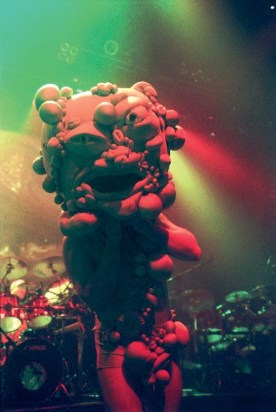 So how do we look? The way we are is best described as storytellers. We don’t act it out like Gabriel did, you know? I’m not coming on dressed up as Rael or putting Slipperman costumes on and all that stuff. The nearest I got is putting a Captains hat on for Charlestown So I did suggest a bit more visual interest and I think it was Kris who came up with the Steampunk idea. I don’t know why, I think he had been watching ‘The Golden Compass’ or something like that and he quite liked the waistcoats and goggles and top hat look and stuff. So once we got that idea, everyone went running off to Oxfam and took great pride in doing their own costume/look. It wasn’t coordinated from the middle or anything. It was just “Go out and kit yourself out.” And we had great pleasure in showing everyone…here is my costume.
EP: Was it taken in good spirit?
GM: There were some people who found it more comfortable than others. I think in the end though we all embraced it. When you see the Prog magazine in Nov (2013) you’ll see Martin has this lovely little waistcoat and goggles and he looks like some sort of demented mole or something. He looks really good and Julie… well Julie looks like a dark version of ‘Mary Poppins’ dressed up in this sort of corset and long dress and tied up boots. And I look like some sort of mad professor, well not mad…probably like some sort of country squire in my long coat and waistcoat, my thin glasses and a sort of 1930’s Genevieve car riding hat and pirates boots up to my knees. We all look very odd!
I just hope people take it in the spirit it’s being given and just embrace it for being fun. Some people might say we look like a bunch of pretentious twats and I’m quite expecting to get some sort of backlash. You know, some people are going to look at those photos and say “What the bloody hell do they think they look like?”
But I tell you what, I am so sick of seeing five guys in black t-shirts standing with their arms folded. I hate those shots, or the ones of guys leaning against a brick wall. I don’t want to do that. We are going to do something a bit different. We went a Heritage railway museum and we dressed my youngest, Nathanial, up as Death (with Scythe and everything) and every time there was a photograph he was lurking in the background, hauntingly hanging around you know? We brought him in because there are a lot of Manning songs about Death and we had a right old laugh when we did it. The whole thing was a great day out, it was absolutely boiling hot, we had a lot of fun and we just hope that when people do see it that we don’t come across as pretentious arty farty basically.
It’s fun, it’s just fun. It’ll be bloody hot sitting on stage in it though, I can tell you.
EP: Have you tried it, a dress rehearsal.
GM: Not yet but the day we shot it, it was bloody hot, probably the hottest day of the year. But I know we will be warm. I’m hot in a t-shirt and joggers so I know it’s going to be tough. But we’ll see.
I think you have to suffer for your art!
EP: So you hope to bring your songs to life through what you are wearing?
GM: Yeah, hopefully. Like I say we are not going to act them out. But we want to bring a sense of style to the proceedings. It’s not meant to be taken seriously. It was more to do with Alice in Wonderland than anything else.
 EP: Thanks Guy, I enjoyed our chat and look forward to catching up with you again soon.
GM: Indeed…Very, very enjoyable. Thanks.
For more information about Manning and the latest album visit:
Manning Website
Root the Leaf and the Bone promo video
Sample track – ‘The Huntsman and The Poacher’


 The ever-brilliant and intriguing Matt Cohen posted some very good (if cryptic) news this morning on Facebook.














 Progarchy