The WordPress.com stats helper monkeys prepared a 2014 annual report for this blog.
Here’s an excerpt:
The Louvre Museum has 8.5 million visitors per year. This blog was viewed about 140,000 times in 2014. If it were an exhibit at the Louvre Museum, it would take about 6 days for that many people to see it.
Dream Theater have shown, with their latest live album, Breaking the Fourth Wall, that they are the kings of progressive metal. This album, recorded live at the Boston Opera House on March 25, 2014, brilliantly embraces all aspects of the band’s incredible career. I purchased the Blu-ray version of the show, mainly because I am completely enamored by their latest studio album, Dream Theater. Breaking the Fourth Wall goes further beyond their last album.
I am relatively new to Dream Theater, being introduced to the band by their latest album. I am still sifting through their back catalogue, and I am certainly enjoying it. It seems that many long-time Dream Theater fans disliked their latest album, and I’m not really sure why. Yeah, Mike Portnoy isn’t a part of the band anymore, but Mike Mangini is a more than capable drummer who brings his own heavier style to their music. For those that say the new album is missing soul or heart, just read the lyrics. It is probably the most personal and spiritual album that the band has ever made. Do I miss Portnoy? Yes and no. I have become a massive Mike Portnoy fan in the past year, and he has been making some incredible music outside of Dream Theater – music that probably wouldn’t have been made had he still been a member of DT.
Alright, enough of my defense of Dream Theater. Their music can stand as a defense.
Act 1 of the album begins with a rocking rendition of the grammy nominated “The Enemy Inside.” We then bounce back to music from Black Clouds and Silver Linings,Falling Into Infinity, A Dramatic Turn of Events, and Dream Theater. While it is all awesome, especially enjoyable are “The Looking Glass,” “Trial of Tears,” and “Enigma Machine” (instrumental). The first two songs have clear Rush influences, with “The Looking Glass” sounding like a Rush arena rock song such as “Spirit of the Radio,” and “Trial of Tears” beginning and ending like “Xanadu.” As usual, the musicianship is in top form, and the concert gets off to a rousing start.
Act 2 begins with several songs off of 1994’s Awake album. It was really nice to hear the band play the older music, and it was interesting to hear the differences in drumming styles throughout the concert. Mangini Dream Theater is definitely heavier (in a Bonham way) than Portnoy Dream Theater. It isn’t particularly noticeable until music from across their catalogue is played together at once. The Act ends with the emergence of the Berklee College of Music Orchestra and Choir to aid in “Illumination Theory.” Wow! I’m often skeptical of orchestras and rock bands, but this combination was perfect. The melding of the band with the choir and the orchestra creates a full and beautiful sound.
The Encore consists of portions of Scenes from a Memory, on which the orchestra and choir continue to aid. I found this choice of music for the encore interesting, considering the tour was for their latest album. At the end of the show, you are left wondering if you saw a tour for Dream Theater, or DT playing some of their favorite overlooked music from the years. This isn’t necessarily a bad thing considering how good the show sounded as a whole.
I think my favorite part of this show is Jordan Rudess. He clearly loves what he is doing, and he is a true wizard on the keyboards. At some points, I wish he had been playing a Steinway because it would have sounded so much better and much more epic. For me, what truly distinguishes a good band from a great one is their keyboardist. What do Genesis, Yes, ELP, Queen, Muse, and Dream Theater all have in common? A pianist who can play anything from Brahms to hard metal and do it with such virtuosity as to make the most elitist music connoisseurs stand in awe.
Particularly nice is the quality of James LaBrie’s vocals. He sounds good at this show. Either he was in fantastic form, or they did a bit of adjusting in the studio… or both. Either way, it makes for a great show to watch. Whether or not he actually hit those high notes live doesn’t really matter to me since I am watching the Blu-ray, and I paid to see a great show.
My disappointment with this live show comes not from the musicianship, but from the production and mixing. Overall, the mixing is pretty good, especially for the drums. The drums sound great with surround sound – so great that you almost feel like you are sitting in the middle of the drum set. The biggest annoyance is John Myung’s bass is far too low in the mix. On the album, Dream Theater, his bass is front and center, but here he often seems to blend into the background. The overall sound still has a heavy bass feel from the combination of Myung’s bass and Mangini’s bass drums. James LaBrie’s vocals are also too low in the mix, which can make it difficult to understand what he is saying sometimes. Annoyingly, the crowd is up too high in the mix at some points, especially early on in the show.
Further disappointment comes during the middle of the Awake set, in which the editor felt it necessary to play some weird, indiscernible background image over the footage of the musicians. It makes it so that you can’t clearly see the musicians, and it pulls you out of the music. It is needlessly distracting. Other than that, the rest of the show has beautiful HD footage, from many different camera angles. What I especially like is the footage doesn’t jump around every 1/2 second (like on ACDC’s Live at River Platte concert). They give enough time to each shot before moving on. Unfortunately, John Myung is not shown nearly enough in the footage, which I don’t understand at all. Everybody else is shown quite a bit, with John Petrucci shown a lot, but not enough of Myung.
I also wish the entire Dream Theater album had been played, especially “The Bigger Picture,” my favorite song from the album. For me, an inclusion of those songs would have pushed this show over the top.
My disappointments with Breaking the Fourth Wall are rather minor, and they should not keep anyone from purchasing this album. It is probably the best live music DVD/Blu-ray/cd released this year. The music consists of a wide array of pieces from across the Dream Theater collection, and the package itself includes a nice booklet detailing everyone involved in the production of the show and tour. Dream Theater continues to show why they are the leaders of progressive metal and have been for over 20 years.
The prog dog – Snickers. She thoroughly enjoyed Breaking the Fourth Wall from the comfort of my lap. Metal puts her right to sleep.
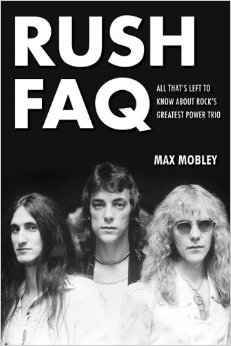
Don’t let the title–which has to be one of the worst titles in book publishing history–fool you. RUSH FAQ is an excellent book.
It’s not just one of the best books on Rush I’ve ever read (and I’ve pretty much read them all), it’s, simply put, a great book. Insightful, factual, captivating. Mobley can write like no one’s business. He’s a huge Rush fan, but he allows this aspect to become playful part of the book. I’m always a huge fan of good writing–whether it’s Dante or about the latest software upgrade for the Mac. This is excellent writing. And, frankly, it’s the equivalent in the book world of what BEYOND THE LIGHTED STAGE is in the movie world.
Why the title of the book? Not a clue. I ordered this assuming it would be a reference book, and I had almost no hope that I would enjoy it. What a happy shock I got when the UPS man delivered it. RUSH FAQ is so far from a reference book. . . it’s a great series of coherent essays. Love it.
I’ll write a real review soon. But, for now, order the book and enjoy.
The book: Max Mobley, RUSH FAQ: ALL THAT’S LEFT TO KNOW (Milwaukee, WI: Backbeat Books, 2014.)
I hope this isn’t obnoxious. . . but I want to let every progarchist (writer and reader) know that I’m very, very happy to return to the actual day-to-day editing of progarchy, along with Chris and Carl. I’m sorry I had to fade out of the scene for past few months, but I was really overwhelmed with work and family matters. Nothing is wrong–in fact, everything is going extremely well at work and with family. But, there was just too much to do for a bit there, and I let events overwhelm me. All has passed, and my life has calmed down.
And, now that all has returned to normal, I realize just how much progarchy means to me.
A huge thanks to Carl and Chris, my co-founders, for being patient with me, and for welcoming me back as an equal. So, as of December 27, we’re back to mutual editorial duties, though Chris said I can keep the title “Founding Father.” Granted, I’m no George Washington. . . but, I’m more than happy to have the accolade.
But, seriously, I hope you all (all y’all in Texas) realize how much I love this website and what it stands for. And, I’m incredibly proud of what we’ve accomplished in just a little over two years.
As I see it, sites like progarchy match the current music scene very well. Just as record labels are failing as the market continues to decentralize through the web, so I hope those establishment rags–such as Rolling Stone and NME–fall big time. This is the time of the entrepreneur and artist, not the time of the corporatized and tapioca-addled propagandist.
For all intents and purposes, WE ARE THE NEIL PEART generation, and we offer whatever nasty gesture we can at the establishment that has done so much to promote conformity rather than excellence.
One of my pet peeves with much space-based science fiction has to do with setting. In particular, so many sci-fi novels, short stories, TV shows, and movies of the space-based variety are set in some far off galaxies on imimaginary planets. This doesn’t necessarily make those stories bad, and in fact some are very good (for example, the best sci-fi TV series ever in this reviewer’s opinion, Babylon 5). The reason it’s a pet peeve with me is that it gives a short shrift to our own cosmic backyard, the Solar System, which is chock full of some of the most fascinating wonders imaginable (to be fair, some action of Babylon 5 does take place on Earth, Mars, and near Jupiter).
In the music world, thankfully, there has been an acknowledgement that we live in a most interesting cosmic neighborhood. Gustav Holst was the first to do this with his suite, The Planets, which premiered in 1918. Between then and now, our knowledge of our own Solar System has grown exponentially. This is in no small part due to the Voyager 1 and Voyager 2 probes. These probes were launched in the mid-1970’s and made their way through the Solar System in the 1980’s. Thus, Cailyn has now stepped in to build on both Holst and our expanded knowledge with her musical interpretation, Voyager.
Voyager is an album of 14 tracks, most of which address various celestial bodies encountered in the 1980’s by the Voyager 1 and Voyager 2 probes. Four of the tracks – Jupiter, Saturn, Uranus, and Neptune – are Cailyn’s re-interpretation of Holst’s original compositions from The Planets. While these are quite good in their own right, the best tracks on the album are Cailyn’s own original compositions. Seven of these tracks are directed to various moons of the outer gas giants. The track Voyager refers to the probes themselves, while Pale Blue Dot refers to our own planet as seen from Voyager at the outer rim of the Solar System. Heliopause refers to the outer boundary of the Solar System, which both Voyager probes have now passed beyond.
All of the tracks are worthy of mention, but I’ll just mention a few here. Io has some interesting contrast, including one musically volcanic eruption that is representative of that world. Titan is a study in dynamic contrasts shrouded in mystery, much like its namesake, which includes some nylon string guitar on top of heavier rock underneath and an atmospheric ending befitting of the only moon that has an atmosphere. Miranda at times feels like it’s alternating between a rock song and a Beethoven piano concerto, and can be dark and moody. Pale Blue Dot is a mellow and reflective piano-driven piece that hits home perfectly for its subject matter – the photograph of Earth, from one of the Voyager probes, as it was leaving the Solar System. But they are all good.
Although this is primarily a review of music, the packaging of Voyager definitely deserves mention here. In particular, there are notes in the booklet for every track that provide a description of its subject matter. For the celestial bodies themselves, this includes information about the origin of their respective names and physical composition. Reading these track descriptions is a must to get their full impact. They provide food for thought that is not typical for instrumental works. Better yet, they makes this album educational, as well as an enjoyable listen.
This album is best listened to in the dark, and if you want to really get your geek on, pulling up a desktop planetarium or space simulator in an otherwise darkened room and looking at the various planets and moons as their respective tracks play is a good way to go. Or perhaps if you live in an area away from the city lights, it would be a good listen while looking through a telescope. No matter what environment you choose, this album is a very satisfying musical and cosmic voyage that should not be missed.
Actually it seems like just a year ago when I was thinking ‘here we are again.’ And you’re probably thinking the same thing at this point.
‘Best of’ posts seem to be a tradition at this point in time, when we also celebrate our planet returning to the same point (galactic orbit notwithstanding, naturally…) as it was 365-and-a-bit days ago. Hurrah! We’re back! Now, where did we leave our keys?
Johannes Kepler – the only man this year to publish a positive review of ‘Heaven and Earth’.
Of course if Johannes Kepler (pictured to the left, apparently pre-empting a delicious Chinese main course by snaffling a Tunnock’s Caramel Wafer) was to try to build a predictive model of the prog releases even a year into the future he would probably end up a bit stumped, and would look stupid for even trying. So that’s why we don’t try to model prog – most of us look stupid enough without the ignominy of a failed ‘Theory Of Everything™’ on our CVs too.
Anyway, I digress, as is my wont.
Musically 2014 has been an interesting year. Mostly because it has been quite different from 2013.
“Well, colour me surprised, Mr. Clarke, that’s generally how the space-time continuum works!” I hear you shriek. But please set your Interweb keyboard warrior fury aside for a moment or two, and let me finish my epistle before you judge me too harshly.
My 2014 has felt pretty lacking when it comes to stand-out, arse-kicking, blindingly-brilliant music. Maybe we peaked in 2013. I mean, 2013 was pretty amazing for a number of reasons, not least:
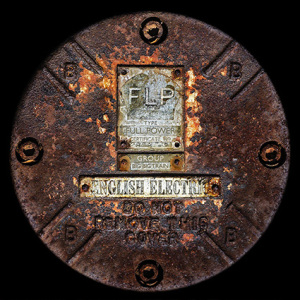
Big Big Train released their insta-classic ‘English Electric:Full Power’ double album, making me homesick once again.
Haken’s ‘The Mountain’ rocked my world.
Thieves’ Kitchen’s ‘Of Sparks and Spires’ didn’t help with the homesickness thing, thanks very much indeed.
Spock’s Beard finally returned to form with the absolutely stonking ‘Brief Nocturnes and Dreamless Sleep.’
Scott and I made a trip back to the mother country (that’s England – keep up, everyone) for The Big Big Weekend (Saturday and Sunday are here in glorious TechniPanaColourVision,) where we forged new friendships, ate curry and drank beer.
Now the above may be a small list, numerically-speaking, but each of those items was a Very Very Big Deal to me. In comparison 2014 really hasn’t lived up to the standards of 2013. How could it possibly?
There have been a few albums by artists whose back catalogues I have a lot of time for, but that this year have failed to set me on fire:
Gazacho’s “Demon” didn’t have the longevity I thought it would, which is a shame – it’s a nice enough album, but not something to draw me back time and again. If I am honest, I think my trajectory and theirs have diverging somewhat since Night.
Cosmograf’s “Capacitor” worked well for the first few spins in rapid succession, but then I think I over-listened to it. It takes (me at least) a lot of work to get the most out of it so I have to ration my exposure now. I go back once a month for a fix, but because of that, it hasn’t been entwined with my life this year. Perhaps that’s for the best – caviar gets boring when you eat it for every meal.
North Atlantic Oscillation’s “The Third Day” left me pretty cold. I loved 2012’s “Fog Electric”, and Sam Healy’s 2013 “Sand” was a damn fine album too. But TTD now sound like they have been re-treading the same ground over, and over, and over again. And again. And over again.
Anathema’s Distant Satellites started well but then fell apart. For my ears, the music certainly lived up to the band’s name.
I chose to completely bypass Yes’ “Heaven and Earth” for a number of reasons, not least of which is my refusal to continue to be serially disappointed by a band’s output for three entire decades. So I have finally given up watching that particular slow motion car crash.
Combine all of the above with a very busy and sometimes fraught year at work and home, and it adds up to make me feel that things just aren’t what they used to be.
But like Climate Change there are peaks and troughs. Are we in a trough in 2014? Was I just looking the other way while all the cool stuff happened? Maybe I was at the shops.
Looking forward my personal highlights for 2015 will be Big Big Train releasing the Real World DVD and playing live at King’s Place in August (and yep, we will be there!)
We have new material from Phideaux, Spock’s Beard and Haken among others, which I am also very excited about. The list is not endless, but it’s promising. Fingers crossed…
Anyway, back to the year in question. 2014. What has floated my boat?
IQ – The Road Of Bones
This album is absolutely the best thing to come out of 2014.
It’s still as fresh as it was when I first heard it, and it’s still a firm favourite on my car media player. In fact, it’s rarely not being played. I have played it to death, and yet it still lives! It is absolutely the pinnacle of IQ’s output. You may recall I quite liked it and said as much a while back. If you haven’t heard it, you should really, really hear it. And of course, buy the bonus CD.
Uphill Work – Missing Opportunities
This album was a real surprise find for me. A very late arrival to my ears, once again the Progstreaming site came up trumps while I was browsing during a quiet moment earlier this month.
Uphill Work are a Moscow-based group formed in 2002. I’d never heard of them – it’s discoveries like this that make me very happy The Interwebs, and sites like Progstreaming, exist.
This album’s an absolute bloody gem – quirky, interesting, humourous, very droll lyrically, and a great vocal approach.
Listen to it (and buy it!) on Uphill Work’s Bandcamp page.
Dave Kerzner – New World
Another December find, this is a musical feast. I don’t identify as a Pink Floyd fan at all, and a lot of parallels have been drawn between this release and the Pink Floyd sound, and yes, they’re definitely there. The big difference for me is that I like this album and I haven’t liked any PF albums. So I guess I win!
This album keeps pumping from start to finish – every track delivers something different, and it’s all good, every last bit of it. Recommended!
Three keepers in a year, the first of which was released in May, and the other two which I was introduced to in December. That’s a big gap! I would have despaired if IQ had been the only transcendent release in the year. So for that number to treble in the space of a week or two, well I consider that excellent luck! Thanks goodness for happy accidents.
All that aside I actually don’t really believe in the good musical year/bad musical year thing.
You make your own good year/bad year.
What floats your boat sinks others’, and vice versa.
You get out what you put into it.
OK, I will stop sounding like your grandmother now.
I’m sure I missed a bunch of other good musical stuff while I was doing other non-musical stuff. Such is life, and I’m also sure that if it’s that good I’ll discover it next year.
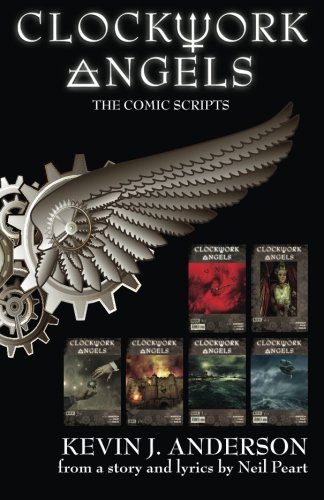
A review of Kevin J. Anderson, CLOCKWORK ANGELS: THE COMIC SCRIPTS (Monument, CO: Wordfire Press, 2014); from a story and lyrics by Neil Peart.
Birzer rating: 10/10.
From WordFire Press (December 2014).
Two things need to be stated before I even get into the heart of this review. Well, ok, let me put this in active form, before my students yell “foul!” I, Brad, need to state two things before getting into this review.
First, one could write a long and interesting article just about the convoluted and circuitous publishing history of CLOCKWORK ANGELS. And, why not? What a fascinating history. In the beginning, CLOCKWORK ANGELS was an album by Rush (remember, though, the first two songs came out almost two full years before the album itself).
Then, it was a best-selling novel by Kevin J. Anderson and Neil Peart.
Then, it was a huge worldwide rock concert tour, a live album, and a live concert DVD.
Then, it came out from BOOM! Studios in comic book form, illustrated by the extremely talented Nick Robles, over six issues. These six issues, of course, will be released in graphic-novel form in the spring (April 2015) with, I’m guessing, an intro or conclusion by Peart.
Now, however, CLOCKWORK ANGELS has come out from Anderson’s WordFire Press as THE COMIC SCRIPTS.
Soon, there will be a sequel, CLOCKWORK LIVES, which Anderson has only recently happily finished with the equally happy blessing of Neil Peart.
It’s possible the whole cycle might start over with the sequel.
And, if Rob Freedman is correct, CLOCKWORK ANGELS will probably grab the fancy of some Hollywood producer, direct, and acting talent, and it will be made into a major motion picture. If so—and, let’s pray this happens—the script is completely written, the scenes already storyboarded by Anderson, a true master of the art.
Second caveat. It’s no secret—at least to readers of progarchy—that I’ve been following the career of Neil Peart very closely since the spring of 1981. Since the age of 13, Peart has been as much a part of my life as has Ray Bradbury, J.R.R. Tolkien, Mark Twain, T.S. Eliot, and the list could go on.
Sci-fi demigod, Kevin J. Anderson.
Since some time in the early 1990s, however, I can also state the same about Kevin J. Anderson. Among modern science-fiction writers, the only other person I’ve followed as closely is J. Michael Straczynski. I’m absolutely fascinated by their writings as well as the trajectory of their careers. Each is a expert of his craft and an imaginative perfectionist. Each is also very much in-tune with his audience and the possibilities the internet presents. And, as probably well known, each has advanced the cause of progressive rock in a variety of ways. Straczynski had done so by promoting the career of Christopher Franke and Anderson by writing with Peart, producing the story and lyrics (along with his wife) for Roswell Six, and through a myriad of other ways. Each, also, fully embraces the comic and graphic novel worlds. Straczynski tends toward horror and the gnostic, and Anderson tends toward science fiction and the mythic, but, otherwise, the two have a great deal in common.
So, these two caveats stated, let’s get back to Anderson’s latest, THE COMIC SCRIPTS.
Even from a cursory examination of Peart’s song lyrics, the story of CLOCKWORK ANGELS seems a nicely updated version of 1978’s HEMISPHERES. There’s the side of order, and there’s the side of chaos. The hero, choosing not to embrace either extreme, finds a via media, making his own path and his own choices. He finds, in reality, that his choices are limited, however, but choice does exist. So, free will exists, but it does so only within certain bounds.
Anderson’s novel offers a wondrous exploration of Peart’s universe. Employing the literary devices of utopia and dystopia, Anderson, a sci-fi demigod, gives the story a much needed and beautifully executed Tolkien-esque and Chestertonian fairy-tale ethos and atmosphere. We discover why the Clockmaker craves surety and the Anarchist disorder. We also discover why Owen must reject both and become, for all intents and purposes, the everyman version of Cygnus.
Not limited to lyrics for twelve songs merely, Anderson explores, lulls, mulls, and lingers. With his deft hand, the world of Owen and the CLOCKWORK ANGELS becomes rich, full, and tangible. Though many have labeled this world as Steampunk—a label neither Anderson nor Peart would deny—it is much more than Steampunk as well. The pastoral quality of parts is truly pastoral and adds the Tolkienian fantastic to it all. Indeed, Anderson’s best writing—while always superb—truly shines when he is detailing the cultures that arise in distant and rural landscapes.
Equally important, though, is that Anderson is not only a great friend of Peart’s, he’s also a huge fan of Rush (and Hugh Syme). These loves show in almost every word and on every page of CLOCKWORK ANGELS. For those of us obsessed with Rush, Anderson ably rewards the reader, throwing into his novel (and the comics, and, thus, THE COMIC SCRIPTS) Easter eggs galore.
What surprises me most about THE COMIC SCRIPTS, however, is how utterly and brilliantly visual Anderson’s imagination is. Frankly, after having read much of his science fiction and some of his detective fiction, I really have no right to be surprised by any of this! Anderson is a genius at nearly every level, but he is especially excellent in and at creating a MYTHOS around, behind, and near every one of his novels. There’s a reason major international serials praised his own renditions of the XFILES as some of the best sci-fi of the 1990s. Sure, the XFILES was a great TV show. But, Anderson’s skill made the characters and the MYTHOS a thousand times better. I suppose my surprise at Anderson’s ability to visualize and imagine is, if anything, an indication of my own lack of imagination.
Looking at THE COMIC SCRIPTS, one readily sees that Anderson anticipated and then directed every single panel of the comics. He describes the emotions on the faces as well as the technology that will (certainly) jolt the reader into a sort of glee. Anderson presents every aspect of the CLOCKWORK world in all of its alchemical madness and glory.
By describing every thing visually, Anderson paints an interesting portrait of this world that could tease the Rush fan and the sci-fi/fantasy reader without end. Some day, lit crit folks will have a field day deconstructing all of this. For example, per both Peart’s and Anderson’s desires, the reader never actually sees the faces of the angels. This must be left to the individual mystery and imagination. Or, one sees that the symbol of the order-loving Clockmaker is a beehive and honeybee. The beehive looks suspiciously like the symbol of Utah, the Mormons, and the former State/Empire of Deseret. Is this intentional? I don’t know.
Or, how about the description of our hero, Owen? He is truly everyman—“He is non-ethnically specific,” Anderson explains. He “should have darker/olive skin, dark eyes, dark hair.” Anderson describes the cities of his world as Manhattan with a twist of old Berlin with a huge touch of the art deco. Could this be Gotham? Metropolis? Dark City? Of course.
Ok, but what surprises me most? That Hollywood hasn’t snatched up Anderson in a major way. Holy Moses, this guy can think, he can write, and he can imagine.
So, should you buy this latest offering from Anderson?
Do you like Rush? Yes.
Do you like science fiction? Yes.
Do you like intelligence and imagination in your fiction? Yes.
Do you like the visual arts? Yes.
For me, THE COMIC SCRIPTS is another brilliant exploration of the CLOCKWORK world. But, even if you’d never heard of Rush or even if you’ve never read the novel or the comics, this is still well worth owning. Anderson’s writing is so good, and his visual imagination is so fascinating, that THE COMIC SCRIPTS could easily (and does) stand on its own as a screenplay or as an actual stage play.
Apologies from the band for a recent lack of email updates. Over the summer, the mailing list grew too large to manage using our Outlook email client and we were no longer able to send updates. We have now moved the mailing list onto purpose-built software and will be able to provide more regular updates.
Unfortunately, the failure of our mailing list coincided with the announcement of three Big Big Train gigs at Kings Place in London next year. All the tickets for these shows have sold out but we will be playing further gigs in future years and will ensure early warning via the mailing list and social media.
Big Big Train filmed live performances of a number of songs at Real World studios in August 2014. These performances will be released on Blu-Ray and DVD in the autumn of 2015. At Real World, the band were joined by Rachel Hall on violin and vocals and Rikard Sjöblom on guitars, keyboards and vocals. We are pleased to announce that Rachel and Rikard have now joined both the live and recording line-up of the band.
The band has written around two hours of new songs. Recording of these will be completed for album releases in 2016 and 2017. An EP, featuring three new songs, will be released in April 2015.
We would like to take this opportunity to wish you a Merry Christmas and a Happy New Year!
Andy, Danny, Dave, David, Greg, Nick, Rachel and Rikard
Big Big Train











 Progarchy