

N.B. This is a deeply personal essay considering two examples of why prog means so much to me. I could offer others. But, on this October 11, 2014—the second anniversary of the creation of this website—these are the two I need to offer. I reveal some things that maybe should be left unrevealed. . . but such is life.
***
As some readers of progarchy might know, I’m a progarchist only at night and during my free time. By day, I’m a professional historian, lecturer, and biographer. I’m also a husband of one and a father of six. . . well, seven. . . but that will be explained in a moment.
Though I’ve had the amazing opportunity to lecture in England (2003 at the Ashmolean), I generally lecture in the U.S. In some years, I might lecture as many as 20x in various locations around the country. Usually and understandably, I’m asked to lecture on the liberal arts, Catholicism, biography, etc. But, almost always when someone who knows me only from my academic career looks at my resume, he sees “progarchy” or something about “prog rock” and becomes more than a bit dumbfounded. Yes, I admit it. Rather proudly. I’m 47, and I love Socrates, Jesus, and progressive rock. I love Batman, too, but that’s another story.
All of this is merely to give context to what I’m about to write.
From as early as I could remember, I read everything I could get my hands on. I was never a huge TV person (aside from Star Trek), and I’d just as soon spend any free time outside exploring that vast horizons of Kansas as I would reading. But, also, for as long as I can remember, I loved music. As a toddler (and my mom can confirm this), I’d crawl out of the crib, make my way to the family room, and blast the stereo system at three in the morning, waking the entire house. I also used to turn on oven burners at full blast at 3 in the morning, but this, too, is a different story.

I grew up with a very, very intelligent mother and two spirited and equally intelligent older brothers. They introduced me to Tolkien, to Bradbury, and to progressive rock. Lots and lots of progressive rock. In particular, I used to stare and stare at the gatefolds of Yes’s Yessongs. And, of course, Roger Dean’s art is deeply ingrained in every fibre of my being.
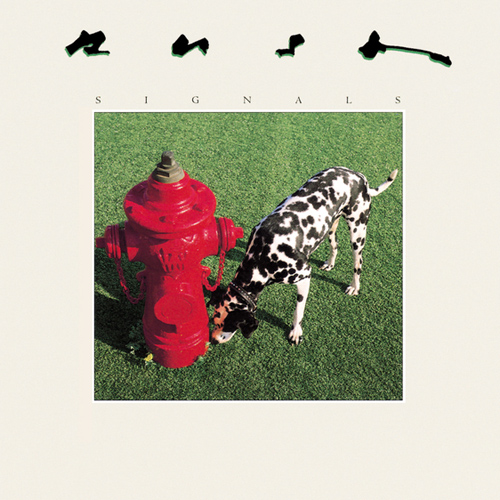
Prog has gotten me through much. As some level, it has been almost religious for me. I can state with complete honesty—though without detail, at least at the moment—that had I not had the music of the Moody Blues, Yes, and, especially, Rush, I would not have survived junior high school. I mean this quite literally. Neil Peart’s lyrics gave me a reason to live when it seemed no others existed. Let’s leave it at this: I had an amazing mom, two wonderful brothers, and a rather evil step father (sounds like a Disney movie, I know, but it’s true—he’s currently serving in the first third of a 13-year prison sentence; not a “nice guy.”).
Even with my step father and his machinations, I was able to escape INTO prog. A simple pop or rock song wouldn’t do it. My imagination demanded long songs, intricate bass and drums, and philosophical lyrics.
It still does.
Most of my prog associations are happy ones, despite what I just wrote above. There was prog when I went through college and graduate school, when I play Canasta (my favorite game), when I bake (one of my hobbies), when I met my wife, when we got married (at our wedding; yes, prog was played!), when we had each one of our children, and throughout my entire professional career. Every book I’ve written, I could’ve easily dedicated to a few artists who inspired me as I pounded the keys and poured over the research.
The lyrics of Greg Spawton, Mark Hollis, Roine Stolt, Andy Tillison, Tom Anderson, Tori Amos, Sam Healy, Roland Orzabal, and Neil Peart hover always near my conscious waking state, and who knows what they do to my dreams? Quite a bit, I presume.
To the crux of the point. I could name probably ten albums that have fundamentally shaped my life and made me—for better or worse—who I am.
But, no moment in my life—even with all the horrors of childhood—compares to August 8, 2007. On that day, my wife delivered a full-term stillborn baby. Our little girl, Cecilia Rose Birzer, had been utterly healthy and had come to full term on August 6. Rather than induce, we decided to wait and allow her to come naturally. It was a wretched decision to make as on the morning of August 8, she became entangled in her own umbilical cord and strangled to death. At the time it happened, my wife felt a strange, painful jolt in her womb. By the time we got to the hospital, though, Cecilia Rose had already suffocated.
It’s one thing to suffer and be abused on a personal level. It’s a radically different thing to see a loved one suffer. There’s nothing in this world more horrific than knowing that your child has been harmed. Nothing. I’d rather die at the hands of a madman than see one of my own children hurt. And, there was my little precious girl strangled to death in the most protective of all places—her mother’s womb.
We held our baby for a very long time after she came into the world. She grew hauntingly and eerily cold as the heat from her mother’s womb dissipated. There was our little girl, never to wear pink, never to love princess, never to fall in love with a prince.
Our community—at the college and through our parish—rallied around us, and, for this, we are eternally grateful. Strangely enough, he had just moved to a new house—located across the street from a grave yard. We had our little girl buried there.
Of course, I’ll never forget the year after she died. I was on sabbatical, and I was writing my biography of American founding father, Charles Carroll. The day Cecilia Rose died was the most confusing of my entire life. My wife handled it all with beautiful strength and grace, her husband less so. For the next week, every single minute seemed a day, every hour a lifetime, and the entire week a year or more. We buried her on August 14.
After the funeral, after the burial, after all of our friends had returned to their respective lives, I felt absolutely alone and quite bitter. I don’t member a lot about that year. I hugged our other kids all of the time, I wrote my biography of Carroll, and I made daily (sometimes more) pilgrimages to Cecilia Rose’s grave. I had experienced real depression as a kid—but it was of an entirely different kind. When I was a kid, the evil happened to me. Now, as an adult, the evil happened to my daughter. The first was bearable, the second didn’t seem to be.
From August 8, 2007, to March 5, 2008, I hated God. There’s no way around it, I hated Him. I never doubted His existence, but I thought He was nothing more than a huge, nasty, omnipotent bully. While at Cecilia Rose’s grave, I would (quite literally) shake my fist at the sky and scream. I’ve been against abortion all of my life, but, standing at her grave, I raved that “God was the biggest and most evil abortionist in the universe.”
On the evening of March 5, 2008, I sat in Mass, and I decided that I hated God so much, I would end my own life. I had thought about suicide a lot as a kid, and it was the words of Neil Peart that had given me the strength to persevere. After leaving for college, entering marriage, and having kids, such thoughts had dissipated to nothing. I’d assumed they were gone forever.
In the near absolute darkness of March 5, 2008, though, I was ready to end it all. All of my doubts and fears overwhelmed me. I was thirteen again, and I was ready to say goodbye, even if that meant leaving my wife and kids alone. In some twisted logic, I’d convinced myself that since I’d allowed my daughter Cecilia Rose to “be murdered” I wasn’t fit to be a father. My wife and kids would be better off without me.
Some small voice resisted that night, and I called one of my closest friends. I won’t give his full name, but his first name is Steve. Steve, being about the kindest person I know (and wickedly smart), immediately came to see me. We met at the parking lot in front of our office building. I’m not sure how long we sat in my car talking. It might have been an hour, it might have been five. Steve, being Steve, never complained. He just listened. I cried, I ranted. I probably seemed more than a bit crazy. And, I think I was. Yet, after however long we talked, it was over. Just the very witness of Steve’s friendship made me realize the beauty of living. I’ve still never gotten over my anger about the loss of my daughter, and I think of her every day. I can, however, now accept her death even if the pain remains (and, believe me, it does, and, I assume, always will).
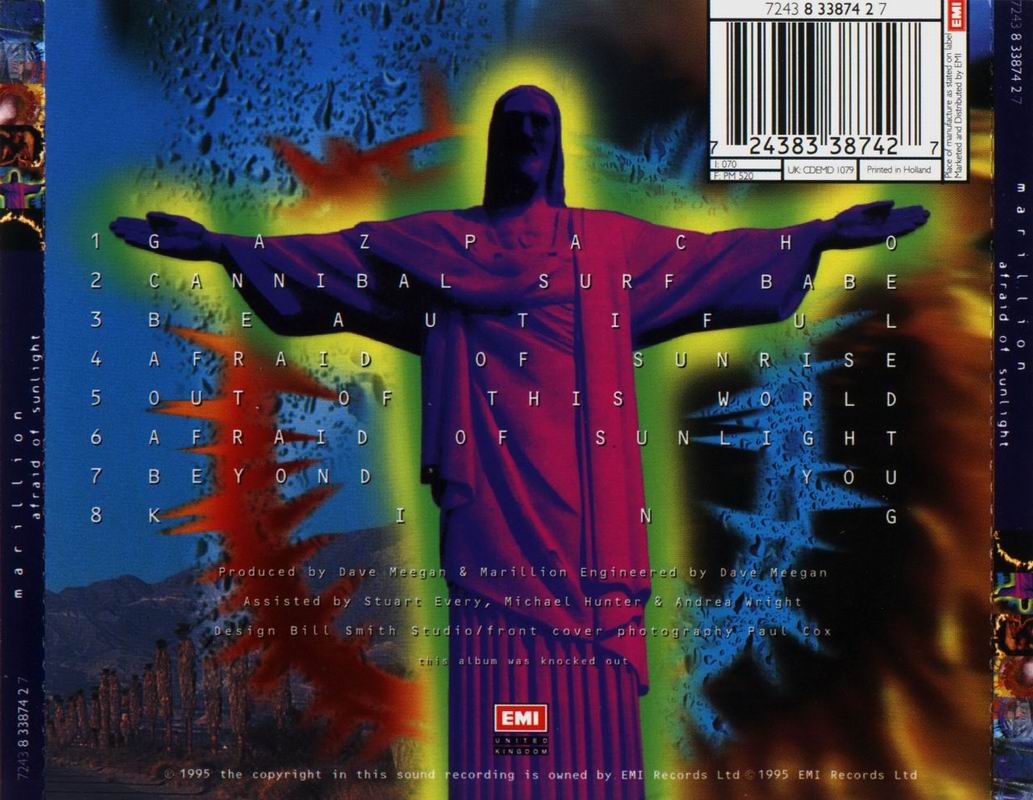
So, what does all of this have to do with progressive rock? One album and only one album sustained me during that horrific time, August 8, 2007-March 5, 2008, even as I slowly and sometimes not so slowly descended into despair: Marillion’s Afraid of Sunlight.
I don’t mean to suggest that I didn’t listen to other music. I most certainly did, and I enjoyed that other music. That was also a year of The Flower Kings, Kevin McCormick, Rush, Talk Talk, Riverside, Porcupine Tree, Pure Reason Revolution, and others. But, it was always Afraid of Sunlight that gave me the most strength, and it was to that album that I returned over and over again.
I had, naturally, come to Brave first (through my friend, Lee), and I loved every aspect of it. I had delved into the lyrics, the music, and the meaning of Brave. It was, perhaps, one of the finest puzzles I’ve ever unraveled. But, of course, it ends in suicide. I had spent so much time deconstructing Brave that I decided just to take Afraid of Sunlight for what it was. I had (and have) every note and every lyric memorized. But, I never analyzed the album. It was only recently—perhaps in the last several months—that I finally looked into its meaning, finding out that the album dealt with celebrity and the death of celebrity: O.J. Simpson; Michael Jackson; and Brian Wilson.
I’m very glad I didn’t know any of this in 2007 and 2008. Then, it was quite simply an album of immense hope—hope in beauty, hope in truth, and hope in goodness. Hope. An overabundance of hope.
Steve’s guitar, Pete’s bass (the bass ties the entire album together), Mark’s keyboards, Ian’s drums—all so gorgeous, so intense, so meaningful. And, then, Hogarth’s voice. What can one say that would ever do justice to such a voice? It’s a voice of hope, a voice of truth, a voice of beauty, and a voice of conviction.
I hope the band will forgive me for reposting these lyrics without permission.
Drive the road to your surrender /Time comes around… out of my hands /Small boats on the beach at the dead of night /Come and go before first light/ Leave me running in the wheel /King of the world How do you feel? What is there to feel? So how do we now come to be /Afraid of sunlight? Tell me girl why you and me /Scared of sunlight? Been in pain for so long/ I can’t even say what hurts anymore /I will leave you alone/ I will deny/ I will leave you to bleed/ I will leave you with your life/ So how do we now come to be/ Afraid of sunlight? Tell me girl why are you and me/ Scared of sunlight? All your spirit rack abuses/ Come to haunt you back by day /All your byzantine excuses Given time, given you away /Don’t be surprised when daylight comes /To find that memory prick your thumbs /You’ll tell them where to run to hide /I’m already dead/ It’s a matter of time/ So how do we now come to be/ Afraid of sunlight/ How do we now come to be /Afraid of sunlight/ So how do we now come to be/ Afraid of sunlight How do we now come to be /Afraid of sunlight/ Dayglo jesus on the dash/ Chalk marks on the road ahead /Friendly fire in hostile waters /Keep the faith/ Don’t lose your head /So how do we now come to be? ….
Such words could not, of course, bring back my Cecilia Rose. But, they did save my life.
For: Dedra and Steve.




 Progarchy