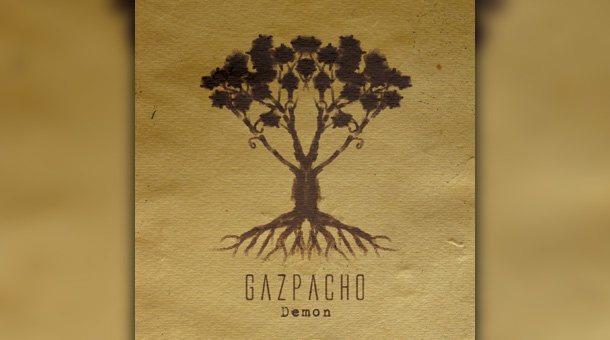
Norse Macabre: Gazpacho’s DEMON

gazpacho_demon_2014[A review of Gazpacho, DEMON (Kscope, 2014—digibook edition).  Lyrics by Thomas Andersen and Jan-Henrik Ohme.   Please forgive any typos.  I composed this on my iPad in an airport waiting area.]

Everyone’s favorite artists from Norway have released an eighth studio album, two years in the making. And, not shockingly, it’s brilliant, stunning, and ingenious. If NIGHT is the Poetic Edda of modern progressive rock, DEMON is the Prose Edda.

Our own progarchist editor, Craig Breaden, has already offered his always excellent thoughts on the album, but I can’t let a Gazpacho release go by without also discussing it. So, please consider this review a supplement to Craig’s, certainly not a replacement.

As with every Gazpacho release, on DEMON, Jan-Henrik Ohme’s vocals are immaculate, and Thomas Andersen’s and Ohme’s lyrics reach toward the highest of the high, the most beautiful of the most beautiful.

As with all of seven of their previous albums, on DEMON, the notes linger in a Mark Hollis fashion, melodies emerge through punctuated walls of sound, Ohme’s vocals soar in an introspective aural empire, every instrument is played with loving perfection and always contributes as a sonic res publica. One can find guitar, base, drums, and keyboards here. But, strings, accordions, umpa brass, and Eastern European folks instruments abound as well. Old phonographs spurt statically operatic voices, dinner party crowds murmur, wind howls, and the natural elements create a wash of color in the background, all adding to a perfectly late nineteenth-century and early twentieth-century haunting. Though frightening, DEMON’s story reflects an eerie Ray Bradbury horror rather than an H.P. Lovecraftian terrifying one.

It would be hard to find a band in 2014 more suited to long epics than Gazpacho. Really, the band’s only serious rival would be Ayreon. Here, I exclude bands such as Big Big Train, The Tangent, and Glass Hammer, as they rather happily create both concept albums and non-concept albums. Ever since NIGHT, though, Gazpacho has created concept after concept: NIGHT (a dream); TICK TOCK (a journey and escape): MISSA ANTROPOS (a pagan Mass); and MARCH OF GHOSTS (a series of short stories). The last especially offers a thematic prologue to DEMON.

While Ayreon reflects a deep knowledge and a loving embrace of science fiction and is close to infinity in its longing expansiveness, Gazpacho creates a fantastic and fabulist aura of quiet darkness and asks us to reflect on ourselves and our ancestors (our ghosts).

In a previous post here at progarchy, I noted that Gazpacho produces what might be called Eddic prog. DEMON only confirms that. Edda is a word that has no definite origins. It’s seemingly neither of Germanic or Latin origin, yet it appears as a vital word in Medieval Scandinavia. In our modern times, we attach it to the work of Snorri Snurlson. Not quite a Saga (also a perfected art form in Scandinavia), an Edda seems, by best definition, to be an “utterance of the soul.” Really, nothing could better describe the lyrics, the vocals, and the music of Gazpacho.

While I have no intimate knowledge of the band (though J-H Ohme is quite gracious on Facebook in answering my pesky questions and putting up with my innumerable tags of him), I suspect that DEMON is meant to be a second or third chapter in a long line of stories dealing with the supernatural. It began either with MISSA ANTROPOS (the calling of the Muses into this world) or with MARCH OF GHOSTS. The latter, though, seems more of a follow-up rather than a beginning. MISSA ANTROPOS certainly has the makings of a prologue or opening chapter to a long novel. If I could offer Gazpacho one piece of advice, it would be this: make the next album about Scandinavia. Images of Sigurd (baptized St. Michael after Christian evangelists appeared), the gods and heroes of the Seeress’s prophecy of Ragnorak, and the modern works of Sigrid Unset would all serve to continue this story so imaginatively begun by Gazpacho.. Imagine the use of traditional Scandinavia folk music (which bled readily from the pagan into the Christian/Lutheran), melodies, and instruments; and the imagery of Nordic prowess, AllThings, rune stones, and the Stave churches. My wannabe Viking heart swells just thinking about the possibilities.

Many reviewers have compared Gazpacho’s music to Radiohead or Sigur Ros, but I don’t hear that. If anything, Gazpacho offers a much more energetic vision first expressed by Mark Hollis and Tim Friese-Greene in 1988’s SPIRIT OF EDEN and 1991’s LAUGHING STOCK. Yet, these comparisons are inadequate. Gazpacho, as with all great bands and artists, is at once backward looking, inward looking, and forward looking. Rarely, however, do artists display the kind of confidence that this band so joyously does. Gazpacho is its own band and never a mimicry of another band. They may very well build on the music of Hollis and Friese-Greene, but they have taken it in directions that Talk Talk never could or would.

No, Gazpacho is its own. Its own beauty, its own excellence, and its own genius. Long may they pursue goodness, truth, and beauty, even while examining the horrors of the macabre.

Mike Kershaw’s new album, ICE AGE, arriving soon

Mike Kershaw released the artwork for his forthcoming album, ICE AGE, today.  It looks incredible.

ice age kershaw

To pre-order, go to Kershaw’s band camp page: http://mikekershaw.bandcamp.com

New Reasoning Announced

Oh boy, what a great day for prog–news from Cosmograf, Anathema, Mike Kershaw, and, now, The Reasoning.  The Cohens and Co. are pretty freaking amazing.

new reasoning album

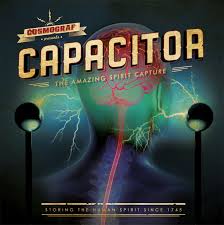
Cosmograf, CAPACITOR: Preorder Tomorrow, April 11.

Stunning album cover.  A progged-out version of Dolby's GOLDEN AGE OF WIRELESS.  Brilliant.
Stunning album cover. A progged-out version of Dolby’s GOLDEN AGE OF WIRELESS. Brilliant.

Master of all things Chronometric and Progometric, Robin Armstrong, has just announced that the new Cosmograf CD, CAPACITOR, will be available for pre-order tomorrow, Friday, April 11.

Progarchy’s advice: pre-order early and often.

Pre-order will be available through the Cosmograf website: http://www.cosmograf.com

To see the album trailer, watch below.

Cosmograf Trailer, “Capacitor”

Using Available Light: The Skaldic Musings of Greg Spawton  

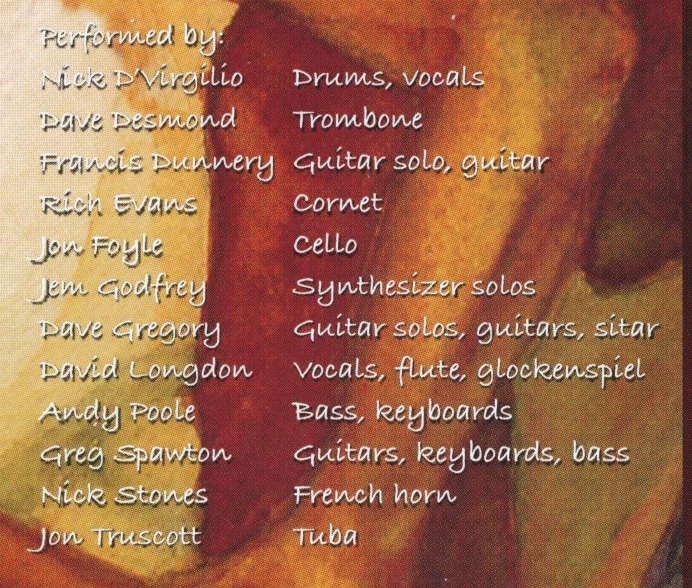
The cast.
The cast.

A review of “The Underfall Yard” from The Underfall Yard by Big Big Train (English Electric, 2009).  Song and words by Greg Spawton.  Additionally: David Longdon, vocals and vocal arrangements; Dave Gregory, guitars; Nick D’Virgilio, drums; Andy Poole, bass and keyboards; and [see image on right for a full list]

*****

As much I love albums, I’m always looking for that perfect song. The song that longs to linger in our souls after we’ve heard its last notes. The song that cries to the heavens in triumph, praise, and rage. The song that hovers over that second away from eternity, rooted in the human condition, but reaching for timelessness.

In my first two pieces of this series, I looked at Rush’s “Natural Science” (1980) and The Tangent’s “Where Are They Now” (2009)? In this article, I turn to none other than a well-recognized masterpiece, a (perhaps, THE) cornerstone of third-wave prog, “The Underfall Yard” (2009) by Big Big Train. It originally appeared at the final track of Big Big Train’s 2009 album of the same name, the first to feature the vocals of the incomparable David Longdon.

Six seconds short of twenty-three minutes in length, “The Underfall Yard” is epic in every sense of the meaning of the word. I once gave it to a non-prog friend of mine as an introduction to the genre. He liked it (really, who couldn’t?), but he also joked, “Brad, when I started the song, I didn’t realize I’d have to miss dinner to finish it.”

The lyrics of the song reveal its scope best:

Using available light

He could still see far skies,

Deep time

Beyond, above, and yet below the far skies rests (not contentedly) deep time. Indeed, given the song, one must imagine deep time as equal parts restless but also confident in its restlessness, sure of itself even in its transitions.

Always a superb lyricist, Spawton reveals his most intimate and poetic sense in this song overall. The words are at once hopeful and melancholic, the piece as a whole trapped in a slowly shifting twilight. The loss is of England’s entrepreneurial and industrial moments of the interwar era, the parents Edwardian, but the children Georgian.

As one stands with Spawton, watching this scene fade in golden and royal hues, he might just as readily be standing with King Alfred hopeful against heathen men as hairy as sin; with Harold of Hastings, tilting against a bastard’s armies; or with Winston Churchill, toiling and sweating against those would rend idyllic places such Coventry with insidious and inhumane progress.

Spawton’s words endlessly capture that which is always true but never quite obvious to all at all times.

The opening moments of the song move from an earnest guitar into a driving and equally earnest interplay of bass and drums, Gregory, D’Virgilio, Poole, and Spawton weaving something both tribal and civilized. More guitars appear, jutting and jetting. Strings emerge as if from the land itself. At 1:45, David Longdon’s voice enters into the art itself with the necessary pitch, the perfect lilt and quaver, and a resonant meaning. If Spawton is coming from sacred soil, Longdon is coming from the heavens, thus allowing the horizon and sky to meet in an infinite moment.

Almost uniquely among singers, Longdon possesses both assuredness and humility in all of his vocal arrangements, but none more so than in this song. While his voice is the voice of a man, it also is the voice of a chorus of men, a plea for generations.

Chasing a dream of the west

Made with iron and stone

Man, in Spawton’s vision, if armed with genius and integrity, reshapes the land, not in man’s image, but in the sacramental, Adamic way had things in Eden not soured.

These are old hills that stand in the way

breaking the line.

It came out of the storm,

out of the sea

to the permanent way

Using just available light,

he could still see far.

Even in his broken state, some men–seers, prophets, bards, skalds, poets and prog rockers–can see beyond the immediate, toward that which is far and that which is deep. Of all creatures, they alone can imagine the heights and the depths of existence.

In Spawton’s vision, England becomes not just another place on this earth, but a place sacred, sacred because man has recreated nature, not through domination, but through creative understanding, the soul and the intellect of each in harmony, not tension.

One is reminded of Spawton’s counterpart in the world of poetry, T.S. Eliot.

A people without history
Is not redeemed from time, for history is a pattern
Of timeless moments. So, while the light fails
On a winter’s afternoon, in a secluded chapel
History is now and England.

–T.S. Eliot, Little Gidding

IMG_0001 - Version 3Even the timeless moment, though, can not be seen or understood forever. Timeless moments—the light falling on a secluded chapel—lasts only as long as man knows to look for it. As with all things of beauty, truth, and goodness, it is fleeing, at least through our abilities to perceive, incorporate, and understand.

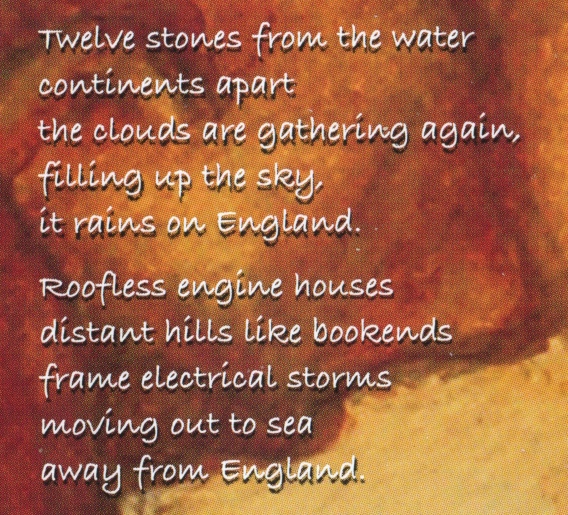
Roofless engine houses

distant hills like bookends

frame electrical storms

moving out to sea

away from England.

Spawton’s words and Longdon’s voice combine to make the above lyrics not only the most moving parts of the song, but combine to make one of the most moving parts of any song in the rock era.

I could never even count how many times I’ve listened to this song over the last five years. Every time, my stomach drops and my heart and soul swell when I hear this. Every single time.

And, yet, despite the loss of the thing itself, the moment in all of the revelation of its glory, Spawton knows—with the greatest thinkers of the western tradition—that memory can comfort us. Perhaps memory alone.

Parting the land

with the mark of man,

the permanent way,

Using just available light,

he could still see far.

The imprint is true. It always exists. We, however, must choose to remember. When we do, the world becomes just a little brighter. Using just available light.

And, thus, Big Big Train reveals its ultimate contribution to the world of art. Somethings are worth remembering, whatever the cost, and memory itself is a precious and delicate thing beyond any cost.

Far skies, deep time.

IMG_0001

Kscope Rocks

A huge thanks to Johnny and Sarah of Kscope for being so gracious in reaching out to and dealing with progarchy.com.  Faith in the prog world very much restored.

–Brad, ed.kscope

Credit Where Credit is Due: Kscope Graciously Responds

kscopeSo, after my longish and personal but open letter to Kscope yesterday, I received a very nice email from Snapper/Kscope.  Credit where credit is due.

Thank you, Kscope.  Not to be too dramatic (or soap operaish), but I’m really pleased to receive a response.  Especially since I didn’t expect one.

Yours, Brad

P.S.  I removed the original post.

John Bassett’s Video of “Comedian”

Brilliant and creepy.  Creepily brilliant.  Brilliantly creepy.  Enjoy.

Annual Charity: $20,000 So Far to Drink Wine with Geddy and Alex

rvkeeper's avatarrush vault

Grapes Geddy and Alex are once again inviting people to bid on a charity package  to benefit Grapes for Humanity, a charity that funds humanitarian causes around the world. Geddy is on the organization’s Board of Directors and each year he and Alex host an auction called Grapes Under Pressure. The winning bidder this year joins the two of them for breakfast and lunch, tasting wine at a winery near Toronto, and riding a train with them around the Niagara wine region learning about grapes and wine. grapes

From Charity Buzz:

“You and a guest will travel with Lee and Lifeson on a private train to the Niagara winery region outside of Toronto. Your day will include breakfast, picking and learning about grapes, a wine tasting, lunch on the vineyard and a 2-night stay at a Royal York Hotel in Toronto. This package is perfect for wine lovers and fans of RUSH!”

The…

View original post 48 more words

Gazpacho – Raising Demons

ImageThis bombing went on for five years. The Supreme Court never passed any judgment on it and the military speaks with pride today that five years of the bombing of Cambodia killed 16,000 of the so-called enemy. That’s 25% killed, and there’s a military ruling that says you cannot kill more than 10% of the enemy without causing irreversible, psychological damage. So, five years of bombing, a diet of bark, bugs, lizards and leaves up in the Cambodian jungles, an education in Paris environs in a strict Maoist doctrine with a touch of Rousseau, and other things that we will probably never know about in our lifetime — including, perhaps, an invisible cloud of evil that circles the Earth and lands at random in places like Iran, Beirut, Germany, Cambodia, America — set the Khymer Rouge out to carry out the worst auto-homeo genocide in modern history. Spalding Gray, Swimming to Cambodia, 1987

These papers were supposedly some sort of manuscript or document or diary.  According to the story, he had been tracking a demon throughout history.  If the manuscript exists or not I have no idea.  That’s not the point.  It got me thinking, what would this manuscript look like, what if the story was true? What happened to the guy? It was supposed to be us trying make an album of what we thought that manuscript would look like and at the same time use that opportunity to look at evil. Thomas Alexander Andersen, Gazpacho, 2014

One of the albums that is so good that after the initial listens it has to wait for me to have time and peace of mind to give it a proper listen. Michał Pawłowski, guitarist/vocalist of newspaperflyhunting, on Gazpacho’s Demon, 2014.

Gazpacho’s Demon lives in shadowy place, vector-connected to other works in my head, where history seems to open up and then close back down, leaving the created work seemingly alone amidst a sea of ordinariness.  Set against the elegantly melodic, mid-tempo electric arrangements typical of Gazpacho’s other works, particularly Night and Tick Tock, and the elongated notes of Jan Henrik Ohme’s vocal, Demon is Gazpacho’s most effective demonstration yet of their approach to a music that is less concerned with genre and more interested in expression of thought.  Mikael Kromer’s accordion and violin interplay lend an earthy, acoustic grounding to the mix, while the rhythm section of Kristian Torp and Lars Erik Asp continue Gazpacho’s penchant for the deep groove, revealing a jazz past more commonly prized by generations of musicians growing up in Europe than in the States.  Combine these with the power brought by the electric core of the band, Thomas Alexander Andersen’s keyboards and Jon Arne Vilbo’s restrained, powerful guitar, and the heady result is a drama of sound, the actual sonic imprint furthering the narrative as voiced by Ohme.

Demon is nominally about the memory of a journal left by a man pursuing a demon across geographies and chronologies. This creates an interesting triple remove for the songwriters, as the story is less about the man or demon than the idea of the journal.  The brilliancy of Gazpacho taking this tack is hard to overstate.  The purity of a demon, a universal among religious or moral systems, balanced against the uncertainty principle that is humanity…and the messiness of a human chasing his devil as filtered through a diary (of a seer or a madman?).  What would such writing look like? How would I perceive it and where would I locate the demon, in the memory, the journal, the man, or the malignant spirit itself? How would I express it to someone else without becoming a demon chaser or a hellhounded man? I think what is so immediate about this record and the way Gazpacho engages its subject is that the story is entirely impressionistic, the images suggestive of the mirrors within the non-narrative.  I comprehend what’s going on in this album lyrically as a next-century response (or sequel) to the Stones’ Sympathy for the Devil.  Yet I would venture that our evils feel perhaps more deeply woven than they did five decades ago, our inability to find our demons and our continued need for the chase leading inexorably back to ourselves.

The tendency to dark drama in European metal is present, but in the place of a gray/black is a kind of constant waning light, a colored gloaming.  I’m consistently astounded by the ability of Scandinavian musicians to conjure qualities of light in the sounds they create, and Gazpacho’s talent for this on Demon is peerless.  As the lengthy I’ve Been Walking begins unfolding, with its crushing guitar matching the lyrical denial of our various versions of paradise, we see internal arguments on faith and evil’s meaning within it.  The Wizard of Altai Mountains follows, a radio-friendly reflection on following someone/something wearing “red pants and the ghost of a grin,” having to follow, despite a bone weariness and a sense of revulsion.  The accordion-driven outro to the song, given as much space as the lyric, reinforces the feeling that Wizard could easily be a Tom Waits tarantella, but where Waits would bring irony Gazpacho goes for something else entirely, a folksong sincerity that we’ve all but lost in modern music, except in progressive rock, which is one of that genre’s key strengths.  I’ve Been Walking then continues, embedding even more deeply folksong, like treasure in the buried, scratchy 78 verse:

“Have you news of my boy Jack?”

Not this tide.

“When do you think that he’ll come back?”

Not this tide.

“Has any one had word of him?”

Not this tide.

“When do you think that he’ll come back?”

Not this tide.

…and in its second section, with a guitar intro suggestive of Alex Lifeson’s intro riff on Rush’s Xanadu, the song contains one of the most richly gorgeous vocal melodies I’ve heard, delivering words like disconnected pieces of a puzzle.  Much is made of Ohme’s similarities with Radiohead’s Thom Yorke, but Ohme’s voice is more a bowed instrument, sustaining notes and finding variations in them as they decay.  The sympathy between Ohme’s approach and the band’s is quite remarkable, and the album’s conclusion, Death Room (on the CD there is a “bonus track,” Cage, that isn’t on the LP), is where the risky length, over 18 minutes, pays off precisely because the band knows how to arrange its material with such great dynamic effect, including the most tasteful use of a gospel choir out of context I can remember.

This is a great record from a great band who remains at a summit of creativity, and leaves them to grapple with a demon of their own: what next?

Note:  A beautiful and thematically rich record deserves the kind of packaging Kscope has given to Demon.  For the CD version, its yellowing journal look, courier typeface, and booklet of lyrics does justice to the music.  I cannot comment on the LP.  I was going to pony up for it, but the bonus track Cage was not included, and unfortunately at this writing Kscope doesn’t clarify if LP buyers will receive the MP3 for free if they aren’t buying through Burning Shed, their distributor.