New Music Video from Days Between Stations

Here’s the official video for their wonderful song, “The Man Who Died Two Times”, featuring the irrepressible Colin Moulding (of XTC fame). It’s from their outstanding 2013 album, In Extremis. You have to love a band that don’t take themselves too seriously!


The Beginning of a Beautiful Friendship – Rush’s “Tom Sawyer” and “Moving Pictures”

mp

I don’t know how many people can actually point to a single moment that changed their lives forever and for the better.  Yes, many would point to traditional milestones such as a graduation, wedding day, the birth of their children, etc. All valid events and experiences, to be sure.

I’m talking about something different. Something that might be best termed, to quote Robert Fripp, a “point of seeing.” A singular experience that truly alters your life’s course, where you can look back on that point, that one moment in your life where “your earth” seemingly moved under you. Everything in your world, everything you know, the very lens in which you viewed the world forever changed because of that moment.

Many might cite a religious experience as fitting the bill described above. For me, it was a musical experience.

First, a little backstory…

As a pre-teen kid from around 1978 to 1980, my musical “sun” rose and set with KISS, a band I spent hours upon hours listening to, reading about and talking about. I drew their iconic logo on anything I could find, thumb-tacking any poster of them I could come across on my bedroom walls and ceiling, playing air guitar and drums to them, dressing up like one of them (Ace, circa “Dynasty”) for Halloween, and just staring at their album covers for hours on end. As a beginning drummer, I first picked up the basics of rhythmically separating both hands and feet playing along to “Strutter” while on a family vacation.

Despite this level of fandom, my level of music appreciation probably wasn’t too different from most kids growing up at that time. Having been born in the late 1960’s to parents who parents who kept a couple dozen albums  – “Meet the Beatles” and “Elvis: Aloha From Hawaii Via Satellite” among others – in the record bin of their furniture-sized record player/stereo (yet didn’t really use it), I cut my musical teeth on late-70’s pop, AOR and disco that came across AM radio. Artists such as Styx, Foreigner, The Bee Gees, Cheap Trick, AC/DC, and a couple others were among my first active musical experiences as opposed to passive ones.

That all changed In the spring of 1981 in a Northern California suburb, when a kid two doors down from me invited me over one afternoon following school to hear some music from a band called Rush. I knew nothing of Rush save for an entry in a late-70’s World Almanac that showed a number of their albums going gold or platinum. That was it.

I walked into my friend’s parents’ family room, sat cross-legged on an off-white, plush carpet floor as he took out an album, placed on the turntable and sat down near me.

The next 4 minutes and 33 seconds changed me forever.

rush-ts

It was “Tom Sawyer,” the leadoff track from Rush’s new album, “Moving Pictures.”

The blend of instruments, how every instrument fit perfectly into this new (to me) music, the spacey sound that triggers throughout and, of course, a level of drumming I hadn’t heard before. It was rock and roll, yes, but the sound that spilled out of the stereo speakers was on a level of which I had no prior knowledge.

Without knowing anything about Rush, without knowing anything about the genre of music I was experiencing for the first time, I was hooked on this music.

I hadn’t even begun to decipher what was sung, but no matter; to paraphrase another quote of Fripp’s, “…music leaned over and took me into its confidence. I honestly can’t remember if my neighbor played it again after the first listen or not; for all I know, I probably went home in a daze.

Whenever I “came to,” I’m certain my first order of business was to ask my parents for some money so I could go to my small town’s record shop and see if they had “Tom Sawyer.” Despite it not quite being a Top 40 single in the U.S., it had been released as a single and the store had a copy in stock.

So, for the next month or so, I proceeded to listen to my “Tom Sawyer” 7-inch single over and over (not so much the B-side, “Witch Hunt,” at the time), never tiring of it and surely wearing out my family who heard the same song from my bedroom every weeknight and weekend.

Later, with school out and with some half-decent grades, I was rewarded with the opportunity to buy a couple albums and “Moving Pictures” was, of course, the only album I really cared about owning. The rest of my summer was mostly spent holed up in my bedroom, playing one side of “Moving Pictures” and then the other, over and over, every day.

With what was possibly my first album lyric sheet, I first memorized the lyrics to the six songs with vocals and later began to draw mental pictures of what Neil Peart wrote (with Pye Dubois’ help on “Tom Sawyer”) and what Geddy Lee sang, most of those pictures still vivid all these years later, available simply by playing any of the songs on the album…the “repeatable experience” that Peart has commented on.

I’ve never been able to recreate that first-listen experience, no matter how many hundreds times I played it again that year and the (likely) thousands of times I’ve heard it in the last 33 years. It was almost like the Nexus in “Star Trek Generations,” where Guinan explained to Captain Picard that being in the Nexus was like “being inside joy,” prompting one to do ANYTHING to get back to that place.

“Tom Sawyer” gave me my first exposure to a philosophy put to music:

“No his mind is not for rent…to any god or government.” 

What a WAY of thinking for an impressionable teen! Only years of maturity keeps me from determinedly thrusting my fist into the air any time I hear that line sung.

“Red Barchetta” was the first telling of a short story put to music I had heard, “YYZ” was my first rock instrumental (rock bands PLAY instrumentals?) and “Limelight” seemed like the perfect side closer. Really, is there a better album side (of songs) in progressive rock? In all of rock?

“The Camera Eye” was the first epic I ever heard; the intro to it remains one of my all-time favorite intros. “Witch Hunt” initially served as a perfect soundtrack to drawing up AD&D adventures in my bedroom – yes, I was THAT kind of kid – and much later I came to really appreciate Alex Lifeson’s riffs on that track. Finally, while reggae was an unknown genre to me, I came to like “Vital Signs” as something different, more “digital” in the sequencers, shimmering chords and tight snare in the track – and boy, would we be treated to something different on their next album!

The front and back covers of “Moving Pictures” are legendary images to me, as are the sleeve notes, lyrics (down to the fonts) and the images of the band playing their instruments; until that point, the only pictures of them I saw were the ones from the “Tom Sawyer” single and I didn’t who played what!

Aside from being exposed to a couple Rush classics such as “Fly By Night” and “Working Man” – both doing almost nothing for me as they lacked the modern sounds and playing of “Moving Pictures,” my next Rush album was “Exit..Stage Left,” then I moved backwards to take in – in order – “2112,” “Permanent Waves,” “Hemispheres” and “A Farewell To Kings,” all before “Signals” came out in the fall of 1982.

“Moving Pictures” turned out to be the first of four albums that would define and dominate the soundtrack of my life: 1982 brought me “Asia,” in 1983, Yes’ “90125” was released and soon after I got my first listen to their previous masterwork, ‘Drama.” While these albums might not carry the same level of adoration for many that numerous progressive rock albums of the ’60’s and ’70’s do, they set me on a musical journey that continues today, pointing me towards a genre of music where MUSIC is valued above all else.

IMG_6080

However, I can trace my love of music in general – which, to me, is like breathing – as well as anything I do musically, back to those 4 minutes and 33 seconds on a spring day in 1981, when I experienced “Tom Sawyer” for the first time…

…because you never forget your first time.

IQ’s “The Road Of Bones” Is Astounding

If you haven’t already bought IQ’s recently-released “The Road Of Bones” here’s a public service announcement:

MAKE SURE YOU GET THE BONUS DISC TOO!

CD1 is absolutely stonking (that’s British for ‘good’,) and while most ‘bonus’ discs are rarely a bonus (instead usually filled with oddities and detritus) IQ has actually released something that’s absolutely the opposite.

I consider the The Road Of Bones bonus disc (bones disc? – hur hur!) to be absolutely essential listening. It’s difficult for me to understand why this wasn’t released as a double album – there’s so much top-notch material on these 2 CDs!

For GBP4 on top of the single CD (which is selling at GBP10) you get the bonus disc too. You won’t regret it!

Get it here.

“Executive Summary”

Listen to them, the children of the night. What music they make!

Indeed, what music they make!

The highest accolade I can grant music I adore is to lovingly transfer it to my car’s MP3 player and then purposely drive to work during the height of rush hour, thereby being left alone with it for extended periods of time at a blistering number of decibels.

And that’s precisely how my Thursday morning went.

IQ has gone back in time, finely minced up all of its previous material, strained out all the dull bits, distilled the concoction, added many tricks and traps, clicked the heavy button, and produced a breathtaking piece of work.

So does the above suggest there’s nothing new to listen to here? Well, a lot of it will be familiar territory for IQ fans…but that’s why we’re fans…right? And there’s still plenty of new stuff going on, and new approaches to old stuff, and old approaches to new stuff and…oh I’m sure you get the point!

To (mis)use a food analogy, this is IQ steak tartare. All flavour, no filler, and no buggering about with stoves.

For you vegetarians there’s no analogy that could possibly apply so I’ll just move on.

Themes

In line with most of IQ’s material, things are pretty downbeat thematically. The title is the first clue that this isn’t children’s party music (unless you really don’t like children, in which case it could be kind of fun to play it at volume 11 outside a kindergarten.) The Road of Bones is the Russian Kolyma Highway, built by political prisoners exiled by the Stalin regime between the 1930s and 1950s. Nice chap. Thousands died during its construction – not exactly bright and breezy subject matter. Slavery, mental illness, relationship breakdowns and violence all make an appearance in various guises, producing some dark moments that make this release all the more effective, moving and somewhat disturbing. The album artwork sets the scene for what’s to come.

Sounds

First, the rhythm section is absolutely on fire! Tim Esau’s bass work is superb – punchy, intricate and up front in the mix – just the way I like it! There’s also a ton of bass pedals, which gives proceedings an immense kick in the low frequencies…so to speak.

Paul Cook’s drum work provides a solid backbone on every track, with fewer intricate and noodly distracting flourishes than on previous albums. This is a good thing.

This album has been variously described by some of the Big Big Train Facebook group stalwarts as ‘synth-heavy’ and I’d have to agree. Neil Durant has done a great job on keyboards. There’s some powerful stuff here, with bass, synths and guitar producing walls of sound that are simply irresistible.

Michael Holmes is in great form as usual, although there aren’t as many standout solos from him as I’d like. But he’s ever present alongside Tim’s bass doing the heavy stuff, and he gets a chance to let loose on plenty of occasions with some soaring work. I always enjoy his playing, and he has certainly added plenty to the atmosphere of this album.

Peter Nicholls’ voice is like my loudspeakers – great when driven hard. On previous albums I’ve not been so keen on his quieter vocals but at higher energy levels there’s a howling edge in his voice that always brings chills. Thankfully the vocal energy across the album is high and he hits the mark (and my spine) many, many times, and even in the quieter moments he still sounds damned good.

The album was recorded and engineered at Rob Aubrey’s Aubitt studios in Southampton, and Rob’s engineering wizardry is once again very evident, bringing a nicely-expansive sound that, to my poor tinnitus-damaged ears, makes the most of the band’s extensive talents. I’m a sucker for bass, and it’s positioned right up front – what’s not to love!

Much of the album is very percussive – there’s always punch in various forms (all good) and even the quieter material has a real presence to it. Expect to uncontrollably tap your foot in the ‘Restless Leg Syndrome’ manner that only a true prog fan can muster.

Time signatures are (as is mandatory for IQ) extremely variable throughout. This makes the punchiness even more fun and appealing, and I defy you to resist headbanging at the heavier moments – but only when nobody’s watching, of course.

So here goes – a brief review, including the bonus disc, that you can still buy here in case you forgot.

Tracks – CD1

From The Outside In

Opening with suitably-spooky atmospheric synths and a special guest appearance by Bela Lugosi (isn’t he sounding well?) things soon get going with some solid pumping basslines backed by synth flourishes and Peter’s voice cutting through it all. There’s more atmospherics to come, before a return to the pumping rhythms. A great opening track. But wait, there’s more…

The Road Of Bones

A slow-burner this one, opening again with synths and piano. This is a particularly haunting track, and Peter’s lyrics and vocals are astounding. “For now the need is met, I almost hate myself. Almost. But not quite.” And cue the slow, understated bass-driven buildup to an eventual and very welcome musical kick in the face.

You’ll find this track on IQ’s website.

Without Walls

I was fooled by this track the first time I heard it. The first couple of minutes I found pretty uninspiring, but during its nineteen minutes it morphs several times through much more interesting territory, and ends up going all over the place quite brilliantly. This is actually quite common right across the album, which is what makes it so appealing. There’s always something unexpected around the corner.

Ocean

One of the less-energetic tracks on the album, there’s power, warmth and intricacy that carries it along quite nicely to a satisfying conclusion.

Until The End

Another stunner, starting slow with plenty of atmospherics, eventually getting going with synths taking centre stage, giving way to Peter’s vocals with some great bass work around the 7 minute mark and a storming performance by all personnel, coming to a very poignant piano and acoustic guitar-led conclusion.

Tracks – Bonus Disc

And on to the bonus disc. You need to own this! Did I mention you can get the 2 CD release here? I’m sure I did…

Knucklehead

This is the first of many excellent reasons why you should get the package including the bonus disc. A brooding combination of drums, bass and synth open, cutting to acoustic guitar and Peter’s voice. And then all hell breaks loose. Play it loud, people!

Hateful, vengeful numbskull.

1312 Overture

This one starts off with some very triumphant and very nicely sampled orchestra and choir, and then immediately dives into the sort of complex IQ rhythms that we know and love – it always puts a big smile on my face. I defy you not to play air drums! This track’s an instrumental, and while I usually prefer my songs to come with a big dollop of lyrical goodness, this one just keeps me wanting more.

Constellations

Electronic rhythms open this one, making it sound rather intriguing right from the first bar. There’s a feeling of frantic energy, which eventually moves into something less so, but once again eventually more epic territory via a brief-yet-urgent (and great fun!) mid section.

Fall And Rise

Fall and Rise is the only song that doesn’t sound immediately to me like IQ, and while I love their signature sound, there’s no harm in moving in a different direction. So after all that punchy heaviness of previous tracks, this one features fretless bass, acoustic guitar, gentle synths (and is that a banjo?) and a much smoother, yet no-less fun ride. Think Japan and you’re not a million miles away.

Ten Million Demons

When I first heard this opening I was reminded of….well every song Muse has ever recorded. I considered that a black mark, but thankfully things very quickly turn a corner and transcend the aforementioned unmentionables, becoming another really solid tune with a great, chugging bassline, once again full of atmosphere and surely ending with a delightful nod to T Rex? (Actually it’s Chicory Tip! Thanks to Stephen Pieper for the correction!)

Hardcore

More punch for the final track, starting slightly weird and ethereal, but then grabbing you by the ears, with stabs of synth over a bouncing bassline, into a quiet passage and we’re into long instrumental territory. A nice, if somewhat subdued way to end the second disc.

Summary

I am a big fan of IQ’s past material, but the consistently high quality of every single track across 2 CDs makes this their strongest release to date.

Kudos, chaps!

A Challenge

Finally, a small challenge to you, Dear Reader. Given the second CD is a bonus disc, how would you re-sequence both CDs to create a classic double album?

Best answer gets my undying admiration.

Synergistic Perfection: First – and Lasting – Impressions of Moving Pictures

I. Blown Away

ImageIt was a beautiful spring day.

At least so it seemed. The calendar said it was still February, so officially we were still in winter. But Winter 1981 in Lexington, KY, was unseasonably warm.

On that fateful afternoon, I met up with my friend Greg Sims at the end of the school day. We hopped into his Chevy Monza (or, ‘The Monza-rati’ as we called it) and he drove me over to the K-Mart on New Circle Road. I went in, quickly located a copy of the new Rush album, Moving Pictures, made my purchase, and headed back out to the car. Greg gave me a ride home, and then took off, as he had to work while I had the night off from my job.

 I don’t remember the exact day it was when I made this purchase, but it likely was the same day the album was released. While that detail is fuzzy through the haze of thirty three years, I can say with confidence that I hadn’t heard so much as a single note of the record yet. At that time, listening to FM rock radio was a big part of my music consumption, and songs from Moving Pictures (especially Tom Sawyer) were in heavy rotation almost as soon as the album was released. Knowing that I had not heard any of the album before I listened to it on that fateful day tells me that it most likely was its release date.

 I opened the window in my bedroom to get in some of that nice spring-like air and then quickly removed the cellophane from the album cover. The vinyl record was removed from its sleeve, and put on the turntable. I set it in motion to start playing before quickly but comfortably implanting myself into an oversized beanbag chair I had in my room. As I pulled out the liner to look at the lyrics, I heard the needle make contact with vinyl, hearing the first few cracks and pops that were so common to music lovers of that era. And then …

 … the synthesizer intro to Tom Sawyer, the drums pacing things underneath. Oh my God.

 Right then and there I knew I was listening to a great album – Rush’s masterwork. To some, it might have seemed like I was jumping the gun. But there are some things you just know. And based on nothing more than the first few seconds of Tom Sawyer, I knew. Oh man. This is going to be a great album.

A modern day warrior

Mean, mean stride

Today’s Tom Sawyer

Mean, mean pride

Duh duh duh duh duuuuuuuuuuuuuuuuuuuunnnnnnnnnnnnhhhhhhhhhhhh

 (oh man, this is AWESOME!!)

Duh duh duh duh duuuuuuuuuuuuuuuuuuuunnnnnnnnnnnnhhhhhhhhhhhh

Duh duh duh duh DUUUUUUUUUUUUUNNNNNNNNHHHHHHHHH

I was soooooo hooked and I wasn’t even one minute into the first song. With every Alex Lifeson power chord, with every pluck of the Geddy Lee’s bass, every keyboard note, with every drum beat from Neil Peart, my conclusion of greatness was confirmed and reconfirmed.

 Today’s Tom Sawyer

He gets high on you

And the space he invades

He gets by on you

 And then came the synthesizer solo. There are no words that can describe my state of mind at this point. ‘Ecstatic’ … ‘thrilled’ … ‘mesmerized’ … all were inadequate. The rapture of a Rush fan.

Nevertheless, the rational part of my brain was still fully functioning. As I listened through the rest of Tom Sawyer, it was clear that Rush was in the process of making a quantum leap forward. This didn’t just sound like any other Rush album … it sounded like all the Rush albums. But I knew would have to distill that thought a bit to bring it into focus.

 Red Barchetta was up next. I loved it immediately. It was more guitar driven than the previous song, but still had a certain refinement not heard on some of their earlier guitar-heavy works. And it didn’t take long to recognize the lyrical themes of freedom vs. tyranny, the individual vs. the collective, and the free man vs. the state that I had first encountered on 2112 (discussed here). One of the things I had loved about Rush when I first heard them was all right here in one neat little package.

 Then came YYZ. Another instrumental, just as they had done on Hemispheres with La Villa Strangiato. However, this one was much more focused, much tighter. It certainly could not be called “an exercise in self-indulgence” as the band had referred to its previous instrumental. Full of great riffs and great playing, this one is still instantly recognizable all these years later, and still one of their live centerpieces.

 Side one drew to a close with Limelight, and again I knew I was listening to an instant classic. The music included some thick power chords from Lifeson’s guitar, not unlike some of their earliest works. Yet, it still seemed very fresh and new. The whole feel of this song was great. Something new and yet something familiar. The song ended and the needle returned to the resting position, but my state of euphoric shock continued.

 After flipping the vinyl record over and starting the turntable for side 2, I noticed that the first song, The Camera Eye, was a bit extended in length. Not a sidelong suite like 2112 or Hemispheres, but more comparable in length to the excellent Natural Science from their previous album, Permanent Waves.

 I kicked back again to the comfort of the beanbag and listened to the city noises that preceded some random synth buzzing before some proper keyboard lines made their appearance. Eventually, Lifeson joined the party, as the song moved forward with some heavy grace. A brief pause intervened, and then a more frantic keyboard line announced “here we go!” And just like that, Lee, Lifeson, and Peart were off to the races.

Duuuuuuuun dun dun DAAAAAN dun dun

Duuuuuuuun dun dun DAAAAAN dun dun

DAAAN dun dun

DAAAN dun dun

DAAAN dun dun

DAAAN dun dun

(Yeah, we are cruisin’ now, baby!!)

 It was as if we were being transported somewhere. We arrived when the instrumental section gave way to Geddy’s vocals. He delivered lyrical imagery of life in New York City from the point of a detached observer contemplating it all. I wasn’t sure what it all meant, but I loved it nonetheless.

 After that, the cycle repeated, and off we were transported to London for some images and observations of that city, and a contrast with New York.

 A more fantastic beginning to Side 2 would have been impossible. Five songs in, and my hastily drawn conclusion of the album’s greatness didn’t seem so hasty now. On the contrary, my initial gut feeling had been right on target.

 The mood of the music definitely took a shift with Witch Hunt. With this song, I followed the lyrics more closely than I had with any other. While I was never one to be particularly rebellious, I have long had a skepticism for authority and for others who “knew what was best” for me. Thus, when Geddy delivered the line “those who know what’s best for us must rise and save us from ourselves,” it hit home.

 I had some ideas of the particular intolerant a**holes to whom the lyrics referred at the time, but as I’ve learned over the years, the lyrics are broadly applicable to intolerance from all across the political spectrum.

 Six tracks up, six tracks down. Every damn one of them incredible. Only one left to go.

 Vital Signs made it seven for seven. A quirky synthesizer and guitar with a reggae beat? Who can pull that off? Well, Rush can. I laid back and enjoyed the music as the album I had dubbed a masterwork in its opening bar raced to its conclusion.

 The familiar cracks and pops returned for a few seconds before I heard the needle lift and the arm move to its resting spot. I sat there and contemplated what I had just experienced, and drew a few more conclusions.Image

 I knew this album was going to be huge. Every Rush fan and their grandmother was going to want a copy, and it would also bring in legions of new fans. While the hipster critics would hate it (but who cares about them, anyway?), the fans, both new and old, were going to love it. I knew Tom Sawyer would be their signature song. It was played at each of the four Rush concerts I witnessed subsequent to the release of Moving Pictures and appears on every video concert of Rush that I have watched. I knew that this would be the end of one era and the beginning of another for Rush. And I definitely knew that in my little bedroom on Marlboro Drive, on my modest stereo, this album was going to spend a lot of time on the turntable. Through the remainder of 1981, there was not another album that even came close.

 Rush albums generally take a few listens before they truly sink in with me. This is not necessarily a bad thing, and in fact, it’s something I like about Rush. Having the various layers revealed through multiple listens can be very rewarding it its own right. This album, on the other hand, did not. It strongly resonated with me right out of the gate. Just one listen, and I truly was blown away.


II. The Sum and The Whole

 Moving Pictures was many things. For one, it was an album that took the best of everything Rush had done before then, combined it, and distilled it into a whole that was greater than the sum of its parts. It was a culmination of their previous work in the same way that Close to the Edge was for Yes; it was the album that made the statement “we have arrived” the same way Dark Side of the Moon did for Pink Floyd.

 The music of the first few Rush albums were centered around heavy guitar. As the band honed their chops, they began writing extended pieces, first with The Fountain of Lamenth and then hitting big with 2112. In A Farewell to Kings and Hemispheres, the role of keyboards in Rush music changed from simply providing atmospheric background to a more prominent role in the melodic discourse, often times being a featured instrument for sections of songs. In the meantime, the band took a more experimental approach, both musically and lyrically. And on Permanent Waves, the band pared back some of the excesses of previous albums while tightening up their songwriting.
Image Moving Pictures takes something from all of the previous Rush albums and combines it into something new – and greater. Here, Rush took pieces from every one of their previous albums and put it together into something that sounded both fresh and familiar. On the outstanding documentary Beyond the Lighted Stage, Peart states “As I define it, that’s when be became us … I think Rush was born with Moving Pictures.” He further states “It represents so much that we learned up to that time about songwriting, about arrangement, that’s when we brought our band identity together.” Both statements – but especially the second – really hit home for me. Moving Pictures pulled it all together into one package that is both synergistic and perfect.

III. And Ending and a Beginning

 Given that Moving Pictures is a culmination of everything the band had produced up to that time, it represented (at least to me) an ending to the first phase of Rush music. But as much as it was an ending, it was also a beginning. Moving Pictures also served as a segue to and a launching pad for Rush’s output in the 1980’s. Particularly notable on Moving Pictures was the integration of the keyboards into the music. To be sure, most Rush albums prior to Moving Pictures had included at least some keyboards. However, keyboards seemed to be featured primarily when the other instruments stopped, most notably evident in keyboard solos that appears in songs such as Xanadu, Circumstances, and Jacob’s Ladder. This has been the source of a significant amount of controversy among Rush fans, with Moving Pictures being the dividing line. Nevertheless, anecdotally anyway, most Rush fans I have known like this album, irrespective of where they stand on their prior or subsequent work.

 For my money, Moving Pictures was the first in a sequence of four albums that marked a portion of Rush’s career that was creatively very fertile. Following with Signals, Grace Under Pressure, and Power Windows, the tighter integration of the keyboards that began with Moving Pictures continued even further, while the number of outside influences that made their way into the music continued to increased. This trend eventually played itself out in the late 1980’s and early 1990’s. Rush began to return to a more guitar-centric sound, with 1993’s Counterparts being most emblematic of that shift.   However, in the twelve years leading up to that album, the echoes of Moving Pictures could be heard in every intervening release.

 IV. Lasting Impact

 I’ve heard every album of original Rush music (I have not heard Feedback, their album of remakes … but I’ll get to it). None of them are bad, most of them are at least good, and a number of them are truly great. I’ve been astonished at their ability to produce so much good music over the course of their career. I’m even more astonished that they have been able to produce such excellent music so late in their career (Clockwork Angels, anybody?) at a time when other bands are typically doing nothing more than rehashing their glory days or producing sub-par output.

 Still, no Rush album has ever had an impact on me that is as lasting as Moving Pictures. If I had to choose only one Rush album to take to a desert island with me, this would be it and it wouldn’t even be a tough decision. Now as you can guess from what I’ve written above, that is not a criticism of any of their other albums. It’s just a simple recognition that not only did Moving Pictures have an immediate and powerful effect on me on that February day in 1981, it’s that the effect has never faded. Higher praise than that is simply not possible.


20 Looks at The Lamb, 7: Cages

My body is a cage that keeps me
From dancing with the one I love
(Arcade Fire)

lamb-picto-2 (cage)Descartes, widely touted as the father of modern philosophy, taught us to think that what we are most certain about, what we grasp most confidently and most tightly, is “in here.”  I know that I exist if I am thinking, he said, and this implies that I am a thinking thing regardless of what is “out there.”  It’s a picture that has been rejected by most recent philosophers, but it still casts its long shadow over Western culture.  It’s the picture that makes both The Matrix and Inception compelling.  I am my mind, and my mind is an inside that knows no outside, what Leibniz called a “monad.”  Even if I have a body, the body is outside, like a cage that imprisons me, from which I might hope to be set free in an afterlife.

Whatever life (in any strong sense) that I have, I have “in here.”  “I’ve got sunshine in my stomach. But I can’t keep me from creeping sleep.”  And worst of all, I might be truly alone.  Others are outside too.   Outside the cage, Rael sees his brother John (a name meaning “graced by God”).  It’s a cage not only because I am kept in, but also because others are seemingly kept out.

If my body is the cage, then it is so, so tempting to think that the “windscreen wiper,” the dick that the doc docks, might be some sort of key, but when it disappears into the ravine, isn’t it still radically unclear whether anything is really unlocked?

Bruce Cockburn reminds us that a cage is something that an animal might pace, that we catch ourselves “pacing the cage.”  And the cage in that context implies darkness, too:

Sometimes the best map will not guide you
You can’t see what’s round the bend
Sometimes the road leads through dark places
Sometimes the darkness is your friend
(Bruce Cockburn)

The cage is dark like a cave.  Rael’s cage, congealing after the cuckoo cocoon, is in fact a cave.  Here it’s difficult to avoid thinking of Plato’s cave, where prisoners are chained, watching shadows of reproductions of supposedly real things.  And the real things are outside.  Cages are joined together in a network, yes.  But John sheds a bloody tear and turns away from Rael’s cries for help.

When the cage dissolves, it’s still the body (another cage?) that revolves.

Palpating the texture of Rael’s story at this point, we find cages within cages.  But are any of them really cages?  They come and go (perhaps dreaming of Michelangelo?).

If I could change to liquid,
I could fill the cracks up in the rocks.
I know that I am solid
And I am my own bad luck.

Is it just too simple, too freaking trite, to suggest that we forge all of these cages ourselves, that we are our own jailers?  If so, perhaps it is even more trite, even more oversimplified, to think that I can find the keys to my own cages, all by myself.  The suggestion that there are others, that there may be an Other who must take part in our various releasements, may bring us back toward what I am broadly characterizing as “religious.”  I don’t mean that to be a narrow, highly controlled veering-back.  I don’t have a dogmatic agenda.

Or, maybe at one level, I sort of do.  If you pick up the idea that release from cages is necessarily tied to others, to An Other, then you are getting a major element of my drift.

But it’s only a drift, and I hope it carries you back to Rael’s story so that you may test it yourself.  In your own cages.

<—- Previous Look     Prologue     Next Look —->

20 Looks at The Lamb, 6: Danse Not-So-Macabre

Considering castration, a certain strange displacement occurred.  It didn’t really strike me until after writing the fifth look, but it was indeed a displacement, and as I think about it since, it seems stranger and stranger.  Death is what is displaced, and the reason why its displacement is so strange is because it is normally simultaneously final and transitional.

The Death card in a Tarot deck is often understood as ending, loss, or conclusion, but also often as transition or change.

With shaving, biting and cutting given the symbolic pride of place, death — so often the BIG finality, or the BIG transition — turns out to be not that big a deal.  Its caricature in The Lamb is in “The Supernatural Anaesthetist,” with its disarmingly brief and casual lyric:

Here comes the supernatural anaesthetist.
If he wants you to snuff it,
All he has to do is puff it

— he’s such a fine dancer.

Here is a figure of death unlike the skeletal Death of Tarot, or the darkly robed Grim Reaper.  This guy sounds like someone you might like to get to know, or perhaps someone who would like to get to know you.  Think of Joe Black (Brad Pitt).  Or think of the bubbly and alluring Death of the Endless, from Neil Gaiman’s Sandman series.  This may be the better association, as “Anyway” voices the expectation that “she” is supposed to be riding a pale horse.  The anaesthetist merely “puffs,” presumably delivering a gaseous sort of sleep-inducing substance.  And dancing?  Why would he be a fine dancer?  Perhaps because (as in The Sandman) the delivery, though dark, is welcome and pleasant.

Is it even clear whose death has this unassuming harbinger?  Of course, the most natural reading is that it’s Rael’s death.  But the real death that soon follows is that of the Lamia.  I’m reminded of the Tarot reading at the end of The Gunslinger, the first volume of Stephen King’s The Dark Tower, when the man in black draws that ominous card and speaks to Roland:

Death, but not for you, gunslinger.

And at the end of the series, this pronouncement is repeated, with amplification:

Never for you. You darkle. You tinct. May I be brutally frank? You go on.

It is as if Death, normally THE big deal, becomes no big deal.  Rael “writes Death off as an illusion.”  Yet death does come for another, and in both The Dark Tower and The Lamb, the death of the other is an immense burden on the heart of the hero (Roland/Rael).  I’m not sure how much help this is, however.  The doors come before in The Lamb, and the doors come after in The Dark Tower.  Well, maybe so.  But in each case there are doors.

This may be no more than the obverse of the previous look.  I’ve urged you to listen to the ways in which the (in)scisions mark the liminal sites, the thresholds.  The cutting is so much more significant, more to be feared than death.  Death dances, and nonchalantly puffs.

But maybe we should also remember that, as Emily Dickenson pointed out, “The distance that the dead have gone / Does not at first appear…”

The only thing that seems clear to me here is that, if you try to see death as a major theme in The Lamb, it doesn’t quite work.  I’m tempted to say that you’d be dead wrong.  But that might be too strong.

Another poet (Eliot) put in the mouth of his magus: “I should be glad of another death.”

<—- Previous Look     Prologue     Next Look —->

20 Looks at The Lamb, 5: Two Doktors, How Many Blades?

Translating Sigmund Freud’s writings into English has left a formidable heap of wreckage strewn across the twentieth century.  We’re used to saying “Ego” and “Id” when he simply used ordinary German words for “I” and “It.”  Most relevant for this look at The Lamb, we’re used to hearing (if we hear this part of Freud at all anymore) about “castration” or the fear of it.  Castration means the removal of the testicles, but that’s not what Freud was talking about.  He was concerned about the removal of the penis, or the fear of its removal, or the child’s suspicion that it has been removed in the case of the female.  The association with the idea of cutting is always strong, and of course blades (swords) may be phallic.  A blade may shave as well as cut.  Incision by a blade is a cousin of biting, some teeth being known as incisors.  Here I want to call attention to the chain of associations in The Lamb that includes shaving, biting, and cutting.

Now, bringing up Doktor Freud seems (to continue speaking Freudian language) hopelessly “overdetermined” by the violent contests that comprise the history of psychoanalytic thought.  It is so often assumed that the legacy of Freud is somehow “settled” or finalized, that he has been refuted, or subsumed, or otherwise tamed by subsequent inquiry, whether that inquiry bears the honorific adjective ‘scientific,’ or rests upon some other authoritative revelation.  I take for granted here, without providing any explicit argument, that it is still worth paying heed to Freud, and that doing so still evokes insight that is not negated by the countless ways in which viewpoints associated with his name have been criticized.  I ask to be allowed to invoke his name only provisionally, not simplistically as an infallible authority.  I do not expect acceptance of any view according to which “biology is destiny,” noting in passing that even Freud himself arguably did not hold this as a dogma.  I take up a Freudian gaze here not so much as what we usually think of as explanatory theory, but more as a hermeneutic lens.  Try it.  I’m not looking for unqualified commitment.

One of the most important things to realize about shaving, biting, and cutting in The Lamb is that it is clearly not associated with death.  The images that accompany death are very different, suggesting the violence of an impact at first (“Fly on a Windshield”), but having much more to do with breath, with wind, with blowing or sucking in of air, and of course with transformation of one kind or another, with throwing into question the borders of the real (Rael).  More on that soon.  Shaving, biting and cutting, on the other hand, are all focused upon the bodily loci of love and sex.

The heart (also “the porcupine”) is shaved.  Flesh is bitten by the (snake-like) Lamia, and they in turn are eaten by Rael (whose blood has killed them).  And then there’s the visit to Doktor Dyper.  “Don’t delay! Dock the dick!”  This cutting is presumably some sort of treatment (“cure”?) for the curse of being a Slipperman (which came from having “tasted love”). The preservation of the member in a yellow plastic tube (“honey-pouch”) promises “safety” of some sort, safety which brother John is unwilling to risk when Rael’s is lost to the raven, and into the ravine.

Think of how all of this involves severing.  What (or who) is severed from what (or whom)?  It seems as though the severings (including that of John from Rael) are essential in leading to Rael’s ultimate experience of seeing his own face where John’s should be.

Shaving, biting, cutting, severing, removing, preserving (“pickling”).  And if Docktor Freud is taken at least as a reliable cultural iconographer, also borrowing two or four cents from Jacques Lacan, may we conclude that the forms of sexual severing (alienation?) in The Lamb are part of what clears the way for the Other as mirror?

I do not present this as a conclusion.  In order to understand why, think about how “It” is not a conclusion either.  “It” has always been my least favorite song on the album musically.  (See?  I am not WHOLLY uncritical of the album.)  “It” seems to act like a grandiose finale, and I’ve never thought it was really a successful one.  But as I’ve thought with Freud a bit here, it has occurred to me how completely apt this may be.

No conclusion, but suddenly a director shouts, “CUT!!”

<—- Previous Look     Prologue     Next Look —->

20 Looks at The Lamb, 4: Thing Type Sex

I’m counting out time,
Got the whole thing down by numbers…
Got my finger on the button…

Sure, I’ll do this first person, as if speaking for a “we.”  By doing so, I open it to an intractable vulnerability.  You may not identify with it.  You may think it foreign or strange.  You may think it objectionable, disgusting, sexist, or whatever.  But I’m betting some of you won’t.  I’m betting some of you will recognize bits and pieces of yourselves, or maybe even more than that.

Sexuality was a topic that wasn’t really broached directly in my youth.  We imagined that our parents had no idea how much we knew and did.  We certainly didn’t imagine what our parents actually had known and done, even before we were born, which was, like, before creation.  There were books to be read, if parents or nineteen sixties librarians allowed it, or if we managed to read them anyway, as we often did.  There was that polite near-silence among the “adults,” to be filled with contraband Playboy and Penthouse magazines.  There was that huge freaking mess of an ethical minefield where religious and moral expectations and performances made a strange shadow within which all sorts of things happened anyway, sometimes not reflected upon, or sometimes endlessly analyzed in a language that many of us would later recognize when Bill Clinton got caught in public (as my mother used to say, “in front of God and everybody!”) apparently trying to make out what ‘is’ is.

Sometimes when you hear a song, it’s as if you already know it very well.  That was me and “Counting Out Time.”  By the time I was initiated into the symbolic world of The Lamb, I was definitely a boy who was resting for his testing.  I knew what was meant by “digesting every word the experts say.”  I knew what Gabriel meant by “mankind handkinds.”  I’m strongly inclined to say that it was the first song on The Lamb that I REALLY understood.  I certainly felt like I understood it.  As adolescence progressed, it felt more and more like a chapter in my own story, including the disappointment and questioning.

It’s worth remembering how much it felt like my own story, precisely because of its just-so blend of a happy, upbeat sense of discovery with a dark, foreboding sense of objectification and abuse of women.  It’s worth pausing to study on its unapologetic privileging of male libido and its frankly expressed hope for an algorithm with which to elicit desired female response.   Hegel’s ideas regarding the importance of “lordship and bondage” find a musical conduit here, more subtle and deep than the more famous take by Cheap Trick: “I want you to want me.”  There was an uncanny waffling in that desire between the hope of dominance and forced (“automatic”?) submission on the one hand, and the hope of voluntary giving of self on the other.  “Just lie there still, and I’ll get you turned on just fine.”

genesis-counting-out-time-charisma-3The song is a profoundly deep meditation on a profoundly shallow gaze (regard) of a middle twentieth century pubescent male and his object, in precisely the Freudian sense of “object.”  Ah yes, I already did suggest that we might make a visit to Dr. Freud, but in this look I am only making an initial entry into the space of sexuality, and sexuality (like religion, evoked last time) will from now on be a constant companion.  But the point of this entry is the uncanniness, the discomfort, the vacillation between desire and disgust.  In my own case, I know that a twisted and destructive savor of sexuality haunted my adolescence, like an abusive partner that I would not leave, but would return to again and again.

In order to understand the comical but revelatory character of the other sexual images in The Lamb, even more important than a predictable Freudward nod, I would argue, is that we have a feel for the current running through it that is palpably misogynist on its face, and perhaps deeply misanthropic at its core.  It should remind us of the discomfort that arises when we realize that Nine Inch Nails’ “Closer” both is and is not about sex (and, for that matter, religion as well).

Some of you may have some other route to the sort of discomfort that I am calling for here, but I suspect that something like the route I have traced here is familiar to many.  The allusion above to Hegel suggests the notion that there is something painfully paradoxical at the center of human desire, made most palpable in its sexual manifestations.  The suggestion that arises here is that a desire with no possible fulfillment, an incoherent desire, might be a part of what I am.

There is more to come, but listen from there for a while if you can stand it.

<—- Previous Look     Prologue     Next Look —->

30 years after taking “Drastic Measures”, John Elefante revisits Kansas

Any rock group that has been around for a few decades has seen its share of line-up changes. The same is true several times over for certain prog groups, some having a near legendary reputation for players coming and going, returning and re-leaving, rinsing and repeating. Yes comes to mind, along with King Crimson, Asia, and Kansas. The latter has essentially (if not precisely) had three different incarnations in the forty years since it formed in 1973: the original/current one (1973-1981; 1985-present), the one with John Elefante replacing Steve Walsh as lead singer/keyboardist (1982-84), and the line-up with Steve Morse taking the place of Kerry Livgren as lead guitarist (1985-89). Violinist Robbie Steinhardt has come and gone several times over the years; the two stalwarts have been drummer Phil Ehart and guitarist Rich Williams, who have appeared on every Kansas album. (A complete breakdown is available here)

The 1980s brought challenges stylistic, cultural, and technological in nature for most prog groups (Yes, Genesis, etc.) that tasted or enjoyed significant success in the 1970s . Much is made of the influence of punk in the demise of ambitious, complex prog albums, but other factors were in play. Those included the advance of electronic instrumentation and production values that were intertwined with the arrival of New Wave Music, something of a sophisticated, artsy cousin of punk. Also notable was the rise of Album Oriented Rock (AOR) in the mid-70s, which johnelefante_neweventually narrowed the focus and homogenized the content of music-oriented radio. It is rather fascinating, in considering the groups Yes, Genesis, and Kansas, how each went through big line-up changes in the late 1970s and early 1980s, and then experienced massive successes in the first part of the Eighties with songs and albums that were less complex, more commercial, and often very much in keeping with the AOR sounds of the time. Journey, the band that (arguably) best embodied the AOR “sound”—or at least approach—was originally formed in the mid-1970s as a rather “meandering jazz-rock” , prog-ish band, finally arriving on the winning formula when singer/songwriter Steve Perry joined the group in 1977. And there is no doubt that Asia was formed by four prog giants in order to produce radio-friendly music that could—and did, of course—move truckloads of units. 

Kansas, meanwhile, had its biggest hit with “Dust In the Wind” (what, you’ve heard of it?), which reached #6 on the Billboard Top 100 in 1978. Yet the song was not the typical Kansas song up to that point: it was quite short—just over three minutes long)—quite simple, and quite sparse, with just vocals, acoustic guitar, violin, and a great melody line (not to mention some overtly existential lyrics shot through with palpable angst). But, having achieved remarkable success, the band began to show the wear of constant touring and being pushed to have further commercial success. In addition, band founder and primary songwriter Livgren announced during the Monolith tour in 1980 that he had converted to Christianity after years of obvious spiritual seeking (many of the lyrics on the Monolith album were influenced by The Urantia Book). Later in 1980, Livgren released his first solo album, Seeds of Change, which featured overtly Christian lyrics. With discord growing, Walsh finally left Kansas in October 1981. The year before, Walsh had released his first solo album, Schemer-Dreamer, which featured Kansas band mates Livgren, Williams and Ehart, as well as the great Steve Morse, who would eventually become the lead guitarist of Kansas when Walsh rejoined the group in 1985 (yes, keeping track of this stuff can be challenging!).

Which brings me, finally, to John Elefante.

Back in late 1980, he was a young 22-year-old just getting started, along with his brother Dino (guitar), in the music business. He was also a recent convert to Evangelical Christianity and a huge fan of both Kansas, Yes, Gentle Giant, and other prog groups. In this 1992 interview, he explained how he came to be the lead singer of Kansas: he knew someone who knew someone who knew…and the rest was history. “I remember, the first thing the band wanted to do was to go over some of their early material,” he said, “They’d been off the road for a few months at that time, and I actually knew some of the songs better than they did!” The other two top candidates for the job were reportedly Warren Ham and Michael Gleason, both of whom would eventually form the group A.D. with Livgren in 1983. Kansas hit the road for one of the highest grossing tours of 1981 and then released Vinyl Confessions, which included the hit song, “Play the Game Tonight” (#17 on Billboard) and three songs penned by the Elefante brothers and one (“Play On”) co-written by Livgren and John Elefante. 

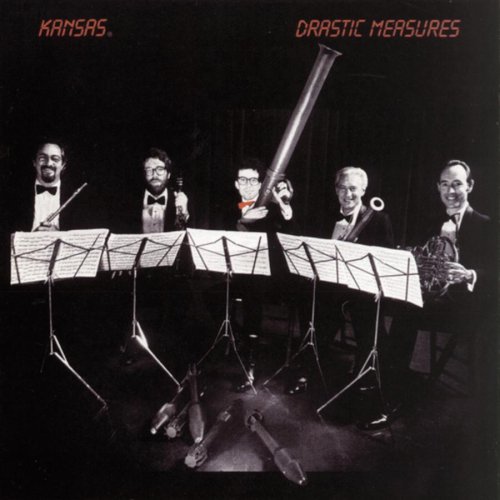
What is notable about Vinyl Confessions is the obvious move in the AOR direction; the only song that I would generally describe as “prog-gish” is the final cut, “Crossfire”, penned by Livgren. AllMusic.com is in the ball park in writing that “it was getting hard to distinguish Kansas from Foreigner and Journey.” The big difference was that while Journey and Foreigner specialized in love songs, the new Kansas material was lyrically much more in the vein of early ’80s CCM (Contemporary Christian Music). Songs such as “Borderline”, which urged listeners to make a choice between being “hot and cold”, obviously referred to the church of Laodicea, chastised in the Book of Revelation for being “lukewarm, neither hot nor cold” (Rev 3:15). The next album, Drastic Measures, which features the worst Kansas album cover of all time. was Elefante’s second and last with Kansas, and it was, to put it nicely, a mixed affair. Livgren was already moving on to A.D., and at times it is hard to believe it was produced by the same band that had, just a few years before, put out Leftoverture (1976)and Point of Know Return (1977). As Elefante would bluntly admit ten years later: “I didn’t like ‘Drastic Measures,’ and we even said to the band, ‘Guys, this is almost an Elefante Brothers album. This isn’t what Kansas is all about.’” Steinhardt had left the band at the end of 1982 and the band was now an overly AOR group, with just one song, “Mainstream”, breaking the six minute mark—and it was a Livgren-penned tune that openly skewered the direction of both the music world and his band:

It’s so predictable and everybody judges by the numbers that you’re selling,
Just crank ’em out on the assembly line and chart ’em higher (higher, higher),
Just keep it simple boys it’s gonna be alright, as long as you’re inside the Mainstream,
are we moving too far away?
Is it worth it if it doesn’t pay?

That said, the album does demonstrate that the young Elefante, in addition to being a fine vocalist, could write a great hook and a good tune. The hit, “Fight Fire with Fire” (#3 on the Billboard Mainstream Rock Chart) is a good example, but personal favorites include “Andi”, which is a precursor of sorts to songs such as Night Ranger’s “Sister Christian”, with its imploring, ruminating lyrics about a young girl trying to find her way in life (“And you’re not just anyone; don’t be ashamed”), and “Don’t Ever Take Your Love Away”, which ambiguously works as either a love song or a modern psalm: “‘Cause nothing means a thing unless you’re here/To live without your love’s my only fear/I just want to let you know/I can’t make it on my own.”

After Kansas broke up in 1984, John Elefante embarked on a prolific and award-winning career (multiple Grammy and Dove awards) in CCM as a producer, songwriter, and bandleader (Mastedon). Although he received offers that promised success in the broader music world (such as an invite to be lead singer of Toto in the late 1980s), Elefante was committed to working with Christian artists, including Guardian, Petra, Bride, and numerous others and, later, producing some of his own albums. During the 1990s, he released three solo albums, none of which I’ve listened to. In fact, I’ve not paid much attention to Elefante’s work for many years until he released his new solo album, On My Way to the Sun, his first in fourteen years, which came out on May 7th. I saw the album on amazon.com, noticed that Kansas members Williams and David Ragsdale (violin) performed on the 11-minute-long opening cut, “This Is How the Story Goes”, and I had a listen. My immediate impression was, “This is Kansas, circa 1978!” That was not entirely accurate, but similarities are obvious: the lush harmonies, the violin-driven opening, the very Kansas-esque guitar licks from Williams. In truth, the song is a near perfect marriage of mid-1970s and early 1980s Kansas, but with superior production and some frankly evangelistic lyrics:

And this is how the story goes:
You must believe it all, my friend,
from the beginning to the end.
Everyone lives forever, we just have to choose where,
Because the virgin had a son,
and the stone was rolled away,
so how can we can be terminal,
because He lives today.

Granted, those sort of direct lyrics aren’t going to attract many new listeners (I do like the line about being “terminal”; it reminds me somehow of Part IV if Eliot’s “East Coker”). But, while I’m not a big fan of overtly evangelistic rock tunes, I think “This Is How the Story Goes” is a really fine bit of prog-rock. It is perfectly produced and performed, has a killer hook, develops wonderfully, and is both rocking and thoughtful. Another plus, and a pleasant surprise, is just how great Elefante sounds. He has always been a fine singer, and he displays not only range, but an admirable combination of confidence and reserve, never over-singing or being indulgent; there isn’t an unnecessary note on the album.

The other nine songs are certainly in the AOR/”classic rock” vein, but with lots of nice twists and details. “Where Have the Old Times Gone” has some obvious tips of the hat to Led Zeppelin and Foreigner, but also features violin work that is directly from the Kansas playbook. The Foreigner influence is front and center on the title track while “All I Have to Do” could have fit nicely on Vinyl Confessions, albeit with an updated sound. “The Awakening” begins with a huge, warm wash of harmonized vocals that then leads into lush guitar-driven verse and chorus that reminds me of some of Livgren’s work with A.D. “Half the Way Home” featured more lush harmonies, over the top of a 38-Special-like guitar riff; the lead vocal, oddly enough, sounds like Doug (Dug) Pinnick of King’s X in a few spots, and there is a huge sing-a-long chorus (did I mention the album has big hooks?). “We All Fall Shorts” is a largely acoustic number that starts with a Beatles/Phil Keaggy vibe before moving into a very Yes-ish chorus. “Don’t Hide Away” returns to the Foreigner influenced sound, but with a very Styx-like chorus, along with a short section of rap (yes, that’s right). “This Time” offers a somewhat abrupt shift in tone and lyrics, a moody, minor-keyed (and quite emotional) song about a pregnant girl who decides, at the last moment, to keep her baby rather than have an abortion. The closing track, “Confess”, is, frankly, a praise-and-worship tune, but a very well done one at that: “Fall down on your knees/Praise Him/And fall to your knees/And confess with your lips/that Jesus is Lord.” 

While the influences are obvious, there’s never a sense that Elefante is trying to write, say, a “Foreigner” or “Kansas” tune. Rather, this is a very cohesive-sounding album that works because Elefante is an exceptional musician, songwriter, and producer who seamlessly marries a myriad of loves and influences without losing his way or his focus. He knows prog-rock and classic rock better than most, and he does a fine, even exceptional, job of crafting songs that draw on those sources. Anyone who enjoyed the Elefante-fronted Kansas, or likes AOR/classic rock with lyrics that are unapologetically Christian will enjoy this well-crafted album. Having said that, here is the opening cut:

Pro Tip : Two great technologies that help you work on your music and videos from anywhere – Cloud Desktop and Cloud SharePoint from the best DaaS provider http://www.apps4rent.com .

20 Looks at the Lamb, 3: After Supper

Foxtrot72

After supper comes dessert.  Pudding.  But “how can you have any pudding if you don’t eat your meat?”

Bringing up “Supper’s Ready” means rattling that dangerous chain of signifiers that includes Bible, religion, Revelation, apocalypse.  In the mid 1970’s, we knew about zombies, but there was not yet any strong popular associative tendril between zombies and apocalypse.  A more likely association, at least in my neck of the woods, was with Hal Lindsay’s popularization of dispensationalist theology in The Late, Great Planet Earth (1970) and other books (precursors to the more recent Left Behind series).

What comes after (ooh, we need a Terje Rypdal soundtrack here!), or the end (Doors?), in this case is the eschaton, the culmination, the “last things” in the argot of Christian theology.  The supper of the Lamb that is the last one.  Not “the last Supper” before the arrest of Jesus, but the LAST supper, when time shall be no more.  THE LAMB of the biblical Apocalypse, or Book of Revelation (please don’t add an ‘s’ to the end; in the biblical text, it’s THE REVELATION of the Christ, not a book of predictions!), it’s THAT LAMB whose Supper is ready on 1972’s Foxtrot.

Lamb74What comes After Supper, then?  What’s the dessert?  Selling England by the Pound (1973) would rightly be called pudding as opposed to dessert (arguably motivated in part by a desire to keep Genesis’ image veddy British), but what we’re worried about here is The Lamb, the one that Lies Down on Broadway.  Off to America with a vengeance?  No, I won’t chase any speculations of posturing in relation to The Pond.  The connection that stands out here is THE LAMB.  Having any knowledge of “Supper’s Ready,” how could one possibly avoid bringing to Rael’s story an ear prepared for the continuing adventures of that same Lamb, the true dessert course after The Lamb’s Supper?  If we consider this as one possible gaze (regard), what do we see?

“Religion” is such a problematic word.  It probably originally meant something like “binding,” and this probable meaning still seems to echo loudly when its friends and foes both react to the various ways, both good and bad, in which we might think ourselves “bound.”  But let’s use it for the moment.  Sure, we can find some religious themes in The Lamb, even besides the obvious figure of the title, but aren’t they much more subtle, more muted?  And isn’t the climax this time much more clearly in tune with Eastern religion, where “you are that” (Tat Tvam Asi)?

What does The Lamb have in common with “Supper’s Ready” that might be construed in “religious” terms?  I’ll cut to my chase.  One central figure, but in each case the canvas is made of relationships.  Lovers.  Sex partners (casual or not).  Siblings.  Others whom one wants to trust.  Others who might deceive, who might betray one’s trust.  Others who comically conform to stereotypes, or who fail to conform.  Others with whom one might belong, or with whom one (hopefully) does not belong.  Must experience be solitary and lonely, or can it be shared?  Can’t you feel OUR souls ignite?  Or do others end up as silent sorrow in empty boats?

Remember that, for some streams of Christian theology, God is the “Wholly Other.”  Mightn’t Otherness be considered THE “religious” question, or problem?  THE site of the opening of the “religious”?  If it is not Other, then I cannot love it.  If it is not Other, then neither calling nor command could issue from it.

Now step slightly to your left.  Keep that same basic gaze, but shift it over here, ever so slightly.  Here are lyrics that we might call “religiously loaded.”  There are lyrics about love and longing for an Other.  Do you see any line of demarcation, any dividing boundary between the two?  I don’t.  I suspect that one of the places this will eventually lead us is a meeting of two Doctors (Dyper and Freud); the lack of separation here has always been palpable as far as I can tell.  But that meeting will have to do with “sex,” which we will treat under a separate gaze (at least one).  The differences between the gazes is provisional and strategic.

The Lamb is a sacrificial figure.  It is The Lamb that is slain (lies down).  (Death is here, and will be a more vocal visitor in gazes to come.)  When The Lamb lies down, is it not with The Lion?

Suppose “religious” has everything to do with Otherness, longing and love.  Suppose, under the provisional shade of “religion,” that I (or You, or Rael) could not be God.  (Leave aside, for the moment, that heroic/pathetic voice in the Third Impression of “Karn Evil 9,” desperately intoning:  “I am all there is!”)  Suppose that dessert cannot be eaten alone, that pudding must be shared.

Suppose the Last Things are Others.  Listen to the Lamb, with Rael as background rather than foreground, with Others as the foreground.  Have you ever noticed how many there are, other than Rael, or how his story is as much a story about those Others?  About Otherness?  It is that which I am recommending here as a “religious” gestalt, a gaze at The Lamb that comes after Supper.

Some of the other gazes may spring from some of those Others, but perhaps it will be helpful to see them first from here.

<—- Previous Look     Prologue     Next Look —->