

Landmark album/CD releases – whether landmark in positive or negative ways – gather layers of lore as each one rolls across the terrain that is its “public,” or its “audience.” That audience is no static landscape, of course. It changes, and is changed by such albums. Such albums seem to settle over time into the status of “signposts,” marking ways through the landscape, though they are also partly responsible for blazing the very trails that they mark.
 If we stop at a crossroads where one of these markers is now set, if we look closely at the ways in which the marker has weathered, eroded, and perhaps even been defaced by other passersby, don’t we always love to see the cleavages, the conflicts, the signs of fragmentation or disintegration that we have been told are there? Don’t we often look for them with a sort of sadomasochistic nostalgia? We listen to the Beatles’ “White Album,” and we “hear” the disruptive, threatening presence of Yoko, the creative divergences that are opening between the four discernible musical personae. For many progressive rock fans, Yes’ Tales from Topographic Oceans (1973) has this feel. Whether hated or cherished, the music captured on its four vinyl faces embodied deepening tensions that we know were lurking just beneath its surface, manifest soon after most clearly in Wakeman’s departure.
To consider a non-prog example, I remember my introduction to the album, Shoot Out the Lights (1982) by Richard and Linda Thompson, several years after its release. Via Rolling Stone‘s enshrinement of that album as #1 of its release year and in its top 500 of all time, I learned the mythology regarding how the album amounts to documentation of the disintegration of the Thompsons’ marriage, and how it was followed by “The Divorce Tour.” 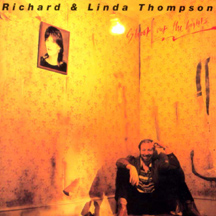 I bring up the example of the Thompsons’ exquisitely painful album precisely because “mythology” is the appropriate term in that case. While it is clear that the Thompson’s marriage was a tempestuous one, the idea that one can literally hear the demise of the marriage taking place in the recordings for SOTL has been disputed by a number of commentators, who have claimed that their relationship was relatively good at the time of the recordings, and did not actually fall apart until after they were completed. Whatever the truth of the matter, the fact that there is dispute about events serves to underline the mythological character of the common narrative, “myth” here meaning precisely narrative that has solidified into a tradition, a tale that is passed on much more for its poignancy and its authentic “ring” than for its truth in the sense of historical accuracy.
There can be a properly “mythic” ring to an album more in connection with its critical drubbing (as with Tales), or more for its acclaim (as with SOTL). The reason why I bring up all of this, of course, is in order to bring it to bear in the service of this second look at The Lamb Lies Down on Broadway. We have all heard the stories of diverging visions, of deep tension, of a near-split during recordings, all leading to Peter Gabriel’s actual departure after the tour. One may take the divergence, tension, and dissension as directly connected to how absolutely awful the album is (reportedly helping to push at least one of my Progarchy colleagues, in disgust, in the direction of punk), or one may take the same as the key to its sublime character, its poetic and musical superiority to most other “concept albums” of the time (the latter often being my own temptation).
But here is what I most want to suggest to you here as a regard, as a possible “gaze” upon The Lamb: Is it possible to put aside myth, to bracket the normative narrative, and listen to the album as if none of that is what really matters? I believe that it is possible, because it is how I first heard the album. I’ve already noted how The Lamb is the first Genesis album to which I paid careful and sustained attention, and at the time I had almost no clue regarding the band’s history or contemporary situation. I was largely unaware of the dramatic shift from prior cooperative writing to Gabriel’s emphatic assertion of narrative and lyrical dominance. I first encountered The Lamb as the Gesamtkunstwerk that it presented itself as being. It was only later that I learned about the negative press regarding the album, and even more regarding the supposedly disastrous tour.
When I encounter listeners who otherwise appreciate Genesis, but who despise (or at least mostly ignore) The Lamb, I often wonder whether any of these listeners have had the chance to experience the album without being encumbered by the mythology. Perhaps some of them have. But I expect that there are many who have not. My recommendation today is that you at least attempt such a look at The Lamb (admittedly difficult, but surely not simply impossible). Listen to the way in which the band melds together like a single complicated voice, having its own “feel,” its own musical texture that can be attended to without insistently comparing it to prior recordings by the same players. This is an auditory parallel to the sort of impact that I hoped to evoke before with regard to the packaging
My own sense is that listening to The Lamb as a singularity (rather than as an instance of…) gives little ground for the standard sorts of disparagement of the “self-indulgence” of its scope, or of the “incomprehensibility” of its story. I may be asking the impossible, which was only possible in my case because of my idiosyncratic listening history. But surely there are times when it is possible largely to “bracket” context for the sake of one particular look (or in this case, listen). Can’t we sometimes briefly “forget” what an artist’s other paintings look like, how her style developed, etc., and allow ourselves to be struck anew by what this particular painting looks like? Doesn’t the religious believer sometimes deliberately try to see a scriptural text as strange, even though it is familiar?
Try (if you’re willing to indulge me) to listen to The Lamb again in this way. It’s the debut album by an unknown band. Rael has nothing to do with the man who will portray him onstage in a tour to follow. There is no genre into which either the music or the story must fit. There are no such things as “concept albums” or “rock operas.”

It may not work, naturally, but I invite you to try.
The lights by which we often hear (to mix metaphors with way too much boldness) are the lights that shine before and after an album in the output stream of an artist. And it is often the case that it is precisely those bright lights that we want to see. But can we sometimes shoot out those lights, and try listening again, as if for the first time?
Contextual considerations will loom large in most of the looks to follow. (Coming soon, for example, is an explicit consideration of how The Lamb may be seen/heard “religiously,” especially as it is served after “Supper.”) But don’t neglect kinds of looking/listening that resist contextualization, that try to hear a well-aged and myth-laden message as fresh and new.


 Progarchy