

 Say what you will about pop radio, you nostalgists and prognosticators of musical doom. I will laugh and scoff with you, because there is, as there always has been, portents of conformity in the monochrome sameness of the popular. But your arguments against are blind to the tail-chasing beast: it’s as often in pop as not that the true revolutions happen, where the work is done, before in creeps mimicry and gold diggery. In the case of Hozier, the revolution is subversion by honoring the blues and soul music his native Ireland so loves. In 2014 into 2015 he produced a bona fide pop radio hit in “Take Me To Church,” which got played on all the I Heart Radio stations in the U.S. In true pop radio fashion it was catchy, easy on the ears, anthem-y. But unusual too — it wasn’t hard to hear beneath the compressed radio waves a rock band sweating it out behind a gifted singer, songwriter, and guitarist. It almost seemed like it was a mistake, because how long has it been since you heard an actual band pumping out the rock on a pop station? The song was from Hozier’s full length, self-titled debut, which, while not a perfect record, isn’t far from it. With lyrics that investigate sexuality, religion, and drugs without robbing any of them of their dark poetry, the album maintains a soulful bounce that only occasionally loses its chug. Them-period Van Morrison would be proud. “To Be Alone,” which Hozier put together, or so I understand because the internet on this point mostly fails me, as a tribute to Junior Kimbrough (who gets a writing credit), does not bear the stamp of Kimbrough’s rough electric blues — although perhaps captures the feel — suggesting instead Peter Green during his brief time as the leader of Fleetwood Mac, it’s lead riff echoing the B riff of Green’s”Oh Well.” The production, too, has that dank, rainy reverb that Green loved, and deals in the dark depths of green manalishis and black magic women. Knowing nothing of the man but his music, I can say that he’s gotten at least that bit right, and while it would be a stretch to say his is the future of pop music, that he found his way into pop’s armored compound is a righteous thing.
 “Outlaw country” is an ironic descriptor at best, applied to a music that, without the modifier, began as a lucrative embarrassment to the phonograph salesmen of the 1920s, their newly-minted “hillbilly” record catalogs doing surprisingly well next to the more respectable stacks of whatever maudlin tenor was the operatic toast of the day. Country music’s cornpone reputation grew as its burgeoning industry began to trade on an image based in white southern poverty; but if the marketing suggested the music was as impoverished as its people (a patent falsehood), this achieved for the proponents of such thinking a comfortable outsider-ism, a romantic us-versus-them rewind and replay of Reconstruction that survives in other place in the South as well, through for instance a protracted and continuing — and, unfortunately, necessary — civil rights movement, to this day. So then, what’s this Outlaw business? The term attached to Willie Nelson, Waylon Jennings, and a handful of other country writers and singers who, starting in the late 1960s, were drawn away from the industrial strength, smooth country music produced by “Nashville,” that Tennessee town’s small oligarchy of producers and record labels who held sway over any music distributed under the category of country, and pointedly avoided shifting their audience’s gaze towards the rockier issues or musical themes of the times. Jennings, like Nelson, bucked at this, knew what it meant for their art, and went back to Texas; he turned up the rock’n’roll rhythms he’d played with Buddy Holly, sang what he wanted, and called Nashville out on its phony conservatism. In so doing, Waylon and the country outlaws — and the new southern bands like the Allman Brothers and Lynyrd Skynyrd — found a younger, national country audience, and also reminded rockers that their favorite music was as much country as blues.
 In 1979, while in New York City and around the time he was adding guitar overdubs to
  Put a couple of decades on the protagonist of
 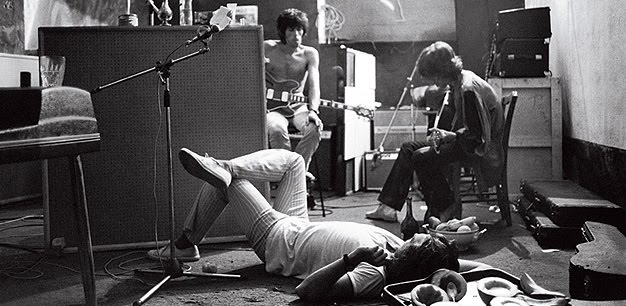 “Unlikely” is probably the right word, that the hairiest, grittiest, straight-uppenest American rock record of the 1970s, maybe ever, would be made by an English band in tax exile in the south of France lolling in sheer European decadence. That the Rolling Stones attained such a state of grace is only partly surprising, though, given the sheer will of their progress to the point of Exile on Main Street: with Beggars Banquet, Let It Bleed, and Sticky Fingers the writing was on the wall, but it was this double album that sealed their legend, where the channeling was complete, where without seams the Deep South blackness poured through their pasty, pale, drug-addled limey fingers in drums and basses and guitars and voxes and keys and horns. They hadn’t just gone to the crossroads, they’d set up the tent years before and waited it out, for the spirit to finally visit them. “Satisfaction”? “Get Off My Cloud”? Even “Honky Tonk Women,” with its perfect guitar? Those were killing time, chop builders, and the work they’ve done since has had high points too but has never been more than the downhill coast. Exile’s the big meet up, a meticulously made album with no contrivance, a blues turned over with a rock shovel, originals mixing with covers with barely a hint of borderline, as if this is their music as much as it is yours or mine or
  Boston’s mega public broadcasting treasure trove, WGBH, has added to its Open Vault the interviews that went into the making of its epic 1995 documentary, Rock and Roll. Those of us who remember this 10-hour landmark from those foggy, hoar-bitten pre-Wikipedia days may think fondly of it as the only long-form documentary to take on the genre as a whole, from a reasonable distance from Rock’s genesis but while many of its prophets were still alive and interview-able. While the finished programs are not as yet available (no doubt due to copyright on the songs used in the film), video and transcripts of the interviews are here:
