Dolores O’Riordan, requiescat in pace

Screenshot 2018-01-15 13.28.00The news of the death of Dolores O’Riordan, singer and songwriter for The Cranberries, is both deeply saddening and quite shocking, given that O’Riordan was just 46 years old. The band has released a statement saying:

The lead singer with the Irish band The Cranberries, was in London for a short recording session. No further details are available at this time. Family members are devastated to hear the breaking news and have requested privacy at this very difficult time.

As the statement indicates, O’Riordan was keeping busy, and a quick search of YouTube turns up a number of performances, both solo and with the band, over the past couple of years. Here is an April 2017 performance of “Linger,” one of the singles off of the band’s 1993 hit album Everybody Else Is Doing It, So Why Can’t We?: Continue reading “Dolores O’Riordan, requiescat in pace”

soundstreamsunday #94: “Gold Dust Woman” by Fleetwood Mac

fleetwoodmacThere is a little irony that Fleetwood Mac hit superstardom ten years into its existence, having jettisoned numerous guitar heroes — including the group’s founder, the inimitable and brilliant Peter Green — and did so as a West Coast soft rock band rather than the grimy British hard blues act that inspired contemporaries and was absolutely formative for Jimmy Page in his vision of Led Zeppelin.  By 1975, beleaguered and getting old in the rock and roll tooth, and years since it had anything approaching a hit, the band made a last ditch, daring sea change that saw them bring on the largely unknown singer-songwriting couple Stevie Nicks and Lindsey Buckingham, who radically reshaped Fleetwood Mac’s sound.  1975’s Fleetwood Mac was their breakthrough, while 1977’s Rumours proved the formula worked, as Nicks and Buckingham brought a finesse of songcraft sorely missing since Peter Green left the band.  More than this, though, the two Americans integrated, rather than overlayed, their sound on Fleetwood Mac.  Onstage, Nicks became Green’s “Black Magic Woman” incarnate, a gypsy witch with a unique vocal power (and a sexual presence that didn’t hurt the band’s progress), while Buckingham, a gifted, complete guitarist, could play lines summoning the group’s bluesy manalishi ghosts while feeding the ravenous pop machine he was building.

The last song on Rumours, Nicks’ “Gold Dust Woman” is an ode to coke, interwoven with the legendary California cartoon of disintegrating relationships and romantic triangles making up Fleetwood Mac’s lore.  It completes side two of the LP as assuredly as “The Chain” begins it, the two songs dancing at the edges of Peter Green’s blues terrors, advancing into soft rock classic dark jazz torches like “Lush Life” while setting the stage for future L.A. creatures like “Babylon Sisters.”  Like the LP it finishes, the song is a dark star, a downer completing one of the unlikeliest of pop albums.  “Rock on, gold dust woman.”

soundstreamsunday presents one song or live set by an artist each week, and in theory wants to be an infinite linear mix tape where the songs relate and progress as a whole. For the complete playlist, go here: soundstreamsunday archive and playlist, or check related articles by clicking on”soundstreamsunday” in the tags section.

My 12 favorite prog albums of 2017 (12 days late!)

bentkneeband
Bent Knee (www.bentkneemusic.com)

(1) “Land Animal” by Bent Knee: One of my favorite albums of 2017, regardless of genre, classification, categorization, etc. As I marveled in my mini-review for Progarchy: “the whole of Bent Knee is, again, hard to describe, a mixture of orchestral-ish passages, raw but tight guitar, polyrhythmic craziness, classically-imbued moments of open tenderness, angst-packed explosions, and much more.” Don’t miss it.

(2) “In Contact” by Caligula’s Horse: The lads from Down Under rarely disappoint, and this powerful, masterful album catches them at the height of their powers. As I wrote in my fairly detailed Progarchy review: “In Contact proves the band is incapable of producing anything less than exceptional, and it is arguably their best work to date.”

(3) “Malina” by Leprous: More pop-ish and less overtly prog-ish than previous releases, this is a lean, catchy, and often anthemic album that still packs plenty of heavy punch while clearly reaching out to a wider audience. Great driving music!

(4) “The Source” by Aryeon: A wild, over-the-top sprawl of an album filled with more hooks than a deluxe fishing kit, equalled only by the number of singers (dozens? hundreds?). Considering the dystopian, apocalyptic nature of the story and lyrics, this is simply aural fun at its best. Ear candy deluxe!

Continue reading “My 12 favorite prog albums of 2017 (12 days late!)”

Radiant Bargain Bin

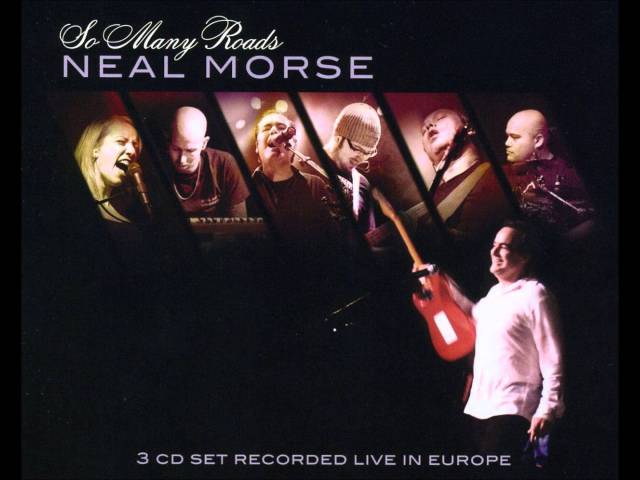
nm so many roads
One of Neal’s best.

Every once in a while, it’s well worth checking out the bargain bin at Radiant Records.  Right now, some great stuff–as always.

http://www.radiantrecords.com/products/334-so-many-roads.aspx

They Might Be Giants: “I Like Fun”

NPR has a preview of the new album coming January 19 from They Might Be Giants:

Flansburgh and Linnell wrap everything in radiantly bubbly power pop, and fuzz-guitar punk, and Beach Boys vocal-harmony flourishes. I Like Fun is a series of lugubrious songs about death, dismemberment and other unfortunate events dressed up for a Friday night joy ride. Of the several missing limbs discussed in these songs, the most disorienting comes just after the joyous Jackson 5-style guitar introduction to “Push Back The Hands:” “You would give your right arm to go back to when you had a right arm.”

Likewise, TMBG look at death from all sides. “I Left My Body” employs a sanguine, Kinks-ish tone to tell of a departure, and it all seems fairly conventional until the line about how “they’re gonna tow you if they think you’re abandoned.” It’s the parking authority as the essence of fear, even in death’s aftermath.

It’s the same vaguely absurd idea-juxtaposition that They Might Be Giants have always dished, just lifted into a loftier place — song-nerdism taken to rococo extremes. When you consider all the songs that these two people have written, it’s downright inspiring to hear them still out there trawling for those divine (and increasingly elusive) moments of pop bliss.

From Heavy Metal Overload: RIP, Eddie Clarke

It’s already been a tough week in metal, with the passing of both Chris Tsangarides and Iron Man’s Alfred Morris III, but now I’m sad to report that Motörhead/Fastway guitar hero “Fast” Eddie Clarke has passed away aged 67 following a battle with pneumonia. Clarke was the last surviving member of the classic Motörhead lineup […]

via R.I.P. “Fast” Eddie Clarke (1950 – 2018) — HEAVY METAL OVERLOAD

Review: The Mercy Stone – Ghettoblaster

Ghettoblaster

There is music that I can’t relate to. Sometimes it’s because the song is plainly stupid, trite, or obnoxious that I just wish it would be sent into the sun. It’s like your friend who posts way too much personal stuff on Facebook, you just want to scream “Stop”. Then, there is an even more perverse music, a music that speaks like a man half-way through a Xanax withdrawal, a music that both baffles the mind and produces a near awkward laughter in the listener. This is the music of lunatics, music that I would say (in the most professional of instances of course) has gone “completely bananas”.

And here we are with just an album, The Mercy Stone’s debut experimentation Ghettoblaster. An album I am sure my closest friends are sick of hearing and hearing about in the last coupe of weeks, yet it took me some time to write about it because — life.

If you are someone who actually was alive to see the prog spectacle of the ‘70s you may remember the slightly nerdy King Crimson or even the lord dorkdom of the cape wearing Yes. While there are many genuinely cringe worthy moments from those bands nothing — and until I can be proven wrong I genuinely mean NOTHING compares to the awkward vibe you get from Ghettoblaster.

The Mercy Stone is a new project; it’s been around for a few years and was assembled by composer and guitarist Scott Grady — who has a master’s degree in music composition — and who assembled a 12-piece group to “to put his composition chops to work within a project that would have the substance and sophistication fitting for a contemporary-classical concert stage as well as the accessibility that would be palatable to rock audiences.” Going simply-said for an extraordinary amalgam of Classical Music, Jazz and Rock, the group presents a large body of work with their full-length debut Ghettoblaster. Large as in bringing together Stravinsky, Led Zeppelin, Nirvana, Radiohead, Bach, Nine Inch Nails, Pink Floyd, to name but a few.

The music on Ghettoblaster is very well composed and performed. Grady tends to pull together a strong cast of performers for his musical circus act. These fine tunes tend to be something to marvel at. It is this dichotomy that provides more of the head scratching moments. The album progresses in a peculiar, but fairly typical fashion during the majority of its run time. You might find the music endearing and charming as it blends rock, jazz, and classical qualities.

The ‘70s were a glorious period in music because people were getting paid way too much money to do all sorts of crazy projects, and even though some of the end results were complete disasters there was a sincerity to them. There was no sense of irony or pretentiousness in the attitudes of the musicians, they just wanted to make weird and complicated music. With Ghettoblaster, this ensemble does exactly that. The Mercy Stone are driven by the love of music, and it pays back — maybe not filling their pockets, but rather something on a higher, more spiritual level. Highly recommended.

Follow The Mercy Stone on Facebook.

Dorothy Freedom Tour 2018 @itsdorothysucka

Oh yeah man, Dorothy is coming to town! Don’t wanna miss this. Gonna be a great show! Check out her 2016 album ROCKISDEAD. Last year, I found out it makes for a great playlist pairing with Hobosexual’s Monolith. Rock on, chillun’. See you in the VIP!

dpmsnqauqaadqht

Rick’s Quick Takes: Wonderous Stories by Jerry Ewing

“I do hope that [this book] succeeds in going some way to shedding light on the intrigue of progressive music.  Of where it came from, and where it’s going.  And more importantly, how it got to where it is today.” — Jerry Ewing, from the introduction.

To cut to the chase: Jerry Ewing succeeds at all of the above with Wonderous Stories.  If a friend or relation asked me “why are you so fired up about ‘prog rock,’ anyway?” this just replaced Will Romano’s fine Mountains Come Out of the Sky as the book I’d loan them.  After extracting solemn promises in blood to return it ASAP.

Ewing knows what he’s talking about; he’s been spreading the news about progressive rock since the early days of Marillion, ultimately founding Prog Magazine as a “focal point and filter” for the genre in 2009, and steering it through the choppy straits of modern periodical publishing till now.  Wonderous Stories distills Ewing’s love of the music, his experience of the scene, and his considered take on prog fandom into a sumptuous coffee table book you didn’t know you needed.

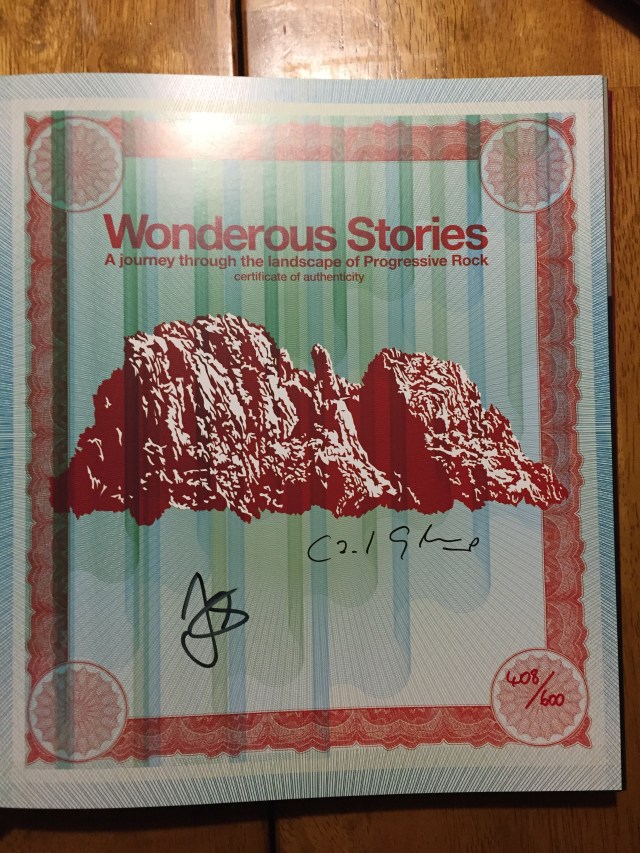
Yes, “coffee table book.”  A big part of Wonderous Stories’ appeal is its gorgeous graphic design by Carl Glover, pulling together band shots, album covers and live concert pics on each page to accent the text.  The book works better for browsing than reading from cover to cover; each chapter is self-contained, often repeating information or opinions found earlier, with minimum cross referencing.  You pick it up, read a bit, put it down because you’re satiated — until you want to enjoy some more.  So you pick it up again …

And there’s plenty to enjoy.  After laying his foundation with intros to the 1960s & 1970s, Ewing tackles his mainstream “big six” of prog (Pink Floyd, Genesis, Yes, Jethro Tull, King Crimson and ELP), then branches out to far-flung tributaries (the Canterbury and folk scenes,  Krautrock and art rock, American and European bands, neo-prog and prog metal, and much more).  Along the way, he spotlights a dozen “albums that define prog,”  from the Moody Blues’ Days of Future Passed to Opeth’s Blackwater Park, including full band biographies as he goes.  Some selections are surprises, but they’re all deserving — three of them are on my Amazon wishlists now.

But unlike other recent books on the genre such as David Weigel’s well-intentioned but sloppy The Show That Never Ends, Ewing doesn’t leave the story of progressive rock sucking in the ’70s.  He makes a strong case for the 1980s as better years for the music than opinionated fans think; then he insightfully posits grunge, not punk, as the fad that killed prog for the mainstream music industry, forcing survivors like Marillion and neophytes like Porcupine Tree to fend for themselves.  In Ewing’s telling, this do-it-yourself ethic and the Internet’s ability to connect bands and fans worldwide sowed the seeds of renewed creativity and interest in progressive music, culminating in “The Steven Wilson Effect” (winner for best chapter title!) and the state of the genre today: “a thriving form buoyed by a big worldwide market.”

To sum up, this is a thoroughly delightful book, worthwhile both for newcomers to prog and to long-time fans.  While a few copies of Wonderous Stories’ limited edition are still currently available through Pledge Music, a hardback trade edition costing substantially less but looking just as yummy is coming out in the UK (on February 15) and in the US (on April 1).  Don’t hesitate to order it! — Rick Krueger
IMG_4497