Bob Dylan, The Bootleg Series: Trouble No More, Volume 13 / 1979-1981

by Rick Krueger

I’m not a hardcore Bob Dylan fan, but I admire quite a bit of his work: the early folk music, leading into the groundbreaking electric stuff (basically what’s in The Original Mono Recordings box set); Blood on the Tracks and Desire; the recent run of “old guy plays the blues” albums that started with Time Out of Mind.  I’m also grateful that Dylan’s music has midwifed some of the most resonant work by highbrow rock writers like Greil Marcus, Clinton Heylin and Michael Gray, along with poet Christopher Ricks’ masterful Dylan’s Visions of Sin.

To top all that off, Dylan’s Bootleg Series is, in my mind, one of the best-curated rarities/reissue series from a major artist.  Every volume has been at least an interesting listen for me, and I consider the last two releases, The Basement Tapes Complete and The Cutting Edge 1965-1966 (as well as Volume 4, The ‘Royal Albert Hall’ Concert) downright essential.

I also remember, as a college freshman, reading Jann Wenner’s review of Dylan’s Slow Train Coming in Rolling Stone.  Wenner knotted himself into a human pretzel trying to reconcile the free-spirited, hippie picture of Dylan he had built up for himself with a new album of — shudder — “born-again Christian” music.  It was unintentionally hilarious.

I’d argue that Slow Train Coming was really more of an “lost Old Testament prophet” kind of record — and thus in line with Dylan’s long-term aesthetic.  It wasn’t a masterpiece, but it was quite good — and there were occasional fine songs on the other “Christian” albums, especially “Every Grain of Sand” from Shot of Love.

Thus, Trouble No More: The Bootleg Series, Volume 13 /1979-1981 is definitely on my want list.  8 CDs plus 1 DVD of live and unreleased studio material, to be issued (like King Crimson’s Sailor’s Tales) on my birthday, November 3.  I really need to find some long-lost rich relatives!

More info here.

Cloud Cult: Here and Back Again

Sing, Siren– and tell the tale of Cloud Cult, a band worth seeking. Though labeled as an alternative rock band, or sometimes called an “orchestral indie rock collective”, the Minnesota-native band is over 20 years old. My introduction, though, is very recent. I heard lead singer and songwriter Craig Minowa interviewed on the On Being with Krista Tippett podcast (episode “Music Is Medicine”); after listening to their latest album The Seeker and learning that Cloud Cult is having two concerts with the Minnesota Orchestra next April 7&8, 2018 (how cool!) – I am convinced they are a hybrid progressive rock band.

The Seeker is a visceral experience, starting slowly with “Living in Awe” and opening up in “To The Great Unknown”. Can we find humor in the cynic? Can we find faith in the Great Unknown? The sounds are upbeat and the lyrics challenging: “God gave you brains, so don’t go drowning in your own thinking. God gave you hands so you can pick up your broken pieces. God gave you feet so you can find your own way home.

“Days to Remember”, “Chromatica” and “Come Home” are transition songs, mostly instrumental. They take you by the hand and lead you deeper into the journey – “the water’s warm, and the sun is shining; I just want to spend some time with you.” You almost feel the warmth, if you close your eyes, and appreciate the convergence of multiple voices with a varied combination of guitar, drums, violin, trumpet, cello, trombone, bass guitar, keyboard, and French horn in each song.

But this album shivers. The sixth and seventh songs of the album– “No Hell” and “Everything You Thought You Had”– are the middle of the road in this journey. “Time Machine Invention” is my favorite song of this album, serving a poppy beat and heartfelt story of a not-so-bright inventor who’s made up his mind to travel time: “I waste so much time a worryin’ I forgot to live my life; I’m not going anywhere ‘til I’m back to where it was we were before. I don’t need anything except always needing just a little more. ” Humanity’s searching in life is often “just a little more.”

The end of the album’s song titles set a descending tone: “The Pilgrimage”, “Three Storms Until You Learn To Float”, “You Were Never Alone”, “Prelude to an End” and “Though the Ages”.

The repeated theme of “faith in the Great Unknown” is what propels the Seeker of this album. But it is unclear: is the narrator or the listener the Seeker? That is a beautiful line never crossed; a mystery to embrace.

If life is a story we’re meant to live through,
then both me and you are the pages.
I’ll tell you a tale, and most of it’s true,
you see, I came here for you through the ages.

We are all on this walk, this memorizing loop across deserts and rainbows and streets and volcanos. Cloud Cult’s music is intimate enough to engage intellectually and broad enough to include its audience. The crescendo at the end of the album, after following a steady stream, felt like an enlightenment. Not a proper ending, tied in a bow– no, an awakening of understanding and senses.

On a side note, I love the line “There’s a reason God is doG backwards, we must chase the tail.”

It makes sense that tail would be spelled like a dog’s tail, but it’s also a play on “tale”, and the image of each of us chasing our own story is a glorious one.

Niribu: The Soundtrack

For those of you worried that September 23 will be the LAST day. . .

soundstreamsunday: “Spoon” by Can

Can2
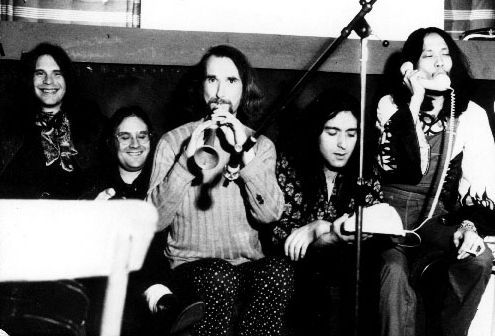
Michael Karoli, Irmin Schmidt, Holger Czukay, Jaki Liebzeit, and Damo Suzuki, circa 1972.

Across five albums and five years Can rendered the categories meaningless and set the bar for the kind of rock future that would make stars out of bands like Radiohead; there’s probably an argument that theirs is still the standard.  Like the better so-called “krautrock” bands of the era, Can’s music sounds like little else, and the environment supporting such freedom became a magnet for American and British artists looking to stretch (Keith Jarrett, Brian Eno, David Bowie).  But for such a self-styled experimental rock band, Can’s music is as accessible as it is confounding, a beautiful cut-and-paste mess controlled by disciplined musicianship (and editing).  Noise, psychedelia, jazz, funk, world, new and no music vie for space in the grooves, battling, more often than not, to equal victory.

By the time Can came to make 1972’s Ege Bamyasi they’d navigated a path through narcotic claustrophobia (Monster Movie‘s V.U.-summoning “Father Cannot Yell,”), cling-clang guitar trance (Soundtracks‘ “Mother Sky”) and long-form boogie freakout (Tago Mago‘s “Halleluwah”) butted up against concrete pieces that, to paraphrase Julian Cope, were guaranteed to clear the room at parties.  On Ege Bamyasi they tighten the bolts — at least on record, as live footage from the time shows vocalist Damo Suzuki doing everything to not play along, with varying degrees of success — and come up with an album that contains, in the context of Can’s musical universe, a slew of pop-shaded nuggets.  “Spoon” distilled all previous impulses into a succinct 3-minute masterpiece of Suzuki no-sense, Jaki Liebzeit clockwork, and Michael Karoli string-slinging wizardry, with Holger Czukay and Irmin Schmidt binding it all together.

It’s the perfect mixtape “link” song: rhythmic, catchy, weird.  It was a hit in Germany, adopted for a TV thriller and selling hundreds of thousands of copies.  Successful bands have named themselves after it.  It was and is — attractively to young, arty and ambitious Americans — roundly ignored in the States along with the rest of Can’s stunning catalog.  And even unto itself it’s a marvelous thing.

soundstreamsunday presents one song or live set by an artist each week, and in theory wants to be an infinite linear mix tape where the songs relate and progress as a whole. For the complete playlist, go here: soundstreamsunday archive and playlist, or check related articles by clicking on”soundstreamsunday” in the tags section.

The Albums that Changed My Life: #5, War Requiem by Benjamin Britten

by Rick Krueger

“My subject is War, and the pity of War.  The Poetry is in the pity … All a poet can do today is warn.” — Wilfred Owen (1893-1918)

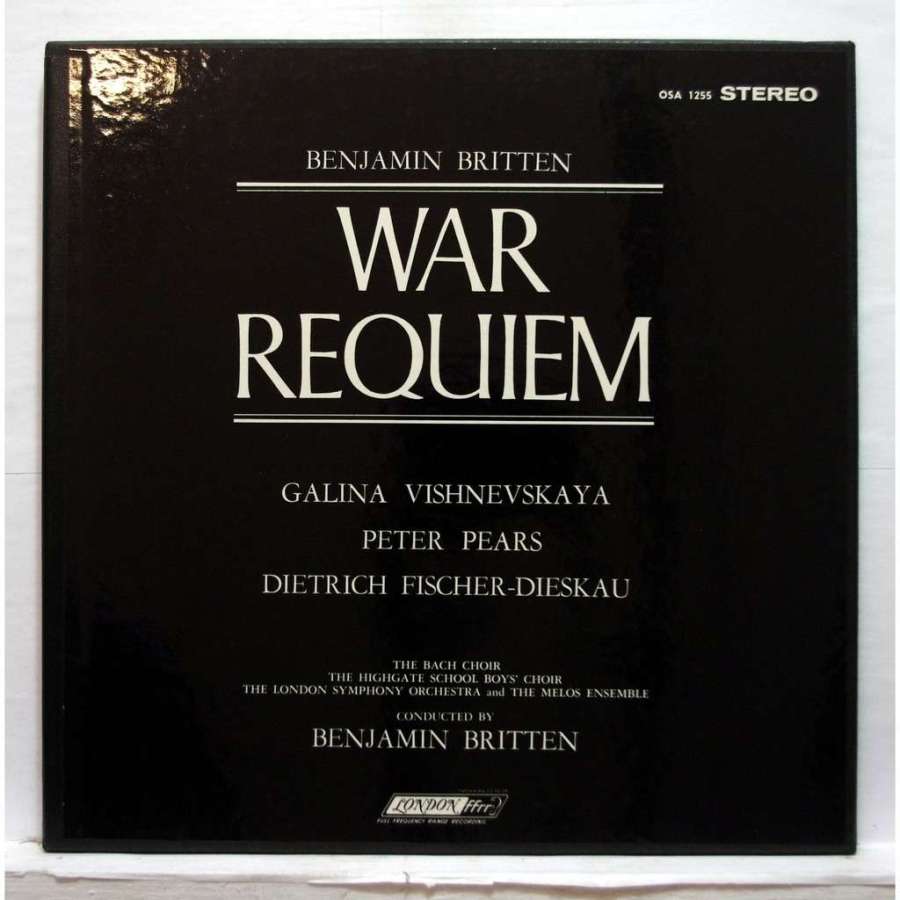
I took an orchestration class in early 1982.  The final project sounded simple: listen to Benjamin Britten’s War Requiem and write a report.  While I knew of Britten, and had heard his music — The Young Person’s Guide to the Orchestra was still standard music appreciation class material  — this piece was new to me.  I figured I’d borrow the record (conducted by the composer) from the college library, hear it once, and have what I needed to bang out an analysis.  Then I dropped the needle:

This piece demanded full attention — ears, head, heart and guts.  90 minutes later, I sat in my dorm room, drained and amazed.  35 years (and one long lost paper) later, I’m still completely engaged every time I hear the War Requiem, and singing it with the Grand Rapids Symphony Chorus in 2008 was a highlight of my life in performance.  It’s always commanded my wholehearted admiration, and it set me off on a deeper exploration of classical music (and 20th century music in particular) that’s endured to this day.  Why?

Continue reading “The Albums that Changed My Life: #5, War Requiem by Benjamin Britten”

I Will Choose Free Will

After spending two and a half hours discussing Marxism in class (with myself being the only one willing to put up any sort of resistance to his freedom-destroying ideas), this song seems fitting. I’d like to keep my ability to think for myself, thank you very much. I will choose free will.

Glass Hammer News: UNTOLD TALES 1

Delights forthcoming from Glass Hammer.  As Steve Babb writes: “PREVIOUSLY UNRELEASED TRACKS AND MORE UNTOLD TALES begins with songs from 1993 and concludes with a live recording from 2017.”

Knowing Glass Hammer, this album will serve as the equivalent of one of Tolkien’s appendices in THE LORD OF THE RINGS.  And, I couldn’t be happier!

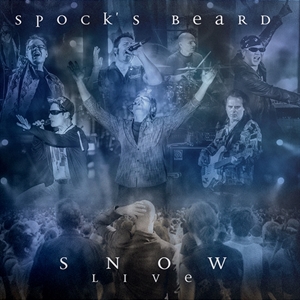
SNOW Live–Spock’s Beard

Snow Live

Though Neal Morse’s Radiant Records has become much less friendly (at least to reviewers) over the last year or so, I’m still rather excited about this release.

SNOW has been a masterpiece of prog since it first came out 15 years ago.  I’m still kicking myself for not purchasing the deluxe package of Marillion’s last album, so I’m not going to make that mistake for this one.

And, I’ll not so quietly wish that Neal Morse and Radiant become more responsive to their fans in the not so distant future.

To order, go here: http://www.radiantrecords.com/products/692-snow-live.aspx