
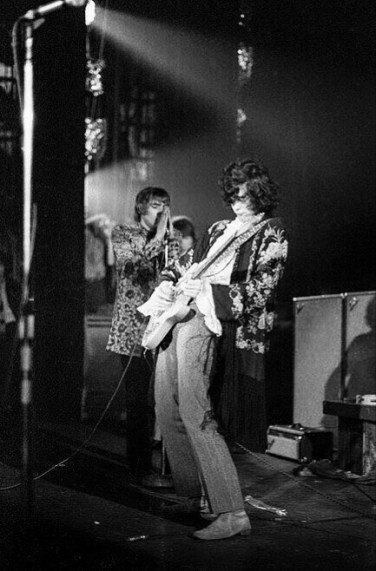
In July 1968 an exhausted Keith Relf handed the keys to the Yardbirds to Jimmy Page, the last of the triumvirate of ground-breaking guitarists to grace the seminal rock band. Relf and drummer Jim McCarty had tired of the road and, in some measure, rock itself, and wanted to do something in a folk vein. For them the frenetic rock scene had run its course.
In October of that year Page took the New Yardbirds (himself plus John Paul Jones, Robert Plant, and John Bonham) to Olympic studios in London. Over 36 hours they hammered out Led Zeppelin, the biggest shockwave in rock history, the culmination of Chuck Berry’s rock n’ roll thunder, recaptured by Jeff Beck’s dangerous and deviant guitar a couple of years earlier, the climax of every frenzied dance ending in sweat-drenched pony-tails and bobby socks blackened by the gym floor.
Page proudly wore his old band on his paisley sleeve: “Communication Breakdown” brandished the proto-punk of Roger the Engineer; “Dazed and Confused” bore the same structure of the Yardbird’s cover of Jake Holmes’ original (credit where it’s due), including a mirror of Page’s guitar break from the BBC version of “Think About It”; “Black Mountain Side” was the Near Eastern-inspired complement to “White Summer”; and the slow burning blues tracks (“You Shook Me” and “I Can’t Quit You Baby”) harken to the Yardies’ roots.
The final Yardbirds salute, the over-powering “How Many More Times,” opens with a cocksure shuffle after the manner of Clapton-era “Smokestack Lightnin’,” then rolls through a Beck-style bolero into not one but two Samwell-Smith-inspired rave ups that bookend a surreal break: a bow drawn over Page’s heavily distorted ‘dragon’ Telecaster — the schoolgirl catching her breath and picking herself up from the dancefloor.
Oh, Rosie…
Seeing Jefferson Airplane in 1967 and hearing Jack Casady’s Homeric bass solo, Page thought to himself, “This is the end of the world.” No. Led Zeppelin was the end of everything. All rock music since January 1969 is post-Zeppelin. Even Led Zeppelin had to become post-Zeppelin to maintain its dignity. The virus exploded; the DNA of countless, nameless concert halls, honky tonks, and juke joints spread through the atmosphere, reconfiguring itself in other forms: folk rock, metal, punk, fusion, techno, roots rock, grunge, etc.
Not the least of these was progressive rock, which is where Keith Relf turned up in 1974 when he formed Armageddon. In addition to Steamhammer’s speed riffer Martin Pugh and bassist Louis Cennamo, Florida native Bobby Caldwell — veteran of stints with Johnny Winter, Rick Derringer, and the Allman Brothers (“Mountain Jam”) — took a seat at the drum kit.
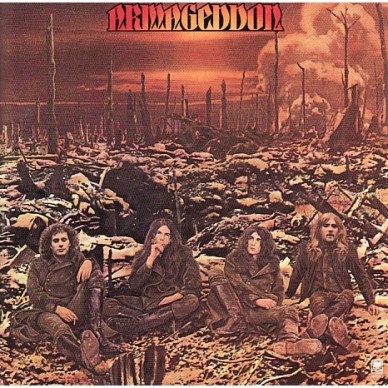 Armageddon (1975) is an aptly titled foray into the post-Zeppelin musicscape. But the album isn’t a detour unto itself. It looks at the past and present musically, and to the future lyrically. Pugh’s riffs are contemporaneous with Houses of the Holy and Physical Grafitti. Prefiguring later developments in prog rock, the music pulls back from the inclusion of multiple themes and motifs, settling into a groove, often one with funk and fusion elements, and extending the passage with subtle alterations. This is particularly evident on the blistering opener, “Buzzard,” as well as “Last Stand Before.”
Relf’s voice isn’t as deep and prominent as on the old Yardbird’s tracks. A lifelong asthma sufferer (it’s painful to watch Jeff Beck mimic Relf puffing on an inhaler), Relf was basically down to one lung by this stage of his ill-fated life and career. But this didn’t thwart his signature harmonica work, and when the instrument makes its appearance toward the end of tracks it comes with the harrowing apocalyptic authority of seven trumpets blowing.
Rock and roll, moving your soul
Took a few as well
On the line, out of time
Shooting stars that all fell
Oh Lord, do something, gotta slow it down
It’s coming on too fast, can’t take it
Feel like I’m gonna drown
Gonna stand and face it, but I need you near
Through the darkest hours, I’m calling
Sometimes I think you don’t hear me calling
Hear me calling
Awareness of the consummation and transformation of all things pervades the album. From the shimmering “Silver Tightrope,”
I thought I saw the candle-bearers
On their way to the beyond
Beckon to me from the future
To come and join the throng
I stepped upon the silver tightrope
Balancing beliefs
And wings unfurling with a new hope
I left behind my griefs
Even the darker “Buzzard” includes a promise,
But the meek will stand
Understanding nature
Seeing far beyond the plan
Take their place in time
Take their place in timeless structure
The end of this present life came quickly and unexpectedly for Keith Relf in May 1975, as he was the victim of an accidental electrocution while working with ungrounded sound equipment in his basement. When the Yardbirds were inducted into the Rock n’ Roll Hall of Fame his wife and son accepted the honor on his behalf.
This post-everything world doesn’t last forever. In the meantime Armageddon occupies the already/not yet space with tight arrangements, subtle time changes, and expert chops from all its participants. And Relf proves the humblest instrument of ages past works in this context, creating a confident work one can take on a long drive — keeping an eye on the speedometer — in the direction of Proghalla.
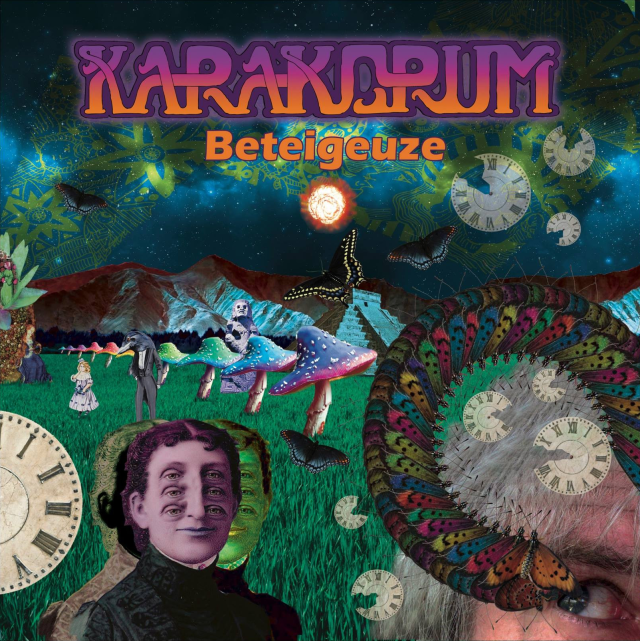
 It’s not until it works its witnesses into a state of ecstatic frenzy, as if reading a preacher-inflected text so self-aware it reaches ascendancy, that New York rock satisfies itself and its audiences. It’s a city of distillations and self-regard, and so in its great contribution to rock and roll, New York puked up a revival so dazzling in its love for rock’s foundations it sometimes barely reads as the punk it became known as (or maybe a common idea of punk): there is no rejection, it is all embrace.
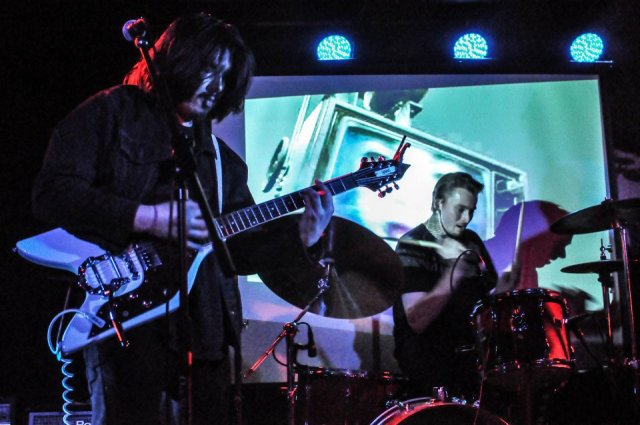
 Music critics tend to dismiss Joy Division’s posthumous Still as a hit-and-miss collection of studio scraps paired with a lackluster recording of their last show. And in a specific context — compared to the brilliant Unknown Pleasures and Closer, it seems a bit of a rush job with less-than-pure motivations — this holds some weight, although I’d argue as its own thing Still may be more representative of the band as a whole, and that the live half of the double album contains fiery performances wildly joining hard rock, punk, and synth-y goth music. My first exposure to Joy Division, over thirty years ago now, was hearing “Shadowplay” from Still, and it gave me the metal thunder frights. It sounded as if Peter Hook, Bernard Sumner, Ian Curtis, and Stephen Morris channeled the essence of Fleetwood Mac’s “Green Manalishi” through a punk filter, as they sped to the center of the city in the night. Even as they rode their wave of goth punk popularity their songs betrayed the band’s primary strength: their music was as much about making connections as alienation, masked and revealed in turns by Curtis’s not-waving-but-drowning lyrics and delivery.
 Progarchy