

Review of Ayreon, THE THEATER EQUATION (Insideout, 2016; 2CD/1DVD).
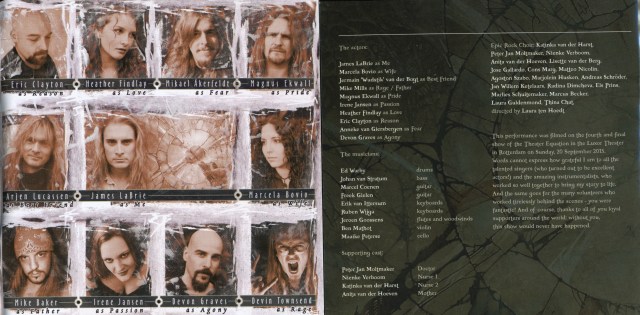
Well, I should just come straight out and state it—there are few things (or perhaps no things) that I don’t love about Arjen A. Lucassen. Is there anything the man can’t do? Whether its composing, performing, recording, designing, or interacting with his legions of fans, Lucassen is the essence of idealized humanity, prog’s Philosopher King. Whether it’s Star One, solo, Guilt Machine, Ambeon, Gentle Storm, Stream of Passion, or Ayreon, I embrace everything he creates. My oldest son, Nathaniel, feels the same. And, now about a decade of students—whether at Hillsdale College, the University of Louisville, or CU-Boulder—have been introduced to Lucassen as well. I always bring in this music and proudly show the Ayreon timeline when I’m lecturing on science fiction, fantasy, and dystopian literature.
Which leads me to admit something else. Well, two somethings. When I first heard that Lucassen would be performing all of THE HUMAN EQUATION as a visual opera, I was thrilled. When I first saw the stills from the show, however, I was downright embarrassed. I thought it looked terribly cheesy. Smoke, a few vague figures, a hospital bed, and a crashed car. As soon as it came out, I purchased it, of course, but I only listened to the CDs. Astounding sound production, by the way. Indeed, my son and I have listened to the album now (both CDs) repeatedly for about 2 months. I refrained from watching the show, however, fearing that I would be sorely disappointed.
Then, for whatever reason, I finally popped the DVD in. Holy schnikees, I am SO sorry that I waited this long to watch it. Not only is the sound even better than on the CDs, but the show is absolutely riveting. Almost too many folks to count come and go on the set, and the singers do an incredible job not only in hitting their marks, but also of actually acting!

This is true opera.
I had assumed the production would be expensive and difficult, but I had no idea just how extensive, expensive, and difficult it must have been until watching this show.
So, I offer two thoughts.
First, Arjen, I’m terribly sorry I doubted you. How utterly stupid of me. You’ve never done anything without perfect excellence, so why I thought this would be different, I have no idea.
Second, for you the progarchy reader, do not fail to enjoy this prog opera as it is meant to be: watched. Get the DVD and immerse yourself. Believe me, there’s nothing better on your screen.
Thank you, Mr. Lucassen. Once again, you prove your absolute genius.





 Not only that but they’ve also been well deservedly nominated as one of the Rising Prog Stars in the new band Limelight Award over the past 12 months in the prestious PROG Magazine. How cool is that!And so pleased for you and your fans.
 “Outlaw country” is an ironic descriptor at best, applied to a music that, without the modifier, began as a lucrative embarrassment to the phonograph salesmen of the 1920s, their newly-minted “hillbilly” record catalogs doing surprisingly well next to the more respectable stacks of whatever maudlin tenor was the operatic toast of the day. Country music’s cornpone reputation grew as its burgeoning industry began to trade on an image based in white southern poverty; but if the marketing suggested the music was as impoverished as its people (a patent falsehood), this achieved for the proponents of such thinking a comfortable outsider-ism, a romantic us-versus-them rewind and replay of Reconstruction that survives in other place in the South as well, through for instance a protracted and continuing — and, unfortunately, necessary — civil rights movement, to this day. So then, what’s this Outlaw business? The term attached to Willie Nelson, Waylon Jennings, and a handful of other country writers and singers who, starting in the late 1960s, were drawn away from the industrial strength, smooth country music produced by “Nashville,” that Tennessee town’s small oligarchy of producers and record labels who held sway over any music distributed under the category of country, and pointedly avoided shifting their audience’s gaze towards the rockier issues or musical themes of the times. Jennings, like Nelson, bucked at this, knew what it meant for their art, and went back to Texas; he turned up the rock’n’roll rhythms he’d played with Buddy Holly, sang what he wanted, and called Nashville out on its phony conservatism. In so doing, Waylon and the country outlaws — and the new southern bands like the Allman Brothers and Lynyrd Skynyrd — found a younger, national country audience, and also reminded rockers that their favorite music was as much country as blues.



 Progarchy