Tony Banks in Rolling Stone on whether he listens to current rock music:
I’ve never really been connected as a listener since about 1968. There’s so much music, and I’m totally disconnected now. People talk about these people, and I’m sure I’ve heard them. I keep the radio on. Certain acts I do like — I’ve heard Coldplay, and I like them. I hear of people like Kanye West, and I have no idea who they are or what the music is. It’s probably not for me. It’s normally for a younger audience than me. I’m 65 now. I don’t feel I’ve moved away at all, though. I love the sound of heavy drums and stuff; I’d certainly rather hear heavy metal than any rap or anything. I still listen, but probably more to old stuff, I suppose. I think rock music has left me behind more than I’ve left it behind. I’m working in the orchestral world now, and that seems to be working for me. People seem to want me there.
And even beyond the streaming service, the new version of Apple’s signature music software seems especially broken. In the name of creating a “complete thought around music,” iTunes 12 has crammed a streaming service and a media library and a recommendation service and a file store and a device manager into one interface. The sum is that nothing “just works”—and MP3s especially don’t work well.
…
Apple has already discontinued its iPod Classic, the last media player that could conceivably let you tote around your entire music library in one device. The company is floating to a streaming model.
If classical listeners are ill-served by streaming services, though, they will stick with music files; and that means they represent, as a bloc, the set of listeners who will continue to maintain personal libraries of owned music even as the larger public rents their digital music instead.
…
The CDDB is the database which iTunes used to detect what was on a CD while ripping it.
Classical is not the only genre that works poorly with this tagging system, said Jonathan Sterne, author of MP3: The Meaning of a Format, a history and meditation on the technology. Audiobooks, lectures, and sound art don’t really adapt well either.
If anything, said Sterne, the long-playing record and the compact disc—the two great audio formats of the late 20th century—might have been special cases.
With both the CD and the LP, he said, “it just so happened that things that were of interest to the broader world of people who made recorded media, and people who were in the music industry, lined up with those of classical performers and audiences.”
Analogously, perhaps the technology for prog also peaked with the gatefold LP?
Or with the 70-minute epic prog CD that had a fold-out booklet with liner notes and poster?
It’s time for our Weekly Featured Product! This week we’re featuring the upcoming release from Neal Morse, Morsefest 2014 LIVE and with it, announcing the winner of our Morsefest 2015 VIP Giveaway! This live release contains over 5 hours of great performances including the entire Testimony and One albums plus special encores of the Spock’s Beard classic, “The Light” featuring Alan Morse, and the Transatlantic epic “Stranger In Your Soul.” Also included is a behind-the-scenes documentary with footage of Neal’s exclusive acoustic concert, rehearsal footage, “Name That Prog Tune” game with Mike and more! And now, we’re excited to announce that the winner of the Morsefest 2015 VIP Gold Package is Philippe Ranellucci! (email heather@radiantrecords.com to claim your ticket!)
Neal Morse
Morsefest 2014 “Testimony” & “One” LIVE
Available in Double BluRay or a Special Edition 6 Disc Set. Official release date: August 21st, 2015.Pre-order here!
Take a sneak-peek at Morsefest 2014 LIVE!
Filmed during night one of Morsefest 2014 in Cross Plains, TN.
It’s a wonderful true story about a father and a daughter and a shared love of great music!
Here’s just a taste:
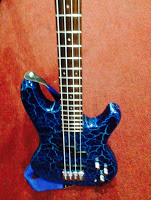
I learned to play bass while I was a young man in the Army, and then when I came back to the States, with my very first paycheck (working at Shakey’s Pizza Parlor, in Waukesha, Wisconsin), I went down to the pawn shop and picked her out — a beautiful blue bass guitar that I ended up giving a name to later on, Betsy. I played countless hours over the next five years, jamming with a number of other musicians, practicing and improvising on my own, playing along with tapes and records. I experimented with various amps and effects. Out of necessity, I learned how to use a bass along Lemmy-lines, like a rhythm guitar, but instead of just overdriving it, I ran it through distortion and a bit of chorus into a 200 watt power preamp, down into a 15-inch speaker, with my old 12-inch practice amp taped into the circuit as well.
So, when my daughter asked, “Dad, can I take the bass home?” I had to think — and feel my way through a surprisingly tough decision. I deliberated over it a long time, both by myself and with my wife. And at the end, I made the right decision — but it was tough.
No list of classic female bass players will ever be complete—there’s always one more name to add, one more bass riff to savor, one more argument to be had over who is over- and underrated.
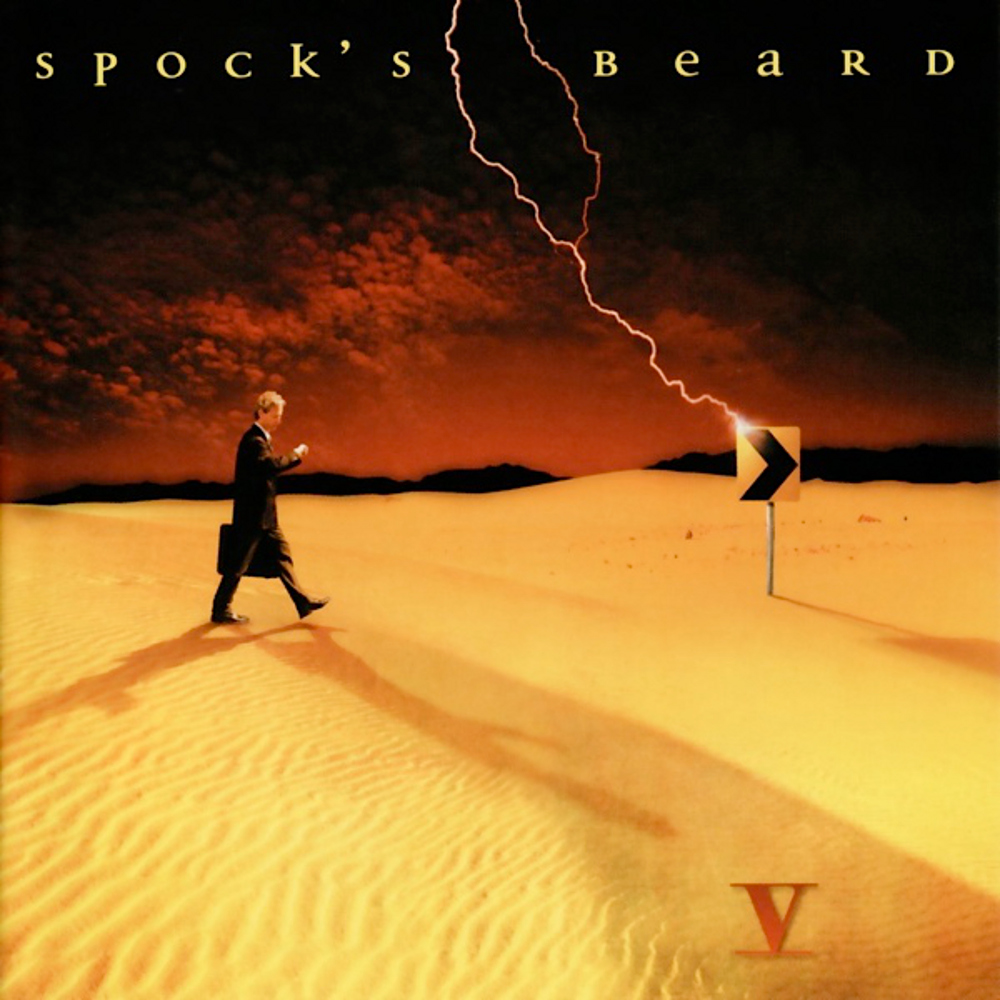
Retrospective on Spock’s Beard, V (Metal Blade/Radiant, 2000). Produced by Neal Morse and Spock’s Beard. Tracks: At the End of the Day; Revelation; Thoughts (Part II); All on a Sunday; Goodbye to Yesterday; and The Great Nothing.
All tracks written by Neal Morse except Thoughts (Part II), written by the Morse brothers; and Revelation, written by the Morse brothers, NDV, and Okumoto.
Even the cover is brilliant, foreshadowing Neal Morse’s forthcoming moment at Damascus.
I was haunted continually by the cruel irony of it all; I had a gift to give to the world, but no recipient to pass it on to.
–Neal Morse, TESTIMONY (the book)
Two days ago, I posted my reflections on hearing Transatlantic’s SMPTe for the first time. I treasure those memories. At the time, I’d only been married about a year and half, I already had a one-year old son, and my wife was VERY pregnant with child #2 (who has grown up a serious Neal Morse fan). I was also in my second full year of college teaching, and I was working on my first biography.
It’s hard if not impossible for me to separate my love of Morse’s art from my own professional life. I’m pretty sure I was the first person in Bloomington, Indiana, to purchase THE LIGHT during graduate school, and Morse’s music has remained a constant soundtrack to all my writing—whether books or lectures. My entire family shares my love of Morse’s music, and my wife and I eagerly await joining in the celebration at Morsefest 2015.
And, as I mentioned in the previous post, Transatlantic’s SMPTe has hardly aged. Indeed, it sounds just as grand today as it did fifteen years ago. I ended that reflection of SMPTe thanking Transatlantic for introducing me to The Flower Kings. But, there’s more. So much more. It’s not just Transatlantic that came out of the year 2000. There’s Flying Colors as well, all of Neal Morse Band releases, Yellow Matter Custard, and the list goes on. . . .
And, yet, I’m not sure I should express any surprise that Morse has produced so much since Transatlantic’s first album. Think about the years between the release of THE LIGHT and SMPTe. In just one half of a decade, Spock’s Beard released five albums in five years, a cd of rarities, and four live albums. And, Neal Morse released a solo album. Morse is nothing if not full of energy. Ceaseless and abundant energy.
Equally impressive, just think about the astounding maturation of the sound of Spock’s Beard. It is nothing short of startling. Of course, THE LIGHT is a classic. But, compare it objectively to V. Spock’s Beard is a band that grew decades rather than years between 1995 and 2000.
Last night, I went back to look at the views of “V” from the time of its release, and I was rather surprised to see lots of criticism—that is, of the negative sort. SB is doing nothing new here. The band did this here or that there. Blah, blah, blather, blather. Not to be too rude, but give me a break. There was almost no discussion about the beauty of the album or Morse’s ability to evolve so quickly over such a short period of time or the excellence of NVD’s drumming or. . . the list goes one.
Bizarre.
V is, at least to my years, pretty much perfect. Whereas THE LIGHT was angry and angular, V is humble and organic. THE LIGHT is fascinating, but V is gorgeous. Suffice it state, I love both albums but for very different reasons. If someone asked me for the best Spock’s Beard album over the first five, there’d be no question that V would be it. I would proudly introduce them to this as the best of the first five SB releases as well as a masterpiece of third-wave Prog. I thought this in the year 2000, and I think it even more in the year 2015. V is a masterwork at every level. It’s playful without being childish, and it’s innovative without being quirky. Every musician gives his absolute all, and Morse ably mixes rock, pop, country, classical, and even some Latin. Yes, SB fans, fear not. Señor Valasco lurks somewhere around the corner of several passages.
V is the fulfillment and culmination of everything that came before it. And, in its textures and language, it is an intense and stunning thing.
I will also freely admit that no small amount of nostalgia makes me like this music from 2000. At age 47, it’s hard not to divide the world into pre 9/11 and post 9/11. The world before–at least in the U.S.–feels much more innocent. Compare the innocence of V with the rather angsty feel of SNOW or “We All Need Some Light” from LIVE IN AMERICA vs. LIVE IN EUROPE. The song might as well be an entirely new one after the horrific events of 9/11.
The editors of Progarchy and I have an agreement that we will avoid overt discussions of religion and politics. So, a trigger warning–and a request for forgiveness as I delve into the former. And, please know that what I offer is only personal speculation and nothing more.
Interestingly enough–and I have no idea how to account for this at any rational level–V turns out to be rather Christian in its feel as well as in its essence. Yet, when V came out, Morse was still 2 years away from his conversion. I might account for this by Morse seemingly much more comfortable with his own voice and his own failings (and, consequently his own successes) on V. The lyrics exude charity, honesty, humility, resignation, and Stoicism as well as passion. V might also be–at least from a Christian perspective–Morse lessening his will and preparing himself for the reception of grace. I’ve never met Morse, so I have no personal knowledge of any of this. All of this is merely a guess and a hunch. But, the prophetic path that Morse lays out is, to say the least, uncannily accurate on V.
You’re doing fine, it’s not too late
To lay your burden down
And walk through heaven’s gate
Try to find a way
Try to say goodbye to yesterday
Goodbye to yesterday, say goodbye
Try to find a way
Try to say goodbye to yesterday
Goodbye to yesterday, say goodbye
You’ve got to find a way to say goodbye
–Neal Morse, Spock’s Beard, “Say Goodbye to Yesterday”
And, “The Great Nothing” is a sequel, an answer really, to “The Light.” If The Light is anger and angular weirdness, “The Great Nothing” is resignation and guarded hope. Even in failure, doing the right thing is success. The “Great Nothing” is one of the best rock songs ever written. It is organic and whole. The lyrics describe so beautifully the unbought grace of life.
One note timeless
Came out of nowhere
It wailed like the wind and night
It sought no glory
It added no meaning
Not even a reason why
No thought
No need to say something
No message to sell
It played without a buzz or a showing
Out of the great nothing
It came without fail
–Neal Morse, Spock’s Beard, “The Great Nothing”
It’s also interesting to note that Morse was not alone in a transition. Think about the difference between Rush’s TEST FOR ECHO and VAPOR TRAILS at the same time. Granted, events threw Peart’s life into pure chaos, but the transitions occurred nonetheless. Or, more recently, thank about Steven Wilson’s move from Porcupine Tree to solo career. Morse transitioned from Morse 1.0 to Morse 2.0 between V and SNOW, and he gives full credit to his own conversion and acceptance of grace. Who are we to deny this? After all, the evidence suggests this is true, and whatever relationship Morse has with God is a rather intimate and personal one.
I, as one man, thank each profoundly for the gifts bestowed upon the world. V is a treasure. And, so is SNOW, TESTIMONY, ?, SECOND NATURE, and so many others.
Ladies and gentleman, Mr. Neal Morse, from Mars, Los Angeles, Nashville, and Heaven’s Gate.
Maybe it’s the professional historian in me, but I love dates, and I love anniversaries.
This year is the fifteenth anniversary of Transatlantic’s first album, the rather stunning and never aging SMPTe.
I’d not heard of the project until one of my students handed me a copy of the CD in the fall of 2000, about six months or so after its release. I knew Morse (I’d been one of the first–if not the first–persons in Bloomington, Indiana, to purchase THE LIGHT from Spock’s Beard), I knew Trewavas (having been a Marillion fan since BRAVE), and I knew Mike Portnoy, having purchased every Dream Theater release since 1992’s IMAGES AND WORDS. Roine Stolt? Didn’t have a clue at that point, though I’d heard of The Flower Kings.
My first reaction upon seeing the CD cover was one of elation. This looked like a very modernized Yes cover. And, of course, I loved the starship/blimp. I thought the album title, SMPTe, was kind of weird, as I didn’t quite get why the names of the members were so important, but, then, it was a “supergroup.”
Looking at the credits, I thought, “Ok, this is a Morse project. I wonder why he isn’t finding enough fulfillment in Spock’s Beard?” Not that I knew much about anything going on in any of the bands represented in Transatlantic. I knew the music, but I didn’t know any details about any of the bands.
In fact, the only real music news I kept up on at the time was for Rush, Yes, Tears for Fears, and Talk Talk. Admittedly, I did a very good job of keeping up with these bands, but I was aided by some really good user groups and news groups (remember those?!!?).
When I put the Transatlantic cd on my stereo, I was completely floored. The first minute of sound effects not only grabbed me, but all 31 minutes of the epic rooted me in place. I was utterly blown away. Yes had given us songs at 22-24 minutes, and Rush had come close, but 31 minutes? Holy schnikees. This was flat out amazing. Then, “We All Need Some Light,” which I thought sounded much like a Spock’s Beard song. Thus, I Iiked it. And, it was the perfect breather after “All of the Above.” I didn’t fall in love with this track, though, until I heard it live on LIVE IN AMERICA.
The third track, “Mystery Train,” really caught my attention as well, pulling me back into the depths of the album. I loved the psychedelia of it, and I was especially taken with the Beatle-esque refrain. This was an updated version of something off of the MAGICAL MYSTERY TOUR–yet it was an homage not a mimicry.
If I’d been captivated by tracks 1 and 3, I was once again thrown into a tizzy as I listened to the sixteen minutes of “My New World.” The references to the Doors and Jimi Hendrix sold me. And, I’m a sucker for Stolt’s voice. As soon as I heard this album, I immediately purchased all of The Flower Kings up to that point.
SPACE REVOLVER, by the way, became and remains one of my top ten favorite all-time albums.
As I looked back over the first four tracks of SMPTe, I came to realize how very different each song had been. There was no distinctive “Transatlantic” song. They each hit me in different ways.
Then, as though I deserved dessert (which I didn’t!), Transatlantic gave me a remake of one of the best Procol Harum songs ever written. Granted, it wasn’t “Simple Sister” but it was the next best thing.
When Transatlantic played live over the internet, I listened. When the live album of that recording, LIVE IN AMERICA, came out, I bought it–the day it came out. And, I’ve done the same with every single live or studio CD since. I will admit that I was horribly shocked by Portnoy’s language on the live releases. At the time, I was only recently married. My wife comes from a very conservative Texas family, and she knew nothing about prog. As I was listening and Portnoy said inappropriate things, I cringed. Astoundingly, my wife either didn’t hear Portnoy or chose not to hear. She’s now as much a Morse/Portnoy fan as I am. So, all’s well that ends well!
I will admit that it’s a bit hard for me to accept that I first heard SMPTe fifteen years ago. At that point, I was newly married, and my oldest child was just a year old! Now, he’s sixteen, and he has six siblings! Sheesh.
And, my wife is now a prog fan. Again, the times do change.
A huge thank you to Morse, Portnoy, Trewavas, and Stolt. That one album from a decade and a half ago introduced me to the Flower Kings, and it made me realize that third-wave prog was and remains pure, unadulterated love and beauty.
I began writing this post several months ago, in January, carried along on the brief rush of excitement that comes with a new year. “2015! How about noting a bunch of anniversaries of great albums?” And, in fact, one of the great strengths of Progarchy.com is the sense of music history and the awareness of anniversaries: “Forty year ago….thirty years ago….twenty-five years ago…twenty years ago…”, as opposed to the dominant model out there, which is “Forty minutes ago…thirty seconds ago…twenty tweets ago…” But then life overwhelmed me and the burst of focused energy dissipated for a while. Now it’s back. Best strike while the vinyl is hot—or something along those lines.
The idea here is very simple: I listen to hundreds of new albums every year, along with hundreds of older albums that I come back to for various reasons; but how much of that music has real staying power? And what, in the end, makes a person return repeatedly to This Album rather than That Album? Sure, of course it is because of impeccable taste and a rare instinct for timeless music. (Duh.) But there is a wonderful mystery to it all, for so much of what resonates in a particular album comes from accidental things: the time, the place, the event, the moment. Certain songs bring back great memories; certain songs make you want to jump off a cliff (yes, I’m looking at you, Olivia Newton-John’s “Physical”).
But it isn’t simply a matter of nostalgia, which can only go so far; it is, I hope, more often a matter of discovery, of hearing something new—or, in some cases, hearing something old and suddenly hearing it. Really hearing it.
My criteria is this: what albums from 60, 50, 40, 30, 25, 20, and 10 years ago do I still listen to now on a regular basis? And never tire of hearing? And why? With that, here goes!
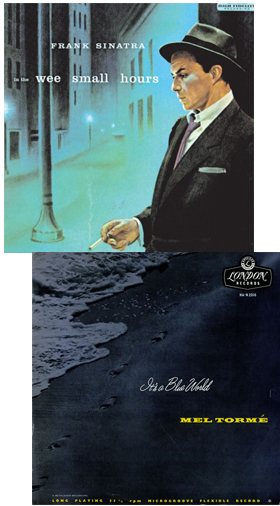
1955: In the Wee Small Hours by Frank Sinatraand It’s a Blue World by Mel Tormé. I was not raised on Sinatra’s music; quite the contrary—I was raised on decent hymns and mediocre to rotten “Christian” music; I hardly paid attention to Top 40 pop and rock until I was in junior high. And I didn’t really listen to Sinatra or Tormé until a dozen years ago. Prior to that, I simply didn’t “get it”. Then I did. Why? I’m not sure. But since then, I’ve collected some 1300 Sinatra songs. The Chairman of the Board produced many classic albums, but this one is my personal favorite: dark, lush, aching, beautiful, gut-wrenching, perfect. I sometimes fall to sleep listening to it, especially when it’s 2:00 in the morning and I’m wide awake. Sinatra had the rare gift of making you, the listener, believe The Voice was singing only to and for you. It’s impossible to describe; it simply has to be heard and experienced. And don’t forget: Sinatra is the God Father of Prog. Really. Sinatra, by the way, was born a hundred years ago this year.
Tormé did not have the edge or darkness of Sinatra, nor did he ever plumb the depths of emotional despair as did the legend ten years his senior. But Tormé had range, talent, and genius to burn, not just as one of the greatest vocalists of the 20th century, but also as an accomplished songsmith (he penned 250 songs or so), fabulous arranger, top-notch drummer (and decent pianist), novelist, biographer, author, actor, screen writer, consummate showman, and collector (guns, cars, movies, etc.). It’s a Blue World is a lush, impeccable set of songs, likely influenced by Sinatra’s Wee Small Hours. While Sinatra packs an emotional punch, Tormé thrills with pure beauty and dazzling musicality, all delivered with an effortless ease that reminds me of watching Roger Federer play tennis at Wimbledon. Bing Crosby, asked late in life to name his favorite musicians, named only one vocalist–Tormé–saying, “Any singer that goes to hear this guy sing has got to go and cut his throat.” For a taste, check out Tormé singing Duke Ellington’s “I’ve Got It Bad, And That Ain’t Good”. Continue reading “60 Years, Twelve Albums, One Man’s Favorites”→
Yes, I do plan to add some actual NEW content very soon (reviews, Top-Ten lists, etc.) but for now, here is another song that has some nascent proggy elements that I really like.
It’s not the killer “rock” chorus (which is good on its own merits) but the almost Genesis like vibe around the 1:18 to 1:50 mark, and again from the 2:25 to 3:00 mark that earn this track inclusion.






 Progarchy