The album Coalesce has been two years in the making. And it sure does show. Skilled attention to detail and an intense musical intelligence shines forth on this album.
Nine tracks of ambient prog metal awesomeness are kicked off by “All in Now,” which is available here as a free download.
The band comments on the track:
Pummeling riffs and soaring ambient lines are complemented by clean melodies and harmonic backings, defining our signature sound.
Lyrically, “All in Now” delves into our current state of worldly affairs; how we connect through the intangible web of communication, watching our spiritual awareness expand with the overflow of information.
Here’s a guide to the lyrics:
Verse 1
Multiplying the social
Connectivity wires us together
Questioning all the doubtful
Intertwining the need for the censor
Chorus
Breathe in to allow
Impulsive pure presence
All in now
All in now
Emotive pure essence
Verse 2
Uncertain futuristic
Ideology, transient moments
All experience is cyclic
Periodically forced to torment
Bridge
All In Now
Written by: Mark Weatherley and Marlain Angelides
Arranged by: Ascending Dawn
Ascending Dawn are: Constanze Hart, Mark Weatherley, Owen Rees, Marlain Angelides
As I’ve noted too many times in these pages, I’ve been rather proudly listening to prog since the tender age of four or five, all the way back to 1972. I’m the same age as Steven Wilson and Will Ferrell, not completely without surprise, a child born in the so-called summer of love. Fortunate to be raised in a family that cherished all types of great music and the youngest of three boys, I inherited my tastes from good sources. I heard the earliest of Yes and Genesis as a child, but nothing moved me at the time as much as Yessongs—in its music as well as its stunning artwork. My first political memory is of Richard Nixon resigning (yay!), but my first musical memory is opening that three-album treasure, Yessongs. What an invitation. Floating islands, some idyllic wildlife, and weird looking guys. The mystical called to me, and I gladly immersed myself in the wild world of Roger Dean.
Now that I’ve once again established my “prog street cred,” let me jump to the present. Having listened to prog for forty years and having reviewed it for the past decade or so, I’ve never encountered a year like 2014. Yes, this could sound downright silly. No year is exactly like any other year. But, as Andy Tillison and Brian Watson have so thoughtfully argued, we’ve been living in a third wave of progressive rock since about 1994.
A real work of genius, Andy Tillison’s NOT AS GOOD AS THE BOOK.
By the way, if you have not yet, you should read Andy’s discussion of Third Wave Prog in the novella accompanying the album, NOT AS GOOD AS THE BOOK. Andy is well known for his complex and deep music, his immense integrity, and his snappy dressing—but he should also be recognized for his writing. He is truly a master of all he does, and the world breathes a little easier because of genius. His discussion of Third Wave Prog comes on pages 54-55 of the novella. Indeed, NOT AS GOOD AS THE BOOK is so filled with insights and imaginings, that an academic course could be taught on it.
Back to our history and chronology. 2009 felt excellent and comfortable, as did 2010, 2011, 2012, and 2013. Each year, I thought, “this is THE best year ever in prog!” Not that I’m innocent of hyperbole, but I meant what I wrote each year. And, I also believe that the music being produced right now—not only in terms of quantity but much more importantly quantity—is the best since the genre first began. What Yes and Genesis produced in the early 1970s might very well be called a “Golden Age,” but we’re not living—in any, way, shape, or form—some kind of “Bronze Age of Prog.” If what was being produced in 1973 is gold, then what’s being produced now is Platinum.
Of course, the world of 2014 is not the world of 1974. But, this is as true of the state of the world (very glad you’re dead Soviet Union!) as it is in Prog (good riddance, Sony Records!) I’ll happily dance on the grave of the communists and the corporations. Foul conformists and materialists, all! May the abyss take them.
And since we’re on the bad news, there have been a number of nasty surprises for me this year. I think Anathema hit its best with the stellar live DVD, Universal. Sadly, its follow up, Distant Satellites, is as devoid of any real ideas as Universal is brilliant. The same, I fear, is true of the new Lunatic Soul. The albums of each reveal a profound and unhappy exhaustion.
One happy surprise for me in 2014, however, came from a reexamination of Steven Wilson’s The Raven. I still believe it’s nothing but a rehash and reworking of Andy Tillison’s work. But, if you have to imitate, you might as well imitate the best.
One of the finest albums of 2014.
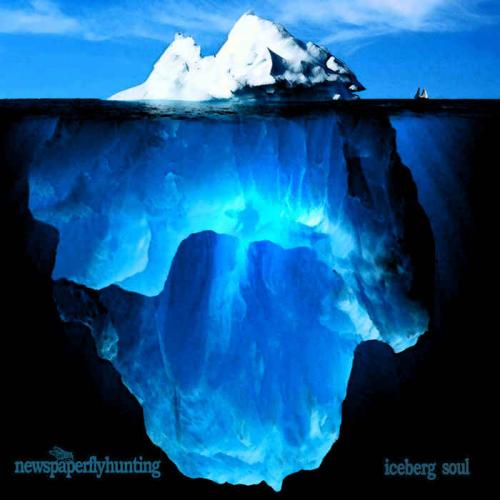
And, yet, so many, many great albums came out this year. Really, give a good listen to Distant Satellites and then give an equally good listen to Newspaperflyhunting or any of the bands listed below. Anathema simply sounds dead. Newspaperflyhunting? Holy Moses, keep it coming!
But, how to place these many new and newly reworked bands of 2014? Musically, 2014 feels like a very different year than 2013. I strongly suspect that the trio of outstanding releases last year—Big Big Train’s English Electric Full Power, The Tangent’s Le Sacre, and Glass Hammer’s Perilous—marked not only the high point, but the conclusion of third wave prog. Simply put, these three albums are so outstanding, that they’ve surpassed the work of first and second wave prog. The grandchildren have outlived and outperformed their grandfathers. Not that the grandchildren could have done any of it without the grandfathers. . . but this is always true. Granted, I’m quite fond of Roman republican notions of piety, but no progger worth her salt is not. Of all participants and fans of genres of music, we proggers lovingly embrace pietism, genealogy, and lineage. Only the true jazz lovers come close to us in our respect for those who came before. Simply put, those who love prog are as much progressive as they are reactionary. No shame in this.
But, Fourth-Wave Prog? What might this be? I don’t think it started this year, but it seems to have become prominent now. Though I’m not entirely willing to commit to this (or any of this re: 4th Wave; I’m thinking out loud), I think we could probably tag ubermensch and Anglo-Saxon Guitar God, Matt Stevens, as the spearhead of the movement, an eclectic one to be sure. I think that other great Anglo-Saxon (what is it with you English people?!?!?) bard, John Bassett.
Let me first try to define what Fourth Wave might be with the list of the best artists of the past year: In no particular order: Jason Rubenstein, Salander, Fire Garden, Newspaperflyhunting, John Bassett, Matt Stevens, Fractal Mirror, Andy Tillison, Galahad, Glass Hammer, Cailyn Lloyd, NAO, Tin Spirits, Simon Godfrey, Flying Colors, and Heliopolis.
“Pull Me Under” is the single now pre-released from Adria’s forthcoming EP. She has a great voice and I have always loved her magnificent work with All Eyes on Saturn on their extremely hard-to-find but totally brilliant EP, “Where the Shadows Find Their Homes.” Check out her new music now on YouTube:
Patrick Moraz relates a nice little piece of Yes history:
“We had decided to do some writing — starting in 1975, when I was also helping Chris and Steve to record some music,” Patrick Moraz tells us. “We had started to compose and to co-compose and to gather material for what was going to be the album Going for the One, and I was very much involved in the composing of ‘Awaken’ at the time. I even recorded one or two tracks in the very, very beginning — in the early stages of sessions in 1976. I recorded some basic tracks for what was going to become ‘Awaken,’ and other tracks for Going for the One. Unfortunately, those were taken out, to allow Rick to come back to the band.”
Moraz ultimately repurposed the work he had done on “Awaken” into a solo song called “Time for a Change,” released in 1977. “When I had to exit Yes at the end of ’76, I started a new album of mine — and I decided call the album Out in the Sun,” Moraz adds. “Maybe I should have called it Time for a Change! It’s a long track; it’s the last track. There were two or three movements that were part of ‘Time for a Change.’ The very beginning of it, the first minute and half or so, reflect what I had actually co-composed for the song ‘Awaken’ itself. It’s a very beautiful kind of piece, which I used as an introduction. What ended up on the record, which is being played by Rick, is completely different than what I would have written.
You can download the entire track “Time for a Change” (9:10) for only $0.99 from iTunes.
If you like purely instrumental prog, check out the fine tunes from OVRFWRD.
OVRFWRD is a four piece all instrumental progressive rock band formed in late 2012. All four seasoned musicians, including drummer Rikki Davenport and guitarist Mark Ilaug, bassist Kyle Lund and keyboardist Chris Malmgren came together with diverse and complex backgrounds and musical influences. Together they have a common goal; to create and perform powerful, colorful, interesting and sonically descriptive music, engaging and pushing forward on the musical journey they have embarked on.
Here’s a taste from the album they put out this year, Beyond the Visible Light. The song is called “Can We Keep the Elephant?”:
The new album from Ascending Dawn is 100% amazing. Be sure to check out its rich textures and atmospheric layers. I declare it one of the best of the entire year!
Take a look at the supercool guitar work on the excellent track “Opposites“:
N.B. This post should be approached with caution. It is at least PG-13, if not NC17. Not for language, but for personal revelation and content. Additionally, I’ve written about one or two of these things before, especially about Peart as a big brother. Please don’t fear thinking—“hey, I’ve read this before.” But, even the few things I’ve mentioned before are here rewritten. Final note: for an exploration of Peart’s Stoicism, see Erik Heter’s excellent piece on the subject, here at progarchy.com.
Neil Peart, ca. 1987.
***
As I’ve mentioned before in these pages and elsewhere, few persons, thinkers, or artists have shaped my own view of the world as strongly as has Neil Peart, Canadian drummer, lyricist, writer, and all-around Renaissance man. I’ve never met him, but I’ve read all of his words and listened to all of his songs. I’ve been following this man since the spring of 1981 when two fellow inmates of seventh-grade detention explained to me the “awesomeness” of Rush. My compatriots, Troy and Brad (a different Brad), were right. Thank God I got caught for doing some thing bad that day. Whatever I did, my punishment (detention) led to a whole new world for me, one that would more than once save my life.
Having grown up in a family that cherished music of all types, I was already a fan of mixing classical, jazz, and rock. Rush’s music, as it turned out, did this as well as any band.
While the music captivated me, the lyrics set me free. I say this with no hyperbole. I really have no idea how I would have made it out of high school and through the dysfunctional (my step father is serving a 13-year term in prison, if this gives you an idea how nasty the home was) home life without Peart. I certainly loved my mom and two older brothers, but life, frankly, was hell.
I know that Peart feels very uncomfortable when his fan project themselves on him, or imagine him to be something he is not. At age 13, I knew absolutely nothing about the man as man, only as drummer and lyricist. Thus, even in 1981, I absorbed his lyrics, not directly his personality. Though, I’m sure many of Peart’s words reflect his personality as much as they reflect his intellect.
Rush gave me so much of what I needed in my teen years. At 13, I had completely rejected the notion of a benevolent God. He existed, I was fairly sure, but He was a puppet master of the worst sort, a manipulative, Machiavellian tyrant who found glee in abuse and exploitation. As a kid, I was bright and restless, and I resented all forms of authority, sometimes with violent intent. Still, as we all do, I needed something greater than myself, a thing to cherish and to hold, a thing to believe in.
I immersed myself in science fiction, fantasy, and rock music. Not a tv watcher in the least, I would put the headphones on, turns off the lights in my bedroom, lock the door, and immerse myself in the musical stories of Genesis, the Moody Blues, ELO, ELP, Alan Parsons, Yes, Jethro Tull, Pink Floyd, and, especially, Rush. I could leave the horrors of my house for roughly 44 minutes at a time.
Scratch, scratch, side one. Zip, turn. Scratch, scratch, side two.
Rock music was the sanctuary of my world. But, not just any rock. ZZ Top and REO Speedwagon might be fun when out on a drive, but I needed a work of art that demanded full immersion. I needed prog. I was not only safe in these rhythmic worlds, I was intellectually and spiritually alive, exploring innumerable realms. Pure, unadulterated escape. But, escape into a maze of wonders.
The first time I heard the lyrics (at age 13, the spring of 1981) to “Tom Sawyer,” I knew Rush was MY band. It seemed as though Peart was talking specifically to me, Bradley Joseph Birzer. That’s right. To 13-year old Brad in Hutchinson, Kansas. Peart was 15 years older than I, and he must have gone through the same things I had. Or so I thought. Again, I knew him only through his lyrics. But, did I ever cherish those lyrics. I lingered over each word, contemplated not just the ideas, but the very structures of lyrics as a whole.
Though his mind is not for rent
Don’t put him down as arrogant
His reserve a quiet defense
Riding out the day’s events
No, his mind is not for rent to any God or Government
Always hopeful, yet discontent [corrected from my original typos]
He knows changes aren’t permanent, but change is
Though I’ve never given any aspect of my life to the Government (nor do I have plans to do so), I long ago surrendered much of myself to the Second Person of the Most Blessed Trinity and to His Mother. While I’m no modern Tom Sawyer at age 47, I still find the above lyrics rather comforting. And, I do so in a way that is far beyond mere nostalgia.
Armed with Peart’s words and convictions, I could convince myself to walk to Liberty Junior High and, more importantly, to traverse its halls without thinking myself the most objectified piece of meat in the history of the world. Maybe, just maybe, I could transcend, sidestep, or walk directly through what was happening back at home. I could still walk with dignity through the groves of the academy, though my step father had done everything short of killing me back while in our house.
[N.B. This is the PG13 part of the essay] And, given all that was going on with my step father, the thought of killing myself crossed my mind many, many times in junior high and high school. I had become rather obsessed with the notion, and the idea of a righteous suicide, an escape from on purposeless life hanged tenebrous across my soul. After all, if I only existed to be exploited, to be a means to end, what purpose did life have.
What stopped me from ending it all? I’m still not sure, though such desires seemed to fade away rather quickly when I escaped our house on Virginia Court in Kansas and began college in northern Indiana. Not surprisingly, my first real friendship in college—one I cherish and hold to this day—came from a mutual interest in all things Rush. In fact, if anything, my friend (who also writes for this site) was an even bigger Rush fan than myself! I’d never met such a person.
Regardless, from age 13 to 18, I can say with absolute certainty that some good people, some good books, and some good music saved my life, more than once. Neil Peart’s words of integrity and individualism and intellectual curiosity stood at the front and center of that hope.
Perhaps even more importantly to me than Moving Pictures (“Tom Sawyer,” quoted above) were Peart’s lyrics for the next Rush album, Signals. On the opening track, a song about resisting conformity, Peart wrote:
Growing up, it all seemed so one-sided
Opinions all provided, the future predecided
Detached and subdivided in the mass production zone
No where is the dreamer or misfit so alone
There are those who sell their dreams for small desires
And lose their race to rats
Even at 14, I knew I would not be one who sold my dreams for small desires. I wanted to be a writer—in whatever field I found myself—and I would do what it took to make it through the horrible home years to see my books on the shelves of a libraries and a bookstores. Resist and renew. Renew and resist. Again, such allowed me to escape the abyss of self annihilation.
Indeed, outside of family members (though, in my imagination, I often think of Peart as one of my older brothers—you know; he was the brilliant one with the goofy but cool friends, the guys who did their own thing regardless of what anyone thought). From any objective standpoint, as I look back over almost five decades of life, I can claim that Peart would rank with St. Augustine, St. Francis, John Adams, T.S. Eliot, Willa Cather, Ray Bradbury, Russell Kirk, and J.R.R. Tolkien as those I would like to claim as having saved me and shaped me. If I actually live up to the example of any of these folks, however, is a different question . . .
I also like to say that Peart would have been a great big brother not just because he was his own person, but, most importantly, because he introduced me as well as an entire generation of North Americans (mostly males) to the ideas of Heraclitus, Plato, Aristotle, Sophocles, Cicero, Seneca, Petrarch, Erasmus, Voltaire, Adam Smith, Mark Twain, Ernest Hemingway, John Dos Passos, T.S. Eliot, J.R.R. Tolkien, and others.
During my junior year of high school, I wrote an essay on the meaning of Huck Finn and Tom Sawyer, based on Peart’s interpretation. I earned some form of an A. In one of my core humanities courses, while at the University of Notre Dame, I wrote my major sophomore humanities term paper about the cultural criticisms of Neil Peart as found in his lyrics to the 1984 album, Grace Under Pressure. Again, I received an A.
I’m not alone in this love of Rush. The band is, of course, one of the highest selling rock acts of all time, and they are just now crossing the line into their fortieth anniversary. Arguably, no other band has had as loyal a following as had Rush. Thousands and thousands of men (and some women) faithfully attend sold-out concerts throughout North and South America to this day. This is especially true of North American men, ages 35 to 65. Now, as is obvious at concerts, an entirely new generation of Rush fans is emerging, the children of the original set.
Telling, critics have almost always despised Rush, seeing them as having betrayed the blues-based tradition of much of rock, exchanging it for a European (and directly African rather than African-American) tradition of long form, complexity, and bizarrely shifting time signatures. Such a direction and style became unbearable for the nasty writers of the largest music magazines. They have felt and expressed almost nothing but disdain for such an “intellectually-pretentious band,” especially a band that has openly challenged the conformist ideologues of the Left while embracing art and excellence in all of its forms. Elitist rags such as the horrid Rolling Stone and equally horrid NME have time and time again dismissed Rush as nothing but smug middle-class rightists.
That so many have hated them so powerfully has only added to my attraction to the band, especially those who came of age in 1980s, despising the conformist hippies who wanted to mould my generation in their deformed image. Rolling Stone and NME spoke for the oppressive leftist elite, and many of my generation happily made rude gestures toward their offices and their offal. I had no love of the ideologues of the right, either. But, they weren’t controlling the schools in the 1980s. Their leftist idiotic counterparts were in charge. They had no desire for excellence. They demanded conformity and mediocrity.
[The best visual representation of this widespread if ultimately ineffective student revolt in the 1980s can be found in “The Breakfast Club” by John Hughes (RIP).]
To make it even more real for me, the parents of Geddy Lee, the lead singer and bassist of Rush, had survived the Polish holocaust camps, and the parents of Alex Lifeson, the lead guitarist of the band, had escaped from the Yugoslavian gulag. Peart came from a Canadian farming community, his father an entrepreneur. No prima donnas were these men. They understood suffering, yet they chose to rise above it. And, of course, this makes the British music press even more reprehensible for labeling the members of Rush as rightest or fascist. Again, I offer the most dignified description for Rolling Stone and NME possible: “ideological fools and tools.”
At age 13, I stared and stared at this image. I loved the look of each of the guys. They couldn’t be more interesting to me.
Enter Rob Freedman
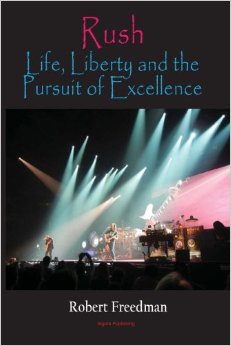
In his outstanding 2014 book, Rush: Life, Liberty, and the Pursuit of Happiness (Algora Press), author, philosopher, and media specialist Rob Freedman has attempted to explain not just Peart’s popularity among his multitude of fans—some of the most dedicated in the music world—but also the Canuck drummer’s actual set of ideas and explored beliefs in his books and lyrics. Not surprisingly, Freedman finds the Canadian a man deeply rooted in the western tradition, specifically in the traditions of western humanism and individualism.
As Freedman notes, one can find three themes in all of Peart’s lyrics: individualism; classical liberalism; and humanism. It’s worth observing that Freedman has formal training in academic philosophy, and this shows in his penetrating discussion of the music as well as the words of Rush.
Cover of Rob Freedman, Rush: Life, Liberty, and the Pursuit of Excellence (2014). A must own.
Relying on interviews with the band, the music journalism (much of it bogus and elitist idiocy) of the last forty years, and actually serious works of Rush criticism, such as that done admirably by Steve Horwitz in Rush and Philosophy (Open Court, 2011), Freedman offers not so much a biography of the band, but rather a map of their intellectual influences and expressions. Freedman possesses a great wit in his writing, and the book—relatively short at 164 pages—flows and flows, time standing still until the reader reaches the end. For all intents and purposes, Freedman’s book serves as an intellectual thriller, a page turner.
As a lover of Rush, I have a few (very few) quibbles with Freedman’s take. Mostly, from my not so humble perspective, Freedman gives way too much space to such charlatans as Barry Miles of the English New Music Express who claimed Rush promoted neo-fascism in the late 1970s. Freedman, while disagreeing with Miles, bends over backwards defending Miles’s point of view, as it did carry immense weight in the 1970s and wounded the band deeply. From my perspective, there is no excuse for Miles. He maliciously manipulated and twisted the words of Peart—using his lyrics and a personal interview—which were as deeply anti-fascistic as one could possibly imagine (paeans to creativity and individualism) and caused unnecessary damage to the reputation of three men, two of whom who had parents who had survived the horrors of the twentieth-century ideologues, as noted above. Miles’s take on Rush is simply inexcusable and no amount of justification explains his wickedness and cthluthic insensibilities toward three great artists. Dante best understood where such “men” spent eternity.
Author Rob Freedman.
I also believe that Freedman underplays the role of Stoicism in his book. The venerable philosophy barely receives a mention. Yet, in almost every way, Peart is a full-blown Stoic. In his own life as well as his own actions, Peart has sought nothing but excellence as conformable to the eternal laws of nature. This is the Stoicism of the pagans, admittedly, and not of the Jews or Christians, but it is Stoicism nonetheless. Freedman rightly notes that Plato and, especially, Aristotle influenced Peart. But, so did Zeno, Virgil, Cicero, and Seneca. This comes across best in Peart’s lyrics for “Natural Science” (early Rush), “Prime Mover” (middle Rush), and in “The Way the Wind Blows” (recent Rush). In each of these songs, Peart presents a view of the world with resignation, recognizing that whatever his flaws, man perseveres. Erik Heter and I have each attempted to explore this aspect of Peart’s writings at progarchy. Heter has been quite successful at it.
As the risk of sounding cocky, I offer what I hope is high praise for Freedman. I wish I’d written this book.
Peart as Real Man
Neil Peart, ca. 2008.
In the late 1990s, Peart experienced immense tragedy. A horrible set of events ended the life of his daughter and, quickly after, his wife. Devastated, Peart got on his motorcycle (he’s an avid cyclist and motorcyclist) and rode throughout the entirety of North America for a year. It was his year in the desert, so to speak.
Then, in 2002, Rush re-emerged and released its rockingly powerful album, Vapor Trails. The men were the same men (kind of), but the band was not the same band. This twenty-first century Rush, for all intents and purposes, is Rush 2.0. This is a much more mature as well as a much more righteously angry and yet also playful Rush. This is a Rush that has nothing to prove except to themselves. The last albums—Vapor Trails (2002); Snakes and Arrows (2007); and Clockwork Angels (2012)—have not only been among the best in the huge Rush catalogue, but they are some of the best albums made in the last sixty years. They soar with confidence, and they promote what Rush has always done best: excellence, art, creativity, distrust of authority, and dignity of the human person.
Peart is not quite the hard-core libertarian of his youth. In his most recent book, Far and Near, he explains,
The great Western writer Edward Abbey’s suggestion was to catch them [illegal immigrants], give them guns and ammunition, and send them back to fix the things that made them leave. But Edward Abbey was a conservative pragmatist, and I am a bleeding-heart libertarian==who also happens to be fond of Latin Americans. The ‘libertarian’ in me thinks people should be able to go where they want to go, and the ‘bleeding heart’ doesn’t want them to suffer needlessly” [Far and Near, 58]
If he has lost any of his former political fervor, he’s lost none of his zest for life and for art. “My first principle of art is ‘Art is the telling of stories.’ What might be called the First Amendment is ‘Art must transcend its subject’.” [Far and Near, 88]
These twenty-first century albums speak to me at age 47 as much as the early albums spoke to me at age 13. I’ve grown up, and so has Rush. Interestingly, this doesn’t make their early albums seem childish, only less wise.
After my wife and I lost our own daughter, Cecilia Rose, I wrote a long letter to Neil Peart, telling him how much the events of his life—no matter how tragic—had shaped my own response to life. I included a copy of my biography of J.R.R. Tolkien. Mr. Peart sent me back an autographed postcard as thanks.
I framed it, and it will be, until the end of my days, one of my greatest possessions.
After all, Neil Peart has not just told me about the good life, creativity, and integrity, he has shown me through his successes and his tragedies—and thousands and thousands of others—that each life holds a purpose beyond our own limited understandings. As with all things, Peart takes what life has given and explodes it to the level of revelation.









 Progarchy