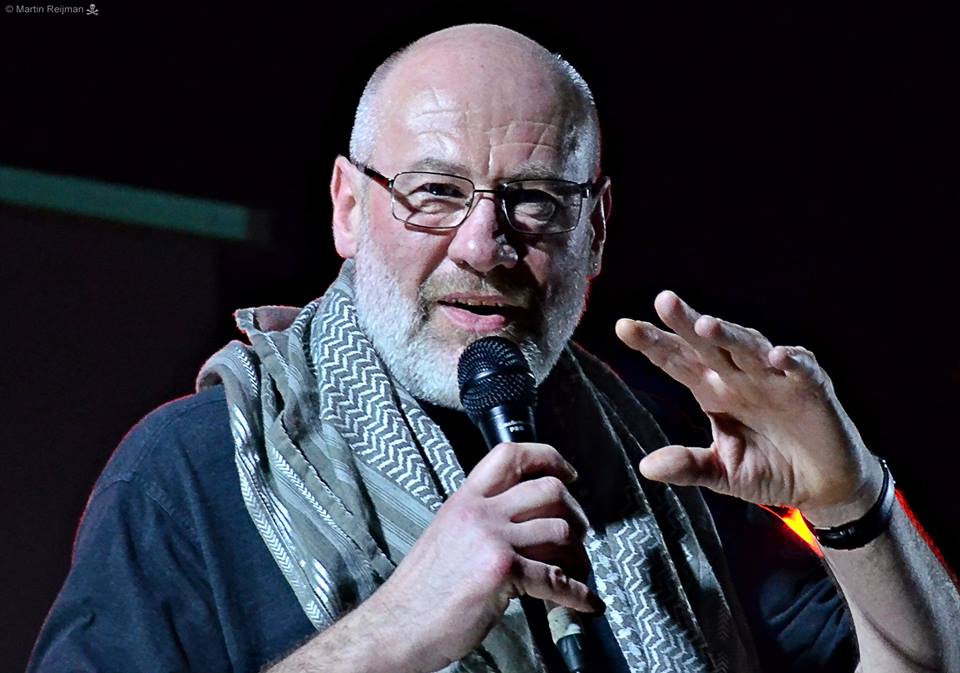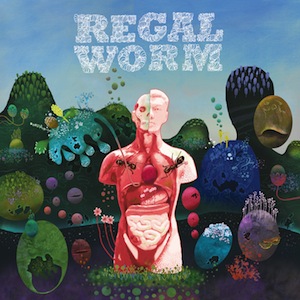
Wow! Not only did Big Big Train perform the classic hat trick at last night’s CRS Awards! The fabulous Moon Safari from Skelleftå, Sweden, were also heralded with the awards for “Best Overseas Band” and “Best Live CRS Gig”!! So well deserved! Big Big Hooray!!!
This photo was rather unceremoniously stolen from Steve Llewellyn’s Facebook page. Let’s hope he doesn’t mind!
If you’ve not noticed before, we progarchists kind of, sort of, really, really like Big Big Train. So. . . it’s with much excitement that we report this.
The Classic Rock Society of the U.K. has just awarded BBT with three well-deserved awards: 1) David Longdon for best vocals; 2) “East Coast Racer” as the best track of the year; and 3) Big Big Train as Great Britain’s best band.
The progarchists of progarchy hq in central Hillsdale County of Michigan are doing a little victory dance for our friends across the Atlantic.
Congratulations to Greg Spawton, David Longdon, Nick D’Virgilio, Dave Gregory, Danny Manners, Andy Poole, and Rob Aubrey. And, of course, to Jim Trainer as well. Amazing and brilliant and wonderful.
Early Rush: John Rutsey, Geddy Lee, and Alex Lifeson
Rush landed in my life like a broken window when I was thirteen, that weird, shard-like spiral guitar intro to The Spirit of Radio busting things open for me in 1980. It wasn’t an easy sell at first — Rush is a studied taste and I’d still say on most Rush records for every moment of musical or lyrical poetry there are two that are just brainy. What maybe distinguishes the band, though, is their absolute, all-in commitment to THEIR muse as a trio. It’s been mentioned in these pages before, but worth reiterating: Rush is as powerful now as they were 40 years ago, despite just about every obstacle you can throw at an artist.
Forty years ago next month Rush released its first, self-titled album. In its way it’s one of the most intriguing records in their catalog because, unlike almost every other one of their albums, it is a product of its time and shows it. That it’s also a prime example of early 70s hard rock is often lost in the various fanboy legends of Rush, where all songs are anthems and where first drummer John Rutsey is alternately pitied or maligned for not being Neil Peart. Rush the album is a tight, finely-walked tour of guitar rock, a thick, sludgy, power trio slab that screams North American midwest, 1974. There are odes to hard working folks, stoner rock birds flipped at the Man, ballads and blues boogie admonitions to the ladies, and hard luck stories from the rock and roll road. This was not a lightly-traveled terrain: Mountain, Robin Trower, and armies of Uriah Heep-ish bands were all pounding to dust the path blazed by the Yardbirds then Cream then Zep, and Rush was very much a part of the meat-and-potatoes rock circuit that included bands like REO Speedwagon and the Amboy Dukes.
But Rush intrigues for a number of reasons, not least of which because as a record it shows a working rock band fully constructed. They were young but had paid their dues, there was no doubt, witnessed by the super tight performances. And looking back at the record 40 years on, there are moments when Alex Lifeson’s chord voicings or Geddy Lee’s bass patterns seem to jump forward to their present work. They had a kernel of a sound and a whole lot of chops, and I’d argue that when they replaced Rutsey with Peart they possessed an uncommon strength, which allowed them to deconstruct their sound and build it up again, to eventually realize a vision absolutely unique in rock.
Technically, too, the record has a lot to recommend it. Working with limited technology, even for the era, the band created an album with a saturated, present guitar sound that was clearly evolving with what could be reproduced on a record. The separation is very good, although the drums don’t always pop like they could, probably as a result of the guitar’s appetite for bandwidth, rather than Rutsey’s playing, which swings with the best hard rock records of the time. The extended soloing space, too, is defined and disciplined, guitar-focused and deriving more than a little from the studio recordings of Led Zeppelin, one of Rush’s early beacons. Rush had their ears on this recording, and I don’t think it’s any mistake that more recent stoner and heavy rock records have a lot in common sonically with Rush’s first.
Thirty years after Rush released its first record, they recorded Feedback, an homage to their influences. Played back to back with Rush, the two albums almost seem of a pair, their respective sounds not that unlike, and as if the songs on Feedback might have made up the rest of the set had you seen the band in ‘72-73. Feedback arrived two years after Vapor Trails, when Rush re-asserted its harder, guitar-focused edge, and began a phase of fine work that continues up to their most recent record, Clockwork Angels. As the title of that album suggests, this is a band that appreciates the spiral and the cycle of their art, the seed of which can be heard, if you’re listening for it, on Rush.
First Things, a moderate to rightish Roman Catholic periodical, has a nice piece on Neal Morse, progressive rock, and Christianity this morning. Foht is a great writer, and he certainly offers much to think about.
On February 9, I had the pleasure of finally seeing one of my favorite bands for the first time—a progressive rock supergroup called Transatlantic. Because all of my friends are too respectable for such things, I made my journey to the concert alone. For a progressive rock supergroup, however, Transatlantic has an excellent pedigree: The band was founded in 1999 as a side project of four progressive rock musicians from America and Europe (hence the name Transatlantic): Neal Morse, then of Spock’s Beard; Mike Portnoy, then the drummer for Dream Theater; Roine Stolt, the lead guitarist of The Flower Kings; and Pete Trewevas, the bassist from Marillion.
Neal Morse represents part of the growing movement of Christian progressive rock, having converted to Christianity (of a sort) in 2002. The overall terrible quality of Christian rock is well-known, and since progressive rock is already a somewhat disreputable genre, you might think Christian progressive rock is the worst of both worlds. But you also might be wrong.
Hollow Branches recently released the new single “Weave Unweave” – the third single of a total of four, all of them a part of an EP called “The Hum” which are being released one track at a time.
Produced by Marius Sjøli and Robert Osgood, and with recording ongoing through the first winter months of 2013/2014 at Sjøli and Catl Prod Studios, “The Hum” is a stripped back collection of songs which the duo plan to release separately across the winter 2013/2014 – as each mix is completed.
“Weave Unweave” along with the singles “The Utopian” and “Silence so Clear” can be streamed on Bandcamp, Spotify and is also available through iTunes and Amazon.
Robert Osgood: Vocals, guitars, keyboards and sound design
Marius Sjøli: Guitars, backing vocals, keyboards and sound design
New upcoming full length album:
Hollow Branches also recently recorded drums for a upcoming full length album at IKA Studios. Contrasted with our previous full length, the acoustic driven, “Okanagana Waves”, the new album has a greater focus on electric guitar, vintage synth, and heavy, progressive arrangements.
Current line up for the full length:
Robert Osgood: Vocals, guitars, keyboards and sound design
Marius Sjøli: Guitars, backing vocals, keyboards and sound design
This post isn’t about music, but John Hughes (1950-2009) did much to introduce my generation to great English New Wave. My ode to him at my other website, The Imaginative Conservative.
In a nice coincidence, during the same time that Brad was writing and has posted his Progarchy Editorial on “The End of Rock,” I have been listening to and enjoying the new Boston CD released back in December, “Life, Love, & Hope.”
Boston has a great sound that can best be described with the adjective “soaring” — as in: soaring guitar riffs, soaring lead lines, soaring organ solos, and incredibly rich layers of soaring vocal harmonies. No wonder their signature album cover look has always been one that depicts guitars as spaceships.
I am happy to report that the new Boston album is a work of excellence. Tom Scholz has always been a perfectionist and he is very famous for his protracted battles with record companies. After he was pressured to use a non-basement studio to re-record the demo tracks for the original Boston album (1976), and after he was pressured to release the second Boston album without being fully happy with it (Don’t Look Back — 1978), Boston albums have ever since only come out at the rate of about one per decade: Third Stage (1986), Walk On (1994), Corporate America (2002), and now Life, Love, & Hope(2013).
Scholz prefers to be a loner in the studio, in order to best pursue excellence through perfectionism. There has always been something wonderfully “prog” about Scholz’s insanely detailed musical devotion. There are abundant examples of musical virtuosity on Boston records, but just take “Foreplay/Long Time” from Boston (1976) if you would dispute placing Boston in the prog pantheon. And Scholz can achieve stratospheric musical heights in just a two minute instrumental — for example, take either “Last Day of School” or “O Canada” from the new album — thus demonstrating how he can soar even higher than what the average prog band can attain in even ten minutes.
It was interesting to read Brad’s editorial and at the same time try to imagine an album like Boston (1976) being released today and achieving similar mass acclaim with sales figures of over 17 million. What a cultural loss that we cannot hear any tracks from the new Boston album being played across all radio stations everywhere! The youth of today are suffering a great deprivation.
For my part, I am thankful that I encountered Boston at the age I did. For me, Boston in effect was “starter prog,” as the excellence that they conveyed in “More Than a Feeling” opened me up to the transcendent possibilities available through music. “More Than a Feeling” was a true revelation, and my love of that song has never changed. It sounds as magical to me now as when I first heard it.
It’s a genuine thrill that Scholz is still devoted to his uncompromising art and that this new album has caught me off guard by being so darn good. Every track is wonderful and I will have to post further at Progarchy about it.
For now, in the spirit of Brad’s excellent editorial, I just wanted to share with you what Scholz writes in the liner notes. His note shows that the heart of rock and roll is still beating, and that the spirit of prog is what animates that beating heart. Now, you may perhaps know that spirit by one of its more well-known names — “The Spirit of Radio” — but for me, because of what I learned early on from Scholz, I have always known that that spirit is a spirit that is indeed “More Than a Feeling”:
When I started recording this album over ten years ago, who’d have thought I’d still be working on it in 2013? OK, don’t answer that. These are all songs from the heart, each of them taking many months of effort to write, arrange, perform and record, always up to the demands of BOSTON’s harshest critic, me. They have all been meticulously recorded to analogue tape on the same machines and equipment used for BOSTON’s hits for the past 35 years.
After the internet and digital file sharing knocked the foundation out from under the music business, it no longer became possible to record a full production analogue album like this one, unless you were willing to do it purely for the art. I found out that I was. But as the years wore on, struggling with obstinate pieces, over-stressed gear, and my own uncertainty, I sometimes wondered if these songs would ever see the light of day. Now, listening to the album, I feel like I have burst from a dark tunnel of seemingly endless solitary work and self-doubt into a bright new world. If any of these songs can brighten your day for a few minutes, it was worth it.
Master of all things keyboard related, Andy Tillison, has just posted this on Facebook. Tillison and Stevens. What form of heaven be this?!?!?!
Pictured during a 26 minute workout based on “Careful with That Axe Eugene” – the recording of the Matt Stevens/ Andy Tillison album has been taking place on an undisclosed planet this weekend. More about this as the improvisations that have taken place are knocked into shape over the next few weeks!!! We have had SERIOUS fun.–Andy Tillison, Facebook, February 16, 2014
Masters among masters: the Anglo-Saxon pantheon–gods of guitar and keyboards, respectively.
Over at Onemetal, the always insightful Chris McGarel has an excellent review of the forthcoming Gazpacho album, DEMON (Kscope). As far as I know, this is the very first review of the album to appear.
These Norwegian purveyors of chilled and eccentric progressive sounds have long been a well-kept secret. Their unique blend of electronic sounds, insistent Radiohead-inspired minimalist beats, dynamic riffing and European folk instrumentation is cherished by a hardcore (and burgeoning) few. Once heard it is difficult not to fall under its spell. Demon is their eighth album.
Nordic jazz has a long tradition of fusing folksong with a cinematic rendering of the vast wildness of the landscapes into which it was born. Gazpacho’s feet are firmly planted in the rock camp though their music too seems imbued with a cold pastoral majesty while facing outwards, taking influences from ethnic traditions with a global and timeless remit. Thematically they have found another story to tell worthy of their stylistic reach.