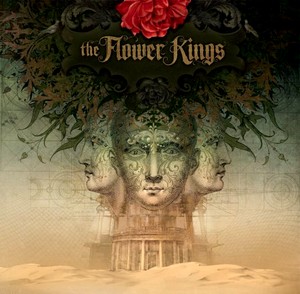
Unlike Eric Perry in his earlier, excellent review, I approached the new Flower Kings album from a position of relative ignorance. I greatly admire Roine Stolt’s work with Transatlantic, but I do not have any Flower Kings in my music library. However, after listening closely to Desolation Rose the past few days, that is about to change!
21st century media provide wonderful benefits (could something like Progarchy have even existed 15 years ago?), but any technology can also be perverted into something terribly harmful. Desolation Rose is a dark and brooding jeremiad on the dangers of corrupt media and government, perpetual war and violence, and religious fanaticism. Freedom is not a given, and Desolation Rose is a dire warning to those who would trade it for “security”, whether by indiscriminately believing what governments and mainstream media tell us, or by neglecting critical thinking when it comes to the claims of deceptive religious figures. Each song segues seamlessly into the next, reinforcing the overall impact of the lyrics. It may take a few listens for them to take hold, but once they do, they are very powerful.
A sampling of some of the most memorable lines (as best I can decipher them; I do not have a lyrics booklet):
“Lies bring comfort to the king and his nation/Like fools, we just stare at the sun.” (‘Tower ONE’)
“In the silent soil of Eden lie the bones of a predator/From the sun and the stars, a dreamless penitentiary.” (‘Sleeping Bones’)
“In silent graveyards we look for saviors/A promised land beyond our prayers” (‘Desolation Road’)
“So if you follow, go look beyond the lies/A brand new kingdom will brighten up the skies/Close to the sea, the river’s getting wider/Take off the blinders, and love will take you higher” (‘Resurrected Judas’)
“We are just the silent masses/The things you need are out of fashion/And so the clock keeps ticking out of time” (‘Silent Masses’)
“When a man is not a man, but hostage to machinery/Will they ever let you out from this dreamless penitentiary?” ‘(Last Carnivore’)
“So the state has become the offender/To the point where there’s no turning back/Now you dream of your new independence/While they tighten their grip round your neck” (‘Dark Fascist Skies’)
“We are stardust and we’re sun-kissed/We are brothers and still we’re strangers” (‘Blood of Eden’)
Just as words and phrases are repeated in the songs, musical themes recur throughout, making the album a remarkably cohesive work. The propulsive drumming of Felix Lehrmann is terrific; Tomas Bodin’s manic organ locks horns with Roine Stolt’s lead guitar and musical sparks result. Hasse Froberg’s vocals are outstanding – full of dark menace one moment, and aching lament the next. Jonas Reingold’s bass work is as melodic and inventive as Geddy Lee’s.
Highlights are ‘Resurrected Judas’, which has a nice “Trick of the Tail”-era Genesis vibe and a graceful, loping guitar solo; the straight-ahead rocker ‘Silent Masses’, with its jaunty piano riff and nimble bass line; and ‘Last Carnivore’, which is very dark and oppressive until a key change brings relief and light. ‘Last Carnivore’ is representative of the album as a whole – from the first track, the band creates an atmosphere of conflict, darkness, and oppression which isn’t relieved until the beautiful and stately ‘Blood of Eden’ makes its appearance near the end. Hearing it is like seeing clouds part and the sun shine through after a violent thunderstorm. However, lest we think everything’s going to be fine, the ‘Silent Graveyards’ show up one last time in a musical coda that ties together the various themes masterfully. Froberg’s voice rises as if he’s framing a question, and it is unsettling to realize that ‘Dark Fascist Skies’ are always lurking around the corner.
With Desolation Rose, the Flower Kings have produced an album of extraordinary power and depth. Lyrics and music combine to pack an emotional punch that cannot be ignored. Detta är en att älska.
I came across this interesting interview of Ian Anderson by Fox News. In it he talks about deciding to play the flute instead of the guitar, Thick as a Brick, Thick as a Brick 2, his current tour, and his next album. Enjoy.
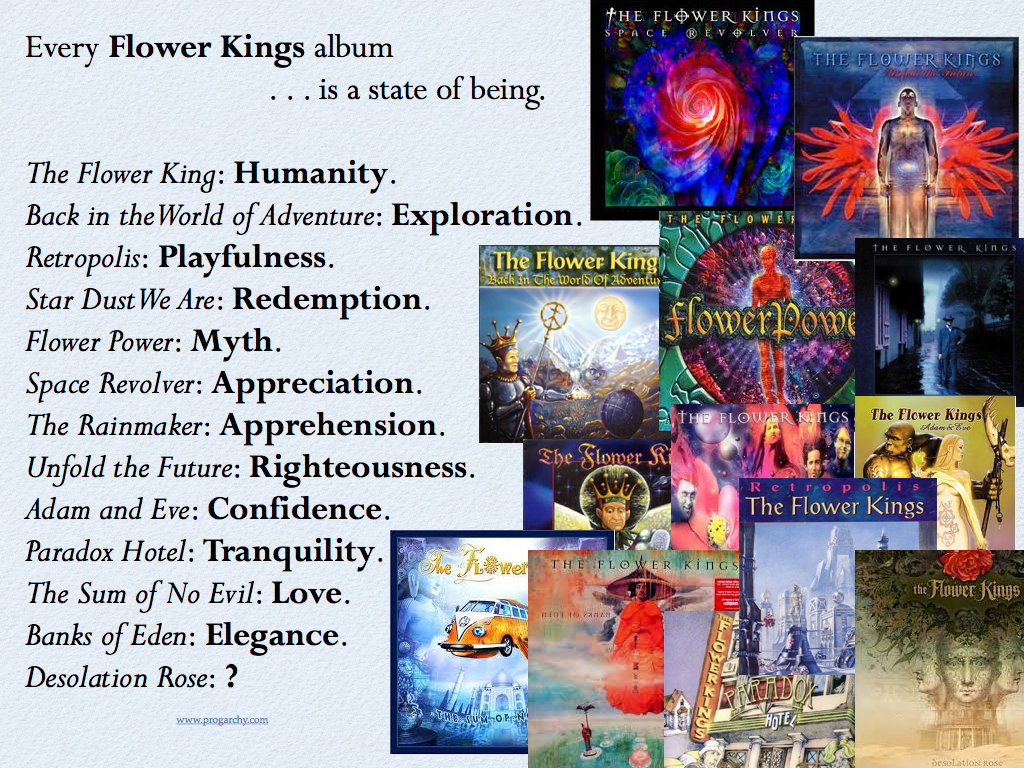
It’s probably accepted by many people who have followed the career of The Flower Kings that the prime years for them were the albums that ranged from the official band debut, ‘Back in the world of Adventures’ (1995) through to the peak of the era ‘Space Revolver’ (2000).
The work that followed on from this time was by no means less prolific and has examples of some of their best moments however there was a sense that some of the spark and sheer wonderment of the earlier work was lacking. Indeed by 2007 the experience seemed exhausted for some, with the feeling that the music was going through the motions and as a result the band was put on a break for the next five years.
Last year the return of the regular line-up produced ‘The Banks of Eden’ (2012) which signaled a new charge driven in part by the lively and talented drummer Felix Lehrmann. The heavier, gutsy sound was a continuation of the harder edge that had shaped the group over the past decade, with all the elements that made up The Flower Kings still present.
Fast forward to now and the new release, ‘Desolation Rose’ and we see that the band have embarked on a new methodology which ironically provides the listener with 60 minutes of familiar music which firmly places it high up among the bands aforementioned peak period. Rather than arriving at the studio with the new material prepared, the approach was much more of an organic, cohesive effort of ideas and creativity. The results are exciting and varied and yet the sound is pure Flower Kings, pure Prog and kingly epic.
An initial first glance at the track listings and the die-hard fan might begin to wonder where the regular 25 minute song is this time around. But fear not, Desolation Rose is essentially a continual piece where the melodies and passages that open the first half are revisited in the closing sections. A powerful ascending refrain, very typically Flower Kings, crops up from time to time, effectively bringing it together and ensuring a neatly stitched continuity. The tracks bleed into each other like chapters in a novel adding to the overall joined up assembly. After several listens it begins to feel similar to ‘Garden of Dreams’ from ‘Flower Power’ (1999) in its journey-like experience. The connection to this album is likely emphasised in the input from Thomas Bodin who like ‘Flower Power’ has had a bigger contribution this time in the making of ‘Desolation Rose’.
Bodin’s contributions are spectacular, providing a dazzling symphonic base for the frequently soaring guitar from Stolt. The stand out moments from him are everywhere, but ‘Desolation Road’ (not rose) is perhaps one of the greatest of them, from the gentle piano opening to the glorious choral symphonies – “While the road to desolation….lingers on….” and finishing with a growling angry wild animal of an organ over a pounding Lehrmann beat .
“Pure Flower Kings, pure prog and Kingly epic.”
However the darker themes around the realities of war and suffering contrast the dream like qualities of Garden and are more evenly presented than their earlier opus too. That said, after many listens to the ambiguous lyrics and there is still uncertainty about the imagery and meanings. Yet this is a good thing, rather like sitting at an abstract painting in a gallery and seeing something new each time.
It is clear enough to see though that ‘Desolation Rose’ is TFK’s outcry and dismay at the world and its problems. Particularly conflict, and the senselessness of it. The latter is dealt with in ‘White Tuxedos’, a bleak picture of the inevitable conclusions of war, the title referring to the shroud of white over the dead. It’s a tale where there are no winners, neither from civilians or the soldiers who are sent to the four corners of the earth to fight under a flag of peace. The looping mantra of Nixon telling us of his desire for peace over and over again is a particularly chilling bookend to the track.
Following the intensity of White Tuxedos there is the almost certain contender for some of the finest Flower Kings magic anywhere. ‘Resurrected Judas’ ( him again) features some sublime guitar from Stolt over with a driving middle section instrumental, underpinned by some incredible bass and drums which is classic TFK, with shades of Genesis from a time when they made your skin tingle.
The darkest moments of this album are still matched with some regular TFK celebration at the beauty of the universe and the view from space at the earth. In ‘Blood of Eden’, our home is presented, still green and beautiful, -“We are Stardust and we are sun kissed”)- and we hear a pleading call to the heavens to a higher power to provide an answer to the problems we make.
Somewhat coldly though we are returned to the reality of the world in the closing gospel-like lament of ‘Silent Graveyards’-“in silent graveyards we look for saviours” – a reprise of the title track. The lonely desperation builds towards the finale where there is a hopeful prayer for a promised land and for an end to suffering, closing with a desperate agonising scream, from the impressive vocal abilities of Hasse Fröberg. There probably isn’t a Flower Kings album that closes as powerful as this, with the exception of the majestic end of ‘Stardust We Are’ (1997)
Without doubt the band have produced something spectacular again with this album, If there is such a thing as a flawless release this would be nudging to be a member of that club. Quite how they have pulled it off again is a mystery as it was written and produced in a time frame that is almost beyond belief. Much more than a stop gap between now and the next Transatlantic, this is an album that should be regular favourite for many fans and still talked about as one of the very best.
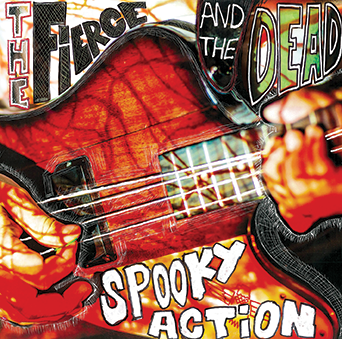
So, here is the eagerly-awaited new release from The Fierce and the Dead, their first on Bad Elephant Music, and it’s difficult to imagine a more appropriate title. Whatever else might be meant by the title, the music that you’ll find here is quite rightly described as “spooky action.”
Those who were paying attention probably caught the effusive note that I wrote for Progarchy back in May, just after I had really discovered TFATD. I was ushered into this sound-world from the antechamber of guitarist Matt Stevens’ solo recordings (apparently, just as Matt himself fell into TFATD). Do you remember that scene from the Wizard of Oz, when Dorothy opens the door from the spooky (artfully unsettling) black-and-white Kansas landscape onto the spooky (attractive, but even more unsettling?) color landscape of Oz? That first experience was, for me, that powerful, that attractive, and that blissfully unsettling.
Does Spooky Action live up to the expectation set by its predecessors? No. “Live up to” is (if I may resort to somewhat technical language here) totally lame. What we have in the music of TFATD, and what shines as brightly as we might have hoped on this new set, is the spooky action that is music-making. Not just writing songs and playing them. Not just outstanding playing (though it certainly is that too). The music that these guys make is a sort of alchemy, transforming sonic base metals into gold. Gold, that is, of the sort that gives in just the right way when you give it a trial bite.
Naturally, a number of earlier influences make themselves known in these tracks. As with earlier TFATD, I hear the sort of minimalist spirit that made its way so strikingly from Steve Reich into the early XTC. I hear the grungy (not grunge, but grungy) soil-like qualities of early 1970’s King Crimson. I hear collages of textured audio drawn from some of the same esoteric tomes consulted earlier by Sonic Youth. But what makes the musical action here so spooky is the alchemical feel, the je ne sais quoi that makes the sounds you are hearing music in the deepest and richest sense. Rhythmic complexity doesn’t come across here as contrived, as “lookie what we can do that isn’t 4/4,” but as a breathless invitation to join the band in an invigorating dip into a pool of ecstatic expression. The making of music should be a spooky action, and here it is so.
Do any of the tracks on Spooky Action have weaknesses? Limitations? Faults? I bet I could find some if I keep listening. But some music gives up its weaknesses early on, and having listened to Spooky Action twice now, it gives with an open, immediate generosity and profundity that outshines about everything new that I’ve heard lately, except perhaps the very different but equally enthralling sounds of Big Big Train. If the first listens are considered as a surface, at which I splash tentatively, gently lowering my face into the liquid warmth, then I see no immediate evidence that it has a bottom. There’s no measure for its depth available to the naked ear.
Having some familiarity with prior work by TFATD and by Matt Stevens, I suspect that one of the main ingredients in its depth is an overt avoidance of excess gravity. (Hmm. Can an avoidance be overt? I think it is here.) This is music that reaches the depth and richness it reaches precisely because it does not take itself too seriously. These guys are having fun, and that’s one of the keys to their achievement of a nearly perfect level of seriousness. The shortness of the tracks (especially by prog standards) enhances the intensity of the fun but fierce and deadly seriousness.
At a time when a fair amount of good music is being released at a fairly steady rate, The Fierce and the Dead have already made recordings that stand out, and by my initial listenings, Spooky Action is no disappointment. Matt Stevens, Kevin Feazey, Steve Cleaton and Stuart Marshall are an amazing unit.
Listen to it! And in case you haven’t seen it yet, here again is their delightful video for “Ark”:
TA announced their studio album today, to be released on January 27, 2014.
And, that impish genius, Mr. Diskdrive, announced a series of rolling back catalogue releases, available only through http://www.thetangent.org. Some folks like to call Steven Wilson, “Mr. Prog.” For me, that title goes to Mr. Diskdrive. I’m listening to the first, FOG, as I type this. A nice glimpse of the beyond. . . .
I appreciate it has been a while but life ‘n’ stuff keeps getting in the way of the fun stuff like writing for progarchy and whatnot. Plus my laptop dumped all my saved settings so whereas before I had a single button click to get here I’ve had to try to find the dashboard by trial and error (aka google). Anyhoo, not a lengthy piece first time up but a few words on my most prized possession, a gadget called a Brennan JB7. A shameless plug I know but I am very fond of it. I get in from work, press one button (one button solutions always work well for me) and it begins to shuffle through about 1500 albums, allowing me to hear stuff I haven’t heard for years or, as has happened tonight, stuff that I grew up with. In this case it is 2112 from All The World’s A Stage, the first ‘proper’ album I ever owned. Imagine a freckly teenage boy in grim, grimy industrial northern England in late 1977/early 1978. You have that image? Good, then I’ll begin. Spitting, snarly school friends had taken to sticking safety pins through parts of themselves and calling themselves punks. They listened to music in the common room that involved people shouting, swearing and clanging away on what sounded like pots and pans. I, on the other hand, ‘wished it might come to pass’, and it did. In the form of Rush. Rush, thanks to my friend Robert Hudson (who had an older brother) begat Yes, who begat Genesis who begat ELP et al. Blue Oyster Cult I discovered all by my self but that’s another story for another time.
And now all that accumulated loveliness from the past 35 years or so is now stored on a box about the size of a hardback book. And not a very thick one at that. Thus far this evening it has already thrown Strangefish, Manning, The Watch, Kaipa and Blue Oyster Cult out at me. It was when 2112 came on, however, that I felt compelled to write something, to get back on the horse so to speak. I have a huge pile of new CDs from the likes of The Tangent, Thumpermonkey, Shineback, Be Bop Deluxe to name but a few to load onto the beast, so shall try to convert some of my evenings doing so into witty and erudite passages for the good folks at Progarchy. Now that I’ve discovered out how to log onto the site again, that is.
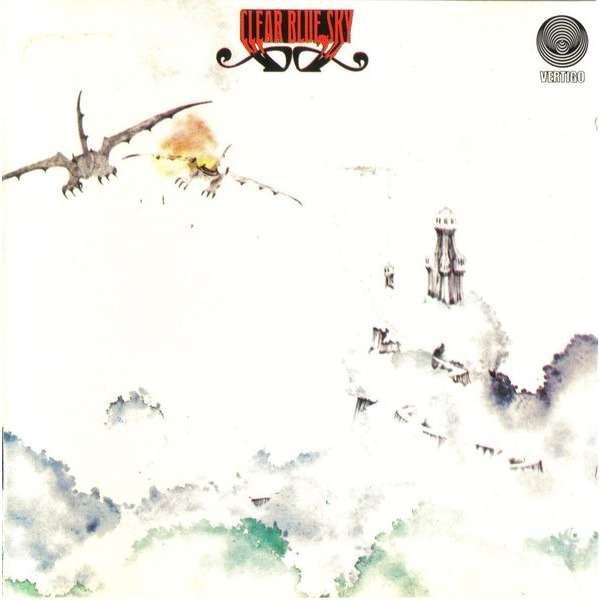
The fourth installment in this series will focus on a band called Clear Blue Sky. Although they are still active (they released an album this year), I would like to focus on their eponymous debut album Clear Blue Sky. Formed in the late 1960s by John Simms (vocals and guitar), Mark Sheater (bass), and Ken White (drums), Clear Blue Sky actually received some attention after the release of their first album because of one of their fans: John “Thunderfingers” Entwistle of The Who. The masterful bass player enjoyed listening to this new band and would even stop by the studio to jam with them. With a musician like Entwistle supporting them, one would think that Clear Blue Sky would have punched their ticket to stardom. Unfortunately this was not the case, as their music was not quite “radio friendly” enough to get sufficient airplay. The album opens up with a 17 minute rock epic entitled Journey to the Inside of the Sun and ends with the softer Birdcatcher. The songs featured in between are shorter, heavier rock pieces that may remind some listeners of Atomic Rooster (sans Hammond organ). John Simms’s guitar takes center stage on all of the songs and he plays with prodigious skill for an 18 year old. Sheater and White are not to be ignored, however; they provide a sound rhythm section. Overall, the band plays with solid skill (considering how young they were) and it is unfortunate they did not get the attention they deserved. Sadly, this seems to be the case for so many progressive rock bands. Nonetheless, this is one album certainly worth listening to.
Chris Wade, known to Progarchistas as the genius behind Dodson and Fogg, is also a rock writer, and has just published a book on Black Sabbath. I happen to know that he’s a huge fan of Sabbath’s first record (as am I), and so look forward to his take on the devil’s chord, flashing the horns, and all things sabwise.
Get thee to a Kindle, or order a paperback from Chris directly (the paperback will also be available on Amazon soon):
Dominique Leonetti with Romain Thorel on drums and Vincent Barnavol on hand drum.
Few bands out there in Progland have a unique power and magic to completely rip up the rule book and make music which messes with your mind, touches your soul and fills you with a joie de vivre, that leaves you ever gasping for more.
As regular readers of my occasional blogs may now be more than aware, I have forged a very close connection with prog’s most original and certainly most exciting live band, Lazuli. Who? Well, if you live in the USA, you may not have encountered them yet but, hopefully, that will change soon.
Having performed in mainland Europe and also Canada, Lazuli’s one US appearance was at Rosfest in 2009 and their first live UK gig was at the Summers End Festival two years ago. They were Friday night headliners, unknown to all – including yours truly – but a handful of the more savvy festival goers.
We were conscious there were some guys resembling the cousins of Legolas, Boromir and Aragorn mingling with the audience but, having noted how striking they looked, thought nothing more of it – until they arrived on stage as the headliners. The rest, as they say, is history.
As well as looking like the good guys in Lord of the Rings down to their goth Masonic attire and elaborate hair styling, including a plaited beard, their inventory of instruments is extraordinary, comprising French horn, mandolin, marimba (more of which later), beat box, assorted guitars, an elegantly angled keyboard,a single hand drum and the Leode (more of that later too). Their other USP (unique selling point) is that they do not sing a single word in English.
Now imagine how all that could look and sound when delivered live on stage. I tell you in all sincerity – it is mind-melting. Central to the sound is the aforementioned Leode, an instrument invented by the band’s original guitarist Claude Leonetti after he lost the use of his left arm in a motorcycle accident back in the 90s. According to the band’s website, Claude had a dream about creating an instrument, literally a sonic box of tricks which he could operate with one hand. This extraordinary electronic device, resembling a Chapman stick can conjure up all manner of sounds, ranging from Middle Eastern mysticism to out and out prog metal.
Their UK debut at Summer’s End was without exaggeration the greatest live performance I have ever seen. Never mind none of us being able to understand a word they were singing, such was the sheer brilliance of their show, it was as if you were being transported away to a parallel musical universe, indeed to Lazuli Land.
It was not just the originality of their music, which owes much to the influence of the Beatles, to whom they listened when they were young Lazulis, but the way they delivered the songs – with a passion, a love, a belief, an intensity and also with great joy and humor.
Frontman Dominique (Domi) Leonetti, brother of Claude, is quite bewitching with his clear, powerful pitch perfect voice and his almost waist length hair secured in a long ponytail which takes on a life of its own when at his most animate. He also plays rhythm guitar, acoustic guitar and mandolin.
His main compadre is the ever-smiling guitarist Gederic (Ged) Byar, a fellow possessor of an extravagant head of braided hair and sculpted beard, but blessed with a fluid, vibrant smooth style which runs in perfect parallel with the cutting edge sounds of the Leode. He even occasionally runs a screwdriver up and down the fretboard,
They don’t have a bass player either. I thought I ought to mention that. The lower registers are left to the laser eyed Romain Thorel and his keyboard, again another instrument which seems to have an endless repertoire of sounds ranging from piano to drums. Oh, and he is the one who also trebles up on French horn and the drums, freeing up regular drummer Vincent Barnavol to play marimba, a hand drum resembling a djembe and beat box.
So, there’s the lowdown on what they do and how they do it.
French prog tends to either veer towards the avant-garde and experimental or the more Celtic. So, in many respects, Lazuli really have broken the mould, their songs centering on subjects important to them such as L’Arbre (The Tree) that is all about nature and man’s evolution (or lack of it).
Their most recent album 4603 battements, released in 2011, had time as its central theme. Many would argue that their adventures in recording are a far different and less exciting proposition than their live shows but I defy anyone to hear the incredible 15H40 (more about this later too) and its depiction of time ticking without a sense of wonderment. The album title translates as 4603 beats because that is how many there are on all 11 songs on the album.
And so to the present. Lazuli have been more than aware that I have been their UK cheerleader in chief since that epic performance two years ago. Last year, they performed at Germany’s Night of the Prog at Loreley, which clashed unfortunately with the first Celebr8 festival here in the UK.
So it was a masterstroke when the Summers End organisers announced they would be back for this year’s festival, along with German band Sylvan who had been the main crowd pleasers the year before in 2010. When Prog magazine asked me to write a preview of this year’s Summers End, it was a chance to touch base with Lazuli again to get their reaction about coming back to the UK to play.
Thanks to Google’s translation facilities, Domi provided some charming responses to my questions, saying how they grew up on British music so to cross the Channel to play here was very symbolic. Of their 2011 show, he said it was “beautiful and terrifying at the same time.” However, the welcome they received was so warm, they soon forgot their anxiety and enjoyed “this precious moment”. They were very excited and honored to be back at the festival.
Fast forward to Saturday October 5, the night they were appearing at Summers End, following the main headliners Gordon Giltrap and Oliver Wakeman performing the stunning Ravens & Lullabies.
Well, Lazuli rocked up halfway through the afternoon. It was great to catch up with them again and I gave them a copy of Prog magazine with my preview, ending up using my very rusty French to translate back to them the quotes they had given to me!
Cutting to the chase, they finally came on half an hour late and I must admit the ensuing one hour and forty minutes were a bit of a blur, because all that Gallic sorcery and charm was still there. Again, it is that connection they make with the audience which is so special as they give every part of their being to making their performances as dynamic as possible.
One song Film D’Aurore saw Domi with a tiny light on his hand that he shone onto his expressive face, but it is the extraordinary Le Miroir Aux Alouettes which hopefully you can see at the end of this paean, which is them at the height of the powers for many reasons, mainly its immense tempo change halfway through when Romain takes over drums from Vincent, then the whole mood goes from folk to Arabic scales.
Romain is such an accomplished musician, he gets his own solo spot to show off his incredible versatility on the keyboards, all improvised with a bit of jazz and funk thrown in this time. Even Domi and Ged crouch down by the side of the stage to watch him in full flight.
Then when they played 15H40, Domi decided to spin out the tension and to my utter surprise, decided to include yours truly in the song when trying to convince everyone it was “twenty to four” instead of around midnight so he jumped down from the stage and sought my counsel on the time.
Well, the time was ticking away and fast approaching 12.30 when they were called to order because of the lateness of the hour. So, instead of playing the brilliant 12 minute long Naif where audience participation is key to its success, they pushed the marimba to the front of the stage. And this is where the true genius of this band really showed with their Nine Hands Around The Marimba as all five band members simultaneously played chords and melodies, while taking the occasional potshot at each other. And was that a few bars of Solsbury Hill in there somewhere too?
If it was not for some of the throng having to rush out to get the bus back to their weekend lodgings, the band would probably still be playing as no-one wanted them to go.
How can I explain it succinctly? This band has such a positive, humble and uplifting vibe about them that they seem to reach inside and illuminate every corner of your inner being. Even over a week after the show, I am still buzzing about them like a hyperactive queen bee!
If you want further proof then catch their new DVD, Live @ l’Abeille Rode, the first part of which is them performing their live show without an audience but which is so beautifully shot, you feel you are part of the invisible crowd watching – and probably cheering them!
Well, what more can I say about this French connection except that Martin Reijman, who loves photographing them, and I are doing a crash course in French with a view to meeting up with them again next year in France. My aim is to interview them in French which hopefully will further help us all to understand the essence of this truly remarkable, unique band.
If you want to learn more about them, go to: http://www.lazuli-music.com/ and you can tell them Alison sent you.
Otherwise, please enjoy the Summers End encore (courtesy of Pete “Pedro” Waite) or Le Miroir Aux Alouettes shot at the Night of the Prog last year.





 Progarchy