Gilberto Gil Loves Us

Ah! We can see this for what it is: a masterful searching for rhythms and melodies, rooted in heritage, clothed in artistic progress, presented as gritty authenticity.  Heritage. Progress. Authenticity.  Three weeks ago, when I saw Gilberto Gil perform at Memorial Hall on the campus of UNC Chapel Hill, there WAS a master at work.  Over 50 years a professional musician, Gil shows no sign of slowing down.  Credited, with fellow Brazilian Caetano Veloso, for creating from a bewitching hybrid of bossa nova and rock’n’roll what became known as tropicalia, Gil is a living legend.  And he should be, for at age 70 he boogied and strutted with his audience and band for two hours, electric guitar casually over his shoulder, a set of musicianly masters in their own right, clearly in love with him, backing him up.

The only point of comparison I have for this is seeing Carlos Santana circa 1987 at the Dallas Fair Park Bandshell, where 5,000 Texicans and 4 white people shook their asses for a couple of hours while Carlos played hardly a hit and barely anything I recognized.  Revelatory.  Fast forward 25 years and the experience is nearly duplicated.  I do not discount the Latin commonality of these two experiences.  As with the Mexican roots of Santana’s music, in Brazil’s music fusions are perhaps most likely to occur.  African, Portugese, Spanish, and Asian musics have mixed with each other for decades if not centuries, and with rock thrown in I defy anyone not to call it progressive.  So much so, in fact, that Velosa and Gil were forced into political exile in the late 60s/early 70s, biding their time in London while things cooled down in the home country.  Music that matters, like your life depended on it.

Continue reading “Gilberto Gil Loves Us”

Trevor Rabin: “As long as it’s good and well-played, all music is worth listening to.”

Once again, the AllAboutJazz.com site has another great piece about a prog musician: “Trevor Rabin: All Colors Considered”, by Ian Patterson. The focus is on Rabin’s outstanding new solo album, Jacaranda  (one of my favorites of 2012), which is Rabin’s first solo excursion since his exceptional 1989 album, Don’t Look Away, which I played incessantly back in the day and revisit on occasion. Patterson begins by putting Rabin’s impressive career in perspective:

Whether taking a stance against apartheid in the early ’70s in his native South Africa or turning down the opportunity to play in super group Asia for artistic reasons, Rabin has always done things his own way and stuck to his principles at every step. Rabin is perhaps best known around the world for the mega-hit “Owner of a Lonely Heart” and his 12-year stint with progressive rock giant Yes, but there are a surprising number of strings to the musician’s bow.

While it would have been easy to carry on touring and recording with the legendary British group, Rabin felt that after a dozen years a new challenge was needed, and he said no to Yes. So it was in the mid-1990s that Rabin embarked upon another career as a composer of film soundtracks. In a little over 15 years, Rabin has recorded 40 film soundtracks of varying genres, winning numerous awards in the process.

Just when it seemed as though Rabin’s music would only be heard in cinema houses around the world, he’s back with another surprise in the form of his sixth solo album, Jacaranda (Varese Fontana, 2012). It’s his first solo album of original material since Can’t Look Away (Elektra, 1989), and it’s an inspired collection of guitar- based instrumental compositions.

Continue reading “Trevor Rabin: “As long as it’s good and well-played, all music is worth listening to.””

Why I am not a rock-god …….

This is not a review, so please don’t expect a review.

Rather it is mind-meander, a jumble of thoughts, a mind-fart if you like 🙂


As I settled in to the sumptuous Swedish leather of my up-market estate car, cocooned in blue-backlit luxury, ready to drive home to my lovely modern detached, warm, comfy house,  listening to Big Big Train, I began to ponder ……   where did it all go wrong ??!!

You see, although I’ve been a good Dad and a loyal husband and I have certain talents (if you consider running up muddy hills a talent), there is one thing nagging away at me that I suggest nags away at a lot of people (men, mainly) who are into music and are of a certain age. 

You see, I really really wanted to be good at playing the guitar.

It all started out so well.

 At 16 I got my first guitar. An Angus Young look-a-like Gibson SG copy.

In front of the mirror I was a God.  Long hair, denim, attitude.

I was into Rush, AC/DC, Motorhead.  All I had to do was look like them and I would be them – easy ! 

Then the problems started. 

First problem : the strings were so far from the fret board you could drive a bus between them. Rubbish. 

Second problem : I’m small, very small and my hands weren’t big enough to form chords or even press hard enough to get the strings down to touch the fret board. 

Third problem : I couldn’t, and still can’t, read music so had to do everything by ear.

 Fourth problem : I couldn’t hear very well because my hair was so long it covered my ears. At least it covered my eyes as well so I couldn’t see, or hear, my mum screaming at me to ‘Turn that bloody rubbish down !’

Fifth and last problem : LOFT.  Lack Of F… Talent.


Anyway, persistence and a touch of youthful arrogance saw an epic battle against all odds and eventually a semblance of music was made and a burgeoning career as a talented rock-god lay round the corner.

A group was duly formed with school mates with the usual mix of who’s Dad had the most money, who had the best girlfriends and who had got the most pocket money for the pints after practice.

It somehow worked and we ended up doing gigs, yes, gigs, concerts.

We were called 4-Wheel Drive and we specialised in hard rocking and cutting edge post-rock.   Actually, we thought this but the reality was we played Eagles and country and western !!

Our gigs were local pubs, Working Mens Clubs and the occasional heady heights of the local school fete.

Usually we were on before the pub disco started (so as to not get attacked by bottles and drunken women) or squeezed between sets of Bingo “Now then ladies, we’ll have a break from t’bingo whilst we listen to these lovely lads from Manchester playing some music for you all”.

One memorable New Years Eve we played at Collyhurst Working Mens Club, a bleak and post-industrial suburb of Manchester.  After setting our gear up we waited for the crowds.  We waited.  And waited.

Our encore of ‘The Crystal Chandelier’ was performed in front of an 80 year old woman with no teeth who had got lost and a 75 year old drunken ex miner who thought he had come to see strippers …..  my guitar broke, an amplifier broke down …..  it was not a good night.

Our highlight was playing at Piccaddilly Railway Workers Club, in a magnificent club under the arches in Manchester. The steward welcomed us and took us down a swanky corridor to a changing room !  A bloody changing room, with one of those mirrors surrounded by lightbulbs.  Well,  we thought we had made it but then when another guy came in and said ‘Fred’s drumming for you tonight” we were made up.  Changing rooms ? A house drummer ?  Wow.

On we went and were confronted with hundreds of folk all looking happy and settled in a huge club.

By this time I had given up with the guitar and was sent to the bastion where ex-guitarists go – bass guitar.  In other words,  there are fewer strings, you don’t have to play chords, you don’t have to do solos – any idiot can play bass – that was me.

As I moved to my position I looked at Fred the drummer and saw what can only be described as a very, very old man.  Well into his 80’s, thin as his drum sticks, no teeth, whippet at his feet and a pint of stout to one side.

‘Do you know Hotel California ?” I asked

‘No lad’, he replied ‘ but I’ll join in !’

Fearing the worst we played the moody, atmospheric intro as the dry ice swirled around our feet and the gorgeous girls on the front row gazed longingly at the rock gods in front of them (reality check : wizened old hags who’s bingo had been interrupted sulkily looked on whilst their husbands dutifully sat there nursing their pints…)

Just as we get to the part where the drums come in – BANG !


Little old Fred absolutely nails it. 


Neil Peart eat your heart out. Gavin Harrison (had I known him them) couldn’t shake a stick to old Fred – he was fantastic, knew every trick and never missed a beat.

It turned out to be a great concert – the best we ever did !

We never went far from there, we all went separate ways into families, careers, wandering round the world.  I recently found out our guitarist, who was talented now works as a Doctor in Australia and saved several lives in the Bali bombing.  That makes my hill running look a bit feeble but then one of the other guys ended up as a dustman in Droitwich so that makes me feel better.

When I see the likes of Matt Stevens up close and Bruce Soord from no more than two feet away,  I can only stand and gaze in awe at their talent and skill and think …

‘ … where did it all go wrong ?’


A Couple of Links

Over at In The Studio.net, there is an interview with Yes on the occasion of the 40th anniversary of Close to the Edge.  It’s about 20 minutes long and well worth a listen.  Hat tip to Paul Watson who previously posted about this on the BBT Facebook page.

On YouTube, I stumbled across an interview with Neal Peart regarding Clockwork Angels, and thought it would be a good companion to the post below regarding the same album.  Its about 43 minutes in length, but like almost any interview with Peart, you can be sure it’s interesting.

Thinking is the Best Way to Travel

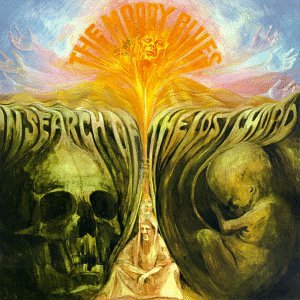
Okay, I remembered another one of my “generic” 8-tracks from the early 70’s (see my prior post).  In Search of the Lost Chord by the Moody Blues (1968).  (Yes, I’ve owned at least two legitimate copies since.)  My experience with it was in many ways comparable to that with King Crimson’s Islands (discovered at nearly the same time, if not the same day).

My entrée into a high orbit around the notion of “prog” had not been through radio airplay, and I was only beginning to discover the wonders of WMMS in Cleveland (in its Golden Age).  As with King Crimson, I was not yet familiar with the Moody Blues’ first two albums, so Chord was my point of entrance, and has remained a sort of fulcrum in my perception of the band.  I heard the music first without the impact of cover art.  And to be quite honest, the art didn’t do that much for me when I eventually saw it.

I love the whole album, partly because of its place in my early listening life.  But this “mini-review” is really about one song, the one that has most profoundly stuck with me from then to now:  “The Best Way to Travel” (credited to Mike Pinder).

In the early 7o’s, I was rather blissfully naive regarding drugs, so I didn’t hear that I could “fly high as a kite” as others might have heard it.  Oh, I knew vaguely who Timothy Leary was, but my general intake of the album’s search-and-discovery motif was uncluttered with chemical enhancement experience.  Others were often more aware than I was of my apparent destiny as an academic and an intellectual (in 7th grade, several other kids at school called me “Professor”).  Nonetheless, what I heard was that thinking…  THINKING…   is the best way to travel.

Texture in music is almost always uppermost to my ears, as if it were a surface to caress or to palpate.  This is one of those songs with a texture that carries its lyric with an ease or a naturalness that approaches perfection.  (Other examples of this:  “Jerusalem” by ELP, “Earn Enough for Us” by XTC, and several Genesis songs, including “The Colony of Slippermen” and “Squonk.”)  The texture conveys precisely the sort of “travel” to which the lyric alludes.  Bold, dense, percussive acoustic guitars that propel whatever is the vessel (seesaw?) on which we ride.  Yet they hesitate dramatically to allow us to regain a fix on the ethereal “beep,” reminiscent of radar, which may or may not be some sort of guide.  We may need to follow a bit in order to find out.

Four decades later, I still believe every strum and every word.  Thinking is the best way to travel.

Cosmograf news

Progarchists, our friend and ally, Robin Armstrong, just announced a slight delay in the release of the new Cosmograf album, The Man Left in Space.  The album will now be released at the end of January 2013, giving Robin a bit of cushion in the final production.  Robin’s full post (complete with wonderful Rush references in the title) can be found here:

http://www.cosmograf.com/launch-delayed-too-many-snakes-not-enough-ladders/

Also, Robin would like as many as possible to “like” Cosmograf on Facebook:

http://www.facebook.com/groups/552531094761535/

Of course, it should go with out stating that every Progarchist should own the first three Cosmograf albums as well as pre-order The Man Left in Space.  Sadly, the first one is very difficult to find, but let’s hope Robin reissues it.

Comograf’s music can best be described–if a comparison is necessary–as a cross between Ayreon and Big Big Train–theatric, eclectic, and totally prog.  Despite the comparison, Robin’s music is certainly original, and he is, no doubt, his own man and artist.  The new album will feature other Progarchy favorites, Greg Spawton and Nick D’Virgilio of Big Big Train and Matt Stevens of The Fierce and the Dead.  Additionally, our generation’s Phill Brown, Rob Aubrey, is helping with engineering.  And (yes, I’m incredibly proud of this), I have a few spoken lines on the album.  How cool is that?  Very.

One last treat: here’s the title track of the last release.  Enjoy.

Clockwork Angels (Best of 2012 — Part 2)

Another one of the albums in my Top Ten for 2012 is Rush’s Clockwork Angels.

Stories like “Xanadu” and “Cygnus X-1” were what first enthralled me. So it is a dream come true to have a full-blown concept album from Rush after all these years. And with an accompanying novel, no less.

“Though Rush has often embraced huge themes and stories, sometimes over several albums, this is the first time the band has attempted a full concept. The story, nearly sixty-seven minutes long, follows the journey of a young man finding his own voice in a society ruled by indeterminate god-like fates (the Watchmaker and the Clockwork Angels), a rule-based conformity but peopled by a number of eccentric persons and subcultures,” writes Brad Birzer.

The story seems to be ever ancient (obviously it’s an epic remake of Red Barchetta, and Subdivisions, and [insert your favorite Rush song here]), yet ever new: “a very Calvinistic set of gods attempt to control all through mechanized precision, while alchemy, rather than science, has progressed. The album is divided into twelve songs, each represented by an alchemic symbol positioned at each hour of a twelve-hour clock.” (Brad Birzer on the story)

Brad also notes:

What is especially fascinating is that Rush—in music and lyrics—has with Clockwork Angels created an all-embracing mythos, referencing their own works and music going back to the band’s very first album. There are hints, some overt and some not, from albums across the past four decades, and the protagonist must—as with Aeneas and a number of other classical heroes—experience, survive, and outwit the gods.

In Clockwork Angels, though, the hero realizes one very vital thing: the divine will always control time. The gods might not control our individual fates—despite what the priests and politician tells us—but, in the end, Chronos devours all. But, within that given time in the world, man can do many things, and he can even dream and pursue the highest of all things.

In other words, Neil Peart continues to inspire. As Brad has noted elsewhere, “Neil was the big brother who introduced us to the literature our teachers seemed to have misplaced: classical myth, Voltaire, Coleridge, Twain, Dos Passos, Hemingway, Rand, Tolkien, Eliot, and others.”

Brad’s tribute to Rush there hits the target:

In the late 1970s, 1980s, and 1990s many of us lovingly thought of ourselves as the younger brothers of Peart. He was the genius kid with integrity, who always walked through the halls with two hilarious, equally smart (if not overtly intellectual) and infinitely loyal friends. One of his friends had parents who had survived the Holocaust camps of the Nazis. The other friend had folks who had escaped the prison camps of the Communists. Now, the three were free to express themselves in any way they so decided on this side of the Atlantic.

These three confidently confronted the world as a perfect trio, unbreakable and ever mutually re-enforcing and inspiring.

We looked up to all three as those who could understand our failures and successes, our desires and our alienation, our rejection of conformist culture and our drive to better ourselves.

Going where I want, instead of where I should
I peer out at the passing shadows
Carried through the night into the city
Where a young man has a chance of making good

A chance to break from the past
The caravan thunders onward
Stars winking through the canvas hood
On my way at last 

Also on my 2012 list is Oceania. Like Brad, fan boy Billy Corgan also knows how to pay appropriate tribute to Rush.

Mark Hollis in Ecstasy, Live in 1986

In the spring of 1987, while browsing the new music at the Hammes Bookstore at the University of Notre Dame, I fortuitously came across an album called “The Colour of Spring” by a group I had previously dismissed as nothing more than a trendy New Wave band with the bizarre name of Talk Talk.

Though I knew next to nothing about Talk Talk or their music, I was quite taken with the cover, a James Marsh painting of a number of butterflies and moths with a variety of surreal designs on them.  Judging the album by its cover, I decided to take a chance and make a spontaneous purchase.

After a listen to “The Colour of Spring” back in my dorm room in Zahm Hall, I was a convinced Talk Talk fan, and I’ve been ever since.  Indeed, I’d never heard anything like the music or the lyrics.

In the opening track, Hollis sings with astounding conviction:

“Try to teach my children/To recognise excuse before it acts/From love & conviction to pray.”

In the concluding song, Hollis again brings in a religious theme–this time of the nature of evil, and the power of good to overcome it:

“As bad as bad becomes/It’s not a part of you/Contempt is ever breeding/Trapped in itself/Time it’s time to live”

With at least fifteen musicians and two choirs performing on the album, including Traffic’s venerable Steve Winwood, “The Colour of Spring” is complex, religious, and dramatic.  It was made by musicians who clearly love what they do and who enter into music as fully as humanly possible.  Even to this day, I feel chills when I hear the album.  It’s not lost any of its quality, even after twenty-two years.

Two years later, in the fall of 1988, when I was working at as a classical host and a rock DJ at WSND-FM, Talk Talk released its fourth album, “The Spirit of Eden.”  Now regarded as the foundation of the post-rock movement, the album might be one of the finest non-classical albums ever made.  Intense, moody, and deeply meaningful, the “Spirit of Eden” captures and propels the imagination for a little over a 40 minutes.  Costing an outrageous sum of money to produce, taking 14 months to make, and employing 16 musicians and a choir, the “Spirit of Eden” simply confused the music industry.

In a radio interview (available on the Talk Talk facebook page), Hollis acknowledged that the lyrics—based on the notion of creation and destruction, on the loss of real and traditional communities in the modern world, and on the disturbing absence of silence—have a profound meaning for him.  In the middle of the opening 18-minute song, Hollis sings:

“Summer bled of Eden/Easter’s heir uncrowns/Another destiny lies leeched upon the ground.”

Another song, “Wealth,” rewrites the famous “Prayer of St. Ignatius of Loyola.”

Talk Talk’s final album, “Laughing Stock,” has a similar feel to “Spirit of Eden,” in terms of music and lyrics.  On the fifth track, “New Grass,” Hollis sings:

“A hunger uncurbed by nature’s calling/Seven sacraments to song/Versed in Christ/Should strength desert me. . . . Lifted up/Reflected in returning love you sing/Heaven waits/Someday Christendom may come/Westward.”

*****

Photo from: http://skyarts.sky.com/talk-talk-live-at-montreux-1986

After twenty-two years, Talk Talk released its first live DVD.  Recorded July 11, 1986, in Montreaux, Switzerland,” the band—Mark Hollis, Lee Harris (drummer), Paul Webb (bassist), two keyboard players, and two percussionists—offers the small Swiss audience every single thing they have to offer over roughly 90 minutes.  The concert, consisting of 15 songs (fourteen listed, but the best song by far, the 1 minute 30-second long “Chameleon Day,” receives no official notice in the packaging) is nothing short of inspiring and heady, and the music—even the earlier poppier stuff such as “My Foolish Friend”—has an organic, impressionistic, jazzish, progressive feel.

Some songs unexpectedly come to life in fascinating ways, such as “Does Caroline Know,” a relatively weak studio cut.  In concert, though, it stuns and comes off as a progressive rock epic.

Every person on the stage seems to be enjoying himself immensely, each a professional and artist fully in sync with every other person.  Harris, especially, plays with such steady ferocity that I feared his drum kit might collapse during the concert.  It didn’t, and Harris played with passionate verve throughout.  He clearly holds the varied instruments and musicians into a centric and cohesive whole.

But, most importantly, Hollis sings as though he is standing before the court of God, afraid to squander any precious talent bestowed upon him.  As strange as this might read, he appears as though he is full ecstasy. I mean ecstasy in its original sense—not as something sexual, but as something divine.

He seems the perfect medieval saint, enraptured by the Divine.  There are moments during the concert when he walks back to a bench/seat in front of the drum kit and simply collapses.  Yet, even in these down moments, he is fully and completely one with the music, if his body movements, swayings, and motions are any indication of the state of his soul.  Indeed, from roughly the third song to the end, he seems to be completely immersed in the art and intensity of the music.

At the end of the concert, when Hollis says:  “Thank you very much.  Good night.  God bless.  Thank you very much,” he seems to mean every word of it.

Oceania (Best of 2012 — Part 1)

The Smashing Pumpkins

One of the albums in my Top Ten for 2012 is The Smashing Pumpkins’ Oceania.

Volcanic bass guitarist Nicole Fiorentino and Rush fanboy Billy Corgan deliver some especially mind-blowing musical moments. The title track invites us to go swimming in 9:07 minutes of heavy prog wonder, in which we encounter an acoustic guitar island and then ride out more waves with multiple distorted guitar solos.

But every track is a keeper. In the album order, my four fave tracks are “Quasar” (which rocks things off with an appropriately heavy mystic quest, as the chorus sings out the Tetragrammaton—YHWH—until meditative bliss is encountered), “The Celestials” (complete with a heavenly epiphany—see next paragraph below), “My Love is Winter” (an incredibly melodic mind-grabber that builds the tension expertly in a prolonged way and then attains delirious resolution after teasing us delightfully with the extended musical deferral), and “The Chimera” (for its epic monster riffing).

“My Love is Winter” was the divinely lovely song that stayed with me most when away from the headphones; but “The Celestials” is perhaps my upper-echelon selection for epic greatness. It opens with an awesome sing-along acoustic guitar enticement. Then it blasts into rock trio orbit at 1:16 as the bass (oh yeah! dig the bass!), the guitar, and the drums prepare for the jump to light speed. And wham, at 1:52 we launch into hyperspace and the whole world suddenly accelerates and then magically slows down as, now outside time, we cosmically survey it all via the synthesizer’s lens. Powered into crazy warp speed by the ripping guitar beginning at 2:22, then eventually, at the edge of the universe, at the three-minute mark, the horizon of spiritual enlightenment is crossed as the music invites us to contemplate the spiritual master’s most divine insight (sung in harmony with the guitar): “Everything I want is free.”

Wow.

“Everything I want is free.”

Give somebody this album as a gift for Christmas.

May the music help you swim in the ocean of love. Ride on!

Oceania

‘Tis the Season…

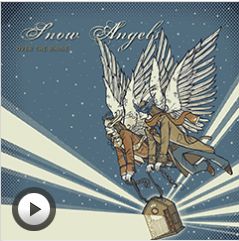
…for some free music! Noisetrade is offering a download of Over The Rhine’s Christmas album, “Snow Angels”. Nice, jazzy/folk holiday music. Click the album cover to go to the download page.