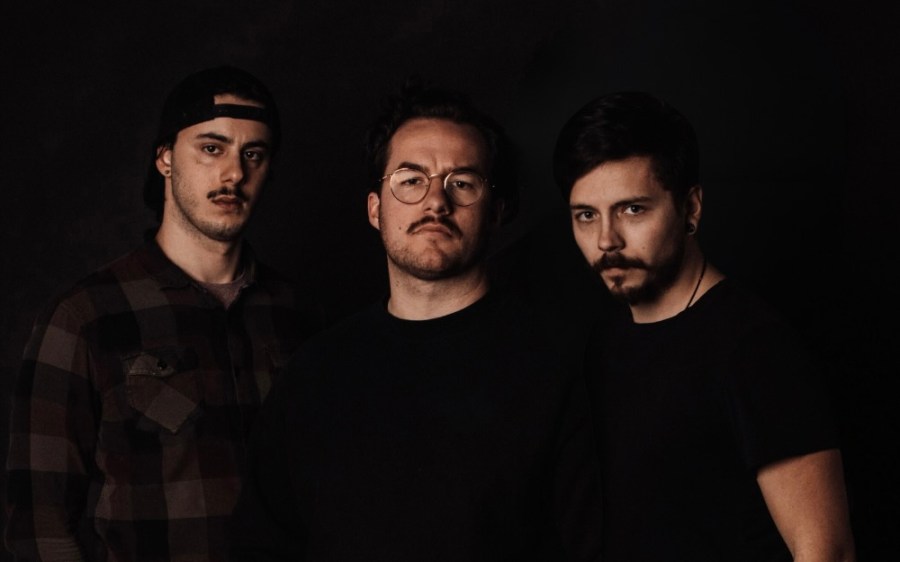
Groovy riffs from The Down Troddence often inspires a dance more than headbanging. But they do bind that western groove metal backbone with some exotic elements. Even though these extraordinary and exotic strands originate several time zones away, everything they have conjured sounds coherent. This magical coherence of groove thrash with Indian classical or with that of local lore and folklore, or with regional dialect feels inexplicable. Unsurprising their roots reside in the land of looms and lores, a popular name for a small town in Kerala. Braiding Malayalam language and the surrounding cultural references, The Down Troddence weaves an enchanting hand crafted harmony, something which sounds familiar and yet remains foreign.
The song “Forgotten Martyrs” is a smoldering testament to all these qualities. Layering a Carnatic melody meets Jimi Hendrix like blues on a groove train, with precision vocal modulation, and sheer propulsive force of drums, The Down Troddence crafts an uncanny symphony. The track simply binds together an otherwise exploding album with diverse ideas. These influences range from groove, to folk to death metal and alternative. A track this rich, vibrant and well produced transports this elegant melange of an album to a new class. The tier where fine talent, production engineering, and refined aesthetic sensibilities converge, forging the subtle and exquisite ungodly metal we all adore.
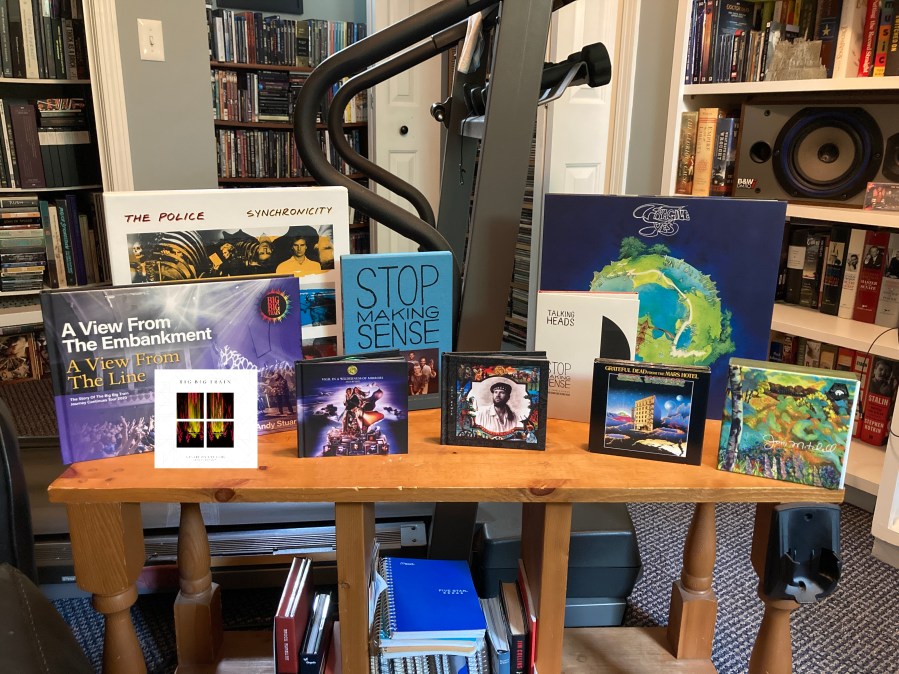
Like a man named Will said, summer’s lease hath all too short a date – so I decided it was time for a lightning roundup of the season’s box sets! Purchasing links are included in the artist/title listings below, with streaming and video samples following each review.
Big Big Train, A Flare on the Lens: Officially released on September 13th, only promotional audio was available for review, so I can’t tell you how the closing night of BBT’s 2023 European tour looks on BluRay – but it sure sounds like dynamite! With all the animation and verve they displayed on this year’s first American jaunt, Greg Spawton’s mighty crew (joined by guest guitarist Maria Barbara and the obligatory brass quartet) tear into a similar setlist packed full of drama and pathos. New vocalist Alberto Bravin is particularly impressive, getting right to the heart of fan favorites like “Curator of Butterflies” and “A Boy in Darkness” along with epic standbys “East Coast Racer” and “Victorian Brickwork”. But everyone’s at the top of their game, culminating when Nick D’Virgilio and Rikard Sjöblom join Bravin up front for a devastating yet joyous medley of “Leopards”, “Meadowland” and “Wassail” in honor of the late David Longdon. Amply documented here as well as in Andy Stuart’s mouth-watering tour diary/photobook A View from the Embankment, A View from the Line, and on new album The Likes of Us, BBT’s rebirth is a genuine cause for celebration.
Fish, Vigil in a Wilderness of Mirrors and Internal Exile: In the wake of his stormy departure from Marillion, lead singer/lyricist Fish (AKA Derek Dick, rock star and Scottish nationalist) was unsurprisingly eager to prove his worth as a solo act. 1990’s debut Vigil In a Wilderness of Mirrors was as emotionally direct and lyrically convoluted as ever, built around the charged concept of climbing “The Hill” of success — a goal unrelentingly pursued despite the Stateside seductions of “Big Wedge”, the obsessions holding “The Voyeur” captive, the damage documented in “The Company” and “Family Business”. Internal Exile, released the following year after legal troubles and a label change, steers toward individual songs; highlights include delicate ballad “Just Good Friends”, comfortably numb polemic “Credo” and the Highland-inflected title track. Fish’s dramatic declamation is the focus throughout; it’s as riveting as always, though the music (mostly by sidekick Mickey Simmonds) can be a bit pedestrian, lacking the organic interplay and inspired unconventionality that marked Marillion’s response to his heady, hearty words. Each album is available as 2-LP Vinyl Editions, 3-CD Standard Editions (with bonus demos and live versions) and Deluxe Editions (with another disc of live versions and surround mixes on BluRay).
Grateful Dead, From the Mars Hotel:It took a looong time, but somehow I’ve finally tuned into the Grateful Dead’s wavelength (and without the use of illegal substances, mannnnn). Having zeroed in on the band’s “stoned electric bluegrass” period of the early 1970s, this latest 50th anniversary reissue is right up my alley – and it has more appeal even now than you might expect. Made in the midst of the Dead’s doomed attempt at running their own record label, there’s a delicacy instilled in the music, a humble yet unflinchingly honest cast to the lyrics. The social commentary of Jerry Garcia and Robert Hunter’s “U.S. Blues” and “Ship of Fools” is more bemused than bitter; tinged with Keith Godchaux’s harpsichord, “China Doll” is an exceptional ballad, and the awestruck love song “Scarlet Begonias” stayed in the band’s onstage repertory for decades. Plus, there’s Phil Lesh’s extended workout “Unbroken Chain”, one of the few Dead songs of that vintage to feature the bassist’s charmingly down-home vocals. Add a live set that handily covers the group’s career to that date, featuring well-chosen country covers and mesmerizing jams, all blasted through the band’s Wall of Sound to a University of Nevada audience the year of From the Mars Hotel’s release, and you have an exemplary package. 1971’s Skull and Roses (first encountered in my older brother’s record collection) and Europe ’72 remain the quintessential Dead in my book, but this isn’t far behind.
Joni Mitchell, The Asylum Albums (1976-1980): Let the record show that Mitchell carried a torch for jazz for decades, ranking Miles Davis right up there with Beethoven long before her music slid into the smoothly swinging grooves of 1974’s Court and Spark. With Hejira (1976), haunting meditations on love and wandering like “Coyote”, “Amelia” and the title track lit out for more expansive territory, simultaneously anchored and uplifted by fusion genius Jaco Pastorius’ free-floating bass work. 1978’s Don Juan’s Reckless Daughter stretched further into abstraction, with the side-long tone poem “Paprika Plains” swathed in rich orchestral colors, instrumental “The Tenth World” and the grooving “Dreamland” enveloped in Latin percussion, and Pastorius’ Weather Report compatriot Wayne Shorter swooping in with unmistakably lateral sax work. And in collaboration with a dying genius, 1979’s Mingus (instigated by composer/bassist Charles Mingus himself) saw Mitchell pay tribute to the era epitomized in the closing “Goodbye Pork Pie Hat”, with words as inspiringly bopping as the tunes. Add the live double album Shadows and Light, with Mitchell backed by then-young guns like Pat Metheny on guitar and Michael Brecker on sax, and you have a remarkably unified overview of her farthest out, yet most eccentrically open period. (Volume 4 of Mitchell’s Archives series, focusing on unreleased and live music from these years, is released October 4th.)
Atlanta-based progressive rock band ETHOS is back with their latest release, An Eye for an Eye, a full-length album that dropped on June 25th, 2024. With a rich blend of progressive rock elements and thought-provoking themes, ETHOS continues to push the boundaries of their sound, marking a significant evolution since their last work. In this exclusive interview, the band delves into the inspirations behind the album, the challenges they faced during its creation, and the unique songwriting processes that shaped this dynamic release. From tackling global power structures to exploring personal resilience, An Eye for an Eye offers a complex narrative that is as bold as it is introspective. ETHOS also shares their experiences working remotely, collaborating on guitar parts, and mastering the album alongside the renowned Jens Bogren. This interview gives fans a deeper look into the creative minds behind the music and what they can expect from ETHOS moving forward.
Congratulations on the release of “An Eye for an Eye”! Can you tell us about the inspiration behind the album’s title?
Austen: Thank you! I have a painting by fantasy artist Fian Arroyo that shares the same title. At some point during the post-production process for this album, I walked past the piece and it just clicked. A lot of the lyrical content is fueled by distrust of power structures or a tongue in cheek commentary on those systems and their inevitable reckoning. However, the implication of the phrase “An eye for an eye” assumes there is remedy for every wrong doing, and I don’t believe that to be true. Rather, I believe that through creativity we can heal ourselves and each other by transforming our experiences – even the worst – into something beautiful. There is a lot to be angry about in today’s world, but it’s important to ask yourself “what will you do with it?”
How did the process of writing and recording “An Eye for an Eye” compare to your previous works?
Kuyper: We relied more heavily on remote work this time around, for a variety of reasons. A lot of the initial ideas for this album came from remote sessions Austen and I had via JamLink, where we could join a session and play in real time. We started recording those sessions which led to me tracking my parts separately and sending them to Austen. Then the rest of the guys would get together in the studio and we would solidify song structures and rewrite parts until we were all happy with them. For a while we didn’t know how writing would work out of state but we adapted to that challenge and it definitely contributed to how we approached songwriting. Times when we were all in the same room were rare and precious so we handled a lot of the meticulous stuff over calls and remote sessions so we could enjoy every moment we had in person as a full band.
Austen, as both the vocalist and the keyboardist, how do you balance these roles during live performances and recordings?
Austen: It’s a much easier balancing act than vocals, keys, AND guitar… It used to be that Matt and I wrote a lot of dueling guitar parts together, I would sling the guitar over my back, hit a piano break, and back to guitar! “An Eye for An Eye” marks a shift in that and I focused more on vocals and keys. If it’s a piano driven song I tend to work out vocals earlier on, but we have plenty of material that was written instrumentally before most of the vocal ideas came into play. When the ideas are written that way it takes forethought and practice to make sure it’s feasible live. I still do some writing on the guitar but with 5 of us now, a lot of possibility has opened up and even more ideas can be shifted from instrument to instrument.
Kuyper and Matt, how do you collaborate on guitar parts to ensure a cohesive yet dynamic sound?
Matt: This EP was the first time Ethos has released music as a 5-piece. Before Kuyper came aboard, I was used to occupying most of the guitar space. Kuyper is an absolute beast of a guitar player and an incredible composer and what he brings to the table is so unique, but we each have our own way of approaching the guitar and songwriting. This allows us to give each song exactly what it needs. We are both writers and lead guitarists but I find that we mostly complement each other because of our differing styles.
Kuyper: Collaboration has been interesting because of the distance since I am in Nashville, TN and Matt is in Rome, GA. We really haven’t gotten to sit in the same room and write before. Because of that, we have had to cultivate a ton of trust. Matt is a brilliant guitar player and composer so it makes it easy to respond to an idea he has written. Overall I think our collaboration is defined by an unwavering trust in the other’s abilities and musical sensibilities.
Nick, can you talk about your approach to bass on this album and how you ensure it complements both the rhythm and the melody?
Nick: For me, the approach was a bit different than our previous releases. This was the first time we wrote music as a five piece, so with two distinct guitar parts going on for many of the songs, I was very careful in how I weaved in and out of those parts. I approach bass composition differently now than I did on our previous releases anyway. I have begun to find more interest in the “less is more” approach and how much is actually going on in rests and the spaces between notes. In other words, I don’t have to show my full hand or dig so deep in my bag of tricks for every song. I think it is OK to say that I am pretty proud of my parts on this album. I feel like they compliment the guitar parts instead of trying to push through or fight for space against the guitar parts. I always want to be conscious of what’s best for the song. It may not be the most flashy or technical part, but if it holds the song together and lays a good, solid foundation for the other parts, that is what I want to always strive to do.
Tribb, what were some of the challenges and triumphs you experienced while recording the drum tracks for this album?
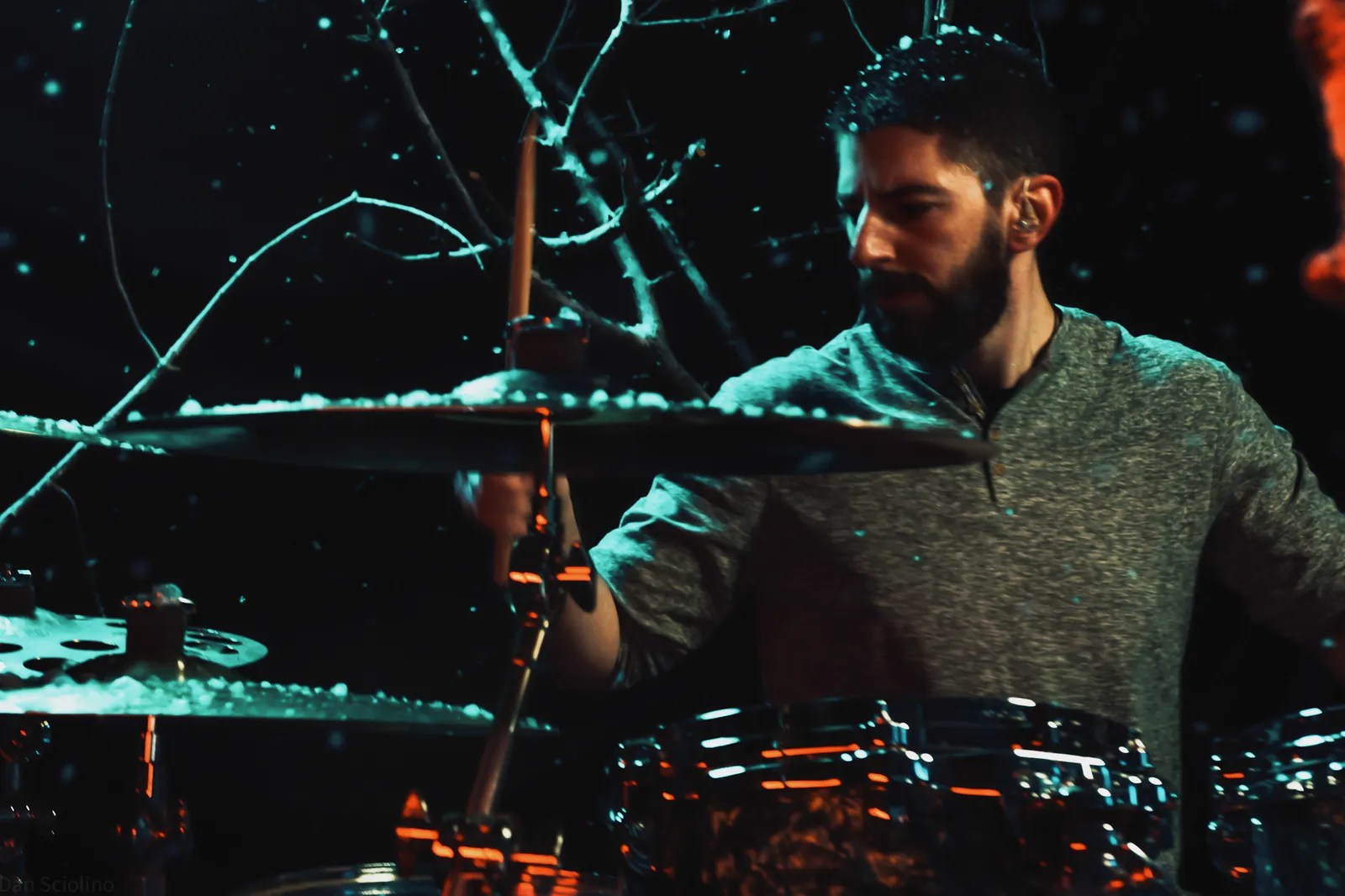
Tribb: For this release, we took a different approach from our previous releases and I tracked drums remotely using an e-kit to help create a more crisp, punchy, “modern metal” production. In the past it’s been purely me on an acoustic kit, which of course has that warmth, dynamic, and imperfection that makes a natural drum performance so magical and have that human aspect that’s hard to replicate in an electronic setting. The danger in this day and age with all this technology at our exposure is phoning it in and over-editing drums so it essentially becomes a cold, perfect drum machine, instead of an actual drum performance. I think people can tell when it’s not real. It was important to me to still perform the parts and get them how I wanted them to be and how I actually played them and I’m more than happy with the end result.
Austen, you mixed the album at Darkroot Studios. How did being involved in this part of the production process influence the final sound of the album?
Austen: It’s a tricky thing to work on post production for your own project but I leaned on the guys for feedback in order to check my own bias. It allows me to run with ideas in the part writing such as doubling certain layers or being creative in how intentionally certain parts come through in the final mix. One of the benefits is that I am able to let the recording process inform some of the decisions we make in the arrangement of the songs – having a good pre-production process and creating demos allows you to hear how everything is interacting in a way that is more objective. Removing yourself from the performance often informs a decision to adjust parts, move them to a different instrument, or drop it completely for the benefit of the entire song.
The album was mastered by Jens Bogren at Fascination Street Studios. What was it like working with Jens, and how did his mastering impact the final product?
Tribb: Jens (Bogren) is one of the masters in the production world, mixing and mastering for bands we love like Haken, Katatonia and Opeth, so we were beyond ecstatic to work with him again. It was all through remote communication and file sharing and he was a pleasure to work with as usual. His mastering really rounded out the overall sound to make the songs sound fuller and bring out certain frequencies to really give it that extra push and a nice overall sheen.
Can you walk us through your typical songwriting process? How do you start, and how does a song evolve within the band?
Matt: Writing with Ethos is highly collaborative. It requires input from every band member. Typically one or two of us are instigators with some kind of riff or idea and then we continue to shape and mold it–usually over a long period of time. We’ll start a recording session or hash it out in a room until it sits well with everyone. Sometimes it’s seamless and other times it’s grueling and we completely disagree or dismantle a piece. However the process goes, we work until we are happy with it, which usually entails us getting the “feels” from the composition.
“An Eye for an Eye” has a very progressive sound. Which bands or artists have influenced your music the most?
Tribb: This could obviously be a very long list and we’ve all got varying influences across a lot of genres. Early on there was a heavy Muse, Circa Survive and 30 Seconds to Mars influence, then more modern prog bands like Karnivool, Porcupine Tree, and Haken, and more recently some “heavier” prog metal bands BTBAM, Opeth and Periphery. Mix in some more alternative bands like Third Eye Blind, Keane, The Reign of Kindo and a lot of influence from the “classic” prog bands like Rush, Queen, Yes and Styx have always been there as well.
What themes and messages are you trying to convey through the lyrics on this album?
Austen: Some key themes that come to mind are balances of power, calling out corruption and greed, introspection and our derivation of purpose, the cyclical nature of existence and what role we have to play in all of it. There is both a sense of hope and despair at times and I think it tends to reflect a lot on the fundamental truth that our experience is shaped by both. What truly defines a person is not their beliefs, but their adversities.
We tend to view chaos as fundamentally “evil” but the truth is that order breeds its own brand of evil and all things must live in balance if we are to call it “good.” I think ultimately Carl Jung said it best, “No tree can grow to reach heaven unless its roots reach down to hell.”
How do you think your music fits within the broader landscape of the progressive rock genre?
Tribb: Stylistically, we’ve definitely got a lot of progressive elements but one could argue we’re more in the alternative rock realm, and of course with some metal thrown in there. We venture into “classic” prog territory with certain pieces that are heavier on classical piano, theatrics, and more complexity in instrumentation with odd time signatures, like some of “The Archetype Suite”, but for the most part we’re looking more to experiment with layers and how pieces fit together and unique melodic approaches and creative rhythmic structures, rather than flexing any ability (or lack thereof) to shred in 13/8 or anything like that, though we all love those kinds of bands.
Can you share any interesting stories or experiences from the recording sessions for “An Eye for an Eye”?
Austen: There were a lot of unexpected road blocks along the way. We started recording this EP in early 2020 before having to step back during the shutdown and resuming in 2021. I wound up very sick after having COVID in August that year and continued to decline until I nearly died in the hospital with late onset Type 1 Diabetes February 2022. Recording was further delayed because of this but I came back feeling stronger than ever vocally and with a renewed sense of urgency in finishing what we started.
Kuyper: We didn’t plan for this EP to have any Archetype songs on it. It kind of dawned on all of us independently. I remember typing out a long Discord message to the group like “Hear me out…” pitching the idea to make the last 3 songs part of “The Archetype Suite”… Little did I know that Austen had the same epiphany the night before and had already spoken to at least one of the other dudes about it. It was a fun revelation and we knew it had to be that way since we were already on the same page without even talking about it.
What has been the response from your fans to the new album so far? Any feedback that particularly stood out to you?
Kuyper: A lot of people have spoken about how this release is more mature and polished. We have always taken care to put out a polished product but a few things have helped with that this time around. Growing as friends and being intentional with our time together in the studio has been a big part of it. Because of that we have been much more liberal with giving parts the ax and refining things. When you trust the other dudes with your life, making music is an incredible thing. Another significant callout on this polished sound absolutely comes from Austen’s continued dedication to production excellence. His business Darkroot Studios has allowed him to become an absolute monster and I would be remiss if I didn’t talk about what he has added to the album. His attention to detail is all through this album.
How do you prepare for live performances, and what can fans expect from an Ethos concert?
Tribb: We try to make our live performance high energy and dynamic. It’s nice to see people moving around and really getting into the music, but typically it’s equally rewarding for us to see people standing there really paying attention or with their eyes closed soaking it all in as well. We hope to eventually get to a point where more visuals and greater production can be a reality, since our music seems to translate better in theaters or closed environments to experience the atmosphere we’re going for. We’ve not played live in several years and actually never played with all five of us on stage, so that will take a lot of rehearsing and getting back in “live shape” and finding out what works or what we might need to change.
With the album released, what are your plans for the rest of the year? Are there any tours or live performances scheduled?
Nick: We’ve not scheduled any shows so far, but definitely hope to get back on stage at some point. Likely early next year, once schedules can line up and we can properly rehearse and prepare to bring the best live show we’re able to.
In the meantime, we’ve already gotten a head start on writing new material and have three or four fairly well developed ideas we’re all excited about. So hopefully we can get some new songs out there sooner than later.
How do you see the band’s sound evolving in the future? Are there any new directions or experiments you’re excited to explore?
Matt: To be honest, I don’t exactly know how it will evolve but I think that’s what is most exciting. I truly don’t believe we are a band that sets out to make progressive rock music, it’s just the product of all our collective minds, influences, and skill sets. With that being said, it’s astonishing the kinds of ideas we run with and we never know how it will end up. It’s like a painter with a blank canvas that doesn’t know what they’re about to paint but they start putting colors together and suddenly it’s a beautiful portrait or landscape. We have already started writing a new body of work since the release of “An Eye for an Eye” and it’s got us all jazzed… I can’t quite put my finger on the sound yet, which is exciting.
What do you think sets Ethos apart from other bands in the progressive rock scene?
Tribb: We’ve evolved a bit over the last several years and have some slightly different elements now that maybe weren’t as present before, but the classical piano has always been an integral part of our sound. Many prog bands have keyboards of course, but the way that Austen utilizes it with more of a classical sensibility, or even the songs that have more synth, hopefully provide a unique sound when mixed with our melodic alternative prog rock/metal approach.
Can you talk about the artwork for “An Eye for an Eye”? Who designed it, and how does it reflect the album’s music and themes?
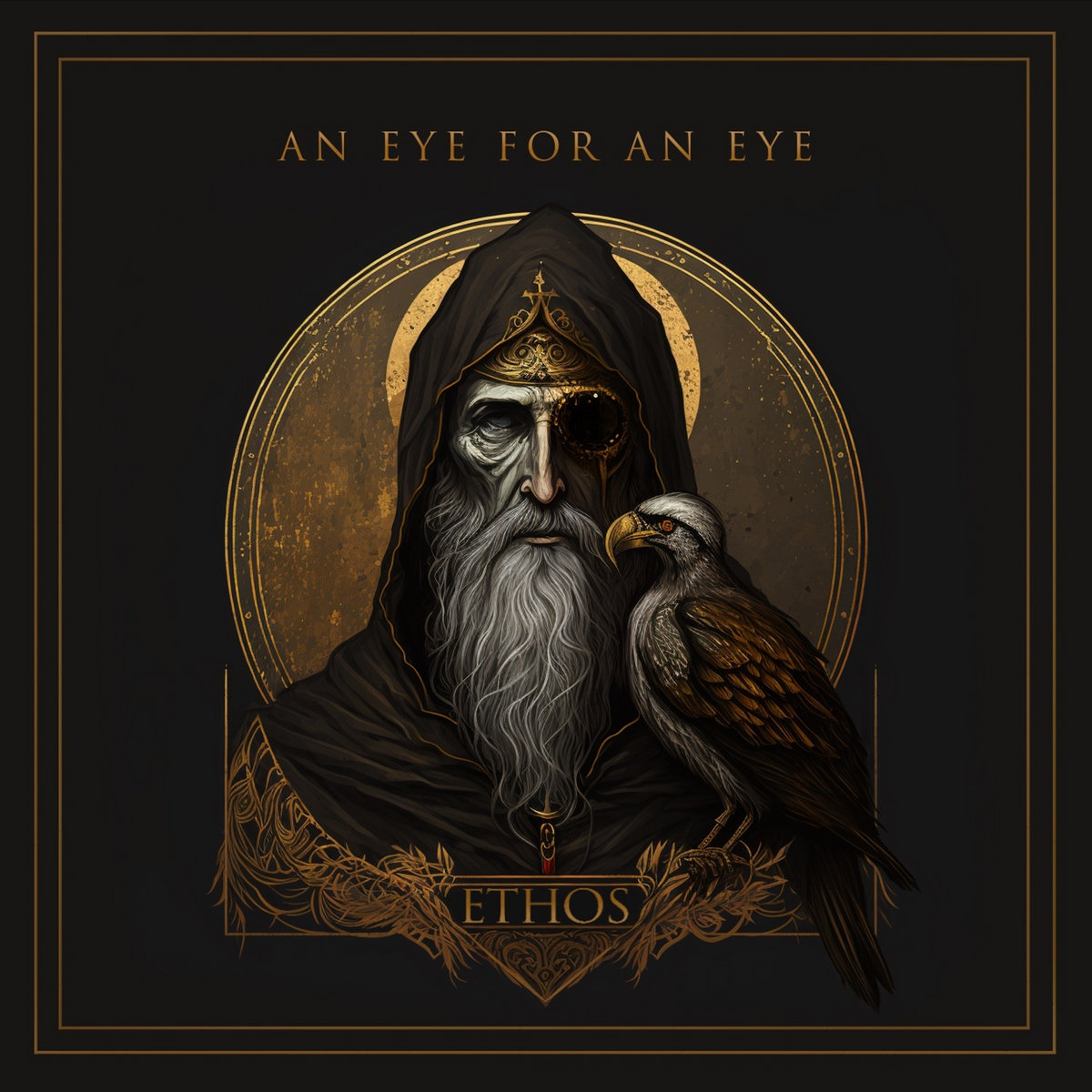
Austen: I designed the album art and have done so for all of our releases so far. I was inspired by gold leaf orthodox icons for the style. There is a sinister tone to a lot of the material on this record and a leaning into our metal influence – I wanted that to be represented visually for this record. There are lyrical themes of corruption and commentary on power structures throughout with a tone of “holding the feet to the fire” so to speak. I would say that “Holy Water” probably informed a lot of the imagery when I was working on the artwork for this record, not to mention, I am a huge fan of the Dark Souls game series.
How do you stay creatively inspired and avoid burnout, especially in a genre as demanding as progressive rock?
Tribb: I think we all have enough unique ideas between the five of us to keep things interesting and exciting, in terms of writing creatively. Like any band, there are certain stages in the process where we might get stuck or there might be some frustration, but usually leaving it and revisiting later solves that. Most of us try to stay abreast of newer bands and hear fresh ideas and innovations and that helps to motivate us in a sense to try different things. We try to play to our strengths and stay true to our sound as well, instead of trying to be the “best”, “fastest” etc. since that’s an easy way to make it about an unhealthy competitive mindset and it can be really easy to get down on ourselves when there are so many insane bands out there, in terms of speed and technicality. It’s more about songwriting, melody and fitting pieces together in a way that’s unique for us I think.
For someone who is new to Ethos, which track from “An Eye for an Eye” would you recommend they listen to first and why?
Tribb: That’s tough since every song has different elements of our overall sound, but maybe a good starting point is “Holy Water”. It’s a bit more on the heavier, post-hardcore side than some of our other stuff and has less prog or classical elements, but it’s got good energy, Muse-tinged verses, a catchy chorus, and a heavy bridge with some organ thrown in. It’s already becoming a fan favorite from the feedback we’ve received.
Finally, what message would you like to send to your fans and listeners as they experience “An Eye for an Eye”?
Matt: First of all, thanks for listening! I hope the music takes them to a far away place. We love to write stuff that you don’t hear very often and may even surprise you. It’s not about the progressive rock skill flex, it’s about the relationship between the listener and the music. It’s that feeling of hearing a song for the first time and then having to play it back 10 more times because it strikes you exactly where you are but takes you to a different plane. I want someone to be carried away by it.
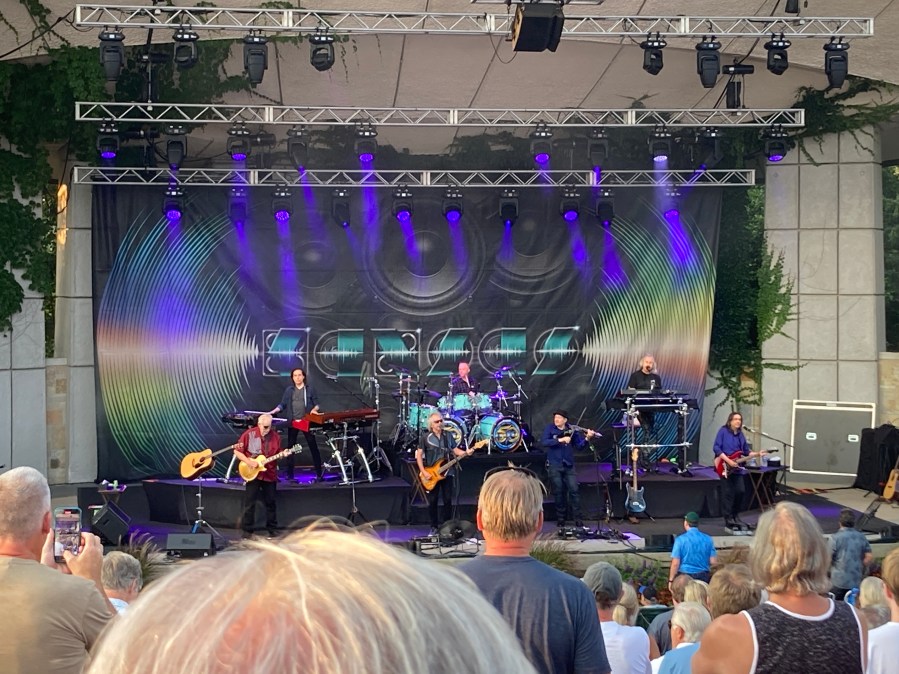
Kansas, Meijer Gardens Amphitheatre, Grand Rapids Michigan, August 8, 2024
With a sell-out crowd in front of them, a nostalgic vibe in the air and their last album of new music (late career highlight The Absence of Presence) released back in 2020, you could argue that all Kansas really had to do last night was show up, then conjure their heyday by playing their hits. And they did that, with drive and enthusiasm to spare. But thankfully, they also did much more, delving deep into their catalog to unearth the sturdy foundation of their mid-Seventies success.
In this age of long-running rock bands morphing into ongoing franchises, you could also try to litigate the “but is this really Kansas?” question. After all, only one original member (fluid, piratical-looking guitarist Rich Williams) was onstage last night, and (gasp) three of the current members hail from New Jersey!
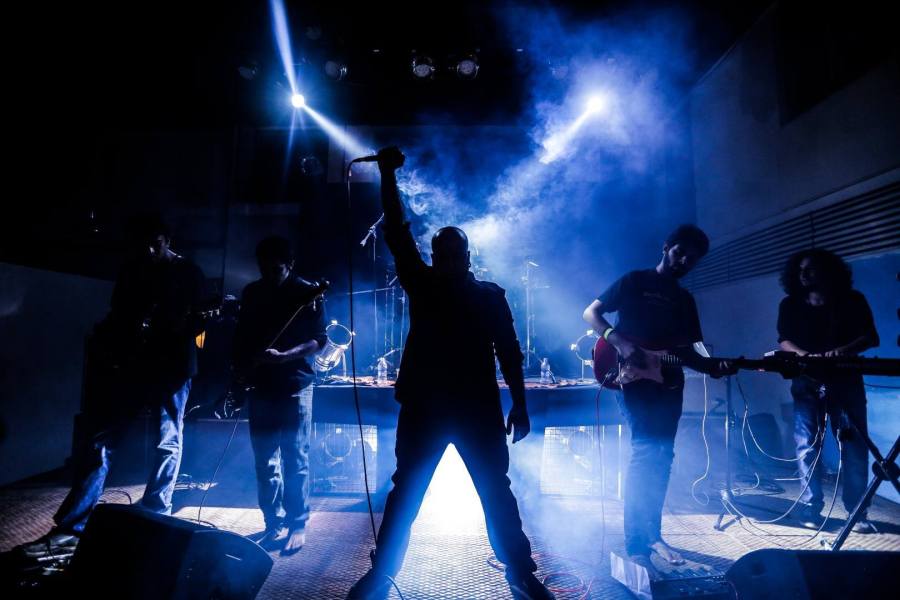
But let’s acknowledge that time marches on. Founding drummer Phil Ehart continues to recover from a major heart attack, but his protegé Eric Holmquist filled the drum throne with confidence; he has Ehart’s taut grooves, twisty rhythms and spectacular licks down cold, with plenty of power undergirding the finesse. Longtime bassist/singer Billy Greer was back after an extended leave, looking and sounding great as he anchored the low end, tackling the late Robbie Steinhardt’s vocal parts and revving up the crowd with genial banter. After eight years as Kansas’ lead vocalist, Ronnie Platt consistently rose to the occasion, following the trail Steve Walsh’s legendary performances blazed with both the midrange power and the high-end acrobatics required. And those guys from New Jersey? Keyboardist/musical director Tom Brislin locked in with Holmquist to propel the music with pulverizing organ and fluent piano and synths, while Joe Deninzon on violin (plus a little guitar) and Zak Rizvi on guitar went to town — ranting and raving, bearing down with crunchy power chords, firing up hard rock riffs (often played face-to-face or back-to-back, just like old times).
Left to right: Billy Greer, Tom Brislin, Ronnie Platt, Joe Deninzon onstage at Meijer Gardens Amphitheatre. Photo by Bob Keeley.
All night, Kansas’ playing was spectacular; their intricate instrumental weave ebbed and flowed through the music’s symphonic paces, whether earlier tunes like “Icarus”, “Song for America” and “Can I Tell You” or deep tracks from the chart-topping years “Paradox” and “Miracles Out of Nowhere”. Performed as a tribute to Steinhardt, the early southern rock of “Down the Road” smoked and sizzled, with Deninzon getting his Charlie Daniels on with a scorching fiddle break. And of course the hits were present, correct and eagerly welcomed; “Dust in the Wind” (to my knowledge, one of only two US Top Ten singles based on Ecclesiastes – and definitely the most depressing) “Hold On” (one of songwriter Kerry Livgren’s earliest born-again altar calls) and inevitable encore “Carry On Wayward Son” (complete with five-part harmony, maniacal Brislin organ and piercingly precise Williams guitar) brought on lit-up cell phones and bellowed singalongs galore.
Fifty years ago, if you’d told me I’d be sitting on a hill watching a young couple in front of me swaying to a song about Albert Einstein — “Portrait (He Knew)”, in case you were wondering — I’m not sure I would have believed you. But even though last night’s weather was about as perfect as you can imagine, the current edition of Kansas whipped up an unstoppable musical storm that pulled their eager audience into that kind of a vortex. Classical gas, prog rock, heavy metal, folky balladry, lyrics about seeking and occasionally finding – it was all there, and it all worked to near-perfection. If you caught Kansas back then, they’ll still take you there effortlessly; if you’ve discovered them since then, they won’t disappoint.
This time around, a cross-section of mostly new, mostly instrumental albums that may start in one genre but willfully refuse to stay there — with frequently bracing results. Purchase links are embedded in the artist/title listings, with any additional purchase links for physical media at the end of a review and streaming access following.
Bass Communion, The Itself of Itself:We can’t say Steven Wilson doesn’t warn us on the album sleeve: “audio artefacts and noise such as tape hiss, wow and flutter, vinyl crackle, distortion and earth hum are (probably) deliberate.” Delving into his longstanding experimental/electronic doom-drone persona, Wilson once again abandons melody and rhythm to slap down raw sonic textures and grind them together across extended time spans. The results range from arresting (the relentless build of horror-soundtrack opener “Unperson”, the uneasy, alarming stasis of the title piece) to utterly forgettable (when my dehumidifier kicked in during “Study for Tape Hiss and Other Artefacts”, I really thought it was part of the track). Am I finally sussing out (as some have theorized) Wilson’s extended con of the prog world? Getting a sneak peek of his 2025 solo album The Overview? Or hearing the latest from an artist who just does whatever he wants and doesn’t particularly care how possessive fans get about him? I’m a diehard Wilson fan, but when it comes to Bass Communion, your guess as to his motivation is probably as good as mine. (Order the CD from Burning Shed here.)
Can, Live in Aston 1977:Krautrock’s most thoroughly improvisational outfit got thoroughly funky in the late ’70s, courtesy of Rosko Gee, Jamaican bassist of no mean ability. With Gee powering the beat and previous bassist Holger Czukay dialing up snippets from shortwave radio and tape libraries, this version of Can is rhythmically tighter and tonally looser at the same time. That means Michael Karoli has more room to howl on guitar, Irmin Schmidt can conjure thicker clouds and launch edgier thunderbolts from his keyboards, and drummer Jaki Liebezeit can drill down into his unstoppable, drily metronomic groove. The clangorous solo section of “Drei” (enticing in its ambiguity – who’s playing this crazy thing that sounds like a bell choir in hyperdrive?) and the insistent, stonking, organ-led groove of “Vier” are high points. A solid addition to this fine archival series of vintage concerts.
The Revolutionary Army of the Infant Jesus, The Dream We Carry: RAIJ’s 2020 effort Songs of Yearning was my Top Favorite album of that strange year; I called it “a sacramental transmission from, then to, the heart of creation.” The Liverpool “experimental arthouse collective” has reduced its core personnel and pared back its weirdness ever so slightly, but their inviting mélange of reflection and insistence, sacred and profane persist. Jesse Main’s vocals and Eliza Carew’s cello gracefully arc over Paul Boyce and Leslie Hampson’s lush instrumental backing; on multi-track suites like “Les Fils des Etoiles” through “Object of Desire”, fragments of multilingual poems, songs and spoken word rise from nowhere, become incarnate, declare their tidings, then disappear into a wistful bed of chamber and orchestral tone color. Like RAIJ’s entire catalog, The Dream We Carry testifies to mystery tucked within the mundane, exemplified by album ender “The Song of Wandering Aengus”; it’s an eloquent yet elusive invitation to encounter the Spirit active at the heart of the fields we know.
Rich Ruth, Water Still Flows:Reviewing 2022’s I Survived, It’s Over, my thumbnail sketch of Nashville guitarist Rich Ruth pointed to him as RAIJ’s American counterpart — but on the evidence of his latest, that assessment sells him short. For Water Still Flows, Ruth adds massive slabs of dark metal riffage to his already potent mix of cosmic ambience, celebratory spiritual jazz, and slow-crawling post-rock. Opener “Action at a Distance” feels like a heftier “Won’t Get Fooled Again”; marauding power chords choke off the luxuriant strings of “God Won’t Speak”; the blissful comedown of “Somewhere in Time” sticks a soft landing after the devastating climax of “Aspiring to the Sky”. With an eclectic ensemble of sax, harp, and pedal steel plus Ruth’s frenetic axework anchored by Reuben Gingrich’s crashing drums, this album is a mighty, impeccably shaped tone poem that once again journeys through pain and catastrophe to refreshment and renewal. (Order the LP or CD from Third Man Records here.)
Soft Machine, Høvikodden 1971: The seminal British jazz-rock band at its creative peak, recorded over two nights at a Norwegian arts center. At each show, Mike Ratledge’s inimitable fuzz organ takes command; multi-saxist Elton Dean lets loose with an unending stream of raucous Coltrane licks; Hugh Hopper’s bass swarms, clambers and climbs, refusing to stay on the low end; Robert Wyatt’s limber drumming seethes, weaving through the tonal murk at will. Sometimes locking together in breathtaking unison, sometimes scattering to widely separated corners, the Softs approach classic material like “Facelift”, “Fletcher’s Blend” and “Out-Bloody-Rageous” from vastly different perspectives at different shows; the first night is a anarchic fireworks display, gobsmacking in its sweep, while the second night channels the quartet’s energy into a thrilling, thrusting sense of unified drive (albeit with laid back interludes). There’s tons of live Soft Machine available, but this newly released box set is a genuine high point of their already formidable discography.
Billy Strings, Live Vol. 1: I’ve gotta admit, I’m late to the party here; before a recent sojourn in Nashville and a resulting reacquaintance with all things Americana, I had missed out on the mightiest musician to hail from Michigan in a long, long time. Strings is, without a doubt, the real deal: a virtuoso guitarist, a first-rate singer and a songwriter who’s already shown signs of true, durable greatness. On his first live release, he and his band turn gritty evocations of small-town vice (“Dust in a Baggie,” “Turmoil and Tinfoil”) and poetic contemplations of the bigger picture (“Long Forgotten Dream”, “Fire Line/Reuben’s Train”) into unabashed, dynamic bluegrass brilliance, stirring in proggy interplay and psychedelic seasoning, stretching out their jams for maximum tension and impact, but with nary a wasted note or a thoughtless lick. This is an absolutely smashing major label debut, a snapshot of a phenomenon in perpetual motion, the music grounded in Strings’ heart as well as his fearsome chops, and already on my Favorites list for this year. (Strings’ next studio album, Highway Prayers, has just been announced for a September 27 release.)
Mark Wingfield, The Gathering:Nightmarish complications severely curtailed MoonJune Records’ ability to sell this beauty on CD — which is a shame, because it may be British fusionist Wingfield’s most accomplished and focused effort to date. Languorous, enticing compositions like “Apparition in the Vaults”, “A Fleeting Glance” and “Cinnamon Bird” consistently take flight here: Wingfield’s guitar traces ecstatic melodic parabolas and sparse changes; Gary Husband colors the soundscape with juicy pads, inspired atmospheres and choice accents on piano and synth; Asaf Sirkis lays down a spacious, unshakeable polyrhythmic grid to propel things forward. What makes this even more of a killer session is the overdubbed bass contributions of King Crimson’s Tony Levin (focusing on active, rich-toned counterpoint) and Brand X’s Percy Jones (bubbling under with his unique tone and angular comping). It’s daring and delightful from start to finish, as an all-star lineup of truly great players work with total concentration and dedication, and make this sophisticated yet accessible music their own.
What do the new releases shown above and reviewed below have in common? To me, they all show their creators working at the top of their capabilities — whatever the genre of music and whenever it was made. Purchase links are embedded in the album titles.
For example: these days, nobody does rock in the classic vein better than Anglo-American supergroup Black Country Communion. Never mind the unimaginative title: BCC’s fifth album V hearkens back to the days of Deep Led Purple Zeppelin in high style. Whether on opener “Enlighten” with its drone/riff switchoffs, the doomy chug of “Red Sun”, syncopated symphonic wobble “Skyway” or the crushing power-chord funk of finale “Open Road”, Joe Bonamassa’s guitar wails and stutters, vocalist Glenn Hughes howls at the moon, Derek Sherinian’s keys grind away underneath, and Jason Bonham brings that devastating family backbeat. From start to finish, this addition to my Favorites of 2024 list is whoop-ass hard rock at its finest.
Back during the indie-rock boom of the early 2000s, The Decemberists flew a geekier flag than most; Colin Meloy’s artsy ensemble reminded me of nothing so much as They Might Be Giants and Fairport Convention collaborating on a Very Special Episode of Glee. The band’s first album in six years, As It Ever Was, So It Will Be Againis a double-LP summation of Meloy’s enduring obsessions: the snarky jangle-pop of Side One (“Burial Ground”, ” Long White Veil”); the death-haunted Brit-folk on Side Two (“William Fitzwililam”, “The Black Maria”); Side Three’s servings of vicious, brassy satire (especially the scabrous “America Made Me”) and – what else? – a side-long prog-rock epic, “Joan in the Garden” (think Pink Floyd’s “Echoes” with Uriah Heep mounting a hostile takeover), to wind the whole thing up. It’s all utterly theatrical and ever so tongue in cheek; but you can also tell that Meloy and his merry crew also adore what they (gently) mock. If you’re looking for a record that has everything including the kitchen sink, this sprawling, delightful mess could be just the ticket; it snuck its way onto my Favorites list with nary a warning.
DIY Brit-progger John Holden, on the other hand, takes his theatricality seriously, and the result, Proximity and Chance, is the best album of his burgeoning career. It’s sleek, richly dramatic musical storytelling throughout, whether Holden is basing his playlets on true stories (Victorian melodrama “Burnt Cork and Limelight”, modern-day spy scenario “Agents”), plundering Kipling to grand effect (the mini-cantata “The Man Who Would Be King”), or marveling at the odds against existence, let alone love (the two-part title track). An talented array of singers and players — Peter Jones leaning into his vocal roles and providing exquisite saxophone work, Sally Minnear leaving it all on the studio floor for the breakup ballad “Fini” — bring their A-games to enhance the lush synthesized orchestrations. Craft meshes beautifully with content here on Holden’s most flowing, accomplished effort to date.
Speaking of theatrical prog: two-thirds of the way through their late 1970s “folk trilogy”, Jethro Tull were arguably at the height of their fame and drawing power — so what better time for their first complete live album? The latest deluxe re-boxing from Tull’s catalog, 1978’s Bursting Out returns as “The Inflated Edition”; along with the obligatory, whistle-clean Steven Wilson remix of the original album, this 3-CD/3-DVD set includes concert video simulcast by satellite from Madison Square Garden. Both shows impress: Ian Anderson is an adrenalized whirling dervish on vocals, acoustic guitar and flute, while the rest of Tull is an equally driven performing unit, executing with passion and precision throughout a mix of hits (“Skating Away”, “Thick As a Brick”, “Aqualung”, “Locomotive Breath”) newer tunes (“Songs from the Wood”, “Heavy Horses”) and oddball moments (“God Rest Ye Merry Gentlemen”? Eric Coates’ “Dambusters March”?) A sentimental fave from my college years, it’s as solid a sampler of Tull as you could hope to find.
As accomplished young players aiming for smart, retro-soul nirvana, Boston’s Lake Street Dive has occasionally got in their own way attempting to crown their groovy concoctions with Big Social Statements. But their latest, Good Together, hits the bullseye for brainy, danceable pop; Bridget Kearney’s ear-catching bass licks and Rachael Price’s arresting vocal hooks make for a winning combination on the title song, the single “Dance with a Stranger” – heck, all the way through the album! And with witty commentary on the state of postmodern love stirred into deep tracks like keyboardist Akie Bermiss’ “Better Not Tell You” and drummer Michael Calbrese’s “Seats at the Bar”, the whole band is pulling in the same direction, sharp and on point throughout. Even the thinkpiece ideas like the closer “Set Sail (Prometheus and Eros”) click this time; Good Together is proof of concept that Lake Street Dive can boogie down and philosophize at the same time. The end result is fun that stays with you long after your feet stop moving.
You can understand why the soundtrack of Paul McCartney & Wings’ live-in-studio video One Hand Clapping remained unreleased for fifty years – the drummer quit, new albums followed quickly, Macca tossed off a lot of twee tunes from behind the piano. But really, this is a magnificent find; raucous and committed, the band sizzles here. Linda McCartney’s thick synth sweeps, Jimmy McCullough’s eager, active lead guitar, perfectly judged touches of brass and strings all back up Paul’s riveting performances of core Wings tracks plus sideswipes at Elvis and the Beatles. There’s glam rock, a country excursion or two, the cinemascope brilliance of “Live and Let Die” – whew! Yes, Wings had their daft moments, but if you think McCartney never got his mojo working again after Abbey Road (or if you don’t get why people listen to this geezer who’s older than both presidential candidates), you owe it to yourself to hear this.
About twelve years ago, I heard Joanne Shaw Taylor live at a local hole in a wall and was appropriately floored. A fiery British blues-rock guitarist with an impassioned singing voice that sounds like it’s been soaked in Tennessee whiskey? Count me in! At every stop on her checkered path Shaw Taylor has always impressed, but her new Heavy Soulwent straight on this year’s Favorites list. Her songcraft takes a giant step forward on “Sweet ‘Lil Lies”, “Black Magic” and the onomatopoeic title track – her developing pop chops mesh magnificently with her blues roots – and she tackles Joan Armatrading’s anthemic “All the Way from America”, Gamble and Huff’s funky “Drowning in a Sea of Love” and the Celtic soul of Van Morrison’s “Someone Like You” with joyful abandon. If you’ve not checked JST out, you should, and this is a strong a shot of her as you’ll find.
Richard Thompson is the guitarist Joanne Shaw Taylor probably hopes she can be someday, the songwriter Colin Meloy wishes he somehow could be; from his days inventing British folk-rock with Fairport Convention through a critically acclaimed set of solo albums that never captured mass attention, Thompson’s gleefully downbeat tunes and gnarly instrumental wizardry have never failed to move and shake those in the know. His latest album Ship to Shoreis another first-in-six-years gem; if anything, Thompson is working on a higher level than before. His acidic takes on thwarted love (“Freeze”, “Trust”, “Turnstile Casanova”) leave you gasping for breath; shadows lurk behind the desperate infatuation of “Maybe”, the queasy jollity of “Singapore Sadie” and the downhome cliches of “What’s Left to Lose” and “We Roll”. Backed by Taras Prodaniuk’s bass and Michael Jerome’s drums, Thompson conjures a clinging fog of guitar anchored in power-trio punch, with one brooding texture and lacerating lead break after another. As the title of one of his self-released albums unsubtly insinuates, doom and gloom from the tomb are Thompson’s stock in trade – but watch out! His unique blend of heartbreak and black humor can be oddly addictive.
Finally, the undisputed masterwork of the man who taught King Crimson’s Robert Fripp to bend a string gets the deluxe edition it deserves. Robin Trower’s 1974 classic Bridge of Sighs hit rock fans in the USA (where Trower and Crimson toured together that year) like a ton of bricks; in vocalist/bassist Jimmy Dewar and drummer Reg Isidore, Trower had his dream team to escape the classical flourishes of Procol Harum and dig into musical veins previously mined by his hero Jimi Hendrix. “Day of the Eagle”, “Too Rolling Stoned” and “Little Bit of Sympathy” hit hard and funky; the title track, “In This Place” and “About to Begin” leave the listener floating on little wings of poignant mysticism. And everywhere, Trower’s unique solo sound; a guitar that really does sound like the sky is crying. A rough mix that reveals producer Matthew Fisher and engineer Geoff Emerick’s crucial roles in unifying the album and a raucous live-in-studio set provide the perfect complements to a genuinely great record.
— Rick Krueger
This set of Quick Takes is in memory of friend and concert buddy Jack Keller (1952-2024), with whom I saw Joanne Shaw Taylor, Richard Thompson, and many other fine artists live. Wish I could hear his story about working security for the Grand Rapids stop of Genesis’ The Lamb Lies Down on Broadway tour one more time . . .
And I will do alright Well in truth, I might I may be stumbling round on some cold night And I will miss the times when we were so right Although it seems so long ago, so long
Brass Camel has just completed a nationwide tour after trekking 25,000km across Canada. Back home to record their next album, they played a triumphant gig at the Canada Day celebrations yesterday at McLeod Athletic Park.
The band took the stage as the grand finale for the day. They were billed on the program as 70s-inspired rock ‘n’ roll, but I think most of the crowd was unprepared for the heavy prog onslaught that blasted forth from the stage. Is progressive rock the official national genre? From Rush to Brass Camel, the torch of musical liberty is certainly shining like a beacon down from the Great White North. The lucky audience that day got to witness something special.
Brass Camel played six tracks from their debut album Brass, and then finished the show with a track from their forthcoming disc (which apparently has the working title: Camel).
They kicked off the show with “Pressure Cooker,” and to fit the special occasion they threw into the middle of it a version of Canada’s national anthem as a solo section highlighting guitar and synth synergy.
Next up was “I’ve Got the Fox,” complete with an extended scream that must have jolted the audience into realizing they were witnessing something historic, because it was on the order of magnitude of The Who’s “Won’t Get Fooled Again.”
The next tune was the witty prog extravaganza, “King for a Day,” which was introduced by a proggy medley of Canadian musical references. Must stunning of all, there was an extended bit of Rush’s “La Villa Strangiato” included as part of the tribute.
The group sounded amazing. No doubt their close musical bonding on their recent tour is what had them sounding so tight. The only flaw I could notice was in the sound mixing, which I assume was beyond the band’s control at this festival gig. The bass, drums, and synths were louder in the mix than the vocals and the twin guitars.
I was okay with that happenstance, since I know all the songs by heart. Thus, I can fill in any gaps in the sound mix by using my memory and imagination. But it’s a shame that new listeners in the crowd would have missed out on the subtle excellences in the vocals and guitar performances. I noted this missed opportunity during the band’s next song, “Only Love,” which has exhilarating lyrics lifted aloft by guitar heroics. So it was sad that some in the crowd may have missed out on the uplifting enunciation within the song’s chorus: “only love conquers all.”
Brass Camel proved that they were pulling no punches in the prog department when they proceeded to play one of my very favorite songs next: “Last Flight of the Vulcan.” How incredible that they expose a mass audience to this elegant flight of extended musical excellence. Perhaps some kids in the crowd had a sonic epiphany that day which will change their musical tastes henceforth. At the very least, it transported the adults in the crowd over 50 years back in time to the heyday of prog.
Continuing the relentless prog onslaught, “Easy” was up next. This song had the most hilarious introduction of all the tunes in the set. The band tossed out frisbees into the audience, but the kids who caught them threw them right back at the band. After all, if you throw a kid a frisbee, their natural reaction would be to continue the fun game and reciprocate your throw.
This went on for awhile as the band tried to explain to the young frisbee enthusiasts that the frisbees were the band’s gift to them and they could hang on to them, keep them, and take them home. It took some time for this message to get across. Eventually the band gave up and announced, “okay, it’s time to rock!” and they charged ahead into “Easy.” Thankfully, they didn’t get pelted with frisbees as the song got underway. But it sure wasn’t “easy” getting it started!
After playing that dazzling set of a half-dozen killer tunes from Brass, they broke out the double-neck guitars for a mind-blowing preview of their next album. The song was called “Another Day,” and it seemed to supply proof positive that Brass Camel has doubled down on the prog for their next album. The song was so epic that the band ran well over their scheduled stage time. Piercing screams, blazing guitars, 70s synth sounds, and even gong crashes treated everybody to a spectacle as wondrous as any acrobatic airshow.
Anyone who was there to witness this concert knows what a national treasure Brass Camel is. I can’t wait for when the nation’s Rush fans — and everyone else around the world — gets to find out what this band is doing to fly the flag for prog.
Rock on, Brass Camel. I couldn’t have imagined a better way to celebrate Canada Day. We can’t wait to hear your new album. Thanks for keeping the prog alive.
Brass Camel live in Langley at McLeod Athletic Park on July 1, 2024 playing a song from their next album.
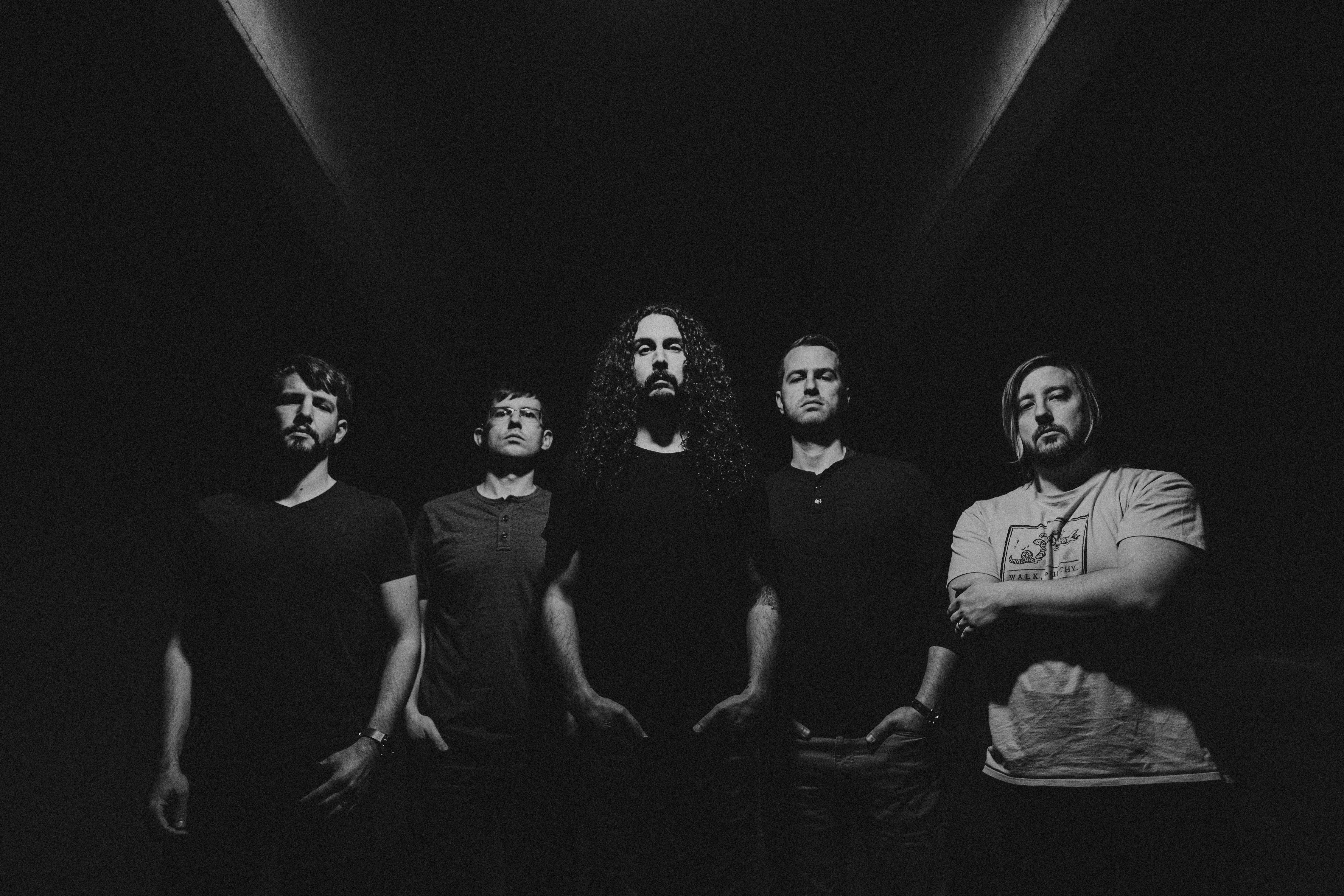
Ethos, the Atlanta-based progressive rock quintet, has delivered their latest album, “An Eye for an Eye,” released on June 25th, 2024. This release marks a significant milestone for the band, showcasing their evolution in sound and style while retaining the essence of what has established them over a decade ago. Comprising Austen Earp on vocals and keyboards, Kuyper Cummings and Matt Palopoli on guitars, Nick Riggs on bass, and Tribb Robison on drums, Ethos recorded and mixed the album at Darkroot Studios, with mastering done by the renowned Jens Bogren at the Fascination Street Studios.
“An Eye for an Eye” presents itself as a journey through the band’s musical and personal growth. According to bassist Nick Riggs, the album serves as a bridge between the band’s past and future, featuring writing and composing contributions from all five members for the first time. This collaborative effort has led to a more cohesive yet dynamic sound, leaning towards heavier and faster territories compared to their previous releases. Riggs emphasizes that this album represents a significant shift in their overall sound and writing style, providing a glimpse into the future direction of Ethos while reinforcing their established identity.
Listeners familiar with Ethos‘s earlier work will notice a maturation in both the music and the thematic content. Guitarist Kuyper Cummings notes that the record took several years to write, a period marked by significant life changes for the band members, including becoming parents, moving, and career shifts. This time of growth is deeply embedded in the album, with each song meticulously crafted and refined. If a part didn’t add meaningfully to a song, it was either reworked or discarded, a process that applied to both the music and the lyrics. This approach has resulted in a more polished and mature sound that still retains the band’s signature blend of heavy riffs and intricate piano melodies.
The album’s title, “An Eye for an Eye,” was inspired by a painting by fantasy artist Fian Arroyo. Vocalist and keyboardist Austen Earp explains that the title reflects themes of distrust in power structures and the inevitable reckoning that follows. However, the phrase “An eye for an eye” also suggests a more nuanced perspective on justice and healing, emphasizing the transformative power of creativity in addressing wrongdoings. This thematic complexity is mirrored in the album’s music, which blends rock and metal with classical motifs in a way that feels both natural and innovative.
Track Analysis
1. Begin With the End (4:01)
The opening track, “Begin With the End,” sets the tone for the album with its compelling mix of heavy riffs and melodic intricacies. The song showcases Ethos‘s ability to balance aggression and beauty, with Earp’s vocals delivering a poignant narrative that draws listeners in from the outset. The instrumentation is tight, with Cummings and Palopoli‘s guitars creating a dynamic interplay that propels the song forward.
2. Holy Water (4:09)
“Holy Water” continues the momentum with a more aggressive, larger-than-life feel. The track features soaring vocals and a driving rhythm section, anchored by Riggs‘ solid bass lines and Robison‘s precise drumming. The song’s chorus is particularly memorable, showcasing Ethos‘s knack for crafting hooks that resonate long after the music has stopped.
3. The Archetype Suite: IV. Stars Align (6:41)
The “Archetype Suite” is the centerpiece of the album, a multi-section epic that demonstrates Ethos‘ ambition and creativity. “Stars Align,” the fourth part of the suite, is a standout track that pushes the band’s musical boundaries. Spanning over six minutes, it takes listeners on a journey through complex time signatures, intricate guitar work, and haunting melodies.
4. The Archetype Suite: V. The Caudal Lure (1:37)
“The Caudal Lure” serves as a brief interlude within the suite, offering a moment of reflection and introspection. At just under two minutes, the track is a showcase for Earp’s vocal performance. This piece highlights Ethos‘s ability to create atmospheric and emotive music, even in shorter compositions, but still making it on point.
5. The Archetype Suite: VI. A New Regime (5:03)
The final track, “A New Regime,” concludes the album with a powerful statement. This song encapsulates the album’s themes of change and transformation, both musically and lyrically. The band pulls out all the stops, delivering a performance that is both technically impressive and emotionally resonant. The interplay between the guitars and the rhythm section is particularly striking, along with Earp‘s always soaring vocals painting a rich sonic landscape that leaves a lasting impression.
Conclusion
“An Eye for an Eye” is a compelling and ambitious album that showcases Ethos‘ growth as artists. The band’s ability to blend rock, metal, and classical motifs into a cohesive and dynamic sound is impressive, and their meticulous approach to songwriting and production is evident throughout the album. Fans of progressive rock and metal will find much to appreciate in this release, which serves as both a reflection of Ethos’ past and a preview of their future. With “An Eye for an Eye,” Ethos has solidified their place as a force to be reckoned with in the progressive music scene.
For more about Ethos visit their website. “An Eye for an Eye” is available now from Bandcamp.
Due to circumstances beyond my control — thanks to everybody who helped out! — this edition of Quick Takes is playing catch-up. This time around, purchase links are embedded in the release title, with any additional sample/streaming links labelled (LISTEN HERE).
The last few months’ progressive rock releases have skewed heavily toward reissues — for example, Keith Emerson and Greg Lake’s mid-1980s reunion with hard-rocker Cozy Powell in the drummer’s chair. Triple-cd box Emerson, Lake & Powell: The Complete Collection(LISTEN HERE) is a compact, yet worthy appendix to the ELP canon. The main album, ranging from extended throwbacks “The Score” and “The Miracle” through jazzy diversion “Step Aside” to souped-up classical gas like the single “Touch and Go” and Holst’s “Mars, the Bringer of War” is big, brash, widescreen stuff; both in the studio and on the two live discs included, Emerson’s thrusting digital synthesizer upgrades, Lake’s full-throated bravura vocals and Powell’s sleek percussive drive come on like gangbusters on new material and vintage classics such as “Pictures at an Exhibition” and “Pirates”. ELP’s mass appeal remained in the rear view mirror, but Emerson, Lake and Powell was a game try at reinvention for a different time.
Carl Palmer was playing drums for Asia during ELPowell’s flare and fade, but he’s remained engaged with his biggest band’s work, stepping up as legacy guardian after Emerson and Lake’s passing. Disc 1 of Palmer’s solo boxFanfare for the Common Man(a reissue/expansion of 2001’s Do You Wanna Play, Carl?) shows how he emerged from his bandmates’ shadows in the later 1970s, asserting himself in spellbinding trio jams, big band blowouts and a stylish, eclectic percussion concerto; disc 2 covers his roots in British R&B and psychedelia plus his later collaborations with Asia and others, while a new 3rd disc documents live work reinventing the ELP repertoire for guitar-based power trio. The accompanying BluRay video and biography are revealing, though scattered and even self-contradictory. But that’s a minor blemish: Palmer remains rightly admired and respected by musical peers and fans, and still on the road in his 70s, he retains the rhythmic fire and momentum that this set amply demonstrates.
ELP weren’t the only proggers trying to reinvent themselves after the mid-70s; on side one of 1977’s The Missing Piece(LISTEN HERE), the manic British sextet Gentle Giant made ever so coy feints at co-opting the energy of punk and New Wave (especially on the self-conscious spoof “Betcha Thought We Couldn’t Do It”). Side two was more relaxed; reaching for the soul-inflected art-pop that Genesis and Yes later rode to the top of the charts, the Shulman brothers & company still stirred in Baroque cross-rhythms (“As Old As You’re Young”), stately balladry (“Memories of Old Days”) and breakneck instrumental and vocal twists and turns (“Winning”). With Steven Wilson providing fresh stereo and spatial audio remixes, this is another delightful installment in the Giant’s ongoing series of album upgrades.
English folk-classicalists Renaissance kept plugging through the decades, with operatic lead singer Annie Haslam at the helm. 2000’s Tuscany(LISTEN HERE) was Haslam’s last go-round with key members guitarist Michael Dunford and drummer Terence Sullivan (plus limpid guest piano work from former keyboardist Jon Tout). Not as urgent as their 1970s work, it’s still a lovely, impressionistic album, gently meditating on the nexus of art (“Lady from Tuscany”, “Dear Landseer”), nature (“Pearls of Wisdom,” “Dolphin’ s Prayer”) and love (“In the Sunshine”, “One Thousand Roses”). A complete live show from Renaissance’s 2001 tour of Japan included as a bonus mixes new tunes with career standbys such as “Carpet of the Sun,” “Northern Lights” and “Mother Russia”, showing off Haslam and company’s musicality and consistency. As usual, Esoteric Recordings’ latest Renaissance reissue provides the context to better assess the work of this underrated band.
And in the wake of its new reissue, I now consider Yes’ 1994 album Talk the most unified effort of their post-prog decade. (It was also the least well-known, due to grunge taking over rock radio and Yes’ record company collapsing.) The only full-blown songwriting team-up of hippie muse Jon Anderson and guitarist/keyboardist/composer Trevor Rabin, Talk’s tunes ooze out-there ambition and hi-gloss appeal; the choral kick of “The Calling” and “Walls”, “Real Love’ jangle-pop/heavy metal synergy, the skip-hopping “State of Play” and the closing multi-part epic “Endless Dream” are stunningly remastered to devastating impact. Rhythm section Chris Squire and Alan White are at their most down and dirty; Tony Kaye leans in with expressive, gnarly organ work. And a bonus live set (from the soundboard at a 1994s tour stop) showed that this lineup could conjure a fairly close approximation of the classic sound on standbys like “Heart of the Sunrise” and “I’ve Seen All Good People”. If you loved Yes but wrote them off between 90125 and Union, I’m serious; give Talk a shot.
There have also been plenty of ear-opening new releases, mostly rooted in improvisation rather than composition. The latest posthumous set from piano legend Chick Corea has its source in a 2019 tour and follow-up sessions with eclectic banjo virtuoso Bela Fleck; the aptly-titled Remembrance(LISTEN HERE) covers an incredible range of sonic possibilities, with the duo wailing on Thelonious Monk’s “Bemsha Swing”, Scarlatti sonatas, brand new compositions and impromptus pulled from thin air. Impeccably tasty and always in the moment, Corea and Fleck spark off each other constantly, caught up in an unending sense of play and delight. Fans of either player will love this, and folks who dig acoustic jazz, bluegrass or both will find themselves smiling again and again when they hear it.
While Brad Mehldau is one of the numerous young lions who followed in Corea’s wake on piano, his sound and vision are uniquely his own, as a fresh pair of solo discs make clear. On After Bach II, Mehldau brings his love for the classical piano tradition and his improvisational chops to bear on a second set of J.S. Bach’s richly poised keyboard works, mingling preludes and fugues played straight with jazzier extrapolations (“Between Bach”) and superimposed twists of rhythm and counterpoint based on one of Bach’s pinnacles, the Goldberg Variations. Apres Fauré brings a similar freedom to the music of Gabriel Fauré, the French composer who became a unique bridge between the late Romantic and Impressionist schools; Mehldau responds to Fauré’s sense of adventure with sweeping repetitious bass lines, long-spun singing melodies, and thick two-handed harmonies. Plenty of rigorous development to chew on, plenty of knotty invention and lush sound to bask in on both of these!
On their new EP Tropic of Cancer, Chicago’s heavy-prog-jazzers Sons of Ra show how they can unspool variations on a theme with staggering impact. Setting a nimble, dancing idea with roots in fusion’s golden age into motion, multi-instrumentalists Erik Oldman and Keith Wakefield and drummer Michael Rataj put it through exhilarating paces over 23 minutes: you get wah-wah electric piano extrapolations, a sax/bass duet over a bed of guitar/sax noise; a wonderfully idiomatic folk/Celtic throwdown (complete with guests on violin, flute and pipa); a Santanesque guitar jam that spirals up dizzingly before it goes off like a fireworks display; and a gargantuan finish with hypnotic sax wailing over a shuddering guitar army. No jive; this is great stuff, and Sons of Ra are a band to which attention must be paid!
King Crimson-adjacent power trio Markus Reuter, Trey Gunn and Pat Mastelotto are also back with the ironically titled Tu-Ner for Lovers, another heaping helping of rich, doomy thrash. Sculpted from improvs recorded on their 2023 tour, the trio scrape, scratch and scrawl from the get-go, with Mastelotto laying down off-kilter tribal beats, Gunn rattling listeners’ innards with sludgy bass lines and Reuter slapping down arresting leads and color clusters on touch guitar. Stalking the abstract sublime, the music coalesces as the album progresses, locking in to galvanizing effect on closing stompers “They Call Him Threnody” and “Transistor Valentine”, wispily floater “I Put a Crush on You” and skittering finale “Combat and Courtship”. You may need to be in the right mood for this to grab you — alienation? Righteous anger? — but when you are, boy, does it hit home!
Kamasi Washington’s long-awaited double album Fearless Movement is every bit as kickass and sprawling as previous spectaculars The Epic and Heaven and Earth (the latter my 2018 Album of the Year), but somehow settles in a gentler, more welcoming vein. It kicks off with “Lesanu”, an Egyptian Orthodox chant of Psalm 96 riding first a free-jazz slam, then a finger-snapping, hand-clapping vamp and ends with “Prologue”, an Astor Piazzolla tango that morphs into a blaxploitation movie theme; at all points within and between, Washington on tenor sax, keyboardists Cameron Graves and Brandon Coleman, Ryan Porter and Dontae Winslow on brass, and a platoon of guests play and sing up a storm. But slower burning tracks like “Asha the First” and “Together” provide respite from the intensity of Washington’s sweep and surge, and a looser, relaxed sense of momentum on the Zapp cover “Computer Love” and the extended workout “Road to Self (KO)” helps you catch your breath. Washington and his friends are still making audacious spiritual jazz, building from whispers to screams again and again and dancing across barlines like they don’t exist; but somehow this set feels more like a place to make a home than a monument to visit. And yes, this one’s gonna be on my Favorites list this time around, too . . .
And sometimes, you just need some down-home picking and singing. On the heels of selling out the Ryman Auditorium (documented on record to great effect last year) and duetting with Willie Nelson, Charley Crockett pitches a passel of new songs our way on $10 Cowboy(LISTEN HERE) As with much of Crockett’s recent work, this album leans into soul nearly as much as country; the choogling brass and choral vocals of “America”, the piano-with-strings heartbreaker “Gettin’ Tired Again” and the funky “Diamond in the Rough” can’t help but call Motown and Memphis to mind. But there’s plenty of Nashville/Austin classicism too, in the steel guitar-laced single “Hard Luck and Circumstances”, the Latin-flavored acoustic revenge ballad “Spade” and the honky tonk shuffle “Ain’t Done Losing It” Whether this is the long-predicted breakthrough for Crockett or not, $10 Cowboy is a thoroughly satisfying album, capturing sharply defined snapshots of a nation wondering when things will get better.
And (thanks to the copious music collection found at the main branch of the Grand Rapids Public Library), I discovered that Sierra Ferrell’s 2021 debut Long Time Coming is every bit as good as her new one (Trail of Flowers, reviewed last time). My entire notes for this one consisted of the word “WOW!!”, so I’ll just point you in the direction of this review (from my go-to site for genre news and reviews, Saving Country Music), add Long Time Coming to my 2024 Favorites list and look forward to hearing her live in September!
We’re only five months into the year, but Witherfall has just released this weekend what definitely seems mostly likely to claim the title of the prog metal album of the year. The classic heavy metal album of the year has already been claimed by Judas Priest in March, with their untoppable Invincible Shield. The closest rival to Witherfall’s melodic death metal excellence that I can think of so far this year is Unleash the Archers, who gave us their amazing new disc Phantoma in early May.
With so many great new albums in 2024, it’s hard to pick favorites, especially with Neal Morse’s The Dreamer—Joseph: Part 2 from January still wearing the crown for prog epic of the year, and Big Big Train claiming prog album of the year in March with The Likes of Us. So I’m just going to declare a seven-way tie for the best albums of the year-to-date, and then proceed to explain below my rationale for giving upper-echelon placement to Witherfall’s Sounds of the Forgotten:
Prog Metal AOTY: Witherfall, Sounds of the Forgotten
Classic Metal AOTY: Judas Priest, Invincible Shield
Metal Epic Concept AOTY: Unleash the Archers, Phantoma
Prog Epic Concept AOTY: Neal Morse, The Dreamer—Joseph: Part 2
Prog AOTY: Big Big Train, The Likes of Us
Glam Metal AOTY: Sebastian Bach, Child Within the Man
Doom Metal AOTY: Pallbearer, Mind Burns Alive
Okay, let’s talk about Witherfall. Witherfall gathers together a stunning array of talent: guitarist/songwriter Jake Dreyer, vocalist/songwriter Joseph Michael, bassist Anthony Crawford, drummer/percussionist Chris Tsaganeas, keyboardist Gerry Hirschfeld, and studio-only drummer Marco Minnemann, whom you may be familiar with from The Aristocrats, Jordan Rudess, and Steven Wilson, not to mention Witherfall’s superb previous album, Curse of Autumn (2021). I’ve been following Witherfall’s underrated audio excursions from the very beginning. I count this as their fifth album, taking its predecessors as Nocturnes and Requiems (2017), A Prelude to Sorrow (2018), the substantial EP Vintage (2019), and Curse of Autumn (2021).
Their latest album is their greatest album—Witherfall’s Sounds of the Forgotten (2024), which I like to think of as built on a spine of seven epic, nicely prog-length tracks:
“They Will Let You Down” [Track 1 (5:59)]
“Where Do I Begin?” [Track 2 (6:30)]
“Insidious” [Track 4 (6:47)]
“Ceremony of Fire” [Track 5 (7:32)]
“Sounds of the Forgotten” [Track 6 (5:23)]
“When It All Falls Away” [Track 8 (6:39)]
“What Have You Done?” [Track 10 (10:19)]
Even if you wanted to pin down Witherfall as melodic death metal, you’d have to admire the perfect pacing along this seven-song spine. The songs alternate between the more demented death forays and the more melodic metal earworms: “They Will Let You Down,” “Insidious,” “Sounds of the Forgotten,” “What Have You Done?” are the four darkest of the spine tracks, whereas the highly melodic, multi-layered vocal choruses of the others pull you into singing along every time (“Where Do I Begin?”, “Ceremony of Fire,” “When It All Falls Away”).
The other three tracks on the album are clearly intros or outros to that seven-track spine, which is evident simply from their time lengths:
“A Lonely Path” [Track 3 (1:33)]
“Aftermath” [Track 7 (1:31)]
“Opulent” [Track 9 (2:45)]
These three snippets are characterized by brief but effective instrumental evocations of mood and atmosphere and by half-sung word paintings by vocal frontman/songwriter Joseph Michael, in which the other half of the vocal timbre is spookily spoken or growled. “A Lonely Path” offers a seamless introduction into “Insidious,” whereas “Aftermath” seals “Sounds of the Forgotten” with a suitably harsh coda. “Opulent” starts off with a nice instrumental break before the final epic “What Have You Done?” as Jake Dreyer dazzles us with more Spanish-style guitar licks, but Joseph Michael also returns at its end with more dramatic vocal narrative.
It’s impossible not to be floored by the band’s instrumental virtuosity. The central track in the seven-song spine, “Ceremony of Fire,” thrills me to no end with its soloing section, because the emotions I feel during that excursion parallel the excitement I once felt when I first heard the guitar-bass-drums interaction on some classic Rush tracks. The ecstasy induced by the guitar-bass-drums interaction on “Ceremony of Fire” is consolidated by the track’s sudden tempo change and downshifting into Joseph Michael’s magical bridge. That magic lasts right to the final notes, with concluding guitar and organ chords that invoke the heights of musical mysteries. If hearing one song will get you to buy the album, this is the winner.
But while all the musicians contribute to making this Witherfall’s most astounding album, it is perhaps Joseph Michael who leaves me with the mightiest impression here. Yes, it was Jake Dreyer’s guitar playing that drew me to the band, since it is rare to find such shredding talent anywhere that also deploys itself in service of unusually brilliant songwriting. But with Sounds of the Forgotten I have to declare that Joseph Michael is the one who has now stepped forward and truly achieved his own personality. By “personality” I mean that, no matter who he may remind you of here and there, he has a distinct voice that has attained an incomparable individual incarnation. Some examples of iconic musical personalities: Ozzy, Dio, Rob Halford, Chris Cornell, Freddie Mercury. When you hear these guys, they sound like themselves. Same with Joseph Michael, who I would venture has joined the pantheon with this latest performance. The range of what he does on this album is quite something to hear. Screams, shrieks, growls, whispers, howls, layered choruses, he does it all. He’s thereby the perfect frontman to epitomize Witherfall’s overall chameleon-like musical abilities.
I’d advise ordering the CD direct from DeathWave Records, which was created by Witherfall headmen Joseph Michael and Jake Dreyer. I did, and it was most gratifying to receive the CD in the mail in advance of the official release date, along with a bunch of extra goodies like snazzy art and band photo postcards, a band name sticker, and an Anthony Crawford Witherfall guitar pick.
The disc doesn’t have a bonus track, but maybe it will eventually be released with the cover version of Aerosmith’s “Kings and Queens” that the band unveiled earlier. If I could advise the band, I would tell them to release a full album of covers, including their own past covers. The thing about Witherfall’s versions is they put their own stamp on the songs and they morph them into their own delightfully demented renderings. What’s the point of doing a cover if you don’t unexpectedly transform the song into a new reward? Witherfall knows the secret to making a good cover. Witness their contrarian takes on Boston’s “Foreplay/Long Time” (from the Curse of Autumn era) and Tom Petty’s “I Won’t Back Down” (from the Vintage era). I say we need more. In the meantime, enjoy one of the best albums of the year: Witherfall, Sounds of the Forgotten. ⭑⭑⭑⭑⭑ = 10/10 = A+.