Modern Rock at Its Finest: English Electric Vol. 2

wk poole
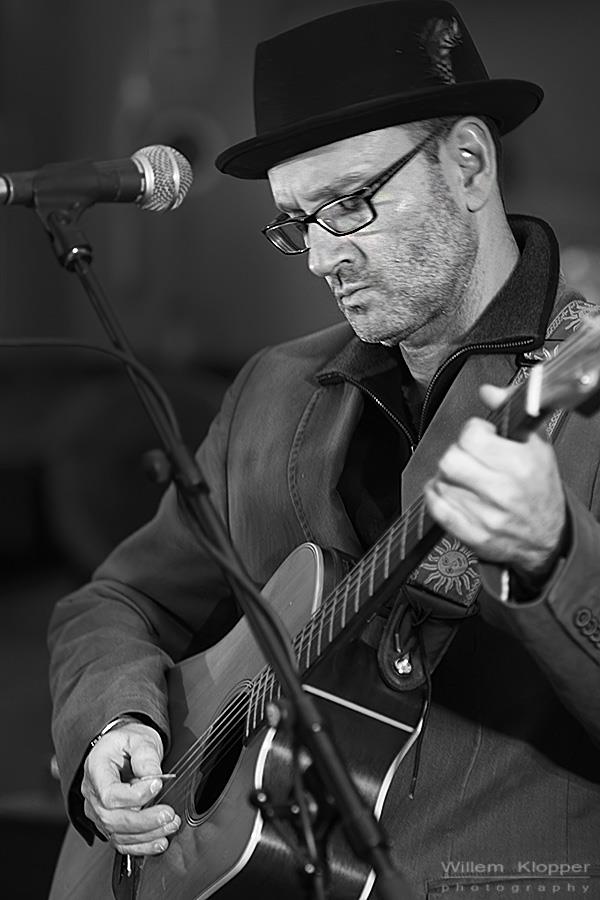
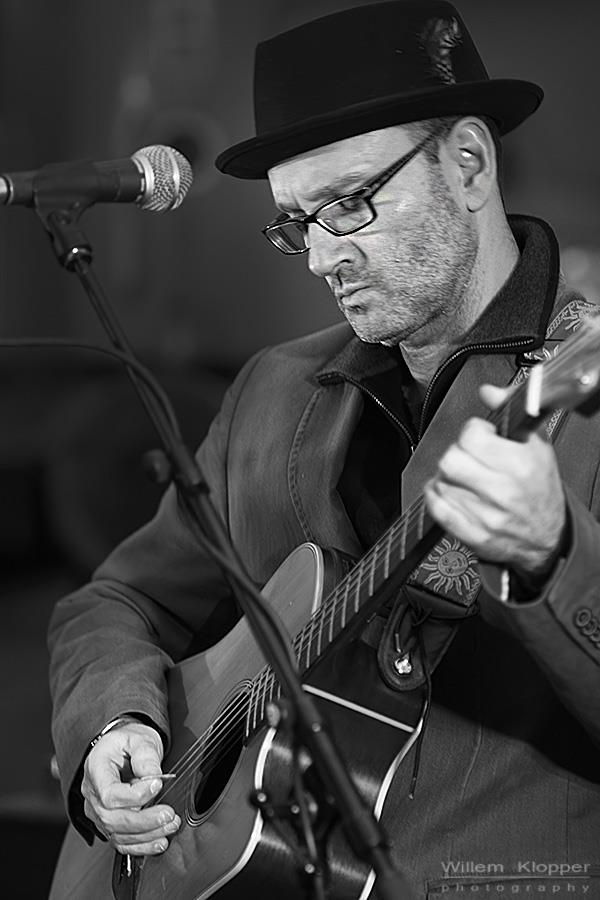
Photo of Andy Poole, co-founder of BBT, by the brilliant Willem Klopper. Used with his kind permission.

by Frank Urbaniak

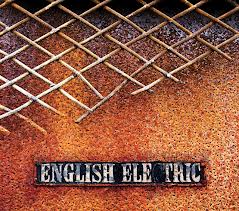
Reviewing Part Two of Big Big Train’s English Electric presents an interesting challenge-should this be considered as a Magnum Opus song cycle that just happened to be released in two sections, or should we consider EE2 as a separate and distinct release?

The good news is that EE Part Two stands on its own as a great collection of incredible compositions, interesting lyrics, and outstanding performances with more ‘space’ to develop the songs than on EE1.  The band is not afraid to wear its influences proudly on their sleeves-suggestions of Elbow, Genesis, PreFab Sprout, Radiohead and others appear and are gone in a flash, hinted at but never copied.  The instrumentation is again diverse but is not a repeat of EE1, and there is more room for Dave Gregory to stretch and embellish the song’s melodies, especially the sitar/guitar in Keeper of Abbeys playing counterpoint to the violin, Worked Out’s Tull feel, and the biting melancholy of The Permanent Way.  The production is impeccable and a delight through headphones, although there are moments I might wish for just a tad ‘less’ in the future.

EE Part Two continues to create a compelling argument for challenging the classification of BBT as ‘prog’.  The songs are so well composed and universal in themes that they could/should appeal to a wider listening audience.  On the other hand, the ‘proggers’ who summarily dismissed EE1, perhaps favoring metal/experimental or one of the other prog sub classifications (typically meaning heavier), will be hard pressed to embrace this one as well.  As an example, while Curator of the Butterflies is one of the finest ballads I have ever heard, the opening vocal ‘she likes to walk’ sound strangely like a Simon and Garfunkel tune, which won’t win over the gang who prefer their prog a bit heavier.

Continue reading “Modern Rock at Its Finest: English Electric Vol. 2”

The Permanent Way: The Music of Big Big Train

IMG_3725by Tad Wert

The long-awaited release of the second part of Big Big Train’s English Electric does not disappoint. It continues the band’s reverence and celebration of the unsung heroes of Great Britain’s past, beginning with the first track, the epic “East Coast Racer”. After a beautiful, elegiac opening featuring new member Danny Manners’ piano, the listener is suddenly hurtling down a railroad track on the exhilarating 1938 record-setting run of the famous Mallard steam locomotive. True to its subject, this 15+ minute song speeds by in no time, thanks to the propulsive drumming of Nick D’Virgilio. His stick-work evokes to an uncanny degree the clackety-clack rhythm of a train running full-bore across the countryside.

Another excellent song is “Worked Out”, a tribute to the millions of coal miners who labored underground to provide the fuel for the industrial revolution. It’s quite a rocker with a catchy sing-along chorus. David Longden’s “Leopards” is a nice change of pace, as the album turns inward to examine the conflicted emotions of two former lovers tentatively reconnecting. “Keeper of Abbeys” has one of the catchiest melodies ever written by the band, and it includes a hoedown featuring some delightful fiddle.

Continue reading “The Permanent Way: The Music of Big Big Train”

EEv2 Impressions

by Nick “Dr. Nick” Efford

If I’m honest, I was harbouring a secret wish for something rather different in tone from EE1: darker and more edgy, perhaps. Clearly, we don’t have that here – but it would be churlish to feel disappointment at getting more of the same, given the sublime nature of EE1. And there’s no doubt that Big Big Train have once again served up some wonderful music for us.

bbt ee2East Coast Racer is a suitably epic album opener that doesn’t quite gel for me yet. There are several parts to it that I really like but I’m struggling to find the thread linking them all together. It is growing on me with repeated listens but is giving up its secrets slowly!

No such issues with Swan Hunter, which is much simpler and more direct. The affection and nostalgia infusing this track makes it a natural companion piece to EE1’s Uncle Jack.  The obvious lyrical connection is that both Uncle Jack and Swan Hunter concern members of Dave Longdon’s family, but if you put to one side the lightness of the former and the more stately cadence of the latter then there are also some interesting melodic parallels to be found.  I’m not sure if this is deliberate or not, but it added something to the music for me.  All in all, a very pleasant piece, although not as memorable as the tracks that follow.

Worked Out is, I think, where this album truly sparks into life. The opening motif is pure pop and sounds like something Mike & The Mechanics might play, with Dave Longdon’s voice uncannily matching the timbre of Paul Carrack’s in places.  Then it switches into ‘prog wig-out’ mode, first with a flute-filled passage that would make Jethro Tull proud, then with a driving closing section featuring some brief but very welcome synth soloing. Absolutely splendid stuff.

Continue reading “EEv2 Impressions”

Pete Blum’s Open Letter to BBT

by Pete Blum

Dear BBT,

BBT EE2It feels as though it wants to be a “love letter” of a sort.  But it isn’t really there yet.  It’s not intensely passionate; it’s not yet full of those deep and personal codes that arise from having spent time as lovers or as the closest of friends.  It’s more like a very early and tentative venture, saying that I’ve been seeing and hearing you, I’ve been watching you and feeling the growth of some kind of friendship, but I wonder if it is (or could be) more.  I’m afraid, too.  Afraid of how you might respond, or even more afraid that you will not respond.  Afraid that if any blood flows into my words, you might miss it and find flattery alone, perhaps sprinkled with a spur here, a barb there, if that’s how you take some of it.  Do I dare ask for your patience when you don’t really know me?

Anyway, this is mainly about our third time “alone together,” as I truly tested that “together”:  It seems to have “tested positive” as the medical folk say.  I can’t refrain from this reaching out, from this speaking (though with a computer keyboard that may not be quite as clumsy as a voice).  It may be selfish on my part.  But isn’t it true that everything may be such, for all of us?

The Underfall Yard was where we first met, right after our mutual friend BB (no T) pointed you out to me with undisguised awe.  I heard, I believe, that at which his awe was aimed, or that which called to it.  Then the first installment of English Electric seemed to confirm it, in concert with some reaching back to earlier efforts.  You seemed so familiar, but also to move so easily and sensually beyond the familiar.  I was brought to an emotional dead halt by “A Boy in Darkness.”  I must confess, it had my attention locked in its cold embrace for days, haunting every other element of my everydayness.  I wrote a brief note about that before.

Continue reading “Pete Blum’s Open Letter to BBT”

So it Begins. . . Big Big Train, English Electric Vol. 2

[And so it begins. . . the reviews of the latest release from Big Big Train, English Electric Vol. 2.  You can pre-order now, as the official release date is March 4, 2013.  BBT is already shipping.  Our Progarchists will be reviewing the new release intensively and extensively between today and March 4, 2013.  Indeed, let us declare the four days of BBT an official holiday of leisure, truth, and beauty in our little Republic of Progarchy–Brad, ed.]

***

ee2“English Electric Pt 2 – Pictures at an Exhibition”

by Alison Henderson

I like to think that listening to English Electric Pt 2 is like visiting a rather exclusive sonic picture exhibition.  You walk into the gallery and you are instantly surrounded by seven exquisite works of art, each with its own character, telling a different story, but somehow all inextricably linked. As the album begins to play, you are drawn to each of them individually, especially the detail and care that has been taken into bringing them to life and you are filled with admiration for their creators, and with awe for the effect they have on you.

East Coast Racer is a tour de force of the collection, big and certainly epic enough to cover a whole wall because of the detail and precision that has gone into its making.  At its centre, you see this legendary steam locomotive the Mallard taking shape through Danny Manners’ intricate piano lines that start and end the piece, introducing us to its sleek lines and curves, before it bursts out of the canvas at breakneck speed, David Longdon’s voice soulfully expressing the pride and passion felt by the men who crafted and engineered this beautiful mechanical masterpiece. Ever changing, ever evolving, this work shifts up and down the gears several times, the attention to detail paid through the painstaking instrumentation, adding texture to the Turneresque picture evolving in the music.

Continue reading “So it Begins. . . Big Big Train, English Electric Vol. 2”

Medium-sized Egos, The Seventh Train, Lush Soundscapes, and Big Big Train: The 2013 Interview, Part II

N.B. AP is Andy Poole, DG is Dave Gregory, DM is Danny Manners, GS is Greg Spawton.  Progarchy interview conducted by Brad.

***

Progarchy (BB): When you put EE1 and EE2 together, how do you expect the listeners to see the whole EE? Say, 20 years from now, few will have had the experience of getting one, then the other. It will most likely be just EE. Do you expect your listeners–me, for example, or anyone else–interpreting EE1 differently in light of EE2? In particular, I think about a track like Hedgerow. As you probably know, Greg, I consider this the single finest conclusion to any album.  Ever. Period. Even better than Abbey Road, which had that position for me prior to hearing EE1. But, when I do get to hear EE2, I will now see Hedgerow as the middle song. BBT EE2

GS: You’ve put your finger on something that has caused us a fair bit of soul-searching Brad. At first, we had a fairly straightforward view on this which was simply: ‘it’s a double album, but we’ll split it into two separate releases’. Our reasoning was that 2 hours of music is a lot for the listener to get their head around which can initially cause under-appreciation of the double album in question. We were also aware that if you release so much music at one time, you get one round of publicity then the world moves on. If you split the release into two, the band is in the spotlight for a longer period of time. The only downside to this release strategy is that English Electric becomes seen as two separate pieces of work and so we always planned to release a special double edition bringing it all together. The thing is though, and as your question makes clear, it’s not as simple as we thought it would be. If you’re splitting an album into two you do have to try to make two satisfying separate halves, which is what we have tried to do. And that isn’t the same as sequencing a whole double album. So, the question we began to ask is: what do we do when we prepare the double Full Power edition? Do we simply stick Part One and Two together or do we start from scratch and re-sequence it as a double album? You mention Hedgerow as being a strong concluding track but we’ve also got Curator of Butterflies which is, we think, another strong end-piece. Which one of those takes precedence and gets to close the double album? And what happens with the three extra tracks we’re including? Where do they fit in? What we now think we’ll do is to start again from scratch and re-sequence Full Power as a double album without any reference to the orders on EE1 and EE2. It may be that we find some of the sequencing on EE1 and EE2 also works for EEFP and if it does, it does. Or it may be that the sequencing is completely different. In any case, the additional tracks will inevitably change the feel of things. The other question you raise is what happens when EEFP is released? Does that mean that EE1 and EE2 should go out of print? If not, will any new listeners buy them or will they go straight to EEFP? This is, I think, something we’ll have to keep under review. If EEFP turns out to feel like a very different listening experience to EE1 and EE2, then it makes sense to keep them all in print. Of course, the extra tracks will also be available on an EP and as downloads to make sure listeners don’t feel obligated to buy a double album just to hear three new songs. So, for many people their experience of English Electric will be as three separate releases.

Progarchy (BB):  Tell me about the additional songs added to the full package? Will there be much new artwork?

GS: There are three strong new songs. They are not leftovers from the original sessions but have been recorded specifically for EE Full Power. One of them is a sort of bookend love song to go with Leopards. Another builds on the main album themes of working communities and the English landscape. And the final one is something very different for us.

AP: As regards the artwork, I’m working on a lavish design with a comprehensive booklet telling the stories behind the songs and behind the album.

Progarchy (BB):  After EE2, you’ve announced plans to release Station Masters. Can you give us some details about this? Will it be reworked older tunes? Are there some new tunes?

NDV by Willem Klopper.

GS: It’s a triple CD which aims to tell the story of the band. All recordings will be with the new line-up so songs from albums prior to The Underfall Yard will be entirely re-recorded. Some of these are radically re-worked, others are fairly close to the originals but with the strong performances that the current line-up is capable of. Even more recent material may be reworked to some extent. For example, I always wanted to feature violin in The Underfall Yard but we didn’t have a violinist at the time. Rachel Hall will feature on the updated version. Wherever we look back and think something could have been better, we’ll make it better.

Progarchy (BB):  Will anything else come with the CDs? Any kind of BBT timeline or a poster? Concert DVD?

AP: There may be some video or other visual material. We haven’t made any final decisions on that yet.

Progarchy (BB):  Where do you see BBT’s place the history of rock and the history of prog rock?

GS: I think it’s too early to make an assessment. There are many drafts of history. I hope we’ll find ourselves as more than just a footnote when later drafts are written. However, progressive rock is a fairly contained world and we’re a long way away from making any sort of breakthrough in the broader rock and pop worlds.

Progarchy (BB): You have an immensely large and loyal fanbase. How does this affect you or the band’s approach to music and the music world?

GS: We’re really lucky with our fanbase. They seem to us in all of our interactions to be a thoroughly decent and likeable bunch. The feedback we’ve had over the years has been really important. To hear that what we like to write about resonates with others and particularly that we’ve moved people with our music makes a huge difference.

Progarchy (BB):  What is your view on packaging the material? You sell lots of downloads, and we live in a download world (for better and worse), but you also put a lot into the packaging of your CDs. Which I love. As you might remember, after I downloaded all of your albums up to The Underfall Yard, I contacted you because I wanted to purchase physical copies. And, it was worth the investment. Why do you consider it so important for BBT to have such beautiful packaging, especially in day and age? And, would you say such quality packaging should be important for all bands?

AP BBT
Andy Poole by Willem Klopper.

AP: The ideal package for us is a presentation of the words, music & images. The artwork is integral and we have been very fortunate over the years to have teamed-up with Michael Griffiths, Jim Trainer and Matthew Sefton who have each provided inspiring works that both complement & advance the sensory delivery of our albums.

Growing up with vinyl in the 70’s, you had an ingrained sense of interacting physically with an album … the touch, feel & smell of a new gatefold release was savored and an essential part of the experience … quite apart from placing a stylus in the groove and being aurally transformed to a progressive world of music where none of the old rules applied.

The initial advent of hurriedly released compact discs in their horrid plastic jewel cases and Lilliputian inserts amounted to instantly inferior packaging largely forgiven by consumers for the promise of digital sound.

We migrated to digipaks for the enhanced tactile experience, albeit in miniature compared to vinyl, and greater flexibility to represent the visual artists who collaborate with Big Big Train.

Although it is tempting to suggest and hope that other bands disregard the importance of physical product packaging to our advantage, I actually believe that it behooves us all to raise the quality bar up high and to the reasonable limits of affordability.

DG: It was certainly a very important factor with XTC. Andy Partridge claimed that every time he finished writing a song, he’d design a sleeve for it just in case it was chosen as a single! But then, he’s a very talented artist and can’t help himself. I’m certain sales of many of our releases were multiplied as a result of the packaging, as well as boosting the band’s ‘arty’ credentials.

Progarchy (BB):  I’m always amazed at what a community BBT is. That is, it’s clear–from the music as well as things such as FB posts, etc.–that you each really like one another. There’s no sense of brilliant radical individuals working next to each other (such as in certain early Yes albums), but a true sense of group brilliance, an organic whole. What do you think accounts for this?

GS: From my point of view I come back to something I’ve said before – surround yourselves with talented people and things start to happen. There is something else as well though, and that is that the guys in the band are all thoroughly good chaps. We’ll all hold strong positions from time-to-time and we say what we think but good manners are important. Speaking of Manners, you’re the new boy, Danny, do you have any observations?

DM: Some of it is simply that there are no huge egos in the band, whether by luck or by conscious or unconscious choice. (Medium sized, maybe, but not huge!)  However, one musical thing that strikes me is that the band members aren’t over-specialized – BBT doesn’t consist of “the singer”, “the drummer”, “the guitarist”, etc., all vying for the spotlight.  Everyone is a multi-instrumentalist to at least some extent, and everyone also has writing and/or arranging experience, so there’s much more focus on making the music work as a whole.

DG: Don’t forget also that we’re grown men, not ambitious youngsters. We are focused on the music at all times, because we love it. Both Greg and David, as writers, are extremely accommodating in terms of accepting ideas and contributions from all of us; they have yet to display any serious proprietorial tendencies when it comes to protecting their original vision. Which is not to suggest that it’s an open free-for-all; we live with the songs for months, plenty of time to assimilate their essence, so we’re generally united in the common aim, ultimately.

Progarchy (BB):  And, how do you see the role of Rob as engineer or any guest musicians you bring in? That is, how integral are they to a BBT sound, if such a particular thing exists.

146BBT1
The Seventh Train and Phill Brown of our age: Rob Aubrey. Photo by Amy Mumford.

GS: It’s an evolving sound and it will continue to develop. We have some really important collaborators at the moment and I envisage we will continue to work with many of them in the long-term. Certainly, Dave Desmond (who plays trombone and arranges the brass band) and violinist Rachel Hall will have significant input into Station Masters. As for Rob, he’s the seventh Train and our dear friend.

Progarchy (BB):  Where do you see BBT after Station Masters?

GS: I’d like us to be playing some shows at some stage. It would be good to do something around the time of Station Masters and then something around each release after that. As mentioned earlier, we have another album well underway and have started recording it so that is likely to come out in 2015.

Progarchy (BB):  Any final thoughts on the current and future state of rock?

GS: In Britain, the last of the high-street record stores has gone into administration. I guess there are similar issues in other countries. The supermarkets have stepped into the breach and will only really sell music in the pop charts, so the route through traditional music-distribution is closing down to most progressive bands. However, online, the choice is very broad and the issue there is getting noticed amongst all of the competition. Making a living out of music is going to get harder still but it’s been a labour of love for most folk and jazz musicians for years and I don’t see why it should be different for rock bands.ee2

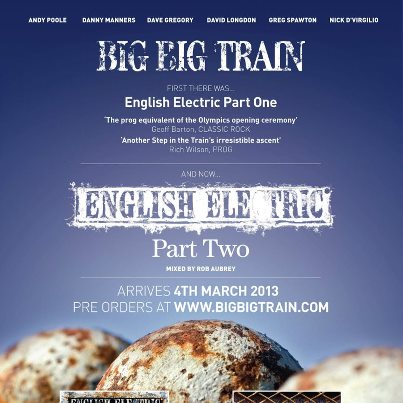
 English Electric Part 2 enters the world on March 4, 2013.  To order, go to Big Big Train’s online shop.

[Well, what does one say after such amazing interview, except—thank you.  Thank you to BBT for giving us so much time for this interview.  An even bigger thank you for making the world just a little bit brighter.—Ed.]

Brown M&Ms, Writing Grooves, Natural Historians, and Big Big Train: The 2013 Interview, Part I

I would love to give an elaborate introduction, but, really, I’ll be very honest with myself–you’re here to read the words of Andy, Dave, Danny, and Greg.  They very graciously gave us a significant amount of their time.  All Progarchists eagerly await the release of Big Big Train’s much anticipated conclusion to the highly successful English Electric Part One.  The first half released only last year represents, for me at least, the finest album in the rock world since Talk Talk’s 1988, “Spirit of Eden.”  No pressure, guys.

Ok, Brad, remember you promised to bloviate only very, very little. . . .

Progarchy proudly presents an exclusive interview with Big Big Train (though, feel free to make this less exclusive and repost anywhere and everywhere).

Spawton bass
Photo by Willem Klopper.

N.B. AP is Andy Poole, DG is Dave Gregory, DM is Danny Manners, GS is Greg Spawton.  Progarchy interview conducted by Brad.

***

Progarchy: Greg, EE1 did extremely well in terms of critical response. Did its success surprise you at all? If so, what part of it surprised you?

GS: We believed we had made a strong album but by the time the mix is finished, all objectivity goes out of the window so you never really know what will happen when others get to hear it. I think we were a little anxious about the number of other albums being released last year, and English Electric started shipping at around the same time as Sounds That Can’t Be Made, so we worried about whether it would get lost amongst all of the attention that CD was going to receive. A couple of weeks ago, Prog magazine published its readers’ polls for 2012. It only really hit home to us when we saw the results of those polls as to quite how much reach English Electric has achieved. It was surprising and very pleasing to be up there with Rush, Marillion, Porcupine Tree and Anathema.

Progarchy: Does its success change at all what you think about BBT?

GS: BBT is six chaps making music. However well we do, that’s all I think of it as.

DM: We haven’t reached the stage yet where our rider has a “no brown M&Ms” clause.

brown_mm_10703016
Photo not by Willem Klopper.

GS: I suspect it has changed how others view us. I read a couple of reviews recently where the album was described as being ‘hyped’ and I felt a little indignant as that misrepresents us. We’ve promoted it sure, but not in an excessive way. If other people write or talk about something, that isn’t hype.

Progarchy: How much of EE2 was written before EE1? That is, how much of this album is a response to the last? Or, are they really two parts of a whole?

GS: All of the songs were written and recorded as part of the same sessions. Any of the songs on Part Two could have been on Part One instead and we had mixes of all 15 tracks before EE1 was released. However, once we knew the track-listing for EE1, those eight songs on the first part got our maximum attention to make sure they were ready for release. As soon as EE1 was out we then went back to the EE2 tracks and continued to work on them.

AP: We wanted to take full advantage of the 6 month gap between the two albums to make sure all of the songs were at their best. That sometimes meant a bit of a rethink about the arrangements. East Coast Racer, in particular, benefitted from us being able to spend more time on it. We always thought it was a good track but now I think it’s one of our best.

Progarchy: Was the writing process much the same as the last album and previous albums? David clearly offered much in terms of lyrics and song ideas. It it the same with EE2?

Nick, Andy, Dave, David, Danny, Greg.  Photo by Willem Klopper.
Nick, Andy, Dave, David, Danny, Greg. Photo by Willem Klopper.

GS: We’re really in a groove with the writing now and have very established way of working within the band. I’ve written more of EE2 than EE1, but that’s just to do with how the track-listing fell. In fact, David has already written a lot of material for our next studio album and we’ve recorded Nick’s drums for some of the songs. The other guys are heavily involved in arrangement and, in truth, there can be a blurry line between writing and arranging. The accepted practise is that the songwriter is the person that composes the chord sequence, the main melody and the words. However, sometimes the parts written by the musicians for those chord sequences and melodies can be as important as the underlying music. So, the songs evolve at the hands of all of us.

Progarchy: Can you tell us about some of the themes–musically and lyrically–of EE2. The titles are poetically enticing, and there’s, of course, a huge anticipation on the web as to what the titles mean. Curator of Butterflies? Worked Out? The Permanent Way? Keeper of Abbeys (my favourite title)? For better or worse, I have lots of James Marsh images floating around in my head as I visualize the possible meanings of the titles.

GS: English Electric isn’t a concept album but it is an album with a number of themes linking many of the songs. On EE2 some of the songs pick up on the subject matter of songs from EE1 whilst others head off in different directions. Swan Hunter and Worked Out are both about lost working communities (from the shipyards and the mines) so those follow on from songs like Summoned By Bells. East Coast Racer is set in the 1930’s when a group of people designed and built a steam train called Mallard which ran very fast indeed. It’s a great adventure story. Leopards is a love song and provides an important contrast with some of the more epic material. Keeper of Abbeys is about a chap I met at a ruined abbey in the north of England. This man worked from dawn until dusk every day, tending to the stones. I got to know him a little bit but used my imagination to join up the missing parts of his story. Curator of Butterflies is inspired by a woman called Blanca Huertas who is the Curator Lepidoptera at the Natural History Museum. I read an article about her where she said the study of butterflies can allow so many tales to be told. The song is about how narrow the line is between life and death. I was very anxious about it sounding trite and so I wove a character into it to make it a story and tempt me away from spouting platitudes. Finally, The Permanent Way is the pivotal track where we try to bring everything together.

Progarchy: There’s lots of excitement about you joining, Danny. Can you tell us a little bit about yourself and how you came to join BBT?

DM: Well, I started off learning classical piano from a young age, and later became very interested in twentieth century classical music – at one point I was fairly obsessed with Stravinsky and had serious ambitions to be a composer. In my teens I also took up double bass (and later bass guitar) and got heavily into modern jazz and jazz-rock. You could say I was always into “progressive” music in the broadest sense of the word. But also, I was at school in the mid-seventies when some of the classic prog rock albums were being released, or had recently been released, and handed round on vinyl. I remember really liking early Yes, and Gentle Giant – still a favourite band. After that, I was more interested in the Canterbury end of prog, probably because of the jazzier connections. At university, as the eighties started, I became fascinated with some of the new wave bands that were combining the more advanced musical ideas I was already into with the stripped-down aesthetic of punk, which I’d initially been completely affronted by! XTC became a particular favourite, and a big influence on a university band I played bass guitar in and wrote for. (It got nowhere, although the members all had interesting careers in music afterwards.)

After that I played a lot of jazz, and some free improvised music, on the London scene – on double bass.  I joined a big band, The Happy End, which mixed up Kurt Weill, Sun Ra, swing, and protest songs from around the globe into a joyful, ramshackle stew, and got heavily involved for a few years gigging and writing arrangements for them – a highlight was working with Robert Wyatt, who made a guest appearance on a Happy End album. Gradually, I also became involved with various alt, leftfield or indie rock/pop singer-songwriters. The notable ones were: Sandy Dillon – that’s a female Sandy – originally from the US, whose band mixed blues and roots with the avant-garde, with Tom Waits and Captain Beefheart as major influences; Cathal Coughlan, one of the best lyric writers I know, whose voice and songs can range from beautiful ballads to corruscating anger; and, most importantly, Louis Philippe, a Frenchman resident in London, whose music mixes influences from the great pop writers like Brian Wilson or Burt Bacharach, classical music, jazz, French chanson…. I’ve worked with Louis for 25 years now, initially as a bassist, but later also as keyboard player and arranger, and as a participant in some of his production work for other artists.

In 1995, I think, Louis showed me a letter he’d been sent by a fan, who turned out to be David Longdon. David had included some of his own music, and was obviously hugely talented as a singer, songwriter, instrumentalist and arranger. So Louis had no hesitation in asking him to do a gig with us, and then to participate in Louis’s next few albums. (Also featured on those was Dave Gregory, who Louis had met when arranging and producing an album for labelmate Martin Newell.) I stayed friends with David, and he kept us informed about the Genesis near-miss, but we didn’t see each other for a while after that as we were both busy with young families. I do remember him telling me he’d joined a prog band, although the name Big Big Train meant absolutely nothing to me at that point. (I hadn’t kept up with contemporary prog at all.) Then a couple of years ago, he asked if I’d put down some double bass for a song called British Racing Green…ee2

Happily, the band liked it. I think David had possibly recommended me for the keyboard chair earlier than this, but Greg and Andy may have been wary because I didn’t have any track record specifically in the prog field. However, when they started work in earnest on EE1 they asked me to see if I could do anything with the piano on a couple of songs. Again, it turned out to our mutual satisfaction, and in the end I contributed to almost every track, did a bit of arranging on Summoned By Bells, and stuck my nose in at the mixing stage as well.  By the time attention turned to finishing off EE2, I was pretty much fully involved, so it made sense to them to ask me to join the band officially. I really liked the fusion they’d arrived at on EE, blending folk  and acoustic instruments into the prog and other elements already there, and it was a great opportunity to work with fabulous players like Dave G and Nick, so I didn’t have any hesitation in accepting.

On EE2 I’m playing keyboards a bit more – including an honest-to-goodness, “I’m prog and I’m proud” synth solo – and it’s going to be quite exciting exploring further on future releases.

Part II tomorrow.–Ed.  To order English Electric Part II, please go here–BBT’s official shop.

Danny Manners Boards Big Big Train

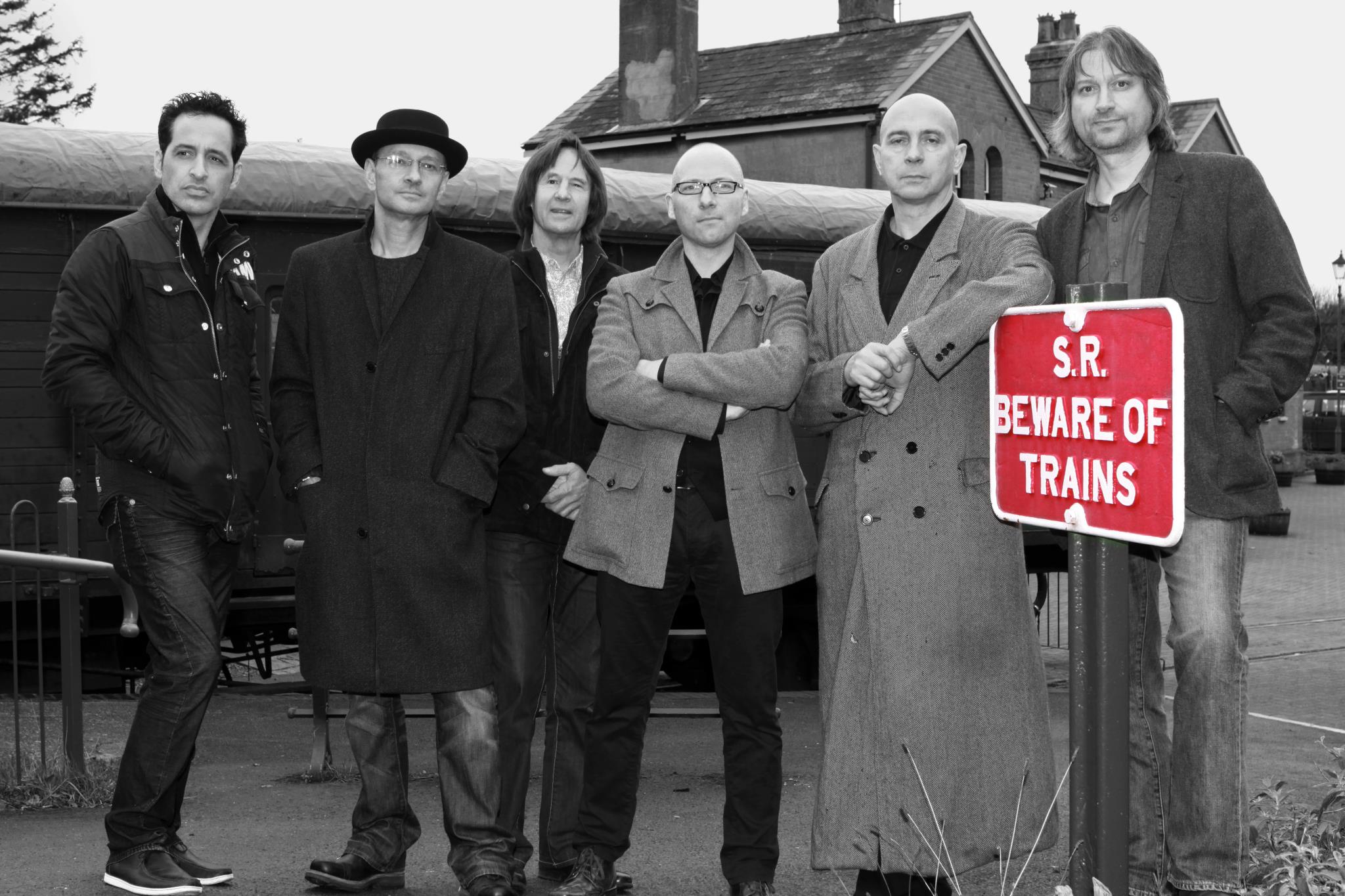
Nick, Andy, Dave, David, Danny, Greg.  Photo by Willem Klopper.
Nick, Andy, Dave, David, Danny, big red sign, Greg.
Photo by Willem Klopper.

Great news today on Facebook from the station master himself, Greg Spawton of Big Big Train.  Bassist and keyboardist Danny Manners has officially become a member of the band, joining Spawton, Andy Poole, David Longdon, Dave Gregory, and Nick D’Virgilio.

Spawton wrote:

We are pleased to announce that Danny Manners has joined Big Big Train as the band’s keyboard player. Danny made a significant contribution to English Electric Part One, playing keyboards and double bass and we are delighted that Danny has accepted our offer to join the band in time for the release of English Electric Part Two on March 4th. Danny’s past credits include Louis Philippe and Cathal Coughlan.

Manners’s training has been mostly in classical and jazz.  He writes of himself at his website:

For those who have stumbled across me: I’m a double bassist, electric bassist, pianist, arranger and composer living in London, England. Starting with classical music as a child and teenager, I worked my way backwards through jazz and finally worked out how to play pop half-decently in my thirties. Along the way I’ve also been involved in improvised and “leftfield” musics. At the moment I’m lucky enough to be doing a little bit of all of these…

He also lists an impressive discography, having played extensively with Louis Phillippe, Louise Le May, Cathal Coughlan, Sandy Dillon, and Muse: http://www.dannymanners.co.uk/albums.html

I must admit, I’m (I–ed., Brad) thoroughly impressed with this addition.  Over twenty years old, beginning with original members, Spawton and Poole, Big Big Train has never ceased to grow, take grand chances, and transform into what is arguably one of the greatest–if not THE greatest–rock band of our era.  With their near collapse after the recording “Bard,” Spawton and Poole have developed the group tremendously with “Gathering Speed,” “The Difference Machine”, “The Underfall Yard”, and “Far Skies Deep Time”.  Their 2012 release, “English Electric Part One”, has received rave reviews and has been labeled the single finest release of 2012 by a number of critics.

To this critic, “English Electric Part One” is not just the best of 2012, it’s the best rock release since Talk Talk’s 1988 magnum opus, “Spirit of Eden.”  Before that, one would have to jump back to Yes’s “Close to the Edge” or Genesis’s “Selling England By the Pound” in the early 1970s or to Dave Brubeck’s “Time Out” to find comparable works of music in the last half century.

It should be noted as well that the engineer for Big Big Train, Rob Aubrey, is the Phill Brown of our era as well.

Finally, Manners has worked with David Longdon before, and–I assume–connected Big Big Train to the famous bassist and keyboardist.

The second part of English Electric will be released on March 4 of this year.  American drummer, Nick D’Virgilio, a full-time member of the band, just finished recording the final drum parts for “English Electric Part Two.”  Additionally, the band will be releasing a limited edition of the full “English Electric” in the fall and the re-imaging of previous tracks on “Station Masters” in 2014.

A Beginner’s Guide to Big Big Train

Dear Progarchists,

My apologies for the absence of posts yesterday, November 15.  I’m in the middle of round two of grading freshmen papers and midterms, and life overtook me this week.

It’s late Friday afternoon as I type this in Michigan, but I still have one more academic event today.  At six (in about 2 hours), I’m giving a lecture on The Killing Fields, the sublime 1984 movie about the holocaust in Cambodia, 1975-1978.  As I think about watching that movie for the first time, I get chills.  What horrors humanity creates for itself.  But, that’s a different topic.

As the sun streams into my office window, I’m in the mood for much more pleasant things.

In particular, I’m thinking about the majesty and wonder that is Big Big Train.  I saw a Twitter post two days ago from a friend who expressed shock at the intensity and greatness of BBT.  In a way, I’m incredibly jealous those who have yet to experience BBT for the first time.  So, for those who have not had the grand pleasure that is listening to BBT, here’s a guide.

And, just so I make myself as clear as possible: the new BBT album, EEP1, is the equal in greatness of Talk Talk’s 1988 “Spirit of Eden” and Genesis’s 1973, “Selling England By the Pound.”  This is, without question, a must own for any lover of music, progressive or otherwise.

As many times as I’ve heard it, there are several tracks that still make me what to blaze a path toward social justice and there are several that just make me smile, for the opening note to the last.

But, certainly, nothing on this album is frivolous.   Each track is fraught with meaning.

***

On September 3, 2012, Big Big Train released its latest best studio album, English Electric Part One.  It is a thing of truth, beauty, and goodness in every way.  Part Two arrives in March.  From what I’ve seen on the web and through brief correspondence, it looks as though Part Two will be every bit as intense and glorious as Part One.

Thank to the good will of webeditors, Winston Elliott, Josh Mercer, and Carl Olson (the last, being a full fledged citizen of Progarchy), I’ve had the joy of writing about BBT a number of times..  Last summer, the band released an epic single dealing with the life of St. Edith.  To see this, click here.  http://www.catholicvote.org/discuss/index.php?p=19315

If you’re new to the genre of progressive rock, which its fans rightly consider every bit as good if not better than the best of jazz (equal in musicianship, but superior in inventiveness and, of course, lyrics, since jazz is generally without vocals), I’ve tried to explain and defend the genre to specialized audiences here: http://www.nationalreview.com/articles/299126/different-kind-progressive-bradley-j-birzer

And, here: http://www.ignatiusinsight.com/features2011/bbirzer_progrock_may2011.asp

On my personal blog, Stormfields (www.bradleybirzer.com), I’ve had the great pleasure of writing about some of my favorite bands: Big Big Train, Matt Stevens and his The Fierce and the Dead, Talk Talk, the Cure, Rush, The Reasoning, Arjen Lucassen, Tin Spirits, and XTC.

At my main professional site, TIC (founded by Winston Elliott, the main editor and brain behind it), I’ve also had the good fortune of writing extensively about Big Big Train:http://www.imaginativeconservative.org/search/label/Greg%20Spawton

While I couldn’t even come close to calculating how many words I’ve employed in writing about progressive rock over the years, the same would be even more true regarding my favorite, Big Big Train.

The latest BBT release, English Electric Part One, is not only BBT at its best, it is art at its absolute best.  Best described as pastoral, Georgian, and bucolic, the new album is also eccentric (without ever losing its center), intense, brooding, meandering, reflective, joyous, and deeply vernal.  This is something new, as BBT has traditionally explored the more autumnal aspects of life.

It’s also simply hard not to love these guys on a personal level.  I started corresponding with Greg Spawton several years ago, and he responded immediately and with what I quickly discovered was his characteristic wit and kindness.  After all, who was I–just some goofy guy from the U.S. who happened to fall over myself explaining why I loved BBT.  I once wrote something similar to Neal Peart.  I got a nice postcard back two years later.  But, from Greg, a friendship emerged.  Now, my kids even color pictures for him and ask how my “English rock star friend” is doing.  I have found that all of the members of this band are similar in this regard, and it’s very, very clear by their art that they love one another in a way only brothers can.  Indeed, they face the world not as individual artists, each pulsating with radical individuality, but as a band, ready to leaven all that is good in the world.

A quick look at the wide-ranging debates on the BBT FB page shows how many wonderful and meaningful folks gravitate toward this band and remain to talk some more!  Some of these people have also become good friends, though I’ve yet to meet a single one, face to face.

Greg Spawton and Andy Poole formed the band in the early 1990s, and they’ve since added some of the absolute finest musicians of our day: American drummer Nick D’Virgilio (rivaled in drumming only by Neal Peart of Rush and Mike Portnoy, formerly of Dream Theater), guitarist Dave Gregory (formerly of XTC and currently of Tin Spirits) and flautist and singer, David Longdon, a music professor and folklore and folk music expert.  Augmented by a professional team, in particular engineer and producer, Rob Aubrey, BBT makes music that reflects not only the woes, sufferings, and glories of this world, but without timidity, of the next world.  Imagine the three parts of The Divine Comedy come to life, and you’ll get a sense of what BBT is doing.

Spawton and Longdon, the two main writers of the lyrics, are clearly well read and articulate.  Listening to a 2-hour interview with David “Wilf” Elliott (no relation to the famous Texan cultural critic, Winston Elliott) this past weekend reminded me once again how excellent true conversation among friends and professionals can be.  I would give much for our loud talk show (Mike Church excepted, as always) and TV show hosts in this country to take notice of what educated and purposeful English gentlemen can do.  To here the interview, go here: http://www.theeuropeanperspective.com/?p=1764.  I would not be surprised if these five would’ve been welcomed in the Thursday evening discussion in the 1930s in C.S. Lewis’s rooms at Oxford.

It’s also worth calling Rob Aubrey, who engineered the album, a sixth member of the band.  Aubrey is the Phill Brown of our generation.

To conclude this late Friday afternoon piece, let me encourage you to purchase a cd from Big Big Train. http://www.bigbigtrain.com/ This is a band that not only pursues, as mentioned above, the Good, the True, and Beautiful, but they are entrepreneurs, each trying to make his way in this rather fallen world.  For over twenty years, they have chosen not to pursue the commercial path of pop culture sensations and corporate conformity.  Every writer for and reader of Progarchy knows too well that the once successful system of patronage is long gone.  We must be willing to support culture and art where it emerges.  I promise you, the music of Spawton, Longdon, and Co. will not disappoint, and the band is well worth supporting.

If you’re still not convinced, try one of their many songs for free here: http://www.bigbigtrain.com/main/listen

They’ve certainly changed my life and only for the better.

Going to Ground: A Review of Big Big Train’s Difference Machine

[An outrageously and somewhat circuitous review of “The Difference Machine” by Big Big Train (original release: 2007; reissued 2010).]

To see a little further/down below a mist hung over the fields/and the stars are falling away like raindrops on glass/further apart/slowing spinning dark–Greg Spawton/BBT, 2007

Being a Kansas Anglophile

For as long as I can remember, I’ve been an Anglophile.  And, I use this term inclusively: I’m fascinated by the history, cultures, and languages of the British Isles, and all of its inhabitants—from the Celts and Picts to the Angles and the Saxons and even the barbaric, invading Danes (and many others, of course).  I’m sure much of my love of all things English (and British) comes from my earliest readings of Tolkien and his vast mythology, all of which [ ].  I’m also married to a McDonald, who happens to be more German and Swedish than Irish, but the name . . . that blessed Celtic name.

But, I’m taken with so many other persons as well, some real and some fictitious and some a bit of both in larger British history: Bran the Blessed, Arthur, St. Patrick, St. Augustine of Canterbury, St. Bede, St. Boniface, Alcuin, Alfred the Great, Harold of Hastings, the nobles, temporal and spiritual who challenged King John at Runnymede, Sir Thomas More, Edmund Burke, William Pitt, Winston Churchill, C.S. Lewis, Owen Barfield, T.S. Eliot, etc., etc.  And, this is just the short list.

Despite this noble lineage of great men, the British people have somewhat paradoxically chosen Arthur, not the much more victorious Alfred the Great, as “the central figure of national heroic legend.  So wrote the nearly forgotten British (himself half Welsh, half English) historian, Christopher Dawson, in 1936.  After all, he believed, the British loved lost causes, especially if the loss came in the face of extreme opposition while defending what is right, good, and just.  Indeed, he argued, giving one’s all for the good of British society remains a fundamental part of the British character, as proven in the last several centuries by figures such as the Irishman Edmund Burke and Anglo-American Winston Churchill.

Such a fascination with lost causes gives the British a properly melancholic and, simultaneously, noble national character.

All of this played to my Kansas upbringing, staring across the wheat fields and sandhills, wandering what might exist beyond.

Big Big Train

When I bask in the music of the very, very English progressive rock band, Big Big Train, I feel—at the deepest possible levels—each of these quintessentially British traits: perseverance for the good no matter the cost; and a singular melancholic intensity.
 The Difference Machine flies/you can see stars right through it/your mum or your dad or your kids; or the love of your life/bring light to the dark spaces between us/Stars bu8rn through the coins on my eyes.”–Greg Spawton/BBT, 2007

Though I do not fully understand all of the lyrics (and this is good, mystery is a fundamental part of art, to my mind), I can’t help but think English nobility and melancholic intensity as I listen to my most recent BBT purchase, the 2007 The Difference Machine, reissued last year.

Indeed, I first bought it as an mp3 download.  I was so taken with the subtlety of the music, the instrumentation, and the lyrics, I happily reordered the full CD version.  I’m glad to have done so, as the quality, not surprisingly, is so much higher.  I’ve now listened to the “The Difference Machine” multiple times and in a variety of different situations: on my iPod while out for exercise; through my car stereo while driving; and on my kitchen stereo while baking (one of my loves—yesterday, I was baking English oat bread while listening to the CD).  Frankly, there’s no bad place to listen to BBT music—as long as it’s not as mere background.  It would be shame and a slap at real art to listen to this as anything other than what it is and how it was recorded—to enjoy it fully, to immerse oneself in it.

As with every other BBT release, this one simply stuns me, and it does so even more with each new listen.  I treasure each new listening, for I keep discovering new things, more beauty, more sadness, and more creativity.

While there exist a number of bands and musicians I follow—and I’ve been listening to progressive rock since 1972, when I was four—there are only a couple of bands that totally absorb my interest.  Those bands have been (in order encountered):

Yes (especially, “Fragile” through “90125”); Rush (especially, “Permanent Waves” through “Power Windows”; “Vapor Trails” to present); Talk Talk (especially, the last three albums); and The Cure (especially, “Faith” through “Wish”).

To these four groups, I also include the music of Kevin McCormick.  But, while I can objectively state his music is as good as anything I’ve ever heard, I also must admit, he’s been one of my closest friends since 1986, so a bias toward him rather strongly exists.

I would also include Gazpacho, the music of Matt Stevens, Roine Stolt, Arjen Lucassen, and Neal Morse in their many forms, and anything Matt Stevens does.

Back to my claims.  So, I’ve been listening to prog consistently since the earlier 70s, when my older brothers introduced me (probably unintentionally).  Not only have I listened, collected, and analyzed prog for much of my life, I’ve also been a radio DJ, having my own prog show in college.  I write this only to suggest that I’ve given this all a lot of thought—in between, around, above, and under academic projects, teaching, and family obligations.

So, with all of this explanation to the above nearly forty-year old list, I add a fifth band of excellence: Big Big Train.

If Yes’s “Close to the Edge” and Genesis’s “Selling England by the Pound” best represented the 1970s; if Talk Talk’s “Spirit of Eden” best represented the 1980s, then, BBT’s last full LP, “The Underfall Yard” best represents the last decade of music.  [Yes, I know I left out the 1990s, I’m still thinking about this one]

A huge claim, I know, but I very much believe it true.  And, for my good friends reading this, you know if I equate anything to “Spirit of Eden” (an album I’ve obsessed over way too much), I’m serious.

To me, Big Big Train—its history, its perseverance, its openness to its listeners and followers through the internet, especially, its musicianship, its desire for reaching perfection, its poetic and imagist lyrics—represents the very best of what exists in music today.  This is far from feint praise, for there’s a considerable amount of competition out there—some almost equally fine music from groups as diverse as Porcupine Tree, Gazpacho, and others.

BBT only increases my love of things English.

Going back through the reviews and history, I see that Big Big Train almost broke up after the recording of “Bard.”  Thank God, they didn’t.  While Bard is the only album of BBT’s I’ve not heard, I’m quite positive—given where they’ve gone since Bard—BBT was just catching its stride around the making of that album.  Though I have a feeling—and I don’t know any of what I’m about to write this from personal knowledge, only from the interviews, lyrics, etc.—the current members of BBT must have gone through some very powerful trials and shakeups.  Like the best of those who came before them, Greg Spawton and Andy Poole, original band members, persevered.  Where they’ve gone—especially with “The Underfall Yard”—is almost certainly not something they could’ve expected a decade or so ago.  Instead, “The Underfall Yard” is a product of long struggle, experience, and craftsmanship; one of those unbought graces—but one that can’t arrive without extreme dedication to an artform.

Signals fail/A moment of time/lost, home/salt water, silence.–Greg Spawton/BBT, 2007

The Difference Machine

As noted earlier, my version of “The Difference Machine” came out last year.  In his own description of the album, Spawton writes:

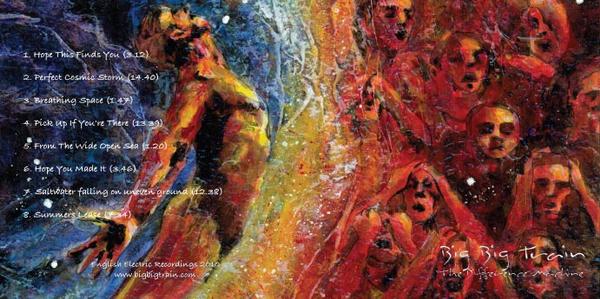
The Difference Machine received significant critical acclaim and, at the time of writing, is our best-selling CD.  After the release of Gathering Speed, we  invested the proceeds in our studio to ensure we could record music at the highest possible quality for an independent band.  Furthermore, Andy had gained considerable experience as an engineer and we felt much more confident in our ability to get the most out of our studio.  The Difference Machine is a concept album – a ‘small’ story; the loss of loved ones as life progresses, set against a ‘big’ story; the death of a distant star.  The songs for the album were written  quickly. The prog rock / post-rock crossover thing was now fully formed and everything flowed very smoothly.  Indeed, a  number of other songs which didn’t make it onto the album also came out of the writing sessions (BramblingHope You Made It and a 17 minute track – The Wide Open Sea.) The main musical motif for the album is set out early on in the opening track – an instrumental called Hope This Finds You. Played on viola by Becca King, the theme is restated briefly in Pick Up If You’re There before returning at the end of the album in the closing section of Summer’s Lease. Other musical motifs abound, some buried deeply in the music, some combining with others to form new themes. For example, the main album theme on the playout of Summer’s Lease is intertwined with a motif from Perfect Cosmic Storm which is initially set out in an understated manner on electric piano, before returning as the grand closing section of the song.  There’s a lot of this on The Difference Machine – it is an album which is intended to pay repeated listenings with new discoveries.

After having given this beautiful album innumerable listenings, I can confirm Spawton’s own description of it.

There are eight tracks on the 2010 version of “The Difference Machine.”

The opening track, “Hope this finds you”—a short but powerful instrumental, captures the essence of the entire album, setting out the themes of wide open space, and vast emptiness, but, with the entrance of the viola, a deep and abiding sorrow appears, thus closing the space into something intensely personal, even intimate.

“Perfect Cosmic Storm” begins with a strange signal and some dissonance.  A disembodied voice beckons: “signals go to ground” and then, circling the listener, cries “For me there is not hope at all.”  From what I can tell, immersed in this man’s longing and despair, he believes he has either died or is on the edge of death.  His life flashes before his eyes, and “before I go to ground,” he catches a glimpse of some of the happiest things of his existence: kids, parents, and all good that connects one good thing to another, allowing us to transcend this overwhelmingly dark life.

At over fourteen minutes, “Perfect Cosmic Storm” is a masterpiece in every way.  Every voice and every instrument finds its exact place, and while much of the music is chaotic, there is an order to it all (especially beginning at 5:47 into the song, when the sax (itself, used here as an instrument of despair)), just as there is for the man (in the lyrics) dying. When, at 6:30, the singer comes back in with “Signals go to ground,” the listener breaths a sigh of relief.  No relief remains permanent, though—as dissonance and counter harmonies continue throughout the track.  Musically, the listener is left with the feeling that the protagonist has some massive choice still confronting him.

Spawton’s lyrics make this a truly great song.  But, of course, a number of other things also make this song one of near perfection.  Nick d’Virgilio’s drums and Dave Meros (of Marillion)’s bass are some of the best of each I’ve ever heard.  Though he can play anything, D’Virgilio was made to play the music of Spawton and Poole.  Phew.

The third track, “Breathing Space,” is exactly what it seems.  A profound openness emerges during this song, and one feels as though the protagonist has realized either that he’s not quite dead or that he has some kind of redemption and permanent happiness awaiting him.  It must be early evening, though, as crickets chirp, and space signals continue to emanate from somewhere.

In track four, “Pick Up if You’re There,” the protagonist, now realizing that the abyss is not all that confronts him, searches for signs of life.  He climbs a hill, but only sees a mist below him and, when looking up, sees stars falling.  Spawton offers some of his best poetic moments in lyrics to this song.  The drums, bass, and organ are especially strong on this track, driving the protagonist toward some thing, whether that some thing be good or ill, a purgation of the worst or the best.  “You can almost taste the pain/you can almost touch it.”  And, again, D’Virgilio’s drums and, this time time (especially beginning around 4:39 into the song), Pete Trewavas’s bass is nothing less than breathtaking, as is Tony Wright’s flute at 8:40 into the track.  But, the jam (especially the interplay of drums, bass, and Greg’s organ) beginning around 10:05 is my favorite part of the album.  That protagonist is heading somewhere and fast.  I still not quite sure where, but I know he’s moving at an outrageous speed.  “One by one the signal’s fail/the sky is full of comet’s tails/–pick up if you’re there.”

“From the Wide Open Sea,” a track foreshadowing, in title and theme, the final track of BBT’s 2010 ep, “Far Skies Deep Time,” serves the same function as track three.  The listener can relax, at least momentarily, as the spacey keyboards swirl.

Track six, “Hope you made it,” is another short song.  Despite it’s relative brevity, the song’s lyrics cast much doubt on the fate of the protagonist.  Life seems to break this man, and the best escapes him.  “Mercury falling over the snow fields/the passage of time/as the notes in the margins/the last day of summer/the last day you loved her.”  Is all of life nothing more than sporadic marginalia?

“Saltwater (falls on uneven ground)” is my favorite track.  After a hauntingly false introduction, the song quickly changes direction, and we have an Eliot-esque man, a “hollow man” unable to keep some centricity to his life.  And yet, as typical with BBT, a brief hope emerges.  The sky brightens, and though the ground is frozen, the protagonist hears his love—or what he thinks is his love—walking behind him.  From my perspective, lyrically, this song serves as the most important moment of the album.  The protagonist, as close to death as possible without actually crossing into the shadow realm, sees before him the cold and relentless grasp of winter.  As he does, voices of men and beasts (a cat that sounds strangely Pink Floyd-esque) as well as the signals from space swirl around him.  BBT offers several minutes of a really laid-back jam (ok, I have no other way of explaining this).  At 8:41, the protagonist, surrounded by a cold winter death, suddenly remembers the glories of summer, “days without end/exploding with fire.”  If without end, the man only has to claim these as his true eternity.  “Extraordinary again,” the lyrics conclude.

The final track, “Summer’s Lease,” gives us no settled answer.  Summer conquers winter, and love rears its profound head among the prevalent pain of the world.  But, the protagonist still seems somewhat lost.  At 3:14, the song becomes relentless, frantic.  “Where did you come from/where will you go to?/Don’t go away (repeated several times),” the protagonist cries.  Every instrument seems to explode here.  At around 4:56, the song becomes simple again—a rhythmic return to the rather melancholic themes of the album as a whole.

“Signals fail/a moment of time/lost home/salt water, silence/where did you come from /where will you go to?/Don’t go away.”  And with these lyrics, backed by Spawton’s best keyboard work of the album as well as that pursuing viola of Becca King and sax of Tony Wright, the story ends as the piano fades out.  “Summer’s lease” seems to have run out.

Again, I’m not quite sure where I’m left.  I, Brad, am deeply satisfied, musically.  But, what of the protagonist of the album?  Did he make it to eternal happiness, eternal damnation, or just simply nothingness?


Summation

Well, if it’s not clear by now, I think the world of this lp.  If “The Difference Machine” is not a part of your collection, it should be by the time you finished this outrageously long review.
Overall, while I consider “The Underfall Yard” to be the gold standard of our time (hence, on my professorial scale, earning an A+), I would award The Difference Machine a solid A.  Its sins, such as they are, are sins of omission, not commission.  After so many listens to The Underfall Yard, I’ve come to expect the guitar work of Dave Gregory, the vocals of David Longdon, and the drum work of Nick d’Virgilio on every song.  While Spawton and Poole have offered us everything they have (and, if this is as good as it gets—which is spectacular–but those of us who know BBT know that they only get better) on The Difference Machine, The Underfall Yard has all of the best of its predecessor with the permanent addition of Gregory and d’Virgilio and with the hypnotic voice of David Longdon.