Our Progarchist Week

GlassHammerPerilous2012borders_001Just in case you missed any of this, we had yet another brilliant week at Progarchy.  Dr. Nick and Alison Henderson reviewed the new Steve Hackett album, Genesis Revisited II (Insideout).  Tad Wert posted about guitarist Michael Hedges.  Chris Morrissey reviewed (briefly) one of his favorite albums of the year, the debut album from Flying Colors, and he posted about the excellence of Mike Portnoy.  I had the great privilege of interviewing Blake McQueen of Coralspin.  Ian Greatorex (doesn’t everyone want an ubercool last name such as Greatorex?) looked at the past of Beardfish.  Roger O’Donnell remembered his time recording Disintegration with The Cure.  Jazz legend, Dave Brubeck, passed away, the day before turning 92.  Carl Olson offered a nice review of his career.  Finally, our Englishman, turned-Kiwi, Russell Clarke, explained why Big Big Train allows him to remember, fondly, his homeland.

Forthcoming, more reviews of Steve Hackett (at least one more, maybe two) as well as a review of the forthcoming King Bathmat.  Several (if not all!) Progarchists will also be explaining our “best of 2012.”  Lots and lots to come before 2012 is done.

On a personal note, I’ve spent much of my free time this week, going back through the myriad interviews with the various members of American prog demi-gods, Glass Hammer.  There’s plenty of quotable material from these guys.  My favorite, though, comes from a 2002 interview with one of my oldest friends, Amy Sturgis.  In response to one of her questions, Steve Babb stated: “We were attempting to repackage progressive rock (which we though had long since vanished) as fantasy rock.”

Continue reading “Our Progarchist Week”

Cosmograf news

Progarchists, our friend and ally, Robin Armstrong, just announced a slight delay in the release of the new Cosmograf album, The Man Left in Space.  The album will now be released at the end of January 2013, giving Robin a bit of cushion in the final production.  Robin’s full post (complete with wonderful Rush references in the title) can be found here:

http://www.cosmograf.com/launch-delayed-too-many-snakes-not-enough-ladders/

Also, Robin would like as many as possible to “like” Cosmograf on Facebook:

http://www.facebook.com/groups/552531094761535/

Of course, it should go with out stating that every Progarchist should own the first three Cosmograf albums as well as pre-order The Man Left in Space.  Sadly, the first one is very difficult to find, but let’s hope Robin reissues it.

Comograf’s music can best be described–if a comparison is necessary–as a cross between Ayreon and Big Big Train–theatric, eclectic, and totally prog.  Despite the comparison, Robin’s music is certainly original, and he is, no doubt, his own man and artist.  The new album will feature other Progarchy favorites, Greg Spawton and Nick D’Virgilio of Big Big Train and Matt Stevens of The Fierce and the Dead.  Additionally, our generation’s Phill Brown, Rob Aubrey, is helping with engineering.  And (yes, I’m incredibly proud of this), I have a few spoken lines on the album.  How cool is that?  Very.

One last treat: here’s the title track of the last release.  Enjoy.

David Longdon’s Wild River

David Longdon, Wild River (2004)

Those of us who grew up in the era of 70s rock remember a time when American FM stations played everything under the sun, and didn’t bother too much with categories, straight-ahead, punk, progressive, or otherwise.  There wasn’t really a point, because whether it was Buddy Holly one moment or Yes the next, it just all kind of got lumped together as rock — a young art, then, with lots of potential.  I think this achieved a certain illumination in those of us tuned in, to the potential of finding complex worlds even in the simplest of songs, and fresh air in a 12-minute time-changing epic.  There’s a lot of discussion on Progarchy, veiled and explicit, about what prog is.  This is as it should be, because there are so many reasons for why music achieves progressiveness.  It can be a splatter-art dionysian revelry or a heavily-mannered architecture, but it is the intention that is perhaps similar in the various executions of the art, and why, as I mentioned in another review, prog is riskier, more failure-prone, than, say, old time music or country blues or punk.  It is duty-bound to ‘prog’-ress.

I believe one of the ironies of the story of progressive rock is its oft-pointed-to golden period, roughly the early- and mid-70s, when the storied and hairy pioneers of the genre rolled in semi-trucks over the land, painting broad swaths of sidelong vinyl canvas with twiddly squonks and noodly solos, periodically emerging with a real gem that actually sold respectable numbers of triple gatefolds.  Genesis, King Crimson, Yes, Supertramp, Rush, Barclay James Harvest, those semi-truckers ELP, and the hosts of second stringers who got enough traction with either the freakout crowd (Hawkwind, Gong) or the Middle Earthers (Uriah Heep, Gentle Giant) to keep working bands out on the road for decades longer than anyone would imagine.  Then, chapter two, punk raises its head, and the proggers flee their patch bays for the comfort of (often very good, and often quite proggishly weird) new wave pop, digestible without having to get up for a pee mid-song.  Yup.  For every Foxtrot there are thousands of copies of Abacab, for every Close to the Edge there are bins-full of 90125.  Shall I enumerate the ratios for Rush and Supertramp, too, to this crowd? I think not.  You hear me.  This eventuality was not a bad thing — the proggers were striving to keep their muse alive in an era of undeniably important cultural change — and I think it by and large says a lot about the survival instincts and musicianship of the first-stringers.  Yes, I will always wish Rush had another “Xanadu” in them, but am also glad they figured out how to edit.  Now to the irony:  the prog “revival” tends to focus on the lengthy suites favored by the hairy period of prog, rather than the pop songcraft that came with short back and sides.

David Longdon’s record Wild River fits into the song-driven, streamlined version of progressive rock circa 1980.  Not to say it’s retrograde, but rather that it is essentially a pop record with a prog pedigree.  Longdon, who joined Big Big Train as vocalist in 2009, has a vocal timbre very close to Phil Collins and Peter Gabriel, and in fact worked with Genesis as a possible replacement for Collins in the early aughts.  He did better finding Big Big Train, I think, and Genesis probably did worse in not choosing him.  In the interim, Longdon produced 2004’s Wild River, a lovely collection of succinct tunes that I find expressive and joyful, light (as in luminous), and full of the twists and turns that should keep close listeners tuned in.

“Always” opens the record with a briskly fingerpicked guitar, bass, and drums, and a nice Hammond organ.  Longdon’s vocal is fluid, jazzier than his closest comparisons Gabriel/Collins, and the song has “hit” written all over it.  It is like Seal’s best work, and is also reminiscent of that period in the early 90s when the pendulum was swinging from both grunge and synth pop to a more organic sound championed by producers like T. Bone Burnett.  The balance of the record lives up to these set expectations, with an earthy, upbeat acoustic approach brightening the songs.  The sex romp of “Honey Trap” is fun, nice and hooky, darkened by the mixed emotions of the narrator.  “Mandy” is where the mandolin kicks in (Mandy/mandolin?), but there is no forced quaint-ization because of it; flanked by organ, drums, and electric guitar, with a ska section in the chorus, it actually works. That said, a mandolin and an English singer always makes me think of the venerable and much-missed Ronnie Lane, who knew himself how to work these elements, and who I could see singing the hell out of this song.  Thankfully, Longdon does this himself, doing justice to a tune about, as far as I can tell, the politics of relationships (nothing new, but effectively and hazily wrought).  Here’s the thing: I’m one of those listeners who discerns the lyrics last — I’m just much more interested in how a song’s layers and textures fit together.  I listened to this song about five times and until I wrote this review I didn’t care what the lyrics were about, it’s just a great tune, where the vocal is another instrument.  Which is why I knew I was going to like this record.  It works as a musical piece first, and the lyrics work as lyrics should, a combination of poetry, narrative, and tune.  It’s a master working who can take a line like “You decide, my feet are on the ground,” and shape it to a melodic hook.  “About Time” adds strings and a creeping dissonance, again with a short ska section in the chorus (and again effectively done — this is not a worn device).  While comparisons fall short, I see a certain Nick Drake angle working here, with Bryan Ferry looking on.  The Englishness, in other words, is more than apparent, but that’s what this music is, and it works.  “Vertigo” boasts the line, “Vertigo, look out below, all my surroundings are spinning around, must be the masochist in me that wants another chance.”  I find this compelling rather than precious, and the arrangement is so variegated that I’m shaking my head:  this is a pop tune.  Broadway should be knocking at Longdon’s door, but he’s better than that, I think.  His are not vocal gymnastics for the sake of impressive technique.  He serves his songs.  And that’s perhaps what makes this album transcend.  To reference Bryan Ferry again, Longdon has the similar ability to create a soundscape that centers on his vocal but doesn’t depend on it solely.  The mid-paced title track sets the tone for the record and is its literal centrepiece.  “Life is a wild river, not a low cut stream, and I need to believe, I need to hang on, to hold on to someone,” Longdon sings, his British R&B working a ground often neglected since the death of Dusty Springfield.  It works as the album’s middle piece, and the followup track, “Loving and Giving,” is reflective, slowing the pace further.  But with “In Essence” the valley is crossed, the ground rises and the pace picks back up.  This is album crafting, and “This House” rocks out, harmonica hitting a soul note with a bullet mic vocal treatment and dirty guitar giving the lie to wallowing in one’s self-pity.  “This house doesn’t feel like a home anymore” might read like a pop-psych platitude, but Longdon sings it like the universal sentiment it can be, tapping into a commonality we can all relate to.  “Joely” goes to guitar and string quartet, with a hoedown fiddle, profiling what I imagine is a young woman whose life has gotten away from her:  “Joely, the world’s your oyster, Take a knife, open the shell, and sever the creature.” How can this sound so good? But it does. Progress. And then the spoken poem at the end….  Poetry. Narrative. Tune.  “Falling Down” follows, with a rubbery bass and a Gabriel-esque delivery, balances holding on to the past with working towards the future.  This may be the mate to “Wild River,” urging onward in the face of history — “I can’t say I’m not dissapointed,” Longdon sings, and I don’t know about you, but I can relate to this some of the time — dashed expectations happen, they don’t have to define our lives, but they’re there.  The final track, “On to the Headland,” is an optimistic last salvo, solo guitar and voice.  Lighters up, please.  We’re moving forward, damn the torpedoes.

I really like this record and I’ll be presumptuous and say you should too.  But be prepared to only find it on Big Big Train’s site.  Not on iTunes, not at Amazon, not at Emusic.  What the ?#@>????  There is no reason on earth this shouldn’t be out there.  N.B. David Longdon and BBT:  give it up, proggers. Great records deserve a listen.

[David’s album, Wild River, can be ordered here.]

A Beginner’s Guide to Big Big Train

Dear Progarchists,

My apologies for the absence of posts yesterday, November 15.  I’m in the middle of round two of grading freshmen papers and midterms, and life overtook me this week.

It’s late Friday afternoon as I type this in Michigan, but I still have one more academic event today.  At six (in about 2 hours), I’m giving a lecture on The Killing Fields, the sublime 1984 movie about the holocaust in Cambodia, 1975-1978.  As I think about watching that movie for the first time, I get chills.  What horrors humanity creates for itself.  But, that’s a different topic.

As the sun streams into my office window, I’m in the mood for much more pleasant things.

In particular, I’m thinking about the majesty and wonder that is Big Big Train.  I saw a Twitter post two days ago from a friend who expressed shock at the intensity and greatness of BBT.  In a way, I’m incredibly jealous those who have yet to experience BBT for the first time.  So, for those who have not had the grand pleasure that is listening to BBT, here’s a guide.

And, just so I make myself as clear as possible: the new BBT album, EEP1, is the equal in greatness of Talk Talk’s 1988 “Spirit of Eden” and Genesis’s 1973, “Selling England By the Pound.”  This is, without question, a must own for any lover of music, progressive or otherwise.

As many times as I’ve heard it, there are several tracks that still make me what to blaze a path toward social justice and there are several that just make me smile, for the opening note to the last.

But, certainly, nothing on this album is frivolous.   Each track is fraught with meaning.

***

On September 3, 2012, Big Big Train released its latest best studio album, English Electric Part One.  It is a thing of truth, beauty, and goodness in every way.  Part Two arrives in March.  From what I’ve seen on the web and through brief correspondence, it looks as though Part Two will be every bit as intense and glorious as Part One.

Thank to the good will of webeditors, Winston Elliott, Josh Mercer, and Carl Olson (the last, being a full fledged citizen of Progarchy), I’ve had the joy of writing about BBT a number of times..  Last summer, the band released an epic single dealing with the life of St. Edith.  To see this, click here.  http://www.catholicvote.org/discuss/index.php?p=19315

If you’re new to the genre of progressive rock, which its fans rightly consider every bit as good if not better than the best of jazz (equal in musicianship, but superior in inventiveness and, of course, lyrics, since jazz is generally without vocals), I’ve tried to explain and defend the genre to specialized audiences here: http://www.nationalreview.com/articles/299126/different-kind-progressive-bradley-j-birzer

And, here: http://www.ignatiusinsight.com/features2011/bbirzer_progrock_may2011.asp

On my personal blog, Stormfields (www.bradleybirzer.com), I’ve had the great pleasure of writing about some of my favorite bands: Big Big Train, Matt Stevens and his The Fierce and the Dead, Talk Talk, the Cure, Rush, The Reasoning, Arjen Lucassen, Tin Spirits, and XTC.

At my main professional site, TIC (founded by Winston Elliott, the main editor and brain behind it), I’ve also had the good fortune of writing extensively about Big Big Train:http://www.imaginativeconservative.org/search/label/Greg%20Spawton

While I couldn’t even come close to calculating how many words I’ve employed in writing about progressive rock over the years, the same would be even more true regarding my favorite, Big Big Train.

The latest BBT release, English Electric Part One, is not only BBT at its best, it is art at its absolute best.  Best described as pastoral, Georgian, and bucolic, the new album is also eccentric (without ever losing its center), intense, brooding, meandering, reflective, joyous, and deeply vernal.  This is something new, as BBT has traditionally explored the more autumnal aspects of life.

It’s also simply hard not to love these guys on a personal level.  I started corresponding with Greg Spawton several years ago, and he responded immediately and with what I quickly discovered was his characteristic wit and kindness.  After all, who was I–just some goofy guy from the U.S. who happened to fall over myself explaining why I loved BBT.  I once wrote something similar to Neal Peart.  I got a nice postcard back two years later.  But, from Greg, a friendship emerged.  Now, my kids even color pictures for him and ask how my “English rock star friend” is doing.  I have found that all of the members of this band are similar in this regard, and it’s very, very clear by their art that they love one another in a way only brothers can.  Indeed, they face the world not as individual artists, each pulsating with radical individuality, but as a band, ready to leaven all that is good in the world.

A quick look at the wide-ranging debates on the BBT FB page shows how many wonderful and meaningful folks gravitate toward this band and remain to talk some more!  Some of these people have also become good friends, though I’ve yet to meet a single one, face to face.

Greg Spawton and Andy Poole formed the band in the early 1990s, and they’ve since added some of the absolute finest musicians of our day: American drummer Nick D’Virgilio (rivaled in drumming only by Neal Peart of Rush and Mike Portnoy, formerly of Dream Theater), guitarist Dave Gregory (formerly of XTC and currently of Tin Spirits) and flautist and singer, David Longdon, a music professor and folklore and folk music expert.  Augmented by a professional team, in particular engineer and producer, Rob Aubrey, BBT makes music that reflects not only the woes, sufferings, and glories of this world, but without timidity, of the next world.  Imagine the three parts of The Divine Comedy come to life, and you’ll get a sense of what BBT is doing.

Spawton and Longdon, the two main writers of the lyrics, are clearly well read and articulate.  Listening to a 2-hour interview with David “Wilf” Elliott (no relation to the famous Texan cultural critic, Winston Elliott) this past weekend reminded me once again how excellent true conversation among friends and professionals can be.  I would give much for our loud talk show (Mike Church excepted, as always) and TV show hosts in this country to take notice of what educated and purposeful English gentlemen can do.  To here the interview, go here: http://www.theeuropeanperspective.com/?p=1764.  I would not be surprised if these five would’ve been welcomed in the Thursday evening discussion in the 1930s in C.S. Lewis’s rooms at Oxford.

It’s also worth calling Rob Aubrey, who engineered the album, a sixth member of the band.  Aubrey is the Phill Brown of our generation.

To conclude this late Friday afternoon piece, let me encourage you to purchase a cd from Big Big Train. http://www.bigbigtrain.com/ This is a band that not only pursues, as mentioned above, the Good, the True, and Beautiful, but they are entrepreneurs, each trying to make his way in this rather fallen world.  For over twenty years, they have chosen not to pursue the commercial path of pop culture sensations and corporate conformity.  Every writer for and reader of Progarchy knows too well that the once successful system of patronage is long gone.  We must be willing to support culture and art where it emerges.  I promise you, the music of Spawton, Longdon, and Co. will not disappoint, and the band is well worth supporting.

If you’re still not convinced, try one of their many songs for free here: http://www.bigbigtrain.com/main/listen

They’ve certainly changed my life and only for the better.

First Ever Progarchy Competition begins NOW

Image
Photo courtesy of Cracked.com.

I’m happy to announce our first ever Progarchy competition.  The prizes: cds of Rush, “Clockwork Angels”; Big Big Train, “English Electric Part One”; and The Reasoning, “Adventures in Neverland.”

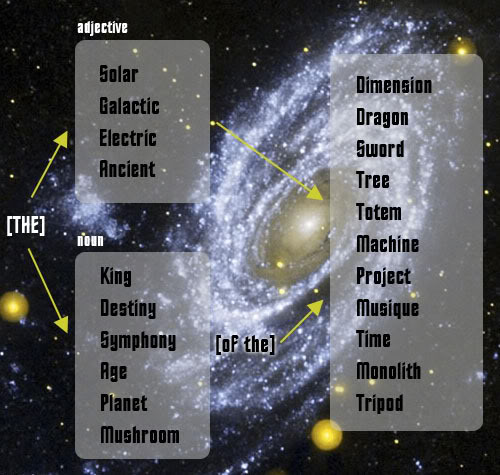
The contest (brain child of my friend, Seth James): 1) come up with the best name for a prog band.  2) come up with the most absurd name for a prog band.  Do not use names of actual bands (past or present).  These must be original.  No need to distinguish, however, which is best and which is absurd.  

The judges will be the Progarchists, and we will announce the winner on the Ides of December.

So, to enter, just comment below–name of the band and a way to get ahold of you.  Competition ends on December 8, 2012.

Nick D’Virgilio News

Thanks to Prog for posting this:

http://www.progrockmag.com/news/nick-dvirgilio-not-giving-up-on-spocks-beard-reunion/

A Pilgrim’s Prog-ress

I balked for a few moments at the temptation of writing an indulgent, long, complex, and idiosyncratic post about my journey to and into prog, and then realized: hey, this is Progarchy.com! If I cannot string together tenuously-related, semi-mystical concepts and conceits imbued with mythical overtones, quasi-autobiographical meta-narratives, and intertwining (and purposely confusing) philosophical musings here, then what’s the point of this wonderful blog? (No need to answer that, as I’m already soloing  on my inner Moog without regard for the boring 4/4 time signature others might wish to force upon me.) Actually, much of what follows was already presented in a long-ish comment I left on a previous post below. But Brad, as he often does, inspired me to do more, even at the risk of embarrassing the shy and retiring Olson clan. So here goes.

I was oddly oblivious to most music until my early teens. This was due in part to being raised in a Fundamentalist home and church, both of which largely frowned on rock music as the rhythmic spawn of the devil, meant to corrupt good morals and encourage bad haircuts. Yes, the stereotypes do hold, at least to some degree.  I heard a lot of church music (classic Protestant hymns, some of them very good) and mostly bland to bad contemporary Christian music. Then, around the age of fourteen or so, I started listening to the radio (one station, weak signal) and began to slowly accumulate a few tapes. My road to prog went through AOR acts such as Journey, REO Speedwagon, Loverboy, Foreigner, and Styx, with a helping of popular mid-80s albums by ELO, Elton John, Toto, and Queen. I found the standard rock of the day (including some of the stuff above) to be rather dull; I was fascinated by the more extended songs of Elton (the early 1970s albums especially), Queen, Asia, and the Moody Blues. I’m happy to say I was hooked on “Bohemian Rhapsody” long before “Wayne’s World” re-presented it to my generation. Also, I thought the usual popular, party music about sex, drugs, and rock ‘n’ roll was mostly shallow, even if occasionally diverting. Which is another way of saying I secretly listened to my share of Van Halen while playing some laughable air guitar (oh, wait, all air guitar is laughable). I did not, however, ever party. Seriously.

Around 1985 or so, I bought a copy of “The Best of Kansas”. That opened the door to prog. There was something about the mixture of Livgren’s lead guitar, Steinhardt’s violin, and Steve Walsh’s amazing voice, along with lyrics soaked in spiritual longing and Americana, that grabbed me by the scrawny neck. Over the next three or four years, I ended up collecting everything by Kansas, Kerry Livgren (solo and with AD), and Steve Morse (solo, Dixie Dregs, etc.). My favorite Kansas albums are “Song for America” and “In the Spirit of Things”, although they weren’t the chart-toppers that “Point of Know Return” and “Leftoverture” were. I also went on a serious Moody Blues binge, focusing on the early stuff, prior to their more pop-oriented work of the mid-’80s. Then I really got into Yes (both Rabin-era and the early classic albums with Howe), Rush, and Pink Floyd; in fact, while in Bible college (1989-91), I freaked out some of my more staid classmates with my obsessive interest in Pink Floyd, Queen, Queenrÿche, and King’s X (and, yes, I also listened to Petra, David Meece, White Heart, White Cross, Russ Taff, and Margaret Becker). King’s X was a major revelation, especially the brilliant, crunching, melodic beauty of “faith hope love”, which was a masterful blend of hard rock, metal, prog, blues, and Beatle-esque harmonies. And I recall very clearly driving across the Montana plains to school in Saskatchewan, blaring “Fly By Night” and other brilliant Rush tunes. Ah, to be young again.

A quick aside here, in the spirit of musical indulgence: while in high school, I also developed a semi-secret soft spot for country artists such as Johnny Cash, Johnny Horton, and Jim Reeves. And two composers: Mozart and Brahms. I tried to get into opera (our family doctor, who owned a massive classical collection, gave it his best shot), but couldn’t get there. I would try again in the late 1990s, failing again. And at one point I must have listened to Eric Clapton’s 1989 comeback album, “Journeyman”, about a thousand times. Go figure, as it’s the only Clapton album I’ve ever fixated on. Okay, back to prog.

In my early-to-mid twenties (1989-1995), I launched into Van Morrison, Seal, Jeff Buckley, Radiohead, and jazz, five of my big musical loves ever since (I’ll eventually write some disturbingly long posts about each, I hope). My interest in prog advanced in fits and starts. Yes was a constant, as I worked through most of the band’s catalog, with excursions into solo projects by Jon Anderson, Trevor Rabin, Rick Wakeman, Bill Bruford, and Steve Howe. The next big breakthrough was Dream Theater in the late 1990s, followed by Spock’s Beard, then Porcupine Tree and a bunch of others. Then, around 2004, I “discovered” Frank Sinatra, which led to the purchase of about 1,000 Sinatra tunes (favorite album: “In the Wee Small Hours”). I mention Sinatra because I have the semi-crazy idea of writing a blog titled, “Sinatra: Grandfather of Prog?”, that will either get me ejected from Progarchy, or enshrined in the Progarchy Hall of Fame.

I fully agree with Brad: we are living in a new, golden age of prog. There is such a stunning array of prog and prog-ish music to be had, I’ve long given up hope of keeping abreast of it all. Current favorites, in addition to the already mentioned acts, include Pain of Salvation, Threshold, Riverside, Muse, Animals As Leaders, Big Big Train, Anathema, Devin Townsend, Three, Astra, Blackfield, The Pineapple Thief, King Crimson, Headspace, and Mars Volta. But there are still huge holes in my prog knowledge and experience. I’m making prog-ress, but the road continues to rise and wind ahead. Which is exciting, as it means there is more to discover and hear.

Inheriting Fine Words

Image[I sent this to PROG magazine last May; sadly, the magazine chose not to print it.  So, here it is, now safely lodged at Progarchy.–Brad]

May 24, 2012

Dear PROG,

Kudos for yet another brilliant issue (#26). I’m amazed and inspired by the sustained excellence in writing, photography, graphics, and layout. I even like the ads. Every thing in its right place and always accomplished with characteristic British taste, intelligence, and wit.

Having listened to progressive rock for four decades, I am firmly convinced that we are now living in the glory days, built upon the traditions and experiments of the past. Raised on a healthy diet of lyrics by Neil Peart and Mark Hollis, I’m especially taken with the quality of lyric writing in recent years. How can we listen to Big Big Train’s “Underfall Yard,” Gazpacho’s “Dream of Stone,” or Tin Spirits’ “Broken” and not realize that these artists are the heirs not only of Dvorak, Brubeck, and Davis, but also of Coleridge, Wilde, and Eliot?

Yours, Brad Birzer (Hillsdale, Michigan, USA)

High Praise, Indeed. From a Master.

English gentleman, bassist, and lyricist Greg Spawton offered some very kind words regarding Progarchy today.  Thank you, Mr. Spawton!

Progressive rock has a very vibrant presence on the internet, with a number of communities and sites all with their particular strengths and idiosyncrasies. Over the years, I have probably visited Progressive EarsProgarchives and DPRP more often than most, but there are many others, including sites hosted by individual bands (such as the BBT Facebook Group.)

Now, there is a fine new prog site called Progarchy which I strongly recommend. The site functions as a blog and includes reviews and articles. The number of contributors and readers is expanding very rapidly and I forecast that Progarchy will become an essential resource for prog listeners. The site can be found here and followed on Twitter here.

Going to Ground: A Review of Big Big Train’s Difference Machine

[An outrageously and somewhat circuitous review of “The Difference Machine” by Big Big Train (original release: 2007; reissued 2010).]

To see a little further/down below a mist hung over the fields/and the stars are falling away like raindrops on glass/further apart/slowing spinning dark–Greg Spawton/BBT, 2007

Being a Kansas Anglophile

For as long as I can remember, I’ve been an Anglophile.  And, I use this term inclusively: I’m fascinated by the history, cultures, and languages of the British Isles, and all of its inhabitants—from the Celts and Picts to the Angles and the Saxons and even the barbaric, invading Danes (and many others, of course).  I’m sure much of my love of all things English (and British) comes from my earliest readings of Tolkien and his vast mythology, all of which [ ].  I’m also married to a McDonald, who happens to be more German and Swedish than Irish, but the name . . . that blessed Celtic name.

But, I’m taken with so many other persons as well, some real and some fictitious and some a bit of both in larger British history: Bran the Blessed, Arthur, St. Patrick, St. Augustine of Canterbury, St. Bede, St. Boniface, Alcuin, Alfred the Great, Harold of Hastings, the nobles, temporal and spiritual who challenged King John at Runnymede, Sir Thomas More, Edmund Burke, William Pitt, Winston Churchill, C.S. Lewis, Owen Barfield, T.S. Eliot, etc., etc.  And, this is just the short list.

Despite this noble lineage of great men, the British people have somewhat paradoxically chosen Arthur, not the much more victorious Alfred the Great, as “the central figure of national heroic legend.  So wrote the nearly forgotten British (himself half Welsh, half English) historian, Christopher Dawson, in 1936.  After all, he believed, the British loved lost causes, especially if the loss came in the face of extreme opposition while defending what is right, good, and just.  Indeed, he argued, giving one’s all for the good of British society remains a fundamental part of the British character, as proven in the last several centuries by figures such as the Irishman Edmund Burke and Anglo-American Winston Churchill.

Such a fascination with lost causes gives the British a properly melancholic and, simultaneously, noble national character.

All of this played to my Kansas upbringing, staring across the wheat fields and sandhills, wandering what might exist beyond.

Big Big Train

When I bask in the music of the very, very English progressive rock band, Big Big Train, I feel—at the deepest possible levels—each of these quintessentially British traits: perseverance for the good no matter the cost; and a singular melancholic intensity.

 The Difference Machine flies/you can see stars right through it/your mum or your dad or your kids; or the love of your life/bring light to the dark spaces between us/Stars bu8rn through the coins on my eyes.”–Greg Spawton/BBT, 2007

Though I do not fully understand all of the lyrics (and this is good, mystery is a fundamental part of art, to my mind), I can’t help but think English nobility and melancholic intensity as I listen to my most recent BBT purchase, the 2007 The Difference Machine, reissued last year.

Indeed, I first bought it as an mp3 download.  I was so taken with the subtlety of the music, the instrumentation, and the lyrics, I happily reordered the full CD version.  I’m glad to have done so, as the quality, not surprisingly, is so much higher.  I’ve now listened to the “The Difference Machine” multiple times and in a variety of different situations: on my iPod while out for exercise; through my car stereo while driving; and on my kitchen stereo while baking (one of my loves—yesterday, I was baking English oat bread while listening to the CD).  Frankly, there’s no bad place to listen to BBT music—as long as it’s not as mere background.  It would be shame and a slap at real art to listen to this as anything other than what it is and how it was recorded—to enjoy it fully, to immerse oneself in it.

As with every other BBT release, this one simply stuns me, and it does so even more with each new listen.  I treasure each new listening, for I keep discovering new things, more beauty, more sadness, and more creativity.

While there exist a number of bands and musicians I follow—and I’ve been listening to progressive rock since 1972, when I was four—there are only a couple of bands that totally absorb my interest.  Those bands have been (in order encountered):

Yes (especially, “Fragile” through “90125”); Rush (especially, “Permanent Waves” through “Power Windows”; “Vapor Trails” to present); Talk Talk (especially, the last three albums); and The Cure (especially, “Faith” through “Wish”).

To these four groups, I also include the music of Kevin McCormick.  But, while I can objectively state his music is as good as anything I’ve ever heard, I also must admit, he’s been one of my closest friends since 1986, so a bias toward him rather strongly exists.

I would also include Gazpacho, the music of Matt Stevens, Roine Stolt, Arjen Lucassen, and Neal Morse in their many forms, and anything Matt Stevens does.

Back to my claims.  So, I’ve been listening to prog consistently since the earlier 70s, when my older brothers introduced me (probably unintentionally).  Not only have I listened, collected, and analyzed prog for much of my life, I’ve also been a radio DJ, having my own prog show in college.  I write this only to suggest that I’ve given this all a lot of thought—in between, around, above, and under academic projects, teaching, and family obligations.

So, with all of this explanation to the above nearly forty-year old list, I add a fifth band of excellence: Big Big Train.

If Yes’s “Close to the Edge” and Genesis’s “Selling England by the Pound” best represented the 1970s; if Talk Talk’s “Spirit of Eden” best represented the 1980s, then, BBT’s last full LP, “The Underfall Yard” best represents the last decade of music.  [Yes, I know I left out the 1990s, I’m still thinking about this one]

A huge claim, I know, but I very much believe it true.  And, for my good friends reading this, you know if I equate anything to “Spirit of Eden” (an album I’ve obsessed over way too much), I’m serious.

To me, Big Big Train—its history, its perseverance, its openness to its listeners and followers through the internet, especially, its musicianship, its desire for reaching perfection, its poetic and imagist lyrics—represents the very best of what exists in music today.  This is far from feint praise, for there’s a considerable amount of competition out there—some almost equally fine music from groups as diverse as Porcupine Tree, Gazpacho, and others.

BBT only increases my love of things English.

Going back through the reviews and history, I see that Big Big Train almost broke up after the recording of “Bard.”  Thank God, they didn’t.  While Bard is the only album of BBT’s I’ve not heard, I’m quite positive—given where they’ve gone since Bard—BBT was just catching its stride around the making of that album.  Though I have a feeling—and I don’t know any of what I’m about to write this from personal knowledge, only from the interviews, lyrics, etc.—the current members of BBT must have gone through some very powerful trials and shakeups.  Like the best of those who came before them, Greg Spawton and Andy Poole, original band members, persevered.  Where they’ve gone—especially with “The Underfall Yard”—is almost certainly not something they could’ve expected a decade or so ago.  Instead, “The Underfall Yard” is a product of long struggle, experience, and craftsmanship; one of those unbought graces—but one that can’t arrive without extreme dedication to an artform.

Signals fail/A moment of time/lost, home/salt water, silence.–Greg Spawton/BBT, 2007

The Difference Machine

As noted earlier, my version of “The Difference Machine” came out last year.  In his own description of the album, Spawton writes:

The Difference Machine received significant critical acclaim and, at the time of writing, is our best-selling CD.  After the release of Gathering Speed, we  invested the proceeds in our studio to ensure we could record music at the highest possible quality for an independent band.  Furthermore, Andy had gained considerable experience as an engineer and we felt much more confident in our ability to get the most out of our studio.  The Difference Machine is a concept album – a ‘small’ story; the loss of loved ones as life progresses, set against a ‘big’ story; the death of a distant star.  The songs for the album were written  quickly. The prog rock / post-rock crossover thing was now fully formed and everything flowed very smoothly.  Indeed, a  number of other songs which didn’t make it onto the album also came out of the writing sessions (BramblingHope You Made It and a 17 minute track – The Wide Open Sea.) The main musical motif for the album is set out early on in the opening track – an instrumental called Hope This Finds You. Played on viola by Becca King, the theme is restated briefly in Pick Up If You’re There before returning at the end of the album in the closing section of Summer’s Lease. Other musical motifs abound, some buried deeply in the music, some combining with others to form new themes. For example, the main album theme on the playout of Summer’s Lease is intertwined with a motif from Perfect Cosmic Storm which is initially set out in an understated manner on electric piano, before returning as the grand closing section of the song.  There’s a lot of this on The Difference Machine – it is an album which is intended to pay repeated listenings with new discoveries.

After having given this beautiful album innumerable listenings, I can confirm Spawton’s own description of it.

There are eight tracks on the 2010 version of “The Difference Machine.”

The opening track, “Hope this finds you”—a short but powerful instrumental, captures the essence of the entire album, setting out the themes of wide open space, and vast emptiness, but, with the entrance of the viola, a deep and abiding sorrow appears, thus closing the space into something intensely personal, even intimate.

“Perfect Cosmic Storm” begins with a strange signal and some dissonance.  A disembodied voice beckons: “signals go to ground” and then, circling the listener, cries “For me there is not hope at all.”  From what I can tell, immersed in this man’s longing and despair, he believes he has either died or is on the edge of death.  His life flashes before his eyes, and “before I go to ground,” he catches a glimpse of some of the happiest things of his existence: kids, parents, and all good that connects one good thing to another, allowing us to transcend this overwhelmingly dark life.

At over fourteen minutes, “Perfect Cosmic Storm” is a masterpiece in every way.  Every voice and every instrument finds its exact place, and while much of the music is chaotic, there is an order to it all (especially beginning at 5:47 into the song, when the sax (itself, used here as an instrument of despair)), just as there is for the man (in the lyrics) dying. When, at 6:30, the singer comes back in with “Signals go to ground,” the listener breaths a sigh of relief.  No relief remains permanent, though—as dissonance and counter harmonies continue throughout the track.  Musically, the listener is left with the feeling that the protagonist has some massive choice still confronting him.

Spawton’s lyrics make this a truly great song.  But, of course, a number of other things also make this song one of near perfection.  Nick d’Virgilio’s drums and Dave Meros (of Marillion)’s bass are some of the best of each I’ve ever heard.  Though he can play anything, D’Virgilio was made to play the music of Spawton and Poole.  Phew.

The third track, “Breathing Space,” is exactly what it seems.  A profound openness emerges during this song, and one feels as though the protagonist has realized either that he’s not quite dead or that he has some kind of redemption and permanent happiness awaiting him.  It must be early evening, though, as crickets chirp, and space signals continue to emanate from somewhere.

In track four, “Pick Up if You’re There,” the protagonist, now realizing that the abyss is not all that confronts him, searches for signs of life.  He climbs a hill, but only sees a mist below him and, when looking up, sees stars falling.  Spawton offers some of his best poetic moments in lyrics to this song.  The drums, bass, and organ are especially strong on this track, driving the protagonist toward some thing, whether that some thing be good or ill, a purgation of the worst or the best.  “You can almost taste the pain/you can almost touch it.”  And, again, D’Virgilio’s drums and, this time time (especially beginning around 4:39 into the song), Pete Trewavas’s bass is nothing less than breathtaking, as is Tony Wright’s flute at 8:40 into the track.  But, the jam (especially the interplay of drums, bass, and Greg’s organ) beginning around 10:05 is my favorite part of the album.  That protagonist is heading somewhere and fast.  I still not quite sure where, but I know he’s moving at an outrageous speed.  “One by one the signal’s fail/the sky is full of comet’s tails/–pick up if you’re there.”

“From the Wide Open Sea,” a track foreshadowing, in title and theme, the final track of BBT’s 2010 ep, “Far Skies Deep Time,” serves the same function as track three.  The listener can relax, at least momentarily, as the spacey keyboards swirl.

Track six, “Hope you made it,” is another short song.  Despite it’s relative brevity, the song’s lyrics cast much doubt on the fate of the protagonist.  Life seems to break this man, and the best escapes him.  “Mercury falling over the snow fields/the passage of time/as the notes in the margins/the last day of summer/the last day you loved her.”  Is all of life nothing more than sporadic marginalia?

“Saltwater (falls on uneven ground)” is my favorite track.  After a hauntingly false introduction, the song quickly changes direction, and we have an Eliot-esque man, a “hollow man” unable to keep some centricity to his life.  And yet, as typical with BBT, a brief hope emerges.  The sky brightens, and though the ground is frozen, the protagonist hears his love—or what he thinks is his love—walking behind him.  From my perspective, lyrically, this song serves as the most important moment of the album.  The protagonist, as close to death as possible without actually crossing into the shadow realm, sees before him the cold and relentless grasp of winter.  As he does, voices of men and beasts (a cat that sounds strangely Pink Floyd-esque) as well as the signals from space swirl around him.  BBT offers several minutes of a really laid-back jam (ok, I have no other way of explaining this).  At 8:41, the protagonist, surrounded by a cold winter death, suddenly remembers the glories of summer, “days without end/exploding with fire.”  If without end, the man only has to claim these as his true eternity.  “Extraordinary again,” the lyrics conclude.

The final track, “Summer’s Lease,” gives us no settled answer.  Summer conquers winter, and love rears its profound head among the prevalent pain of the world.  But, the protagonist still seems somewhat lost.  At 3:14, the song becomes relentless, frantic.  “Where did you come from/where will you go to?/Don’t go away (repeated several times),” the protagonist cries.  Every instrument seems to explode here.  At around 4:56, the song becomes simple again—a rhythmic return to the rather melancholic themes of the album as a whole.

“Signals fail/a moment of time/lost home/salt water, silence/where did you come from /where will you go to?/Don’t go away.”  And with these lyrics, backed by Spawton’s best keyboard work of the album as well as that pursuing viola of Becca King and sax of Tony Wright, the story ends as the piano fades out.  “Summer’s lease” seems to have run out.

Again, I’m not quite sure where I’m left.  I, Brad, am deeply satisfied, musically.  But, what of the protagonist of the album?  Did he make it to eternal happiness, eternal damnation, or just simply nothingness?


Summation

Well, if it’s not clear by now, I think the world of this lp.  If “The Difference Machine” is not a part of your collection, it should be by the time you finished this outrageously long review.

Overall, while I consider “The Underfall Yard” to be the gold standard of our time (hence, on my professorial scale, earning an A+), I would award The Difference Machine a solid A.  Its sins, such as they are, are sins of omission, not commission.  After so many listens to The Underfall Yard, I’ve come to expect the guitar work of Dave Gregory, the vocals of David Longdon, and the drum work of Nick d’Virgilio on every song.  While Spawton and Poole have offered us everything they have (and, if this is as good as it gets—which is spectacular–but those of us who know BBT know that they only get better) on The Difference Machine, The Underfall Yard has all of the best of its predecessor with the permanent addition of Gregory and d’Virgilio and with the hypnotic voice of David Longdon.