
Brown M&Ms, Writing Grooves, Natural Historians, and Big Big Train: The 2013 Interview, Part I

I would love to give an elaborate introduction, but, really, I’ll be very honest with myself–you’re here to read the words of Andy, Dave, Danny, and Greg.  They very graciously gave us a significant amount of their time.  All Progarchists eagerly await the release of Big Big Train’s much anticipated conclusion to the highly successful English Electric Part One.  The first half released only last year represents, for me at least, the finest album in the rock world since Talk Talk’s 1988, “Spirit of Eden.”  No pressure, guys.

Ok, Brad, remember you promised to bloviate only very, very little. . . .

Progarchy proudly presents an exclusive interview with Big Big Train (though, feel free to make this less exclusive and repost anywhere and everywhere).

Spawton bass
Photo by Willem Klopper.

N.B. AP is Andy Poole, DG is Dave Gregory, DM is Danny Manners, GS is Greg Spawton.  Progarchy interview conducted by Brad.

***

Progarchy: Greg, EE1 did extremely well in terms of critical response. Did its success surprise you at all? If so, what part of it surprised you?

GS: We believed we had made a strong album but by the time the mix is finished, all objectivity goes out of the window so you never really know what will happen when others get to hear it. I think we were a little anxious about the number of other albums being released last year, and English Electric started shipping at around the same time as Sounds That Can’t Be Made, so we worried about whether it would get lost amongst all of the attention that CD was going to receive. A couple of weeks ago, Prog magazine published its readers’ polls for 2012. It only really hit home to us when we saw the results of those polls as to quite how much reach English Electric has achieved. It was surprising and very pleasing to be up there with Rush, Marillion, Porcupine Tree and Anathema.

Progarchy: Does its success change at all what you think about BBT?

GS: BBT is six chaps making music. However well we do, that’s all I think of it as.

DM: We haven’t reached the stage yet where our rider has a “no brown M&Ms” clause.

brown_mm_10703016
Photo not by Willem Klopper.

GS: I suspect it has changed how others view us. I read a couple of reviews recently where the album was described as being ‘hyped’ and I felt a little indignant as that misrepresents us. We’ve promoted it sure, but not in an excessive way. If other people write or talk about something, that isn’t hype.

Progarchy: How much of EE2 was written before EE1? That is, how much of this album is a response to the last? Or, are they really two parts of a whole?

GS: All of the songs were written and recorded as part of the same sessions. Any of the songs on Part Two could have been on Part One instead and we had mixes of all 15 tracks before EE1 was released. However, once we knew the track-listing for EE1, those eight songs on the first part got our maximum attention to make sure they were ready for release. As soon as EE1 was out we then went back to the EE2 tracks and continued to work on them.

AP: We wanted to take full advantage of the 6 month gap between the two albums to make sure all of the songs were at their best. That sometimes meant a bit of a rethink about the arrangements. East Coast Racer, in particular, benefitted from us being able to spend more time on it. We always thought it was a good track but now I think it’s one of our best.

Progarchy: Was the writing process much the same as the last album and previous albums? David clearly offered much in terms of lyrics and song ideas. It it the same with EE2?
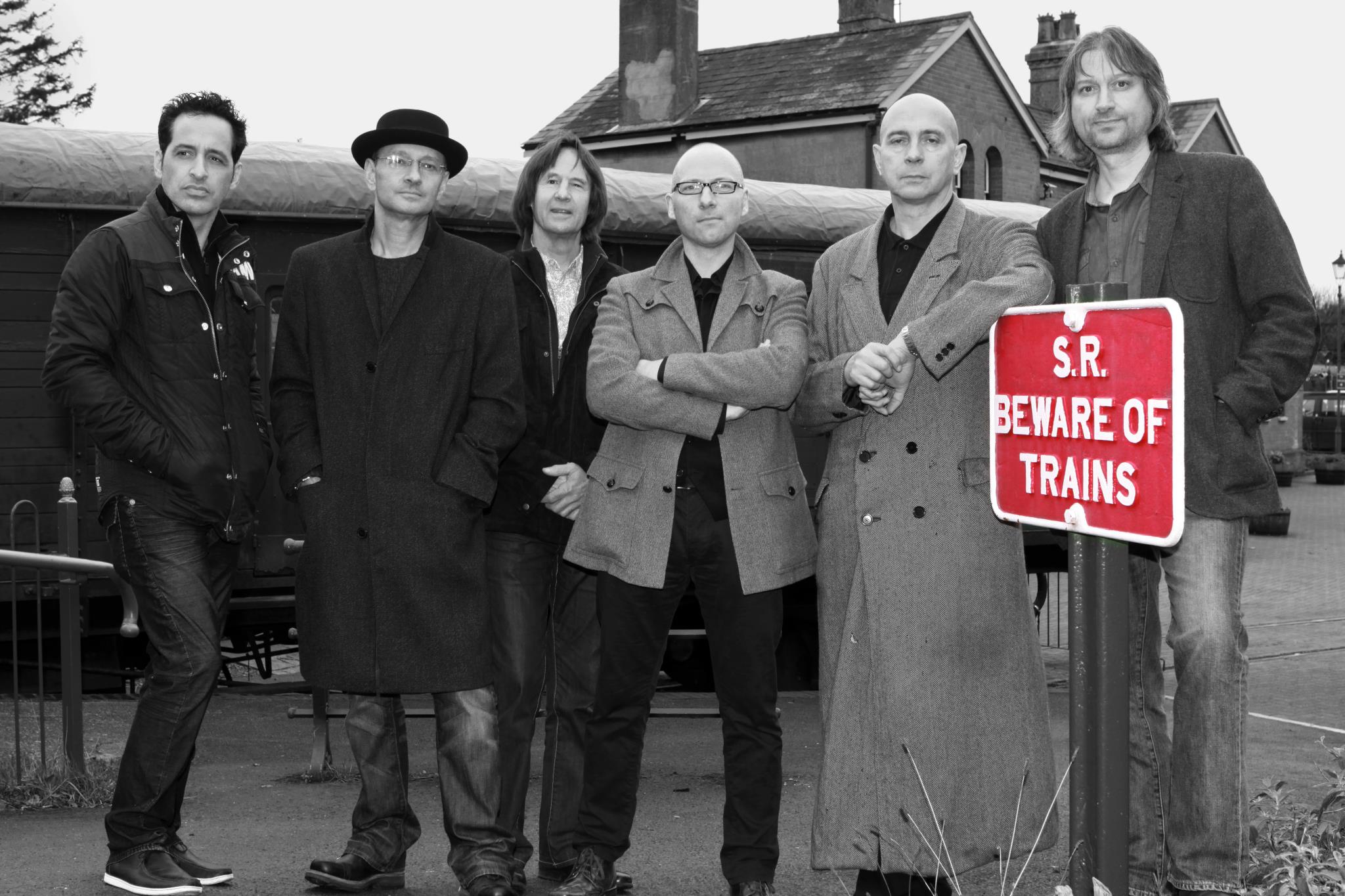
Nick, Andy, Dave, David, Danny, Greg.  Photo by Willem Klopper.
Nick, Andy, Dave, David, Danny, Greg. Photo by Willem Klopper.

GS: We’re really in a groove with the writing now and have very established way of working within the band. I’ve written more of EE2 than EE1, but that’s just to do with how the track-listing fell. In fact, David has already written a lot of material for our next studio album and we’ve recorded Nick’s drums for some of the songs. The other guys are heavily involved in arrangement and, in truth, there can be a blurry line between writing and arranging. The accepted practise is that the songwriter is the person that composes the chord sequence, the main melody and the words. However, sometimes the parts written by the musicians for those chord sequences and melodies can be as important as the underlying music. So, the songs evolve at the hands of all of us.

Progarchy: Can you tell us about some of the themes–musically and lyrically–of EE2. The titles are poetically enticing, and there’s, of course, a huge anticipation on the web as to what the titles mean. Curator of Butterflies? Worked Out? The Permanent Way? Keeper of Abbeys (my favourite title)? For better or worse, I have lots of James Marsh images floating around in my head as I visualize the possible meanings of the titles.

GS: English Electric isn’t a concept album but it is an album with a number of themes linking many of the songs. On EE2 some of the songs pick up on the subject matter of songs from EE1 whilst others head off in different directions. Swan Hunter and Worked Out are both about lost working communities (from the shipyards and the mines) so those follow on from songs like Summoned By Bells. East Coast Racer is set in the 1930’s when a group of people designed and built a steam train called Mallard which ran very fast indeed. It’s a great adventure story. Leopards is a love song and provides an important contrast with some of the more epic material. Keeper of Abbeys is about a chap I met at a ruined abbey in the north of England. This man worked from dawn until dusk every day, tending to the stones. I got to know him a little bit but used my imagination to join up the missing parts of his story. Curator of Butterflies is inspired by a woman called Blanca Huertas who is the Curator Lepidoptera at the Natural History Museum. I read an article about her where she said the study of butterflies can allow so many tales to be told. The song is about how narrow the line is between life and death. I was very anxious about it sounding trite and so I wove a character into it to make it a story and tempt me away from spouting platitudes. Finally, The Permanent Way is the pivotal track where we try to bring everything together.

Progarchy: There’s lots of excitement about you joining, Danny. Can you tell us a little bit about yourself and how you came to join BBT?

DM: Well, I started off learning classical piano from a young age, and later became very interested in twentieth century classical music – at one point I was fairly obsessed with Stravinsky and had serious ambitions to be a composer. In my teens I also took up double bass (and later bass guitar) and got heavily into modern jazz and jazz-rock. You could say I was always into “progressive” music in the broadest sense of the word. But also, I was at school in the mid-seventies when some of the classic prog rock albums were being released, or had recently been released, and handed round on vinyl. I remember really liking early Yes, and Gentle Giant – still a favourite band. After that, I was more interested in the Canterbury end of prog, probably because of the jazzier connections. At university, as the eighties started, I became fascinated with some of the new wave bands that were combining the more advanced musical ideas I was already into with the stripped-down aesthetic of punk, which I’d initially been completely affronted by! XTC became a particular favourite, and a big influence on a university band I played bass guitar in and wrote for. (It got nowhere, although the members all had interesting careers in music afterwards.)

After that I played a lot of jazz, and some free improvised music, on the London scene – on double bass.  I joined a big band, The Happy End, which mixed up Kurt Weill, Sun Ra, swing, and protest songs from around the globe into a joyful, ramshackle stew, and got heavily involved for a few years gigging and writing arrangements for them – a highlight was working with Robert Wyatt, who made a guest appearance on a Happy End album. Gradually, I also became involved with various alt, leftfield or indie rock/pop singer-songwriters. The notable ones were: Sandy Dillon – that’s a female Sandy – originally from the US, whose band mixed blues and roots with the avant-garde, with Tom Waits and Captain Beefheart as major influences; Cathal Coughlan, one of the best lyric writers I know, whose voice and songs can range from beautiful ballads to corruscating anger; and, most importantly, Louis Philippe, a Frenchman resident in London, whose music mixes influences from the great pop writers like Brian Wilson or Burt Bacharach, classical music, jazz, French chanson…. I’ve worked with Louis for 25 years now, initially as a bassist, but later also as keyboard player and arranger, and as a participant in some of his production work for other artists.

In 1995, I think, Louis showed me a letter he’d been sent by a fan, who turned out to be David Longdon. David had included some of his own music, and was obviously hugely talented as a singer, songwriter, instrumentalist and arranger. So Louis had no hesitation in asking him to do a gig with us, and then to participate in Louis’s next few albums. (Also featured on those was Dave Gregory, who Louis had met when arranging and producing an album for labelmate Martin Newell.) I stayed friends with David, and he kept us informed about the Genesis near-miss, but we didn’t see each other for a while after that as we were both busy with young families. I do remember him telling me he’d joined a prog band, although the name Big Big Train meant absolutely nothing to me at that point. (I hadn’t kept up with contemporary prog at all.) Then a couple of years ago, he asked if I’d put down some double bass for a song called British Racing Green…ee2
Happily, the band liked it. I think David had possibly recommended me for the keyboard chair earlier than this, but Greg and Andy may have been wary because I didn’t have any track record specifically in the prog field. However, when they started work in earnest on EE1 they asked me to see if I could do anything with the piano on a couple of songs. Again, it turned out to our mutual satisfaction, and in the end I contributed to almost every track, did a bit of arranging on Summoned By Bells, and stuck my nose in at the mixing stage as well.  By the time attention turned to finishing off EE2, I was pretty much fully involved, so it made sense to them to ask me to join the band officially. I really liked the fusion they’d arrived at on EE, blending folk  and acoustic instruments into the prog and other elements already there, and it was a great opportunity to work with fabulous players like Dave G and Nick, so I didn’t have any hesitation in accepting.

On EE2 I’m playing keyboards a bit more – including an honest-to-goodness, “I’m prog and I’m proud” synth solo – and it’s going to be quite exciting exploring further on future releases.

Part II tomorrow.–Ed.  To order English Electric Part II, please go here–BBT’s official shop.

Danny Manners Boards Big Big Train

Nick, Andy, Dave, David, Danny, Greg.  Photo by Willem Klopper.
Nick, Andy, Dave, David, Danny, big red sign, Greg.
Photo by Willem Klopper.

Great news today on Facebook from the station master himself, Greg Spawton of Big Big Train.  Bassist and keyboardist Danny Manners has officially become a member of the band, joining Spawton, Andy Poole, David Longdon, Dave Gregory, and Nick D’Virgilio.

Spawton wrote:

We are pleased to announce that Danny Manners has joined Big Big Train as the band’s keyboard player. Danny made a significant contribution to English Electric Part One, playing keyboards and double bass and we are delighted that Danny has accepted our offer to join the band in time for the release of English Electric Part Two on March 4th. Danny’s past credits include Louis Philippe and Cathal Coughlan.

Manners’s training has been mostly in classical and jazz.  He writes of himself at his website:

For those who have stumbled across me: I’m a double bassist, electric bassist, pianist, arranger and composer living in London, England. Starting with classical music as a child and teenager, I worked my way backwards through jazz and finally worked out how to play pop half-decently in my thirties. Along the way I’ve also been involved in improvised and “leftfield” musics. At the moment I’m lucky enough to be doing a little bit of all of these…

He also lists an impressive discography, having played extensively with Louis Phillippe, Louise Le May, Cathal Coughlan, Sandy Dillon, and Muse: http://www.dannymanners.co.uk/albums.html

I must admit, I’m (I–ed., Brad) thoroughly impressed with this addition.  Over twenty years old, beginning with original members, Spawton and Poole, Big Big Train has never ceased to grow, take grand chances, and transform into what is arguably one of the greatest–if not THE greatest–rock band of our era.  With their near collapse after the recording “Bard,” Spawton and Poole have developed the group tremendously with “Gathering Speed,” “The Difference Machine”, “The Underfall Yard”, and “Far Skies Deep Time”.  Their 2012 release, “English Electric Part One”, has received rave reviews and has been labeled the single finest release of 2012 by a number of critics.

To this critic, “English Electric Part One” is not just the best of 2012, it’s the best rock release since Talk Talk’s 1988 magnum opus, “Spirit of Eden.”  Before that, one would have to jump back to Yes’s “Close to the Edge” or Genesis’s “Selling England By the Pound” in the early 1970s or to Dave Brubeck’s “Time Out” to find comparable works of music in the last half century.

It should be noted as well that the engineer for Big Big Train, Rob Aubrey, is the Phill Brown of our era as well.

Finally, Manners has worked with David Longdon before, and–I assume–connected Big Big Train to the famous bassist and keyboardist.

The second part of English Electric will be released on March 4 of this year.  American drummer, Nick D’Virgilio, a full-time member of the band, just finished recording the final drum parts for “English Electric Part Two.”  Additionally, the band will be releasing a limited edition of the full “English Electric” in the fall and the re-imaging of previous tracks on “Station Masters” in 2014.

A Beginner’s Guide to Big Big Train

Dear Progarchists,

My apologies for the absence of posts yesterday, November 15.  I’m in the middle of round two of grading freshmen papers and midterms, and life overtook me this week.

It’s late Friday afternoon as I type this in Michigan, but I still have one more academic event today.  At six (in about 2 hours), I’m giving a lecture on The Killing Fields, the sublime 1984 movie about the holocaust in Cambodia, 1975-1978.  As I think about watching that movie for the first time, I get chills.  What horrors humanity creates for itself.  But, that’s a different topic.

As the sun streams into my office window, I’m in the mood for much more pleasant things.

In particular, I’m thinking about the majesty and wonder that is Big Big Train.  I saw a Twitter post two days ago from a friend who expressed shock at the intensity and greatness of BBT.  In a way, I’m incredibly jealous those who have yet to experience BBT for the first time.  So, for those who have not had the grand pleasure that is listening to BBT, here’s a guide.

And, just so I make myself as clear as possible: the new BBT album, EEP1, is the equal in greatness of Talk Talk’s 1988 “Spirit of Eden” and Genesis’s 1973, “Selling England By the Pound.”  This is, without question, a must own for any lover of music, progressive or otherwise.

As many times as I’ve heard it, there are several tracks that still make me what to blaze a path toward social justice and there are several that just make me smile, for the opening note to the last.

But, certainly, nothing on this album is frivolous.   Each track is fraught with meaning.

***

On September 3, 2012, Big Big Train released its latest best studio album, English Electric Part One.  It is a thing of truth, beauty, and goodness in every way.  Part Two arrives in March.  From what I’ve seen on the web and through brief correspondence, it looks as though Part Two will be every bit as intense and glorious as Part One.

Thank to the good will of webeditors, Winston Elliott, Josh Mercer, and Carl Olson (the last, being a full fledged citizen of Progarchy), I’ve had the joy of writing about BBT a number of times..  Last summer, the band released an epic single dealing with the life of St. Edith.  To see this, click here.  http://www.catholicvote.org/discuss/index.php?p=19315

If you’re new to the genre of progressive rock, which its fans rightly consider every bit as good if not better than the best of jazz (equal in musicianship, but superior in inventiveness and, of course, lyrics, since jazz is generally without vocals), I’ve tried to explain and defend the genre to specialized audiences here: http://www.nationalreview.com/articles/299126/different-kind-progressive-bradley-j-birzer

And, here: http://www.ignatiusinsight.com/features2011/bbirzer_progrock_may2011.asp

On my personal blog, Stormfields (www.bradleybirzer.com), I’ve had the great pleasure of writing about some of my favorite bands: Big Big Train, Matt Stevens and his The Fierce and the Dead, Talk Talk, the Cure, Rush, The Reasoning, Arjen Lucassen, Tin Spirits, and XTC.

At my main professional site, TIC (founded by Winston Elliott, the main editor and brain behind it), I’ve also had the good fortune of writing extensively about Big Big Train:http://www.imaginativeconservative.org/search/label/Greg%20Spawton

While I couldn’t even come close to calculating how many words I’ve employed in writing about progressive rock over the years, the same would be even more true regarding my favorite, Big Big Train.

The latest BBT release, English Electric Part One, is not only BBT at its best, it is art at its absolute best.  Best described as pastoral, Georgian, and bucolic, the new album is also eccentric (without ever losing its center), intense, brooding, meandering, reflective, joyous, and deeply vernal.  This is something new, as BBT has traditionally explored the more autumnal aspects of life.

It’s also simply hard not to love these guys on a personal level.  I started corresponding with Greg Spawton several years ago, and he responded immediately and with what I quickly discovered was his characteristic wit and kindness.  After all, who was I–just some goofy guy from the U.S. who happened to fall over myself explaining why I loved BBT.  I once wrote something similar to Neal Peart.  I got a nice postcard back two years later.  But, from Greg, a friendship emerged.  Now, my kids even color pictures for him and ask how my “English rock star friend” is doing.  I have found that all of the members of this band are similar in this regard, and it’s very, very clear by their art that they love one another in a way only brothers can.  Indeed, they face the world not as individual artists, each pulsating with radical individuality, but as a band, ready to leaven all that is good in the world.

A quick look at the wide-ranging debates on the BBT FB page shows how many wonderful and meaningful folks gravitate toward this band and remain to talk some more!  Some of these people have also become good friends, though I’ve yet to meet a single one, face to face.

Greg Spawton and Andy Poole formed the band in the early 1990s, and they’ve since added some of the absolute finest musicians of our day: American drummer Nick D’Virgilio (rivaled in drumming only by Neal Peart of Rush and Mike Portnoy, formerly of Dream Theater), guitarist Dave Gregory (formerly of XTC and currently of Tin Spirits) and flautist and singer, David Longdon, a music professor and folklore and folk music expert.  Augmented by a professional team, in particular engineer and producer, Rob Aubrey, BBT makes music that reflects not only the woes, sufferings, and glories of this world, but without timidity, of the next world.  Imagine the three parts of The Divine Comedy come to life, and you’ll get a sense of what BBT is doing.

Spawton and Longdon, the two main writers of the lyrics, are clearly well read and articulate.  Listening to a 2-hour interview with David “Wilf” Elliott (no relation to the famous Texan cultural critic, Winston Elliott) this past weekend reminded me once again how excellent true conversation among friends and professionals can be.  I would give much for our loud talk show (Mike Church excepted, as always) and TV show hosts in this country to take notice of what educated and purposeful English gentlemen can do.  To here the interview, go here: http://www.theeuropeanperspective.com/?p=1764.  I would not be surprised if these five would’ve been welcomed in the Thursday evening discussion in the 1930s in C.S. Lewis’s rooms at Oxford.

It’s also worth calling Rob Aubrey, who engineered the album, a sixth member of the band.  Aubrey is the Phill Brown of our generation.

To conclude this late Friday afternoon piece, let me encourage you to purchase a cd from Big Big Train. http://www.bigbigtrain.com/ This is a band that not only pursues, as mentioned above, the Good, the True, and Beautiful, but they are entrepreneurs, each trying to make his way in this rather fallen world.  For over twenty years, they have chosen not to pursue the commercial path of pop culture sensations and corporate conformity.  Every writer for and reader of Progarchy knows too well that the once successful system of patronage is long gone.  We must be willing to support culture and art where it emerges.  I promise you, the music of Spawton, Longdon, and Co. will not disappoint, and the band is well worth supporting.

If you’re still not convinced, try one of their many songs for free here: http://www.bigbigtrain.com/main/listen

They’ve certainly changed my life and only for the better.