In terms of perfectly integrated, fully coherent masterpieces, I thought BBT might have peaked with The Underfall Yard. The Far Skies and Wassail EPs, and the multiple versions of English Electric (with no definitive track order), all contained fantastic music, but evinced an unmistakable prog version of ADD, as BBT and their fans were fiendishly enabled by the latest technology to “build your own” concept album, with your own favorite track order: S, M, L, XL, XXL, Full Power, whatever.
But now with Folklore, we have a stunningly coherent concept album that has absolutely perfect flow. And here’s the best part: the perfect flow is found not on the CD version (because “London Plane” works best not coming after “Folklore” but after “Salisbury Giant”) but on the glorious vinyl gatefold edition that has the definitive order for the tracks.
Big Big Train, FOLKLORE (Giant Electric Pea, 2016).
The band: Greg Spawton; Andy Poole; Danny Manners; David Longdon; Dave Gregory; Rachel Hall; Nick D’Virgilio; and Rikard Sjöblom. Engineered by Rob Aubrey.
Tracks: Folklore; London Plane; Along the Ridgeway; Salisbury Giant; The Transit of Venus Across the Sun; Wassail; Winkie; Brooklands; and Telling the Bees.
By chance, the new issue of PROG arrived at the same time as FOLKLORE. A glorious day.
The centerpiece of third-wave prog, Big Big Train, matters. How they write music matters; how they write lyrics matters; how often they perform live matters; how they package their music matters; and how they market what they do matters. They are a band that has evolved significantly over twenty-plus years of existence, a restless band that never quite settles on this or that, but rather keeps moving forward even as they never stop looking back. In their art, they move forward; in their ideas, they move backward. All to the good.
It’s not everyday that a Big Big Train album appears in my mailbox. An immense thanks to Kathy Spawton and Greg Spawton for sending it, and to the band for signing it!
Veronica Rose celebrates with SONGS FROM THE BIG CHAIR, BBT style.
Big Big Train, STONE AND STEEL (GEP, 2016), blu-ray; and Big Big Train, FROM STONE AND STEEL (GEP, 2016), download.
The band’s first blu-ray.
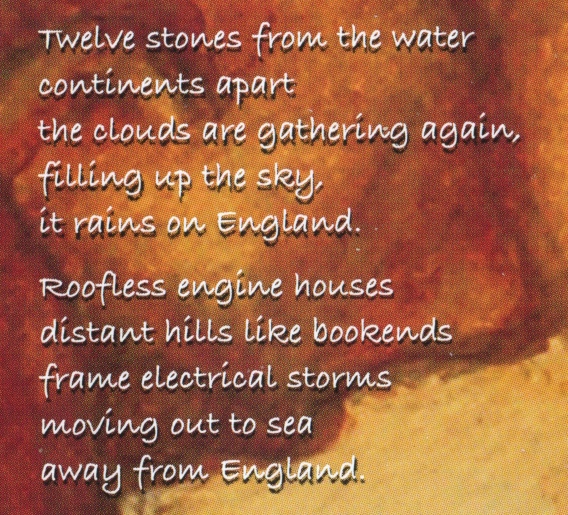
Twelve stones from the water. . . .
Yesterday, thanks to the fine folks at Burning Shed, the first blu-ray release from Big Big Train, STONE AND STEEL, arrived safely on American soil. Then, today, thanks to the crazy miracle of the internet, Bandcamp allowed me to download FROM STONE AND STEEL.
In a span of twenty-four hours, my musical world has been thrown into a bit of majestic ecstasy.
2016 might yet be the best year yet to be a fan/devotee/admirer/fanatic (oh, yeah: fan) of the band, Big Big Train. I’ve proudly been a Passenger since Carl Olson first introduced me to the band’s music around 2009. And, admittedly, not just A fan, but, here’s hoping, THE American fan. At least that’s what I wanted to be moments after hearing THE UNDERFALL YARD for the first time.
Tracks: Wassail; Lost Rivers of London; Mudlarks; and Master James of St. George.
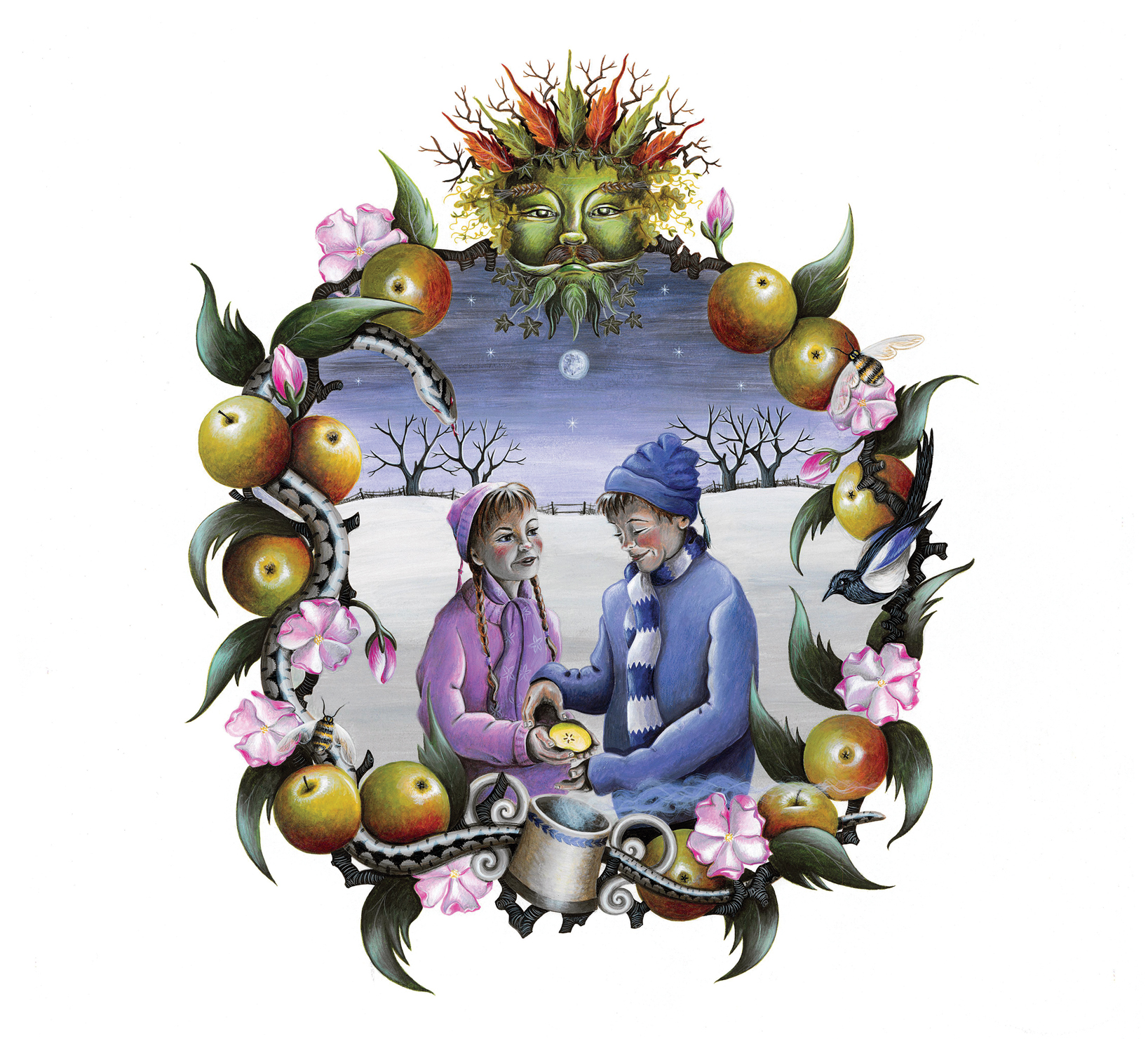
Wassail, the new EP from Big Big Train
As far as I know, I’ve never tasted Wassail.
Of course, I come from Bavarian peasant stock and possess, sadly, not a drop of Anglo-Saxon or Celtic blood in my veins. My wife, however, is blessed with Celtic as well as Swedish ancestry, and I’m more than happy to have played a role in passing those genes on to our rather large gaggle of children.
As far back as I remember, though, my very German-American family drank something that sounds quite similar, at least in essence if not in accidents, to Wassail, Gluhwein. Even the very word Gluhwein conjures not just the scents of warm cinnamon, cloves, and anise, but also the idea of heavenly comfort and satiation.
Much the same could be said of all of Big Big Train’s music. Not that it doesn’t have its share of tensions and darker moments within the music, but, it’s hard to imagine a band in the world today that better understands the goods and beauties of this world than does Big Big Train. They find glory in even the most ordinary of things. And, rightly so.
A beautifully rendered cover, layered with symbolism equal to the music in every way.
Wassail is a triumph, frankly. Not a huge triumph in the way The Underfall Yard or English Electric were each immense, almost overwhelming, triumphs, but a triumph, nonetheless.
A good, little truth.
In Greek, one would employ a word that has become utterly perverted over the last hundred years to describe Wassail best: a “dogma.” Literally, translating it from Greek to Latin, a dogma means a “good little thing,” a thing good in and of itself whether we understand its relation to larger truths or not.
Such is Wassail. A good little truth, whether we understand its relation to anything else or not. Only four songs at 25 minutes and 39 seconds, Wassail ends all too quickly. And, yet, for those nearly 26 mintues it plays, it fills our souls to the brim.
The opening song, “Wassail,” is a sing-songy English folk tune, completely with poetic and thoughtful lyrics. Here is the apple—the symbol of the devil, the instrument that caused the Fall, and the fruit that, to this day, brings so much love and joy. How can one thing be so loaded down by so many meanings—from the very existence of the universe and our relation in it, to the very thing that serves at the heart of what our grandmothers make best? This is a Longdon song, pure and simple. It is, for all intents and purposes, the sequel to Hedgerow, but without the rock edge.
The second song, “Lost Rivers of London,” is as much a Greg Spawton-song as the first was a Longdon song. What remains of the ancient world under the very streets of the city that represents so much good and truth in this world? What has nature wrought, our ancestors cultivated, and our current generation forgotten? These are quintessential Spawton questions, and, of course, true to Gregorian form, he serves as our modern natural historian, our urban archeologist, and our prog bard.
The third song, “Mudlarks,” is also a Spawton song, but its fullness comes across as a Big Big Train song more than the song of any one person. On “Mudlarks,” every member of the band, contributes and plays his or her heart out. Of the four songs, this is the most pop-rock oriented, despite the use of a whole set of rather folksy strings.
The final song of the EP, “Master James of St. George,” reveals just how much the band has evolved since the song first appeared—rather gloriously—on The Underfall Yard. Recorded live at Peter Gabriel’s Real World Studios, this version of “Master James” is much more layered than the original. Whereas the original offered a folksy minimalism, this version is layered almost beyond reason. The new strings add much but what really comes to the fore in this version is Danny Manner’s keyboards.
Big Big Train in Real World Studios.
The Wassail version of “Master James” in no way makes the original obsolete. Quite the opposite. This new version just makes those of us who love BBT justifiably a little prouder of them. For, really, this version shows just how truly alive their music is, how much depth it possesses, and long it will be remembered. . . long after any of us have vanished from this world.
Let us just hope when we get there (wherever “there” is), we know which apple to choose. It’s pretty clear that BBT wishes us well, and they’ve even kindly provided the soundtrack for that journey.
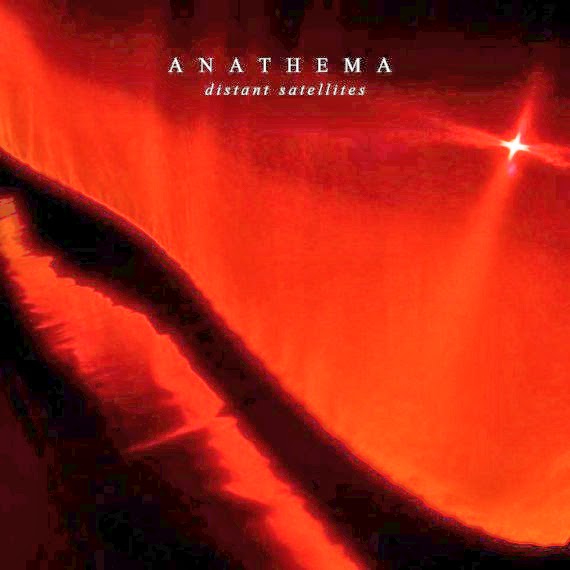
[Review of Anathema, Distant Satellites (Kscope, 2014). Reviewed from digital files and without liner notes or lyrics.]
NOT RECOMMENDED.
I would give much either to have the opportunity to write a different review or avoid writing a review of this album altogether. The latter is my usual M.O. when I don’t like something or when I think something is subpar. Though other progarchists would justly and properly disagree with me on this issue, I think it important to spend our time writing and thinking about beautiful things. Life is simply too short to waste on mud, muck, and decay, and art is too precious and rare to squander or abuse it.
Also, simply put, I’m not good at writing about things I don’t like. I would also guess that spending time with things that are poor or corrupt damage my soul (and yours) irreparably.
But, I can neither ignore the new Anathema nor write a positive review of it without being dishonest. Distant Satellites is not corrupt, but it is, for the band, sub par. I wish Anathema would have taken more time with the writing of this album or simply have taken time off for a rest. Or, perhaps, the band could have released just a few of the best songs as an EP rather than as a full-fledged album. As an album, it can’t hold together.
A year ago, if someone had asked me to discuss the present state of rock music, I would have sung the praises of Big Big Train and The Tangent, correctly claiming that each band was reach so far and attaining so much that they were very close to becoming untouchable. 2014 wouldn’t change this assessment. BBT and The Tangent are not only at the very top of their game, they are at the very top of THE game. Outside of North American bands (I’m intentionally excluding Rush and Glass Hammer), I would have gladly said that Cosmograf and Anathema were so close to untouchable as to be nearly at the level of the top two. 2014, thus far, has drastically changed the prog landscape. Whereas Cosmograf has moved into the top three with its new masterpiece, Capacitor, Distant Satellites reveals a broken or, at best, wounded, decaying Anathema.
How different a year ago was. Looking at the trajectory of Anathema—from A Natural Disaster to Universal—I would have placed good money on the rise of the band. Well, not really, I think gambling is a waste of time and money. But, you get the idea. I mean, really, Universal has to be one of the best live albums of the rock era. In terms of intensity and significance, this was a band with everything. While I would not have rated the two lead vocalists of Anathema—Vincent Cavanaugh and Lee Douglas—at the level of, say, David Longdon, Susie Bogdanowicz, or Leah McHenry, they would be close.
As mentioned above, I really wish I could write a different review for the new album. I have now listened to Distant Satellites close to a dozen times in hopes of coming to love it. Every listen, though, only makes realize how poor it is compared to their previous releases. Not that it’s terrible. Overall, it’s ok, but it’s, unfortunately, not much better than ok. I find myself wanting to skip through almost every song. There are two exceptions to this. Track Four, “Ariel,” has to be one of the single best songs Anathema has ever written.
The second best song on the album, “Distant Satellites,” is fascinating, but not necessarily for the right reasons. I’m fairly sure that if I allowed 100 dedicated prog fans to listen to it for the first time without giving them a single piece of information about the track, 75 to 90 of them would claim it to be a never-before-recorded track from Radiohead’s Kid A sessions. Indeed, I won’t be totally surprised when my physical copy finally arrives from the UK, if the liner notes reveal that Thom Yorke actually wrote the track and sang lead vocals on it. It’s one thing to pay homage to an exemplar, it’s a very different thing to mimic them. I really don’t know what to make of all of this, or why Anathema decided to pursue the course it did.
I really wish I could proclaim Distant Satellites to be the finest work yet by Anathema. I would be lying, though.
If you’re an Anathema or Kscope completest, buy this. Otherwise, I simply can’t recommend it. Other than tracks 4 and 9 and, possibly, 10, it’s not worth the price. Purchasing it would be kind of like putting stock in the Skylab project a few days before it crashed into Australia.
Let’s all hope the band’s followup puts them back into orbit.
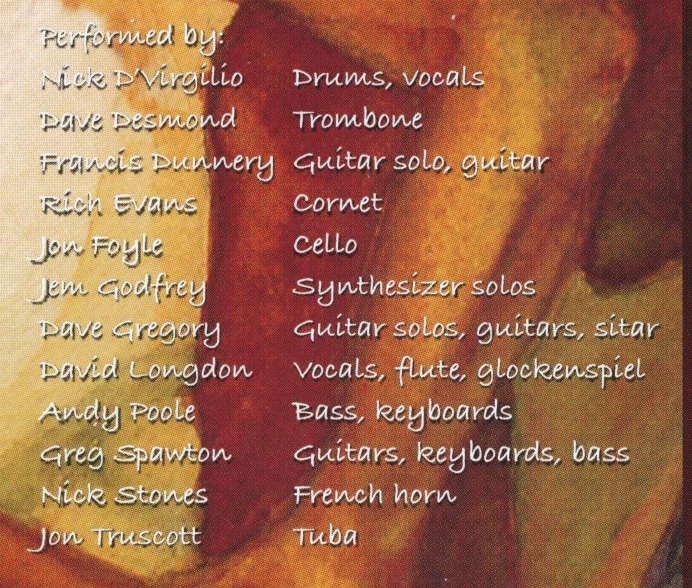
A review of “The Underfall Yard” from The Underfall Yard by Big Big Train (English Electric, 2009). Song and words by Greg Spawton. Additionally: David Longdon, vocals and vocal arrangements; Dave Gregory, guitars; Nick D’Virgilio, drums; Andy Poole, bass and keyboards; and [see image on right for a full list]
*****
As much I love albums, I’m always looking for that perfect song. The song that longs to linger in our souls after we’ve heard its last notes. The song that cries to the heavens in triumph, praise, and rage. The song that hovers over that second away from eternity, rooted in the human condition, but reaching for timelessness.
In my first two pieces of this series, I looked at Rush’s “Natural Science” (1980) and The Tangent’s “Where Are They Now” (2009)? In this article, I turn to none other than a well-recognized masterpiece, a (perhaps, THE) cornerstone of third-wave prog, “The Underfall Yard” (2009) by Big Big Train. It originally appeared at the final track of Big Big Train’s 2009 album of the same name, the first to feature the vocals of the incomparable David Longdon.
Six seconds short of twenty-three minutes in length, “The Underfall Yard” is epic in every sense of the meaning of the word. I once gave it to a non-prog friend of mine as an introduction to the genre. He liked it (really, who couldn’t?), but he also joked, “Brad, when I started the song, I didn’t realize I’d have to miss dinner to finish it.”
The lyrics of the song reveal its scope best:
Using available light
He could still see far skies,
Deep time
Beyond, above, and yet below the far skies rests (not contentedly) deep time. Indeed, given the song, one must imagine deep time as equal parts restless but also confident in its restlessness, sure of itself even in its transitions.
Always a superb lyricist, Spawton reveals his most intimate and poetic sense in this song overall. The words are at once hopeful and melancholic, the piece as a whole trapped in a slowly shifting twilight. The loss is of England’s entrepreneurial and industrial moments of the interwar era, the parents Edwardian, but the children Georgian.
As one stands with Spawton, watching this scene fade in golden and royal hues, he might just as readily be standing with King Alfred hopeful against heathen men as hairy as sin; with Harold of Hastings, tilting against a bastard’s armies; or with Winston Churchill, toiling and sweating against those would rend idyllic places such Coventry with insidious and inhumane progress.
Spawton’s words endlessly capture that which is always true but never quite obvious to all at all times.
The opening moments of the song move from an earnest guitar into a driving and equally earnest interplay of bass and drums, Gregory, D’Virgilio, Poole, and Spawton weaving something both tribal and civilized. More guitars appear, jutting and jetting. Strings emerge as if from the land itself. At 1:45, David Longdon’s voice enters into the art itself with the necessary pitch, the perfect lilt and quaver, and a resonant meaning. If Spawton is coming from sacred soil, Longdon is coming from the heavens, thus allowing the horizon and sky to meet in an infinite moment.
Almost uniquely among singers, Longdon possesses both assuredness and humility in all of his vocal arrangements, but none more so than in this song. While his voice is the voice of a man, it also is the voice of a chorus of men, a plea for generations.
Chasing a dream of the west
Made with iron and stone
Man, in Spawton’s vision, if armed with genius and integrity, reshapes the land, not in man’s image, but in the sacramental, Adamic way had things in Eden not soured.
These are old hills that stand in the way
breaking the line.
It came out of the storm,
out of the sea
to the permanent way
Using just available light,
he could still see far.
Even in his broken state, some men–seers, prophets, bards, skalds, poets and prog rockers–can see beyond the immediate, toward that which is far and that which is deep. Of all creatures, they alone can imagine the heights and the depths of existence.
In Spawton’s vision, England becomes not just another place on this earth, but a place sacred, sacred because man has recreated nature, not through domination, but through creative understanding, the soul and the intellect of each in harmony, not tension.
One is reminded of Spawton’s counterpart in the world of poetry, T.S. Eliot.
A people without history
Is not redeemed from time, for history is a pattern
Of timeless moments. So, while the light fails
On a winter’s afternoon, in a secluded chapel
History is now and England.
–T.S. Eliot, Little Gidding
Even the timeless moment, though, can not be seen or understood forever. Timeless moments—the light falling on a secluded chapel—lasts only as long as man knows to look for it. As with all things of beauty, truth, and goodness, it is fleeing, at least through our abilities to perceive, incorporate, and understand.
Roofless engine houses
distant hills like bookends
frame electrical storms
moving out to sea
away from England.
Spawton’s words and Longdon’s voice combine to make the above lyrics not only the most moving parts of the song, but combine to make one of the most moving parts of any song in the rock era.
I could never even count how many times I’ve listened to this song over the last five years. Every time, my stomach drops and my heart and soul swell when I hear this. Every single time.
And, yet, despite the loss of the thing itself, the moment in all of the revelation of its glory, Spawton knows—with the greatest thinkers of the western tradition—that memory can comfort us. Perhaps memory alone.
Parting the land
with the mark of man,
the permanent way,
Using just available light,
he could still see far.
The imprint is true. It always exists. We, however, must choose to remember. When we do, the world becomes just a little brighter. Using just available light.
And, thus, Big Big Train reveals its ultimate contribution to the world of art. Somethings are worth remembering, whatever the cost, and memory itself is a precious and delicate thing beyond any cost.
This photo was rather unceremoniously stolen from Steve Llewellyn’s Facebook page. Let’s hope he doesn’t mind!
If you’ve not noticed before, we progarchists kind of, sort of, really, really like Big Big Train. So. . . it’s with much excitement that we report this.
The Classic Rock Society of the U.K. has just awarded BBT with three well-deserved awards: 1) David Longdon for best vocals; 2) “East Coast Racer” as the best track of the year; and 3) Big Big Train as Great Britain’s best band.
The progarchists of progarchy hq in central Hillsdale County of Michigan are doing a little victory dance for our friends across the Atlantic.
Congratulations to Greg Spawton, David Longdon, Nick D’Virgilio, Dave Gregory, Danny Manners, Andy Poole, and Rob Aubrey. And, of course, to Jim Trainer as well. Amazing and brilliant and wonderful.
The ever-wonderful David Longdon, lead singer of Big Big Train, looks back at his life, 2013. A fine reflection.
Here we are at the end of another year and what a fantastic year it has been, not only for Big Big Train but also for Progressive Rock Music in general. There have been some tremendous releases in our genre this year.
This post is intended to be a brief overview of our year, from my ‘behind the mic’ viewpoint.
On the 2nd of January 2 2013, we found ourselves on location at theEastleigh Railway Works in Southampton. As you would expect, it was cold despite the addition of an industrial heater. The works were in use by the railway carriage engineers and we were in awe of the sheer scale of the work that these men carry out, as if it was nothing. It felt most strange performing along to our track in the midst of all this dramatic industrial scenery. Eventually though, after a few runs through, we began to get used to the absurdity of it and we adjusted to the weirdness of it. The video was made to give those who are interested in us, a glimpse of what it might be like, when we perform live. The video was directed by Peter Callow and upon it’s release in September this year, it has helped to opened up new possibilities for us.








 Progarchy