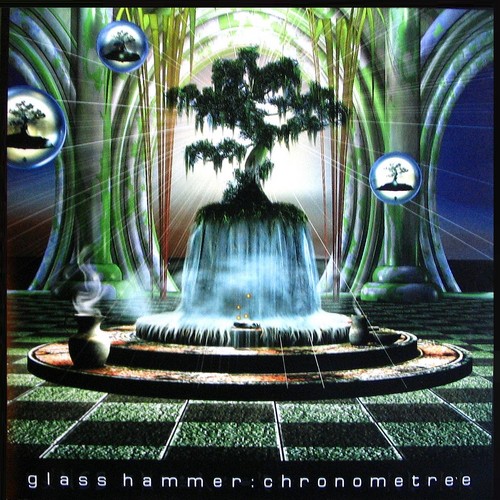
Glass Hammer’s fourth studio album, CHRONOMETREE (2000).
As I look back on the last seventeen years of my life, there are a number of things that amaze me and humble me: marriage; children; career. . . and, well just plain life.
I’m also shocked that an art form I’ve loved for the vast majority of my life–progressive rock–has grown so successful and diverse over the past two decades.
And, the year 2000: SPACE REVOLVER by the Flower Kings; SMPTe by Transatlantic; V by Spock’s Beard. I’ve had the privilege of writing about each of these albums at some length. Then, there was also LIGHTBULB SUN by Porcupine Tree and UNIVERSAL MIGRATOR by Ayreon as well. Really, just pause and think about the year 2000 for a moment. What a vital year.
One I’ve not noticed yet, however, is another favorite from that rather delightful year of prog, Glass Hammer’s CHRONOMETREE. I didn’t come to Glass Hammer until 2001, but I quickly went backward in their catalogue.
August 22, 2015, will be the fifteenth anniversary of this astounding work of art. As some point in the next week or so, I’ll examine it at length. For now, though, I reached out to my good friend and hero, Steve Babb. Here’s what he kindly wrote back to me.
I remember my wife and I left town for a week’s vacation and when we returned a lot of Chronometree’s music had already been written by Fred [Schendel]. He wanted it to be an instrumental solo project, but the sound of that Hammond organ and the retro style of the music was such that I insisted we make it a full blown Glass Hammer project with a storyline. We never imagined it would be such a turning point for us. That’s the moment we embraced our roots and we have never truly repented of it. Prog fans couldn’t resist the storyline, as everyone could relate to our character “Tom” and his slacker friends. Chronometree was a prog album about taking prog albums too seriously. We’re all guilty of it. Leave it to Glass Hammer to call attention to that.
I was going to wait and incorporate Steve’s quote into the larger article, but it seems simply too good for me to hold back from our progarchy audience! So, enjoy.
Review: Glass Hammer, THE BREAKING OF THE WORLD (Sound Resources, 2015).
Tracks: Mythopoeia; Third Floor; Babylon; A Bird When it Sneezes; Sand; Bandwagon; Haunted; North Wind; and Nothing, Everything.
The band: Steve Babb; Fred Schendel; Kamran Alan Shikoh; Aaron Raulston; Carl Groves; and Susie Bogdanowicz.
Additional musicians: Steve Unruh and Michele Lynn. Produced by Schendel and Babb.
Birzer rating: 10/10
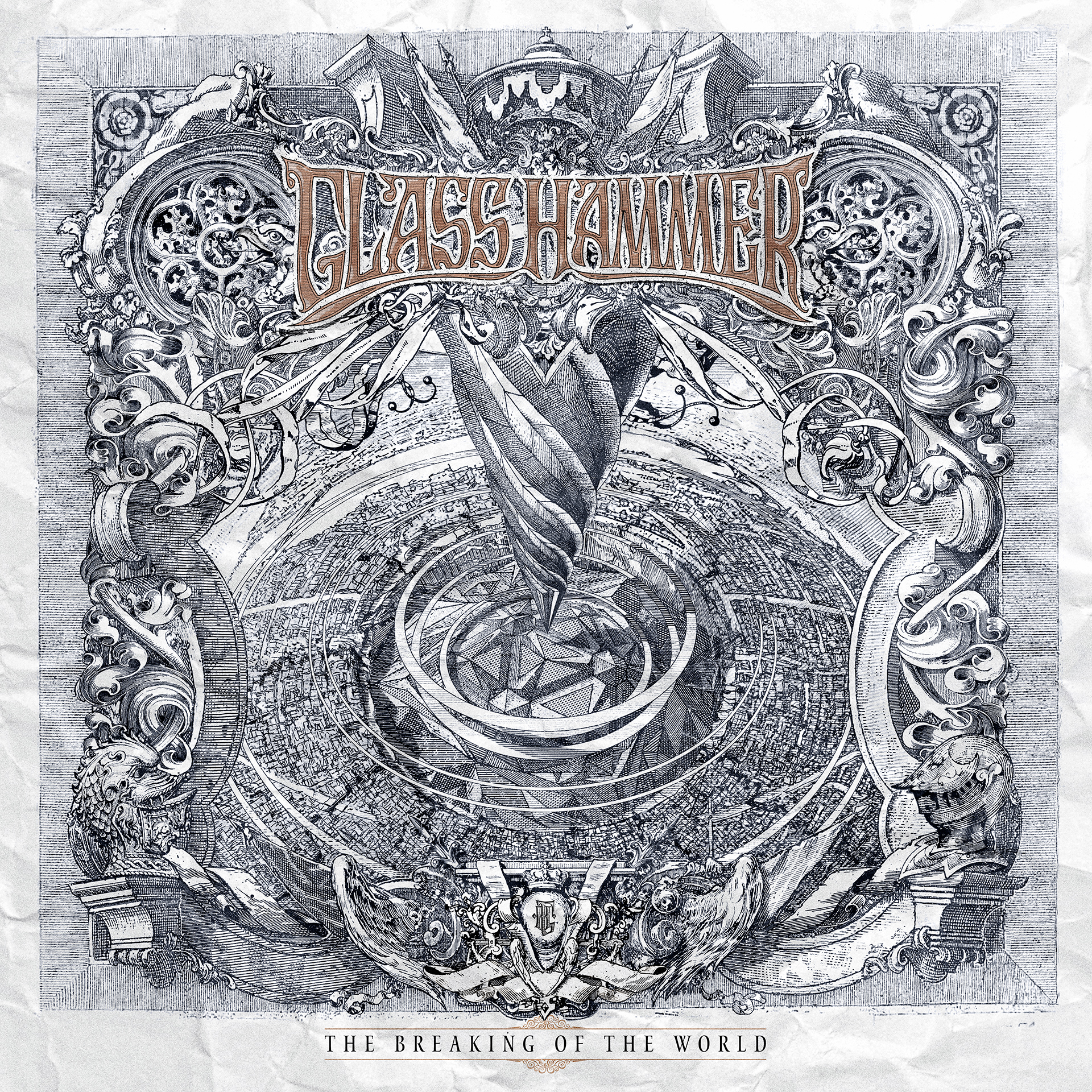
The cover art is as gorgeous as the music. Now, THIS is a real album cover.
A mortal yet strives in his fallen state
Blessed is he
Who hears yet the strains of the song eternal
–Mythopoeia
Just when you thought the greatest and most venerable American prog band could get “none more prog,” along comes THE BREAKING OF THE WORLD, the best work of Glass Hammer’s career and, in some related fashion, their most progressive album thus far. This is not just album number fifteen in a list of fifteen sequential studio albums. Of course, there’s no such thing—and never has been—as “just another Glass Hammer album.” Each is a treasure, in and of itself. At the risk of sounding somewhat bizarre, I must write that THE BREAKING OF THE WORLD is so progressive, that it probably goes beyond progressive rock. It’s not genre-less, but it is probably genre-creating or, at the very least, genre transformational.
Glass Hammer has never shunned or forsaken its loyalties, and one always hears a bit of their loves and admirations in their music. Sometimes it’s Yes, sometimes Genesis, sometimes Kansas, and sometimes, ELP.
For everything there is a season. For better or worse, the music of Glass Hammer did not enter into my life and penetrate my very soul until 2002. Fortuitously, a close friend and academic colleague knew of my love (obsession wouldn’t be inaccurate) of everything prog. She also, amazingly, knew Babb and Schendel really well.
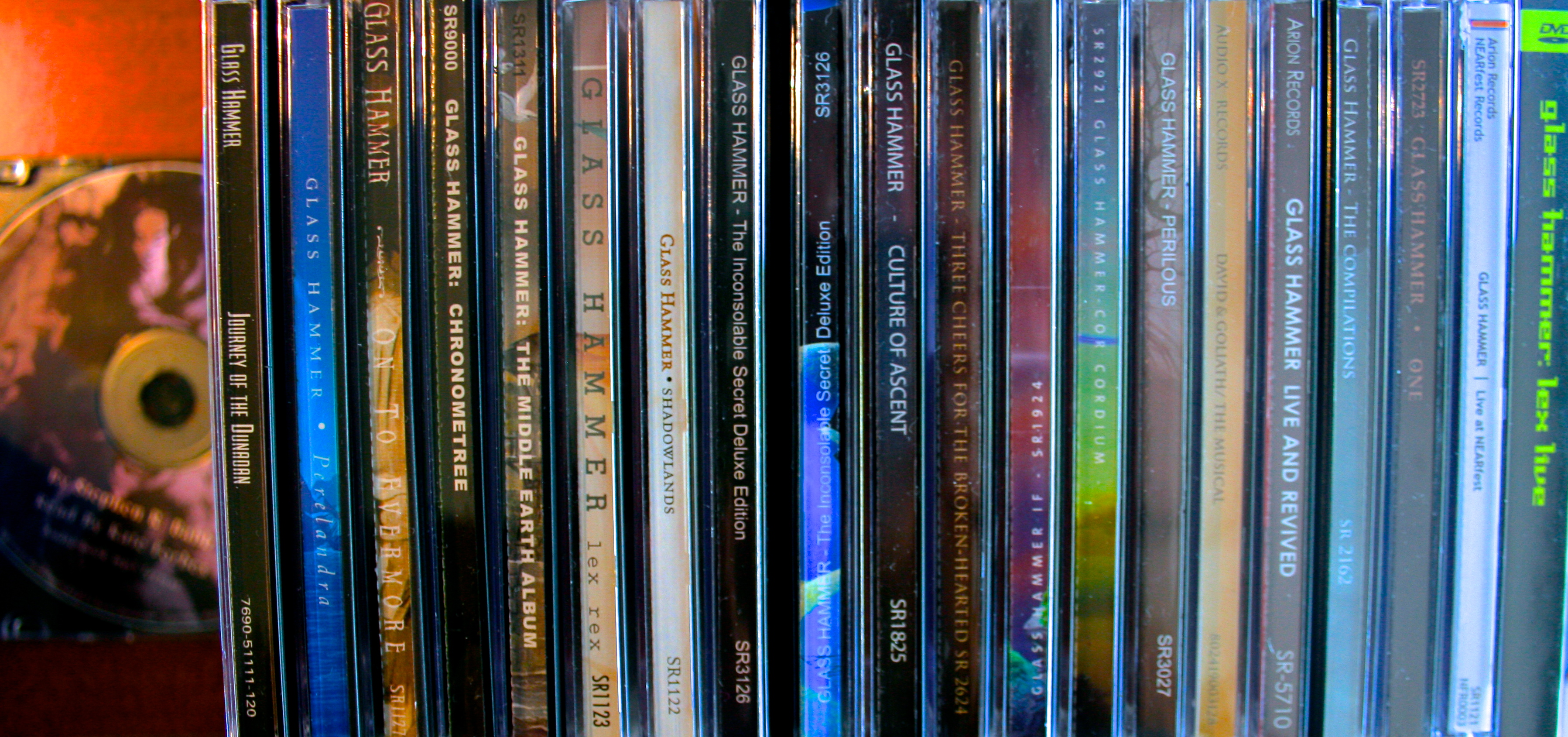
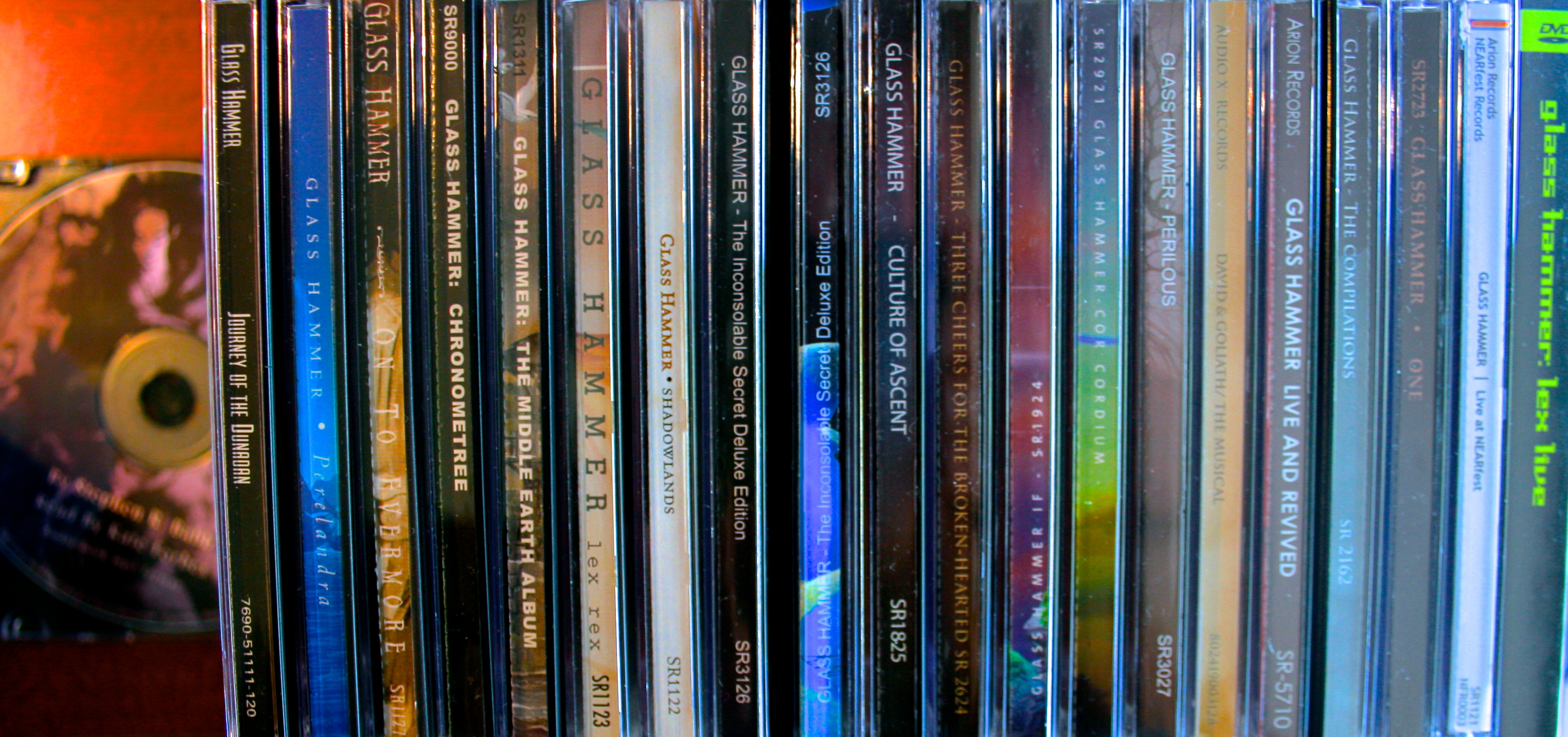
My Glass Hammer collection, pre-ODE TO ECHO.
As I’ve proudly mentioned elsewhere and frequently, LEX REX, Glass Hammer’s prog saga from 2002, just utterly floored me. I mean floored me. Really, utterly floored me. LEX REX did not merely become another part of my rather sizeable and ever-growing album collection, it became a defining album and remains so to this day, 13 years later. One of the problems with encountering a masterpiece from a band is that every subsequent release not only has to match that one, but it must best it. The standard is pretty amazingly high, and it only goes up for every album release. “Now, without further ado. . .”
No way could these two guys from Tennessee do that again, at least not without re-writing and re-hashing LEX REX. But, then, came SHADOWLANDS (2003) with its overwhelming intensity; THE INCONSOLABLE SECRET (2005) with its depths of imagination and poetry; CULTURE OF ASCENT with the glorious voice of Susie Bogdanowicz (the best voice in rock, to my mind, with David Longdon and Leah McHenry standing at the top with her); the playfulness of THREE CHEERS (2009); the sonic horizons broken with IF (2010) and COR CORDIUM (2011); the soulfully penetrating story of PERILOUS (2012); and the classical reach of ODE TO ECHO (2014). I guess two guys from Tennessee really can do astounding things, repeatedly!
The stench of morality, real or imagined
Reeking like burning hair
All those meddling fools, all those pious Judases
Let them all burn in the world they hold dear
I sail away, crossing the Rubicon.
–Babylon
Following this band rather seriously for almost a decade and a half, I can state a few things rather certainly. First, this band never settles. Second, this band never stops pursing excellence. There’s almost a holy fidelity in Babb and Schendel’s struggle against the tapioca conformity of so much of this post-modern world. In true romantic fashion, the two wield a number of finely-honed (most likely, Elvish) blades against such demons of conformity and the whirligig of the abyss. Third, not content to fight alone, they lead not only their fellow artists, but also their fans in a righteous rage against all that grates in the here below.
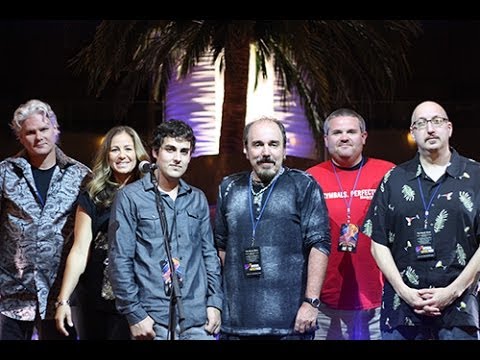
Grove, Bogdanowicz, Shikoh, Babb, Raulston, and Schendel.
It’s worth pondering the sheer amount of talent Babb and Schendel have gathered around them and their two-decade plus project. Of course, Babb is one of the best bassists alive, topping Squire and equaling Lee, and Schendel can plays the keys as well and, frankly, far more tastefully than the standard bearer of prog, Wakeman. Then, add in Aaron Raulston, one brilliant pounder of skins. And, with Raulston and Babb, you have the single best rhythm section alive. Shikoh plays with mighty innovation and verve. Groves gives everything he has in his singing, presenting melodies in a divine fashion. And, then, of course, there’s Bogdanowicz, who, I assume, must’ve been given some preternatural glimpse of heaven, for her voice is something out of Dante’s Paradiso.
On this album, Babb and Schendel have also brought in Michele Lynn to contribute on vocals and Steve Unruh to play violin and flute. Each adds considerably to what is already an incredible album.
Indeed, THE BREAKING OF THE WORLD holds together perfectly. The album begins with a re-working of J.R.R. Tolkien’s 1931 poem, “Mythopoeia,” dedicated to his closest friend, C.S. Lewis. In many ways, this is Glass Hammer dedicating not just this album—but its entire body of work—to its many, many fans. Through the mysterious turning of the spheres, Babb and Shendel have been offered a glimpse of all that matters here and in eternity. This album, then, is nothing less than a gift.
Track two, “Third Floor,” is equal parts serious intensity and playfully quirky. ON the serious level, the lyrics seem to be a mythological story dealing with the loss of reason as well as of imagination. At a more playful level, it’s about an elevator’s frustration at being limited in its movements.
“Babylon,” the third track, has a Neil Peart-quality, a righteous anger against those who wield a falsely righteous anger. At what point does a warning become mere unrelenting bitterness?
Possibly a sequel to Yes’s “Man in a White Car,” the fourth track of the album, “A Bird When it Sneezes” is a very humorous wall of jazz fusion, thirty-four seconds in length. As with “Man in a White Car,” “A Bird” is more mystery than story.
Melancholic, “Sand” considers the endless devouring of time, the wasting of time, and our inability to recapture what has come before.
Track six, “Bandwagon,” is the most traditionally progressive of the songs, something from the GOING FOR THE ONE and the POINT OF NO RETURN era. Pounding, energetic, and hyper, it presents the perfect counterpoint to “Sand.”
“Haunted,” the seventh track, might very well be the conclusion to the story so beautifully told in PERILOUS. The guitarist, Shikoh, writes the music, while Babb pens the lyrics. Babb, an accomplished and published poet, offers his best verse here. If the opening track, “Mythopoeia,” presents a Glass Hammer mission statement, “Haunted,” offers the highest of the high, a sort of liturgical desire. This is my favorite track of the album, and its essence certainly lives up to its title, with Babb giving us words equal to those of T.S. Eliot and David Jones in their penetration and pervasion. If I’m interpreting this correctly, “Haunted” is about the tragedy of the seasons and the seemingly endlessness of human follies. But, as with all haunted things, there’s a hopefulness, as it reveals there is something vital beyond the present moment. Certainly, the words that Babb writes here are worthy of his next book of verse.
The penultimate track, “North Wind,” immediately brings to mind George MacDonald’s classic, AT THE BACK OF THE NORTH WIND. Lush, the song, driven by bass and keyboards, contemplates the meaning of the warmth or coldness of a emotional responses. As with so much on this album, whatever problems exist, the world will right itself in its own time. Or, in God’s own time.
Also beautiful, especially lyrically, is track nine, “Nothing Everything,” a meditation on how the smallest thing represents the largest, but also how the smallest thing influences the world in ways uncounted and uncountable.
For a band known for their tightness, they’ve never sounded tighter.
For a band known for its soaring melodies and harmonies, they’ve never soared high or this rapidly.
For a band known for its poetic lyrics, they’ve never been more poetic.
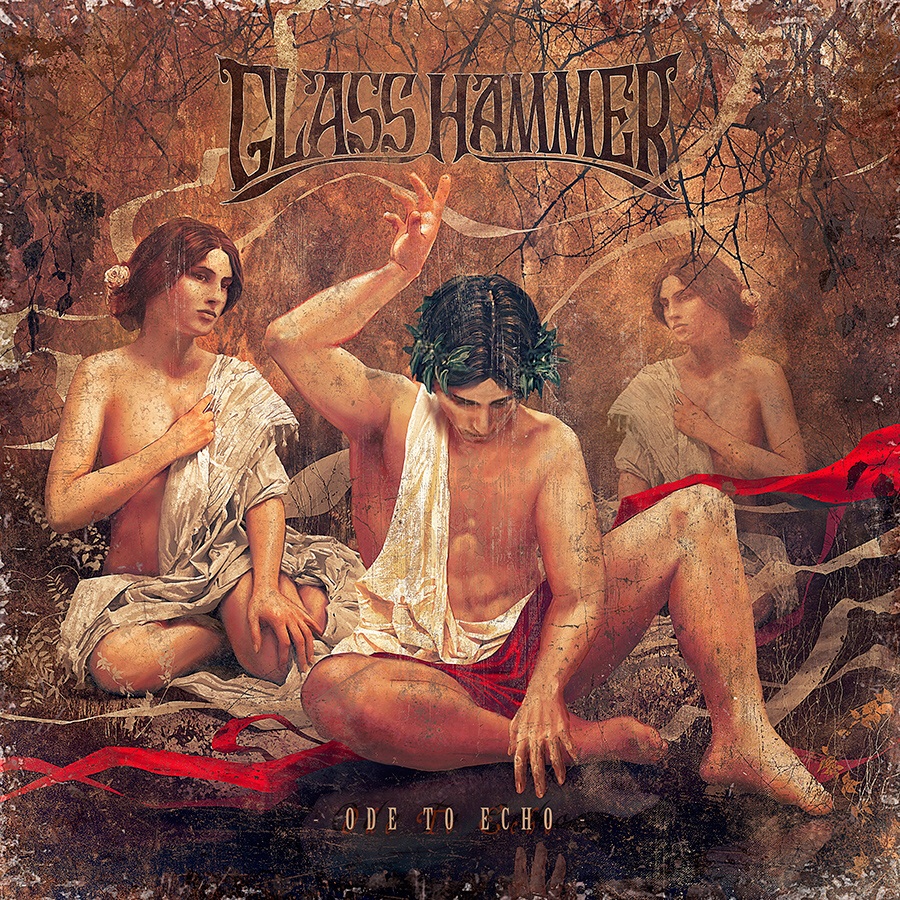
Last year’s excellent Glass Hammer album, ODE TO ECHO.
In 1950, J.R.R. Tolkien expressed his desire to create a mythology and a world so rich that artists, poets, and architects of a million backgrounds might play around in it. Babb and Schendel have never shied away from their profound admiration of all things Inklings. As mentioned earlier, the opening song references and rewrites much of Tolkien’s poem of appreciation to his best friend, C.S. Lewis.
It’s worth repeating two stanzas from the original poem:
I would that I might with the minstrels song
and stir the unseen with a throbbing string.
I would be with the mariners of the deep
that cut their slender planks on mountains steep
and voyage upon a vague and wandering quest,
for some have passed beyond the fabled West.
I would with the beleaguered fools be told,
that keep an inner fastness where their gold,
impure and scanty, yet they loyally bring
to mint in image blurred of distant king,
or in fantastic banners weave the sheen
heraldic emblems of a lord unseen.
I will not walk with your progressive apes,
erect and sapient. Before them gapes
the dark abyss to which their progress tends–
if by God’s mercy progress ever ends,
and does not ceaselessly revolve the same
unfruitful course with changing of a name.
I will not treat your dusty path and flat,
denoting this and that by this and that,
your world immutable wherein no part
the little maker has with maker’s art.
I bow not yet before the Iron Crown,
nor cast my own small golden sceptre down.
I’ll come back to these stanzas in a moment.
Before getting back to them, though, it’s vital to discuss the meaning of the album title, THE BREAKING OF THE WORLD. The idea also comes from Tolkien, specifically from the end of the Second Age of Middle-earth. In Tolkien’s legendarium, he wrote that the men of Númenor, blessed by all of the gods, took their gifts for granted, listened to the lies of Sauron, and began to worship death itself. In a final act of hubris, the men of Númenor decided to invade the Blessed Realm, the land of the gods.
To save the world as a whole, Iluvatar (God the Father) broke the island kingdom, though not before the Men of the West, such as the human ancestors of Aragorn, made their way to Middle-earth. The story is long and involved, as mythic as it gets (this is Tolkien, after all), and the lesson is clear: never take for granted all that is given us and never make a god of false things.
In one of Tolkien’s many writings, he put the following into the mouth of a wise woman: “We cannot dwell in the time that is to come lest we lose our now for a phantom of our own design.”
And, this brings us back to Tolkien’s poem, “Mythopoeia.”
In every word, every note, every piece of art that Glass Hammer presents or ever has presented, Babb and Schendel refuse to compromise, they refuse to give in, and they refuse to worship false things. They are progressive, but only if that progress leads us to Truth, Beauty, and Goodness.
Glass Hammer’s 17th studio album, “The Breaking Of The World” to be released March 31st 2015 with pre-ordering of autographed copies starting March 1st. Featuring Babb, Schendel, Groves, Shikoh, Bogdanowicz and Raulston. Nine new tracks with audiophile mastering by Bob Katz of Digital Domain and art by Michal Xaay Loranc.
Glass Hammer is an American progressive rock band from Chattanooga, Tennessee. They formed in 1992 when multi-instrumentalists Steve Babb and Fred Schendel began to write and record the Tolkien-themed concept album “Journey of the Dunadan”. While many musicians have appeared on Glass Hammer albums over the years, Babb and Schendel have remained the core creative force of the band. Both play a variety of instruments, but Babb is better known as the bassist while Schendel is the primary keyboardist. And though they also sing, a number of other vocalists (most notably Michelle Young, Walter Moore, Susie Bogdanowicz, Carl Groves and Jon Davison) have also handled lead vocal duties through the years.
Lyrically, Glass Hammer is inspired mostly by their love of literature (most notably Tolkien, C. S. Lewis and John Krakauer) and Babb’s love of Victorian prose and medieval mythology.
Musically, they lean towards 70’s driven symphonic rock, focusing on epic-length songs anchored by Babb’s distinctive bass guitar work and strong keyboard playing from Schendel; specifically Hammond organs in the tradition of ELP. They have a superb melodic flow to the music they make, encapsulating real power and dynamics without ever becoming overpowering. Their most apparent influences are ELP, Genesis, Gentle Giant and, to a less noticeable extent, Camel. Fans and critics are usually quick to attest that Glass Hammer have managed to combine those influences into a unique style all their own.
Critically acclaimed albums have continued to flow from the Glass Hammer studio, with the most successful and noteworthy being “Chronomtree” (2000), “Lex Rex” (2002), “The Inconsolable Secret” (2005) and “IF” (2010). Vocalists and fan-favorites Carl Groves and Susie Bogdanowicz took a temporary hiatus from the band after 2009 and vocalist Jon Davison took over as lead vocalist for three studio albums; “IF”, “Cor Cordium” and “Perilous”. Kamran Alan Shikoh joined the band at the same time taking on the role of guitarist. Both Shikoh and Davison remain in the group currently, though Davison has also assumed the role as front-man for Yes. This led to Carl Groves rejoining the Glass Hammer in 2013 for live performances and recording. Aaron Raulston joined at the same time as drummer for the group. Susie Bogdanowicz rejoined in late 2013 and is slated to appear along with Raulston, Groves and Shikoh in 2015 concerts.
Glass Hammer’s 2014 release “Ode To Echo” features performances by many of the band’s vocalists, including Bogdanowicz, Young, Moore and Davison, though Carl Groves handles the lion’s share of the vocal duties.
Other prog musicians and rock artists have made contributions to Glass Hammer projects, including Jon Anderson of Yes, Arjen Lucassen, Rich Williams and David Ragsdale of Kansas, Rob Reed of Magenta and Randy Jackson of Zebra. Glass Hammer has also appeared with The Adonia String Trio and performed two concerts (2006-2007) with 120 plus member choirs from Belmont University and Lee University.
Currently, Glass Hammer is in the studio recording their sixteenth studio album which is set for release in early 2015. The current live lineup for the band is Babb, Schendel, Groves, Shikoh, Raulston and Bogdanowicz.
[A review of Glass Hammer, ODE TO ECHO (Sound Resources, 2014). Please excuse any typos. I composed this on my ipad while waiting for a very, very delayed flight at the Detroit airport.]
For Glass Hammer, ODE TO ECHO means two things. First, and vitally, it’s a reference to a story of antiquity by Heroicus and dealing with the greatest of warriors, Achilles. Second, it’s a tribute to two decades of success as a band.
In every way, this album is packed with brilliance, beauty, and treats around every corner.
One of the most noticeable features of Glass Hammer’s latest, ODE TO ECHO, is its sheer diversity of styles and moods. Having four lead vocalists and three backup ones adds significantly to this, and it provides a wonderful listening experience. Over the course of eight songs, Babb and Schendel provide a journey into the fantastic and mythic. One could never find a dull moment here, even if one tried.
The second most noticeable aspect of the album is its self-assuredness. Progging since the early 1990s and rocking since the early 1980s, Babb and Schendel have every right to be confident. Creating Glass Hammer, a project that has always been self supporting, self sustaining, and impressively profitable, has proven significant not only for the history of American rock but, critically, for third-wave prog overall. These two geniuses emerged on the prog scene at the moment the genre was, almost certainly, at its nadir of popularity and influence. Through immense and never faltering talent, entrepreneurial initiative, and intense tenacity, Glass Hammer has reshaped much of the genre over the past two decades.
In almost every way, ODE TO ECHO, is a tribute and—musically—an autobiographical statement.
A third aspect of the album, and intimately connected to the second aspect, is Glass Hammer’s willingness to innovate as well as to borrow. Many reviewers have criticized the band for being too Yes-like. Babb and Schendel are nothing if not feisty, and such criticisms only fuel their desire to do whatever they want. If they want to reference Yes, they do so. If they want to reference Genesis, they do this as well. If they simply want to try something new, they do this, too! It’s endearing, frankly, contrarian, and very American. Hence, at a few points, this album references Yes from Going for the One as well as Yes from Magnification. At other points, it references Kansas (having David Ragsdale as a guest musician doesn’t hurt!). The Beatles creep in at points, too. Mostly, though, the album reveals the love Babb and Schendel bring to the art of music.
Frankly, I’m relieved Glass Hammer followed up their masterpiece, PERILOUS, with ODE TO ECHO. PERILOUS was so good and so mysterious as well as so profoundly moving that it would be most difficult for any band to follow. By moving away from a single story and embracing diversity of vocals and music styles, Babb and Schendel very successfully create a totally different kind of masterpiece.
While this is probably heresy in some circles, I find Jon Davison’s vocals fine but not glorious. I much prefer, for example, the vocals of a David Longdon, a Leah McHenry, a Sam Healy, a Jan-Henrik Ohme, or a Andy Tillison. Davison’s voice just comes across a little too fey at times. But, Susie Bogdanowicz? Be still my beating heart. She can sing, and she can sing with the absolute best of them. Indeed (and again I’m on possibly heretical ground), her version of Yes’s “South Side of the Sky” is better than the original. That she’s as gorgeous on the outside as she is in her vocals, of course, doesn’t hurt. But, once you’ve heard her vocals, you can’t imagine her as anything other than a truly beautiful person, nearly angelic.
Carl Groves and Walter Moore have much to offer as well, as do the backing vocalists.
No review of this album would be even close to complete without a reference to the actual playing. Babb and Schendel are certainly at their best. Indeed, their vast experience lends itself not to complacency but to the drive to perform better than ever. I have a feeling, these two do nothing half way. If a thing is to be done, it is to be done well. And, indeed, very, very well. I must also note the sonic excellence of the new drummer, Aaron Raulston. Sheesh, I’ve not heard anyone this good since Neil Peart and Nick D’Virgilio. Wow is all I can write. This guy will make his mark in the rock world, to be sure.
2014 has already proven to be a year every bit as good as 2012 and 2013, though we’re only in the fourth month. Whatever you do, do NOT bypass this album. ODE TO ECHO is not just great prog, it’s brilliant and shimmering Glass Hammer. Considering Glass Hammer never does anything that is not at the highest of standards, this is saying something.
Progarchist Birzer doesn’t like doing ANY thing half way–his love for GH is tangible. He also owns the t-shirt.
Feel free to call me a “Glass Hammer Junkie.” Steve and Fred might not approve, but it is the truth. Ever since my great friend, Amy Sturgis, introduced me to their music, days or so before LEX REX appeared in 2002, I’ve been hooked. As you can see by the accompanying photograph, I’m pretty much a completist as well. After all, why like anything halfway? Besides, Glass Hammer isn’t a “half-way” kind of love. You either love them completely, or you don’t know them.
Some reviewers have–in an almost obligatory way–compared their music to that produced during the first decade of Yes. As Babb has joked, GH admires Jon Anderson and Yes deeply, but he’s merely acknowledging the debt in his own music, not mimicking it. And, frankly, from my perspective, GH has much more of a “Leftoverature” feel than a Yes one. Regardless, Babb and Schendel are artists, pure and simple, indebted and original all at once.
There is so much I could write about GH, a book really. But, for now, let me state that there will be more much about GH at progarchy, as well as an extensive analysis and history of the band over at Carl Olson’s brilliant, Catholic World Report. Additionally, we’ll have a long interview with GH co-founder, Steve Babb.
As many of you know, I’m not a huge fan of labels, as they tend to narrow the beauty of a thing. If you forced me to label Glass Hammer’s music, though, I’d probably claim it as “Ransom Prog,” the kind of music Elwin Ransom would’ve written while on Malacandra. For one (or three, really) of the things to love about GH is the “voice” of the band. And, I don’t mean the vocalists. There are lots of vocalists for GH, and there have been since the band’s beginning, the release of their first cd back in 1993, twenty years ago. There quite good. I’m especially fond of Susie Bogdanowicz. Phew, can she sing or what? Her rendition of Yes’s “South Side of the Sky” is simply breathtaking. The vocal equivalent would be Dawn Upshaw singing Gorecki’s Third Symphony. Yes, Bogdanowicz is THAT good.
The real voice of the band, however, can be found in three very different things. Second and third, the distinctiveness of the bass and keyboards, a profound mixture of the punctuated, the soaring, and the lush. But, first and foremost, are the lyrics. Glass Hammer contains some of the best lyrics in rock history. No exaggeration. Last year, just as 2012 was winding down, I was utterly blown away by Perilous. I even held up my “best of” because of the album. It went from not being on my radar in October to being one of the top releases of the year by early December. The music is, certainly, excellent. But, the lyrics are top notch–meaningful, imagist, and philosophical.
I think the lack of recognition of excellent lyric writing is one of the great faults in reviewing and assessing this third wave of prog (as our own Brian Watson labels it). After all, look at the lyrics of Spawton, Longdon, and Tillison, the lyrics of the Tin Spirits, of Gazpacho, or Ayreon (the plot of Ayreon is also mind boggling–but this is for another post), and others. The lyrics for GH are at this top. They are as good as the music, and the two–lyrics and music–serve one another. The lyrics are at once mythic and deeply moving. Here’s just one example from Inconsolable Secret:
This is where we draw the line
And here is where we make our stand
You’ll gather all our forces here for
Here we stand on hallowed ground
And here the foe will surely fall
We’ll send his army scattering for
This is where we draw the line
And here is where we make our stand
Now sound the trumpets, form the battle line
Hold the line
Babb’s lyrics reflect those of the Beowulf poet as well as the poet of the Battle of Maldon. Certainly, Babb is drawing upon these medieval sources, and, probably, a bit of Chesterton’ s Everlasting Man.
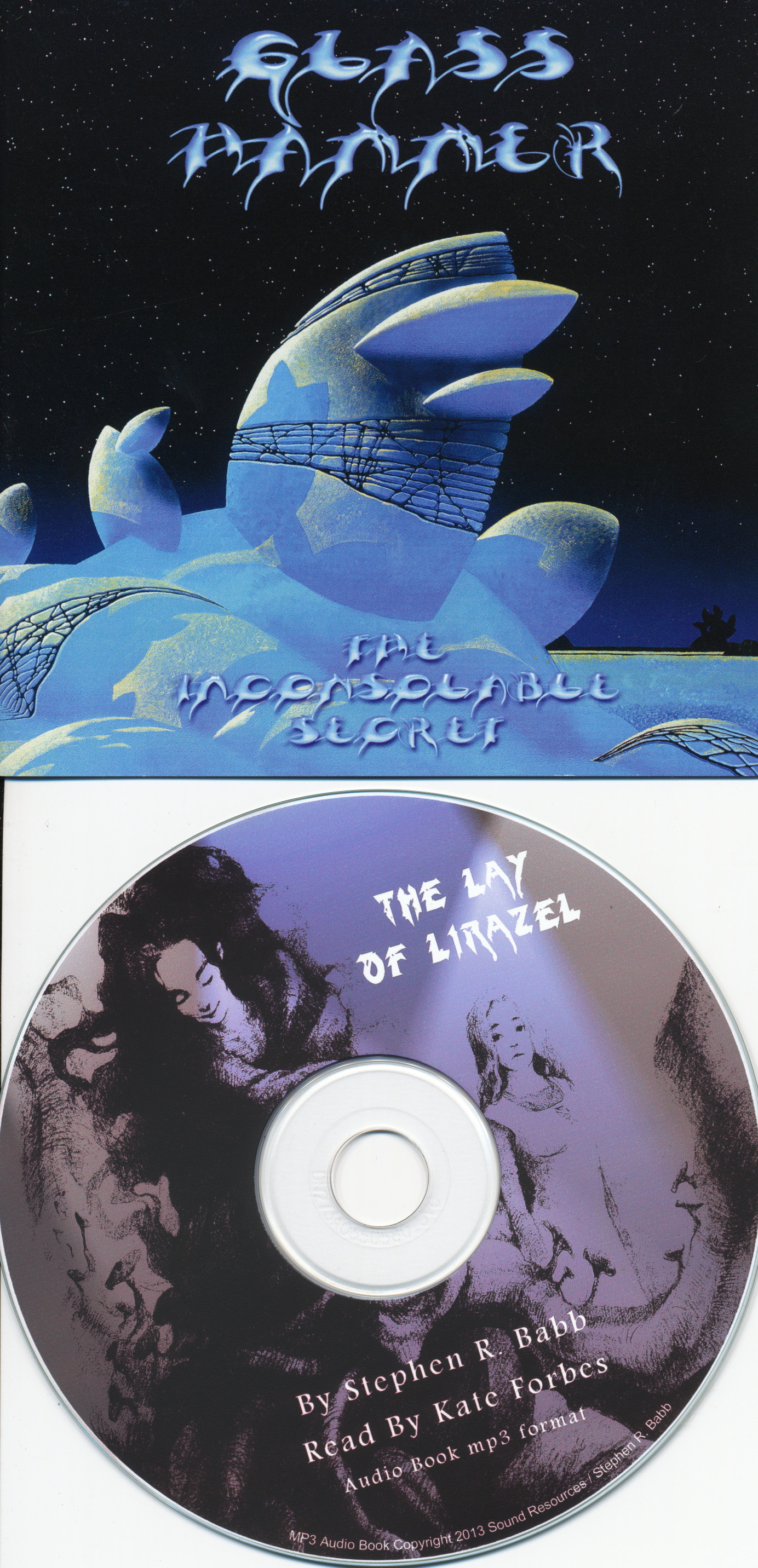
There’s a really nice review of the rereleased and remixed version of Glass Hammer’s masterful, Inconsolable Secret, over at http://www.progrocket.com. Sadly, I can’t figure out who the author is, or I’d give her or him explicit credit.
One of the quintessential modern-day symphonic progressive rock bands, Glass Hammer recently re-released their 2005 album The Inconsolable Secret. The new “deluxe edition” contains all the original material from the two-disc album, as well as a third disc featuring remixes of several of the songs, two with new vocal tracks from present lead singer Jon Davison, who is currently the lead singer for Yes. Glass Hammer is led by multi-instrumentalists Steve Babb and Fred Schendel.–Progrocket.
To keep reading this excellent review, click here.



 Progarchy