

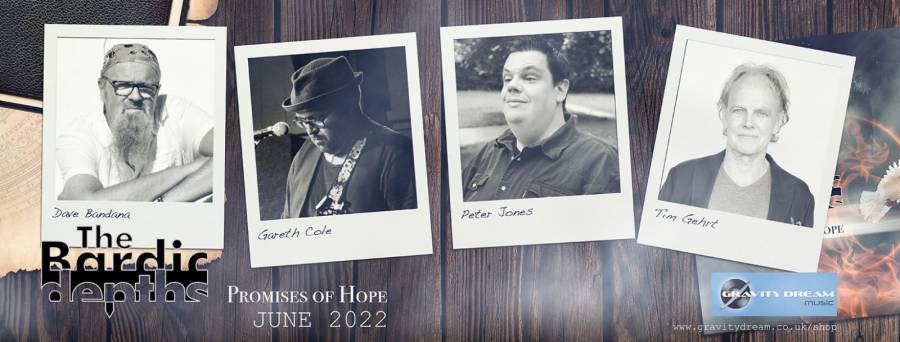
Full disclosure: I PLAY ON THE NEW BARDIC DEPTHS ALBUM!!!!!
Now that I’ve got that out of my system . . . oh, wait. You want details?
Having gotten to know Dave Bandana through this website and the Big Big Train group on Facebook, I was one of the folks who contributed spoken words (“This! Is! War!”) for The Bardic Depths’ 2020 debut. I had mentioned to Dave that, if he ever needed a church organ part for an album, he should get in touch. Which didn’t lessen my surprise when, in that strange summer of 2020, he did! And so, I wound playing not only church organ for Promises of Hope’s closing track “Imagine” (no, not that “Imagine”), but a Hammond organ solo on the opener “And She Appeared.” Being listed in the album booklet as a “special guest” has turned out to be more of a kick than I ever would have anticipated.
With all that as backstory, Dave agreed to join me for a chat about the new album, released worldwide on June 24th! We cover its genesis and the integral contributions of lyricist/conceptualizer Brad Birzer, producer Robin Armstrong, the new core band that plays on every track, and other collaborators. (And yeah, there are a few minutes devoted to a goofy volunteer keyboardist.) The video of our conversation is below, with a complete transcription following.
So, brand new Bardic Depths album! I’ve been looking forward to it, for reasons we will probably get into – but I know a lot of people are as well! But what was the initial impetus for returning to the world of The Bardic Depths?
The success of the first one, and the actual joy of recording the first one and bringing it all together. Especially as, when we originally had done the first album, we didn’t know how it was gonna finish off. It was just gonna be a little home studio thing with me and Brad [Birzer] and a few friends. But then as more friends got involved in it, and then Peter Jones got involved and Robin [Armstrong] got involved, and the thing turned into a fully-fledged proper album. And just the joy of doing that and seeing the fruition from that, we couldn’t not do a second album!
And to be honest, I was straight on writing even before the first one was released. So that was the major impetus for wanting to do a second album. And, hopefully the same thing’s gonna happen for a third one as well!
So, you were so excited that you already had material going for this?
I didn’t have material going. I knew that I wanted to write again and started writing straight away from when that first one came out. I can’t even remember how much of that initial burst of enthusiasm got used on Promises of Hope. Probably a few snippets of it, but the writing certainly started as the first one was completed.
OK. So, where did the concept that drives this album – the overall, the lyrical concept — emerge from? I’m assuming Brad Birzer had a great deal to do with that. But where did that come from?
Yeah, he had a lot to do with it! Brad had sent me a little novelette thing that he’d written, a story. I’d suggested to him a while back, “you’re a great writer. Have you ever written a novel?” He said, “well actually, I started on one, but I never got it finished.” So, he sent that to me, and I said, “this would be a great idea for a concept album.” So, he then carried on and took it — he didn’t actually complete the story; what he did was, he took it as far as he’d gone with it and elaborated around it a little bit more. So, Brad was the guy that came up with the story for the second one.
And in the publicity, you mention that Virgil and C.S. Lewis are the two bards here. And it seems to me that the Virgil, if I’m reading the story right, it’s the story of Dido and Aeneas from the Aeneid.
Yep!
Got that one right! I can’t place the C.S. Lewis part of it, but I’m sure I’ll figure it out as time goes by.
Brad’s the person to speak to for this. I think the actual C.S. Lewis part is actually in the booklet. In the booklet Brad’s written a whole page, basically detailing what the story’s all about. [Searching his memory] I can’t remember the complete title of the book. [A later message from Dave stated that the book is The Horse and His Boy from The Chronicles of Narnia.] Anyway, Brad’s actually quoted from that book, so we’ll see it in there, so we’ll know which one it is.
I left the story to Brad; it’s a tricky sort of subject. But I think it’s one that we dealt with in a not-complex way, in quite a simplistic way. But it told the story that we wanted to tell; it didn’t go into too much detail, but it gives the listener something to think about.
Uh-huh. So why Promises of Hope as the title?
The original title was gonna be Hope, Not Victory. But as an album title, that was possibly a little bit more difficult to explain away. And I liked Promises of Hope; it appears a lot in the lyrics – “with promises of hope, but never of victory” is a line that comes up quite a lot. And I think to have a promise of hope is something to look forward to, rather than the other way around. So, I changed it to make it a little more joyous, for want of a better word, yeah?
Got it! So, as you were recording this, how did the core band that you wound up with at the end of this album take shape as you were making this album?
Continue reading “The Bardic Depths’ Dave Bandana: The Progarchy Interview” Drifting Sun, Forsaken Innocence, 2021
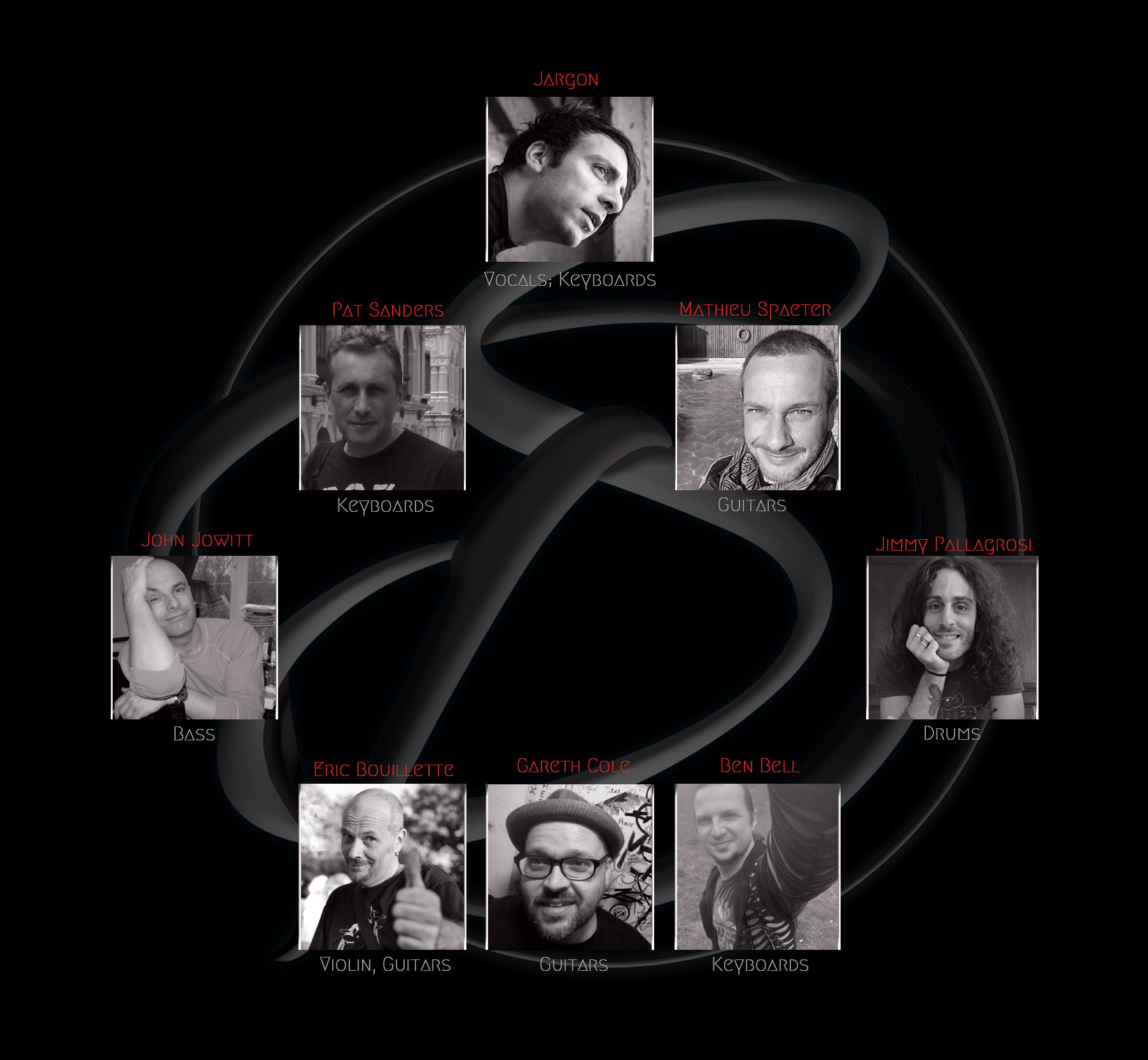 The wonderful Gareth Cole also plays guitar on “Time to Go,” along with Eric Bouillette, who also plays the violin on “King of the Country” and “Forsaken Innocence Part 1.” The violin adds a nice touch, which perhaps could have been used even more throughout. Even so the album sounds great as is. Jimmy Pallagrosi’s drums pull everything together in gentle crashes of snare and cymbal.
 Progarchy